Simon Antonisse es un librero en época de crisis que, debido a las malas cifras de ventas, se ve obligado a cerrar la tienda. Pero todo cambia cuando, durante un desplazamiento en coche, es testigo de un suicidio y queda profundamente afectado. Reaparecen recuerdos de su juventud y la vida de Simon se convierte lentamente en un sueño tormentoso. Solo Regina, una chica a quien conoce por casualidad, es capaz de darle la tranquilidad y el amor que anhela.
Aimée de Jongh (1988) is a comic author, animator and illustrator from the Netherlands, with a large variety of drawing styles. Aimée received her degree in Animation at the Willem de Kooning Academy Rotterdam, KASK Ghent and at the Gobelins Summer School Paris.
She debuted with Snippers, a humorous daily comic series for the Dutch newspaper Metro. Her first graphic novel The Return of the Honey Buzzard won the Prix Saint-Michel and was adapted to film. After this, Aimée decided to focus on graphic novels and animation. Her recent graphic novels are TAXI!, an autobiography about taxi rides, and Blossoms in Autumn, about love after 60, written by the Belgian comic author Zidrou.
In 2017, Aimée made her first graphic journalism work after visiting the refugee camps on Lesbos. This trip resulted in the drawn report Europe's Waiting Room.
Aimée has been involved in the animation industry for several years. She directed and animated the short film Aurora, she created storyboards for Amazon Prime's Undone, and animated a series of music videos for the television show De Wereld Draait Door. Aimée's biggest animation project was Behind the Telescopes, a 71-minute theatrical film with harpist Lavinia Meijer, which she directed and animated.
Aimée has taught various classes about comics, graphic journalism and animation. Currently, Aimée is making two new comic books, which will be released in 2020 and 2021.
“Hope” is the thing with feathers – That perches in the soul – And sings the tune without the words – And never stops – at all –
And sweetest – in the Gale – is heard – And sore must be the storm – That could abash the little Bird That kept so many warm –
I’ve heard it in the chillest land – And on the strangest Sea – Yet – never – in Extremity, It asked a crumb – of me.
- Emily Dickinson -
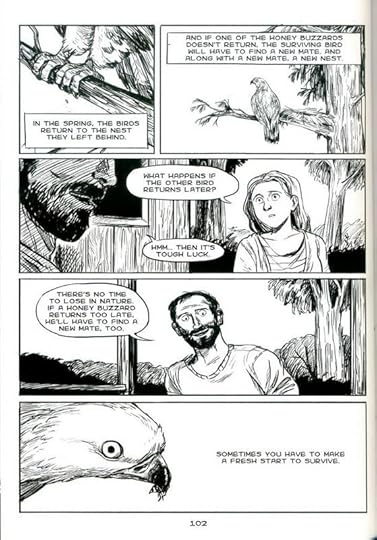
Sometimes one needs a new beginning to survive, like the honey buzzard whose mate did not manage to retrieve their nest when returning from seasonal migration.
Why is it that so many people are fascinated by birds? Wondering about the motives inspiring people to yield to the contemplative art of bird watching, I acknowledge having a soft spot for birds too, and for amateur ornithologists. A few times I could observe a genuine passion for birds arising in a boy’s childhood, turning in a moving everlasting love once the boy had become a man, as The Return of the Honey Buzzard tenderly illustrates. Perhaps birding, like reading, enables to enlighten one’s troubled inner world. Observing the infinite diversity and beauty of birds can bestow an aesthetical route to elude the big bad ugly outer world now and then, an experience beautifully evoked in this atmospheric and touching graphic novel in black- and-white. A bookseller forced to close down his bookshop has to come to terms with the heart-wrenching present and some traumatic memories by liberating himself from a burdensome dutifulness and his sense of guilt. Apart from the empathic touch of magic realism which slightly weakened the subtleness of the story, this is a charming debut. by one of the scarce female (Dutch) authors in this field. It recently also got translated into French and English.
Melancholic and fairly dark, while birds symbolizing hope fly over.
Simon is a bookseller whose family-owned bookshop is going under. But that’s only the beginning of his troubles as he witnesses a woman kill herself which awakens painful childhood memories of a school-friend who also met a tragic end. I know, cheerful lil comic, eh?
I’m right in the middle with Aimee de Jongh’s The Return of the Honey Buzzard - it’s not bad but it’s not great either.
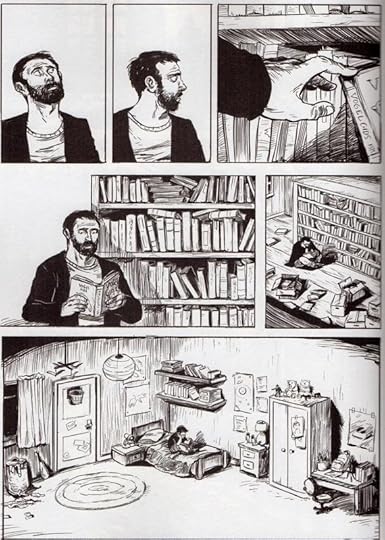
I loved the black and white ink art - so beautifully drawn, great use of space, layouts; the book has a good flow to it thanks in large part to the visuals. This is one of the benefits of the author being both writer and artist.
The book also has some very heavy themes like bullying, suicide and post-traumatic stress disorder (PTSD) which aren’t easy subjects to write about and I fully commend de Jongh for tackling them head on. The story is well-handled in the way it layers the past and present, Simon and Ralf’s friendship is convincing and Ralf’s behaviour in how he responds to being bullied especially feels real. And, though I’ve never suffered from PTSD, you get an unsurprising sense of how nightmarish the experience must be from the harrowingly exaggerated art in those sequences.
The narrative felt a bit too contrived to me though, a bit too writerly. Just when he needs someone to talk to, Simon happens to meet a young girl called Regina who helps him with his issues by listening to him and right away I knew who she was - and it turned out at the end I was right! The honey buzzard metaphor was also a bit too on the nose. It just feels like you’re reading a constructed narrative, you can see the seams a little too clearly, and de Jongh’s treatment of these subjects comes off as a bit too surface-level. I guess the point of the book was Simon finding peace with his demons by the end but the whole thing wraps up too cleanly in a way you only find in fiction.
The Return of the Honey Buzzard is by no means a crap comic but it's obvious construction kept me from getting too invested in the story - I was too aware I was reading A Serious And Important Book. I’d still say it’s worth a look though for indie comics fans.
Simon is a third generation bookstore owner with a lot of baggage. His story is related by Aimee DeJongh, in her first graphic novel. He feels a lot of guilt for not speaking out enough for his best friend, Ralf, who was being bullied when he was in primary school; he feels guilty for not intervening as he watches a woman commit suicide. He feels weighed down as his bookstore fails; his wife wants him to sell to the bookstore chain; the offer is good, but he feels he owes his Dad not to sell to them. When he was in school he wanted to be an ornithologist, but he gave up what he really wanted to do to follow his Dad’s wishes. This is one anguished, tormented dude, with anger issues.
At one point he meets a young college woman who wants to read books on magical realism. She tries to help him face all his demons. It gets complicated, but finally, he sort of does.
And then there are these honey buzzards, and. . . magical realism in the story.
The story is about guilt and trauma and healing, elegantly told. I like the black and white drawing very well. Several wordless contemplative pages. Touches of Craig Thompson style, the use of white space, the strong composition, the deft images. Birds! I like the artwork more than the story, I think. Look forward to seeing more from her in the future.
Herlezen. Vier jaar later. Alleen de tekenstijl zat nog in mijn hoofd en iets van de sfeer was blijven hangen, maar ik was vergeten hoe ik écht erdoor geraakt werd, toen, dus raakte het me nu gewoon weer helemaal opnieuw. Prachtig en indringend! Een kunstwerk van en op eigen bodem dit keer, dat was ook wat direct weer opviel toen ik het opensloeg. Het landschap, de spoorwegovergang, ik ben in de buurt. Over hoop en dromen, opnieuw kunnen beginnen op het moment dat het verleden landt en zijn plek in het huidige leven opeist. Een verstilde graphic novel met grote impact.
Man with beard suffers existential, grief-tinged struggle while ignoring limitless support offered by sympathetic women. I would have liked it more if they had said "you know what, good luck" at the end, rather than letting him have his grand rebirth. True to life, I guess.
Koje su granice nezalečene traume, šta sve mogu da budu okidači i gde ljudska psiha traži oporavak i izlečenje – sve ovo obrađuje Eme de Jong i jedine zamerke su mi što mi je na momente probudila sopstvene traume sa bradatim strejt muškarcem koji ne ume da komunicira.
This graphic artist knows how to use drawings to advance and expand the story! Not every graphic novel demonstrates that ability.
Two storylines are interwoven here: the decline of a family bookstore in the present, compounded by a dramatic incident; the second story is a look back at childhood and another incident that echoes and resonates into the present.
There are pages here with no text at all, and no text required. When I find graphic novels like this, I wonder why more artists don't take advantage of this potential in the graphic format. Clearly, de Jongh is a skilled storyteller, with a firm grasp of the narrative and the ability to convey the necessary elements with her drawings.
I loved the illustration style in this graphic novel-- there is just something so appealing about the simple contrast of hard blacks upon a white canvas. More than that, the harsh contrast helps to portray how dark the narrative is. I think that the illustrative style of the images suited the overall tone of the narrative and levied some of the weight of the heavy subject matter.
However good the illustrations were, though, the plot left something more to be desired. Spoiler I personally think that the suicide of the woman and the accidental death of Simon's friend could've been separate stories, as they are two completely different events taking place in two separate parts of his life. I understand the present story needs to have something that triggers, and therefore leads into past events, but I don't think that the present event needs to be as extreme as what happened in the past-- the woman's death triggering memories of Simon's friend's death for example. It would've been better if the trigger was something simpler, like Simon running into one of the boys that bullied his friend, and that was the thing which triggered his trauma-- this event connects the past and present and gives focus to one key event. Since there are two deaths in the plot they somewhat take away from each other, and the significance of what happened to Simon's friend is dulled and doesn't have the impact I felt it could have-- especially since the death of the woman happens at the beginning of the novel. I felt the story struggled to bring the two events together succinctly and because of this the entire narrative suffered.
I personally don't think the symbol of the honey buzzard worked. I liked the "idea" of the symbol. I thought that it could have been something that was really beautiful and poetic but I don't think it added anything to the story. I feel as though symbols are meant to add a deeper understanding to the subtext, but this symbol meandered and never quite got there in the end. I kept getting the feeling that this was one of he earlier ideas the author had for the story they just couldn't let go of.. which I get, but at the same time you should always do what is best for the story.
Overall this was a very quick read that I enjoyed enough, but I feel as though so much more could've been done and the author could've taken their time and delved further into the depths.. but alas.
4/10
This entire review has been hidden because of spoilers.
Terwijl mijn oudste zoontje de gags van Slimme Pim verslindt, begin ik met veel plezier aan het graphicnoveldebuut van Aimée de Jongh. Eerder las ik het wondermooie Dagen van Zand en haar schitterende bewerking van Lord of the Flies (ook hier een Ralf en een Simon) maar haar debuut was me tot hiertoe ontgaan.
Je leest De terugkeer van de wespendief in één ruk uit. Wat een prachtig beeldverhaal! Sterke narratieve compositie, geloofwaardige gezichtsuitdrukkingen en een magisch realistische toets waardoor hoofdpersoon Simon schippert tussen verschillende werelden. Tussen droom en werkelijkheid, tussen verlangen en herinnering. Tussen de oude boeken.
Een verlaten schuur in een bos dient als opslagruimte voor boekenwinkel Antonisse die op sterven na dood is. Tijdens een rit ernaartoe is Simon getuige van een gruwelijke zelfmoord die heel wat onopgeloste vragen en schuldgevoelens uit het verleden triggert. Wat als?
Simon raakt verstrikt in een literair web waarin een magisch realistische Lolita hem helpt om een aantal trauma's te verwerken. Want dat is wat de wespendief doet. Die overleeft door opnieuw te beginnen.
Bij ons volgende bibliotheekbezoek gaat Raf op zoek naar Slimme Pim 2, zijn vader naar alle andere titels van de Jongh. Wij zijn fan!
Verhaal In deze graphic novel draait het verhaal rond Simon Antonisse. Samen met Laura baat hij de boekenwinkel uit die hij van zijn vader geërfd heeft. De zaken gaan echter niet zo goed en Laura probeert Simon te overtuigen om de winkel te verkopen. Maar dan vindt er een ingrijpende gebeurtenis plaats: Simon is getuige van een zelfmoord. Nachtmerries en levendige herinneringen aan zijn kindertijd worden hierdoor gewekt. Op een dag ontmoet hij toevallig Regina, een jong schoolmeisje, dat dieper tot hem weet door te dringen. Zal hij eindelijk de rust vinden waar hij zo naar verlangt?
Aimée De Jongh De Rotterdamse Aimée De Jongh (1988) is een talentvolle illustratrice die ook bekwaam is in het maken van stripverhalen en animatie. Om een idee te krijgen van haar uiteenlopende tekenstijlen, kan je een kijkje nemen op haar – uiteraard – mooi vormgegeven website. Haar eerste strip ‘Aimée TV’ publiceerde toen ze amper 17 jaar was. Momenteel blijkt ze vooral gekend te zijn van haar strip ‘Snippers’ in het Nederlandse Metro-krantje. Maar zoals je kan lezen op haar website, heeft zij ook reeds heel wat andere mooie projecten op haar naam staan.
Leeservaring
Het eerste wat opvalt wanneer je deze graphic novel openslaat, is het ontbreken van kleur. Zwart-witte tekeningen vullen de bladzijden. Hierdoor ligt de focus als het ware op de essentie van het verhaal en op de duidelijk zichtbare emoties van de personages. Deze tekenstijl heeft iets eenvoudigs, maar is tegelijk enorm krachtig.
Verschillende verhaallijnen worden op een zeer knappe manier uitgewerkt om geleidelijk aan bij elkaar te komen en een mooi afgewerkt geheel te vormen. Wat hierbij opvalt is dat de voortdurende overgang tussen heden en verleden (wanneer Simon geplaagd wordt door herinneringen aan zijn kindertijd) heel soepel verloopt. Hetzelfde geldt voor de overgangen tussen de nachtmerries en de wakkere periodes.
Hoewel er niet erg veel tekst aanwezig is en je dus de indruk zou kunnen krijgen dat het gaat om een licht tussendoortje, bevat het verhaal toch heel veel diepgang. Er staat als het ware geen woord te veel, maar ook niet te weinig. Overal is de gedachtegang duidelijk, ondanks het feit dat niet alles altijd uitgesproken wordt. De expressieve tekeningen dragen hier hun steentje aan bij. We mogen dus spreken van een geslaagde wisselwerking tussen woord en beeld.
Boektrailer Heb je graag een idee van de tekenstijl in ‘De terugkeer van de wespendief’? Kijk dan naar de boektrailer.
Verfilming Wist je dat deze graphic novel ook verfilmd werd? De filmtrailer kan je bekijken op Vimeo. Graag meer info over de film? Neem dan een kijkje op IMDB.
2.5/5 bon…. c’était interessant hein, mais y’a des trucs qui m’ont quand même assez gênée. je me sentais pas à 100% investie dans l’histoire, je pense que j’ai du rater tout le parallèle avec le réalisme magique, ou même ce que la bd voulait réellement transmettre. puis, ça manque peut être un peu de rajout, c’était trop court pour que je puisse vraiment m’attacher aux personnages ou quoi que ce soit. cependant, j’ai énormément aimé les illustrations aux traits assez grossiers et en noir et blanc ! je ne sais pas quel était le purpose de l’illustratrice derrière ce choix, mais l’ambiance collait bien et c’était très joli !
3,5. Livro de estreia da excelente Aimée de Jongh que pesa uma tonelada. Tem bullying, traumas, suicídio e livreiros falidos; ou seja, gatilho para todos os lados. Mas o traço forte de Aimée consegue transmitir beleza e empatia e traz personagens doloridos e marcantes. Nem todos os temas se desenvolvem com fluência e impacto, mas há bastante coisa para se olhar. E se alguma brincadeira poética se perde pelo caminho, o jogo visual e literário com os pássaros voa alto e funciona que é uma beleza.
The story inside is pretty good too. There are some twists, and deeper themes, and beautiful beautiful illustrations. One of those themes is the closure of a used bookstore, so it's a bit of a bummer for us book people, but I kinda loved it anyway.
One of the panels from page 59 is on my list for #projectraintattoo.
Vrlo jednostavna, a u isto vreme efektna priča o traumama, šta one znače i koliko ožiljci koje na nama ostavljaju mogu da se ponovo aktiviraju i zabole i mnogo godina nakon preživljene tragedije. Možda je mogao da bude malo duži i kompleksniji, ali je svakako odličan za kasno oktobarsko veče.
Mooie tekeningen. Het verhaal had potentie, maar voelde ook een beetje uit balans (en had wat lichte #me2 aspecten, die een beetje ongemakkelijk voelden).
I rarely read graphic novels, at most one or two per year, as I generally find them rather rough going. This has very little text, which was a plus, and I really liked the author's art work, but the philosophic and downbeat nature of this was just a bit odd.
Intussen is het voor mij wel duidelijk dat Aimée de Jongh controversiële en moeilijke onderwerpen perfect weet over te brengen. In tegenstelling tot andere werken waar zij enkel voor het grafische aspect instaat is ze hier ook verantwoordelijk voor het verhaal (?), maar dat was voor mij niet op het niveau van de illustraties.
Het hoofdpersonage is nogal doorsnee en hoewel het hem niet meezit vind ik zijn gedrag toch storend en komt hij er wat te makkelijk vanaf. Er zitten wel wat leuke elementen in, het magische realisme bijvoorbeeld, de knipoog naar de echte wespendief die enkel samen blijven als zowel vrouwtje als mannetje levend en wel (en op tijd!) terugkeren uit het zuiden. Ik heb dit in het verhaal als volgt opgevat: Iemand kan lang op je wachten en naar je uitreiken, ooit stopt dat als je niet zelf ook die moeite doet of dat op zijn minst niet toelaat.
Aimée De Jongh kaart stelt in haar eerste beeldroman verschillende vormen van verlies centraal. Ik ben zeer gecharmeerd door haar zwierige tekenstijl en de uitgeverij heeft een te koesteren uitgave afgeleverd. Ik weet niet wat te denken over een bepaald verhaal-element waarvan ik me achteraf afvraag of het met opzet zo doorzichtig is uitgevoerd. Ik denk wel dat dit een strip is die door veel mensen zal gekoesterd worden hoewel het bij mij persoonlijk wat de impact mist van graphic novels als Vermassens 'Het Zotte Geweld' of Vanistendaels 'Toen David Zijn Stem Verloor'. Na de uitstekende gagstrip 'Snippers' toont ze de stripwereld dat ze nog meer in haar mars heeft (naast haar werk als animator, illustratrice en andere plastische kunsten).
Heftig verhaal waarin een man, Simon, met de trauma's in zijn leven moet leren leven. Na elke dode moest ik het boek even aan de kant leggen. Een gebeurtenis tijdens zijn volwassen leven opent een oude wond uit zijn jeugd die we via flashbacks leren kennen. Ondanks de impact die het verhaal heeft, zijn er toch de nodige vraagtekens bij de opbouw te stellen. Waarom wordt de eerste flashback als een herinnering van Simon gebracht, maar daarna niet meer? Hoe komen de jongeren Simon en Ralf plots op het dak van de school terecht? Hoe kan Simon een wespendief in de winter zien, als die op dat ogenblik normaal in Afrika rondhangt? Ook de psychologie van de personages is bij momenten clichématig. En de toevoeging van een meer fantastisch element aan het einde overtuigt ook niet helemaal.
There was one character dynamic in this book that seemed somewhat off, and one aspect of the ending that I couldn't make sense of, which meant that when I finished reading, I was left feeling a little lost. Then I read a review that hinted at something that was going on with one of the characters, and figuring that out resolved my struggles with both the ending and the character in question. I loved the art, especially the balance between drawings and text which made for very good pacing, and I enjoyed most of the story, but I wish the ending had left me a little more satisfied without having to look for clues elsewhere.
This book was an interesting and thought-provoking read. It's about giving life another chance, a fresh start after going through a storm. This 'another' chance is more an act of survival and not about leaving things behind or letting go of your past.
I want to rate this book higher because the artwork was so beautiful, but I found myself upset with the storytelling. The plot itself was intriguing, but there was so much build up to a weak climax, and the resolution was way too fast. It would have been nice to have a more subtle reveal of the big twist, but instead it was super rushed and left me feeling dissatisfied. It's a shame because, like I said, the illustrations were absolutely amazing.
Ik wist niet goed wat ik moest verwachten van deze graphic novel, want ik ken Aimee vooral van haar korte stripjes over haar dagelijkse leven. Maar ik was aangenaam verrast. De tekenstijl is knap en veel realistischer dan wat ik van haar gewend ben. Het verhaal was ook behoorlijk interessant en complexer dan ik in eerste instantie dacht dat het ging zijn. Dus ja, graag gelezen.
Combines a bunch of sad elements like a failing family bookshop, bullying, adolescent tragedies, and migrating birds losing their mates. Is it a surprise that the ending is melancholy and sad? If you're in the right mood, this is a good graphic novel to check out, although it doesn't hit the deeper depths of emotion and I wanted it to be longer. Artwork is great.
Na fali zachwytu „Dniami piasku” pobiegłam do biblioteki po debiutancką powieść graficzną Aimee de Jongh. To historia o księgarzu, którego sklep odziedziczony po ojcu stoi na skraju bankructwa, przez co mężczyzna jest w słabym nastroju. Kiedy dodatkowo zostaje świadkiem samobójstwa na torach kolejowych, do głosu dochodzą największe traumy z dzieciństwa, a mężczyzna przechodzi załamanie nerwowe. W dojściu do siebie pomaga mu nastolatka, która przypadkiem staje na jego drodze. „Powrót pszczołojada” jest zupełnie innym komiksem niż „Dni piasku”. Rysunki są czarnobiałe, historia dużo bardziej skoncentrowana. I o ile warstwa graficzna nadal pozostaje interesująca, de Jongh jest naprawdę dobrą rysowniczką, tak historia przemawia do mnie średnio. Psychologiczno-obyczajowa opowieść z flirtem pomiędzy nastolatką, a dużo starszym nieszczęśliwym mężczyzną, niezależnie od tego czym się okazuje, jakoś mało mnie jara.