Relates Sally Jane's experience of changing times in rural America, as she lives through the drowning of the Swift River towns in western Massachusetts to form the Quabbin Reservoir.
Jane Yolen is a novelist, poet, fantasist, journalist, songwriter, storyteller, folklorist, and children’s book author who has written more than three hundred books. Her accolades include the Caldecott Medal, two Nebula Awards, the World Fantasy Award, three Mythopoeic Awards, the Kerlan Award, two Christopher Awards, and six honorary doctorate degrees from colleges and universities in Massachusetts and New Hampshire. Born and raised in New York City, the mother of three and the grandmother of six, Yolen lives in Massachusetts and St. Andrews, Scotland.
"I thought I could see the faint outlines, but I could not read the past."
As we move through life, we collect many memories along the way, yet perhaps none are so poignant as childhood remembrances. Our recollection of people, places, and memories fill us with the peace of familiarity and home. For Sally Jane, the familiar home and town she's always known will soon exist no more as it will be razed to make way for a new reservoir. Time moves seemingly swiftly as first the valley is emptied of its inhabitants and the communities they formed, and then more slowly as the water flows for seven years before "the hole between the hills" disappears beneath the silent water. Sally Jane gathers and stores up her memories of days gone by while like the water, she too flows to new horizons. In the end, there's a peaceful content and a sureness in the knowledge that new memories are waiting to be made.
I remember listening with rapt attention to how houses could be moved when I first arrived in Katonah, NY. It had never occurred to me before that not just a house but a whole village could be moved! This is wonderful book explores the transition and emotional process of moving and letting go. From the fly leaf, "Drawn from history, Letting Swift River Go proves that the memory of a place can stay with you always." How lovely!
Eek! I’m freaking out right now! Imagine my surprise when I opened this book to the title page and saw that I owned a copy that was signed! Yes, signed! By the author… AND the illustrator!! Gasp! I’m keeping this book in a vault! Ha, ha!
I thought what Cooney wrote alongside her signature was very fitting for this book. “Remember the past; live in the present.”
It’s a story of a little girl who lives in a town and how the town is mapped out to be a reservoir for Boston.
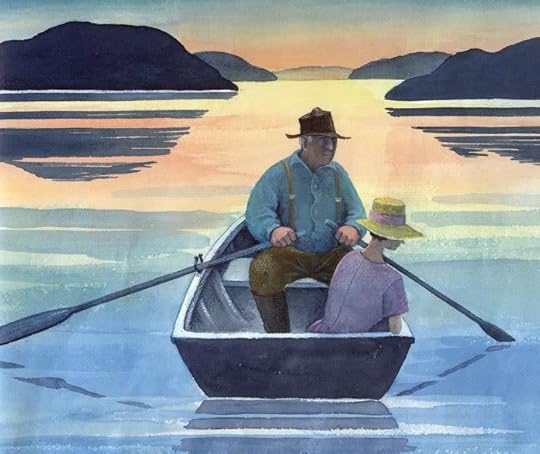
It’s an engaging and interesting story, and of course (because it’s Cooney), the pictures are pure eye-candy.
This one caught my eye because I'm a fan of Barbara Cooney's ethereal artwork, but there's a fascinating, though ultimately sad story here - the flooding of a New England valley to create the Quabbin Reservoir.
So it was voted in Boston to drown our towns that the people of the city might drink.
We see the story through young Sally Jane's eyes, as she watches the destruction of her beloved town until it becomes
Just a long gray wilderness, just a hole between the hills.
Later, Sally returns as a young woman to go rowing with her father on the reservoir, and she recalls the words of wisdom he once offered her as a child.
The story is haunting and sad and powerful. When the graves were moved it felt like they were taken right from my very ribs. And oh the fireflies! And the stars! And how the bridge connecting all that transient luminescence remained a constant!
The illustrations perfectly reflect and illuminate the story, from harvesting the ice to shuffling the graves to the sun leading the canoe along.
This book is for anyone who has ever sat in a canoe and tried to guess the secrets of the lake beneath the waves or had to leave their house and friends but still carry them everywhere.
This is a lovely story about a time and place gone by. It's based on the true stories of the towns now consumed by the Quabbin Reservoir near the author's New England home. I think the story takes place in Connecticut. The story makes me feel nostalgic for a simpler time when kids played outside, slept under the stars, caught fireflies and walked to school without adult supervision. The beautiful Barbara Cooney illustrations help evoke that feeling. The story might be written in blank verse. The sentences are short and somewhat simple but lovely.
However, I don't see this book appealing to children much. It's too slow and old-fashioned. This is apparently on the 4th grade curriculum in Connecticut/western Mass. communities affected by the building of the reservoir recommends it for older elementary readers, no doubt as part of social studies or science because I do NOT see a modern day kid picking this one out on their own. Me, as a weird Little House on the Prairie, history obsessed nerd in the 80s, yes, but my nieces and nephews? Maybe the oldest if her parents picked it out first.
Look at those names; what a team. And the story is a success. The text is almost a poem, the pictures are among Cooney's best. Great addition to any social studies curriculum. I would have liked a bit more history, but the focus was on the feelings, especially of the girl and her father, so ok.
I recently found this in boxes of books purchased from a retired teacher for everyone at our school to add to the collection. It tells of towns destroyed because of the damming of the Swift River for a reservoir fort he city of Boston. There are descriptions of life before it happened and then the poignant saying goodbye as the cemetery is moved, the homes are moved or bulldozed. Yolen's storytelling is always wonderful and this is a story of change and the effects on people's lives told through a young girl's eyes. Beautiful!
Nostalgia, melancholy, and acceptance permeat this true story from Jane Yolen's childhood as the town where she lived for the first six years of her life is literally drowned to provide a water reservoir for the people of Boston. I'm reading this to my library classes this week as we talk about setting.
I don't like letting go. I prefer holding fast to places I love, but those places change. This feels a bit like Wendell Berry for young folks. All things change and we lose the places we love as time passes--what are we to do? Maybe we let go but maybe we still remember.
"One night Nancy Vaughan and her cousin Sara from the city brought three mason jars to my house. We caught fireflies in them, holding our hands over the open tops. Mama came out to watch. She shook her head. "You have to let them go, Sally Jane," she said to me. So I did."
A writing journal from my childhood cataloging books I read as a 4th grader has miraculously appeared from a long time family friend — I left it at her house on a family trip 20 years ago and I’m finding “reviews” I wrote about them when I was 10… this is one of them!! And I wrote a lot about this one ♥️😭
The beautifully-written, contemplative "Letting Swift River Go" is a children's picture book masterpiece.
Some readers assert that the subject matter – the destruction of a valley town to create a freshwater reservoir – is too advanced or challenging for young readers; in my experience, this is not true. Jane Yolen's prose captivates children (and adults), and sets the scene for the dramatic erasure of the narrator's childhood. (Our four-year-old loves this book and requests it often.)
But this isn't merely a melancholy story. To be sure, much is lost – personal, communal, and environmental – but it's above all a story about time and memory. The setting is specific, but the lesson universal: sometimes, for life to continue, memories must be let go, like fireflies.
Jane Yolen continues to provide us with exceptional children's literature. The book is electrifying and the illustrations are breath taking. In 1927 Massachusetts decided that the Swift River should be damned to form a reservoir. In doing so Boston would be supplied with water. Jane Yolen shows us what it must have been like for those that had to give up their way of life. This book is appropriate for all ages form 1-3 and can be used to teach across multiple disciplines: Social Studies, history, science and LA.
This beautiful picture book tells the story of one girl's memories of the town where she was raised. Many years ago, the Swift River communities of western Massachusetts were bought by the government and flooded in order to form the Quabbin Reservoir. Sally Jane shares her happy childhood memories and her experiences once the purchase was made to quench the powerful thirst of Boston, many miles away. The illustrations complement the narrative perfectly. This book could be a great way to discuss how things change over time and the importance of preserving memories.
As an adult, this is really interesting. A city wants to redirect the flow of a river, so the residents of a small town have to move out before their valley is flooded. The tone is wistful, a remembrance of a childhood in a town that is no longer there. But I don't know if young readers will be able to relate.
This is one of my favorite picture books with a touch story. Yolen takes the reader on a journey with her poetic narration, while creating images with her words. Even though illustrations are present, the words paint the true picture.
The writing definitely deserves a 5-star. Cooney's illustrations were perfect. And after all these years, I learned a new piece of our country's history. Left me feeling rather melocholy, contemplative, almost sad, so I will try to take the mother's advice to just "let it go...." Excellent.
Poignant tale of the flooding of towns to make the Quabbin reservoir. It is beautifully told through the voice of a little girl whose family was displaced by the decision.
The drowning of the Swift River towns to create the Quabbin was not a unique event. The same story--only with different names-- has occurred all over the world wherever nearby large cities have powerful thirsts. Such reservoirs are trade-offs, which like all trades, are never easy, never perfectly fair. ~ Author's Note by Jane Yolen
As children we may not realize the significance of the events happening around us. Jane Yolen lived in the Swift River Valley before and during the creation of the Quabbin Reservoir. This picture book, illustrated with her signature artistic flair by Barbara Cooney, is a monument to that time in history. Yolen begins with the simple pleasures of living in the valley, then shows the many preparations for the move including relocating entire houses, and finally the flooding.
The waters from the dammed rivers moved in slowly and silently. They rose like unfriendly neighbors halfway up the sides of the hills, covering Dana and Enfield, Prescott and Greenwich, all the little Swift River towns. It took seven long years.
Under those waters were memories and landmarks that Jane and her family had to let go of and move on. I am glad she decided to share that experience in this bittersweet picture book.
Jane Yolen + Barbara Cooney = a picture book I'm definitely going to give a try!
Interesting historical fiction. Rather a unique slice of history too, not the normal daily life or major historic event sort of story like so many. This one would be harder to pull into a typical storytime, being such a specific historic story, but it would be an interesting one to pull out for elementary school classes instead - maybe a STEM lesson on geography or dams, or for a history lesson talking about changing countrysides or towns, how cities grow up and change the areas around them. Could be used for even older kids too - a simple story to start a discussion/debate on the trade-offs of urbanization and development. The story is simple and straightforward, and would be an easily understood starting off point - the loss of the small towns vs the needs of the city and so many people.
I loved Cooney's illustrations, especially the last few pages. Combined with the reminiscent and almost melancholy tone of the story, it leaves an impression.
Tells the story of the creation of the Quabbin Reservoir through the eyes of a young girl named Sally Jane. The protagonist narrates the story, which begins when she is a mere six years old. She watches as graves are moved, trees cut, homes destroyed and the river dammed. Later she and her father are in a boat on the now filled reservoir. As she looks down into the water she recalls something her mother told her when she wanted to keep lighting bugs in a jar, “ You have to let them go, Sally Jane.” As she looks into the water, she smiles and does just that, she lets it all go.
You could use this book to teach a lesson about science and natural resources. What natural resources were available in the Swift River Valley that was needed in Boston? What other natural resources were collected as the land was prepared for the reservoir? How would these natural resources support the needs of people? What natural resources would not be available after the reservoir was created?
I’m always interested in reading about local history, especially something that seems as traumatic as the flooding of the Quabbin Reservoir.
Jane Yolen takes us on a poetic journey into what the lives of these people might have been like in the Swift River Valley, and how they might have felt when Boston bureaucrats decided the flooding of their towns to create a reservoir for Boston’s drinking water was worth the utter destruction of their homes.
I assume that Yolen did actual research for the book. I was pleased at the inclusion of the facts that they just up and moved many of the buildings from the Swift River Valley to other locations, and that the entire reservoir area was culled of lumber before they drowned it. The totality of the area’s destruction was brutal.
1. Awards (None) 2. Grade Levels- K-7 3. Summary- This book is about towns in the Swift River Valley in Massachusetts that were "drowned" to create the Quabbin Reservoir for drinking water. It was between 1927-1946. Boston needed more water, and they had more water in the Swift Valley, so they voted to make a reservoir to provide drinking water. The book shows the destruction of the towns. 4. Review- The illustrations are my favorite part of the book, which are beautiful yet evoke a nostalgic feeling. 5. In class uses- history, science, water cycle
this book started out very boring. I thought, I would never recommend this to a kid. but I changed my mind about a third of the way in. it goes into good detail about how a little town is willingly destroyed in order to keep Boston afloat. I like the positive attitude of the family in the story and how the emotions are subdued. a great historical resource for young children.
Finally read in the University of Toronto Library on a day trip to Canada! Because of course I would detour to a library given any chance to. Also I promised my friend I'd read it next time I went to a library... did not realize it would take me 6 Months to do so. I knew it would be sad but had no idea about what or why. I definitely want to take the time to read it again !