

What do you think?

Cara Walden Mystery #2
Burning Cold
Budapest: 1956. Newlywed Cara Walden’s brother Zoltán has disappeared in the middle of the Hungarian revolution, harboring a deadly wartime secret. Will Cara or the Soviets find him first?
Cutting short her honeymoon in Paris to rescue a sibling she’s never met was not Cara’s idea, but her husband Jakub has a reckless streak, and she is too much in love to question his judgment. Together with her older brother Gray, they venture behind the Iron Curtain, seeking clues to Zoltán’s whereabouts among his circle of fellow dissidents, all victims of the recently overthrown Communist regime. One of them betrayed him, and Cara realizes that the investigation has put every person they’ve met at risk. Inadvertently, they’ve also unmasked a Russian spy, who is now tailing them in the hope that they will lead him to Zoltán.
The noir film of Graham Greene’s The Third Man inspires Lisa Lieberman’s historical thriller. Burning Cold features a compelling female protagonist who comes to know her own strength in the course of her adventures.
Cutting short her honeymoon in Paris to rescue a sibling she’s never met was not Cara’s idea, but her husband Jakub has a reckless streak, and she is too much in love to question his judgment. Together with her older brother Gray, they venture behind the Iron Curtain, seeking clues to Zoltán’s whereabouts among his circle of fellow dissidents, all victims of the recently overthrown Communist regime. One of them betrayed him, and Cara realizes that the investigation has put every person they’ve met at risk. Inadvertently, they’ve also unmasked a Russian spy, who is now tailing them in the hope that they will lead him to Zoltán.
The noir film of Graham Greene’s The Third Man inspires Lisa Lieberman’s historical thriller. Burning Cold features a compelling female protagonist who comes to know her own strength in the course of her adventures.
Kindle Edition
Published September 12, 2017
About the author
Lisa Lieberman
12 books191 followersI can date my desire to become a writer to the day I read a poem entitled "What" by Stephen Dunn. I was twenty years old and the closing stanza stopped me in my tracks:
people die between birthdays and go on for years;
what stops things for a moment
are the words you've found for the last bit of light
you think there is
Pretty much says it all.
people die between birthdays and go on for years;
what stops things for a moment
are the words you've found for the last bit of light
you think there is
Pretty much says it all.
Ratings & Reviews
Friends & Following
Create a free account to discover what your friends think of this book!
Community Reviews
Displaying 1 - 9 of 9 reviews

July 17, 2017
”Lost souls, all of them.
We were there in 1956, when the Soviets came back crushed the Hungarian revolution. Fleeing the country in a borrowed Skoda sedan the color of dried blood, we passed scores of refugees escaping to the West. Some rode in carts piled with belongings but most walked, carrying a suitcase or two, small children trudging alongside the adults on the muddy roads. Hungarians held no illusions about their fate when order was restored. They’d been ‘liberated’ once before by the Russian Army.”
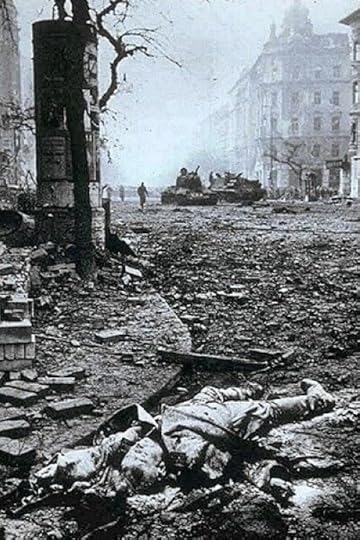
This is the way the city of Budapest looked when the Walden’s arrived.
When the actress Cara Walden discovers that she has a half brother in Hungary, she drops everything, including her honeymoon--or should I say her honeymoon gets relocated to war torn Budapest?--to go find her brother in the middle of a chaotic revolution. Jakub, her new husband, is not only on board with this crazy mission, but as it turns out, he is more gung-ho than Cara wants him to be. Not to be left behind, her older brother Gray also accompanies them on this wild adventure in what they hope is a lull in the fighting before the Soviets return. Can they find their brother before the Soviets regroup and attempt to crush the rebellion? Will Cara be longing for the safe confines of a movie set, or will she be able to make a difference that will be something bigger than anything she has done before?
Lisa Lieberman, whom I have dubbed the Queen of the Hollywood Noir, brings to life Hollywood of the 1950s. This is the second book in what I hope will be a long running series of mysteries featuring Cara Walden. Lisa has graciously agreed to answer a few questions that were on my mind after reading the book.
Jeffrey Keeten: I like the way you drop the titles of books into your mysteries. You mentioned a book I’m very fond of, New Grub Street by George Gissing, and also the author George Orwell. A Dante quote actually becomes integral to the plot in Burning Cold. The main character, Cara’s older brother Gray, seems particularly, precociously, well read. From what I’ve read, actors from this time period were voracious readers. For me, books and life are inseparable. I get the impression that you, as well as your characters, feel the same way?
Lisa Lieberman: I was once waiting for a train, back in my high school days. I was sitting on a bench in the station, reading Agatha Christie and trying to ignore two boys nearby who were talking about girls. It was not an enlightened conversation. “What about her?” one of them said, indicating me. The other, who seemed to be the more expert of the two, dismissed me in two words: “too intelligent.”
My characters exist in a world where nobody would ever say that — a world very much like Goodreads, now that I think of it. That Dante quotation you mention, I found it because I joined a Group Read of The Divine Comedy. For months, I had the Clive James translation on my Kindle, always available should I need to kill time in the dentist’s chair or while waiting to pick up my daughter from tennis practice.
Primo Levi has a chapter in his last book, The Drowned and the Saved, about what it meant to be an intellectual in Auschwitz. He did not have the consolations of a religious believer; prayer was no use to him. “Culture was useful to me,” he wrote. The memory of books he had read as a student before the war brought him solace in Auschwitz. Dante, most of all. He’d memorized vast portions of The Inferno in his classical high school and would recite passages to his fellow inmates. These efforts “made it possible for me to re-establish a link with the past,” he wrote, “saving it from oblivion and reinforcing my identity.”
I gave that to Zoltán (Cara and Gray’s long lost Hungarian brother), who’d survived the brutal penal camps of the Stalinist Rákosi regime. Prisoners really did recite poetry to one another, to keep their spirits alive. I discovered this while researching Stalin’s Boots, a nonfiction essay I published on the failed 1956 revolution. They created a sort of university in their cells at night, the educated inmates sharing their knowledge with their fellow prisoners from the working-class. Here’s how Cara came to understand what it meant, having Dante’s words in prison:
Abandon hope, all who enter here. The dreadful inscription that Dante placed on the gates of Hell. Zoltán had brought the poet’s unflinching vision into the darkness of Recsk to remind his fellow prisoners of the terrible beautiful pain of being alive, and that may very well have been what saved them. “Even a nightmare can be endured, if you are given the words to describe it,” I suggested.
JK: “Marlene Dietrich sashayed into the room wearing a man’s suit that made her look anything but boyish.” Dietrich is essential to any Hollywood Noir story so I was glad to see her making a cameo in your book. Which Hollywood icon can we look forward to seeing in your next book? (Dietrich has been quoted as saying that she dumped John Wayne because he didn’t read. My kind of girl!)
LL: The next book is set in Vietnam in 1957, during the filming of the Joseph Mankiewicz version of Graham Greene’s The Quiet American. (Greene seems to be my co-pilot these days. Burning Cold builds off the Carol Read film of The Third Man, and I’m planning on taking the crew to Cuba next, à la Our Man in Havana.) But, getting back to Hollywood icons, Audie Murphy starred in the Mankiewicz film, and you wouldn’t believe the shenanigans that went on behind the scenes in Saigon.
JK: I’ve always had a fondness for the marriage of Nick and Nora Charles. Novels of the hardboiled variety seem to focus on the divorced, the bitter, and the miserable so I must say it was a breath of fresh air for me to see a couple in this type of novel who are crazy about each other. I do know they are in the lust more than the love phase of their relationship, but it feels like their relationship will play a big part in future novels. How do you see this relationship growing over the series?
LL: I recently watched The Thin Man and was shocked by how much Nick and Nora drank! Dashiell Hammett is reported to have said, when asked about his hobbies, "Let's see, I drink a lot." Cocktails aside, I love the banter between those two while they’re solving crimes. I love French caper movies, with their sexual frisson. All those depressed middle-aged guys with an attitude and a drinking problem get tiresome after awhile. I promise banter and lust as Cara and Jakub settle into married life while continuing to venture together into dangerous places.
JK: You have done extensive research on Hungary. Do you have special ties to that country?
LL: Actually, I do, but I wasn’t aware of this when I was writing Burning Cold. I knew that my father’s family had emigrated to America from some remote part of the Austro-Hungarian empire at the end of the nineteenth century, but the Dual Monarchy, as it was called, was so vast. Also, Jews moved around a lot, and nobody knew exactly where the family lived. But recently, some Lieberman cousin has done genealogical research and found the ship’s records for our paternal grandfather, whose last place of residence turns out to have been a town in the borderlands of eastern Hungary and Ukraine — an area not far from the Tokaj wine region where I’d decided, on a whim, that Cara’s father was born.
In fact, it was pretty random, making Robbie Hungarian. There were quite a few Hungarian expatriates in Hollywood during the golden age, actors like Bela Lugosi and Peter Lorre, and two of my favorite directors, Michael Curtiz and George Cukor. I guess it was a kind of tribute, putting Robbie in that crowd, but he was well-assimilated. He’d changed his name from Roby Szabó to Robbie Walden and buried the past. His origins were immaterial in All the Wrong Places. There was no reason to think that Hungary would figure in a future book.
Then I started writing a nonfiction piece on the failed 1956 revolution and found myself getting drawn into the tragedy of the events. Next thing I knew, I was trying to figure out what would bring Cara to Budapest in the middle of a revolution. I’d already established that Robbie didn’t practice monogamy. Cara and her brother Gray were the products of different dalliances, and there’d been other women in between. What if Robbie had fathered a son back in Hungary? Zoltán would be close to forty by the time of the 1956 uprising. I imagined him as a purist sort who’d run afoul of the Communist regime. Now he’s one of the leaders of the rebellion, unlikely to survive the street battles, given his unwillingness to keep his head down. What if Gray and Cara learn of his existence and decide to go in during the lull in the fighting to bring him out before the Soviets came back? Once I came up with the idea of modeling the story on the movie The Third Man (produced by Alexander Korda, another non-monogamous expatriate Hungarian!), I was thoroughly committed. But who knew that I’d be tracing my own family history when my characters wound up in that border town in Tokaj? I chose it simply because I liked the name, Mád [pronounced Mard]. “We’d be mad to go there,” Gray says at one point. “Mard,” Cara corrects him.
JK: Movies have always been a great solace to me, and sometimes it isn’t the traditional great movies that I slide into the Blu Ray player to help me chase the blues away. The 13th Warrior, Before Sunrise, and To Have and Have Not are three movies I can think of off the top of my head that swing my mood in a positive direction. If things are really dire, it might take a Thin Man marathon. Since you are the Queen of Hollywood Noir can you share with us the five essential Lieberman movies that help you chase away the blues?
LL: Numero uno is Singin’ in the Rain, closely followed by Yankee Doodle Dandy. Generally, I need rousing song and dance numbers to cheer me up, but on those occasions when I want to wallow in it, there’s always A Star is Born. Poor Judy Garland. Two other sure-fire remedies, one with fizz (and Garbo), Ninotchka, and for pure catharsis, nothing beats a James Bond car chase with gadgets Goldfinger Car Chase Scene or ski chase The Spy Who Loved Me Ski Chase Scene.
JK: I know that you went away from a traditional publisher and self-published this book. More and more writers are going that route. I get emails from writers all the time complaining about the lack of support or marketing from publishers. They find they are doing most of the work anyway to promote their books, so why not take the next step and publish their book as well. Could you share with us some of your experiences with the process?
LL: I’d still be traditionally published if Five Star hadn’t dropped their mystery line in 2016, just as I was putting the finishing touches on this book. It’s very difficult to change publishers mid-series, but there are so many resources available to indie authors these days, and I’m finding that I like having everything under my own control. My standards are pretty high, and I don’t like how publishers are cutting corners. I hired first-class editors and was fortunate in being able to use the same production team to format the manuscript and design the cover — I loved the noir look of All the Wrong Places and wanted to keep the “brand.” I even treated myself to a glamorous new headshot.
As for publicity, my rule is that I have to enjoy what I’m doing for its own sake, and I’ve come up with some creative marketing strategies, such as lecturing about classic movies on a luxury cruise liner (I got a free trip to Asia, to scope out Vietnam for the third Cara Walden mystery, and brought my bridge game up to snuff). The mystery writing community is very supportive. My membership in Sisters in Crime gets me into public libraries to speak about writing with fellow mystery authors, and I’ll be on panels at some upcoming conferences this fall, including Bouchercon, the big mystery convention, which is in Toronto this year, a fun place to visit (I’m bringing my husband along).

Lisa Lieberman looking 1950s glam.
JK: Since your novel takes place in the 1950s, I’ll ask yet another movie question. What five films from the 1950s are Lieberman essentials?
LL: The fifties was such a great decade, film-wise, I had a hard time narrowing it down to just five, but since you insist, I’ve come up with one Fellini film, Nights of Cabiria (1957), starring the magnificent Giulietta Masina; Billy Wilder’s noir masterpiece, Sunset Boulevard (1950); and three from France because I am, after all, a French historian: Bob le Flambeur (1956), a hip gangster film by Resistance-hero-turned-filmmaker Jean-Pierre Melville (Melville was his nom de guerre and, by the way, you have to pronounce Bob the way the French do, “Bub,” as opposed to "Bahb," which is how we Americans say it); The 400 Blows (1959), still Truffaut’s best film, as far as I’m concerned; and The Earrings of Madame de… (1953) by Max Ophuls, a historical drama that is sheer perfection.
To order your copies of Lisa's books go to: Passport Press
All the Wrong Places Review
If you wish to see more of my most recent book and movie reviews, visit http://www.jeffreykeeten.com
I also have a Facebook blogger page at:https://www.facebook.com/JeffreyKeeten
We were there in 1956, when the Soviets came back crushed the Hungarian revolution. Fleeing the country in a borrowed Skoda sedan the color of dried blood, we passed scores of refugees escaping to the West. Some rode in carts piled with belongings but most walked, carrying a suitcase or two, small children trudging alongside the adults on the muddy roads. Hungarians held no illusions about their fate when order was restored. They’d been ‘liberated’ once before by the Russian Army.”

This is the way the city of Budapest looked when the Walden’s arrived.
When the actress Cara Walden discovers that she has a half brother in Hungary, she drops everything, including her honeymoon--or should I say her honeymoon gets relocated to war torn Budapest?--to go find her brother in the middle of a chaotic revolution. Jakub, her new husband, is not only on board with this crazy mission, but as it turns out, he is more gung-ho than Cara wants him to be. Not to be left behind, her older brother Gray also accompanies them on this wild adventure in what they hope is a lull in the fighting before the Soviets return. Can they find their brother before the Soviets regroup and attempt to crush the rebellion? Will Cara be longing for the safe confines of a movie set, or will she be able to make a difference that will be something bigger than anything she has done before?
Lisa Lieberman, whom I have dubbed the Queen of the Hollywood Noir, brings to life Hollywood of the 1950s. This is the second book in what I hope will be a long running series of mysteries featuring Cara Walden. Lisa has graciously agreed to answer a few questions that were on my mind after reading the book.
Jeffrey Keeten: I like the way you drop the titles of books into your mysteries. You mentioned a book I’m very fond of, New Grub Street by George Gissing, and also the author George Orwell. A Dante quote actually becomes integral to the plot in Burning Cold. The main character, Cara’s older brother Gray, seems particularly, precociously, well read. From what I’ve read, actors from this time period were voracious readers. For me, books and life are inseparable. I get the impression that you, as well as your characters, feel the same way?
Lisa Lieberman: I was once waiting for a train, back in my high school days. I was sitting on a bench in the station, reading Agatha Christie and trying to ignore two boys nearby who were talking about girls. It was not an enlightened conversation. “What about her?” one of them said, indicating me. The other, who seemed to be the more expert of the two, dismissed me in two words: “too intelligent.”
My characters exist in a world where nobody would ever say that — a world very much like Goodreads, now that I think of it. That Dante quotation you mention, I found it because I joined a Group Read of The Divine Comedy. For months, I had the Clive James translation on my Kindle, always available should I need to kill time in the dentist’s chair or while waiting to pick up my daughter from tennis practice.
Primo Levi has a chapter in his last book, The Drowned and the Saved, about what it meant to be an intellectual in Auschwitz. He did not have the consolations of a religious believer; prayer was no use to him. “Culture was useful to me,” he wrote. The memory of books he had read as a student before the war brought him solace in Auschwitz. Dante, most of all. He’d memorized vast portions of The Inferno in his classical high school and would recite passages to his fellow inmates. These efforts “made it possible for me to re-establish a link with the past,” he wrote, “saving it from oblivion and reinforcing my identity.”
I gave that to Zoltán (Cara and Gray’s long lost Hungarian brother), who’d survived the brutal penal camps of the Stalinist Rákosi regime. Prisoners really did recite poetry to one another, to keep their spirits alive. I discovered this while researching Stalin’s Boots, a nonfiction essay I published on the failed 1956 revolution. They created a sort of university in their cells at night, the educated inmates sharing their knowledge with their fellow prisoners from the working-class. Here’s how Cara came to understand what it meant, having Dante’s words in prison:
Abandon hope, all who enter here. The dreadful inscription that Dante placed on the gates of Hell. Zoltán had brought the poet’s unflinching vision into the darkness of Recsk to remind his fellow prisoners of the terrible beautiful pain of being alive, and that may very well have been what saved them. “Even a nightmare can be endured, if you are given the words to describe it,” I suggested.
JK: “Marlene Dietrich sashayed into the room wearing a man’s suit that made her look anything but boyish.” Dietrich is essential to any Hollywood Noir story so I was glad to see her making a cameo in your book. Which Hollywood icon can we look forward to seeing in your next book? (Dietrich has been quoted as saying that she dumped John Wayne because he didn’t read. My kind of girl!)
LL: The next book is set in Vietnam in 1957, during the filming of the Joseph Mankiewicz version of Graham Greene’s The Quiet American. (Greene seems to be my co-pilot these days. Burning Cold builds off the Carol Read film of The Third Man, and I’m planning on taking the crew to Cuba next, à la Our Man in Havana.) But, getting back to Hollywood icons, Audie Murphy starred in the Mankiewicz film, and you wouldn’t believe the shenanigans that went on behind the scenes in Saigon.
JK: I’ve always had a fondness for the marriage of Nick and Nora Charles. Novels of the hardboiled variety seem to focus on the divorced, the bitter, and the miserable so I must say it was a breath of fresh air for me to see a couple in this type of novel who are crazy about each other. I do know they are in the lust more than the love phase of their relationship, but it feels like their relationship will play a big part in future novels. How do you see this relationship growing over the series?
LL: I recently watched The Thin Man and was shocked by how much Nick and Nora drank! Dashiell Hammett is reported to have said, when asked about his hobbies, "Let's see, I drink a lot." Cocktails aside, I love the banter between those two while they’re solving crimes. I love French caper movies, with their sexual frisson. All those depressed middle-aged guys with an attitude and a drinking problem get tiresome after awhile. I promise banter and lust as Cara and Jakub settle into married life while continuing to venture together into dangerous places.
JK: You have done extensive research on Hungary. Do you have special ties to that country?
LL: Actually, I do, but I wasn’t aware of this when I was writing Burning Cold. I knew that my father’s family had emigrated to America from some remote part of the Austro-Hungarian empire at the end of the nineteenth century, but the Dual Monarchy, as it was called, was so vast. Also, Jews moved around a lot, and nobody knew exactly where the family lived. But recently, some Lieberman cousin has done genealogical research and found the ship’s records for our paternal grandfather, whose last place of residence turns out to have been a town in the borderlands of eastern Hungary and Ukraine — an area not far from the Tokaj wine region where I’d decided, on a whim, that Cara’s father was born.
In fact, it was pretty random, making Robbie Hungarian. There were quite a few Hungarian expatriates in Hollywood during the golden age, actors like Bela Lugosi and Peter Lorre, and two of my favorite directors, Michael Curtiz and George Cukor. I guess it was a kind of tribute, putting Robbie in that crowd, but he was well-assimilated. He’d changed his name from Roby Szabó to Robbie Walden and buried the past. His origins were immaterial in All the Wrong Places. There was no reason to think that Hungary would figure in a future book.
Then I started writing a nonfiction piece on the failed 1956 revolution and found myself getting drawn into the tragedy of the events. Next thing I knew, I was trying to figure out what would bring Cara to Budapest in the middle of a revolution. I’d already established that Robbie didn’t practice monogamy. Cara and her brother Gray were the products of different dalliances, and there’d been other women in between. What if Robbie had fathered a son back in Hungary? Zoltán would be close to forty by the time of the 1956 uprising. I imagined him as a purist sort who’d run afoul of the Communist regime. Now he’s one of the leaders of the rebellion, unlikely to survive the street battles, given his unwillingness to keep his head down. What if Gray and Cara learn of his existence and decide to go in during the lull in the fighting to bring him out before the Soviets came back? Once I came up with the idea of modeling the story on the movie The Third Man (produced by Alexander Korda, another non-monogamous expatriate Hungarian!), I was thoroughly committed. But who knew that I’d be tracing my own family history when my characters wound up in that border town in Tokaj? I chose it simply because I liked the name, Mád [pronounced Mard]. “We’d be mad to go there,” Gray says at one point. “Mard,” Cara corrects him.
JK: Movies have always been a great solace to me, and sometimes it isn’t the traditional great movies that I slide into the Blu Ray player to help me chase the blues away. The 13th Warrior, Before Sunrise, and To Have and Have Not are three movies I can think of off the top of my head that swing my mood in a positive direction. If things are really dire, it might take a Thin Man marathon. Since you are the Queen of Hollywood Noir can you share with us the five essential Lieberman movies that help you chase away the blues?
LL: Numero uno is Singin’ in the Rain, closely followed by Yankee Doodle Dandy. Generally, I need rousing song and dance numbers to cheer me up, but on those occasions when I want to wallow in it, there’s always A Star is Born. Poor Judy Garland. Two other sure-fire remedies, one with fizz (and Garbo), Ninotchka, and for pure catharsis, nothing beats a James Bond car chase with gadgets Goldfinger Car Chase Scene or ski chase The Spy Who Loved Me Ski Chase Scene.
JK: I know that you went away from a traditional publisher and self-published this book. More and more writers are going that route. I get emails from writers all the time complaining about the lack of support or marketing from publishers. They find they are doing most of the work anyway to promote their books, so why not take the next step and publish their book as well. Could you share with us some of your experiences with the process?
LL: I’d still be traditionally published if Five Star hadn’t dropped their mystery line in 2016, just as I was putting the finishing touches on this book. It’s very difficult to change publishers mid-series, but there are so many resources available to indie authors these days, and I’m finding that I like having everything under my own control. My standards are pretty high, and I don’t like how publishers are cutting corners. I hired first-class editors and was fortunate in being able to use the same production team to format the manuscript and design the cover — I loved the noir look of All the Wrong Places and wanted to keep the “brand.” I even treated myself to a glamorous new headshot.
As for publicity, my rule is that I have to enjoy what I’m doing for its own sake, and I’ve come up with some creative marketing strategies, such as lecturing about classic movies on a luxury cruise liner (I got a free trip to Asia, to scope out Vietnam for the third Cara Walden mystery, and brought my bridge game up to snuff). The mystery writing community is very supportive. My membership in Sisters in Crime gets me into public libraries to speak about writing with fellow mystery authors, and I’ll be on panels at some upcoming conferences this fall, including Bouchercon, the big mystery convention, which is in Toronto this year, a fun place to visit (I’m bringing my husband along).

Lisa Lieberman looking 1950s glam.
JK: Since your novel takes place in the 1950s, I’ll ask yet another movie question. What five films from the 1950s are Lieberman essentials?
LL: The fifties was such a great decade, film-wise, I had a hard time narrowing it down to just five, but since you insist, I’ve come up with one Fellini film, Nights of Cabiria (1957), starring the magnificent Giulietta Masina; Billy Wilder’s noir masterpiece, Sunset Boulevard (1950); and three from France because I am, after all, a French historian: Bob le Flambeur (1956), a hip gangster film by Resistance-hero-turned-filmmaker Jean-Pierre Melville (Melville was his nom de guerre and, by the way, you have to pronounce Bob the way the French do, “Bub,” as opposed to "Bahb," which is how we Americans say it); The 400 Blows (1959), still Truffaut’s best film, as far as I’m concerned; and The Earrings of Madame de… (1953) by Max Ophuls, a historical drama that is sheer perfection.
To order your copies of Lisa's books go to: Passport Press
All the Wrong Places Review
If you wish to see more of my most recent book and movie reviews, visit http://www.jeffreykeeten.com
I also have a Facebook blogger page at:https://www.facebook.com/JeffreyKeeten

February 5, 2022
Burning Cold, the second novel in a series, is labeled “a Cara Walden mystery,” but this is a mystery only in a backward way, less concerned with finding a culprit than with uncovering the crimes committed. It gives away nothing to say that history is the culprit—history in the sense of humanity’s efforts to bash one another into order—and the crimes committed are many. Lisa Lieberman, who’s a historian as well as a novelist, is concerned here with Hungary during and after World War II and particularly the 1956 revolution; she previously wrote an e-book on the same subject. Someone who was born and raised in the United States during the 50s (as I was) may have a sense of that period as sunny and placid, but this was far from the case in Central Europe, and Lieberman has constructed a story that allows her to reveal much of the tumult of the time.
Cara, her young heroine, is living in Paris when she learns, just as the revolt against the Soviet-backed regime breaks out in Hungary, that she has a half-brother there, who’s likely to be among the dissidents, and soon she and a handful of companions launch a mission to find him. But there’s more to Lieberman’s tale than the Hungarian uprising; among its other touchpoints are the Spanish Civil War, the flight of exiled artists and intellectuals from many parts of Europe to France during the first part of the century, the miseries inflicted on Europe’s Jews after the war (those who survived the death camps often returned home to face further suffering), and the Hungarian regime’s previous repression of opponents. The novel also furthers Cara’s maturation as a young adult, which began in the first volume of this series, and it includes an unexpected critique of committed activism: Cara concludes, as another character had already remarked, that “heroes can be very hard to live with.”
Though this is a serious-minded historical drama, I read it looking for a particular kind of getaway, and I found that it works that way. It showed me that in the past, things were different, and they were also the same, but—the useful point, for my purpose—they were separate from the trials of today.
From a couple of angles, Burning Cold might be questioned. One is that Lieberman’s story relies on some convenient relationships, character traits, backstories, coincidences, and so forth. No doubt this is part of her design; it allows her to condense the tale and keep it moving while expanding its scope. But it’s possible to feel, as with the puppet show in the opening pages, that strings are being pulled. Another possible issue is that Burning Cold includes occasional words, expressions, and bits of dialogue in Hungarian, which aren’t always clear from the context. It’s not unusual for English-language writing to include untranslated terms from the main Romance languages or from German, presumably on the assumption that our culture springs from those languages and that they’re offered as options in our schools, whereas other languages tend to be minimized or excluded. To put it briefly, this can be taken as a form of cultural imperialism, and Lieberman’s inclusion of Hungarian here can be taken as an admirable diversity move. In any case, it’s increasingly easy for readers in the connected world to look up such things online. Still, I couldn’t help wishing now and then for a bit more clarity.
(Disclosure: The author is an acquaintance of mine.)
Cara, her young heroine, is living in Paris when she learns, just as the revolt against the Soviet-backed regime breaks out in Hungary, that she has a half-brother there, who’s likely to be among the dissidents, and soon she and a handful of companions launch a mission to find him. But there’s more to Lieberman’s tale than the Hungarian uprising; among its other touchpoints are the Spanish Civil War, the flight of exiled artists and intellectuals from many parts of Europe to France during the first part of the century, the miseries inflicted on Europe’s Jews after the war (those who survived the death camps often returned home to face further suffering), and the Hungarian regime’s previous repression of opponents. The novel also furthers Cara’s maturation as a young adult, which began in the first volume of this series, and it includes an unexpected critique of committed activism: Cara concludes, as another character had already remarked, that “heroes can be very hard to live with.”
Though this is a serious-minded historical drama, I read it looking for a particular kind of getaway, and I found that it works that way. It showed me that in the past, things were different, and they were also the same, but—the useful point, for my purpose—they were separate from the trials of today.
From a couple of angles, Burning Cold might be questioned. One is that Lieberman’s story relies on some convenient relationships, character traits, backstories, coincidences, and so forth. No doubt this is part of her design; it allows her to condense the tale and keep it moving while expanding its scope. But it’s possible to feel, as with the puppet show in the opening pages, that strings are being pulled. Another possible issue is that Burning Cold includes occasional words, expressions, and bits of dialogue in Hungarian, which aren’t always clear from the context. It’s not unusual for English-language writing to include untranslated terms from the main Romance languages or from German, presumably on the assumption that our culture springs from those languages and that they’re offered as options in our schools, whereas other languages tend to be minimized or excluded. To put it briefly, this can be taken as a form of cultural imperialism, and Lieberman’s inclusion of Hungarian here can be taken as an admirable diversity move. In any case, it’s increasingly easy for readers in the connected world to look up such things online. Still, I couldn’t help wishing now and then for a bit more clarity.
(Disclosure: The author is an acquaintance of mine.)

November 17, 2017
Burning Cold is the second installment of Lisa Lieberman's Cara Walden mystery series. Like the first – All The Wrong Places – it is a period piece, this time taking us to 1956 Budapest (and environs) during the brutal Soviet put-down of the Hungarian revolution. Lieberman has a wonderful talent for bringing other times and places to life, and does so once again without for a second losing track of the story: a desperate search to find Cara's Hungarian half-brother before the counter-revolutionaries do. Full of intrigue and action, populated by compelling and believable characters (most of all Cara herself), Burning Cold will keep you turning pages late into the night.

December 30, 2019
According to the book description, the film version of Graham Greene’s The Third Man was the inspiration for this historical thriller. Set mainly in post-war Budapest, it certainly has the intrigue and noir feel of The Third Man but I struggled to find many other connections although I admit it’s many years since I watched the film or read the book. What this does mean is lack of familiarity with The Third Man needn’t mar your enjoyment of Burning Cold.
Burning Cold is the second book featuring Cara Walden and there are references to events in the first book. However, I’m pleased to say Burning Cold works perfectly well as a standalone read. In fact, it’s made me keen to read the first book in the series, All the Wrong Places.
I knew little about this period in Hungary’s history before reading the book. The events which unfold in Burning Cold rectified that omission without ever feeling like a history lesson because of the twists and turns of the plot. The atmosphere of paranoia amongst the population of a city with informers everywhere and who live in fear of the secret police is vividly conjured up. The author also creates an interesting dynamic between Cara, her husband Jakub and her brother, Gray.
Burning Cold is an enjoyable, well-crafted historical mystery that explores the legacy of conflict on families as well as nations.
Burning Cold is the second book featuring Cara Walden and there are references to events in the first book. However, I’m pleased to say Burning Cold works perfectly well as a standalone read. In fact, it’s made me keen to read the first book in the series, All the Wrong Places.
I knew little about this period in Hungary’s history before reading the book. The events which unfold in Burning Cold rectified that omission without ever feeling like a history lesson because of the twists and turns of the plot. The atmosphere of paranoia amongst the population of a city with informers everywhere and who live in fear of the secret police is vividly conjured up. The author also creates an interesting dynamic between Cara, her husband Jakub and her brother, Gray.
Burning Cold is an enjoyable, well-crafted historical mystery that explores the legacy of conflict on families as well as nations.

April 14, 2018
Again as I read another of Lisa Lieberman’s books, I was seeing the story unfold in black and white. When I read All the Wrong Places, the first book in the Cara Walden Mystery series, I was so engrossed in the story that it took me back….and I saw the world in black and white. And Burning Cold had that same effect on me….again I was engrossed in Cara’s life and the story taking her, her brother Gray, and her new husband, Jakub, to another area surrounded by war, fighting, and secrets.
Burning Cold takes them to Budapest where they hope to find and rescue a brother they have just found out about. Once in Budapest they also find out that their brother, Zoltan, is married and has a daughter. Unfortunately it isn’t a happy family reunion when they finally meet up with Zoltan and they struggle to convince him to leave the area and go with them where he and his family will be safe. Throughout their travels and everything that they are faced with, Cara remains positive and cannot help but daydream about the happily ever after that will occur when they finally do get everyone home.
Lieberman opens the readers eyes to the terror and the turmoil that surrounds Cara and her family …. you see the love Cara and Jakub share as well as the devotion to family as they try to find Zoltan and bring him and his family to safety. You witness the connection that the brothers, Gray and Zoltan, share even if it is war related. And as with All the Wrong Places, you are left with a better understanding and appreciation of the world around you.
Burning Cold takes them to Budapest where they hope to find and rescue a brother they have just found out about. Once in Budapest they also find out that their brother, Zoltan, is married and has a daughter. Unfortunately it isn’t a happy family reunion when they finally meet up with Zoltan and they struggle to convince him to leave the area and go with them where he and his family will be safe. Throughout their travels and everything that they are faced with, Cara remains positive and cannot help but daydream about the happily ever after that will occur when they finally do get everyone home.
Lieberman opens the readers eyes to the terror and the turmoil that surrounds Cara and her family …. you see the love Cara and Jakub share as well as the devotion to family as they try to find Zoltan and bring him and his family to safety. You witness the connection that the brothers, Gray and Zoltan, share even if it is war related. And as with All the Wrong Places, you are left with a better understanding and appreciation of the world around you.

September 21, 2017
Set during the Hungarian revolution in 1956 and the immediate Soviet response, this is a beautifully written piece of historical narrative fiction. Budapest and the surrounding country are so perfectly described that I could visualize them and found myself swept away by the pace and plotting.
It's rare to find an author who is so gifted writing descriptive prose. I really felt completely immersed in the story. I was engaged with the characters and really hoping everything would work out in the end. The juxtaposition of brutal, even casual, violence and art and culture, love and humanity, living side by side were heartbreaking.
It's a relatively short book (Amazon lists it as 169 pages) and is a quick but very profound read. It's not very often that I find myself finishing a book and having the desire to go back and re-read it. This one did it for me. I really enjoyed this book so very much.
It's listed as the second Cara Walden mystery, but works perfectly well as a standalone book. I intend to go buy the first book, and have added the author to my future TBR list as well.
Exceptional book.
Five stars
Disclosure: I received an ARC at no cost from the author/publisher
It's rare to find an author who is so gifted writing descriptive prose. I really felt completely immersed in the story. I was engaged with the characters and really hoping everything would work out in the end. The juxtaposition of brutal, even casual, violence and art and culture, love and humanity, living side by side were heartbreaking.
It's a relatively short book (Amazon lists it as 169 pages) and is a quick but very profound read. It's not very often that I find myself finishing a book and having the desire to go back and re-read it. This one did it for me. I really enjoyed this book so very much.
It's listed as the second Cara Walden mystery, but works perfectly well as a standalone book. I intend to go buy the first book, and have added the author to my future TBR list as well.
Exceptional book.
Five stars
Disclosure: I received an ARC at no cost from the author/publisher

August 12, 2017
GN I received a free electronic copy of this historical novel from Netgalley, Lisa Lieberman, and Passport Press in exchange for an honest review. Thank you all, for sharing your hard work with me.
Though it is completely stand alone, this is a sequel to Lisa Lieberman's novel All the Wrong Places. We travel with the same people into Budapest in 1956, between the first and second wave of Russian soldiers intent on crushing the Hungarian revolution. Cara and Grey Walden are on a mission to rescue their older brother, Zoltan Szabo and his family. That older brother they previously knew nothing about. An overworked story line but a book you cannot put down. These are people easy to adore and an exciting story. Lisa Lieberman we need more books of this caliber exploring with us the politics and personalities of Europe and the Middle East during the last century. Our exposure to same is criminally limited. Thank you!
pub date Sept 12, 2017
Passport Press
Though it is completely stand alone, this is a sequel to Lisa Lieberman's novel All the Wrong Places. We travel with the same people into Budapest in 1956, between the first and second wave of Russian soldiers intent on crushing the Hungarian revolution. Cara and Grey Walden are on a mission to rescue their older brother, Zoltan Szabo and his family. That older brother they previously knew nothing about. An overworked story line but a book you cannot put down. These are people easy to adore and an exciting story. Lisa Lieberman we need more books of this caliber exploring with us the politics and personalities of Europe and the Middle East during the last century. Our exposure to same is criminally limited. Thank you!
pub date Sept 12, 2017
Passport Press

August 21, 2017
If you want immersion in excellently researched fiction - here is a gem. Well written characters, set appropriately into their contemporary culture, a story line that includes scenes (actual and taken from eye-witnesses), that you will never forget, means it really doesn't get better than this.
Have you ever walked across a square or entered a place of worship and wondered what it would be like, emotionally, to witness events there? Here you have it.
You also encounter unique situations which challenge you to wonder how you would have coped, what critical and instantaneous decisions you would have made under the same circumstances.
Have you ever walked across a square or entered a place of worship and wondered what it would be like, emotionally, to witness events there? Here you have it.
You also encounter unique situations which challenge you to wonder how you would have coped, what critical and instantaneous decisions you would have made under the same circumstances.
March 4, 2021
I can't recommend strongly enough Lisa Lieberman’s Burning Cold ! Set in Hungary in 1956, during the revolt from Russia, the mystery vividly recreates the tensions and paranoia of the time and place. Amidst the treachery of a country physically and spiritually shattered by WWII, Russian oppression, and years of ethnic strife, the heroine, her husband, and her brother race against time to rescue the siblings’ newly revealed half brother before the Soviets roll back in and seal off the country for decades. It’s a great read in the dark and treacherous post-war European noir of The third Man or Berlin Express.
Displaying 1 - 9 of 9 reviews