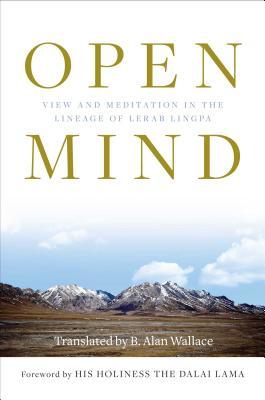
Study the Great Perfection with the celebrated Lerab Lingpa, who imparted teachings to the Thirteenth Dalai Lama, and discover the common ground of Tibetan Buddhism’s many schools in essays by his disciples.
Lerab Lingpa (1856–1926), also known as Tertön Sogyal, was one of the great Dzogchen (Great Perfection) masters of the nineteenth and early-twentieth centuries and a close confidant and guru of the Thirteenth Dalai Lama. This volume contains translations by B. Alan Wallace of two works that are representative of the lineage of this great “treasure revealer,” or tertön .
The first work, composed by Lerab Lingpa himself, is The Vital Essence of Primordial Consciousness . It presents pith instructions on all the stages of the Great Perfection, which is the highest form of meditation and practice in the Nyingma school of Tibetan Buddhism. In this practice, the meditator comes to see directly the ultimate nature of consciousness itself. The work guides the reader from the common preliminaries through to the highest practices of the Great Perfection—the direct crossing over and the achievement of the rainbow body.
The second work, Selected Essays on Old and New Views of the Secret Mantrayana , is a collection of seven essays by two of Lerab Lingpa’s close disciples, Dharmasara and Jé Tsultrim Zangpo. Dharmasara wrote six of the essays, providing detailed, erudite explanations of the compatibility among the theories and practices of Great Perfection, Mahamudra (a parallel practice tradition found in other schools), and the Madhyamaka view, especially as these are interpreted by the Indian pandita Candrakirti, the Nyingma master Longchen Rabjam, and Tsongkhapa, founder of the Geluk school of Tibetan Buddhism. The one essay by Jé Tsultrim Zangpo (a.k.a. Tulku Tsullo), “An Ornament of the Enlightened View of Samantabhadra,” contextualizes the Great Perfection within the broader framework of Mahayana and Vajrayana Buddhism and then elucidates all the stages of practice of the Great Perfection, unifying the profound path of cutting through and the vast path of the spontaneous actualization of the direct crossing over.
This volume will be of great interest for all those interested in the theory and practice of the Great Perfection and the way it relates to the wisdom teachings of Tsongkhapa and others in the new translation schools of Tibetan Buddhism.
This is a really wonderful book in large part because of how Wallace presents it – clear, intelligent, broadly learned, practice oriented, eclectic and respectfully non-sectarian of past traditions, and spiritually balanced for modern ones - a middle way between the polarized extremes of the materialistic fundamentalism (of the Marxists and scientific materialists) and religious fundamentalism (in whatever form). The content is highest Dzogchen (Atiyoga) practice and so will appeal to very few, but those select few surely need not be limited to ethnically Tibetan or spiritually Buddhist (and to say otherwise is to just broadcast one’s lack of understanding what Dzogchen actually is). The first half of the book is Lerab Lingpa’s meditation manual/text and the second half includes seven essays by two of his students, which are more philosophical (and expressly non-sectarian).
Despite Wallace’s modern mindset (as presented in the intro), Lerab Lingpa’s is a very traditional text (content and format) based on a series of mind treasures (termas) - it’s a short lineage but a bit complicated: Samantabadhra (zero-point) → (via direct transmission) → Vimalamitra (8th century) → (via visionary empowerment) → Chetsun Sangge Wangchuk (12th cent.) → (via rainbow body’s final release) → Dakinis → (via Dakinis/Chetsun’s visionary empowerment) → Jamyang Khyentse Wangpo (19th cent.) → (via verbal teaching) → Lerab Lingpa (19th cent.) who acting as scribe wrote down what he’d heard (checking it with his teacher later).
The instructions begin with detailed descriptions of the general empowerment and preliminary practice requirements required for this class of teachings (which aren’t meant to be just read, but to have been actually practiced/accomplished by the student and so made experiential rather than merely intellectual). Then comes instruction on the main practices which aren’t all that extensive (10 pages of “cutting through”, 25 of “crossing over”. and another 10 of “liberation in the intermediate period”).
It’s assumed that the reader of this wants to practice, and so the implication is that they will either do or have done the steps laid out (and not simply cheat - such as sit with a wandering discursive mind but call it an effective meditation on the 'Four Thoughts That Turn the Mind'). There really isn’t much benefit otherwise. This means of course, those drawn today to such practices need to know they will need an actual teacher (which aren’t that hard to find), and that they’ll get more teachings and clarification that way. Personally, I found this presentation, although a bit stiff and traditional due to the accuracy of the translation, very helpful and clarifying for the more subtle aspects of my practice (especially relating to the Ground of Being).
As Wallace says in his intro regarding the rainbow body fruit of Dzogchen realization;
“The teachings and practices leading to such a remarkable transformation are available to us all today, and when people in the modern world prove themselves capable of manifesting the rainbow body in full collaboration with open minded scientists, this may trigger an unprecedented revolution that will have profound repercussions for all branch of the natural sciences, from the cognitive sciences down to the foundations of modern physics.”
So let’s get to it Dzogchenma/pas!
Ps. as a fun compliment to this text, try reading the biography of Terton Sogyal (Lerab Lingpa’s other name) – ‘Fearless in Tibet’ by Matteo Pistono, (based on the hagiography by Tulku Tsulo - author of one of the essays in the 2nd half of Wallace’s book). It is a wonderfully written, highly enjoyable and entertaining yet also profoundly educational account that (unlike Wallace’s more rigorously serious meditation manual) shows the larger context of the terma tradition within the deeply devotional and more fantastical side of the Tibetan psyche.
And as a follow-up to that… try reading Tulku Tsulo’s wonderful 20th century Dzogchen lam-rim commentary on Godemchan’s 14th century terma translated by Tulku Thondrup and edited and published by Keith Dowman in 2018 as ‘Boundless Vision.’