What do you think?
Rate this book


208 pages, Paperback
First published September 6, 2016
From the hemisphere of his mind devoted to the past and the hemisphere devoted to the future great swathes had been shaved off, and enclosing the sensitive little core that belonged to the present there remained only the thin layer of the recent past and near future, leaving him without that recourse to the distant past or future by which in times of difficulty ordinary people were able to ignore or endure or at least justify the present moment.
[…] one has no choice but to watch blindly from the outside […] not so much because one lives in different circumstances, in a situation of privilege […] nor because one is attempting […] in another language entirely […] but because, when such things happen to a person, [their] life […] becomes lost inside their body and ceases to find expression.
Perhaps people simply had no choice. Perhaps they had to keep moving, to get up in the morning, and to go on until evening. Breathing was not a choice or habit after all, it was not something you could start or stop at will. The atmosphere entered the body of its own accord, and in the same way it took its leave, from the first breath to the last, so perhaps in a way living was not a choice. The air would go on advancing, and till it stopped it would go on receding. When you were hungry you would have to eat, and when you were thirsty you would have to drink. When your bladder was full you would have to piss, and when your bowels were full you would have to shit. The legs had to move, so people had to go places, and so there were places they went. The arms had to work too, and so people had to carry things, and so there were things they gripped and held. All the while the atmosphere kept advancing and receding, the chest kept rising and falling, and maybe that was all, maybe that was life.This quotation sums up the philosophy of Anuk Arudpragasam's mesmerizing novella as well as anything could, but just about any page in the book would give the same message: that life is simply something we are a part of, and we accept it as eventually we accept death. It is a long quotation—in fact the full paragraph is twice this length—because Arudpragasam takes his time to examine everything, whether cataclysmic or mundane. He spends an entire chapter describing his protagonist washing himself, four pages on him moving his bowels, countless paragraphs on the simple act of breathing in and out, as though no one function is more important than any other. I suspect that this is a Hindu philosophy, reduced to the very simplest terms.
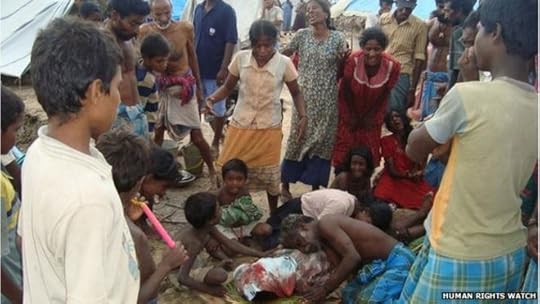

Shrapnel had dissolved his hand and forearm into a soft, formless mass, spilling to the ground from some parts, congealing in others, and charred everywhere else. Three of the fingers had been fully detached, where they were now it was impossible to tell, and the two remaining still, the index finger and thumb, were dangling from the hand by very slender threads. They swayed uncertainly in the air, tapping each other quietly, till arriving at last in the operating area Dinesh knelt to the ground, and laid the boy out carefully on an empty tarpaulin.But despite all the fear and carnage, what Arudpragasam paints is a portrait of Life, not triumphing over death as in the Western heroic tradition, but coexisting with it in the Eastern one. And even though Dinesh hardly knows Ganga, he is so respectful, so aware of his responsibilities, that their brief marriage becomes a true love story—though unlike any other you have ever read.