Atheists are launching a new wave of attacks against Christianity and faith in God. Having to constantly defend your beliefs can feel exhausting, and it's hard to know how to handle atheists' claims of a more scientific and sophisticated worldview. How can you respond to the increasing hostility to your faith?
With instructive clarity, Dr. Louis Markos confronts the modern-day atheists' claims that new evidence disproves the existence of God. In fact, you will find that the "proof" peddled by new atheists is not new at all—but rather, recycled claims already disproven by Christian thinkers of the past...claims that you can silence today with the same solid logic.
Equip yourself to defend your beliefs from a deep well of knowledge and conviction. Stand in confidence that the trial of public opinion versus universal truth has already been held—and God is the victor.
Dr. Markos earned his B.A. in English and History from Colgate University and his M.A. and Ph.D. in English from the University of Michigan. At the University of Michigan, he specialized in British Romantic Poetry, Literary Theory, and the Classics.
He has taught at Houston Baptist University since 1991, where he is Professor in English and holds the Robert H. Ray Chair in Humanities.
Atheism On Trial, written by Louis Markos, is published by Harvest House Publishers. It came out this year--2018. Louis Markos is a delightfully deceptive man. On the one hand, he is lively--as in bouncing off the walls, full of energy, laughing and talking non-stop in his lectures. He loves Lewis and Tolkien; he loves literature; he loves talking about his love of Lewis, Tolkien, and literature. As such, he is God's gift of an energy burst to an often weary Christian community. I could never have trouble staying awake when he is talking.
On the other hand, he is a deeply read and careful scholar. Yes, he can take you on a running tour of Narnia and Middle Earth, but he can also discuss the ancient Greeks, modern skeptics, and post-modern philosophers. Over the past several years, I have had an increasing appreciation for Markos' work after having read his books, listened to him lecture, and met him in person.
Atheism, as a belief system and what is even a religious belief system, has had a pretty favorable run over the past few years. When I was in school as a student, the premier American atheist spokesperson was Madalyn Murray O'Hair. She was quite an obnoxious figure and a loud mouth that was an easy target for many. Her legal battles yielded some fruit such as getting prayer out of the public schools. As far as presenting a real threat to religious belief, whether merely believing in a Deity or believing in Christianity, O'Hair was fluff. I sure there were better representatives of the cause of atheism. Also, that was an age where Communism was a real fear, and atheism is a bedrock doctrine for true followers of Marx.
In recent years, several key figures have emerged as the public intellectual atheists for our time. The late Christopher Hitchens was one of the best. Cynical, droll, witty, and unswerving, he was a strong force. On many occasions he locked horns with Christian theists and was the type of man who elicited admiration even from those who did not agree with him. On the front lines more often has been Richard Dawkins. Along with Sam Harris and Daniel Dennett, these men have been able to "make atheism a household word" (page 11).
While it is probably a little more easy to embrace atheism in our day, I don't find it a force to either fear or to confront very often. All my life--living in the rural Southern Bible Belt--I have been surrounded by plenty of people who have had weird views of God, unbiblical notions of God, inconsistent views of God, heretical views of God, and unclear views of God. But I am not sure I could name five people who I actually and personally know who are atheists. Of course, along with living in the Bible Belt, I have worked in a Christian school for more than two decades and served as a pastor and church leader that long as well. In other words, I am far from the madding crowd.
I figure that I am about as likely to confront a grizzly bear as an atheist. In one case, I would run as fast as I could, but in the other would like just stand and stare in puzzlement. Part of my problem is best explained by G. K. Chesterton. In his delightful book Orthodoxy, he wrote, “It is very hard for a man to defend anything of which he is entirely convinced. It is comparatively easy when he is only partially convinced. He is partially convinced because he has found this or that proof of the thing, and he can expound it. But a man is not really convinced of a philosophic theory when he finds that something proves it. He is only really convinced when he finds that everything proves it.”
So, I do not believe in God because of the cosmological argument, the moral argument, the ontological argument, the argument from design, or any other traditional defense of theism. While not convinced by any of them, I feel quite confirmed by all of them. I also find Cornelius Van Til's transcendental argument compelling. I think Greg Bahnsen's use of that argument in the famous Bahnsen-Stein debate was a work of art. I am strengthened and blessed by Gordon Clark's foundational premise that the Bible is the Word of God and find that to be a sufficient and convincing case. I find pragmatic arguments convincing. I find Pascal's Wager acceptable. I find God with my limited use of rational faculties; I find God with all empirical evidence; I think logic proves God; I think history proves God. I think I was convinced of God's existence from the earliest days of my life. The fact that my environment produced my beliefs presents no concern for me. Obviously, the way I think and who I am and how I came to be who I am is different than the experiences of others. And I do believe it is important for Christians to be well armed, grounded, briefed, and trained to understand atheism.
Despite the many new and somewhat formidable spokespersons (what a clunky word) for atheism, it is not the new kid on the block. Also, there are not conditions--scientific or evolutionary or intellectual--that explain why atheism is more adequate an explanation for reality today than it would have been in the past.
This is the primary strength of Markos' Atheism on Trial. Dr. Markos devotes the bulk of the book to going after the long tradition of arguments and proponents of atheists. He starts where all debates within Western Civilization start--with the Greeks and the Romans. If anyone thinks that all ancient folk believed in gods or God or mystical forces, they have not read the homework. All through the centuries there have been some hombres who have dug in against theism, miracles, absolute truths, the universe having a beginning, and other points of contention.
If I were to make one major change to the cover of the book, it would be to have and highlight the words from Ecclesiastes: "There is nothing new under the sun." But while the arguments against Theism are not new, there is always the need for us to either know the rebuttals or know where to find them.
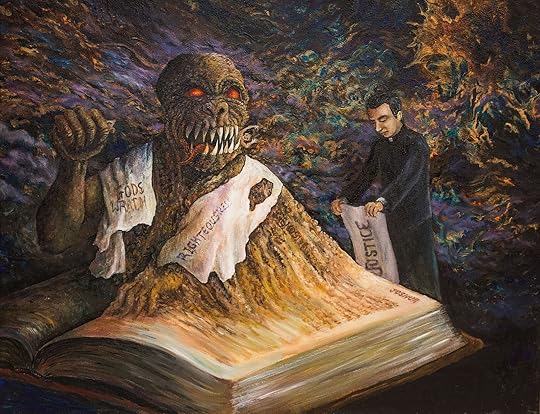
A lot of this is quite good, definitely worth 4 stars. However, Markos’ attempt to defend the evil attributed to God in the Old Testament failed completely; His argument was morally bankrupt and utterly undermined all that he previously proclaimed about the Tao (universal moral truth) that persist throughout time.
When it comes to justice, there are scriptures that inform us what justice is and there is a law that is written on our heart, and there is also the revelation of Jesus on what justice is, so we have some grounds to speak on what is justice and what is not justice.
The problem is that we read of evil and injustice that is attributed to God in the Old Testament. Here we find grotesque evil that violates the universal and timeless moral principles, violates the clear teachings of scripture on what is justice and the sense of justice that God wrote on our hearts. This can be solved by questioning the scriptural authors at certain points, or it is addressed by calling injustice just, darkness light, and evil good. Markos sadly chooses the latter strategy
All Markos does is label injustice as justice (thinking this wholly solves the problem), and then claims any objection would be an objection against the holiness and justice of God. The only reason for such objections (he suggests) is that we are uncomfortable with God punishing evil with judicial evil.
The problem is Markos empties the word “justice” and “holiness” of all their meaning. For literally any injustice, regardless of how unjust according to all definitions of justice, can be labeled just by human beings like Markos. Literally, any evil could be labeled holy if God is said to do it. Since anything could be called “just” or “holy” the words lose their meaning. The attempt to empty the words of their meaning means Markos acts as a propagandist--creating newspeak to rationalize and justify actual evil and then condemning people for committing heresy for not accepting his definitions.
Markos could just as easily do what he is doing, if he wanted to defend Hitler, he could claim all that Hitler did was an act of justice. Hitler was in fact following the Tao, and we should NOT judge or question his actions based upon our modern subjective and humanistic sense of right and wrong. Markos could say what we saw with Hitler was juridical evil; the Jews all deserved what they got, they were vermin and sinners, they were cancer that needed to be removed. We shouldn’t question Hitler, all that he did was holy and just. If we express discomfort with the genocide, well, it wasn’t actually genocide (he spared some Jews); and moreover, Hitler is just, so to be against genocide, is to be opposed to justice; it is to suggest there should be no punishment for sin.
Am I out of bounds in what I am saying? No, I am not. There really is injustice and evil that is wrongly attributed to a holy God in scripture. Consider, for example, the story of the Amalekites; The Amalekites attacked Israel once when they came out of Egypt, and the text has God tell Israelites to NEVER to forgive them, to hate them forever, and to pass the enmity on generation after generation until they can kill them all. We thus see tribalism at its worse (completely contrary to what Jesus commanded and represented). Finally, 400 years later, God then said to tell Saul to go slaughter every male and female, young and old. What is the warrant for genocide? It is that 400 years previously, the Amalakites attacked Israel. So, the justification for genocide IS SOMETHING THAT HAPPENED 400 YEARS AGO! This is the reason scripture gave! It justifies murdering the children for their great, great, great, great, great, great… grandparent’s offense. THIS IS WHAT MARKOS MUST CALL JUSTICE! To be against murdering Children for something their ancestors did 400 years ago would be against justice and the holiness of God!!!! Markos would have to insist the only reason I am opposed to bashing babies' heads against a rock and slicing pregnant woman's stomachs open, and hacking elderly people to pieces for a 400-year-old vendetta is because I am opposed to justice and don't think God is holy!!!!
Notice the text in 1 Sam 15 marks out an ethnic group for annihilation, and then Saul is judged for not being thorough in the genocide, so here herem clearly conveys murdering the entire population. The moral of the story = God tells you to murder everyone, you murder everyone, to obey is better than sacrifice! Later in history, this is how the passage was used, the native Indians were called Amalak, and Christians were told that if they didn't kill young and old that God would reject them. This story in 1 sam 15 is evil, pure absolute evil, the god the story presents is evil, pure evil, there is NO way around this, unless we want to call morality relative or say God's might makes him right, and thus again, there is no moral truth. Anyone with a conscience and a moral sense would recognize what is presented is indefensible and wicked, it was THEN and it is now. It is evil according to Old Testament moral axioms (the children are not to be punished for the parent's sin; an eye for an eye) it is evil in light of the revelation of Jesus.
Markos must call evil good, injustice justice, and darkness light and slanderously attribute injustice and evil to God. He must engage in newspeak. What Markos is doing should be considered the heresy, not those who instead insist that God must in fact be just and holy! Worst, think what Markos is claiming about Morality, he must claim that at least once in history, forever holding a grudge against an entire people group and to continuing to hate an entire people group generation after generation for a single offense, and finally 400 years later, going in unprovoked and hacking women and little girls and infants to pieces was just, good, moral and right! This is a steep price to pay and as I said, it should be considered the heresy.
Another thing I want to state is many take issue with the smiting, slaughter, forced cannibalism, rape, the killing of innocent children for their parent's sin, NOT because they have an issue with justice. Plenty would be perfectly fine with God punishing the wicked and smiting evildoers. However, if God is a God who does smite and punish sin this side of eternity; then the Old Testament gives us an image of a deity who is remarkably arbitrary in his dealings. He hardly ever intervenes and punishes evildoers, but then suddenly, because some people are complaining about eating the same food, he flies into a rage and kills 10s of 1000s. Or because David took a census after God made him do so, he kills 70,000 people, or because someone tried to stabilize the Ark, he smites them dead. For petty irritations, he slaughters multitudes and smites others for minor infractions and trifles, but then does absolutely nothing to punish those truly evil actors in history, something that bugged many a prophet and psalmist. This would be like a father who sits back and does nothing as his son rapes and then dismembers his sister in front of his father. But then later, killed another daughter because she complained about eating Brussel sprouts again.
Markos can recognize evil, cruelty, selfishness, and arbitraness when he reads mythology from other cultures, yet when he reads the same attributed to YHWH in the Old Testament, he must turn off the moral part of his brain, put his hands over his eyes and defend it. Likely because of being faced with a false dilemma driven by a belief in the inerrancy of scripture.
Note that there are plenty of people who have remained Christians, and yet can actually call evil evil when they see it; yes it means adjusting how we approach scripture, but it is necessary. Markos has assigned himself an impossible task; it is tragic to see such a brilliant and intelligent and no doubt decent person contort his brain and make desperate, repugnant, and morally bankrupt claims.
Approaching the book as an atheist, it is immediate from the outset that Louis believes his religious beliefs are true and believes naturalistic explanations for difficult questions like the origin of life or even the universe itself are impossible. He presupposes a few things to make his case: 1. at least one god exists 2. that god is not deistic, and he presents an argument against deism 3. that God revealed itself to us many times in our history 4. that God came down to Earth as Jesus, and Jesus is 100% God and 100% human at the same time 5. Jesus' death was a sacrifice for something called "sins," that we acquired from an event he refers to as "The Fall,"at the centre of which seem to be the characters Adam and Eve. Louis is evidently passionate and a very competent writer, with a diverse knowledge of philosophical traditions, but I was left far from satisfied that he had achieved anything more than establishing his belief would be rational if all his presuppositions happen to true. I was far from convinced that they are, nor that God is anything more than a catch-all for anything we currently don't understand. There were no mechanisms for how God interacts with reality, no description of what God is, no description of what the supernatural is, or how he knows it really exists that I found compelling. Nothing but a big "Nuh uh" to naturalistic explanations, followed by "therefore my God and the entire corpus of my theology."
“For all his so-called scientific objectivity, Einstein did not want the universe to have a beginning, did not want it to be contigent upon a power or force or reality outside of itself.” (Kindle Location 654)
Wow! Louis is not only amazing in his depth and breadth of reading, but the ability he has to apply this knowledge and articulate logical and relatable argument for his thesis is fantastic.
Louis outlines the centuries old argument of order and design versus chaos and chance. Divided into four key areas – the nature of the Universe; the Nature of Knowledge; the Nature of God and the Nature of Man – Louis provides the facts enabling the reader to challenge common culture and thinking and their own personal beliefs. In the end we all have to choose – belief in order and design and its subsequent moral accountability or the alternate view of self-sufficiency and deny the facts that align with this theory – a disordered and chaotic world.
Highlighted is the concept that disbelief in an argument, regardless of its antiquity, does not disprove the argument.
We are self-protective and will choose to not believe something that we do not want to agree with, which may confront or convict us in some way, even when the proof is presented to us.
I only wish I had the time and the capacity to completely absorb and retain the wisdom he has to disclose. Not only does Louis provide current application, he explores the historical accounts, quoting from Greek and Roman myths and great scientists and philosophers from many eras that span more than 2000 years. In this way he challenges and dispels what is commonly viewed as new and reveals its true historical origin.
CONTENT RATING 12+ Academically Challenging Read
SEX & NUDITY Mild – Castration and one other sexually specific term mention, not described, in context of discussing the practices of mythical gods.
VIOLENCE & GORE Very mild – brief mention of human skulls.
PROFANITY None
ALCOHOL, DRUGS & SMOKING None
FRIGHTENING & INTENSE SCENES None
FAITH CONTENT Strong – The whole book argues for creation against atheism.
Overall it is a fine little work of Christian apologetics, though I have several qualms: 1) There are no footnotes, only an annotated bibliography. 2) I do think some of the comparison between ancient and modern materialists are compelling and suggestive, others are somewhat force (such as the comparison between Lucretius and Richard Dawkins). 3) Despite the title, only the first part of the book focuses on Atheism per se, the rest deals with various theistic beliefs that turn their believers into "functional Atheists".
This book discusses how atheism has laid roots in American culture and has represented itself as a neutral position, when it is in fact a religion and worldview that shapes those who follow it. This book also discusses how to refute atheistic arguments, although that parts of the book had very little new information to me.
A great analysis of the deep thinkers behind atheism and how the Christian can approach them with a deeper understanding of how their world views have evolved over history.
Professor Markos makes the most of his expertise in The Classics to critique materialism and its questionable narrative of triumph over alternative worldviews. Louis looks at materialism in its different guises, from Lucretius and the ancients up until Marx and the new atheists.
At several stages, our guide shows the flaws in logic and unjust presuppositions that animate the forms of materialism that have become dominant. At no stage have they disproven theistic competitors, but instead have taken on the forms of most 'religions', assuming and framing all things from an unproven first thing. This is at best self referencing and often self refuting.
Louis makes excellent use of Plato's allegory of the cave to describe the incessant idolatry of shadows that each form of materialism has succumbed to and proffers a way out of the cave that is both convicting and convincing.
Dr. Mark is a gifted teacher and writer. I appreciated the clarity of this work and the exhaustive use of primary source materials to support his arguments. My mind has been educated and my faith has been strengthened.
I love this book! It is so well-written and easy to understand. The author does an excellent job of explaining pretty complex concepts easily and clearly. I think it can be very difficult at times for readers to find apologetic books that are easy to understand and not dreadfully boring. I was very impressed with the way this book defended the position of Christianity.