The true story of British cousins who fooled the world for more than 60 years with a remarkable hoax, photographs of “real” fairies. Exquisitely illustrated with art by Eliza Wheeler as well as the original photos taken by the girls.
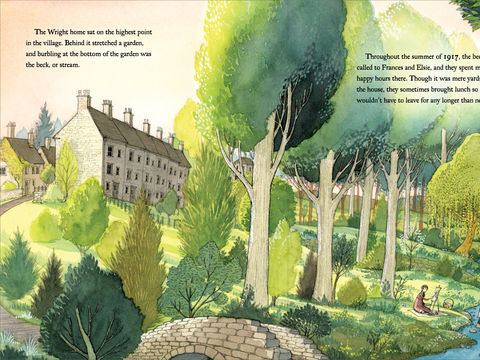
While her father was serving in World War I, nine-year-old Frances Griffiths and her mother went to stay with the Wright family in Cottingley, England. There, Frances became quite close to her sixteen-year-old cousin, Elsie. The two girls spent much of their time playing near a stream at the back of the Wright's property. It was a lush, almost mystical place where one could almost believe fairies frolicked among the ferns.
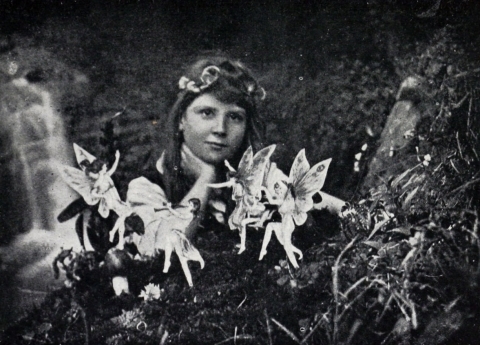
One summer day in 1917, the girls attempted to prove to their parents that they had seen said fairies. After much begging, Elsie's father loaned her his camera. The girls returned with an astounding photograph.
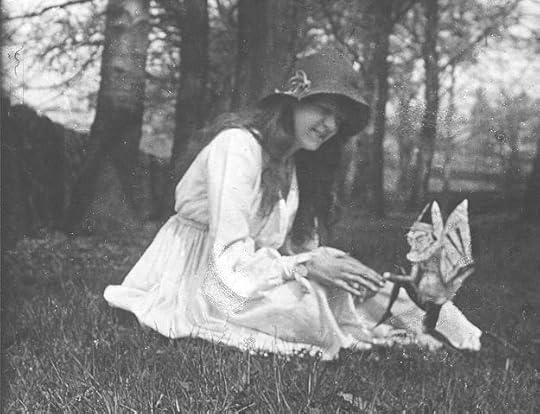
Which was followed by another equally amazing photo:
News of the pictures spread, even garnering the attention of Arthur Conan Doyle, who set out to investigate the photographs. The public was both enchanted and skeptical. As the author states in his end note - . . . people who want to believe do believe . . .
Nobleman presents a charming, and factual account of the fairy frenzy that took place after the photos were published. While the book is geared toward the younger set, it should appeal to readers of all ages. Eliza Wheeler's lovely, ethereal watercolors add to the magic.
Recommended to anyone interested in one of the greatest hoaxes in history.
Author Marc Tyler Nobleman and illustrator Eliza Wheeler tell the story of the Cottingley Fairies hoax in this engaging work of picture-book non-fiction. Angry at the adults in her family for scolding her younger cousin Frances, a sixteen-year-old English girl named Elsie Wright decided to play a trick on them, taking some pictures that she claimed proved the existence of fairies. The year was 1917, and photography was still new to many people. Eventually the cousins' trick grew beyond their fairy circle, convincing even the great Sir Arthur Conan Doyle that they had made a remarkable discovery. He used their photographs in his article on fairies, published in The Strand magazine, creating a widespread sensation. It would be many decades until the truth was revealed: the girls had faked the fairies, which were paper cut-outs propped up with sticks in each scene...
An absolutely lovely book, Fairy Spell: How Two Girls Convinced the World That Fairies Are Real pairs an engaging, informative text with beautiful illustrations. I knew the basic story of the Cottingley Fairies, but I thought Nobleman did an excellent job of expanding upon the better-known facts, and interpreting them in a convincing way. I appreciated his evident sympathy for the two young hoaxers, and the humane way he addressed their trickery. I also appreciated the inclusion of the actual photographs, although the real stand-out for me, visually speaking, was Eliza Wheeler's gorgeous illustrations, done in ink, watercolor and collage. Her color palette was immensely appealing, her human figures charming. I'd recommend this one to young fairy-lovers, and to anyone looking for engaging non-fiction picture-books about unusual and interesting children from the pages of history.
I have loved the Cottingley fairy story ever since I first heard it. This picture book does a wonderful job of letting the story unfold and solving the mystery, mostly. I love that it leaves room to still believe!
It appears that fooling the world with a breakthrough news article nearly a century ago, achieved instant fame for two young girls. In Cottingley, England in 1917, cousins Frances Griffiths, and Elsie Wright announced the discovery of fairies by Frances' stream to their dismayed parents. They even documented the fairies with photos. This is a handsomely told story with exquisite whimsical illustrations done in India ink, water color, cut paper and digital collage. It is fascinating to note that the famous detective author Arthur Conan Doyle published their fairy photos along with a news article. Paced perfectly, with interesting details such as how photographs were made years ago, and the history of the cousins as their story evolved. The Author Note in the back is informative and comprehensive. A delightful narrative non fiction story for readers interested in fairies, and librarians, or teachers seeking a shocking example of how misinformation can be accepted by the masses.
Nobleman brings readers a true story from the the early 1900s of media's powerful influence. Even before Facebook, Twitter, and non-stop reporting via television and radio, books and newspapers had the ability to sway public opinion and change the minds of adults and children who are certain that they know the right answer. In 1917, two girls discovered that fairies and gnomes lived by a stream near their home and took pictures that proved to a nation that fairies are real!! The telling of the tale includes watercolor illustrations as well as copies of the photographs from 1917. Cover reproductions of the The Strand, the magazine that revealed the amazing discovery, are also a part of this picture book that will be of interest to those who love fairies or are intrigued by the might of pen and picture.
This was a lovely little story, about the famous photographs. I recently ordered a fictional book about Cottingley fairies and so when I stumbled upon this short graphic novel on Scribd, I decided to read it.
I adored how whimsical the whole story and the artwork was, and I liked how the ending, while explaining most of it, felt very open and could inspire kids' imagination :)
Frances and Elsie decided to lie to their parents about being by a river, and therefore said they saw fairies. They kept the secret of it being fake for more than 60 years, after it became famous, and many people, including famous author Sir Conan O'Doyle of the Sherlock Holmes series. Big oof, man.
This entire review has been hidden because of spoilers.
This was a terrific book! Beautiful watercolor illustrations coupled with reproductions of the original Cottingley Fairy photos. A little magical, a little hoax, all fun. I'll use it with my information literacy students as we talk about source evaluation, hoaxes, and image manipulation.
There have been books about these girl before, but this is the first one I've seen in a picture book format. It's perfect for a classroom read aloud. I love Wheeler's illustrations as well.
Fairy Spell: How Two Girls Convinced the World that Fairies are Real by Marc Tyler Nobleman- ADVISABLE
Fairy Spell: How Two Girls Convinced theWorld that Fairies are Real by Marc Tyler Nobleman, illustrated by Eliza Wheeler. NONFICTION PICTURE BOOK. Clarion Books, 2018. $18. 9780544699489
BUYING ADVISORY: EL- ADVISABLE
AUDIENCE APPEAL: AVERAGE
Frances and her mother are living with her aunt and uncle while her father serves in World War I. She and her cousin, Elsie are very close friends and when Frances falls into a nearby stream yet again, Elsie attempts to help ease the situation and avoid Frances from getting into trouble by asking to use her father’s new camera to take a picture of the fairies Frances loves to see by the brook. They finally convince him to let them use it and when the photographs are developed, they find that they did indeed capture and image of fairies with Frances. The adults are confounded. The girls manage to get one more photo of Elsie holding hands with a gnome. All of the parents think the girls are tricking them, but they won’t confess, and they can’t prove that the photos are fakes. A well-known author (Arthur Conan Doyle) and a researcher on the supernatural, hear about the photos. Conan Doyle decides to print the photos, without the families’ names, in the newspaper along with an article he is writing about fairies. Elsie and Francis manage to get three more photos of fairies for the article. Many believed this story for many, many years. Eventually, the truth about the pictures came out when Elsie and Frances were well into their golden years.
This is a really interesting story about a hoax that lasted for over fifty years. The pictures are nicely done and the actual photographs are printed within the story. There might be a lot of information for younger readers, but this book would be such a great way to discuss misinformation in the past and how it compares to today. There is an author’s note in the back of the book.
In 1917 two girls in Cottingley, England convinced the world that fairies lived at the creek on their property. They even took photos to prove they were telling the truth. Experts examined the photos and declared them to be real, and the story they told lived on for decades, eventually even being made into a film.
Marc Tyler Nobleman’s book, Fairy Spell: How Two Girls Convinced the World That Fairies Are Real is fascinating both for the glimpse it provides into a time when many people thought fairies existed and for it’s “story behind the story” told about this moment in history.
I was particularly struck that one of the girl’s mothers brought the story to the world’s attention after approaching a speaker at a presentation on fairies. It’s difficult to imagine that a well respected speaker would talk to an audience of adults in today’s world about the possibility that fairies are real. It’s easy to see that in an environment where fairies are possible, providing “evidence” can convince even skeptics. Even Sir Arthur Conan Doyle, the author of the Sherlock Holmes mysteries, believed the girls spoke the truth.
The girls didn’t tell the truth about what happened until they became old, and even then one of them continued to say she really did see fairies, adding to the mystery.
Eliza Wheeler’s illustrations include rich details and are evocative of the time period the story took place. Also, the girls’ photos and other historical documents let readers get a feel for the debate that went on. It’s a fascinating story that will likely capture the imaginations of young children and adults alike. I also recommend the movie, FairyTale: A True Story (1997), on the same topic.
The publisher provided me with a copy of this book in exchange for my honest review.
A picture book biography/history of two girls who took what they claimed were photographs of themselves with real fairies and how their photographs went viral.
An interesting look at how a prank on parents spiraled out of control when some very famous people saw and believed the photographs too. There's also a little mystery left for readers to debate since one of the girls still claimed that fairies were real even though they admitted to faking some of the photos. This is a great read when talking about fake news and evaluating stories or photos seen on the internet today. (There's also some notes on that in the back of the book.) I think Eliza Wheeler is fast becoming one of my top favorite illustrators. I loved her J.R.R. Tolkien illustrations last year and I really like this book's illustrations too. She does a great job of incorporating the theme and tone of the book into her illustrations. A fascinating nonfiction read for kids.
I found this unintentionally hilarious. Basically, two young girls trolled a whole bunch of highly respected people into believing that they had captures fairies on camera. Seeing the photographs now, the tampering is extremely obvious -it looks like they cut out pictures of fairies from magazines and inserted them into pictures of people, which is pretty much what they did - but this was in the very early days of photography, so it is a little easier to understand how it could have fooled people. I mean, we all know about photoshop now and clearly, photo-shopped pictures still fool people all the time, as social media will show you. This is pretty fascinating, and I would have loved it when I was a kid.
I have read so many books on the Cottingley fairies and was excited to check out this version. I love hearing the girls fairy stories and looking at the old photographs. This book seemed very cozy and light. It was writing with children in mind to inspire them to use their own imaginations and to learn about the enjoyment of life with out TV, video games, or the internet. The story might have been the same as all the other books but something about the artwork, the short descriptions, and the charm of this book felt magical and I'm glad I got to revisit the girls and the fairies once more.
Here is the background story on those two girls who, in 1917 by the shady banks of the their backyard creek, took photos of real fairies. What a sensation those pictures made a hundred years ago! And the story continues to put a smile on the face of this reader and surely anyone young at heart who appreciates a good yarn about clever children being creative. Despite being novice photographers, and before digital manipulation, these young girls managed to dupe the world. Fairy Spell is a delightful, beautifully illustrated book.
I read The Fairy Ring, which is the same story, this years ago and just recently came across this picture book. I thought I'd read it to my class because we have been talking about genre and I thought this would be interesting because of the mix of something not real (fairies) and a true story.
Big fail!
Turns out their belief in fairies in strong enough to make this very confusing. At the end, one said, "Mrs. Ackroyd, I can't decide if fairies are real or not now, but I think I am going to still believe they're real."
This is the true story of why and how two English cousins fooled their parents and the world that fairies truly do exist. Although most of the pictures are drawn for this picture book, it also contains the real photos that were taken by the girls. I'm glad the book included the photos instead of drawing what they looked like. What I think is amazing is that it was two young girls who pulled it off. Many children nowadays probably haven't heard of these fairies. I'm glad someone has written a book about this small part of history.
I was familiar with the original hoax but learned so much from this fascinating account of how two sisters fooled the world into thinking their photos of fairies were real. Fake news from the early 20th century! A great remind to young (and not-so-young) readers to be wary of "fake news" -- to not always accept info you hear automatically, to question and investigate to find the truth for yourself. Especially loved Eliza Wheeler's stunning illustrations.
I had never heard of the Cottingley fairies before reading this book but am fascinated by it now! I especially love the author’s stance on the girls’ reasoning and the idea of fairies. This book is beautifully laid out with sepia tones to match the 1920’s photography and whimsical fairy - just really spot on by illustrator Eliza Wheeler. I would LOVE a novel version of this story! Anyone working on that?
This story has been done before in a few children's books, but this one tells the full story complete with the original photographs and darling illustrations. In another book about this the question is left up to the reader: are fairies real? In this one, everything that was said and done is revealed, including that one cousin spent her entire life insisting that fairies were real. I'd love to see this as a movie. Young girl cousins who fool the world!
This is a children's illustrated book, bit with enough information to make you aware of the Cottingley fairies, should you be unfamiliar with the hoax. Two girls take pictures of themselves with the fairies by the stream near their home. These pictures circulated widely and became one of the greatest hoaxes in the world.
Someone wrote a full book on this, and I'm not inclined to read that. I think it would be repetitive, simply milking the story for what its worth. I did read the reviews and got some interesting points: This picture book mentions at the beginning how Frances fell into the water and, incensed at the asults' admonitions, decided to get back at them by faking a story. Also, the fact about Arthur Conan Doyle who was so taken by these photos, lobbying for the fairies: in that other book it was mentioned that he had just lost his son and turned into mysticism. So really, it was a grieving father who was desperate to hold on to what he lost, turning into the spiritual realm.
This book is pretty, captivating, and best of all, leaves room in the end for questioning whether or not the 2 women (they were tracked down in their 50s and even before they passed away) 'owned up to their joke, or simply said theu faked it to get rid of the people who were bothering them. Frances, before she died, unlike Elsie, insisted that there really were fairies. The author's note at the end is also very useful.
So if an illustrated book like this can leave you with quite a lot to talk about, I'd recommend it, definitely.
What a curious story-- I think I'd heard of this before or maybe even saw the picture at some point but reading this book about how two girls hanging around a brook at a home said they saw faeries and took a camera and shared the image on the plate developed by the dad to prove they were real fascinated and astounded not only the people closest to the girls but also famous people like Robert Louis Stevenson.
Eventually the story was uncovered when the girls were mature women about *how* they managed to capture these faeries on camera without any true ownership over whether they were real or not because they thought they were real. It's a story that mixes the hysteria of things like the Salem Witch Trials with proving things in photographic evidence to social psychology and more. I loved it for it's premise and the story itself.
Excellent for grades 2-6! Marc Nobleman does it again; this story fascinated my students and kept them wondering until the end. I found a BBC segment from 2018 that revisited the story and we discussed with grades 5 and 6 why these stories keep circulating and what part news organizations play in perpetuating myths. We combined this book with The Nantucket Sea Monster: A Fake News Story. A big hit!
This is the true story of two young British girls who fooled the world with their story of fairies. They took a couple of pictures that were supposed to be of fairies, but they somehow managed to fake the pictures and make several grownups believe them. Through a series of unusual circumstances, the pictures caught the attention of a few well-known people who vouched for their authenticity.
Based upon a true story in 1917 about cousins who photograph fairies. It represents a time when adults were often swept away in the fantasies of children and a time when children used their imaginations.
Cheerfully illustrated. This book would be a good story to read children of all ages and is a fine example of how technology operated in the 18th century as well as the idea of "fake" news.
This entire review has been hidden because of spoilers.
This is the second book I've read on the Cottingley fairies and I had just as much fun watching two young girls outsmart the WORLD this time around. Excellent source listings and notes at the end, engrossing storytelling, and wonderful illustrations interspersed with the actual photographs made this a delight to read.