

What do you think?

Poems of Rome
A beautiful hardcover Pocket Poets anthology of poems inspired by the art and architecture of the Eternal City.
Poems of Rome ranges across the centuries and contains the work of poets from many cultures and times, from ancient Rome to contemporary America. Designed to accompany readers visiting the city--whether in person or in imagination--the book is divided into sections by place. Its pages lead the reader from the Roman Forum to the Colosseum, from the Vatican to the Villa Sciarra, from the Pantheon to the Palatine Hill, all seen through the eyes of poets who have been dazzled by these glorious sites for centuries. The poets range from Horace and Ovid to Pasolini and Pavese, and from Byron and Keats and Rilke to James Merrill, Adrienne Rich, Derek Walcott, and Jorie Graham, in a collection of international talent as scintillating as the great city itself.
Poems of Rome ranges across the centuries and contains the work of poets from many cultures and times, from ancient Rome to contemporary America. Designed to accompany readers visiting the city--whether in person or in imagination--the book is divided into sections by place. Its pages lead the reader from the Roman Forum to the Colosseum, from the Vatican to the Villa Sciarra, from the Pantheon to the Palatine Hill, all seen through the eyes of poets who have been dazzled by these glorious sites for centuries. The poets range from Horace and Ovid to Pasolini and Pavese, and from Byron and Keats and Rilke to James Merrill, Adrienne Rich, Derek Walcott, and Jorie Graham, in a collection of international talent as scintillating as the great city itself.
256 pages, Hardcover
Published April 3, 2018
Ratings & Reviews
Friends & Following
Create a free account to discover what your friends think of this book!
Community Reviews
Displaying 1 - 8 of 8 reviews

September 8, 2018
Book review of Poems of Rome edited by Karl Kirchwey (2018, Everyman's Library)
As Baedekers go, this book of poems, not necessarily of traveling but certainly of placing, and the "allokataplixis" (a recent neologism by professor Liam Heneghan about going to Ireland) that might happen along, can be indispensable for the lover of poetry and of travel and of the eternal and fallen city of Rome.
This collection (in English and translations) spans a long period of imagined and real time, of kairotic and chronic time, and because there is poetry then I might say also of cryptic time; that is, the time that folds in on itself and can demand its compression/expansion of function for the reader/traveler/poet who dips into the fidget gadget of the stilling and the stirring at the same time of reading/traveling/poeting.
The poetic styles and concerns differ and vary. Yet in some places there is a tongue-in-cheek and also a do-take-yourself-too-seriously intertextuality and mimicry of the classical and the vulgar, grasping toward both the anchor of lost time and the chew of fresh eyes.
Why Rome, and not Babylon, not London, not Shanghai, not Shangri-La, not Karakorum?
It is because perhaps no other city has been traveled to at leisure with already wide open regard before which then yet can still surprise and dilate in broader wonder and in deeper awe. The poems of Rome in this collection give the reader the lurid and the subtle, the semblance and the real McCoy, the things in-between, the once-in-a-lifetime and the returning.
By the close of the anthological, the reader does not so much gather in the breadth and scope of the poet's take of Rome. You could say that the seizing instead goes the other way: it is the city rather that amid its ruins and built-up and quotidian ways holds the beholder to beholding its ecce. Is it the Fiat and Vespa; are they the lovers in the park making out; do the statuaries walk at night; did they really flood the Colosseum to stage famous battles at sea?
No matter the conceits of the city of Rome nor of the poets that have and still tackle the scene, one poem in the book suggests the image of the pale-faced Goth, seeing and looking at it all for the first time, to sack it. In return. To bring to the empire a dose of its own doom. Or something like that.
As Baedekers go, this book of poems, not necessarily of traveling but certainly of placing, and the "allokataplixis" (a recent neologism by professor Liam Heneghan about going to Ireland) that might happen along, can be indispensable for the lover of poetry and of travel and of the eternal and fallen city of Rome.
This collection (in English and translations) spans a long period of imagined and real time, of kairotic and chronic time, and because there is poetry then I might say also of cryptic time; that is, the time that folds in on itself and can demand its compression/expansion of function for the reader/traveler/poet who dips into the fidget gadget of the stilling and the stirring at the same time of reading/traveling/poeting.
The poetic styles and concerns differ and vary. Yet in some places there is a tongue-in-cheek and also a do-take-yourself-too-seriously intertextuality and mimicry of the classical and the vulgar, grasping toward both the anchor of lost time and the chew of fresh eyes.
Why Rome, and not Babylon, not London, not Shanghai, not Shangri-La, not Karakorum?
It is because perhaps no other city has been traveled to at leisure with already wide open regard before which then yet can still surprise and dilate in broader wonder and in deeper awe. The poems of Rome in this collection give the reader the lurid and the subtle, the semblance and the real McCoy, the things in-between, the once-in-a-lifetime and the returning.
By the close of the anthological, the reader does not so much gather in the breadth and scope of the poet's take of Rome. You could say that the seizing instead goes the other way: it is the city rather that amid its ruins and built-up and quotidian ways holds the beholder to beholding its ecce. Is it the Fiat and Vespa; are they the lovers in the park making out; do the statuaries walk at night; did they really flood the Colosseum to stage famous battles at sea?
No matter the conceits of the city of Rome nor of the poets that have and still tackle the scene, one poem in the book suggests the image of the pale-faced Goth, seeing and looking at it all for the first time, to sack it. In return. To bring to the empire a dose of its own doom. Or something like that.

December 26, 2021
This'll be the first ever full book of poetry I've read, and the first time I've really considered the poetry I'm reading since high school English. Sure, I have read a fair bit of poetry since then, but I haven't really taken the time to analyze it like I used to.
Overall, this book was enjoyable. There were certainly poems I enjoyed, and the book did introduce me to Rainer Maria Rilke's work, which I will certainly have to read more in the future, but there were also poems I just read for the sake of completion. While poems are certainly quite subjective, and I understand that my tastes may not match everyone else's, I am still not a fan of having to churn through writing. Still though, of the poems I enjoyed, they were fantastically descriptive and lovely to read. I imagine that on a second read through of this book, I will feel more kindly to it (this isn't to say that I hate it now - I don't, I did enjoy it).
On the plus side, this is a book of poems, each one isn't related to the other like a story (of course), so you can skip the one's you do not like. You can read it at your leisure or at a very slow pace, even more so than with other books.
I imagine that the best case reading scenario of this book would be to read it while on vacation in Rome. I googled many of the locations listed so I could understand what they looked like as I read it, but I imagine that reading each poem in their listed location would be far more gratifying than reading it in bed, like I did.
I would recommend this to anyone who likes Rome (or is currently in Rome, be it living there or just visiting), maybe they have never been or perhaps they just want to visit it on a night in at home, or to anybody who is interested in Roman history, and would like to go more into depth in the literary history of it.
Overall, this book was enjoyable. There were certainly poems I enjoyed, and the book did introduce me to Rainer Maria Rilke's work, which I will certainly have to read more in the future, but there were also poems I just read for the sake of completion. While poems are certainly quite subjective, and I understand that my tastes may not match everyone else's, I am still not a fan of having to churn through writing. Still though, of the poems I enjoyed, they were fantastically descriptive and lovely to read. I imagine that on a second read through of this book, I will feel more kindly to it (this isn't to say that I hate it now - I don't, I did enjoy it).
On the plus side, this is a book of poems, each one isn't related to the other like a story (of course), so you can skip the one's you do not like. You can read it at your leisure or at a very slow pace, even more so than with other books.
I imagine that the best case reading scenario of this book would be to read it while on vacation in Rome. I googled many of the locations listed so I could understand what they looked like as I read it, but I imagine that reading each poem in their listed location would be far more gratifying than reading it in bed, like I did.
I would recommend this to anyone who likes Rome (or is currently in Rome, be it living there or just visiting), maybe they have never been or perhaps they just want to visit it on a night in at home, or to anybody who is interested in Roman history, and would like to go more into depth in the literary history of it.
September 2, 2025
Favorite Poems:
"Santa Cecilia in Trastevere"
What moves between bright thoughts and finished body?
Music's idea turns in the clouds and she
Lies on the floor, denied her time, face
Turned away so as not to see her own pain...
What moves is all we live, heavy
And light, banked in winged tiers, that we
Carve our eyes through day by day, kiss
The bed and back to the devastating sight again.
I believe in a centre to the wasted life
That is carried before the world and holds love
Through distance and strife to the end of a
Perfect reconciliation however many times
Occluded in failed responses finally standing
Whole and obvious, like an orchard in the rain.
- Peter Riley
"Annunciation"
Imagine a loved face reflecting on the side-
edge of a scimitar-shaped shard
of a breaking mirror: just thus,
Sudden sun-whet at the oculus
Barely alone its under eyelid.
Look, eyeliner, I said,
Unimaginatively,
and you looked. That genitive
moment was too long, by an age.
We saw the sickle, not its just-touched edge,
that thinnest paring of light released
lasting
less long
than a whetstone's ring.
Because then the image begins to oxidize
And thicken, smear, fade, as bronze does,
as everything eyestruck does, once
announced
into its noun.
I say Pantheon.
I say You.
- Richard Kenney
"Santa Cecilia in Trastevere"
What moves between bright thoughts and finished body?
Music's idea turns in the clouds and she
Lies on the floor, denied her time, face
Turned away so as not to see her own pain...
What moves is all we live, heavy
And light, banked in winged tiers, that we
Carve our eyes through day by day, kiss
The bed and back to the devastating sight again.
I believe in a centre to the wasted life
That is carried before the world and holds love
Through distance and strife to the end of a
Perfect reconciliation however many times
Occluded in failed responses finally standing
Whole and obvious, like an orchard in the rain.
- Peter Riley
"Annunciation"
Imagine a loved face reflecting on the side-
edge of a scimitar-shaped shard
of a breaking mirror: just thus,
Sudden sun-whet at the oculus
Barely alone its under eyelid.
Look, eyeliner, I said,
Unimaginatively,
and you looked. That genitive
moment was too long, by an age.
We saw the sickle, not its just-touched edge,
that thinnest paring of light released
lasting
less long
than a whetstone's ring.
Because then the image begins to oxidize
And thicken, smear, fade, as bronze does,
as everything eyestruck does, once
announced
into its noun.
I say Pantheon.
I say You.
- Richard Kenney
March 24, 2024
Although there are certainly some good poems here, this book is probably only for readers who already know a great deal about Rome. I have never been to the city nor studied it.
These poems have many unexplained references to buildings, artwork, history, and personages of Rome so I found many of the poems confusing and opaque. If you ae already a big Rome buff you probabply will not have so much trouble understanding these poems.
These poems have many unexplained references to buildings, artwork, history, and personages of Rome so I found many of the poems confusing and opaque. If you ae already a big Rome buff you probabply will not have so much trouble understanding these poems.

April 23, 2025
Honestly, I am not a poetically inclined but... for a book about Rome; only small fraction of them are Roman poets. But I only discover from this that John Keats died in Rome and Percy Bysshe Shelley was buried in Rome too. And Oscar Wilde visited their graves and wrote poems.
April 23, 2025
The Everyman's Library Pocket Poets series is brilliant, and this is a fine collection of poems about Rome by all sorts of writers throughout history. If I can visit Rome someday I will take this little volume with me to accompany the guidebooks and the tours.

Want to Read
December 4, 2021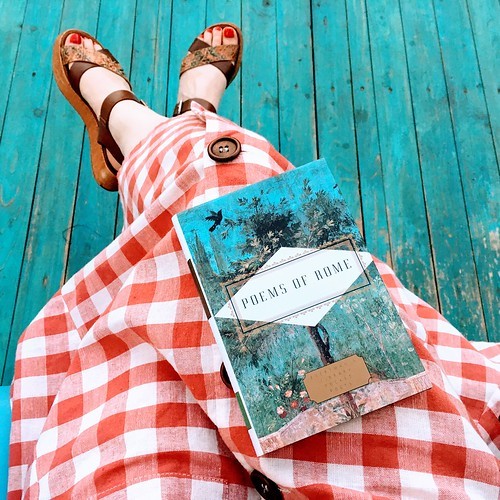

September 22, 2023
It was a really lovely book to carry around on my trip to Rome. While perhaps not comprehensive, I loved the curation of site specific poetry!
Displaying 1 - 8 of 8 reviews