

What do you think?
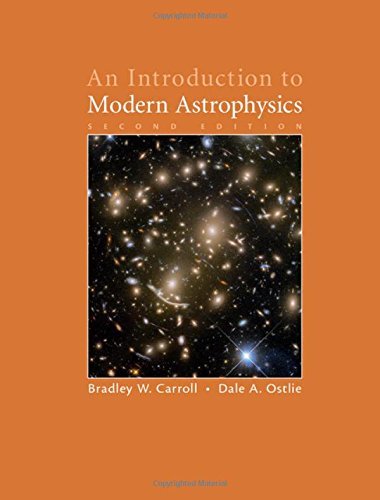
An Introduction to Modern Astrophysics
An Introduction to Modern Astrophysics is a comprehensive, well-organized and engaging text covering every major area of modern astrophysics, from the solar system and stellar astronomy to galactic and extragalactic astrophysics, and cosmology. Designed to provide students with a working knowledge of modern astrophysics, this textbook is suitable for astronomy and physics majors who have had a first-year introductory physics course with calculus. Featuring a brief summary of the main scientific discoveries that have led to our current understanding of the universe; worked examples to facilitate the understanding of the concepts presented in the book; end-of-chapter problems to practice the skills acquired; and computational exercises to numerically model astronomical systems, the second edition of An Introduction to Modern Astrophysics is the go-to textbook for learning the core astrophysics curriculum as well as the many advances in the field.
1359 pages, Hardcover
First published April 1, 2003
Ratings & Reviews
Friends & Following
Create a free account to discover what your friends think of this book!
Community Reviews
Displaying 1 - 30 of 33 reviews

July 17, 2012
For an introduction, Carroll & Ostlie's book is very fine. It's suitable for beginners, both in astrophysics and physics in general. The first few chapters deal entirely with topics that are (or at least are supposed to be) covered in any undergraduate program. Newtonian mechanics, Kepler's laws, blackbody radiation, special theory of relativity... And even later on, the authors do a good job of laying down the foundations (like the theory on waves and optics in chapter 6), which I applaud to. After all, the most important thing is to make the physics clear to the student.
However, as I'm already well acquainted with the aforementioned topics, I've only skimmed through that text. I have concentrated more on the chapters 6 and onwards. Although Carroll & Ostlie tackle a lot of subjects in the book, I still feel as if though the material isn't presented as clear as in some other textbooks (which I happen to hail because of the author's superior writing style). I know, perhaps it's unfair to nitpick at such a thing, given the fact that the authors have covered an absurd amount of topics... But that's the reason I'll give this book 4 stars.
However, as I'm already well acquainted with the aforementioned topics, I've only skimmed through that text. I have concentrated more on the chapters 6 and onwards. Although Carroll & Ostlie tackle a lot of subjects in the book, I still feel as if though the material isn't presented as clear as in some other textbooks (which I happen to hail because of the author's superior writing style). I know, perhaps it's unfair to nitpick at such a thing, given the fact that the authors have covered an absurd amount of topics... But that's the reason I'll give this book 4 stars.

March 23, 2016
This book is incredibly ambitious. It strives to teach you just about the entirety of Modern Astrophysics in one comprehensive text. Any further pursuits would simply be delving into more detail of one of the topics covered. Therefore, it's the ideal reference book for anyone interested in the subject.
After surveying what's currently available and what's being used by professors, it's widely agreed to be the proper text to prepare you for a graduate pursuit of the subject.
For those reasons, I picked it up because I wanted the best book to teach myself Astrophysics. With a decent background in physics, and mathematical competency in the Calc III/DE area, I was able to follow along very well, and completed the book in about 4 months (but skipped many of the problems).
As a whole the book is supreme in content, organization, clarity, and level of detail considering the range of information it covers. My only complaint throughout (and primarily because I was studying it on my own) is that there are no solutions provided or available to the general public. Nevertheless, the problems are challenging and fun to think about. As you go through them and the chapters, Carroll & Ostlie will bring you to the brink of what's known in the areas being described, will be clear about what's still being dealt with in the field, and will leave you wanting to look into each of the current unresolved issues at a deeper level.
After surveying what's currently available and what's being used by professors, it's widely agreed to be the proper text to prepare you for a graduate pursuit of the subject.
For those reasons, I picked it up because I wanted the best book to teach myself Astrophysics. With a decent background in physics, and mathematical competency in the Calc III/DE area, I was able to follow along very well, and completed the book in about 4 months (but skipped many of the problems).
As a whole the book is supreme in content, organization, clarity, and level of detail considering the range of information it covers. My only complaint throughout (and primarily because I was studying it on my own) is that there are no solutions provided or available to the general public. Nevertheless, the problems are challenging and fun to think about. As you go through them and the chapters, Carroll & Ostlie will bring you to the brink of what's known in the areas being described, will be clear about what's still being dealt with in the field, and will leave you wanting to look into each of the current unresolved issues at a deeper level.

May 11, 2015
This is a thick book, and I was skeptical when I began reading it that the book would hold up in an internet age. When you can look up the weight of the moon on wolfram|alpha, what use is a textbook of this form?
But the strength of Carroll's An Introduction to Modern Astrophysics isn't in the raw data. It's in the full and comprehensive analysis of such an incredibly broad scope of material. The book is not only a great reference. If you read it cover to cover, you'll learn the answers to questions you never knew you had. There's both the depth of expertise and the scope necessary to converse on any topic. I'd recommend this book for anyone who needs or wants to hold conversations with astrophysicists.
December 20, 2007
The standard, a/k/a "the big orange book". New 2nd edition (2007) -- I was told about 80% that what every professional astronomer knows (from meteoritics to cosmology) is included in this work (the other 20% is mostly what they specialize in). What other field or book can say that? Now, obviously, it became outdated somewhat even before it went to press (which is why no one writes astronomy books anymore), and it's expensive, but worth every penny (especially if you buy it in USD). NB: a minus for some (a huge relief for others) is that BOB uses SI units instead of cgs.

January 6, 2025
the orange book my beloved
August 23, 2014
Designed for advanced undergraduates/graduates, this is the reference textbook in many Astronomy/Astrophysics programs across the US where it is called BOB (Big Orange Book). It is also useful as a refresher or for scientists who are not entirely familiar with the subject but have a solid foundation in Physics and Mathematics. This is an almost encyclopedic work. It includes plenty of examples and problems.

April 14, 2020
One of the best references for undergraduates and all who have the basic physics background and interested to step forward in astrophysics as a favorite topic for research. It is also a reference in many countries for instructors. Kind of a complete introductory text book. Well written and can be the beginning to start an advance and very specific topic later with other specified references and papers.
June 26, 2020
Explicaciones muy claras, muy detallado para los que necesitamos muchas aclaraciones, y muchísimos datos. Gran libro, aunque no es una lectura ligera.

June 3, 2022
A detailed and introductory text, looking forward to reading. And 5 months later we finish ! yehaa !
Time to return to history !
Really good. Good on stars and binary stars. I struggled with the end bits - galaxies and the cosmos. Maths varied from manageable to obscure-ish, which probably reflects my Maths lack in the last 30 years.
Love the written style. Diagrams plentiful. BOB - it is indeed the Big Orange Book. Well worth the money.
Time to return to history !
Really good. Good on stars and binary stars. I struggled with the end bits - galaxies and the cosmos. Maths varied from manageable to obscure-ish, which probably reflects my Maths lack in the last 30 years.
Love the written style. Diagrams plentiful. BOB - it is indeed the Big Orange Book. Well worth the money.

September 15, 2007
It's not the best textbook on astronomy I've seen but it is very in depth on the mathematics side of astrophysics.

January 29, 2008
Clearly the best introduction to astrophysics at the upper-division undergraduate level.
October 7, 2017
I have had a unique experience with this book: I have taken the class from the author. I like how this book works. I like the math in it.
May 10, 2026
Incredible reference book, too bad the last edition is a few years old, I'd love to see a more updated reference form of the form of BOB, with a little bit more details about what we currently know, for example, a little but more depth in the ISM and planet formation (i.e protoplanetary disks) or even just pretty pictures, however, still of great use and incredibly useful!

April 26, 2022
The recommended text for a second year survey course in Astrophysics, this is a comprehensive book that works to give the student a strong foundation in as much of the field as it possibly can. It's not often you can say you enjoyed a textbook, but I did enjoy this one.

Read
June 20, 2023A good textbook to introductory modern astrophysics with some good problems and examples, though there were at times a lot of parts where the author shows an incomplete equation and says, "I'll leave it to the reader to solve as an exercise." I did not enjoy that.

March 15, 2019
a classic textbook about everything in astrophysics
January 25, 2020
This is one of the best astrophysics books for students .

May 8, 2023
An astrophysicist's favourite companion textbook!
August 13, 2023
Awesome job describing astrophysics in a general way; for the most part, it is self-contained. It’s a good book if you need to review a topic.

October 23, 2024
I'm reading this fucker front to back for my modern astro class (all 1600 pages) so this is absolutely counting towards my reading goal.
Jokes aside, this is objectively a great textbook.
Jokes aside, this is objectively a great textbook.

March 16, 2025
I luv carroll and ostlie

October 22, 2025
A literal introduction to astrophysics. It’s so thick and easy to understand, my lecturers still use this book as a reference for the final year subjects.

May 6, 2026
I have now finished this entire book throughout undergrad it is written well but it has caused much suffering and long nights

Read
July 1, 2026برای کسایی که به این موضوع علاقه دارن و نمیخوان یه کتاب نجوم بخونن که فقط قصه گفته باشه چیز خوبیه. ریاضیات خاصی نداره.
اگر چیز پیشرفتهتری مدنظر باشه، کتاب stellar physicsرو توصیه میکنم
اگر چیز پیشرفتهتری مدنظر باشه، کتاب stellar physicsرو توصیه میکنم

January 14, 2014
Fantastic textbook for an undergraduate course. Readable enough to really explain things. Comprehensive enough to be a useful resource for the rest of the students' careers. It also has good examples and end-of-chapter problems. One of the best texts available in this field.
November 12, 2007
Big as a telephone book! Get an ornate podium and display open like a good Bible or Koran

December 17, 2008
Astrophysics without color pictures? That sucks. Plus it's like 1300 pages.

July 24, 2009
Has the perfect amount of detail for studying astrophysics at uni, and then some. Really interesting!

June 15, 2010
Kinda read it.

May 6, 2011
Pretty damn comprehensive, but kind of daunting. Very straightforward, which I appreciate.
Displaying 1 - 30 of 33 reviews