

What do you think?

It Ends with Us #1
ما تمامش میکنیم
Goodreads Choice Award
Winner for Readers' Favorite Romance (2016)وقتی لیلی با یک جراح مغز و اعصاب خوشتیپ به نام رایل کینکید وارد رابطه میشود، ناگهان زندگی برایش آنقدر زیبا میشود که باورکردنی نیست اما وقتی دغدغههای مربوط به رابطهی جدید، ذهن لیلی را به خود مشغول کرده است، خاطرات اتلس کاریگن، اولین عشقش و رشتهای که او را به گذشته پیوند میدهد، درگیرش میکند. اتلس در گذشته، با لیلی نقاط مشترک فراوانی داشته و از او محافظت کرده است؛ به همین علت، وقتی ناگهان پیدایش میشود، هر آنچه لیلی با رایل ساخته، مورد تهدید قرار میگیرد.
کالین هوور، با این رمان جسورانه و کاملا منحصر به فرد، داستانی را روایت میکند از عشقی فراموشناشدنی که ناچار باید بیشترین بها را برای آن پرداخت.
سارا پیکانن، نویسندهی رمان پرفروش بینالمللی «همسایگان بی عیب و نقص» دربارهی این رمان میگوید: «ما تمامش میکنیم» یک داستان عاشقانهی معمولی نیست. این کتاب قلبتان را میشکند و همزمان، آن را از امید لبریز میکند. تا انتهای داستان، در میان گریه خواهید خندید.
کامی گارسیا، نویسندهی پرفروش نیویورک تایمز معتقد است: «کالین هوور به مخاطبش یادآوری میکند که عشق، شکننده و آمیخته با شهامت، امید و اشک است. هر دلشکستهای باید این کتاب را بخواند.»
کالین هوور، با این رمان جسورانه و کاملا منحصر به فرد، داستانی را روایت میکند از عشقی فراموشناشدنی که ناچار باید بیشترین بها را برای آن پرداخت.
سارا پیکانن، نویسندهی رمان پرفروش بینالمللی «همسایگان بی عیب و نقص» دربارهی این رمان میگوید: «ما تمامش میکنیم» یک داستان عاشقانهی معمولی نیست. این کتاب قلبتان را میشکند و همزمان، آن را از امید لبریز میکند. تا انتهای داستان، در میان گریه خواهید خندید.
کامی گارسیا، نویسندهی پرفروش نیویورک تایمز معتقد است: «کالین هوور به مخاطبش یادآوری میکند که عشق، شکننده و آمیخته با شهامت، امید و اشک است. هر دلشکستهای باید این کتاب را بخواند.»
384 pages, Paperback
First published August 2, 2016
About the author
Colleen Hoover
134 books780k followersInternational and #1 New York Times bestselling author of romance, YA, thriller, women's fiction and paranormal romance.
I don't like to be confined to one genre. If you put me in a box, I'll claw my way out.
My social media username is @colleenhoover pretty much everywhere except my email, which is colleenhooverbooks@gmail.com
Founder of www.thebookwormbox.com charity and Book Bonanza.
I don't like to be confined to one genre. If you put me in a box, I'll claw my way out.
My social media username is @colleenhoover pretty much everywhere except my email, which is colleenhooverbooks@gmail.com
Founder of www.thebookwormbox.com charity and Book Bonanza.
Ratings & Reviews
Friends & Following
Create a free account to discover what your friends think of this book!
Community Reviews
Displaying 1 - 30 of 306,545 reviews

January 7, 2022
➥ 2 Stars *:・゚✧
tw: graphic domestic violence, graphic attempted rape, suicide, depression, alcohol abuse, depression
Update: One of my Goodreads friends brought this article to my attention: an article by domesticshelters.org that outlines the harmfulness of this book. Definitely worth the read.
I’ve rewritten this review three times now, and each time I’ve felt it necessary to lower my rating. I don’t intend for this to be a hot take. I’m not trying to be unique or quirky for disliking a popular book but every day I grow more and more concerned with the number of people who misinterpret and romanticize this book. There will be spoilers in this review.
I’d like to begin by acknowledging Colleen Hoover’s intent with this book and how I believe it is a serious problem.
Firstly, Colleen Hoover has expressed her disapproval and dislike for trigger warnings. She expressed that “as a fellow reader with my fair share of past experiences, I understand that there are issues some people do not want to read about. But as a writer, there are many things I don’t want revealed in the blurbs of my books.” This is extremely irresponsible and inconsiderate of an author. Furthermore, this book has been and is marketed as a love triangle and Colleen Hoover employs the fact that Ryle is an abusive fucker as a plot-twist. In the author’s note, she states that “In the past, I’ve always said I write for entertainment purposes only. I don’t write to educate, persuade or inform. This book is different.” Yet, she continues to format this more serious book, similarly.
Furthermore, although I understand that Colleen “wanted to write something realistic to the situation my mother was in – a situation a lot of women find themselves in”, I feel that Ryle was very different to her father. This coming explanation is just my presumption and random thought process. I could have greatly misinterpreted what Colleen went through and I do not mean to be disrespectful. I do not doubt that domestic abuse can be very different, but I believe the fact that Colleen’s father was an alcoholic has a huge impact on her final opinion of him. One could argue that her father needed help, and that although he is to blame, it did not come purely from malintent and manipulation. I am not saying that he is redeemable by any means, only that part of the violence can be due to an unintentional factor. Ryle still ends up having custody over the baby. This is infuriating to me. But we see that she wrote it this way because Colleen still had a relationship with her abusive father after her mother divorced him. Then we have the way that Colleen's father continues to (in my opinion) manipulate her by showing kind, good aspects of himself, like agreeing and encouraging Colleen’s stepfather to walk her down the isle rather than him. Just a thought or something to possibly consider.
And in this book, we see Ryle presented as, not a bad person, instead, only a "person who does bad things". Now, I've been thinking about this line. I wonder if it was Colleen’s intention to have Ryle say this line to purposefully show how he manipulates Lily into having this mindset or if Colleen really does think this way. Ryle is indeed a bad person, and abuser who is irredeemable. I understand and agree that it is at times, difficult to label someone as “bad” or “good” as it is more complicated than that. But there comes a point, that person is a bad person (for instance, when he tries to horrifically rape her and guilt-tripped Lily with his trauma). Colleen attempts to evoke confliction in the reader by writing in that Ryle donates to charity. Yet, this is not enough. One donation does not make you a good person, especially when compared to the severe harm that you’ve caused others. I cannot believe that after Ryle attempted to rape Lily, there are still Ryle apologists out there. That moment was absolutely mortifying.
Regardless, the general plotline of this book is supposed to be that Ryle starts off as being a kind, loveable man with whom Lily and the reader fall in love with. But, his abusive and manipulative tendencies are slowly revealed until it becomes clear that he is an abuser and that this is a case of domestic abuse. However, from the beginning of the book, Ryle is already portrayed as a concerningly violent and manipulative man. We are introduced to his character when Lily finds him kicking a chair out of anger, something unacceptable and very worrying. Later on, he begs and successfully coerces Lily into having sex with him, purely and solely because he wants to. Unfortunately, at this point in the story, many people still like, possibly even love, Ryle. This is not the "turning point" per se. I’ve also recently seen many people criticizing Colleen Hoover’s ability to write a healthy relationship and I’m beginning to agree. Although I remember enjoying Ugly Love, it was certainly unhealthy, specifically in the way that our female main character was treated. Then I began to read "November 9" and was utterly mortified by the way Ben, our love interest, acted. There are plenty of reviews with quotes etc. that show how horribly and scarily Ben treated Fallon from the beginning, before the plot twist. So, I conclude that Colleen’s failure to properly structure a base for the story to build upon was a main concern.
In regards to Ryle’s trauma, it is something that he weaponizes to manipulate and guilt-trip Lily. It does not excuse the abuse and I think it’s gravely concerning for people to blame the abuse on his trauma. Although it’s understandable to feel bad for what he had to go through, it is all used to manipulate and abuse Lily.
Then we have Atlas. When I first read this book, I was quite taken with how caring and sweet Lily and Atlas’ childhood romance seemed to be. But upon reflection, I’ve become more and more concerned by Atlas’ presence in this book at all. I’ve seen countless girls swooning over the “I know it wasn’t a pity fuck, Lily. I was there” line, yet Atlas had sex with Lily while she was a minor. I question why Colleen Hoover would choose to make it that way. It’s extremely unnecessary and the illegality of it could have been easily avoided had she chosen for them to be the same age. This again shows Colleen’s inability to write healthy relationships.
Furthermore, I found that the side romance in general greatly took away from the purpose of the book. The fact that Lily had to be saved by another man is truly a damaging thing to portray. Many women who experience domestic abuse do not have the option to leave just because there is a better man out there and it’s also damaging to make it seem that Lily is simply picking between Ryle or Atlas. Moreover, this expands my discontent with how Colleen chose to shove in aspects of her usual work to something so serious. A side love story was truly unnecessary for this, but I believe Colleen knew that if she wrote something without romance, it would not sell. Can I blame her for that? I’m not quite sure, but it certainly does not please me.
Deriving from what I’ve mentioned so far, particularly about Ryle, it bothers me how little conclusion Colleen offers at the end of the book. I have had to have conversation after conversation with people who misinterpreted the book, who still forgive Ryle and who think of “It Ends With Us” as a romance book. For a while, my challenge question (for friend requests) was “What is your favourite (dark) romance book and why?” And I cannot tell you the number of times people answered with “It Ends With Us”. Some people write in their reviews that even though Ryle was not Lily’s ultimate partner and just because it “did not work out”, they will still have love for Ryle in their heart and think that he just needs help. And unfortunately, I don’t think these people are to blame. With Colleen still allowing Ryle to have custody, it almost allows for a small redemption for his character. And I believe at the end of the book, Colleen should have written one page with the cycle of abuse and how it was shown throughout the novel, and a conclusion expressing that if you love Ryle, you should not, because everything that he did, he did it consciously and with purpose, through manipulation and guilt-tripping (weaponizing his trauma). I do appreciate however, that she included the domestic abuse hotlines.
I also think it is unacceptable for people to be recommending this book as just a “sad book” or a “book to make you cry”, because diminishing a book that explores such a difficult and serious topic like domestic abuse, to an object that simply serves the purpose of evoking emotions from you, is extremely disrespectful and shallow. Especially considering that this is such a personal book to Colleen Hoover.
Another thing that I found to be really damaging about this book is the audience. There is this #coquette aesthetic on tiktok that I am sure you are aware of. I really to like the look of it etc. But it is a theme among this aesthetic to read books like "It Ends With Us" and "Lolita". I believe both of these texts are greatly misinterpreted, especially considering that it is often young girls who are reading these books from the ages of 11-15. Ignoring Lolita as that is a different topic, I am nearly certain that these girls buy books like “It Ends With Us” purely for the cover. It's pink. And it fits the aesthetic.
I see people saying that they "love" “It Ends With Us” and I find it greatly concerning. What do you love about it? I see people ignoring Lily's plotline and just adoring Atlas and his whole "I know it wasn't a pity fuck, Lily. I was there." They've transformed this as something to romanticise. Not to mention that I also see girls giggle at what seems to be a little inside joke of theirs when they quote "where did you get the magnet lily" or "you fell down the stairs". I am really beginning to think that this book has done more harm than good.
The writing wasn’t something I had a problem with. When I see people criticize Colleen Hoover, it tends to be because they call her writing “wattpad writing” which is stupid, because people will say that any contemporary romance has “wattpad writing”. That’s not a great criticism, they should actually elaborate. Other than the quotes that I’ve disagreed with like “There’s no such thing as a bad person, only people who do bad things”, I found that Colleen Hoover’s writing flows well and that she has some iconic, well thought out quotes.
I wasn’t a huge fan of Lily writing her letters to Ellen and I didn’t really care at first, but in the Acknowledgement section of “It Ends With Us”, Colleen actually says thankyou to Ellen DeGeneres saying that she is “light when it comes to darkness”. Considering what an awful person everyone knows that Ellen is, I again struggle to understand why Colleen chose this specific detail when she could have chosen someone that was a much better person and influence. *I have been informed that because this book was written in 2016, Ellen was not known to be a bad person, although I still question Colleen's decision to make Lily write letters to a talk show host.
Veering off that topic and coming back to my problems with Ryle, is that I strongly despised how he cared for Lily when she was pregnant. I felt that Ryle cared more about the baby than Lily, and it continues to portray women as baby machines who are made to serve a purpose. The way he cared for her stomach and touched her stomach rather than her. It’s disgusting.
Something that also boiled my blood is the internal misogyny that I see Colleen weave into her books. Lily chooses to not decide whether to divorce Ryle or not until after she has the baby because she believes that her decision would be affected by her hormones. What the fuck?????? Was the fact that he tried to rape you and then he beat you not clear enough?
Furthermore, when Lily is trying to explain to Ryle that she wants to divorce him, she tells him something along the lines of “what if this baby girl came home to you and told you ‘daddy, this boy hits me but he apologized and said he wouldn’t do it again’, what if she came home with bruises”, and only then does that garner any sympathy from Ryle. This situation parallels the instances when men only feel remorse for things like sexual assault when they are told ‘what if it was your mother and sister’. It’s horrible and it made me deeply upset that I’ve seen reviews admiring how Ryle was “understanding” after Lily explained that to him.
I believe Lily was a strong character to a degree and I agreed with the way she responded to certain things (or I would have done the same), but there are times where I would have been gone, and Lily stayed (like when Ryle begged her for sex). Still, you can really tell she did have a certain level of logic and reason, and tried to confront Ryle.
Something that really bugged me was the character Devin and how Colleen Hoover writes him as the gay stereotype. He's overly touchy with Lily, touching her breasts and pulling down her bra without her consent. This is truly such a disgusting and rude way to portray characters of the lgbtq+ community, especially considering that Colleen Hoover rarely diversifies her books (very few poc + lgbtq characters). It mainly frustrates me because Colleen Hoover clearly has a huge income from the sales of her books, and that she cannot be bothered to get sensitivity readers or better editors for these things is so concerning.
Another thing that was kind of unnecessary was this line: “A 2-year-old girl will have the same name even when she’s 22, Lily Bloom. Names aren’t something we eventually grow out of.” I understand the meaning behind this sentence, suggesting that parents should put thought into their children's names, and that it should suit an adult as much as a child. But I also understand that this can be seen as quite inconsiderate towards transgender people, and just people who change their names in general, because that's obviously possible too. There are just so many things that could have been easily avoided, and for these things to not be noticed and fixed is quite lazy of the author.
Despite my problems with this book, I think the general idea that Colleen Hoover tried to present in this book was executed decently well at times, hence my two stars.
This is a very difficult read, especially if you relate to any of it at all so please do check trigger warnings and be careful because it can be very uncomfortable to see yourself in someone like Lily, or in her position. Much love to anyone who has been through anything like this, I hope you’re okay <3
"People spend so much time wondering why the women don't leave. Where are all the people who wonder why the men are even abusive? Isn't that where the only blame should be placed?"
━━━━━━━━━━━ ♡ ━━━━━━━━━━━
tw: graphic domestic violence, graphic attempted rape, suicide, depression, alcohol abuse, depression
Update: One of my Goodreads friends brought this article to my attention: an article by domesticshelters.org that outlines the harmfulness of this book. Definitely worth the read.
I’ve rewritten this review three times now, and each time I’ve felt it necessary to lower my rating. I don’t intend for this to be a hot take. I’m not trying to be unique or quirky for disliking a popular book but every day I grow more and more concerned with the number of people who misinterpret and romanticize this book. There will be spoilers in this review.
I’d like to begin by acknowledging Colleen Hoover’s intent with this book and how I believe it is a serious problem.
Firstly, Colleen Hoover has expressed her disapproval and dislike for trigger warnings. She expressed that “as a fellow reader with my fair share of past experiences, I understand that there are issues some people do not want to read about. But as a writer, there are many things I don’t want revealed in the blurbs of my books.” This is extremely irresponsible and inconsiderate of an author. Furthermore, this book has been and is marketed as a love triangle and Colleen Hoover employs the fact that Ryle is an abusive fucker as a plot-twist. In the author’s note, she states that “In the past, I’ve always said I write for entertainment purposes only. I don’t write to educate, persuade or inform. This book is different.” Yet, she continues to format this more serious book, similarly.
Furthermore, although I understand that Colleen “wanted to write something realistic to the situation my mother was in – a situation a lot of women find themselves in”, I feel that Ryle was very different to her father. This coming explanation is just my presumption and random thought process. I could have greatly misinterpreted what Colleen went through and I do not mean to be disrespectful. I do not doubt that domestic abuse can be very different, but I believe the fact that Colleen’s father was an alcoholic has a huge impact on her final opinion of him. One could argue that her father needed help, and that although he is to blame, it did not come purely from malintent and manipulation. I am not saying that he is redeemable by any means, only that part of the violence can be due to an unintentional factor. Ryle still ends up having custody over the baby. This is infuriating to me. But we see that she wrote it this way because Colleen still had a relationship with her abusive father after her mother divorced him. Then we have the way that Colleen's father continues to (in my opinion) manipulate her by showing kind, good aspects of himself, like agreeing and encouraging Colleen’s stepfather to walk her down the isle rather than him. Just a thought or something to possibly consider.
And in this book, we see Ryle presented as, not a bad person, instead, only a "person who does bad things". Now, I've been thinking about this line. I wonder if it was Colleen’s intention to have Ryle say this line to purposefully show how he manipulates Lily into having this mindset or if Colleen really does think this way. Ryle is indeed a bad person, and abuser who is irredeemable. I understand and agree that it is at times, difficult to label someone as “bad” or “good” as it is more complicated than that. But there comes a point, that person is a bad person (for instance, when he tries to horrifically rape her and guilt-tripped Lily with his trauma). Colleen attempts to evoke confliction in the reader by writing in that Ryle donates to charity. Yet, this is not enough. One donation does not make you a good person, especially when compared to the severe harm that you’ve caused others. I cannot believe that after Ryle attempted to rape Lily, there are still Ryle apologists out there. That moment was absolutely mortifying.
Regardless, the general plotline of this book is supposed to be that Ryle starts off as being a kind, loveable man with whom Lily and the reader fall in love with. But, his abusive and manipulative tendencies are slowly revealed until it becomes clear that he is an abuser and that this is a case of domestic abuse. However, from the beginning of the book, Ryle is already portrayed as a concerningly violent and manipulative man. We are introduced to his character when Lily finds him kicking a chair out of anger, something unacceptable and very worrying. Later on, he begs and successfully coerces Lily into having sex with him, purely and solely because he wants to. Unfortunately, at this point in the story, many people still like, possibly even love, Ryle. This is not the "turning point" per se. I’ve also recently seen many people criticizing Colleen Hoover’s ability to write a healthy relationship and I’m beginning to agree. Although I remember enjoying Ugly Love, it was certainly unhealthy, specifically in the way that our female main character was treated. Then I began to read "November 9" and was utterly mortified by the way Ben, our love interest, acted. There are plenty of reviews with quotes etc. that show how horribly and scarily Ben treated Fallon from the beginning, before the plot twist. So, I conclude that Colleen’s failure to properly structure a base for the story to build upon was a main concern.
In regards to Ryle’s trauma, it is something that he weaponizes to manipulate and guilt-trip Lily. It does not excuse the abuse and I think it’s gravely concerning for people to blame the abuse on his trauma. Although it’s understandable to feel bad for what he had to go through, it is all used to manipulate and abuse Lily.
Then we have Atlas. When I first read this book, I was quite taken with how caring and sweet Lily and Atlas’ childhood romance seemed to be. But upon reflection, I’ve become more and more concerned by Atlas’ presence in this book at all. I’ve seen countless girls swooning over the “I know it wasn’t a pity fuck, Lily. I was there” line, yet Atlas had sex with Lily while she was a minor. I question why Colleen Hoover would choose to make it that way. It’s extremely unnecessary and the illegality of it could have been easily avoided had she chosen for them to be the same age. This again shows Colleen’s inability to write healthy relationships.
Furthermore, I found that the side romance in general greatly took away from the purpose of the book. The fact that Lily had to be saved by another man is truly a damaging thing to portray. Many women who experience domestic abuse do not have the option to leave just because there is a better man out there and it’s also damaging to make it seem that Lily is simply picking between Ryle or Atlas. Moreover, this expands my discontent with how Colleen chose to shove in aspects of her usual work to something so serious. A side love story was truly unnecessary for this, but I believe Colleen knew that if she wrote something without romance, it would not sell. Can I blame her for that? I’m not quite sure, but it certainly does not please me.
Deriving from what I’ve mentioned so far, particularly about Ryle, it bothers me how little conclusion Colleen offers at the end of the book. I have had to have conversation after conversation with people who misinterpreted the book, who still forgive Ryle and who think of “It Ends With Us” as a romance book. For a while, my challenge question (for friend requests) was “What is your favourite (dark) romance book and why?” And I cannot tell you the number of times people answered with “It Ends With Us”. Some people write in their reviews that even though Ryle was not Lily’s ultimate partner and just because it “did not work out”, they will still have love for Ryle in their heart and think that he just needs help. And unfortunately, I don’t think these people are to blame. With Colleen still allowing Ryle to have custody, it almost allows for a small redemption for his character. And I believe at the end of the book, Colleen should have written one page with the cycle of abuse and how it was shown throughout the novel, and a conclusion expressing that if you love Ryle, you should not, because everything that he did, he did it consciously and with purpose, through manipulation and guilt-tripping (weaponizing his trauma). I do appreciate however, that she included the domestic abuse hotlines.
I also think it is unacceptable for people to be recommending this book as just a “sad book” or a “book to make you cry”, because diminishing a book that explores such a difficult and serious topic like domestic abuse, to an object that simply serves the purpose of evoking emotions from you, is extremely disrespectful and shallow. Especially considering that this is such a personal book to Colleen Hoover.
Another thing that I found to be really damaging about this book is the audience. There is this #coquette aesthetic on tiktok that I am sure you are aware of. I really to like the look of it etc. But it is a theme among this aesthetic to read books like "It Ends With Us" and "Lolita". I believe both of these texts are greatly misinterpreted, especially considering that it is often young girls who are reading these books from the ages of 11-15. Ignoring Lolita as that is a different topic, I am nearly certain that these girls buy books like “It Ends With Us” purely for the cover. It's pink. And it fits the aesthetic.
I see people saying that they "love" “It Ends With Us” and I find it greatly concerning. What do you love about it? I see people ignoring Lily's plotline and just adoring Atlas and his whole "I know it wasn't a pity fuck, Lily. I was there." They've transformed this as something to romanticise. Not to mention that I also see girls giggle at what seems to be a little inside joke of theirs when they quote "where did you get the magnet lily" or "you fell down the stairs". I am really beginning to think that this book has done more harm than good.
The writing wasn’t something I had a problem with. When I see people criticize Colleen Hoover, it tends to be because they call her writing “wattpad writing” which is stupid, because people will say that any contemporary romance has “wattpad writing”. That’s not a great criticism, they should actually elaborate. Other than the quotes that I’ve disagreed with like “There’s no such thing as a bad person, only people who do bad things”, I found that Colleen Hoover’s writing flows well and that she has some iconic, well thought out quotes.
I wasn’t a huge fan of Lily writing her letters to Ellen and I didn’t really care at first, but in the Acknowledgement section of “It Ends With Us”, Colleen actually says thankyou to Ellen DeGeneres saying that she is “light when it comes to darkness”. Considering what an awful person everyone knows that Ellen is, I again struggle to understand why Colleen chose this specific detail when she could have chosen someone that was a much better person and influence. *I have been informed that because this book was written in 2016, Ellen was not known to be a bad person, although I still question Colleen's decision to make Lily write letters to a talk show host.
Veering off that topic and coming back to my problems with Ryle, is that I strongly despised how he cared for Lily when she was pregnant. I felt that Ryle cared more about the baby than Lily, and it continues to portray women as baby machines who are made to serve a purpose. The way he cared for her stomach and touched her stomach rather than her. It’s disgusting.
Something that also boiled my blood is the internal misogyny that I see Colleen weave into her books. Lily chooses to not decide whether to divorce Ryle or not until after she has the baby because she believes that her decision would be affected by her hormones. What the fuck?????? Was the fact that he tried to rape you and then he beat you not clear enough?
Furthermore, when Lily is trying to explain to Ryle that she wants to divorce him, she tells him something along the lines of “what if this baby girl came home to you and told you ‘daddy, this boy hits me but he apologized and said he wouldn’t do it again’, what if she came home with bruises”, and only then does that garner any sympathy from Ryle. This situation parallels the instances when men only feel remorse for things like sexual assault when they are told ‘what if it was your mother and sister’. It’s horrible and it made me deeply upset that I’ve seen reviews admiring how Ryle was “understanding” after Lily explained that to him.
I believe Lily was a strong character to a degree and I agreed with the way she responded to certain things (or I would have done the same), but there are times where I would have been gone, and Lily stayed (like when Ryle begged her for sex). Still, you can really tell she did have a certain level of logic and reason, and tried to confront Ryle.
Something that really bugged me was the character Devin and how Colleen Hoover writes him as the gay stereotype. He's overly touchy with Lily, touching her breasts and pulling down her bra without her consent. This is truly such a disgusting and rude way to portray characters of the lgbtq+ community, especially considering that Colleen Hoover rarely diversifies her books (very few poc + lgbtq characters). It mainly frustrates me because Colleen Hoover clearly has a huge income from the sales of her books, and that she cannot be bothered to get sensitivity readers or better editors for these things is so concerning.
Another thing that was kind of unnecessary was this line: “A 2-year-old girl will have the same name even when she’s 22, Lily Bloom. Names aren’t something we eventually grow out of.” I understand the meaning behind this sentence, suggesting that parents should put thought into their children's names, and that it should suit an adult as much as a child. But I also understand that this can be seen as quite inconsiderate towards transgender people, and just people who change their names in general, because that's obviously possible too. There are just so many things that could have been easily avoided, and for these things to not be noticed and fixed is quite lazy of the author.
Despite my problems with this book, I think the general idea that Colleen Hoover tried to present in this book was executed decently well at times, hence my two stars.
This is a very difficult read, especially if you relate to any of it at all so please do check trigger warnings and be careful because it can be very uncomfortable to see yourself in someone like Lily, or in her position. Much love to anyone who has been through anything like this, I hope you’re okay <3
━━━━━━━━━━━ ♡ ━━━━━━━━━━━

January 13, 2015
::: SPOILER-FREE REVIEW :::

HOLY WOW! It Ends With Us is one of the most powerful books of 2016 and one of the most raw, honest, inspiring, and profoundly beautiful stories I've ever read. It wasn’t anything like what I expected, but it delivered so much more than I ever hoped for. This is the kind of book that I want to give to every woman and just be like… READ THIS BOOK. NOW. Come to think of it, all the men should read it too. EVERYONE should read this book. Absolutely everyone. It's a story of unshakable love and finding the strength to make the right choice in the hardest situation. I honestly don't think I've ever been prouder of a heroine. I've loved Colleen Hoover's books for a long time because she always writes unique stories... and this one left a lasting mark on my heart. It is a MUST-READ!!
This is a completely spoiler-free review . I'm not even going to add the blurb or tell you what this book is about. It's a Colleen Hoover book. That should be enough to tell you it's amazing. But I really feel that you should just dive into this book without knowing anything about the plot. To be honest, I'm the usually the kind of reader who likes to know every little thing about what to expect in advance, but I've really learned to trust Colleen's writing and her storytelling so even I went into this book without knowing anything at all... and I was blown away by the story!
This book is unputdownable. You'll notice as you read that there are no good stopping points. None at all. I began reading it late at night and every time I tried to put it down to go to sleep, I just had to get back up and keep reading because I couldn't stop thinking about it. I didn't finish until almost 5AM but my gosh was it ever worth it!
Of all the heroines I've ever read, Lily was most certainly one of the ones I admired the most. I knew loved her from the first few pages, but having finished the book, I truly couldn't be prouder of her. Her strength and conviction over the course of this story made her into a heroine I'd want every girl and woman to read about and look up to. She was so real and vulnerable as we all are, but the strength with which she took control of her life was admirable on such a deep level. I just wanted to hug her and cheer. I don't think I've been this proud of a fictional character before.
There's an incredibly powerful message in this book that is very subtly woven in from the start. It begins in the first chapter, but you don't yet realize how significant each of these moments truly are... and as you read more, these pieces of the story come together forming a scenario that gives such a raw, honest portrayal of an incredibly relevant issue. I'm not mentioning it on purpose because I don't want you to expect it. The fact that it's unexpected for you as the reader is very important because it's also unexpected for the heroine. As she begins to realize what kind of situation she's in, so do you. And this realization very much allows you to experience her journey with her.
The only thing I want to address head on is the question of the 'love triangle' because a few of you have read the blurb and have asked about it. All I want to say is to please try and move away from that thought. I don't want to spoil the plot at all, but that is so not what this book is about. That is not the point, or the focus. Whatever it is you're thinking this book is, just trust me -- it's so much bigger than that. Seriously, trust Colleen. I did.
As a romance reader, I found this book incredibly refreshing. As much as I adore the romance genre (and I really do), it sometimes can get a little repetative. As both an avid reader and a blogger, I'm always looking for books that step outside the lines a little; ones that do something different or take the issues a little deeper. This book represented exactly what I wish I could be reading all the time -- not this literal story, but just the fact that it went in such a different direction and gave me such an unexpected story that left me with such a strong message.
One of the things that intrigued me the most and had me wondering when I heard about this book was what the title really meant -- and there's this very specific moment when the title is echoed in the story that just had such a strong impact as I read it. That was my cheer moment. I just sat back and went 'woah!'. The title is truly perfect.
In order to write this review, I went back over the book a second time and one thing I noticed strongly was how many intricate layers there were to the story that I couldn't possibly have known about in my first read. I loved that this is one of those books you experience differently (in a good way) both the first and second time though.
I have to say that this book would make a seriously amazing movie. I could picture every scene so clearly as I read. This is also such an incredibly relevant story for many people -- whether they've personally been through what happened to Lily or they know of someone who has -- so I really do hope that one day this makes it to the big screen.
My copy of this book is literally filled with highlighted quotes in every single chapter but I made a conscious decision not to add any to this review because I really truly do not want to give anything away about the story. Just trust me and jump into this story blind. I promise that it is a reading experience you don't want to miss.
This began as one of my most highly anticipated books of 2016 and it is now of my top favorite books of the year. I was unable to put it down from the moment I started reading and I know that this is one of those profoundly beautiful and unforgettable stories that will stay with me for a long time. I highly recommend it to everyone !
Rating: 5+ STARS! Standalone.
Pre-order IT ENDS WITH US (Kindle)
Pre-order IT ENDS WITH US (Paperback)
Note: If you pre-order a copy, it'll automatically be delivered to your Kindle on release day so that you don't forget!
__________________________
For more of my reviews, book news and updates:
✦ Main blog: Aestas Book Blog
✦ Facebook Blog Page
✦ Twitter
✦ Subscribe by email

Fifteen seconds. That’s all it takes to completely change everything about a person. Fifteen seconds that we’ll never get back.
HOLY WOW! It Ends With Us is one of the most powerful books of 2016 and one of the most raw, honest, inspiring, and profoundly beautiful stories I've ever read. It wasn’t anything like what I expected, but it delivered so much more than I ever hoped for. This is the kind of book that I want to give to every woman and just be like… READ THIS BOOK. NOW. Come to think of it, all the men should read it too. EVERYONE should read this book. Absolutely everyone. It's a story of unshakable love and finding the strength to make the right choice in the hardest situation. I honestly don't think I've ever been prouder of a heroine. I've loved Colleen Hoover's books for a long time because she always writes unique stories... and this one left a lasting mark on my heart. It is a MUST-READ!!
This is a completely spoiler-free review . I'm not even going to add the blurb or tell you what this book is about. It's a Colleen Hoover book. That should be enough to tell you it's amazing. But I really feel that you should just dive into this book without knowing anything about the plot. To be honest, I'm the usually the kind of reader who likes to know every little thing about what to expect in advance, but I've really learned to trust Colleen's writing and her storytelling so even I went into this book without knowing anything at all... and I was blown away by the story!
This book is unputdownable. You'll notice as you read that there are no good stopping points. None at all. I began reading it late at night and every time I tried to put it down to go to sleep, I just had to get back up and keep reading because I couldn't stop thinking about it. I didn't finish until almost 5AM but my gosh was it ever worth it!
Of all the heroines I've ever read, Lily was most certainly one of the ones I admired the most. I knew loved her from the first few pages, but having finished the book, I truly couldn't be prouder of her. Her strength and conviction over the course of this story made her into a heroine I'd want every girl and woman to read about and look up to. She was so real and vulnerable as we all are, but the strength with which she took control of her life was admirable on such a deep level. I just wanted to hug her and cheer. I don't think I've been this proud of a fictional character before.
There's an incredibly powerful message in this book that is very subtly woven in from the start. It begins in the first chapter, but you don't yet realize how significant each of these moments truly are... and as you read more, these pieces of the story come together forming a scenario that gives such a raw, honest portrayal of an incredibly relevant issue. I'm not mentioning it on purpose because I don't want you to expect it. The fact that it's unexpected for you as the reader is very important because it's also unexpected for the heroine. As she begins to realize what kind of situation she's in, so do you. And this realization very much allows you to experience her journey with her.
The only thing I want to address head on is the question of the 'love triangle' because a few of you have read the blurb and have asked about it. All I want to say is to please try and move away from that thought. I don't want to spoil the plot at all, but that is so not what this book is about. That is not the point, or the focus. Whatever it is you're thinking this book is, just trust me -- it's so much bigger than that. Seriously, trust Colleen. I did.
As a romance reader, I found this book incredibly refreshing. As much as I adore the romance genre (and I really do), it sometimes can get a little repetative. As both an avid reader and a blogger, I'm always looking for books that step outside the lines a little; ones that do something different or take the issues a little deeper. This book represented exactly what I wish I could be reading all the time -- not this literal story, but just the fact that it went in such a different direction and gave me such an unexpected story that left me with such a strong message.
One of the things that intrigued me the most and had me wondering when I heard about this book was what the title really meant -- and there's this very specific moment when the title is echoed in the story that just had such a strong impact as I read it. That was my cheer moment. I just sat back and went 'woah!'. The title is truly perfect.
In order to write this review, I went back over the book a second time and one thing I noticed strongly was how many intricate layers there were to the story that I couldn't possibly have known about in my first read. I loved that this is one of those books you experience differently (in a good way) both the first and second time though.
I have to say that this book would make a seriously amazing movie. I could picture every scene so clearly as I read. This is also such an incredibly relevant story for many people -- whether they've personally been through what happened to Lily or they know of someone who has -- so I really do hope that one day this makes it to the big screen.
My copy of this book is literally filled with highlighted quotes in every single chapter but I made a conscious decision not to add any to this review because I really truly do not want to give anything away about the story. Just trust me and jump into this story blind. I promise that it is a reading experience you don't want to miss.
This began as one of my most highly anticipated books of 2016 and it is now of my top favorite books of the year. I was unable to put it down from the moment I started reading and I know that this is one of those profoundly beautiful and unforgettable stories that will stay with me for a long time. I highly recommend it to everyone !
That’s what fifteen minutes can do to a person. It can destroy them.
It can save them.
Rating: 5+ STARS! Standalone.
Pre-order IT ENDS WITH US (Kindle)
Pre-order IT ENDS WITH US (Paperback)
Note: If you pre-order a copy, it'll automatically be delivered to your Kindle on release day so that you don't forget!
__________________________
For more of my reviews, book news and updates:
✦ Main blog: Aestas Book Blog
✦ Facebook Blog Page
✦ Subscribe by email

August 15, 2016
Find all of my reviews at: http://52bookminimum.blogspot.com/
“What a great time to have a dissenting opinion about a book written by an author with a particularly rabid fanbase!” said no one ever. In case we haven’t met and you’re seeing this review due to the new IN YO’ FACE! Goodreads format which shares reviews/updates to your feed errrrrrrrry single time one of your friends likes or comments on them, allow me to introduce myself. My name is Kelly . . . .

Also, I spoil things, so back away quickly if you don’t want this one to be ruined for you.
My glaring 1 Star in a sea of 5s probably makes it pretty clear that I detested this book, but please refrain from fetching your torches and pitchforks for a moment and take note that not only did I just 5 Star a CoHo Story two weeks ago (as well as shoved it down everyone’s throats I possibly could), but also I want to make all of the sexuals with Miles Archer and will fight anyone for dibs on his imaginary lurv making. I didn’t pick this up in order to hate on it. I’m one of you . . . . sometimes. Definitely not this time, but lots of times. And this is why I don’t ever give up on Hoover novels. I never know how I’m going to react.
Allow me to explain what went wrong for me with this one . . .

Let’s start with the obvious annoyances that seem to be in nearly every NA book that drive me batshit before getting to the real nitty gritty. First, the character names. Ryle, Lily Bloom and Atlas???????

Is it against the law to not use absolutely ridiculous (™Ron2.0) names in these books????
Second . . . .
“Your lips. I love how they’re as red as your hair.”
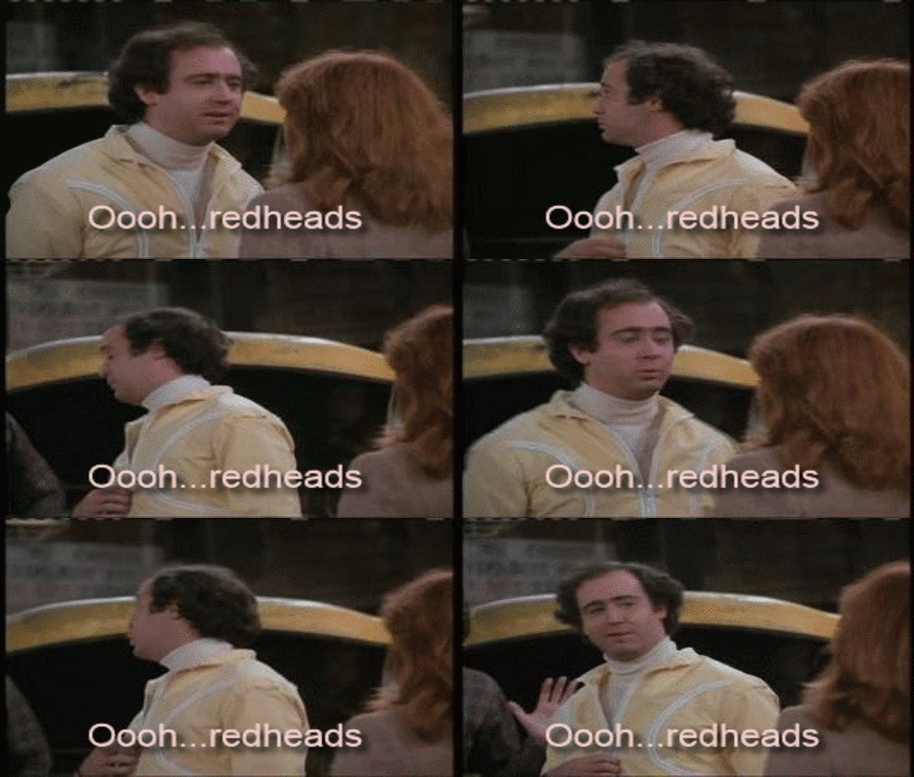
According to Google (all hail Google) less than 2% of the world’s population has red hair, and yet 99.998% of all NA leading ladies do. Just stahp.
Third, non-existent chemistry. In this story Lily and Ryle meet by chance on a rooftop after experiencing respective miserable days. In a matter of minutes Lily goes from worrying the stranger on the roof could be a psycho killer/rapist to getting into his super sexy (NOT) pick-up lines . . .
“If you wouldn’t sleep with someone you just met . . .” His eyes meet mine again. “Exactly how far would you go?”
Ewww. She already said thanks but no thanks freakshow so STFU.
Now let’s move on to the real big issue. I took a gander at my friends’ reviews before I started typing this and noticed my buddy Chelsea was the only other naysayer in the batch. She summed it up perfectly when she talked about the massive amounts of emotional manipulation that was forced down the readers’ throats in order to make them feel all the things.
It’s a running joke with my friends/family/co-workers that I have a robot heart. And for the majority of the time it’s true. I generally experience two emotions – happiness and annoyance. But even a robot like me can be manipulated into having a feeling/crying the ugly tears like a Kardashian once in a blue moon (*cough Me Before You cough*). This time, though? It was like a flashing neon sign . . . .

To begin with, our first leading male Atlas is a homeless teenager who Lily befriends/eventually loses her virginity. In case you don’t get the writing on the wall, Atlas is being set up as the most perfect perfection that ever perfected. He’s also the way to getting the “raised in an abusive household” plotline uncovered. Like in all NA stories, Atlas and Lily are torn apart. Lily moves on with her life, graduates college, yada yada, and, as mentioned above, meet-cutessuper creeper Mr. Right 2.0 on the roof. Mr. Right 2.0 is not only another most perfect perfection that ever perfected, but he’s also rich and a neurosurgeon and very obviously husband material even though he’s never had a girlfriend (also after dating only six months), annnnnnnnd due to their mutually busy schedules not really knowing the guy.
It wasn’t too hard to see where the story was going to go (and no, I hadn’t been spoiled because I didn’t read any reviews or the synopsis, I just auto-request everything by Hoover from both NetGalley and the library). Basically this was a story about domestic abuse and making excuses not only the first time he knocks your ass down “on accident” but also the second time when you wake up after “falling” down the stairs and hearing his sob story about a superbadawful that effed him up as a kid and then agreeing on a policy where “When you’re upset, just walk away. And I’ll walk away” (because THAT’S going to fucking work) and then saying “It’s okay, Ryle. It’s okay. You were angry, it’s okay” and making sure even when you’re bleeding profusely out of your fucking skull and are concussed and have quite possibly just been raped by your own damn husband that you get taken to an emergency room in a hospital other than the one where your bastard abuser works in order to protect his ass as well as explaining “sometimes the reason women go back is simply because they’re in love” and in case all that wasn’t e-fucking-nough you add in a whoopsie baby (another NA per usual) to serve as the wake-up call that maybe it’d be a good idea to ditch this zero and eventually find you a hero, buuuuuuuuuuuut you just come to an agreement regarding visitation and whathaveyou rather than involving the court and much needed supervised interaction because you know he wouldn’t hurt the baby since it’s obvious he loves her . . . .

Nope.
I’m well aware I’m going against the grain here. I give zero fucks. Don’t bother trolling me to tell me how stupid I am (especially if you’re a teenager who has lived a privileged lifestyle and never experienced anything contained in this book for yourself). I went to the wholesale club yesterday and stocked up on big ol’ batch of . . . .

I will be using it freely.
Many thanks to the library for having nearly every book I ever want to read – especially books like these that are only approved to fangirling 5 Star reviewers prior to publication.
“What a great time to have a dissenting opinion about a book written by an author with a particularly rabid fanbase!” said no one ever. In case we haven’t met and you’re seeing this review due to the new IN YO’ FACE! Goodreads format which shares reviews/updates to your feed errrrrrrrry single time one of your friends likes or comments on them, allow me to introduce myself. My name is Kelly . . . .
Also, I spoil things, so back away quickly if you don’t want this one to be ruined for you.
My glaring 1 Star in a sea of 5s probably makes it pretty clear that I detested this book, but please refrain from fetching your torches and pitchforks for a moment and take note that not only did I just 5 Star a CoHo Story two weeks ago (as well as shoved it down everyone’s throats I possibly could), but also I want to make all of the sexuals with Miles Archer and will fight anyone for dibs on his imaginary lurv making. I didn’t pick this up in order to hate on it. I’m one of you . . . . sometimes. Definitely not this time, but lots of times. And this is why I don’t ever give up on Hoover novels. I never know how I’m going to react.
Allow me to explain what went wrong for me with this one . . .
Let’s start with the obvious annoyances that seem to be in nearly every NA book that drive me batshit before getting to the real nitty gritty. First, the character names. Ryle, Lily Bloom and Atlas???????
Is it against the law to not use absolutely ridiculous (™Ron2.0) names in these books????
Second . . . .
“Your lips. I love how they’re as red as your hair.”
According to Google (all hail Google) less than 2% of the world’s population has red hair, and yet 99.998% of all NA leading ladies do. Just stahp.
Third, non-existent chemistry. In this story Lily and Ryle meet by chance on a rooftop after experiencing respective miserable days. In a matter of minutes Lily goes from worrying the stranger on the roof could be a psycho killer/rapist to getting into his super sexy (NOT) pick-up lines . . .
“If you wouldn’t sleep with someone you just met . . .” His eyes meet mine again. “Exactly how far would you go?”
Ewww. She already said thanks but no thanks freakshow so STFU.
Now let’s move on to the real big issue. I took a gander at my friends’ reviews before I started typing this and noticed my buddy Chelsea was the only other naysayer in the batch. She summed it up perfectly when she talked about the massive amounts of emotional manipulation that was forced down the readers’ throats in order to make them feel all the things.
It’s a running joke with my friends/family/co-workers that I have a robot heart. And for the majority of the time it’s true. I generally experience two emotions – happiness and annoyance. But even a robot like me can be manipulated into having a feeling/crying the ugly tears like a Kardashian once in a blue moon (*cough Me Before You cough*). This time, though? It was like a flashing neon sign . . . .
To begin with, our first leading male Atlas is a homeless teenager who Lily befriends/eventually loses her virginity. In case you don’t get the writing on the wall, Atlas is being set up as the most perfect perfection that ever perfected. He’s also the way to getting the “raised in an abusive household” plotline uncovered. Like in all NA stories, Atlas and Lily are torn apart. Lily moves on with her life, graduates college, yada yada, and, as mentioned above, meet-cutes
It wasn’t too hard to see where the story was going to go (and no, I hadn’t been spoiled because I didn’t read any reviews or the synopsis, I just auto-request everything by Hoover from both NetGalley and the library). Basically this was a story about domestic abuse and making excuses not only the first time he knocks your ass down “on accident” but also the second time when you wake up after “falling” down the stairs and hearing his sob story about a superbadawful that effed him up as a kid and then agreeing on a policy where “When you’re upset, just walk away. And I’ll walk away” (because THAT’S going to fucking work) and then saying “It’s okay, Ryle. It’s okay. You were angry, it’s okay” and making sure even when you’re bleeding profusely out of your fucking skull and are concussed and have quite possibly just been raped by your own damn husband that you get taken to an emergency room in a hospital other than the one where your bastard abuser works in order to protect his ass as well as explaining “sometimes the reason women go back is simply because they’re in love” and in case all that wasn’t e-fucking-nough you add in a whoopsie baby (another NA per usual) to serve as the wake-up call that maybe it’d be a good idea to ditch this zero and eventually find you a hero, buuuuuuuuuuuut you just come to an agreement regarding visitation and whathaveyou rather than involving the court and much needed supervised interaction because you know he wouldn’t hurt the baby since it’s obvious he loves her . . . .
Nope.
I’m well aware I’m going against the grain here. I give zero fucks. Don’t bother trolling me to tell me how stupid I am (especially if you’re a teenager who has lived a privileged lifestyle and never experienced anything contained in this book for yourself). I went to the wholesale club yesterday and stocked up on big ol’ batch of . . . .
I will be using it freely.
Many thanks to the library for having nearly every book I ever want to read – especially books like these that are only approved to fangirling 5 Star reviewers prior to publication.

January 29, 2022
”I want you so, so bad, and I swear, once you have sex with me, you'll never hear from me again. I promise."
I'm convinced anyone who gives this five stars is not sane. It contains the typical ~I don't do marriage~ love interest, but somehow, he magically wants a committed relationship and kids with our lucky lady after a few interactions. We love being the only exception. It ends with us contains a lot of dark elements such as abuse, toxic relationships, and attempted rape with no trigger warnings. I guess Colleen Hoover thinks that trigger warnings are spoilers. I understand this novel is based on the author's experience, but that doesn't mean it's good, nor am I obligated to like it. There's absolutely no justification for abuse, and why Lily continues to stay is beyond my comprehension. Her first meeting with the love interest, Ryle, has him being aggressive and kicking chairs on the rooftop at night. While any normal woman would instinctively feel fear and leave, she's too distracted by how hot he is and how his biceps are rippling through his extra-small shirt. Like, girl, get a grip. Throwing away your morals just because someone is hot has got to be the stupidest thing ever.
The author added numerous poor book decisions; I'll list some of them here:
1) The main character’s full name is Lily Blossom Bloom, and she runs a florist shop. Do I even need to say more? She’s the reigning champion of cringey book character names.
2) Lily is obsessed with Ellen Degeneres to the point where Ellen becomes the 4th main character of the story. She writes to Ellen in her diary, which is a way for Hoover to dump Lily's background story on us.
3) Ryle knocked on 29 apartment doors simply to find Lily and proceeded to beg on his knees for her to fuck him. That is so embarrasing, especially since he's only met Lily two times at this point.
4) Lily's bedroom light turned on at the exact perfect moment, just as Atlas was about to commit suicide. Wow, what a coincidence. He thought she was an angel beaming in the light. He said, and I quote, "I ~felt~ something." Apparently, that was enough to stop him from wanting to end his life. That's not exactly how mental health works, but okay. Portraying it this way risks downplaying the seriousness of mental health struggles and the ongoing effort required to heal from them.
5) Ryle secretly took a picture of Lily the first time they met, then immediately framed it and hung it on his wall. Was this supposed to be attractive?
6) The classic "I'll bring my gay best friend as my date to make Ryle jealous," only for the gay best friend to never to show up again. I smell a plot device. It's funny how, in a book full of rich, white characters, the one minor character is the stereotypical gay best friend who only exists for few pages.
7) The quote “There's no such thing as bad people, just people who do bad things." Saying this can be damaging because it suggests that harmful actions, like abuse, are just mistakes rather than deliberate choices. It can make it harder to hold people accountable for their actions. It might excuse or downplay serious harm they’ve caused, ultimately protecting those who need to take responsibility for their behavior.
8) Atlas slept with Lily when he was 18. Interestingly, they slept together on the exact day Lily turned 16, which is typically considered the age of consent. I don't understand why she couldn't make them the same age.
9) Lily's daughter is named Emerson, and I don’t understand why she would choose to name her daughter to honor Ryle, her abuser. It’s also confusing that Ryle even has custody of their child after everything that happened.
10) Lily is overly obsessed with Finding Nemo, constantly referencing the "just keep swimming" quote, even naming her daughter's middle name after it. Repeating it so often comes off more as a gimmick than a meaningful message.
11) Hoover has the most unhinged sentences: ”When he was wiping that cow shit on me, it was quite possibly the most turned-on I have ever been." This is even worse than when the main character in Verity got turned on because the love interest touched her driver's license.
12) Worldwide, millions are struggling to find a job, yet Lily hires a wealthy woman to work for free instead of hiring a broke college student. Allysa even says she doesn’t need the money and wants to do it because she’s bored. Ugh, classic rich people problems! What a coincidence—she's also Ryle’s sister! And, of course, Lily’s only friend. Why is Lily’s only friend her abuser's sister? When Allysa finds out that her brother is abusing Lily, her first reaction isn't to tell Lily to leave him or try to comfort her, but to tell her some sob story about his childhood trauma. It feels like an attempt to excuse his behavior rather than address the real issue.
13) Ryle didn’t want Lily to leave until she asked how he would react if their daughter told him her husband had hit her and pushed her down the stairs. That’s when he finally starts to understand the seriousness of his actions. It’s so frustrating how some men only learn to respect women when they imagine their daughters, mothers, or sisters in the same situation.
Despite the many cringe scenes in the book, I understand the valuable and worthwhile message the book tries to convey. It sheds light on how difficult it is to leave someone you love in toxic situations, which are often complex and hard to navigate. It’s so challenging that you make excuses or convince yourself that the truth isn’t what it is. That being said, I still don’t understand why Lily stayed with Ryle after the first incident of assault. I couldn’t see the emotional foundation of their relationship; it mainly seemed to be based on physical attraction, which was evident from their first meeting. Lily claimed she stayed because she loved him too much, but that never felt convincing, especially since the story only told me she loved him without showing me why.
What’s even more puzzling is how Hoover introduces so many heavy topics—homelessness, guilt, infertility, abuse, suicidal thoughts, sexism, gaslighting, gun violence, death of a parent, and self-harm—without diving deeply into them. It almost feels like they were thrown in to make the book more emotional without exploring the complexities of each issue. Some readers use the excuse “mental health is different for everyone” to justify Hoover’s confusing writing choices, but that doesn’t excuse the lack of depth in these themes. The portrayal of mental health could have been much more nuanced and thoughtful rather than simply using these issues to make the plot feel more dramatic.
Furthermore, I was not too fond of the plot and didn't connect with a single character. I don't understand why Ryle didn't get help, especially when he could do things similar to their daughter or another partner. That man better stay the hell away from me, or I will seal him up in a trash bag and hit him to the moon with a baseball bat. In conclusion, I will never touch another Colleen Hoover book.
I'm convinced anyone who gives this five stars is not sane. It contains the typical ~I don't do marriage~ love interest, but somehow, he magically wants a committed relationship and kids with our lucky lady after a few interactions. We love being the only exception. It ends with us contains a lot of dark elements such as abuse, toxic relationships, and attempted rape with no trigger warnings. I guess Colleen Hoover thinks that trigger warnings are spoilers. I understand this novel is based on the author's experience, but that doesn't mean it's good, nor am I obligated to like it. There's absolutely no justification for abuse, and why Lily continues to stay is beyond my comprehension. Her first meeting with the love interest, Ryle, has him being aggressive and kicking chairs on the rooftop at night. While any normal woman would instinctively feel fear and leave, she's too distracted by how hot he is and how his biceps are rippling through his extra-small shirt. Like, girl, get a grip. Throwing away your morals just because someone is hot has got to be the stupidest thing ever.
The author added numerous poor book decisions; I'll list some of them here:
1) The main character’s full name is Lily Blossom Bloom, and she runs a florist shop. Do I even need to say more? She’s the reigning champion of cringey book character names.
2) Lily is obsessed with Ellen Degeneres to the point where Ellen becomes the 4th main character of the story. She writes to Ellen in her diary, which is a way for Hoover to dump Lily's background story on us.
3) Ryle knocked on 29 apartment doors simply to find Lily and proceeded to beg on his knees for her to fuck him. That is so embarrasing, especially since he's only met Lily two times at this point.
4) Lily's bedroom light turned on at the exact perfect moment, just as Atlas was about to commit suicide. Wow, what a coincidence. He thought she was an angel beaming in the light. He said, and I quote, "I ~felt~ something." Apparently, that was enough to stop him from wanting to end his life. That's not exactly how mental health works, but okay. Portraying it this way risks downplaying the seriousness of mental health struggles and the ongoing effort required to heal from them.
5) Ryle secretly took a picture of Lily the first time they met, then immediately framed it and hung it on his wall. Was this supposed to be attractive?
6) The classic "I'll bring my gay best friend as my date to make Ryle jealous," only for the gay best friend to never to show up again. I smell a plot device. It's funny how, in a book full of rich, white characters, the one minor character is the stereotypical gay best friend who only exists for few pages.
7) The quote “There's no such thing as bad people, just people who do bad things." Saying this can be damaging because it suggests that harmful actions, like abuse, are just mistakes rather than deliberate choices. It can make it harder to hold people accountable for their actions. It might excuse or downplay serious harm they’ve caused, ultimately protecting those who need to take responsibility for their behavior.
8) Atlas slept with Lily when he was 18. Interestingly, they slept together on the exact day Lily turned 16, which is typically considered the age of consent. I don't understand why she couldn't make them the same age.
9) Lily's daughter is named Emerson, and I don’t understand why she would choose to name her daughter to honor Ryle, her abuser. It’s also confusing that Ryle even has custody of their child after everything that happened.
10) Lily is overly obsessed with Finding Nemo, constantly referencing the "just keep swimming" quote, even naming her daughter's middle name after it. Repeating it so often comes off more as a gimmick than a meaningful message.
11) Hoover has the most unhinged sentences: ”When he was wiping that cow shit on me, it was quite possibly the most turned-on I have ever been." This is even worse than when the main character in Verity got turned on because the love interest touched her driver's license.
12) Worldwide, millions are struggling to find a job, yet Lily hires a wealthy woman to work for free instead of hiring a broke college student. Allysa even says she doesn’t need the money and wants to do it because she’s bored. Ugh, classic rich people problems! What a coincidence—she's also Ryle’s sister! And, of course, Lily’s only friend. Why is Lily’s only friend her abuser's sister? When Allysa finds out that her brother is abusing Lily, her first reaction isn't to tell Lily to leave him or try to comfort her, but to tell her some sob story about his childhood trauma. It feels like an attempt to excuse his behavior rather than address the real issue.
13) Ryle didn’t want Lily to leave until she asked how he would react if their daughter told him her husband had hit her and pushed her down the stairs. That’s when he finally starts to understand the seriousness of his actions. It’s so frustrating how some men only learn to respect women when they imagine their daughters, mothers, or sisters in the same situation.
Despite the many cringe scenes in the book, I understand the valuable and worthwhile message the book tries to convey. It sheds light on how difficult it is to leave someone you love in toxic situations, which are often complex and hard to navigate. It’s so challenging that you make excuses or convince yourself that the truth isn’t what it is. That being said, I still don’t understand why Lily stayed with Ryle after the first incident of assault. I couldn’t see the emotional foundation of their relationship; it mainly seemed to be based on physical attraction, which was evident from their first meeting. Lily claimed she stayed because she loved him too much, but that never felt convincing, especially since the story only told me she loved him without showing me why.
What’s even more puzzling is how Hoover introduces so many heavy topics—homelessness, guilt, infertility, abuse, suicidal thoughts, sexism, gaslighting, gun violence, death of a parent, and self-harm—without diving deeply into them. It almost feels like they were thrown in to make the book more emotional without exploring the complexities of each issue. Some readers use the excuse “mental health is different for everyone” to justify Hoover’s confusing writing choices, but that doesn’t excuse the lack of depth in these themes. The portrayal of mental health could have been much more nuanced and thoughtful rather than simply using these issues to make the plot feel more dramatic.
Furthermore, I was not too fond of the plot and didn't connect with a single character. I don't understand why Ryle didn't get help, especially when he could do things similar to their daughter or another partner. That man better stay the hell away from me, or I will seal him up in a trash bag and hit him to the moon with a baseball bat. In conclusion, I will never touch another Colleen Hoover book.

October 8, 2026
at the beginning i told myself i knew what i was in for and i was completely wrong. there are very few times, personally, when a book feels like it’s become a part of you. like you can physically feel it become a core book that you know you’d never stop thinking, talking, and recommending to those that would enjoy it. this is definitely that book
i don’t think this book could have been written more perfectly. from the writing, the plot, to characters…nothing is fabricated. it is raw emotion and realistic.
you fall in love with Lily. You want the best for her and you fight with her from cover to cover. i adored her character and reading her journey.
i was so scared that this would end it a way that would have been unrealistic or just covered up in hearts and butterflies like we didn’t just witness 300+pages of trauma. but it didn’t, it quite literally ends with us. and you won’t know what that means until the very end.
yes i cried. a lot. all for different reasons but i ended the book with the biggest smile on my face. it truly felt like i was on a journey with Lily, like i was vicariously living through her.
this is definitely a favorite book of mine that i’ll be taking to the grave. i loved it so much and if anyone has anything negative to say about it you are simply wrong. i get the hype now and i was blown away. it went above and beyond from my expectations.
if you plan to read this book, look up TWs because it’s very very intense. more intense than i realized. do not romanticize these characters because that’s just speaking over their trauma and experiences. and READ THE AUTHORS NOTE, it tells you how this came about. every page of this is worth it, if you can handle the subject matter of course.
i don’t think this book could have been written more perfectly. from the writing, the plot, to characters…nothing is fabricated. it is raw emotion and realistic.
you fall in love with Lily. You want the best for her and you fight with her from cover to cover. i adored her character and reading her journey.
i was so scared that this would end it a way that would have been unrealistic or just covered up in hearts and butterflies like we didn’t just witness 300+pages of trauma. but it didn’t, it quite literally ends with us. and you won’t know what that means until the very end.
yes i cried. a lot. all for different reasons but i ended the book with the biggest smile on my face. it truly felt like i was on a journey with Lily, like i was vicariously living through her.
this is definitely a favorite book of mine that i’ll be taking to the grave. i loved it so much and if anyone has anything negative to say about it you are simply wrong. i get the hype now and i was blown away. it went above and beyond from my expectations.
if you plan to read this book, look up TWs because it’s very very intense. more intense than i realized. do not romanticize these characters because that’s just speaking over their trauma and experiences. and READ THE AUTHORS NOTE, it tells you how this came about. every page of this is worth it, if you can handle the subject matter of course.

January 11, 2015
5 + brave and bold stars!!!

Want the naked truth about It Ends with Us? Reading this book will change your life. It’s so different from any of Colleen Hoover’s other books. You can tell it’s heavier, more personal, just more. This book is deep. It’s profound. It’s a book that needs to be read. I'll repeat: THIS IS A BOOK THAT NEEDS TO BE READ!
This story is moving. It will make you think about things that are uncomfortable to think about. It will lift your heart, devastate you at times, make you proud, fill you with sorrow and make you smile. It will move you. It’s powerful and intense in the best way, but also has hopeful and lighter moments. The story itself is one that has been heavy on my heart from the moment I finished it.
Sometimes, I read a book and it’s so beautiful, influential and emotional I will cry just thinking about the characters and their story. Not in a bad way necessarily, I just get that moved and that emotional while thinking about it. That is this book. Trying to find the words for this review is bringing me to tears. It’s hard to explain the story completely spoiler free, but this isn’t a ‘sad’ book. It’s a strength book. Because dealing with the issues in this story took so much strength.

I’m not going to talk about the actual story at all, but I will speak a bit about the characters. Lily. Speaking of strength, Lily may be the strongest heroine that I’ve read about. Your strength is really tested when you are put in a hard situation where your choices are impossible. I loved Lily so much. I was proud of Lily and the choices she made. I want to be Lily when I grow up.
There are two men in this story, but please don’t think this is a triangle book. It’s not. It’s hard to explain, but it’s not. Ryle is a charming guy. He’s a giving person. He’s got a lot of great attributes. I’m not sure if I’ve ever felt so conflicted over a character as I did him. Atlas is the type of man I always have a soft spot for as a reader. His story gutted me at times, but he is also a character with a lot of strength and so much beauty. I loved Atlas from the second I met him and that love never stopped throughout the book.


When reading this book, there were moments I struggled between not being able to tear my eyes away from the page, and others I had to take a breather because I couldn't handle what was going on.Parts of this story left me so heartbroken and others lifted me up so high. There are some parts that are just so powerful I could only read them in awe. This is it. This is why I read. Books like this.
If you only read one book this year, let it be It Ends with Us. Everyone needs to read this book. 5+ star favorite. Completely unforgettable and highly recommended!


Want the naked truth about It Ends with Us? Reading this book will change your life. It’s so different from any of Colleen Hoover’s other books. You can tell it’s heavier, more personal, just more. This book is deep. It’s profound. It’s a book that needs to be read. I'll repeat: THIS IS A BOOK THAT NEEDS TO BE READ!
This story is moving. It will make you think about things that are uncomfortable to think about. It will lift your heart, devastate you at times, make you proud, fill you with sorrow and make you smile. It will move you. It’s powerful and intense in the best way, but also has hopeful and lighter moments. The story itself is one that has been heavy on my heart from the moment I finished it.
Sometimes, I read a book and it’s so beautiful, influential and emotional I will cry just thinking about the characters and their story. Not in a bad way necessarily, I just get that moved and that emotional while thinking about it. That is this book. Trying to find the words for this review is bringing me to tears. It’s hard to explain the story completely spoiler free, but this isn’t a ‘sad’ book. It’s a strength book. Because dealing with the issues in this story took so much strength.

I’m not going to talk about the actual story at all, but I will speak a bit about the characters. Lily. Speaking of strength, Lily may be the strongest heroine that I’ve read about. Your strength is really tested when you are put in a hard situation where your choices are impossible. I loved Lily so much. I was proud of Lily and the choices she made. I want to be Lily when I grow up.
Fifteen seconds. That’s all it takes to completely change everything about a person. Fifteen seconds that we’ll never get back.
There are two men in this story, but please don’t think this is a triangle book. It’s not. It’s hard to explain, but it’s not. Ryle is a charming guy. He’s a giving person. He’s got a lot of great attributes. I’m not sure if I’ve ever felt so conflicted over a character as I did him. Atlas is the type of man I always have a soft spot for as a reader. His story gutted me at times, but he is also a character with a lot of strength and so much beauty. I loved Atlas from the second I met him and that love never stopped throughout the book.

“Lily?” he whispers, looking at me sincerely. “You just might be the best thing that’s ever happened to me.”Aside from the three main characters in the story, Lily’s mom played a prominent part. Their relationship played an even bigger part. Ryle’s sister and Lily’s best friend Alyssa was one of my favorite characters in this book. When things got hard she was there. One line she said in the book, to Lily just solidified the type of woman she was. Coleen always writes that one side character that you love so hard in her stories, and Alyssa was that character for me. I can’t not mention Ellen, because, well, it’s Ellen. That part was brilliant. It made me smile every time Ellen was mentioned.

When reading this book, there were moments I struggled between not being able to tear my eyes away from the page, and others I had to take a breather because I couldn't handle what was going on.Parts of this story left me so heartbroken and others lifted me up so high. There are some parts that are just so powerful I could only read them in awe. This is it. This is why I read. Books like this.
All humans make mistakes. What determines a person’s character aren’t the mistakes we make. It’s how we take those mistakes and turn them into lessons rather than excuses.Colleen Hoover is an author who truly has a way with words. She killed this book. I’ve read and loved all of CoHo’s books. Some of her earlier books are some of my all-time favorites. I’ve enjoyed all of her latest books, but this is by far the best book she’s ever written. And it’s tied with Hopeless as my own personal favorite book by her. And that is saying a lot, because Hopeless is one of my top books ever.
If you only read one book this year, let it be It Ends with Us. Everyone needs to read this book. 5+ star favorite. Completely unforgettable and highly recommended!
“It stops here. With me and you. It ends with us.”


March 5, 2016
I honestly don't know how I feel.
There are times I am angry and times I am sad. And then I'm both. And it's the worst, because there is a war raging inside me, and the winner side keeps changing. How is it possible to switch from denial to sorrow to fury to acceptance in a heartbeat?
I did my best not to cry. I felt sick, but I clenched my jaw and forced myself to keep reading, trying in vain to ignore the tremors that ran through my body. But when the last chapters came, and Colleen's note in the end, I couldn't take it any more. I dissolved into angry, hot tears, and I checked my chest to make sure my heart was not bleeding. Lily's story had a lot to teach. I think I died a little when I realized that sometimes love is not enough. Regret, good will, they're not enough to fix some wounds. On the contrary, they make them deeper.
It Ends with Us is the most personal and daring and painful book Colleen Hoover has ever written. Abuse and domestic violence are a delicate subject, and when I found out they were this book's main theme I thought about not reading it. It was a moment of cowardice, a moment I didn't want to witness this side of relationships. But I owed it to myself, as a person and as a woman to proceed. Because pretending a problem doesn't exist does not make it disappear. There will be spoilers below so if you haven't read It Ends with Us, you should probably stop here.
Naked truth coming. I was one of the people who don't understand. The people who, when they hear about abuse, the first thing that occurs to them is why doesn't she leave him? Why does she let her fear guide her, and she's so selfish that makes her children witness such horrors inside their home, that was supposed to be their sanctuary? But what we should ask is what is wrong with him? Instead of making excuses and trying to justify him, we should take a moment and consider how she feels, and the difficult decisions she has to make. Ryle broke my heart into millions of pieces. I fell in love with him, and I kept wishing that Colleen would delete these words, these scenes that hurt me and disappointed me and shattered my belief in happy endings. A part of me, a part I tried to smother, a part I am ashamed that exists, wanted him to change. To try harder, and for Lily to let him try harder. Me, who judged them for not leaving. In the end, I felt sorry for Ryle. For losing the love of his life, for destroying his only chance at happiness. I don't forgive him, I just wish that a magic wand would make everything better.
Lily is a hero. She had dignity, and courage and strength. At first I was judging her mother for staying, but witnessing through Lily's eyes her challenges, feeling her heartbreak and her dilemmas, made me regret all the ugly things I thought. Loving the person who hurts you is a greater torture than the physical act itself. And damn it I loved Ryle, and I hated Colleen for that. I hated her for making me swoon and laugh when she was about to shatter my soul. The Katerina that started It Ends with Us is a different person than the Katerina that finished it. Remorseful, destroyed, wiser.
A part of me wants to forget this raw, powerful, inspirational, beautiful and ugly book. But the dominant part, even though it suffers, is glad I read it and learned.
To every single person out there, READ IT.
To every woman in Lily's place, BE BRAVE AND BOLD.
To Colleen Hoover, THANK YOU. For sharing this with us. With me.
There are times I am angry and times I am sad. And then I'm both. And it's the worst, because there is a war raging inside me, and the winner side keeps changing. How is it possible to switch from denial to sorrow to fury to acceptance in a heartbeat?
“There is no such thing as bad people. We’re all just people who sometimes do bad things.”
I did my best not to cry. I felt sick, but I clenched my jaw and forced myself to keep reading, trying in vain to ignore the tremors that ran through my body. But when the last chapters came, and Colleen's note in the end, I couldn't take it any more. I dissolved into angry, hot tears, and I checked my chest to make sure my heart was not bleeding. Lily's story had a lot to teach. I think I died a little when I realized that sometimes love is not enough. Regret, good will, they're not enough to fix some wounds. On the contrary, they make them deeper.
“Just because someone hurts you doesn't mean you can simply stop loving them. It's not a person's actions that hurt the most. It's the love. If there was no love attached to the action, the pain would be a little easier to bear.”
It Ends with Us is the most personal and daring and painful book Colleen Hoover has ever written. Abuse and domestic violence are a delicate subject, and when I found out they were this book's main theme I thought about not reading it. It was a moment of cowardice, a moment I didn't want to witness this side of relationships. But I owed it to myself, as a person and as a woman to proceed. Because pretending a problem doesn't exist does not make it disappear. There will be spoilers below so if you haven't read It Ends with Us, you should probably stop here.
“Fifteen seconds. That’s all it takes to completely change everything about a person. Fifteen.”
Naked truth coming. I was one of the people who don't understand. The people who, when they hear about abuse, the first thing that occurs to them is why doesn't she leave him? Why does she let her fear guide her, and she's so selfish that makes her children witness such horrors inside their home, that was supposed to be their sanctuary? But what we should ask is what is wrong with him? Instead of making excuses and trying to justify him, we should take a moment and consider how she feels, and the difficult decisions she has to make. Ryle broke my heart into millions of pieces. I fell in love with him, and I kept wishing that Colleen would delete these words, these scenes that hurt me and disappointed me and shattered my belief in happy endings. A part of me, a part I tried to smother, a part I am ashamed that exists, wanted him to change. To try harder, and for Lily to let him try harder. Me, who judged them for not leaving. In the end, I felt sorry for Ryle. For losing the love of his life, for destroying his only chance at happiness. I don't forgive him, I just wish that a magic wand would make everything better.
“So much gravity, pushing down on my emotions. Everything shatters.
My tears, my heart, my laughter, my soul. Shattered like broken glass, raining down around me.”
Lily is a hero. She had dignity, and courage and strength. At first I was judging her mother for staying, but witnessing through Lily's eyes her challenges, feeling her heartbreak and her dilemmas, made me regret all the ugly things I thought. Loving the person who hurts you is a greater torture than the physical act itself. And damn it I loved Ryle, and I hated Colleen for that. I hated her for making me swoon and laugh when she was about to shatter my soul. The Katerina that started It Ends with Us is a different person than the Katerina that finished it. Remorseful, destroyed, wiser.
“Life is a funny thing. We only get so many years to live it, so we have to do everything we can to make sure those years are as full as they can be. We shouldn't waste time on things that might happen someday, or maybe even never.”
A part of me wants to forget this raw, powerful, inspirational, beautiful and ugly book. But the dominant part, even though it suffers, is glad I read it and learned.
To every single person out there, READ IT.
To every woman in Lily's place, BE BRAVE AND BOLD.
To Colleen Hoover, THANK YOU. For sharing this with us. With me.
“Just keep swimming.”

January 5, 2016
EDIT: I read this book when it first came out (as an ARC) and did love it, however, with the continuation of the story I feel like it has tainted (or just changed) my view on this one. When I re-read this in prep for the new one and then diving right in to it, I feel the need to change this rating to a 2. However, I will be leaving my original review up.
It Ends With Us... Wow I really don't know what to truly say about this novel. This review will be a little light because, like most CoHo books, you'll want to go into it with little to no information. I went into this book thinking it was going to be this one thing, and it turned out to be the complete opposite.
IEWU follows Lily, a girl in her early twenties, who has never had it easy. Though coming from a family that was better off she has always had to work for the things she's wanted. After graduating college she gets up and moves to Boston and hopes to start her own business. While there she meets and falls for Ryle, a thriving neurosurgeon who is determined to be the best in his field. The two hit it off hard, and things seem almost too good to be true. Ryle is everything that Lily is not. He is forward, assertive, and stubborn. He is also a lot of thing Lily is; he is strong, passionate, and motivated. Though the two have an immediate connections and sparks fly, the two decided to take their time getting to know one another. Lily is such a beautifully written leading lady. I loved getting to grow with her and be apart of her journey. I loved hearing her thoughts and seeing how she processed things. When I was first reading and got to the point where she does her journal entries, but she does them so they are letters to Ellen DeGeneres, I thought I wasn't going to like that aspect of it. The first few had me thinking "this is a little cheesy", but the more I got into it the more I started to enjoy them. They really tied Lily's past and present perfectly together. As Lily's and Ryle's relationship pushes forward she finds herself looking back at those entries and thoughts of her first love Atlas resurface. Atlas was her first everything and was the biggest impact on her life. Atlas was the homeless boy who found his way into the abandoned house next door. Atlas and Lily as teens formed an unlikely friendship. Sharing everything and having a bond that no one around them seemed to understand. Spending every possible moment together and having so many stolen ones the two were kindred spirits. When Atlas reappears in the story it truly threatens everything Lily and Ryle have. (not a spoiler it's given he eventually will). Both Ryle and Atlas bring such important and different aspects to this story. I think CoHo manages to make them both such polar opposites, but at the same time manages to make them mesh so well.The characters in the book, main or side, all feel so realistic and authentic.
When it comes to the plot there is almost nothing I can say about it. I hope everyone will do the same to keep things from getting spoiled. The story is an emotional roller coaster from start to finish. It's one of those books that you will have a thousand theories about and all of them will be wrong. I kept trying to guess what I thought might happen next and in classic Hoover style she managed to surprise me. This book was solid from page one and was steady throughout, but around the 80% mark is where things really took a turn (in the best way possible). IEWU hit me on such a personal level. I didn't expect this book to impact me so hard. It had everything I wanted from a New Adult read. It's very classic CoHo, but it also branches out somewhere she's never been before, but she does it with such ease. She manages to weave these heavy moments with ones that will make you swoon, laugh, and then cry. My favorite part of this book though, was the author's note. Usually author's notes are at the beginning of the story, however it is so important that this one was left for the end. It took a book that was good and made it exceptional! God, this note effected me like so few books have. It made me cry fifty times harder than the entire book or anything Colleen's ever written.

Finding out how important this book was for her to write will hit you hard, but I hope she also knows how important it is as a reader to read. Knowing where an author gets their ideas from can change your whole outlook on a book, and this one... this one broke me.
Thank you Colleen Hoover for continuing to gift the reading community with your words.
It Ends With Us... Wow I really don't know what to truly say about this novel. This review will be a little light because, like most CoHo books, you'll want to go into it with little to no information. I went into this book thinking it was going to be this one thing, and it turned out to be the complete opposite.
IEWU follows Lily, a girl in her early twenties, who has never had it easy. Though coming from a family that was better off she has always had to work for the things she's wanted. After graduating college she gets up and moves to Boston and hopes to start her own business. While there she meets and falls for Ryle, a thriving neurosurgeon who is determined to be the best in his field. The two hit it off hard, and things seem almost too good to be true. Ryle is everything that Lily is not. He is forward, assertive, and stubborn. He is also a lot of thing Lily is; he is strong, passionate, and motivated. Though the two have an immediate connections and sparks fly, the two decided to take their time getting to know one another. Lily is such a beautifully written leading lady. I loved getting to grow with her and be apart of her journey. I loved hearing her thoughts and seeing how she processed things. When I was first reading and got to the point where she does her journal entries, but she does them so they are letters to Ellen DeGeneres, I thought I wasn't going to like that aspect of it. The first few had me thinking "this is a little cheesy", but the more I got into it the more I started to enjoy them. They really tied Lily's past and present perfectly together. As Lily's and Ryle's relationship pushes forward she finds herself looking back at those entries and thoughts of her first love Atlas resurface. Atlas was her first everything and was the biggest impact on her life. Atlas was the homeless boy who found his way into the abandoned house next door. Atlas and Lily as teens formed an unlikely friendship. Sharing everything and having a bond that no one around them seemed to understand. Spending every possible moment together and having so many stolen ones the two were kindred spirits. When Atlas reappears in the story it truly threatens everything Lily and Ryle have. (not a spoiler it's given he eventually will). Both Ryle and Atlas bring such important and different aspects to this story. I think CoHo manages to make them both such polar opposites, but at the same time manages to make them mesh so well.The characters in the book, main or side, all feel so realistic and authentic.
When it comes to the plot there is almost nothing I can say about it. I hope everyone will do the same to keep things from getting spoiled. The story is an emotional roller coaster from start to finish. It's one of those books that you will have a thousand theories about and all of them will be wrong. I kept trying to guess what I thought might happen next and in classic Hoover style she managed to surprise me. This book was solid from page one and was steady throughout, but around the 80% mark is where things really took a turn (in the best way possible). IEWU hit me on such a personal level. I didn't expect this book to impact me so hard. It had everything I wanted from a New Adult read. It's very classic CoHo, but it also branches out somewhere she's never been before, but she does it with such ease. She manages to weave these heavy moments with ones that will make you swoon, laugh, and then cry. My favorite part of this book though, was the author's note. Usually author's notes are at the beginning of the story, however it is so important that this one was left for the end. It took a book that was good and made it exceptional! God, this note effected me like so few books have. It made me cry fifty times harder than the entire book or anything Colleen's ever written.
Finding out how important this book was for her to write will hit you hard, but I hope she also knows how important it is as a reader to read. Knowing where an author gets their ideas from can change your whole outlook on a book, and this one... this one broke me.
Thank you Colleen Hoover for continuing to gift the reading community with your words.

August 9, 2016
Dear Colleen,
I find it fitting that I write this review as a letter to you the way Lily would write to Ellen. Don't ask me why, I really don't know. What I do know is that I haven't been on Goodreads in nearly six months and it's entirely your fault that i'm here now. So, if i stumble upon a poor review on one of my books and end up in the fetal position on my kitchen floor surrounded by Ding Dong wrappers, well, I'm blaming it on you. I've even given my husband instructions to bill you for the psychiatry bill if that happens.
On Friday I had a hysterectomy. It wasn't the worst day of my life, but it certainly wasn't the best. One chapter of my life--quite possibly the best chapter--ended. The surgery itself took twenty minutes. Twenty minutes. Can you believe that? Twenty minutes to take out the uterus that carried my three beautiful babies for a total of twenty eight months. Twenty minutes to change my life. Don't feel bad for me, that's not what I want. The offending organ had to come out, I knew this. But it didn't make it any easier. It didn't make the finality of the situation any easier. In all honesty, for a couple of minutes I didn't just feel like a chapter was ending, more like an entire flipping book. Maybe my life isn't made up of chapters, maybe it's part of a duet, or a trilogy? Either way, part of my story was over.
Over a matter of several hours, I slowly woke up from surgery and at one point I remember sitting there and just staring at the wall paper in my hospital room.
My uterus was gone.
Mauve diamonds.
The wallpaper was covered in mauve diamonds.
That's the most hideous color, don't you think? Mauve. Not quite pink. Not quite maroon.
I counted seven hundred and fifty three diamonds before I allowed the first tear to fall. But I wasn't just crying for losing a part of my body, and I wasn't crying for losing the ability to carry more children. I was crying because some women don't even get to experience what I've gotten to experience. Some women never get to have babies. They never get to feel them grow in their bellies. They never get to see the slimy little monsters as they tumble their way into this world.
And I did.
I got to do all of that three times.
So why was I so upset? What the hell was my problem? I should be grateful, right? Happy?
My husband slept soundly in the chair, snoring softly, but at some point my cries must have woken him up. He stirred and I did the only thing I could do ... I grabbed your book. You see, it was sitting on my bedside table. I buried my nose between the pages and when my better half asked me if I was okay I simply peeked over the top of the book and whispered, "Colleen. She did it again."
I didn't need to say much more, he knows my obsession with your words and I found myself grateful. Grateful that he knew your books make me cry and grateful that you inadvertently allowed me to grieve. And that's what I did. I read your book and I grieved. I cried when Lily cried. I cried when Ryle cried. And even when no one was crying, I still cried simply because I needed to and I could and no one thought twice about it because i was reading and that's what i do when i read. It was my outlet, my excuse for the tears that wouldn't go away, the tears that kept falling despite my desperate protest.
I cried for all of the Lily's in the world, and the Ryle's too. I cried for the Atlas'. And I cried for the Kirby's (that's my name. No i'm not named after a vacuum, or a cream puff)
But you see, I didn't want to cry. I didn't want to be upset. I have three beautiful children whom I love with my entire heart. My body did it's job extremely well and that is something to be proud of. But why wasn't I proud?
Naked truth?
I'm selfish.
I wanted one more baby even though my husband didn't. I wanted one more baby when there are women out there that can't have any at all.
So why am I telling you this? My story is nothing like Lily's. Not even close.
But maybe it is ...
She wanted something she shouldn't want. I wanted something I couldn't have. She had a decision to make ... one that would change her life. So did I. She made a decision that was right for her and for her life at that particular time.
Ditto.
But the real reason I'm telling you this is because for two days I was drowning and It Ends With Us was my lifeline. It's what I grabbed when I needed to stop thinking ... it's what I grabbed when i needed to cry ... and when i finally finished the book and put it down, it wasn't mauve diamonds that I saw ... it was my smiling children.
My three beautiful smiling children ... and my niece Lily.
-- Kirby
I find it fitting that I write this review as a letter to you the way Lily would write to Ellen. Don't ask me why, I really don't know. What I do know is that I haven't been on Goodreads in nearly six months and it's entirely your fault that i'm here now. So, if i stumble upon a poor review on one of my books and end up in the fetal position on my kitchen floor surrounded by Ding Dong wrappers, well, I'm blaming it on you. I've even given my husband instructions to bill you for the psychiatry bill if that happens.
On Friday I had a hysterectomy. It wasn't the worst day of my life, but it certainly wasn't the best. One chapter of my life--quite possibly the best chapter--ended. The surgery itself took twenty minutes. Twenty minutes. Can you believe that? Twenty minutes to take out the uterus that carried my three beautiful babies for a total of twenty eight months. Twenty minutes to change my life. Don't feel bad for me, that's not what I want. The offending organ had to come out, I knew this. But it didn't make it any easier. It didn't make the finality of the situation any easier. In all honesty, for a couple of minutes I didn't just feel like a chapter was ending, more like an entire flipping book. Maybe my life isn't made up of chapters, maybe it's part of a duet, or a trilogy? Either way, part of my story was over.
Over a matter of several hours, I slowly woke up from surgery and at one point I remember sitting there and just staring at the wall paper in my hospital room.
My uterus was gone.
Mauve diamonds.
The wallpaper was covered in mauve diamonds.
That's the most hideous color, don't you think? Mauve. Not quite pink. Not quite maroon.
I counted seven hundred and fifty three diamonds before I allowed the first tear to fall. But I wasn't just crying for losing a part of my body, and I wasn't crying for losing the ability to carry more children. I was crying because some women don't even get to experience what I've gotten to experience. Some women never get to have babies. They never get to feel them grow in their bellies. They never get to see the slimy little monsters as they tumble their way into this world.
And I did.
I got to do all of that three times.
So why was I so upset? What the hell was my problem? I should be grateful, right? Happy?
My husband slept soundly in the chair, snoring softly, but at some point my cries must have woken him up. He stirred and I did the only thing I could do ... I grabbed your book. You see, it was sitting on my bedside table. I buried my nose between the pages and when my better half asked me if I was okay I simply peeked over the top of the book and whispered, "Colleen. She did it again."
I didn't need to say much more, he knows my obsession with your words and I found myself grateful. Grateful that he knew your books make me cry and grateful that you inadvertently allowed me to grieve. And that's what I did. I read your book and I grieved. I cried when Lily cried. I cried when Ryle cried. And even when no one was crying, I still cried simply because I needed to and I could and no one thought twice about it because i was reading and that's what i do when i read. It was my outlet, my excuse for the tears that wouldn't go away, the tears that kept falling despite my desperate protest.
I cried for all of the Lily's in the world, and the Ryle's too. I cried for the Atlas'. And I cried for the Kirby's (that's my name. No i'm not named after a vacuum, or a cream puff)
But you see, I didn't want to cry. I didn't want to be upset. I have three beautiful children whom I love with my entire heart. My body did it's job extremely well and that is something to be proud of. But why wasn't I proud?
Naked truth?
I'm selfish.
I wanted one more baby even though my husband didn't. I wanted one more baby when there are women out there that can't have any at all.
So why am I telling you this? My story is nothing like Lily's. Not even close.
But maybe it is ...
She wanted something she shouldn't want. I wanted something I couldn't have. She had a decision to make ... one that would change her life. So did I. She made a decision that was right for her and for her life at that particular time.
Ditto.
But the real reason I'm telling you this is because for two days I was drowning and It Ends With Us was my lifeline. It's what I grabbed when I needed to stop thinking ... it's what I grabbed when i needed to cry ... and when i finally finished the book and put it down, it wasn't mauve diamonds that I saw ... it was my smiling children.
My three beautiful smiling children ... and my niece Lily.
-- Kirby

November 18, 2021
"We all have a limit. What we're willing to put up with before we break."
When was the last time a book just completely slayed me, cutting me so deep and evoking such strong emotions? It feels like my heart has been filled, then broken, filled, then broken. In the end, I'm stunned by what I read.
It Ends with Us starts out innocently enough. We follow the courtship of Lily and Ryle. He is handsome, successful, and so thoroughly smitten with Lily he can barely think. He makes advances while claiming he doesn't do relationships. She rebuffs him while secretly pining for him. Really, it's all fun and a bit frivolous, your standard romance.
But then we arrive at the crux of this story, which I'll try my best to be vague here so as to minimize the spoilage. (Though at this point, with all the hubbub surrounding the movie, I'd be surprised if there is anyone out there who doesn't yet know what this is about.) Nonetheless, it's best to read it from Colleen Hoover's own words, and what an astounding set of words they are.
Make no mistake, this isn't a romance even though it starts out as one. Instead, it's a considerably more honest look at relationships—their ups and downs, and what really happens when the rosy tint wears off and it turns out one person has bigger issues than the relationship can contain. As a result, it asks us readers the very uncomfortable question of just how much we are willing to put up with for love.
I will say, the main topic in here is something that a lot of books try to tackle, but very few do right. Often books will go heavy-handed in making one character out to be the villain, as if afraid that a more subtle approach will somehow be misconstrued as condonement. But this does a disservice to the entire situation, making it difficult for us to understand the other character's perspective as well as their reasons for being in the relationship in the first place.
What makes Hoover's portrayal so masterful is her nuanced approach. She brings a humanity to both sides that is sobering and heartbreaking, and it makes the whole thing ring true. It's brutal and compelling, and it's hard to look away.
I think for those of us fortunate enough to never have been in a situation like this, it's easy to take the ideal road and turn our noses up at anything less than the puritanical view. But real life isn't like that at all; it isn't black and white. It's filled to the brim with all sorts of gray, day in and day out. And Hoover shades in the gray with a skillfulness that is so raw and visceral, it often made me forget where my lines are.
I read this book years ago when it first came out, and I remember thinking highly of it, though not much else. So when I read it again this time, I admit I was shaken by how hard it hit me. I think it's because I'm older now and have more experience with love and relationships, so I'm able to appreciate this story even more.
My suggestions if you're going to read this book—have a box of tissues ready and don't skip the author's note at the end. I sobbed my way to the finishing line, then read the author's note and sobbed some more. This is a riveting and worthwhile read, though at times difficult, and it showcases Colleen Hoover at her best, taking her contemporary new adult genre and elevating it to soaring heights.
~~~~~~~~~~~~
See also, my thoughts on:
It Starts with Us
Verity
Reminders of Him
Regretting You
Ugly Love
Layla
~~~~~~~~~~~~
✧ Connect with me ✧ Instagram ✧

August 1, 2016
Preventing your heart from forgiving someone you love is actually a hell of a lot harder than simply forgiving them.
4 1/2 stars. Holy crap, what a book. This is unlike anything Hoover has written before. I have so many emotions right now that it's hard to know where to start, but I think everyone should read this book. That's right: everyone.
I could easily give everything away. I could, but I won't. If you go looking for lots of reviews, it won't be hard to work out what It Ends with Us is about. And if you do, you should still read it, but I think it's better if you don't. I think you should go into this book knowing as little as possible. Just realize that this is something very different from Hoover's usual new adult romances (that I admittedly have had all kinds of problems with).
So I don't want to say too much, but this is an extremely powerful story and it's not what most people will be expecting. It gets its power from the singular first person narrative (I'm honestly not a big fan of the alternating male/female POV romances) and we experience everything through Lily's eyes. When she falls in love, we fall in love; when her heart is broken, our heart is broken; when she gets it all wrong, so do we.
I cannot stress how important and damn smart this book is. There is no black and white characterization - it's much deeper and more complex than that, and therefore, far more emotional.
It peels back the layers of characters and relationships to do something that so many other authors have tried and failed to do - to make you understand a situation that for most people makes no sense. It's very sad, painful and exceptionally honest. My heart hurt while reading it and I almost cried several times.
As well as all this emotion and sadness that I'm being coy about, Hoover also brings out some of her very best writing. Little gems of honesty about human nature and relationships that are all the more painful because of their resounding truth. It's such a quotable book, but unfortunately most of the quotes are spoilers, so I shall refrain from posting them.
There's so many great things to mention, but I keep getting distracted by my feelings. The narrative is interspersed with letters that Lily wrote as a teenager and they are addressed to Ellen Degeneres - a strange touch that ends up being absolutely perfect. Shit, just writing this review and remembering the story is an emotional experience.
And then there's the absolutely fantastic female friendship. I want Allysa to be my best friend. Hoover clearly knows her audience of 16-25 year old women, creating characters with their quirks and habits - Allysa, for example, is a self-confessed "Pinterest whore", which made me laugh. But seriously, she is the best friend ever and she says one of the most perfect lines in this book.
Anyway, I'm just going to start rambling soon because I read this book in a whirlwind of emotions throughout a single day. I've been up since a ridiculous time and I need to go sleep now. But really, give this book a chance. I thought it was excellent.
Trigger Warnings:
Blog | Facebook | Twitter | Instagram | Youtube | Store

August 12, 2017
My additional thoughts on the book adaptation and my movie review:
I love Colleen Hoover so much, I’d probably even read her shopping list if she published it—her perfect blend of angst and tear-jerking emotion always gets me! I also really enjoyed the movie—the performances were strong, the emotional depth was moving, and the powerful, liberating message against domestic violence truly resonated with me.
However, I can’t stand the ongoing feud between the lead actors. It needs to end! They need to make peace, especially with the It Starts with Us sequel coming up. It’s time to put the drama behind them and focus on what’s next for the fans.
Here are my thoughts on the movie: https://medium.com/@niluferyozmekik/w...
———————-
Oh my! Argh! This is me confronting my ripped apart heart pieces after reading this book! Actually, I read the book a long time ago. I was too scared to write a review because writing meant opening up about my feelings. This book hurt me a lot, and I couldn’t find the right words to describe the “hurt” it gave me.
Honestly, this is my longest Coelho reading because I put it down several times. I got pissed! I screamed! I clenched my fists so hard! I cursed the entire family tree of Ryle Kinkaid! I haven’t wanted to hire contract torturers to kidnap a character and give them the punishment they deserved for so long.
The things he did to Lily—the physical and emotional abuse—were impossible for me to absorb. I felt breathless and gave up several times. This book sledgehammered my heart and crushed my soul!
I returned to my reading because the beautiful love story between Atlas and Lily was like seeing sunshine through dark clouds, giving me the only hope I could hold onto. I honestly thought of only reading the flashbacks to warm my heart!
What if they had reconnected that night when they accidentally met again at the restaurant? What if Lily had gone back to him instead of choosing a path with Ryle? That scenario made me so happy, but it would never be the same without the tremendous angst Coelho threw at us because she is an expert at bringing out the dirtiest, ugliest cries of regular human beings! And without pain and suffering, so much sadness, we don’t feel like we’re reading an actual Coelho story, do we? Never!
This book is being developed into a screenplay! It’s so compelling to read this heart-stabbing, soul-sledgehammering story without consuming tons of paper products to dry the tears we may shed. I cannot imagine how the movie will affect me. But sometimes words hurt more than actions, and I’m sure no screenwriter has the ability to reflect all the emotions Coelho made us feel during our reads.
So my advice: stock up on all the paper products from grocery stores, lock yourself in a soundproof room so as not to scare your neighbors with your screams and howling sounds, and give your entire concentration to this lyrical, insanely heartfelt story.
It’s one of the most compelling, sad, and sensational Coelho books. I could hardly digest the emotional turmoil it gave me! But it’s worth the pain. Especially that meaningful, sentimental, poetic ending melted my heart.
I made some adjustments for clarity and flow, while preserving the original emotions and tone.
I love Colleen Hoover so much, I’d probably even read her shopping list if she published it—her perfect blend of angst and tear-jerking emotion always gets me! I also really enjoyed the movie—the performances were strong, the emotional depth was moving, and the powerful, liberating message against domestic violence truly resonated with me.
However, I can’t stand the ongoing feud between the lead actors. It needs to end! They need to make peace, especially with the It Starts with Us sequel coming up. It’s time to put the drama behind them and focus on what’s next for the fans.
Here are my thoughts on the movie: https://medium.com/@niluferyozmekik/w...
———————-
Oh my! Argh! This is me confronting my ripped apart heart pieces after reading this book! Actually, I read the book a long time ago. I was too scared to write a review because writing meant opening up about my feelings. This book hurt me a lot, and I couldn’t find the right words to describe the “hurt” it gave me.
Honestly, this is my longest Coelho reading because I put it down several times. I got pissed! I screamed! I clenched my fists so hard! I cursed the entire family tree of Ryle Kinkaid! I haven’t wanted to hire contract torturers to kidnap a character and give them the punishment they deserved for so long.
The things he did to Lily—the physical and emotional abuse—were impossible for me to absorb. I felt breathless and gave up several times. This book sledgehammered my heart and crushed my soul!
I returned to my reading because the beautiful love story between Atlas and Lily was like seeing sunshine through dark clouds, giving me the only hope I could hold onto. I honestly thought of only reading the flashbacks to warm my heart!
What if they had reconnected that night when they accidentally met again at the restaurant? What if Lily had gone back to him instead of choosing a path with Ryle? That scenario made me so happy, but it would never be the same without the tremendous angst Coelho threw at us because she is an expert at bringing out the dirtiest, ugliest cries of regular human beings! And without pain and suffering, so much sadness, we don’t feel like we’re reading an actual Coelho story, do we? Never!
This book is being developed into a screenplay! It’s so compelling to read this heart-stabbing, soul-sledgehammering story without consuming tons of paper products to dry the tears we may shed. I cannot imagine how the movie will affect me. But sometimes words hurt more than actions, and I’m sure no screenwriter has the ability to reflect all the emotions Coelho made us feel during our reads.
So my advice: stock up on all the paper products from grocery stores, lock yourself in a soundproof room so as not to scare your neighbors with your screams and howling sounds, and give your entire concentration to this lyrical, insanely heartfelt story.
It’s one of the most compelling, sad, and sensational Coelho books. I could hardly digest the emotional turmoil it gave me! But it’s worth the pain. Especially that meaningful, sentimental, poetic ending melted my heart.
I made some adjustments for clarity and flow, while preserving the original emotions and tone.

January 21, 2022
I don’t believe in disliking things just because they are popular. I went into this with the intention of liking it, but ended up feeling uncomfortable by the tone of this book. Although I wholeheartedly respect the personal nature of this story, the author’s note does not exempt this work of fiction from criticism, especially when it comes to a topic as serious as domestic abuse.
I empathize with the main character Lily and I appreciate the effort that was made to highlight how trauma distorts and lingers, but I don’t believe this captured the severity or nuance that a topic this heavy deserves in fictionalized work. This book is marketed as romance, and the synopsis makes it seem like a lighthearted love triangle instead of a woman’s experience with spousal abuse. In comparison to Kate Elizabeth Russell’s harrowing depiction of abuse in My Dark Vanessa, the tone of It Ends With Us feels acutely inappropriate. It reduces domestic abuse to a lovers quarrel and presents a tactless caricature of the realities of abuse. I can acknowledge this may not have been the intention, but the elaboration in the authors note does not absolve this book of its reckless and irresponsible marketing.
It Ends With Us has the bones of a powerful story but reads like a low budget Hallmark movie pushed forward by ridiculous plot revelations. Hoover’s attempt to make Ryle into a three dimensional character completely flops. At first, I thought the accelerated relationship between Ryle and Lily was meant to emphasize how witnessing abuse in early age might make you less likely to spot red flags in others; however, it turns out Hoover was really trying to create a deep relationship between these two. Her use of “Naked Truth” to build their relationship was a lazy ploy to circumvent true development and simulated an unsatisfying and unearned intimacy. I also found the use of teenage diary entries in the form of letters to Ellen DeGeneres to have aged really badly, and comes off as a corny device to tell rather than show readers about Lily’s relationship with Atlas.
The single redeeming quality of this book is the empathy that Lily develops for her mother towards the end, but this moment, as well as the ending, lacks sufficient nuance. I wanted more discussion, I wanted more development, and I wanted less telling and more showing. Although the message that the cycle of abuse “ends with us” is personal for Hoover, I feel like this depiction is reductive and makes it seem like walking away is a choice all women have. Hoover maintains that this book was meant to show that domestic abuse isn’t black and white, but I don’t think it achieved that at all. She made the conscious decision to pit romance and abuse against each other, packaged it with a pink cover, a synopsis free of any mention of abuse, and marketed it to impressionable young adults. However well intentioned this cathartic passion project was, its reception as a work of fiction is devout of nuance, the white knight message of It Ends With Us completely undercut by its blatant romanticism of abuse.
I empathize with the main character Lily and I appreciate the effort that was made to highlight how trauma distorts and lingers, but I don’t believe this captured the severity or nuance that a topic this heavy deserves in fictionalized work. This book is marketed as romance, and the synopsis makes it seem like a lighthearted love triangle instead of a woman’s experience with spousal abuse. In comparison to Kate Elizabeth Russell’s harrowing depiction of abuse in My Dark Vanessa, the tone of It Ends With Us feels acutely inappropriate. It reduces domestic abuse to a lovers quarrel and presents a tactless caricature of the realities of abuse. I can acknowledge this may not have been the intention, but the elaboration in the authors note does not absolve this book of its reckless and irresponsible marketing.
It Ends With Us has the bones of a powerful story but reads like a low budget Hallmark movie pushed forward by ridiculous plot revelations. Hoover’s attempt to make Ryle into a three dimensional character completely flops. At first, I thought the accelerated relationship between Ryle and Lily was meant to emphasize how witnessing abuse in early age might make you less likely to spot red flags in others; however, it turns out Hoover was really trying to create a deep relationship between these two. Her use of “Naked Truth” to build their relationship was a lazy ploy to circumvent true development and simulated an unsatisfying and unearned intimacy. I also found the use of teenage diary entries in the form of letters to Ellen DeGeneres to have aged really badly, and comes off as a corny device to tell rather than show readers about Lily’s relationship with Atlas.
The single redeeming quality of this book is the empathy that Lily develops for her mother towards the end, but this moment, as well as the ending, lacks sufficient nuance. I wanted more discussion, I wanted more development, and I wanted less telling and more showing. Although the message that the cycle of abuse “ends with us” is personal for Hoover, I feel like this depiction is reductive and makes it seem like walking away is a choice all women have. Hoover maintains that this book was meant to show that domestic abuse isn’t black and white, but I don’t think it achieved that at all. She made the conscious decision to pit romance and abuse against each other, packaged it with a pink cover, a synopsis free of any mention of abuse, and marketed it to impressionable young adults. However well intentioned this cathartic passion project was, its reception as a work of fiction is devout of nuance, the white knight message of It Ends With Us completely undercut by its blatant romanticism of abuse.

May 11, 2016
this book sends a really important and worthwhile message, but it's not necessarily enjoyable.
IT ENDS WITH US was not what i expected it to be. i started the novel knowing next to nothing about the storyline except that it's a colleen hoover book (NA romance) and that it's good (my friends kept raving). but if i'm being honest, i wasa little disappointed. i was hoping for a light read with lots of ~FEELZ~ but instead i got something much more intense – not bad, just unexpected.
the main plot revolves around abusive and toxic relationships within families. it really opened my eyes to the emotions of those in these types of situations and helped me gain a lot of perspective. because of this, i think it's important to read this, but it's not enjoyable. it's definitely a really frustrating process to read.
for the majority of this novel, i DIDN'T like it. i was definitely interested and curious, but i didn't care for the characters as much as i thought i would. i was frustrated and annoyed at the situations, and some of it felt artificial, rushed, and stereotypical. it all seemed so... fictional. usually the romance satisfies me, but even that didn't do it. buuuuuut it wasn't so much that i didn't NOT like it. it was simply okay when i expected it to be ~amazing~.
even though i didn't enjoy the process of reading this book, i'm grateful to have read it. there are some books you read for pleasure and there are some you read to gain knowledge and perspective. this is the latter.
IT ENDS WITH US was not what i expected it to be. i started the novel knowing next to nothing about the storyline except that it's a colleen hoover book (NA romance) and that it's good (my friends kept raving). but if i'm being honest, i was
the main plot revolves around abusive and toxic relationships within families. it really opened my eyes to the emotions of those in these types of situations and helped me gain a lot of perspective. because of this, i think it's important to read this, but it's not enjoyable. it's definitely a really frustrating process to read.
for the majority of this novel, i DIDN'T like it. i was definitely interested and curious, but i didn't care for the characters as much as i thought i would. i was frustrated and annoyed at the situations, and some of it felt artificial, rushed, and stereotypical. it all seemed so... fictional. usually the romance satisfies me, but even that didn't do it. buuuuuut it wasn't so much that i didn't NOT like it. it was simply okay when i expected it to be ~amazing~.
even though i didn't enjoy the process of reading this book, i'm grateful to have read it. there are some books you read for pleasure and there are some you read to gain knowledge and perspective. this is the latter.

September 21, 2016
Phenomenal!
This book will make you fall in love, rip your heart out and force you to reconsider your preconceived ideas about abuse. This is the most moving book that I've read in a LONG time. It was absolutely addicting, but so difficult at times. I don't cry very often, but this one had me crying big, fat tears.
It's been a couple of days since I finished 'It Ends With Us' and I'm still thinking about Lily's story. It's one that'll hang with you. In so many ways, her story gutted me. Yet, it was also inspiring.
Lily grows up in an abusive household. After watching her mother suffer for years at the hand of her father, she tells herself that she'll never allow any man to treat her that way. She grows into a strong and independent woman, leaving behind the horrors of her childhood...Or so she thinks.
Despite everything she's promised herself, Lily finds herself in an abusive relationship. The behavior and cycle is so insidious that you almost can't believe what is happening. Ms. Hoover manages to weave the violence into a relationship that is otherwise seemingly perfect. It is so skillfully written that you won't want to believe what you've read.
I found myself making excuses for the abuser. I didn't want to believe that he wouldn't change. For the first time, I could understand why women make excuses for abusers. I can only imagine how strong that pull must be in reality if I felt so strongly about a fictional character.
I am in awe of Lily. Her strength and conviction blew me away. I don't think I would've been strong enough to do what she did. She was an amazing character.
This was a beautiful and heartbreaking book. I recommend it to everyone. It is a must read.
This book will make you fall in love, rip your heart out and force you to reconsider your preconceived ideas about abuse. This is the most moving book that I've read in a LONG time. It was absolutely addicting, but so difficult at times. I don't cry very often, but this one had me crying big, fat tears.
It's been a couple of days since I finished 'It Ends With Us' and I'm still thinking about Lily's story. It's one that'll hang with you. In so many ways, her story gutted me. Yet, it was also inspiring.
Lily grows up in an abusive household. After watching her mother suffer for years at the hand of her father, she tells herself that she'll never allow any man to treat her that way. She grows into a strong and independent woman, leaving behind the horrors of her childhood...Or so she thinks.
Despite everything she's promised herself, Lily finds herself in an abusive relationship. The behavior and cycle is so insidious that you almost can't believe what is happening. Ms. Hoover manages to weave the violence into a relationship that is otherwise seemingly perfect. It is so skillfully written that you won't want to believe what you've read.
I found myself making excuses for the abuser. I didn't want to believe that he wouldn't change. For the first time, I could understand why women make excuses for abusers. I can only imagine how strong that pull must be in reality if I felt so strongly about a fictional character.
I am in awe of Lily. Her strength and conviction blew me away. I don't think I would've been strong enough to do what she did. She was an amazing character.
This was a beautiful and heartbreaking book. I recommend it to everyone. It is a must read.
April 24, 2017
DNF at 18%
"Please have sex with me. I want you so so bad and I swear- once you have sex with me, you'll never hear from me again. I promise"
F this book. Why people continue to swoon over characters who treat them like dogshit is beyond my realm of thought. Especially since she's supposed to be someone who isn't the type of person who does one night stands. Yet here we are again- a story about a guy who apparently has the magical penis to make you throw your convictions out the window just because he's hot and wearing hospital scrubs.
Absolutely not.
"Please have sex with me. I want you so so bad and I swear- once you have sex with me, you'll never hear from me again. I promise"
F this book. Why people continue to swoon over characters who treat them like dogshit is beyond my realm of thought. Especially since she's supposed to be someone who isn't the type of person who does one night stands. Yet here we are again- a story about a guy who apparently has the magical penis to make you throw your convictions out the window just because he's hot and wearing hospital scrubs.
Absolutely not.

June 14, 2022
When Lily Blossom Bloom named her daughter after Dory (the fish) I knew I could not trust Booktok ever again.
Also, imagine having such power that you can literally call your character Lily Blossom Bloom and nobody fucking stops you. I want that much power.
Also, imagine having such power that you can literally call your character Lily Blossom Bloom and nobody fucking stops you. I want that much power.

May 19, 2024
Initially I rated it 3 stars & I just left the screener for the movie. The movie made me appreciate the book so much more.
The parallels between my life & Lily’s character truly hit home. Absolutely check the trigger warnings on the book & movie!
My advice is to read & then watch!
The parallels between my life & Lily’s character truly hit home. Absolutely check the trigger warnings on the book & movie!
My advice is to read & then watch!

February 19, 2016
This book was really heavy. If you tear out most of the pages, it's not as heavy. But when you do that, the book just doesn't make any sense.

September 17, 2016
Just. No.

June 18, 2017
Incredibly predictable, highly overrated and full of characters and ridiculous moments I disliked.

March 26, 2021
this isn’t a romance but half of booktok are not ready for that conversation
July 20, 2021
it ends with this book actually

August 11, 2021
now it is time for my naked truth 😍😍 THIS BOOK SUCKS

October 21, 2021
What I didn’t like? Every single word, paragraph, character, and brain cell this book wasted.
What I liked? The ending — because it meant I was finally free from this dumpster fire in disguise.
What I liked? The ending — because it meant I was finally free from this dumpster fire in disguise.
December 22, 2021
the coloring book is my 13th reason

May 9, 2022
I sincerely hope I never again have to read a book with chapter long diary entries to ellen degeneres

May 28, 2022
changed my rating because colleen hoover is a piece of shit

July 16, 2022
3.5 stars
so many red flags in this book and Lily's obsession with Ellen DeGenerator was the biggest one
so many red flags in this book and Lily's obsession with Ellen DeGenerator was the biggest one

November 19, 2022
what in the peanut butter fuck is this
Displaying 1 - 30 of 306,545 reviews