Jump to ratings and reviews
Rate this book

Kin Types

Rate this book
A chapbook of poetry and flash nonfiction, Kin Types is a 2018 Eric Hoffer Award Finalist.
#familyhistory #history #genealogy #womenshistory #recoveredstories

Welcome to Luanne Castle’s Kin Types, where every piece, poem or prose, is a ghost—but not the sort you can see through. You see, Castle’s ghosts have been resurrected through powerful emotion and startling detail, have been made suddenly solid and real again with a skill that brings to mind the work of Edgar Lee Masters. Herein we find all the heart and heartbreak of ordinary lives from the past finally valuated properly, given their own set of lines and stanzas, their own sentences and paragraphs, the attention and care of a gifted and sympathetic writer. Which is to say, you’re going to want to stick around for a while. Kin Types exists at the precise place where literature and history intersect to make something both beautiful and true.

—Justin Hamm, author of American Ephemeral, editor of the museum of americana


Luanne Castle’s Kin Types is based largely upon genealogy and a fascination with what comes to all of us from the past. A mix of poetry in the traditional sense and highly poetic prose pieces, the collection takes the reader on a journey into the lives of women and somewhat into the lives of men who must carry on alone once the women are gone. The journey of this collection is not a ramble into the past, but a slingshot into the here and now by way of these portrait tales. Of particular importance to readers are these lines from “What Lies Inside:” What lies outside my mind is nothing. Mother’s bones cleaner / than steak bones, buildings diminish to the horizon. // Inside my mind / a junkyard, castoffs from outside others, / flickering and igniting when struck on its inside walls. Clearly, Castle is letting us know that she (and we) are all inhabited by stories of our ancestors. Castle explores the warnings and quirks of relatives in poem after poem. Perhaps Castle is also issuing a warning in “Advice From My Forebears” to those whose lives are lived by the word and pen: Don’t quit writing like I did. Make me a promise. The whole collection is a promise, and not to be missed, whether for its flashlight into the past or its beam into the future.

—Carol Willette Bachofner, Poet Laureate Emerita of Rockland, Maine

44 pages, Paperback

Published July 14, 2017

3 people want to read

About the author

Luanne Castle

11 books51 followers
Luanne Castle’s chapbook Our Wolves was First Runner-up for the Eric Hoffer Grand Prize 2024. Her award-winning full-length poetry collections are Rooted and Winged (Finishing Line 2022) and Doll God (Kelsay 2015), and her chapbook, Kin Types (Finishing Line 2017), was a finalist for the Eric Hoffer Award. Luanne Castle’s Pushcart, Best Small Fictions, and Best of the Net-nominated poetry and prose have appeared in Copper Nickel, TAB, Verse Daily, Saranac Review, Bending Genres, The Ekphrastic Review, One Art, Sheila Na Gig, Feral Poetry, MacQueen’s Quinterly, Does it Have Pockets, South 85, Roi Fainéant, River Teeth, The Dribble Drabble Review, Flash Boulevard, and many other journals and anthologies. Luanne lives with five cats in Arizona along a wash that wildlife use as a thoroughfare.

Ratings & Reviews

What do you think?
Rate this book

Friends & Following

Create a free account to discover what your friends think of this book!

Community Reviews

5 stars
15 (71%)
4 stars
4 (19%)
3 stars
1 (4%)
2 stars
1 (4%)
1 star
0 (0%)
Displaying 1 - 17 of 17 reviews
Profile Image for Anna.
473 reviews33 followers
July 5, 2018
Kin Types is the newest poetry collection by Luanne Castle in which she recreates the stories of her ancestors. She draws you in right away with lines similar to what many of us have heard from our elders, like “Quit scowling or your face will freeze that way” (“Advice from My Forebears,” page 2). I soon found myself immersed in the poems about Dutch immigrants who made their way to Michigan and forged a life, often difficult, judging from many of the poems, but hopeful as well in that these lines are written by their descendant.

From a mother who rushes into a house fire (“An Account of a Poor Oil Stove Bought off Dutch Pete”) to the fast-forwarding and rewinding that recounts the ups and downs of a marriage (“And So It Goes”), from the tale of a family who loses everything (“The Weight of Smoke”) to the names and connections that are uncovered when digging into a family’s history (“Genealogy”), Kin Types is about raising and confronting the ghosts of the past, making sense of the lives that came before us, and honoring the struggles and the sheer grit and determination that keeps the family tree growing over the generations.

Castle’s poems are narrative in style and haunting in that they portray some of the darkest moments in a family’s history, but they give us a glimpse of happiness and hope as well. The quote that opens the collection says it perfectly:

“We’re all ghosts. We all carry, inside us, people who came before us.”
-Liam Callanan

It is easy to see how different today is from the era of the woman portrayed in these poems, but Castle does a brilliant job enabling readers to put ourselves in their shoes, at least for a handful of lines. It is virtually impossible to read Kin Types and not imagine the stories of your ancestors, especially those who you’ve heard about but who lived too long ago for you to have met. This collection is powerful in that, just as in the closing poem, “When Your Grandfather Shows You Photographs of His Mother,” it makes you consider how these long-dead people are reflected in who you are today. Kin Types is the best poetry collection I’ve read in a while, and one I won’t soon forget.

Review posted on Diary of an Eccentric
Profile Image for Andrea Stephenson.
76 reviews6 followers
November 1, 2017
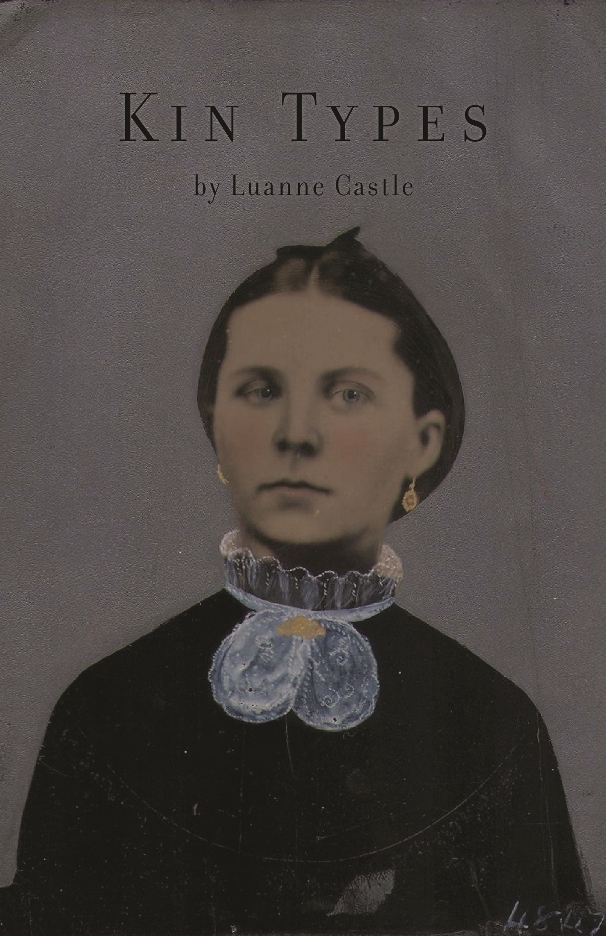
Unique, powerful and evocative, I have never read anything quite like Kin Types before. The author weaves poems and prose from the stories of her ancestors, building worlds upon worlds and bringing to life layers of history. In these raw, visceral and moving pieces, that tell tales of birth, death, love and disaster, Castle tells the stories her ancestors might have told if they only could have. From the powerful stare of the ancestor on the cover, you are drawn into a different world, one peopled by strong, haunting and fallible individuals. The small details of their daily lives and the sweeping tragedies and victories that made them, are lovingly re-created from what I imagine are scraps of history and family anecdotes. This collection and the people within it will stay with me.
Profile Image for Carrie.
697 reviews12 followers
September 7, 2017
The book's format is fascinating in that the author has taken the information she knows about her ancestors and woven it into a combination of poetry and short story narrative. It is dark and sorrowful as were many of the lives of the people who suffered through the poverty, disease, infant death, and fires of the nineteenth and early twentieth centuries. The prose is descriptive and never wasted: "Oil and flame slick and lick her limp apron" and "swaddled inside the crisp sugary walls she nurtured and nestled babies, as slippery as fruit flesh."

If all poetry was like this, I'd read more of it.
Profile Image for Serena.
Author 1 book102 followers
January 3, 2018
Kin Types by Luanne Castle is haunting and deeply emotional, allowing readers to wander off and discover their own ancestral stories. Perhaps they too will re-create the past and see how it mirrors the present or has shaped who they are.
Profile Image for Marie.
62 reviews16 followers
August 30, 2017
I took Kin Types on the road with me. I slipped it into one of my bags, sensing that the thirty pages of poetry and prose belied a depth and density that I’ve come to anticipate with Luanne’s writing. And yet I still wasn’t prepared for the wealth of stories I found among those pages.

Our first night out, in Olive Branch, Mississippi, I pulled Kin Types from my bag, thinking I would read a poem or two while my husband showered, before we turned off the lights. Instead, I read all the poems, totally captivated by the stories of Luanne’s ancestors. In her acknowledgement, she wrote:

“for those who came before me

whose stories I was privileged

to try to inhabit, if only for a moment”

Thanks to Luanne, I’ve developed an interest in my own ancestry: who was it that came before me, what happened to them, how (if at all) their existence has informed my own, besides the obvious connection of DNA. So, with a slight chill, I read the first sentence of “The Nurturing of Nature and its Accumulations”:

“Anything that happened to my grandmother before she got pregnant imprinted the genes she shared with my father and then with me.”

When we study our ancestry, we are trying to learn about ourselves. It’s an ego trip. It’s “all about me.” There is that element in Luanne’s poems, that she unearths these stories in order to learn more about herself, about how “those who came before” her made her who she is today. With Kin Types, though, the self interest is but one element. Luanne writes these poetic portraits with such sympathy, with such deep understanding (appreciation, perhaps even love) for the circumstances each ancestor faced and suffered through, that they almost literally walked off the page and into my heart. The most poignant of these is “And So It Goes,” a prose piece that reads like a novel, the courtship and separation (through death) of Pieter and Neeltje, their beginning and their end. Americans like to romanticize our ancestors’ struggles as they set new roots in what was a “new” world, trying to escape poverty or boredom, oppression or suppression. But their lives, especially the women’s lives, were not the stuff of romantic adventure:

“Neeltje did things without fanfare or explanation, and that’s how she died. [. . .] he realized that even though she’d been at his side since their teens, he had the sense he didn’t know her. [. . .] He’d made her a mother many times over, but she had been only a girl.”

Death is everywhere in these poems, as it was everywhere in the lives Luanne writes about. Death is everywhere but so is life. The death of babies, of brothers to war, of women dying without “fanfare or explanation” occurs among the birth of babies, the growth of families, the setting of roots. It is history; not just that of Luanne’s ancestry but of everyone’s ancestry.

What Kin Types did for me, both as a writer and a reader, is help me realize that my own family history, presumably boring and uneventful compared to those who can claim lineage to kings and generals, was anything but boring and uneventful for the people who lived those lives. Their lives might only be expressed in a few handwritten lines across decades of census taking, a marriage certificate here, a death certificate there. Only a few photographs may exist. But each atom of information is a spark to a story.

Like DNA, the histories found in Kin Types are the building blocks of a poet. Luanne’s poetry gives her ancestors’ stories a living, breathing quality that make them unforgettable. I’m grateful to Luanne for sharing her histories and for inspiring me to continue my own exploration.
Profile Image for Ian Beardsell.
273 reviews35 followers
September 2, 2017
I don't normally read poetry, but as a follower of Luanne Castle's blogs where I have enjoyed her writing and her thoughts on genealogy immensely, I decided to take the plunge. Well! I was not disappointed.

The big thing that struck me about Luanne's chapbook was the ingenious idea of writing about one's ancestors in poetic form. As a non-family member, it can be difficult to read straight-up family memoir, but Luanne has found a way to make these unknown characters come alive for us, give us a glimpse into their lives and thus remind us of our common humanity. As the avid genealogist she is, it would have been easy to write a prosaic family history of who-did-what-when, but this is so tantalizingly different. Luanne has gotten inside the old photographs and behind the family stories and gives voices to the women and men in her family's past. She digs up their hopes, their fears, their feelings, exposing them vividly via some event in the family's past...and the effect is extraordinarily haunting. It is like catching a glimpse of an actual ghost.

Check out this sample describing both the early, chaperoned dates of one couple, to the very end of their lifetime:

Their beginning
Pieter scrubbed before he visited Neeltje on the porch, but the oil smell of herring clung to his skin and hair, to his coat and boots. He left at ten every night. Later, she would press her hands, the ones he held as they sat turned toward each other in the small chairs, to her face and inhale. It had the effect of smelling salts or a burnt feather, reviving her from the dullness she felt when he was not around.

Their ending
When he felt invisible cold vines cold vines wrap around his ankles and calves, he saw her more clearly than he had in twenty years. His son Karel whispered that he would be seeing Mother soon. Pieter thought he meant the mother he had never known, but then realized it was Neeltje and smiled at the image of her standing before the light.



Now I want to go back and look at her genealogical blog again because I have a greater sense of emotional connection and indeed curiosity to these Dutch-American ancestors on whom the poems are based!
Profile Image for Jennifer.
Author 4 books20 followers
October 30, 2017
It is no surprise that for the three nights since reading Kin Types, I have had vivid dreams of my own family. It is no surprise because Luanne Castle's thought-full book presents the concept of family in such a palpable manner, one feels as if you have sat across the table from an aunt, a grandmother, a cousin, and heard family stories that could very well be your own.

Layered with poems and prose, you turn a page to reveal the next colorful character, the faded memory, the texture of a detail only a poet would think to include. The result is a beautiful collage of the family experience — its loves and losses, its joys and sorrows, its tragedies and secrets.

How clever of Castle to include the modern-day theory of behavioral epigenetics, essentially we are that collage, we are the stories, they are in our DNA. It is the premise of the book, and holds its own from the opening epigraph by Liam Callanan (The Cloud Atlas) to the final, beautiful poem “When Your Grandfather Shows You Photographs of His Mother.”

Speaking of photographs, do make note of the woman on the front cover, her knowing glance to the author's photo on the back. Is this the forebear who whispers “Don't quit writing like I did”?

No matter, we are happy Castle heeded the advice!
Profile Image for Ellen Morris Prewitt.
Author 8 books8 followers
June 25, 2019
I don't read a book jacket before I buy the book. I go entirely by how the first page strikes me. So it was after I'd read Kin Types that I was pleasantly surprised to see one of the reviewers on the back cover compare the poetry to Edgar Lee Masters. I've read and re-read Spoon River Anthology—it's one of my favorites—and Kin Types brought it squarely to mind. This is my favorite type of poetry, where you feel you've stepped into an entire community. Where you see the threads that weave them together, and tear them apart. Where you want to keep reading to find out what happens next. Where the concrete detail makes it so real, and the phrasing brings you to a stand still, absorbing what you've just read. The level of family research is impressive, but even more so is what Castle has done with it artistically. When I finished, I wanted to flip right back to the first page and start again. I'm sure I will soon.
Profile Image for Cheryl Malandrinos.
Author 4 books72 followers
October 2, 2017
Emotional and gripping, Kin Types by Luanne Castle is a collection unlike anything I've ever read before. At moments heart wrenching, at moments disturbing, these powerful glimpses into the lives of the women and men from Castle's family history will grab you right away.

While part of me hoped for more lighter moments, the reality is that our ancestors lived in dangerous, difficult times. Castle captures that reality so well with her poetry and prose. She writes a fascinating blog on family history at The Family Kalamazoo. Kin Types is a wonderful new way to bring those people to life for others.
Profile Image for Wall-to-wall books - wendy.
1,060 reviews22 followers
September 30, 2017
A very interesting collection. I love how they are all so different. Some of them are poems some are more prose and some are thoughts or lists. Each one will touch a nerve, will reach into your heart. A few of these are sad and others are encouraging. You can almost picture some of this for your own family.

I really love the whole idea of the book. It's like doing your genealogy or family tree/history in poems. And I am so glad that she wanted to share it with us!

I voluntarily posted this review after receiving an e-book copy of this from Poetic Book Tours. Thank you!
Profile Image for Debra Smouse.
Author 4 books33 followers
December 20, 2017
When it comes to exploring who we are, it's amazing how we can be informed by those who came before us.

Luanne Castle does just that for us - daring to imagine the lives of who came before us - in verse.

Kin Types arrived at just the perfect time for me - as I was diving into my own ancestry, both blood and by love - and exploring the longer trails of ancestry of my partner. This tiny book of poetry packs a powerful punch. Begging you to explore, imagine, and make peace with those we love and those we wish we could love.

A delightful gift for special beloveds this holiday.
Profile Image for Jill.
Author 26 books619 followers
August 24, 2017
I’ll be honest, typically I don’t read poetry, but having been a long time follower of Luanne Castle’s fantastic blog, I had to order a copy of Kin Types for my library, and I’m so happy I did. Kin Types is a perfect mix of poetry and short fiction woven together seamlessly. I highly recommend Kin Types to readers who enjoy genealogy and beautiful prose.
Profile Image for Amberly.
554 reviews12 followers
October 27, 2017
Oh! Be still my heart and soul. This slim, but powerfully moving chapbook (44 pages) of poetry, prose, and flash non-fiction is the perfect read for anyone who loves language, history, and genealogy. You will be drawn into so many different compelling events in Luanne’s family tree. Please read it and tell your friends about it. You will love it!
Profile Image for Suanne.
Author 10 books1,010 followers
March 8, 2018
I enjoyed Luanne Castle's first book, Doll Gods, but LOVED her newest work, KIN TYPES. The mix of poetry with short fiction was interesting. The individual works were tied together with a geneological theme with imagery so fresh and arresting it brought tears to my eyes.
Profile Image for Joy Kidney.
Author 10 books59 followers
April 1, 2021
The stories of ancestors help keep them alive. Luanne Castle does that regularly on her blog called The Family Kalamazoo, but in this slim volume of 19 poems and flash prose, she captures individuals with a vignette of well-chosen details that give you goosebumps, even a lump in your throat. They are poignant, sharing some harsh scenes as well as how one name is so ubiquitous in her ancestry. I especially enjoyed the one about family resemblances in old photographs, and noting the names, dates, and places as her forebears crossed the ocean from The Netherlands and Germany and ended up in Michigan. I also enjoyed finding pictures of some of these on her genealogy blog. This delightful chapbook helps keep alive individuals largely forgotten otherwise.
Profile Image for Elizabeth Gauffreau.
Author 8 books67 followers
March 24, 2024
Luanne Castle’s chapbook Kin Types poses–and ultimately answers–an intriguing question: What was the lived experience of her ancestors, and what is the relevance of this past experience to her–and, by extension, the relevance of our own ancestors’ lived experience to us? While genealogy provides a framework for knowing what ancestors we have–names and dates for births, marriages, and deaths–if it ends there, we’re left with little more than lists of ‘begats.’

Kin Types opens with, “Advice from My Forebears.” Some of the advice is practical and to be expected from people who produced much of their food at home:

“Always use hot pack canning for your green beans
and test your seals at the end.” (p. 1)

Other advice alludes to untold family stories that will remain untold, presumably with good reason:

“We can’t talk about it, but here’s your great-grandma’s
Eastern Star ring so you will have a signal.” (p. 1)

The last stanza of the poem serves as the reader’s entree into the rest of the chapbook:

“If you see someone’s thumb stuck in the dyke,
don’t pull it out.” (p. 2)

For me, these two lines are a metaphor for the chapbook’s central question: What do we have to gain, and what do we have to lose by pulling Grandma’s thumb out of the dyke? Should we go beyond names, dates, and family stories to imagine how our ancestors experienced their everyday lives and significant events–or should we leave well enough alone?

Castle chooses poetry and short, poetic prose pieces to take facts gleaned from historical records, along with perspectives gained from family stories, to imagine significant moments in some of her ancestors’ lives. Some moments are significant because of their horrific nature (“Account of a Poor Oil Stove Brought Off Dutch Pete” and ”Farmhouse Table”). Others are significant because they serve as illustrative vignettes of that person’s everyday life. (“The First Baby Still Sleeps Long Hours” and “Someone Else’s Life”)

Castle creates these imagined experiences through vivid, at times visceral, sensory imagery, compelling narration, and seemingly objective reportage:

“ . . . what heavy air,
close with tobacco and burnt meat.” (“The Ill-Timed Elopement,” p. 21)

“Twice when they thought she was out at the barn
She’d heard them talking about her as if she
were a cow hobbled for the sake of her calf.” (“Someone Else’s Story,” p. 18)

“On Thursday night last, the body of Mrs. Louisa Noffke, 73, was discovered at the shoreline of Emmons Lake by an unidentified passerby.” (“Half-Naked Woman Found Dead,” p. 12)

As a reader, I was left wanting to know more about the lives of the individual people each poem is based on, which is a natural reaction to stories about real people. Upon reflection, I think what’s not known (and, chances are, never will be) functions in the chapbook like negative space in visual art to give a sense of all the past lives whose stories will never be told–and those lives matter to us now because they’re part of who we are.

Kin Types is an emotive and thought-provoking read that brings the past into the present, where it will resonate into the future.
Profile Image for Judy Kronenfeld.
Author 12 books8 followers
September 25, 2024
Luanne Castle is an archaeologist of the past in her chapbook, Kintypes, a striking collection of poems and prose poems (including ironic “newspaper articles”) giving voices to and/or reportage about ancestors from Europe (mostly the Netherlands, but also from Germany), many of whom immigrated to Michigan, and whose lives often spanned part of the 19th and the 20th centuries. This book is dedicated to the author’s children “who taught [her] that kinship means shared stories,” and to “those who came before [her] whose stories [she] was privileged to try to inhabit.” And, indeed, the reader feels what the epigraph asserts: “We’re all ghosts. We all carry, inside us, people who came before us” (Liam Callanan). “Now the gauzy mask of your mother’s face floats across her-your features. Another light source and hour. Another shift of the hologram that is you.” (When Your Grandmother Shows You Photographs of His Mother,” in the voice of Cora Wilhelmina DeKorn Zuidweg, 1872-1932, Kalamazoo, Michigan.)

In the world of this book, nurture shapes nature and is passed on; genes are “already stricken with ages-old infections and the courage necessary for it all” (The Nurturing of Nature and Its Accumulations”). Most of the hard and elemental lives adumbrated here are led by gritty women who suffer but endure in a world constrained by the need to reproduce and survive, and by the strictures of religion, traditional gender roles, and shame. A woman who buried her second born when she “was only 19” goes on to bear seven more children, but goes “some place” her husband “couldn’t follow” after her losses; “[g]radually, over the next 44 years, he stopped searching” (“And So It Goes”). A father refused to let his daughter “leave the house for school after 3rd grade,” and also “forced [her] to stand in the corner until [she] fainted, and “her mother . . . accepted his dominion” (“The Nurturing of Nature . . .”). Doctors falsify women’s suicides.

These are lives with few resources in the face of calamity; fire takes a motherless house, where the laborer father is too ill to work, and all the younger children are dispersed among the neighbors (“The Weight of Smoke”). Yet calamity can be met by steely perseverance: though a “husband’s wagon is hit by a streetcar,” he loses “his wits” and “is sent to the asylum,” the wife, “with a bitter putty” seals off “[a]ll the ways of self-pity open to her.” Forced to work as a “live-in” and send her wages to her mother who is caring for her young son, she “knelt on the floor / and scrubbed and scrubbed . . . / too tired to stand.” And studied “late at night her correspondence course” (“Someone Else’s Story”).

These stark and revealing stories remind many of us that, often, the lives preceding ours were hemmed in by reduced circumstances, the exigencies of luck, and cultural expectations—particularly in the case of our foremothers. And that we are here, because they persevered.
Displaying 1 - 17 of 17 reviews

Can't find what you're looking for?

Get help and learn more about the design.