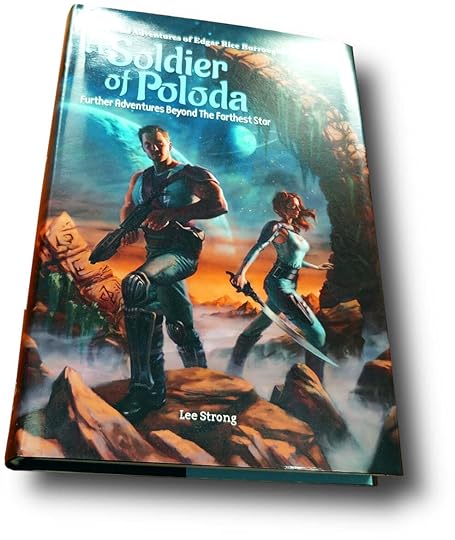
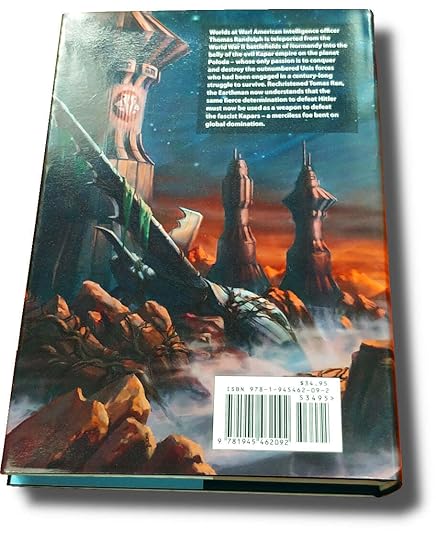
Like fellow Earthman, Tangor from the story "Beyond the Farthest Star," American OSS officer Thomas Randolph is mysteriously teleported to a foreign planet where he lands in the center of a 100-year war that mirrors the Allied Powers’ struggle against Adolph Hitler’s Third Reich.
Unlike Tangor, Randolph – now Tomas Ran – finds himself behind enemy lines where he gains a first-hand view of the inner workings of the corrupt Kapar empire. Will Tomas, using his OSS skills, be able to devise a plan to escape with the beautiful Unisan prisoner, Loris Kiri, that will allow them to join her countrymen in their struggle against the Kapars?
American novelist Edgar Rice Burroughs debuted the world of Poloda in the pulp story Beyond the Farthest Star in 1940 just as Hitler’s Nazis marched across Europe and the Imperial Japanese extended their reach across the South Pacific. Burroughs’ youthful idealism regarding the nobility of America’s previous war efforts had given way to a mature perspective of the savagery of combat that stains every battlefield. Burroughs’ deeply-held views are reflected in this tale about a planet ravaged by 100 years of conflict as the nation of Unis devotes its entire existence to the struggle of freedom against tyranny.
Author Lee Strong created this second adventure on the planet Poloda, which lies beyond the Globular Cluster NGC 7006 ‘ 450,000 light years away from earth. Join Tomas Ran as he explores Poloda, battles Kapars, and finds love Beyond the Farthest Star.
Devouring Edgar Rice Burroughs Inc's recently released Beyond the Farthest Star Restored Edition really put me in the mood for more Poloda. It was a feverish moment, like when you finish a TV show you really like, and hurriedly click More Like This, or Others Also Watched, hoping against hope to find something similar enough to what you just finished so that you can breathe a huge sigh of relief, sink back in those couch cushions, get comfy, and enjoy more of the same.
Ever felt like that? Then read on.
Like other Burroughs fans, I often would reread those two original novelettes, Beyond the Farthest Star and Tangor Returns, lamenting that Ed hadn’t continued these stories as he did his other series. Even a good solid trilogy might have been enough to appease Ed’s flock of fans of which I’m a measly one. But we didn’t have that third novel.
Thank goodness in this case I was able to segue into something that was so darned much like what I’d just read it was almost as if Ed wrote it. I’m referring, of course, to Lee Strong’s, Soldier of Poloda, No. 5 in the Wild Adventures of Edgar Rice Burroughs ™ series by ERB Inc.
First, let me just get this out of the way so no one feels misled—this isn’t Tangor Returns II. Tangor makes an appearance in multiple scenes, sure, but he isn’t the main character. Think of Strong’s story as more like A Fighting Man of Mars where Ed focuses on a different character with a recognizable supporting cast.
My hat is off to Strong who was able, in my opinion, to pull off one top-notch pastiche to one of my favorite novels by one of my authors. Strong certainly captured the “look and feel of Poloda” . . . the desultory “It is War!” cry from the weary people of Unis is there. So are the war-hungry, power-mad, whacked Kaparans. The bombings, airplane battles, green-shirted Zabo, sirens, interrogation rooms, planes falling from the sky . . . all the stuff that reminds you of Poloda is there—but there’s a new twist.
Some of those things are more muted in this novel, lurking in the background, noticed in passing by Ran, the hero, as he wades across the savage, war-torn surface of Poloda offering a different point of view than our beloved flyboy, Tangor. Ran is a foot soldier and has different ideas about how to take on the Kapars. And he’s good at it, coming up on the spot with clever ways out of the messes in which he finds himself. But one of the things I enjoyed most about the novel is Strong’s wit he brings to bear.
Tangor was witty and fast on his feet, and so is Ran. It must be an Earthman thing. Actually, I think Poloda has just been fighting too long they’ve forgotten how to joke. Strong does a killer job of creating an analogous character to Ed’s Tangor while also succeeding in spades in creating his own, unique character whom I found as much fun to read as the original novels.
In summary, Soldier of Poloda is a great sequel to Beyond the Farthest Star.
I think Edgar Rice Burroughs novels were my first "adult" books. I read my father's collection when I was a kid. My favorites were the Barsoom series, but I also remember liking Beyond the Farthest Star, even though I realized, even as a child, that it was both derivative of John Carter (a soldier from Earth suddenly gets transported to another planet where he ends up becoming a superhero) and wildly improbable (a planet in another galaxy has humans of similar technological level on it).
But it was good for its day, so nostalgia induced me to buy Lee Strong's authorized sequel to Beyond the Farthest Star: Soldier of Poloda.
The story is similar: an American soldier in the middle of World War II is suddenly transported from sudden death to wind up on the planet Poloda. Poloda has been locked in a hundred year struggle between the Nazi-like Kapars and the democratic, freedom-loving Unisans. The scale of the war is constantly described as dwarfing World War II, with tens of thousands of bombers being sent out in every raid, and entire cities routinely being smashed up. There are some authorial licenses taken to explain why there is essentially no ground-fighting; the two sides have spent generations living in underground bunker-cities while they try futilely to bomb each other out of existence.
Thomas Randolph, the hero of this novel, naturally meets up with a Unisan cutie, and then goes on various adventures among both the Unisans and the Kapars. He also gets to meet the Earth hero of Burroughs' original novel. The two of them devise military strategies that somehow the native Polodans, despite being from more advanced civilizations than Earth's, have never thought of, thus eventually breaking the decades-old stalemate.
It's high pulp adventure, and true to the book it is imitating, but alas, that also makes it an artifact of the time it is imitating, and while fans of old-school pulp adventure will probably enjoy the manly exploits of Thomas Randolph, aka "Tomas Ran," for the nostalgic fun that it is, there isn't much originality here. It's just a rehash of Burroughs' writing, and I found the writing in Soldier of Poloda often dragged, with many pages consisting simply of episodic snippets describing the progress of the war.
An interesting book for Burroughs fans to add to their collection, but it doesn't really stand on its own.
This book by Lee Strong is the latest in a series of books authorized by Edgar Rice Burroughs, Inc. based on characters and stories written by ERB (1875-1950). This one is based on a book which I enjoyed very much as a kid back in the 60s-"Beyond the Farthest Star." It was actually two novellas-one published in 1941, the other published after ERB's death. It was the only story of ERB's set in a distant star system and it featured a hero-American, natch-who died in World War II only to awaken on the planet Poloda, a world which had been at war for 100+ years. The hero is called "Tangor" and he finds himself on the side of the good guys-Unis-taking on an expanding dictatorship. Poloda's version of the Nazis are the Kapars and they seem to be winning the war. As I said, I enjoyed the story, but felt very frustrated at the end as the story remained unfinished. The war was going on, the bad guys still dominating most of the planet...well, with this book by Lee Strong, the story is continued. A new hero has arrived, American OSS officer Thomas Randolph. His problem is that, following his death in WWII, he arrives in Kapar territory and becomes a prisoner. Can he escape? Can he join Tangor and keep up the fight against the brutal Kapars? Read Lee Strong's book and find out. I for one am happy that Lee has continued ERB's story--and thanks to ERB, Inc. for authorizing this book.
Lee Strong's continuation of the Poloda series created by Edgar Rice Burroughs was an entertaining and enjoyable read. Although focused on a planetary wide war exceeding one hundred years in duration, Lee kept the narration light hearted and quite upbeat. As expected, the stranger, Thomas Randolph, mysteriously arrived from earth, is able to lead the war weary Polodians, on the path to victory and ultimate peace. My only draw back was the volume of Polodian names, cities, and continents that were continuously introduced during the story. Sometimes found it difficult to keep everything envisioned in my mind while reading. A helpful aid might have been an illustrated map of Poloda, showing the layout and locations of sites discussed in the book. Only my opinion. Still enjoyed the read. Nice effort on the part of Lee Strong, to keep the creations of Edgar Rice Burroughs alive.
I WANTED to love this book as Beyond the Farthest Star, was one of my favorite ERB novels. Nope ... too fast this tale is a little to wild and out there and if your going to resolve world war / peace do it over a couple of novels.
This entire review has been hidden because of spoilers.
A Fantastic Pastiche/Sequel of one of ERB's Best Works
Edgar Rice Burroughs had published only the opening portion of Beyond the Farthest Star in his lifetime. The second part, "Tangor Returns" was published posthumously. Now comes this worthy successor that completes the story. A second Earthman, Thomas Randolph, arrives in war-ravaged Poloda, but unlike his predecessor Tangor, he decides to be much more proactive in the planet's war and politics. The result is a story that kept me engaged and left me satisfied at its conclusion.
Author Lee Strong does a good job with his take on the story. His hero is likeable, interesting, intelligent and resourceful. The story itself, while fantastic enough, is well told. Strong does a good job with giving details of Poloda's history and geography that being the world to life.
If you liked the original tale, you should enjoy this one. The first book was among ERB's best books, rising far above the level of most of his fiction. Spring's follow-up, in both style and story finishes the job.
A fairly standalone sequel to Edgar Rice Burroughs late career and somewhat grimmer in tone book "beyond the farthest star" which details the on going 100 years long war between the Nazi like Kapar empire and the nation of Unis on the far off planet of Poloda and the American fighter pilot that is transported to said far off planet!
"A soldier of Poloda" by Lee Strong has its ups and downs in comparison to Burroughs original but is still a good read if you enjoy Burroughs or Burroughs like adventure fiction with a fairly unique alien world and some heady ideas thrown into the mix, and in some ways it is a novel with a bit more meat on its bones then the original!
Very much a fun ride into a pulp fiction type of novel, where the guy always gets the girl. I'd classify this as more fantasy than science fiction, as there isn't a lot of science put forth in the book. But it is fun, and definitely in the tone of the ERB books of that era.
I do my very best to never say this about a book, but there's no other way to say it with this book: it was boring. The writing was amateurish and the plot drags out over the course of five years! It was just plain boring.