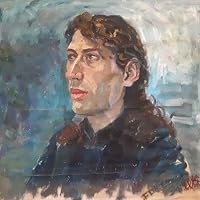
ספר שירים: תל אביב : הקיבוץ המאוחד, תשי"ד 1954 1917 משה טבנקין נולד במושבה כנרת מילדותו ניכרה בו נטיה טבעית לכתיבה: פירסם שירים בבטאון חברת-הילדים של הקיבוץ, יזם הקמת תיאטרון-ילדים, כתב וביים בגיל 12 הצגה בשם "חלום יעקב" ובהיותו בר מצווה חיבר את השיר "השמש יורדת", שיריו המוקדמים התחבבו מאוד על קהל הקוראים. רבים מהם כונסו באנתולוגיות, הוקראו בטקסים שונים ואף הולחנו בידי מלחינים שונים כגון צבי סנונית, דני ליטני, שלמה ארצי ומתי כספי
When I have first bought Sefer Shirim (Poems book) by Moshe Tabenkin in an old book store in Haifa back in 2001, I had no idea that I will only read the book 16 years later, overseas. The strangest thing with that book was that in January 2001, while on a short trip to the holy land, I visited the university of Tel-Aviv one sunny day in order to promote my one and only ever poetry book in Hebrew. Outside the University of Tel-Aviv I have read some of my poems loud to the public and struck up a conversation with some people. At one encounter with a nice old woman; a holocaust survivor, she asked me about my favourite Hebrew poet. I told her that Pinchas Sadeh was my favourite Hebrew poet and that now I bought a poetry book by Moshe Tabenkin. The old woman snapped at me ‘Tabenkin?! You call him a poet? Tabenkin is not a poet! Bialik is a poet’. I have no idea why the old woman had so much grudge against Tabenkin. I didn’t investigate into it but out of awe to her I felt ashamed to read the book. It was strange how bias can destroy your appetite for reading a book. When I returned to Denmark, I put the book together with other books I bought in the attic of my mother in law’s house and forgot about it for more than a decade. When my wife and I bought a house in 2006 we began slowly to take our things back from my mother in law’s attic. A year ago I have found this book in one of the boxes. I felt the hard cover of this pocket book and reminisced. The book is from 1961, but what caught my attention was the publisher. What a bizarre coincidence. The same Hebrew publisher of this book was the one who told me that on merits my Hebrew poems and romance were worthy of publication but because of my background they were not interested to publish me. They investigated into my background and found out that one of my parents was from the ‘Sephardim Jews’ and that they do not publish books who were written by authors with Sephardim roots. I was devastated, but I decided that I will not discriminate Tabenkin because of his notorious publisher. For me all human beings are equal and all poets, regardless of their background, deserve a chance to be judged by their merits, not by bias. I still wonder about why the old woman who loved Bialik despised Tabenkin; it could be based on merits and it could be based on bias (Maybe he was not nationalistic enough like Bialik?) and it could be based on both. Thus, my curiosity for Tabenkin's poetry grew and I embarked upon the adventure of reading this book. I read it and I loved it. I have made an analysis of the poems in Hebrew but since I do not have any Hebrew software I cannot publish my analysis here. What I loved about this collection is that it was purely spiritual. It has not even one speck of bigotry or nationalism or any political or racial ideology. Tabenkin is an epic poet with a longing for eternity. He wrote much about the magic of the silence of the universe. Many of his poems dealt with love affairs to a woman he loved and about relationships with her. Tabenkin is versatile poet; tangible, sensible, humanistic, and compassionate, very soft poet with many intellectually stimulating an oxymoron all throughout the book; like the ‘Singing silence’ and ‘The clothes of our souls’ and ‘Perfumes of hopes bulbs’ ‘The echo of tears’ and many more. Tabenkin is very talented in regard to rhymes and use of alliteration. The structure of his poems was simple and soft but also in a fine disarray at times. His Hebrew was somewhat interesting because he used a lot the tone of the ‘Hagada' from 'Pesah’, a bit ancient Hebrew, and without any dialect of foreign origin which often bears the ideology of a yearning to the holy land; it was clear Hebrew, not contaminated with bias; it was pure and dedicated to love and humanism. There was a feeling of space, like the boats and the stillness and the night and the stars and the universe, mingled often with emotions combined. Tabenkin was an interesting poet to analyse, because he was unlike the typical wandering poet who longs for an answer. Tabenkin was not the river seeking the sea. Tabenkin was a cathartic poet who has already found Shangri-la in his serene poems and harmony with nature. He settled with the simplicity of life. He didn’t seek any vanities or illusions, he found salvation within existence. Tabenkin is a peace loving poet. He also expresses his sorrows for the hardship of the Jews in Israel at the time he lived, but always from a peaceful perspective. It is unfortunate that there are wars imposed on those who only wishes to live in peace and seek peace. The tragedy of the nation of Israel: the curse to be caught in a spiral of violence imposed by war mongers. It is unfair, but Tabenkin remains immune to hatred. It was really a nice collection. I should have read it long ago. As a reader I extract moral lessons from each and every poet I analyse. From Tabenkin I have learned that one should always adhere to fairness and peace, despite the harsh circumstances. Moreover I have learned that one should judge for oneself and not be deterred by opinions of others when it comes down to literature. One should always judge a book by its merits alone.