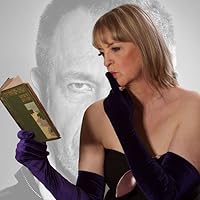
A Van der Valk Thriller - Arlette Van der Valk finds herself widowed from a man who left an indelible mark on the world of crime investigation. After her initial grief, Arlette is at a loose end - Piet was her life, but Van der Valk soon finds that making decisions help ease the pain. After remarrying, she sets up an advisory agency but things don't always run smoothly as this ingenious story shows. Not only dealing with her clients' problems, Arlette must also deal with threats to her life.
Nicolas Freeling born Nicolas Davidson, (March 3, 1927 - July 20, 2003) was a British crime novelist, best known as the author of the Van der Valk series of detective novels which were adapted for transmission on the British ITV network by Thames Television during the 1970s.
Freeling was born in London, but travelled widely, and ended his life at his long-standing home at Grandfontaine to the west of Strasbourg. He had followed a variety of occupations, including the armed services and the catering profession. He began writing during a three-week prison sentence, after being convicted of stealing some food.[citation needed]
Freeling's The King of the Rainy Country received a 1967 Edgar Award, from the Mystery Writers of America, for Best Novel. He also won the Gold Dagger of the Crime Writers' Association, and France's Grand Prix de Littérature Policière.
"Nothing Arthur detested more than cliché. He sought them out, pounded upon them, took them by the scruff and kicked their arse."
Arthur Davidson - Arlette's second husband whom she married after Commissaire Van der Valk had been killed (cf. the extraordinary A Long Silence) - is the alter ego of the author, Nicolas Freeling, who was born Nicolas Davidson. The fervent hatred of clichés of all kinds neatly characterizes not only the fictitious Mr. Davidson, a fussy, scholarly, annoying, and very British sociology professor, but also Mr. Freeling in whose books - and this the 31st book of his that I am reviewing here - one would have to look long and hard to find a cliché character, situation or opinion.
Arlette, who lives with her husband in Strasbourg, decides to open an advice bureau ("Arlette van der Valk: Counsel and aid; personal and family problems"), where she hopes to help people deal with difficult situations in their lives: she sees her role as a combination of Dear Abby, a psychoanalyst, a priest, and a private detective. Her first three clients are a woman with three kids who is being abused by her violent boyfriend, an eighteen-year old high-school student fearing that her father is about to lock her in a mental institution, and a paranoid-sounding businessman convinced that someone is trying to kill him. All three cases prove more complicated than Arlette has expected; one person dies, Arlette's own life is in danger, and the police get involved.
Not only does Mr. Freeling abhor clichés, but he also hates routine. I have read about 20 books by Sue Grafton, roughly the same number by Jonathan Kellerman, perhaps about 30 by Rex Stout, and the main problem with them is that all books in a series are basically the same. Minor variations of plot and characters are not enough to make me feel that I am reading a new book. Not so with Nicolas Freeling - the repetitive elements are kept to a minimum, and almost all his books are of the one-off type, even if they are installments of a series and the same characters are featured. The moods, the emphases, even the writing styles are different and unique for almost all books. This is one reason why I love Mr. Freeling's work. Some of the other reasons are his fierce Europeanness (a tasty combination of the British, the French, and the Dutch ingredients, with generous helpings from other nations), and of course the wonderfully accomplished prose - an unusual literary feat for the mystery/crime genre.
In addition to captivating plot "The Widow" (1979) delivers superb characterizations of Arlette and Arthur, and a vivid portrayal of Strasbourg and its vicinity, with their French and German elements, which finally seem to coexist in peace and harmony. A modest but very good novel that pounds upon clichés, takes them by the scruff and kicks their arse!
Interesting. Written by a Brit, set in Strasbourg. Very difficult to tell sometimes who is speaking the dialogue. Gotta work at it; but very, very clever.
no está mal pero es complicado enterarse de quién habla o dónde están en muchas ocasiones, está poco definido en ese aspecto y hace liosa la lectura pero bueno para pasar el rato estuvo bien
Strasbourgissa tapahtuu. Poliisin leski Arlette alkaa pitää neuvontatoimistoa ja saa kiinnostavia asiakkaita. Huomaamattaan hän sotkeutuu mukaan ammattirikollisuuteen ja saa kärsiä siitä.
Aika mainio kirja, hauskaa ajankuvaa 1970- ja 1980-lukujen taitteesta. Mukana on naisasiaa, korruptiota, vallan väärinkäytöksiä. Tyyliltään kipakka, kriittinenkin. Jännitys- ja dekkarimomentit jäävät tosin melko vähiin.
I mooched this copy, which was in a sorry state, but I am glad I did, because the story is a rattling good one, with v.d. Valk's Widow getting herself involved unwittingly in three enquiries and some frightening events. The details and different strands are cleverly interwoven. I enjoyed it even more than the early v.d. Valk's I had previously read.