As autumn draws in, a Pennine valley town famed for its alternative lifestyles is shocked to its core when a woman is savagely attacked.
The identity of her assailant proves illusive but her colourful past in the amateur world of adult entertainment makes her a tabloid sensation overnight. When further attacks occur, group hysteria spreads and the community seeks a scapegoat...
Journalist Roddy Mace is struggling to stay sober whilst completing the writing of a true crime book based on a previous case. Detective James Brindle, on an enforced leave of absence from secretive crime unit, Cold Storage, is rapidly unravelling without a case to focus on. The two reunite to discover how old myths align with new fears, and the deep history of folk-crimes that lie within the bleak moorlands.
In These Darkening Days a rural idyll is shattered by an outbreak of violence and a place steeped in ancient history becomes the focus of an accelerating modern media that favours immediacy over truth.
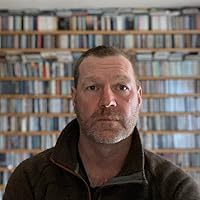
He is an award-winning author and journalist whose recent novel Cuddy (2023) won the Goldsmiths Prize.
His first short story collection, Male Tears, was published by Bloomsbury in 2021.
His novel The Offing was published by Bloomsbury in 2019 and is a best-seller in Germany. It was serialised by Radio 4's Book At Bedtime and Radio 2 Book club choice. It is being developed for stage and has been optioned for film.
The non-fiction book Under The Rock, was shortlisted for The Portico Prize For Literature in 2020.
Recipient of the Roger Deakin Award and first published by Bluemoose Books, Myers' novel The Gallows Pole was published to acclaim in 2017 and was winner of the Walter Scott Prize 2018 - the world's largest prize for historical fiction. It has been published in the US by Third Man Books and in 2023 was adapted by director Shane Meadows for the BBC/A24.
The Gallows Pole was re-issued by Bloomsbury, alongside previous titles Beastings and Pig Iron.
Several of Myers' novels have been released as audiobooks, read by actor Ralph Ineson.
Turning Blue (2016) was described as a "folk crime" novel, and praised by writers including Val McDermid. A sequel These Darkening Days followed in 2017.
His novel Beastings (2014) won the Portico Prize For Literature, was the recipient of the Northern Writers’ Award and longlisted for a Jerwood Fiction Uncovered Award 2015. Widely acclaimed, it featured on several end of year lists, and was chosen by Robert Macfarlane in The Big Issue as one of his books of 2014.
Pig Iron (2012) was the winner of the inaugural Gordon Burn Prize and runner-up in The Guardian’s Not The Booker Prize. A controversial combination of biography and novel, Richard (2010) was a bestseller and chosen as a Sunday Times book of the year.
Myers’ short story ‘The Folk Song Singer’ was awarded the Tom-Gallon Prize in 2014 by the Society Of Authors and published by Galley Beggar Press. His short stories and poetry have appeared in dozens of anthologies.
As a journalist he has written about the arts and nature for publications including New Statesman, The Guardian, The Spectator, NME, Mojo, Time Out, New Scientist, Caught By The River, The Morning Star, Vice, The Quietus, Melody Maker and numerous others.
He currently lives in the Upper Calder Valley, West Yorkshire, UK.
Taking as his inspiration a real life crime case from the north of England, Myers once again lures us into the deepest disturbing psychological realms of his characters, delivering more than a few grim sucker punches along the way. A series of women become victims of a vicious assailant, plunging this close knit community into a miasma of suspicion and accusation. I absolutely loved it. From the cynical world weariness of embittered reporter Roddy Mace, fighting off the temptation of the demon drink, to the reappearance of fastidious, OCD suffering detective James Brindle, and a cornucopia of dislikeable victims and suspects along the way, Myers (as in previous books) draws us in, shakes us up, and then spits us out the other end slightly soiled by our reading experience, but guiltily satisfied by it too. As always the book is suffused by Myers strange mix of sometimes lyrical, oftentimes unerringly brutal imagery of the natural environment against which his characters roil, fight, and will to survive. Perfection.
I really like this author's writing - it is wonderfully evocative and his main characters are very good too. I enjoyed the first Brindle and Mace book a lot hence buying this one. However the first half of this I found rather slow - good writing but no pace to speak of. The second half was far better and I guess overall this is not a bad read. Brindle really only becomes a proper part of this story about halfway through and - weird though he is - I like him and his effective absence in the first half was probably an issue for me. 3.5/5 and I would read more of Myers writing definitely.
A cop, well placed on the obsessive compulsive spectrum, a heavy smoking hard drinking journo, and a brutal assault some where in the North of England. Based on a true legend, this book is steeped in reference to folk horror classics such as s such the WickerMan, Mystery and Imagination, Tales of the Unexpected, and the contemporary League of Gentleman. It is the latter that readers new to Myers will see in "These Darkening Days" more goings on in Roysten Vasey's sister town. The writing of Myers effortlessly mixes into the plot thoughtful social commentary on a diverse number of social issues from the lynch mob mentality of the disaffected and disenfranchised local people, the degradation of free-to-air TV, and 20 different names for rain. I thought it was a great read, and so poignant to these times.
Benjamin Myers is fast becoming my favourite current author. This is the follow up to Turning Blue, and while not quite as dark and bleak as that is an excellent, evocative and superbly written novel. Featuring the same two protagonists Mace and Brindle as it's predecessor and set in the same West Yorkshire stomping ground, These Darkening Days will stay with you a long time after reading. The prose is once again just stunning. Already can't wait for Mr Myers next one.
I enjoyed this piece of Northern noir. Linguistically adroit, rich in authentic detail and with a fascinating undercurrent of the macabre. I will be reading more of Mr Myers. Next up, The Gallows Pole.
A man staggers down a passageway in the small town and finds a lady slumped on the ground and covered in blood. He sees the knife on the ground, picks it up and then panics and drops it down a nearby drain and rushes away from the scene. She is found and taken to hospital, where the surgeons say that the knife missed her eye by 2mm and declare her lucky to be alive.
Most of the residents of the town are shocked by this unprovoked attack. But the victim, Josephine Jenks, a former soft porn star seems unperturbed by the attention. Roddy Mace, a journalist for the local newspaper is covering the crime, however, given her background, the Sun newspaper really want a scoop on this and they dispatch the pretty unpleasant hack, Jeremy Fitz, to the town to secure the interviews and exclusive coverage.
A day or so later there is a second attack, the wife of an alcoholic is slashed and also ends up in hospital. Her idle husband starts to put together a mob to find the attacker themselves as the police aren’t making any progress. Two further people are slashed, a guy who staggers into a restaurant bleeding profusely and a husband finds his wife dead in a farm building. This is now a murder enquiry. Just as the hysteria reaches its peak, a copper who has been put on rest from the force re-appears back in the town and starts developing his own theories about the crimes as he follows his own leads with the help of Mace.
It has the standard tropes of a copper returning after he sees the pretty hopeless local police station is floundering. But there are much darker shards in the plot, it is full of menace as the attacks seem unprovoked and unrelated, the rapid rise of the mob and their intentions is pretty scary too. This is the forth of Myers books that I have read now, and whilst I preferred The Gallows Pole and Beastings, it is still one of the best crime books that I have read in a long while. It is the classic Myers lyrical writing too, it is as much about the place and the landscape as it is about the untangling of the crime, but fast-paced and really really good.
Ben Myers writes excellent books. While this doesn’t quite have the same brutal punch of “Pig Iron”, the pastoral isolationism of “Beastings” or the toe-curling squirm factor of “Turning Blue”, there’s enough of Myers rural lyricism and intricately-plotted storylines to keep us hooked until the end. Super.
Very readable with likeable characters. Myers is occasionally guilty of laying his prose on a little too thick, telling not showing, and not giving the reader much to do. And there isn't quite the same otherworldy quality seen in Beastings, a previous novel. However this is still a riveting read.
Benjamin Myers nous invite à un voyage saisissant dans les profondeurs de l’âme humaine avec « Noir comme le jour ». Dès les premières pages, l’auteur britannique impose une atmosphère lourde, où la pluie incessante de cette vallée du Yorkshire devient presque un personnage à part entière, témoin silencieux des drames qui s’y déroulent. L’ouverture du roman nous plonge immédiatement dans une scène troublante : un homme découvre une femme blessée dans une ruelle. Cette rencontre nocturne établit d’emblée le ton de l’œuvre, entre violence latente et beauté brute des paysages du nord de l’Angleterre, si caractéristiques de l’univers de Myers... La suite de ma chronique sur mon blog : https://lemondedupolar.com/la-fievre-...
Really enjoyed this one. Not as gruesome as Turning Blue, but equally compelling. Being close to the location helped me visualise the story, but Myers's wonderful descriptive style again led to a captivating read.
This is a book I have waited a long time to get the opportunity to read, having finally sourced a copy I was not disappointed. Benjamin Myers is one of my favourite contemporary writers, he is highly praised for his English rural noir, or Dale noir. Call it what you will he just knows how to tell a good story, with location becoming pivotal to the plot and the characters.
These Darkening Days is a sequel to Turning Blue, featuring the same lead characters. I really enjoyed that book, but remarked that it owed a huge debt of gratitude to David Peace and his Red Riding series, it was not a criticism as such more of an observation, and I hoped that Myers would go on to find a voice of his own and not wear his influences so openly. This tale of mass hysteria in a rural Yorkshire village rocked by a spate of random and violent attacks, is much better in my opinion. Myers crafts a thought provoking mystery thriller, lacing the history and folklore of the Yorkshire moorlands with more modern fears sparked by unscrupulous mass media. It’s certainly food for thought in these post Brexit times, and reading it whilst the country was caught up in the hysteria of the Corona virus pandemic also made it that little bit more chilling.
Not as visceral as the previous Turning Blue, which initially brought lacklustre journo Roddy Mace into uncomfortable partnership with obsessive detective James Brindle, These Darkening Days is a cleverly paced story in Myers' distinctive "Folk Crime" genre: a small Yorkshire town is terrorised by violent and bloody attacks - which in turn incite violent mob-hatred among the populace. Springing from real-life attacks and psychological disturbances, the violent clashes brought about by a sense of despair in the enclosed valley are detailed and build through a series of interlocking episodes. Myers manages to look at urban and rural decay with a keen eye and a political/sociological intent without straying too far into Cold Comfort Farm depiction of landscape so that the final deaths are poignant, and the denouement of solution and relationship resolution work well together. There are some brilliant images here: "Josephine is sleeping like a photograph" is clever; but perhaps this is the best summation of Ben Myers's skills in this book: "The rock is cold and impartial beneath his hand. When he places a palm there he feels time slip away. Ancient and obvious, it is incapable of experiencing pain. With trembling hands Garner turns up his collar and zips up his coat." Is it coincidence that this character, feeling this connection, is called Garner?
'These Darkening Days' is the first book I've read by Benjamin Myers. I was caught up in the mystery from the very beginning and especially like the way he developed a sense of place and a real feel for the Pennines, in the northern moor country of Great Britain. His character development is impressive and, as each character shares their unique perception of what is going on, their voices are spot on, unique and recognizable.
The novel opens with a young man named Tony Garner finding a woman slumped in an alley. As he looks more closely, he sees that her face has been deeply slashed and she appears to be almost dead. For a moment, just a moment, Tony considers calling the police but because of his own personal history with them, he decides this is not the best choice. He picks up what he thinks is the weapon and throws it down a gutter. Tony suffered a traumatic brain injury when he was a child and is often impulsive, prone to making poor choices. He makes his living selling marijuana and has been in trouble with the law several times.
Because this is a small town that has been almost crime free, the slashing is in the spotlight. Roddy Mace, a journalist for the local newspaper is covering the crime. Roddy has recently landed here after having worked for a big city newspaper. Something happened to him that was detrimental to his career and sullied his reputation but the specifics are not spelled out. Roddy is in recovery from alcohol and is trying to keep other personal demons at bay. As he looks more closely into the crime, he learns that Josephine, the victim, has had a long career in the sex trade industry and is well-known to many of the local men.
Soon, this crime is followed by others. What was once a quiet tourist town is now on the front page of the national media. Roddy Mace is only one of the interesting characters. Each of them has a back story and, as the novel progresses, the reader learns how their lives are connected. I would have given this mystery a '5' except for my disappointment with the ending. I could not suspend belief to buy into it. Despite that one disappointment, the book was a delightful read.
Nothing is as it seems, he thinks. It’s a fact worth remembering.
The present day, and a small town in the Pennines, which may or not be based on Hebden Bridge, the author’s adoptive hometown, and where we meet a trio of fucked up central protagonists – first Tony Garner, an unfortunate youth growing old and perennially unemployable, surviving on poaching and drowning in alcohol and other forms of substance abuse, whose accident when a pre-pubescent (he fell down a steep incline when out collecting rare bird’s eggs, and sustained a life-changing head injury) has led to a series of comical interactions with the local youth, and skirmishes with the authorities, including defecating in public, beating a swan to death, and more besides. Now, stumbling home one night, he comes across the barely-alive form of local amateur porn actress Josephine Jenks – JJ, to her many adoring fans – in an alleyway, picks up the knife lying nearby (he likes knives, does Tony), then disposes of it down a drain and flees, afraid and confused over what he may or may not have done. But in a small town, connections are everywhere; and then, in this tight valley community often described as a goldfish bowl, there is the not insubstantial matter of the stir-craziness that affects all of its residents after a while, the valley fever of lore.
Then there is the detective on furlough, James Brindle, a man struggling with levels of anxiety, depression and obsession, and who is now fixated on clean living, as well as the history of the Third Reich. Brindle was once attached to the clandestine Cold Storage unit, a police and secret state surveillance outfit, and he badly wants back in. And finally, there’s the journalist Roddy Mace, who has substance abuse issues of his own, is living temporarily on a houseboat, and who, like Eddie Dunford in David Peace’s Red Riding Quartet (of which These Darkening Days is redolent), has tasted the bright lights of the southern capital, working on and off for a tabloid best known for its loose relationship with the truth, and who now wants no more of that life. Instead, he’s retreated to this nameless Yorkshire town, where he works for the failing local newspaper, the Valley Echo. And there’s a connection between Mace and Brindle: because the case that has caused Brindle’s suspension from Cold Storage is the same one that almost destroyed Mace, and he’s been contracted to write a book about it, one with which he’s making little progress.
There are comic moments all the way through These Darkening Days, from the names of the Valley Echo’s editor (Askew) and the Cold Storage pathologist (Graves), to Garner’s youthful escapades, to Askew’s embarrassed excuses that he doesn’t really know Jenks, he’s just heard about her, everyone around here has. There’s also a guest appearance from northern folk legends The Unthanks, under the guise of The Thank-Yous, but these moments of light relief are few and far between, and for the most part, it’s dark, dark, dark. As a whole, These Darkening Days is a beautiful and immaculate shroud of bleakness and desolation, one that wraps itself around you and almost suffocates you, but then lets up, so that it can keep you alive for just long enough to witness the next gut-wrenching horror lurking around the next awful corner. And all of this horror is contained within the wider narrative of the turning of the seasons, of the much greater and macrocosmal natural world, as well as its minutiae, making the unspeakable indignities and terrors that members of one insignificant species choose to visit upon one another seem almost irrelevant.
As well as Peace’s Red Riding Quartet, I was also reminded of a disturbing documentary on the dispossessed underclass of Hebden Bridge, Shed Your tears and Walk Away – you can watch it online – as well as the BBC’s equally formidable Happy Valley. But it stands alone as well, and Myers is an excellent and spellbinding author. I’d also like to make the point here that, with much of the modern pulp fiction that’s erroneously labelled as the psychological thriller, there exists a somewhat irritating structure, whereby each chapter is labeled with the name of its POV narrator, and with the exact point in time in which that part of the narrative takes place; I’ve felt for some time that a more competent writer wouldn’t need to do this, that whichever character was speaking and when ought to be obvious to the reader through the character’s voice, and the writer’s talent, and moreover, through context. And Myers does just this here, deftly and effortlessly, switching within chapters from one voice to the next. If you see what I mean.
Speaking of television, I’ve recently rewatched all of Broadchurch, and just as with that picturesque and picaresque Sunday night crime drama, there is here a failing local newspaper in the background, and an angry and disgraced male detective up front, the previous case that he’s failed to pursue so far as a conviction as much a part of the story as the brutal slashing of Jenks in a lonely ginnel, and all that comes after it. As our three central protagonists hurtle toward each other through the limited time and space of the town, you sense that things can only get worse, and, of course, they do. Not for the faint of heart, five stars.
I really like Myers' writing. Became an instant fan with "The Gallows Pole". But I wasn't that much of a fan of this book. The first one in this detective series ("Turning Blue") is better. The characters felt more realistic at that point. This one seems to have lost a bit of its wind. I'd give it more of a 2.5 than 3 but I still genuinely enjoy the writing so I can't downsize more than that.
Those who have read this author's previous book, Turning Blue, will be entirely familiar with both lead protagonists in These Darkening Days. Roddy Mace, the struggling journalist, once again combines forces, with disgraced Cold Storage, detective, James Brindle, and in their own indomitable style they endeavour to find out just what is happening in this dark corner of the Yorkshire Dales. When a woman is found brutally attacked, the police hunt is on to find the perpetrator, which in this secretive Pennine valley town is easier said than done. Before long it becomes apparent that this vicious attack is the core of something which runs much deeper, and the desperate race against time to discover the attacker is fraught with difficulties and distractions. Tensions run high and secrets run deep and neither the town nor its occupants are prepared to give up their secrets easily. To say more would be to give far too much of this complicated plot away, so rather than spoil it, I will concentrate on the interest I have in this author, who conjures time and place so realistically that you really feel like you stalk the high Pennine moors in company with misfits and murderers. The visceral nature of these stories is not for the faint hearted, and if you haven’t read Turning Blue, than I would suggest that you do before embarking on this one, as to understand the author and his writing you need to start at the very beginning. There is a dark lyricism to the stories, which is perhaps slightly more powerful in Turning Blue, which, believe me, takes a dark tale to the very extreme of darkness, but which is no less authoritative in These Darkening Days. These Darkening Days is a compulsive and, at times, a distinctly uncomfortable read which brings rural-noir to life in a very convincing way. The brooding landscape of the high moors and the secluded nature of a small town at odds with itself is brought vividly and realistically to life.
I was lucky enough to read both Mace and Brindle books back to back and the journey of the main characters was just as compelling as the plot lines through each of these brilliantly executed folk-crime novels. In These Darkening Days Myers seems to have distilled the sense of oppressive small town claustrophobia that he worked so well in Turning Blue . Local characters like Tony ‘trembles’ Garner and the inept policeman Blackstone along with Keith Knox and his ilk flesh out the picture of the community and leave no stone unturned, bringing to mind a sour and brutal echo of Under Milk Wood. Having placed Brindle in an enforced exile from his workplace he has also created a more unhinged version of a character that was already a ticking bomb, raising the tension in both the plot and Brindle and Mace’s relationship to feverpitch. For much of the book the outcome remains unguessable and its eventual reveal creates some insightful parallels when held up against the main character’s developing emotions. There are some excellent touches when Myers pits Mace up against the repugnant Sun newspaper hack Jeremy Fitz. We start to see, through this exchange, why Mace has opted to move away from the city and has chosen to carve out a more authentic existence up in the moors. Josephine Jenks is a brilliant character, as familiar to us as Lister was in the previous outing and you can easily draw parallels between her and the corruption that was uncovered in Turning Blue. The sense of menace and the unsettled hysteria that engulfs the community is palpable throughout; Valley Fever vibrates like a charge through the landscape and this permeates each page. Myers signature northern noir snakes through the pages like an eel over wet grass carrying it’s dark secret with it until the final chapter.
There is no doubt about it, Ben Myers writes fabulous works of fiction.
This is the second instalment of the Mace and Brindle series, and I believe the last one to date. It has all of Myers usual trade marks, a dark Yorkshire setting, some unusual characters, a little bit of violence and that wonderful language in which only Myers can make the gruesome sound beautiful.
I’ll always love the way Myers uses punchy prose in an almost stream of consciousness to encourage quicker reading and heighten the sense of urgency in the story.
This one probably didn’t live up to the first instalment, Turning Blue just took this whole genre to another level. But it’s solid Myers, and should not be discounted - well worth a read. He is my favourite current English writer without a doubt.
When you are next in Bath Ben, let me know, I’d like to buy you a pint.
(Just thought I’d copy and paste this wonderful paragraph……
When Keith Knox walks into the Roasted Ox at his usual time, orders his usual drink - a pint of Copper Dragon - and takes his usual seat at the corner-end of the bar, few eyes of suspicion fall upon him. He is amongst friends now, the old daytime hardcore. Some he considers friends, others he has fought and several he has worked alongside, but mainly they are people who he only ever sees here under artificial lighting where moments of clarity are shared, epiphanies announced, love for one another declared. For only in drink can such men be themselves, their false fronts slowly slipping to the floor with the final circular swill of each drained glass. Here he finds fellow slaves to the ale, lifer broth-hounds who, like him, sup with the committed regimentation of Olympiads in training, but with the thirst of racehorses straight off the course at Aintree. Men with red faces and strong opinions
Read this relatively soon after the first one which I enjoyed. I thought this one continued the same themes while dropping off a little in quality. While Brindle and Mace are well drawn characters and their relationship strangely touching, this book really takes its time bringing them together, instead building up a picture of a valley town not massively different from that in the first book 'Turning Blue'. As in that one, Myers' best work is when he is describing the loners and outcasts on the fringes of tight knit small town life. Tony Trembles here is a kind of toned down version of the savage Steven Rutter in the earlier book; used and treated with contempt by townsfolk, and at peace only when among animals, or hunting illegally like some lost relic of pre-enclosures England. In fact Myers seems to identify so strongly with these characters, and with his damaged protagonists, that he falls down in depicting the ordinary townsfolk, who come across as an amorphous malevolent mob. As if it is only the damaged and neglected who can in some sense resist the sinister influence of the history that haunts this strange valley, and achieve some autonomy. Without giving anything away, the story takes a disturbing but not quite plausible turn, while refusing to resolve or explain away all of the town's problems. With its themes of secretive clannish people controlled by forces outside of their control, this almost felt more like a horror novel than detective fiction, which is what is making these strange paranoid books so compelling. I look forward to a third.
Satisfying, intriguing and thought-provoking. This is noir with nuance, detectives with a difference. Myers manages to combine high quality landscape/place writing (very in vogue), with crime and suspense. His key 'detectors', a detective and a journalist are both 'washed-up' (so far so same), but rather than the usual time-served, weary old cynics, they are young(ish) men with some life crises ongoing. And the nature of their crises offer a realistic and refreshing twist on the 'usual'. I liked the pairing, and look forward to reading more of their story. Coming back to the writing and language, Myers brilliantly evokes the landscape although, to be fair, I think he presents it as rather darker, wetter and more forbidding than it is in reality! Does he like 'the town'?? It is definitely a character in the story, and he deploys very lyrical, almost poetic, language to evoke it. And this is where the book got me and confounded me (that's a good thing): I spent much of it waiting for the action, then the last third realising that the build up was a crucial part of the plot, with the final twists delivered accordingly. I'll be looking out for more.
Having not read the first book in the series I thought I maybe at a disadvantage, but that wasn’t the case. Myers has turned his hand to crime fiction but as with his historical novels the star is the Yorkshire countryside perhaps because it is more difficult to describe his characters Yorkshire traits.
Roddy Mace is a journalist for the local paper. James Brindle is a detective who is currently on a year of leave following the first book (which I know nothing about...). It’s not until the last quarter of the book that they join forces to try and solve the mystery of a series of knife slashings in strange circumstances.
Myers’s books have some excellent reviews. Beastings was a highlight of 2015 for me, and I very much look forward to reading The Gallows Pole . This is well-written and a page-turner, though it is all a bit gentle. He is very early in his writing career, but at present I certainly prefer his historical stuff.
I'm really into Ben's writing. It doesn't disappoint and the attention he is getting at the moment is well deserved. I started off with The Gallows Pole (which is great) and moved onto the most recently published The Offing (beautifully brilliant) and then fell upon this offering on the 'local authors' display at my library.
Perfect for this time of year and the darker evenings. 'These Darkening Days' is set in the valley I live in and tells the dark tale of a mystery slasher; this brings a number of characters together working to solve the mystery. Myers knows the local area with precision and brings it to life perfectly.
A perfect noir peppered with moments of dark comedy and poignant romance. I loved it!
Benjamin Myers is an author I enjoy. This book is set in a fictional West Yorkshire town, it’s Hebden Bridge where I was born. I know the area well and descriptions of the local area are good. There are lots of characters in the area, but their fictional equivalents here are embellished, fictional license. I really enjoyed it, but perhaps my local knowledge swayed my opinion of the plot? Great author! His writing sparks thought and discussion. I recommend him to everyone I know when reading is mentioned.
Took me an embarrassingly long time to remember Mace and Brindle (whose developing relationship I found so fascinating in 'Turning Blue') and that partly because of assimilating the other characters in this damp and stony Pennine town, all of whom were individual, none sympathetic. Gradually the strands wove together and the pace increased and while, for reasons I'm not sure of, the writing didn't feel quite so breathtaking, it was nevertheless very, very good.
With its fine measured prose Myers has the talent to evoke a location it's community and atmosphere and place the reader fully within it. This combined with fine story telling, a plausible unfolding plot peopled by realistic characters adds up to a fine read. This also is far more than a run of the mill crime thriller but a discourse on the impact of fractured rural communities and all the social ills that entails.
Not as bleak as Turning Blue (THANK doG) but still plenty noir to fill your need for dark rural crime tales. The "odd couple" back and forth between Mace and Brindle is even better this go around. The ultimate explanation for the crimes strains credibility but only just, given the cruel world Myers has set up in this series.
Harsh though the crimes are, I'm looking forward to a Mace & Brindle 3.
I really like the way Myers writes his rainy northern thrillers - there's nothing formulaic about them, characters shine as individuals and don't always do what you expect of them. They are quirky, flawed, disgusting and at other times close to lovable. The story didn't grip me quite as tightly as Turning Blue, but it was still a very good read, which resolved with a fairly unexpected conclusion. I'm keen to read more of Myers novels.
Ok, questo secondo atto, questa seconda vicenda con protagonisti il giornalista Roddy Mace (alle prese con un romanzo che non riesce a scrivere, e con una nuova sobrietà) e l'ispettore James Brindle (decisamente in disgrazia) è davvero bella. Tutto ciò che avevo patito nel primo romanzo qui non c'è - oppure lo stile dell'autore mi è entrato dentro e riesco ora ad apprezzare cose che non mi erano piaciute prima. Sia quel che sia, davvero una splendida lettura.
I didn't realise that this was the second of a series until well into the plot, and while I'd like to have read the first one before this I'm not sure it really detracted from my understanding the characters much. It's a well written story, a decent plot, good characters and a great setting. I did feel the Brindle character seemed to solve everything a bit too easily, but it felt a satisfying, if implausible, way to wrap the plot up at the end.
Finished These Darkening Days. Definitely (comparatively) lighter in tone than its predecessor Turning Blue - some dark humour even - and less unrelentingly, claustrophobically grim.
It's a bonus that I know the fictional-but-not-really town so well and he nails it. I'd happily read plenty more Brindle and Mace novels..