

What do you think?

Maria Sibylla Merian: Artist, Scientist, Adventurer
A Moonbeam Children’s Books Gold Award Winner, Sarah B. Pomeroy and Jeyaraney Kathirithamby’s picture book Maria Sibylla Merian is the first biography of the celebrated artist, scientist, and adventurer written for ages 10 and up to enchant budding scientists and artists alike.
In 1660, at the age of 13, Maria Sibylla Merian (1647–1717) began her study of butterfly metamorphosis—years before any other scientist published an accurate description of the process. Later, Merian and her daughter ventured thousands of miles from their home in the Netherlands to the rainforests of South America seeking new and amazing insects to observe and illustrate.
Years after her death, Merian’s accurate and beautiful illustrations were used by scientists, including Carl Linnaeus, to classify species, and today her prints and paintings are prized by museums around the world. More than a dozen species of plants and animals are named after Merian.
With its lively text, quotations from Merian’s own study book, and fascinating sidebars on history, art, and science, this volume is an ideal STEAM title for readers of all ages and interests—who will be inspired by Merian’s talent, curiosity, and grit and will be swept up in the story of her life, which was adventurous even by today’s standards.
In 1660, at the age of 13, Maria Sibylla Merian (1647–1717) began her study of butterfly metamorphosis—years before any other scientist published an accurate description of the process. Later, Merian and her daughter ventured thousands of miles from their home in the Netherlands to the rainforests of South America seeking new and amazing insects to observe and illustrate.
Years after her death, Merian’s accurate and beautiful illustrations were used by scientists, including Carl Linnaeus, to classify species, and today her prints and paintings are prized by museums around the world. More than a dozen species of plants and animals are named after Merian.
With its lively text, quotations from Merian’s own study book, and fascinating sidebars on history, art, and science, this volume is an ideal STEAM title for readers of all ages and interests—who will be inspired by Merian’s talent, curiosity, and grit and will be swept up in the story of her life, which was adventurous even by today’s standards.
96 pages, Hardcover
First published February 13, 2018
About the author
Sarah B. Pomeroy
26 books66 followersSarah B. Pomeroy, Professor of Classics and History, Emerita, at Hunter College and the Graduate School of the City University of New York. She was born in New York City (1938) and earned her B.A. from Barnard College in 1957. She received her M.A. in 1959 and her Ph.D. in 1961, both from Columbia University. Pomeroy has been recognized as a leading authority on ancient Greek and Roman women since her book Goddesses, Whores, Wives, and Slaves: Women in Classical Antiquity was first published in 1975. Her other publications include Xenophon, Oeconomicus: A Social and Historical Commentary (1994), Families in Classical and Hellenistic Greece: Representations and Realities (1998), Spartan Women (2002), and, with Stanley M. Burstein, Walter Donlan, and Jennifer Tolbert Roberts, the textbooks Ancient Greece: a Political, Social, and Cultural History (4th edition, 2017) and A Brief History of Ancient Greece: Politics, Society, and Culture (3rd edition, 2011).[i]
Ratings & Reviews
Friends & Following
Create a free account to discover what your friends think of this book!
Community Reviews
Displaying 1 - 30 of 40 reviews

February 21, 2019
For me, Sarah B. Pomeroy and Jeyaraney Kathirithamby's Maria Sibylla Merian: Artist, Scientist, Adventurer is probably one of the if not actually the most extensive and intensive general illustrated biography of mid 17th to early 18th century German artist Maria Sibylla Merian (who is also now considered to have been one of the first entomologists and ecologists) I have perused to date. Readable, informative, featuring very much information and detail, but thankfully also without in my humble opinion ever getting bogged down with either too much art or science specific jargon, Pomeroy and Kathirithamby present a succinct (less than 100 page) but still always more than informative enough portrait of Merian's life and times (divided into five enlightening and interesting sections, from her childhood in Frankfurt to Maria Sibylla Merian's final years as a bona fide European celebrity, a single woman who with her daughter had travelled solo to the Dutch South American colony of Surinam and had then resided there until 1701 to collect, study and draw its many plants and insects, its varied and lushly tropical flora and fauna).
Accompanied by simply a plethora and aesthetically awe-inspiring smorgasbord of Maria Sibylla Merian's artwork (as well as diverse paintings depicting artist studios, a 1670 city view of Amsterdam etc.), Maria Sibylla Merian: Artist, Scientist, Adventurer presents a truly wonderful, scientifically, historically and culturally sound and exceedingly well researched combination of text and images, an enlightening and approachable (but also narrationally dense and delightfully academic) introduction to a woman who in many ways was totally ahead of her time, who in mid 16th to early 17th century Germany, the Netherlands and yes Surinam was both an independent artist and indeed also a scientist (a botanist and entomologist). And although after Maria Sibylla Merian's death in 1717, while her drawings of flowers, insects and the like were certainly often used and consulted by the establishment, by scientists such as Carl Linnaeus, Merian herself and especially her scientific observations were generally both overlooked and disparaged simply because of her gender and also of course because she was actually and truly quite avant-guarde so to speak with regard to her approaches to biology, zoology, botany and yes even ecology, Maria Sibylla Merian: Artist, Scientist, Adventurer shows and depicts that since the 1970s, Maria Sibylla Merian has thankfully and fortunately been increasingly feted and globally celebrated as not only an artist of talent and renown but also as one of the earliest scientific observers and and studiers of insects and their diverse life cycles.
Highly recommended (and with the supplemental materials at the back of Maria Sibylla Merian: Artist, Scientist, Adventurer being appreciated added academic bonuses, especially the list of organisms that have been named after and in honour of Maria Sibylla Merian and the extensive bibliographic lists, which have, glory be, been divided into both primary and secondary resource sections), although I (personally) would definitely not suggest this book as a biography for readers younger than about fourteen or so (and no, there is nothing even remotely inappropriate or of questionable content and thematics with regard to Maria Sibylla Merian: Artist, Scientist, Adventurer, just that Sarah B. Pomeroy and Jeyaraney Kathirithamby's presented narrative, that their printed words are in my humble opinion a trifle too dense, too academically involved, too potentially difficult comprehension wise for younger readers).
Accompanied by simply a plethora and aesthetically awe-inspiring smorgasbord of Maria Sibylla Merian's artwork (as well as diverse paintings depicting artist studios, a 1670 city view of Amsterdam etc.), Maria Sibylla Merian: Artist, Scientist, Adventurer presents a truly wonderful, scientifically, historically and culturally sound and exceedingly well researched combination of text and images, an enlightening and approachable (but also narrationally dense and delightfully academic) introduction to a woman who in many ways was totally ahead of her time, who in mid 16th to early 17th century Germany, the Netherlands and yes Surinam was both an independent artist and indeed also a scientist (a botanist and entomologist). And although after Maria Sibylla Merian's death in 1717, while her drawings of flowers, insects and the like were certainly often used and consulted by the establishment, by scientists such as Carl Linnaeus, Merian herself and especially her scientific observations were generally both overlooked and disparaged simply because of her gender and also of course because she was actually and truly quite avant-guarde so to speak with regard to her approaches to biology, zoology, botany and yes even ecology, Maria Sibylla Merian: Artist, Scientist, Adventurer shows and depicts that since the 1970s, Maria Sibylla Merian has thankfully and fortunately been increasingly feted and globally celebrated as not only an artist of talent and renown but also as one of the earliest scientific observers and and studiers of insects and their diverse life cycles.
Highly recommended (and with the supplemental materials at the back of Maria Sibylla Merian: Artist, Scientist, Adventurer being appreciated added academic bonuses, especially the list of organisms that have been named after and in honour of Maria Sibylla Merian and the extensive bibliographic lists, which have, glory be, been divided into both primary and secondary resource sections), although I (personally) would definitely not suggest this book as a biography for readers younger than about fourteen or so (and no, there is nothing even remotely inappropriate or of questionable content and thematics with regard to Maria Sibylla Merian: Artist, Scientist, Adventurer, just that Sarah B. Pomeroy and Jeyaraney Kathirithamby's presented narrative, that their printed words are in my humble opinion a trifle too dense, too academically involved, too potentially difficult comprehension wise for younger readers).
January 14, 2025
While dipping into The Great Journeys in History, I came across a description of Maria Sibylla Merian's travels from Amsterdam to Surinam in 1699.
My initial reaction was "Who?" followed by "When????" I am ashamed to admit that I had never before heard of this amazing woman. Yes, she spent many years in the shadows of history, but apparently she was rediscovered in the 1970s. Just not by me.
For the benefit of anyone else who is not familiar with Maria Sibylla, here's her story:
She was born in 1647 in Germany and learned to paint in the household of her stepfather, an accomplished still life artist. She became fascinated with the insects that were frequently included in these watercolors (both his and her own), and at age 13 she announced that she was giving up her social life in favor of studying the lives of these creatures.
And so she did, gathering insects wherever she found them, rearing them in her house, observing them through different life stages, documenting what she saw, and creating detailed drawings of them at different life stages. In short, Merian was one of the earliest entomologists. She developed her own theory of metamorphosis, and although she did not publish it until several years after others had done so, her meticulous records indicate she developed her theories on her own. Gone was Aristotle's idea of spontaneous generation, supplanted by the reality of tiny little eggs that hatched and morphed into larvae and pupae and all manner of flies and bees and moths and butterflies. She tracked the bugs' preferences for specific plants, and noted the phenomenon of parisitoids when what emerged from a chrysalis or pupa was not the same insect that had created it.
Eventually Merian married, had two daughters, published several books of drawings and documentation of "caterpillars", became very much in demand as an artist, divorced, joined a strict religious sect, and moved to Amsterdam.
It was there that she decided to sell everything to finance a trip to the Dutch colony of Surinam, in South America. She had a compelling need to see in their natural habitat the exotic insects, plants and animals that made their way back to Europe. At age 52, accompanied by her younger daughter Dorothea (both her daughters were also painters), she set sail.
The ocean voyages there and back were miserable, as was the heat and humidity in Surinam for women dressed in modest, heavy northern European clothing. But the work Merian produced was breathtaking. She painted and described all manner of insects in their environments. She recorded what she learned from indigenous women (her slaves, sad to say) about the medicinal uses to which they put the plants. And she was arguably the first to illustrate an entire ecosystem by painting an assortment of insects to scale on a single plant, demonstrating their interactions.
After two years Maria Sibylla and Dorothea had had enough and returned to Amsterdam. There she was feted for her achievements, including her book "The Insects of Surinam", which included 90 plates. She had planned a book including reptiles, amphibians and mammals, but died in 1717 before she could follow through. It's worth noting that although most people accepted the reality of her paintings without question, there were skeptics regarding one in which a tarantula is shown devouring a hummingbird. Her observation was proved accurate a hundred years later when a European man observed the same behavior "just as described by Madame Merian!"
Merian and her work languished in oblivion for maybe 200 years, but her original books are now treasured in museums and private collections around the world.
The book I read is published by the Getty Museum and is intended for older children. Although the language is uncomplicated, I didn't find it childish at all, and it included reproductions of many of her own paintings, as well as others depicting the places in Germany and the Netherlands where she lived and worked. I can recommended it without question for anyone who wants to learn more about Maria Sibylla Merian without getting buried in a scholarly tome. Take a look at one of her favorite paintings - of one of her favorite fruits.
My initial reaction was "Who?" followed by "When????" I am ashamed to admit that I had never before heard of this amazing woman. Yes, she spent many years in the shadows of history, but apparently she was rediscovered in the 1970s. Just not by me.
For the benefit of anyone else who is not familiar with Maria Sibylla, here's her story:
She was born in 1647 in Germany and learned to paint in the household of her stepfather, an accomplished still life artist. She became fascinated with the insects that were frequently included in these watercolors (both his and her own), and at age 13 she announced that she was giving up her social life in favor of studying the lives of these creatures.
And so she did, gathering insects wherever she found them, rearing them in her house, observing them through different life stages, documenting what she saw, and creating detailed drawings of them at different life stages. In short, Merian was one of the earliest entomologists. She developed her own theory of metamorphosis, and although she did not publish it until several years after others had done so, her meticulous records indicate she developed her theories on her own. Gone was Aristotle's idea of spontaneous generation, supplanted by the reality of tiny little eggs that hatched and morphed into larvae and pupae and all manner of flies and bees and moths and butterflies. She tracked the bugs' preferences for specific plants, and noted the phenomenon of parisitoids when what emerged from a chrysalis or pupa was not the same insect that had created it.
Eventually Merian married, had two daughters, published several books of drawings and documentation of "caterpillars", became very much in demand as an artist, divorced, joined a strict religious sect, and moved to Amsterdam.
It was there that she decided to sell everything to finance a trip to the Dutch colony of Surinam, in South America. She had a compelling need to see in their natural habitat the exotic insects, plants and animals that made their way back to Europe. At age 52, accompanied by her younger daughter Dorothea (both her daughters were also painters), she set sail.
The ocean voyages there and back were miserable, as was the heat and humidity in Surinam for women dressed in modest, heavy northern European clothing. But the work Merian produced was breathtaking. She painted and described all manner of insects in their environments. She recorded what she learned from indigenous women (her slaves, sad to say) about the medicinal uses to which they put the plants. And she was arguably the first to illustrate an entire ecosystem by painting an assortment of insects to scale on a single plant, demonstrating their interactions.
After two years Maria Sibylla and Dorothea had had enough and returned to Amsterdam. There she was feted for her achievements, including her book "The Insects of Surinam", which included 90 plates. She had planned a book including reptiles, amphibians and mammals, but died in 1717 before she could follow through. It's worth noting that although most people accepted the reality of her paintings without question, there were skeptics regarding one in which a tarantula is shown devouring a hummingbird. Her observation was proved accurate a hundred years later when a European man observed the same behavior "just as described by Madame Merian!"
Merian and her work languished in oblivion for maybe 200 years, but her original books are now treasured in museums and private collections around the world.
The book I read is published by the Getty Museum and is intended for older children. Although the language is uncomplicated, I didn't find it childish at all, and it included reproductions of many of her own paintings, as well as others depicting the places in Germany and the Netherlands where she lived and worked. I can recommended it without question for anyone who wants to learn more about Maria Sibylla Merian without getting buried in a scholarly tome. Take a look at one of her favorite paintings - of one of her favorite fruits.

January 5, 2022
Delightful!

August 30, 2026
Beautiful book about a truly remarkable woman, one of the world's first entomologists and ecologists, and the first European of either sex to travel to South America for purely scientific pursuits.
I've run across Sibylla several times over the years — she's included in both We Are Explorers: Extraordinary Women Who Discovered the World and Explorers' Sketchbooks: The Art of Discovery & Adventure, both by Kari Herbert, daughter of arctic explorer Wally Herbert, himself an insanely talented artist (can see some of his pictures in my review of his biography here: https://www.goodreads.com/review/show...) — and most recently in a reread of the also wonderful Insectopolis: A Natural History. And so decided it was time to learn more about her, and this book absolutely fit the bill, since (as often the case), a biography aimed at precocious children full of illustrations better met my needs than a 400-page text biography.
Maria Sibylla Merian was born in the mid-1600s into a family of artists, and so was able to obtain training unavailable to most women at the time. She produced two famous "books" on caterpillars while living in Germany, ("books" in quotes, because back then they were more like what we'd call folios [I think] today; a collection of single B&W or hand-colored prints that were sold separately to collectors, who then could — or not — take them elsewhere to be bound into a book-like format). She moved to a Calvinist commune in the Netherlands and eventually divorced, raising two painter daughters by herself — again, unusual for the time. Along with her unmarried daughter Dorothea, she eventually traveled to Suriname, which just thirty years earlier had been traded by England to the Dutch for Manhattan at the end of the Second (!?) Anglo-Dutch War.
Over the next two years, she and Dorothea traveled and explored what was largely virgin jungle, endlessly drawing, studying and collecting, (they were as much scientists as artists; Maria has had over a dozen organisms named after her, included two full genera*). After contracting malaria, Maria was forced to return to Holland, where she garnered both scientific and artistic accolades and produced her most famous work, Insects of Surinam. She died in 1717 at the age of sixty-nine, remaining active for all but her last two years, having suffered a stroke. (Shortly before her mother's death, Dorothea moved to Russia where Peter the Great put her in charge of decorating his "room of wonder," which later became the "Imperial [then "Soviet," then "Russian"] Academy of Sciences.")
This book provided a comprehensive overview of Maria's life, accompanied by many large reproductions of her work. It also included "sidebars" on additional timely topics related to painting/printing methods, various insects, slavery in the Americas, other women artists, Calvinism — just a whole bunch of generally fascinating stuff. There is also a considerable bibliography...but I think I'm good; at least for now.
Most highly recommended for absolutely everyone, (as frankly are all three other books mentioned up top).
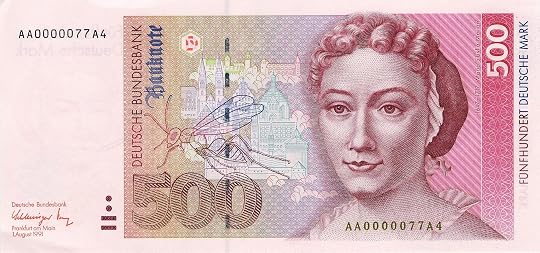
* Much later, Merian was also honored by being put on the 500 deutsche mark note, where she remained until Germany switched to the euro in 1999.
____________________________
PERSONAL NOTE: And I just realized this is my two-thousand-and-first "read" book here on GR, which my sister introduced me to way back in 2012, (and which I'm sure she now regrets). Quite a ride...and we're not done yet!
I've run across Sibylla several times over the years — she's included in both We Are Explorers: Extraordinary Women Who Discovered the World and Explorers' Sketchbooks: The Art of Discovery & Adventure, both by Kari Herbert, daughter of arctic explorer Wally Herbert, himself an insanely talented artist (can see some of his pictures in my review of his biography here: https://www.goodreads.com/review/show...) — and most recently in a reread of the also wonderful Insectopolis: A Natural History. And so decided it was time to learn more about her, and this book absolutely fit the bill, since (as often the case), a biography aimed at precocious children full of illustrations better met my needs than a 400-page text biography.
Maria Sibylla Merian was born in the mid-1600s into a family of artists, and so was able to obtain training unavailable to most women at the time. She produced two famous "books" on caterpillars while living in Germany, ("books" in quotes, because back then they were more like what we'd call folios [I think] today; a collection of single B&W or hand-colored prints that were sold separately to collectors, who then could — or not — take them elsewhere to be bound into a book-like format). She moved to a Calvinist commune in the Netherlands and eventually divorced, raising two painter daughters by herself — again, unusual for the time. Along with her unmarried daughter Dorothea, she eventually traveled to Suriname, which just thirty years earlier had been traded by England to the Dutch for Manhattan at the end of the Second (!?) Anglo-Dutch War.
Over the next two years, she and Dorothea traveled and explored what was largely virgin jungle, endlessly drawing, studying and collecting, (they were as much scientists as artists; Maria has had over a dozen organisms named after her, included two full genera*). After contracting malaria, Maria was forced to return to Holland, where she garnered both scientific and artistic accolades and produced her most famous work, Insects of Surinam. She died in 1717 at the age of sixty-nine, remaining active for all but her last two years, having suffered a stroke. (Shortly before her mother's death, Dorothea moved to Russia where Peter the Great put her in charge of decorating his "room of wonder," which later became the "Imperial [then "Soviet," then "Russian"] Academy of Sciences.")
This book provided a comprehensive overview of Maria's life, accompanied by many large reproductions of her work. It also included "sidebars" on additional timely topics related to painting/printing methods, various insects, slavery in the Americas, other women artists, Calvinism — just a whole bunch of generally fascinating stuff. There is also a considerable bibliography...but I think I'm good; at least for now.
Most highly recommended for absolutely everyone, (as frankly are all three other books mentioned up top).
* Much later, Merian was also honored by being put on the 500 deutsche mark note, where she remained until Germany switched to the euro in 1999.
____________________________
PERSONAL NOTE: And I just realized this is my two-thousand-and-first "read" book here on GR, which my sister introduced me to way back in 2012, (and which I'm sure she now regrets). Quite a ride...and we're not done yet!

December 1, 2017
A gorgeous book about a woman who was way ahead of her time in the fields of entomology and scientific art/illustrations.
I had heard about Maria Merian a couple of times before I saw this book–most notably, I remember her work being featured in Visual Voyages –but didn’t really know her full backstory. She’s someone who deserves so much more recognition, especially since many of her observations of the metamorphosis and life cycle of insects were at least a century or so ahead of her time. Of course, like most other female scientists, her observations were never really taken at scientific value and not believed until male scientists finally discovered or proved the same thing. However, a book like this brings her life into excellent focus and highlights the importance of her contributions.
Being fortunate to have been raised in a family of artists, Maria was able to learn the trade and start incorporating her other love, observing bugs and plants, into her artwork. She recorded detailed observations of the insects she observed or raised, in addition to illustrating them, and even travelled to Suriname to observe tropical species first-hand. Her illustrations didn’t just show a static insect at one stage of life, but rather illustrated the entire lifecycle of an insect, from egg to adult, in one plate. She not only proved that caterpillars hatched from eggs, but also illustrated the relationshisps between insects and the plants they ate, proving how important certain plants were to the insects and how they played into the food chain.
This is billed as a young adult reference book, and while it certainly is written as such, I think it’s a perfect introduction to Maria for readers of any age. The amount of information contained within is quite substantial, and it includes so many plates of Maria’s works that it would also be a lovely coffee table book.
Very highly recommended for natural history, art, and/or bug lovers of all ages!
Thank you to NetGalley for providing me with a free copy to review!
(Cross posted on my blog.)
I had heard about Maria Merian a couple of times before I saw this book–most notably, I remember her work being featured in Visual Voyages –but didn’t really know her full backstory. She’s someone who deserves so much more recognition, especially since many of her observations of the metamorphosis and life cycle of insects were at least a century or so ahead of her time. Of course, like most other female scientists, her observations were never really taken at scientific value and not believed until male scientists finally discovered or proved the same thing. However, a book like this brings her life into excellent focus and highlights the importance of her contributions.
Being fortunate to have been raised in a family of artists, Maria was able to learn the trade and start incorporating her other love, observing bugs and plants, into her artwork. She recorded detailed observations of the insects she observed or raised, in addition to illustrating them, and even travelled to Suriname to observe tropical species first-hand. Her illustrations didn’t just show a static insect at one stage of life, but rather illustrated the entire lifecycle of an insect, from egg to adult, in one plate. She not only proved that caterpillars hatched from eggs, but also illustrated the relationshisps between insects and the plants they ate, proving how important certain plants were to the insects and how they played into the food chain.
This is billed as a young adult reference book, and while it certainly is written as such, I think it’s a perfect introduction to Maria for readers of any age. The amount of information contained within is quite substantial, and it includes so many plates of Maria’s works that it would also be a lovely coffee table book.
Very highly recommended for natural history, art, and/or bug lovers of all ages!
Thank you to NetGalley for providing me with a free copy to review!
(Cross posted on my blog.)

April 23, 2020
This is a great illustrated biography, marketed as a kids’ book but also perfectly appropriate for adults. Maria Sibylla Merian was an early female scientist as well as a skilled artist, whose beautiful and scientifically-accurate paintings of insects and plants illustrate the pages of this book. While little is known about her life, it’s clear that she boldly made her own way in the world, including traveling from Amsterdam to Suriname in 1699, accompanied only by her daughter, to study the metamorphosis of local insects that were unknown to European scientists.
While I have no idea how a child might like this book, I liked it a lot and only in a couple of places (explaining Protestantism was the main offender) found it to be dumbed-down for kids. It’s well put together and the illustrations are simply gorgeous. It includes some of Merian’s insect observations and I learned about some new things, such as the existence of parasitoids: parasites that devour the host, such as flies that lay eggs inside cocoons, which hatch and devour the butterfly before it emerges. If this book doesn’t give a great sense of who Merian was as a person, it’s mostly because very little about her personal life has survived. I read it alongside Chrysalis: Maria Sibylla Merian and the Secrets of Metamorphosis, a fuller biography intended for adults, and I’m glad I did because that book is also great and provides a lot of valuable context. But what better way to read about an artist than in a book illustrated by her own work?
While I have no idea how a child might like this book, I liked it a lot and only in a couple of places (explaining Protestantism was the main offender) found it to be dumbed-down for kids. It’s well put together and the illustrations are simply gorgeous. It includes some of Merian’s insect observations and I learned about some new things, such as the existence of parasitoids: parasites that devour the host, such as flies that lay eggs inside cocoons, which hatch and devour the butterfly before it emerges. If this book doesn’t give a great sense of who Merian was as a person, it’s mostly because very little about her personal life has survived. I read it alongside Chrysalis: Maria Sibylla Merian and the Secrets of Metamorphosis, a fuller biography intended for adults, and I’m glad I did because that book is also great and provides a lot of valuable context. But what better way to read about an artist than in a book illustrated by her own work?

December 13, 2017
I had never heard of Maria Sibylla Merian before, so this was a very interesting intoduction to her life and work. Merian was born in Germany in 1647, and spent her later life in Amsterdam, Holland. This book chronicles her artistic development as well as her scientific exploration. Her specialty was insects -- she would observe all the insects she could find and take notes on their life cycles. She also painted detailed, scientifically accurate pictures of many many insects and plants.
Around 1700, she and her daughter made a scientific voyage to Surinam to study, paint, and collect specimens of native plants and animals, something that was unheard of for a woman in those days -- as the book says, she was a woman "far ahead of her time." She and her daughters published several volumes of paintings, some of which ended up in the collections of the Russian Academy of Sciences.
This book includes many of her paintings (with detailed captions explaining the plants and animals in each one) as well as an overview of Maria Sibylla Merian's legacy at the end -- she's had several organisms named in her honor since her death. The book also includes a glossary and bibliography.
It is inspiring to read about the ways that scientific curiosity and exploration have compelled people (mostly men in those days) to observe, explore, and carefully record the world around them, even long before modern scientific framework or conveniences. It's especially inspiring to read about a woman doing the same thing even when it went against the social expectations of the day.
(Thanks to NetGalley for the review copy.)
Around 1700, she and her daughter made a scientific voyage to Surinam to study, paint, and collect specimens of native plants and animals, something that was unheard of for a woman in those days -- as the book says, she was a woman "far ahead of her time." She and her daughters published several volumes of paintings, some of which ended up in the collections of the Russian Academy of Sciences.
This book includes many of her paintings (with detailed captions explaining the plants and animals in each one) as well as an overview of Maria Sibylla Merian's legacy at the end -- she's had several organisms named in her honor since her death. The book also includes a glossary and bibliography.
It is inspiring to read about the ways that scientific curiosity and exploration have compelled people (mostly men in those days) to observe, explore, and carefully record the world around them, even long before modern scientific framework or conveniences. It's especially inspiring to read about a woman doing the same thing even when it went against the social expectations of the day.
(Thanks to NetGalley for the review copy.)

February 14, 2019
I am reviewing this book for Sarah B. Pomeroy, Jeyaraney Kathirithamby, Getty Publishers, and NetGalley who gave me a copy of their book for an honest review.
Never heard of this great woman but this book was a great eye opener – loved the biography but the marvellous drawings did it for me – what a fantastic book. I could sit and look at the pictures again and again
Never heard of this great woman but this book was a great eye opener – loved the biography but the marvellous drawings did it for me – what a fantastic book. I could sit and look at the pictures again and again

February 2, 2019
I prefer this to Sidman's The Girl Who Drew Butterflies: How Maria Merian's Art Changed Science for a few reasons:
1. The color reproductions are more clear, vibrant, and numerous.
2. There are no goofy poems attempting to express Merian's fascination with nature.
3. The author is not trying to lead us to conclusions with condescending dramatization.
However, I missed the photos of real creatures that were present in the Sidman book on the same topic! Those were great!
Both books used the same metaphor - so obvious; stages of metamorphosis - for chapter headings.
Both books were fascinating and inspiring, and both books left out details that would help readers understand why Merian was so different from the women around her at the time. Or have we misunderstood and underestimated all women in the 17th century?
NOTE: This *is* the book published by the J. Paul Getty Museum.
1. The color reproductions are more clear, vibrant, and numerous.
2. There are no goofy poems attempting to express Merian's fascination with nature.
3. The author is not trying to lead us to conclusions with condescending dramatization.
However, I missed the photos of real creatures that were present in the Sidman book on the same topic! Those were great!
Both books used the same metaphor - so obvious; stages of metamorphosis - for chapter headings.
Both books were fascinating and inspiring, and both books left out details that would help readers understand why Merian was so different from the women around her at the time. Or have we misunderstood and underestimated all women in the 17th century?
NOTE: This *is* the book published by the J. Paul Getty Museum.
This entire review has been hidden because of spoilers.
December 16, 2017
This book is beautiful! The biography was very interesting also, but the images were what really made me like this book so very much! I love that this was written for ages 10+. I plan on having my 11-year-old daughter take a look at this book. I have a feeling we will be buying the physical book. The images will surely be even more beautiful in book format rather than on my computer. I was not familiar with the name Maria Sibylla Merian until now, but I will be researching her and looking to learn more about her and her life

March 26, 2018
Maria Sibylla Merian was a 17th Century German entomologist and artist who had profound effects on the idea of studying insects directly, or in situ, including through their metamorphoses. The daughter and stepdaughter of artists in Frankfurt, Merian took an interest in insects from an early age, studying them and breeding silkworms at as early an age as thirteen. She is considered by modern naturalist Sir David Attenborough to be one of the most important researchers in the field of entomology. Many insects and spiders have been named after her, in honor of her contribution to the field.
This book, which appears to target middle-grade students, offers many examples of Merian's exquisite drawings from nature and biographical information about her rather amazing life, which included traveling with her daughter to Dutch Suriname in the late 1700's in order to study New World insects and spiders. This looks to be a good platform for encouraging interest in budding entomologists, as it touches on the actual scientific exploration process that Merian, unlike many in her day, espoused. (Some of the other artists' contrasting images offered were perhaps less than convincing, however.)
This is a slim volume at 98 pages in the review galley but appears to be a worthwhile addition to any middle grade or high school library.
I received a Digital Review Copy of this book from NetGalley in exchange for an honest review.
This book, which appears to target middle-grade students, offers many examples of Merian's exquisite drawings from nature and biographical information about her rather amazing life, which included traveling with her daughter to Dutch Suriname in the late 1700's in order to study New World insects and spiders. This looks to be a good platform for encouraging interest in budding entomologists, as it touches on the actual scientific exploration process that Merian, unlike many in her day, espoused. (Some of the other artists' contrasting images offered were perhaps less than convincing, however.)
This is a slim volume at 98 pages in the review galley but appears to be a worthwhile addition to any middle grade or high school library.
I received a Digital Review Copy of this book from NetGalley in exchange for an honest review.

October 14, 2019
Maria Sibylla Merian was a woman ahead of her time, a great artist and scientist born in the mid 1600's.
The format of this biography reminded me of a school textbook. Pretty dry, lots of inset pages and captions, but thoroughly informative on Maria Sibylla Merian.
The format of this biography reminded me of a school textbook. Pretty dry, lots of inset pages and captions, but thoroughly informative on Maria Sibylla Merian.

March 1, 2018
A biography of artist Maria Sibylla Merian, born in 1647, showing how she developed a scientific study of insects and other creatures centuries ahead of her time that provided groundbreaking knowledge. Her careful observations connected the multiple stages in the lives of many butterflies and moths, and her illustrations and studies in Surinam brought the Americas to Europe in vibrant color. The book is full of reproductions of Maria Sibylla's amazing illustrations.
This book is incredibly well-researched and is related in a more scholarly style for middle grade and young adult students. I love that they were able to use Maria Sibylla's actual illustrations throughout the book. That really helps to bring the woman to life. I had never heard of her before, but she made some major contributions to science and scientific art in a time when women really didn't have much of a place in the world. She was also rather adventurous for her time, venturing to Surinam from Europe and back to observe the creatures there. It is amazing to realize that she pre-dated Linneaus and that he actually used her works to classify several organisms. In all, a fantastic biography of a woman who made some major contributions to science over 300 years ago!
No content issues.
I received an ARC of this title from the publisher through NetGalley in exchange for an honest review.
This book is incredibly well-researched and is related in a more scholarly style for middle grade and young adult students. I love that they were able to use Maria Sibylla's actual illustrations throughout the book. That really helps to bring the woman to life. I had never heard of her before, but she made some major contributions to science and scientific art in a time when women really didn't have much of a place in the world. She was also rather adventurous for her time, venturing to Surinam from Europe and back to observe the creatures there. It is amazing to realize that she pre-dated Linneaus and that he actually used her works to classify several organisms. In all, a fantastic biography of a woman who made some major contributions to science over 300 years ago!
No content issues.
I received an ARC of this title from the publisher through NetGalley in exchange for an honest review.

Read
April 6, 2018I received this copy from the publisher via NetGalley in exchange for an honest review.
Maria Sibylla Merian lived druing a time when insects were beleived to come into being through spontaneous generation and women were much too tied up with running their households to devote their time to anything else . From an early age, Maria was facintated with butterflies; collecting caterpillars and observing their metamorphosis into butterflies. Growing up in the home of her panter step-father, she was an accomplished artist, As an adult, her books on insects revoluntionized the study of insects and her visit to Surinam introduced Europeans to the wonders of the New World.
Maria Sibylla Marion:Artist, Scientist, Adventurer is a facinating look at the life of an incredible woman. I love antique natural history prints and Maria's artwork was right up my alley. It is amazing to me that she and her daughter traveled to Surinam, at a time when few people left the country of their birth,
The book is beautifully illustrated and contains information about people, places, and events that Maria would have encountered in her own life. A helpful glossary at the end helps with some of the more diffficult terms readers might encounter.
Maria Sibylla Merian lived druing a time when insects were beleived to come into being through spontaneous generation and women were much too tied up with running their households to devote their time to anything else . From an early age, Maria was facintated with butterflies; collecting caterpillars and observing their metamorphosis into butterflies. Growing up in the home of her panter step-father, she was an accomplished artist, As an adult, her books on insects revoluntionized the study of insects and her visit to Surinam introduced Europeans to the wonders of the New World.
Maria Sibylla Marion:Artist, Scientist, Adventurer is a facinating look at the life of an incredible woman. I love antique natural history prints and Maria's artwork was right up my alley. It is amazing to me that she and her daughter traveled to Surinam, at a time when few people left the country of their birth,
The book is beautifully illustrated and contains information about people, places, and events that Maria would have encountered in her own life. A helpful glossary at the end helps with some of the more diffficult terms readers might encounter.
January 11, 2018
What a fascinating biography: When I saw the intricate drawings of flowers and butterflies in all stages of their life cycle, I knew I had seen prints of them before. I just did not know who made them. It is ironic that growing up in Germany I never heard about the studies of Maria Sybilla Merian. As a young girl and later as a woman she was way ahead of her time, applying the scientific method to her work and even travelling for her studies. She lived in a time when most of the girls did not receive much of any formal education and people could be happy to be able to read and write. She was fortunate to be surrounded by an artistic family where she developed her artistic skills and was able to take her time to study nature. This book is wonderful for students grades 5 to 8 and can be used in language arts, science, history and art classes. It belongs in every middle school library. Maria Sybilla Merian sticks out because she lived in a time where mostly men made history. It is about time that we learn more about her. The book is very inspiring.
March 4, 2018
This book is a detailed biography of Maria and in part her family as well. Maria, the daughter and step-daughter, of two talented artists grew up surrounded by art. From an early age Maria learnt how to mix paints, prepare canvases, and eventually developed her own artistic style. Originally basing her artworks on her step-father’s still life paintings she began observing insects in detail and documenting not only their appearance but also their life-cycles. Throughout her life, including marriage and children, Maria continued to explore and expand upon the world’s knowledge of insects through her study.
I had never heard of Maria before seeing this book. It is quite apparent as you read through this book just how exceptional she was for her time in many different ways. She was clearly very dedicated to becoming an artist in her own right, a scientist and entomologist. This is a book that would work in a classroom looking at a variety of topics including women in history, scientists, evolution of scientific processes, observation and documentation in science,
I had never heard of Maria before seeing this book. It is quite apparent as you read through this book just how exceptional she was for her time in many different ways. She was clearly very dedicated to becoming an artist in her own right, a scientist and entomologist. This is a book that would work in a classroom looking at a variety of topics including women in history, scientists, evolution of scientific processes, observation and documentation in science,
April 26, 2018
A beautifully illustrated and clearly written biography of the 17th century scientist, artist and explorer Maria Sibylla Merian. Her scientific illustration is gorgeous and her work influenced many future artists. Merian studied butterfly metamorphosis long before anyone else, and her scientifically accurate paintings were used by Carl Linnaeus to classify species he had never seen. While this book is written for a young adult audience, I think any naturalist or artist will find inspiration in the life and work of Maria Sibylla Merian.
Thank you Netgalley and Getty Publishers for an advanced copy of this book in exchange for a review.
Thank you Netgalley and Getty Publishers for an advanced copy of this book in exchange for a review.
April 24, 2018
Amazing woman. This is an insightful book about Maria Sibylla Merian. She was a great artist/illustrator; her paintings aided Carl Linnaeus in classifying creatures he could not go to see himself. She traveled and painted. Very independent woman. I'd never heard of her before finding this book and think it should be used not only in art and science classes, but in classroom to encourage students, particularly girls. Great book.
I received a Kindle ARC from Netgalley in exchange for a fair review.
I received a Kindle ARC from Netgalley in exchange for a fair review.

May 25, 2018
Fantastic, short, wonderfully illustrated book about an amazing woman! Maria Sibylla Merian was an artist, author, entomologist, and adventurer - a woman very much ahead of her time (16-1700s!). She persistently pursued her scientific and artistic career, traveled and published books, all while raising her two daughters alone as well, who also both became artists. Such a fascinating woman!
May 12, 2018
Beautiful book. Opened my mind to a new world.

August 29, 2018
Gorgeous book and interesting biography about this woman and her life.
March 10, 2023
Works of art and science can be seen and represented in a new light and become inspirational and relevant to life as we see it. This is the case with the wonderful presentation of Maria Sibylla Merian’s life and works by Sarah Pomeroy and Jeyaraney Kathirithamby published in 2018. It was more than 350 years ago when at the age of thirteen, she was inspired by a butterfly’s lifecycle and methodically set out to draw and paint interaction of insects and animals with nature. The paintings not only show how nature thrived in 17th century European gardens but also in South American jungles of Surinam where 40 years after her caterpillar venture, she travelled with her daughter – the voyage alone being a formidable undertaking. Re-discoveries of her works and diaries have inspired current workers in the field and resulted in her portrait being printed on banknotes and stamps in Germany, her country of origin.
May 18, 2021
I picked up this book to look at the pictures and read the entire book in one sitting. Very interesting gorgeous pictures - it is so worth spending the evening with this book. Besides feasting my eyes on Marian's amazing drawings I learned about a remarkable woman, artist, scientist, and adventurer. In 1699 Marian and her daughter Dorothea sailed from Holland to Surinam in South America. They went to explore the jungle and draw what they encountered. The trip was planned for 5 years but illness brought them home early.
Dorothea and her two sisters studied drawing and would sometimes complete their mother's drawings.
So accurate to their mother's style it is often very difficult to tell the drawings of the student from those of the teacher.
For me this was an impulse read that became one of the best books this year.
Dorothea and her two sisters studied drawing and would sometimes complete their mother's drawings.
So accurate to their mother's style it is often very difficult to tell the drawings of the student from those of the teacher.
For me this was an impulse read that became one of the best books this year.
August 30, 2022
This book may have been written for children, but it is a feast for adults, as well, filled with luscious artwork by Maria Sibylla Merian (and her daughters) and straightforward prose about her amazing life. Merian lived in the late 17th Century in Germany and The Netherlands and was famous within the scientific and art communities across Europe. She was a pioneer in the field of entomology and an acclaimed botanical artist, producing many books still in publication with her paintings of insects and plants. She was married and divorced (!), lived for a time in a very strict Protestant commune, travelled across the Atlantic Ocean and lived in Surinam with her daughter for several years to conduct independent research, and operated her own book publication business. Can't wait for my grandchildren to read this book.
November 13, 2020
This book is beautifully illustrated with paintings by Merian as well as her equally skilled daughters. The narrative tells the story of a woman way before her time. In the 1600's there was no place for a woman of ambition and artistic ability. Through her family and her marriages she was able to get training that would have been otherwise unavailable to a woman. She was a woman who let nothing stop her, eventually traveling to Suriname to study her beloved insects as well as plants. She was eventually sought after for her scientific knowledge as well as her detailed paintings of the metamorphosis of many butterflies and moths. This book is very detailed and gives you lots to think about.
March 27, 2023
Beautiful, educational, and thought-provoking - this book was amazing! The artwork and life story of Maria Sibylla Merian is one of my favorite reads of non-fiction these past two years. She was a woman ahead of her time; she was multi-talented; she was inquisitive and bold. Her love of flora and fauna led to a life-long career of exploration into the world of insects, butterflies, moths and other creatures. She was one of the first to document her findings - revealing the unknown about these small wonders to other botanists, scientists and the general public. Having her works revealed to future generations is wonderful. Traveling the world to see her works is a worthwhile bucket list entry.
January 6, 2025
see also The Girl Who Painted Butterflies
A woman entomologist, international traveler and explorer, artist, business woman of the late 17th century? Yes! An interesting life, beautiful and meaningful illustrations -- both of these books on Merian are terrific short reads that include her artwork and portraits of that time period. She illustrated plants and flowers beautifully but became even more interested in the insects that coexisted or sabotaged the plants and included them in the flower art that everyone craved in her culture. Women of the 17th century were integral to the financial viability of their families; surprise, surprise. Read it for beauty, motivation, entertainment.
A woman entomologist, international traveler and explorer, artist, business woman of the late 17th century? Yes! An interesting life, beautiful and meaningful illustrations -- both of these books on Merian are terrific short reads that include her artwork and portraits of that time period. She illustrated plants and flowers beautifully but became even more interested in the insects that coexisted or sabotaged the plants and included them in the flower art that everyone craved in her culture. Women of the 17th century were integral to the financial viability of their families; surprise, surprise. Read it for beauty, motivation, entertainment.
December 7, 2020
Centuries ahead of her time, Maria Sibylla Merian studied and illustrated insects in innovative ways. This book showcases how a young girl with unbounded curiosity changed the way we see our world. Very inspiring for young and older readers alike. I loved it!
I have voluntarily reviewed a complimentary copy of this book which I received through Netgalley. All views expressed are only my honest opinion. I was not required to write a positive review nor was I compensated in any other way. All opinions expressed are my own. I am disclosing this in accordance with the FTC regulations.
I have voluntarily reviewed a complimentary copy of this book which I received through Netgalley. All views expressed are only my honest opinion. I was not required to write a positive review nor was I compensated in any other way. All opinions expressed are my own. I am disclosing this in accordance with the FTC regulations.

November 10, 2022
I loved the abundant images of Merian’s artwork and that is by far the best part of this book. The text is fine, but sometimes repetitive and the frequent additional sections repeated information from the main text and broke the flow of the book. Overall it wasn’t a great reading experience because there’s so much other things going on for each page. Sometimes a two page spread only has a paragraph of actual text for the chapter and the rest is completely filled with images or asides. I’ll rate this highly for the spectacular images, but it was not easy to read.
May 29, 2024
A fantastic introduction to Maria Sibylla Merian. It's suitable for younger readers because they explain terms like entomologist, but it's not written in a goofy style. I thought the amount of material was perfect, they gave an overview of what happened, only going into detail when it was really interesting. And obviously the pictures in the book are excellent. I honestly don't know how a book on this topic could be improved.
Displaying 1 - 30 of 40 reviews