Vítejte v Gothamu. Ve městě plném nejen šílených padouchů, klaunů a tučňáků, ale i mnohem prozaičtějšího zla: feťáků, lupičů, pouličních gangů, drogových dealerů a sériových vrahů. Městě, kde má zlo spoustu tváří. Může vypadat jako sadistický psychopat, který rozřezává ženy na kusy a pohazuje je v popelnicích, nebo jako profesionální zabiják s tajnou misí, za nímž zůstávají desítky mrtvých.
Takovéhle zlo je mnohem nebezpečnější a nepostižitelnější... a zasáhne Batmana mnohem nelítostněji a krutěji, než sám čeká. Temný rytíř po dlouhé době naráží na protivníky, na které možná nebude stačit.
Po knize Batman: Rok jedna přichází Crew s dalšími příběhy z dob, kdy se barvotiskový komiksový hrdina měnil v temného rytíře a kdy se spíš než na monumentální souboje sázelo na ponurou atmosféru drsné školy. Ocitáte se na prahu Batmanova nejtemnějšího... a zároveň nejslavnějšího období.
James P. "Jim" Starlin is an American comic book writer and artist. With a career dating back to the early 1970s, he is best known for "cosmic" tales and space opera; for revamping the Marvel Comics characters Captain Marvel and Adam Warlock; and for creating or co-creating the Marvel characters Thanos and Shang-Chi, Master of Kung Fu. Death and suicide are recurring themes in Starlin's work: Personifications of Death appeared in his Captain Marvel series and in a fill-in story for Ghost Rider; Warlock commits suicide by killing his future self; and suicide is a theme in a story he plotted and drew for The Rampaging Hulk magazine.
In the mid-1970s, Starlin contributed a cache of stories to the independently published science-fiction anthology Star Reach. Here he developed his ideas of God, death, and infinity, free of the restrictions of mainstream comics publishers' self-censorship arm, the Comics Code Authority. Starlin also drew "The Secret of Skull River", inked by frequent collaborator Al Milgrom, for Savage Tales #5 (July 1974).
When Marvel Comics wished to use the name of Captain Marvel for a new, different character,[citation needed] Starlin was given the rare opportunity to produce a one-shot story in which to kill off a main character. The Death of Captain Marvel became the first graphic novel published by the company itself. (
In the late 1980s, Starlin began working more for DC Comics, writing a number of Batman stories, including the four-issue miniseries Batman: The Cult (Aug.-Nov. 1988), and the storyline "Batman: A Death in the Family", in Batman #426-429 (Dec. 1988 – Jan. 1989), in which Jason Todd, the second of Batman's Robin sidekicks, was killed. The death was decided by fans, as DC Comics set up a hotline for readers to vote on as to whether or not Jason Todd should survive a potentially fatal situation. For DC he created Hardcore Station.
This is another crazy 80s Batman story filled with WTF moments, appalling plotting, the boy wonder and PRESIDENT RONALD REAGAN?!
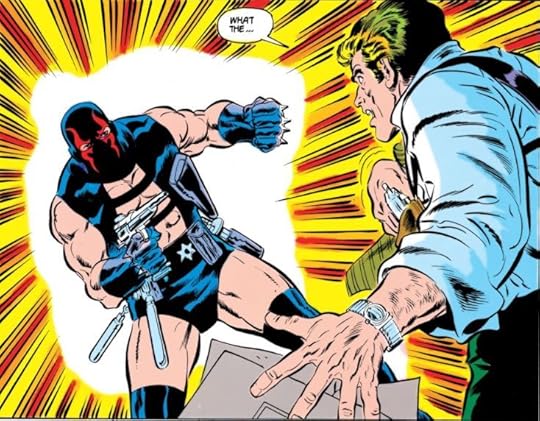
Witness as writer Jim Starlin introduce two villains from two nations every US citizens despised during the 80s: A resourceful terrorist from Iran and a Russian killing machine who will stop at nothing: KGBeast, A master assassin who took leather fetish to a whole new level!
*Spits water*
Together with his terrorist buddy, he will wreak havoc in Gotham city to assassinate ten personals connected to a high profile weapons program. And everyone in KGBeast hit list comes to Gotham even though they know they are being targeted. screw self-preservation, right!
I got to admit that the story started out really good even with all this craziness. The action was spectacular and KGBeast's assassinations were ruthless. It reminded me of Joker's assassinations in both movies and comics, where Batman and the law enforcement knew who the targets were, but still, they were unable to stop the killings.
But then it all goes to hell starting from the third issue, with weird moments like:
(1) KGBeast, while used a nice little ROCKET LAUNCHER to take out a target, decides to stand on top of an elevator shaft and throw concrete blocks one after another to kill another target, instead of throwing a bomb!
(2) KGBeast cuts off his hand instead of cutting the rope. Because that's what macho men do! (3) Let me remind you again: Batman.Kidnaps.The.President.Of.America.
I'm gonna just stop here. The art is fun, but Starlin's writing is not so fun, even with his controversial last act.
3.0 to 3.5 stars. One of my favorite Batman "series within a series" featuring great work by Jim Starlin and Jim Aparo and a superb new villain, the KGBeast.
Good! Jim Starlin honestly wrote some great batman stuff during the 80s, and this one was no exception being the first appearance of KGBeast! My only real complaint is the design of KGBeast, I understand it looked cool in the 80s but now it kind of looks like a bondage outfit Haha. But otherwise very good!
Classic cheesy four parts Starlin/Aparo story. Very brutal and extreme for a late eighties comic, and the Kgbeast is an hell of a cold war vilain. The ending was shocking, unexpected and questonable. Cool aged well Bat-tale.
Una maravilla. Todo lo que tiene que tener un buen Comic de Batman, condensado en cuatro issues de lujo. Y como además este arco argumental tiene un significado especial para mí, va una estrella extra.
Historia entretenida que se lee rápido. Tiene el toque justo de seriedad y bizarrez que tanto me gusta de los cómics de los 70-80. La KGBestia es un villano imposible con un traje estilo BDSM maravilloso. Ya DC y Marvel no hacen cómics así. Una lástima.
Půvabný brak, který v sobě mísí vážný přístup drsné školy (zapadlé uličky, děvky, násilí, vraždy, drogy), špionážního fláku (CIA a KGB spolupracující na chycení ze řetězu se utrhnuvšího elitního zabijáka KGB), hrdinného přesdržkování se bez superschopností či batmanovských gadgetů a to ruku v ruce s Robinem vyloženě do počtu, Reaganem na pokecu s Batmanem či nevyrovnaně napsanými dialogy v překvapivě solidní dějové linii.
Je to typ komiksu, který má nutkavou potřebu každé okénko vyplnit bublinou s textem. Ať již rozhovorem či vnitřním očividné stejně na plnou hubu čtenáři osvětlujícím monologem. Což znamená, že se tu tlachá čistě pro tlachání, postavy sice mluví a mluví, ale nic neříkají a narušuje se tím plynulost. Ovšem to tak nějak patří k osmdesátkovému mainstreamovému komiksu; jakkoli jsou Batmanovy myšlenky (ten tu o svém civilním já přemýšlí jako by to byla jiná postava a forenzní pracovníky tituluje jako šprty!) během městských parkourů dnes již úsměvné. Ovšem má to spád i atmosféru, je to sympaticky nekompromisní a zábavné to je nemálo. A speciálně o finálních dvou číslech bych se nebál říci, že jde přesně o tu podobu Batmana, jak mi sedne ze všech nejvíce.
Velká škoda je odbarvení. Jakkoli miluji černobílou kresbu, tak ne takto uměle vytvořenou. Navíc když je oproti sytými diskotékovými barvami oplývajícího originálu především (zdaleka však nejen) v akci nepřehledná a to až do té míry, že mnohdy nejde vůbec rozeznat, na co se to sakra díváte.
Batman as a quiet and silent puppet in the hands of the government amidst a cold war delirium. Did I accidentaly discovered the worst output by Jim Starlin ever? I worship his cosmic and LSD-inspired works in Marvel as the best cosmic sagas ever written together with Star Wars as well as an accomplishment of maturity (without the sucky, overplayed DARRRRRRRKKKKKK AND GRITTYYYYYYY!11!!!1111!!!!!!11 stuff) in both art and philosophical introspection for the medium, but this is unacceptable, an exercise in painful and absurd conformism from one of the masters if not the master of non-conformism and free thinking assertion in the superhero genre (Alan Moore go to hell). I'll take the Anarchic and Libertarian way of life by Warlock and the tearful rejection of war by Captain Marvel over this any day for the rest of my life. No, Thanks. Only if you can stomach 80's ham-fisted propaganda in form of comic medium.
Ten Nights of the Beast is a four part storyline that ran in 1988, one year after Frank Miller’s famous “Year One” saga helped reboot Batman. This collection can be a bit tough to track down today, but it’s worth the effort as it’s one of the better post Year One storylines out there. As the Soviet Union begins to break down in the last few years of the Cold War, a Soviet super-soldier known as the “KGBeast” appears on the streets of Gotham. The Soviets claim that he’s gone rogue and is acting without orders, although whether they are being truthful is unclear. What is clear is that the KGBeast is a guest on his absolute worst behavior, as he goes on a killing spree intended to weaken America’s “Star Wars” program, targeting U.S. officials up to and including the President of the United States himself.
Despite the fact that he chooses to dress like Ivan Drago in a piecemeal gimp suit, the KGBeast turns out to be a formidable opponent, testing Batman’s limits over their 10 day showdown across Gotham City. Readers who like their Batman stories a bit on the darker side (like yours truly) will particularly enjoy this tale; while it’s by no means as dark as Batman tales can get, the Beast’s rampage takes a heavy toll on Gotham City. The story is extremely well structured and paced, and the final showdown does not disappoint. My only quibble would be with the artwork, which is par for the course with other comics from its era but is simply not my style of choice.
That said, this is a sneaky good Batman story, and one well worth seeking out for fans of the Dark Knight. 4.5 stars, highly recommended!
Muy buena historia con un terrorista ruso y despiadado y un batman muy humano. Jason todd comienza a descontrolarse y a preocupar a Batman y vemos como tristemente acabará.
The story had a lot of potential that I feel was ultimately lived up to more in the character of Bane during knightfall.
The KGBeast was an imposing villain for a time in Batman's career when he had yet to deal with world-class assassins every other day, and there was a lot of fun in the back-and-fourth between them. In particular, the focus on their similar levels of experience gave a good dimension to the conflict, making it feel more like a clash between master tacticians.
The problem is with the story itself. The stakes just weren't there for me. As opposed to an ever escalating plan that unravels as Batman pursues the villain, it's a series of assassinations targeting Americsn intelligence operatives. And if that's the angle, you'd at least hope for a murder mystery? Maybe an inside job? A double agent? Sadly, no. The battle lines are made clear from the start of the story.
What's worse is that Batman is only getting in KGBeast's way, he never feels like a major consideration for the villain so there's no interesting dynamic between them. And nothing is learned about who the KGBeast is. We're never given much more reason to care about stopping him beyond saving the lives of nine guys who I honestly couldn't care less about. Oh and Ronald Reagan. Batman saves Ronald Reagan.
Batman is given more to do in the form of an incompitently run taskforce set up to stop the killings and who don't much care for him, but since Gordon is in his corner all the way, it didn't seem to affect him. It was all a bit of manufactured drama to act as filler since the main villain's presence was only really felt in the admittedly explosive action sequences.
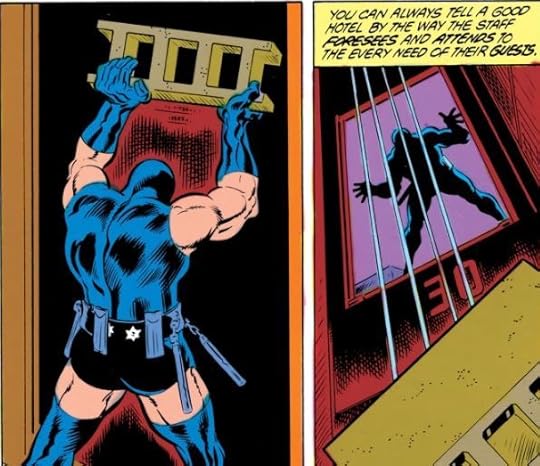
To be fully transparent, I was looking forward to the ending. I knew it was one of the few stories in which Batman can be seen killing someone, so as long as it stuck the landing, I'd be satisfied. I was hoping for more deliberation. More guilt. Batman facing a villain so ruthless that it was either their life or his, and he would forever live with the choice he made. But it kind of just happens. An agent implies it may be necessary beforehand, and apparently, that's all it took. It's a bit chilling, actually. The ruthlessness with which he traps the man with no intention of letting him escape, paired with Jim Aparo's art giving us a sequence of Batman slowly closing the door from KGBeast's perspective is all very potent in a weird way. It'd almost be humanising for the beast if he hadn't cut off his own hand and replaced it with a Canon in cartoonishly evil fashion at the start of the issue.
At the end of the day, no one's ever claimed this to be the greatest Batman story ever told, and I think it's partly on me for building in up in my head so much before hand. But my disappointment is real. So Starlin, Aparo, the Jims, take my two stars and I'll see you after you've exploded me a Robin.
This entire review has been hidden because of spoilers.
Ten Nights of the Beast is a storyline published by DC Comics and introduces Anatoli Knyazev as KGBeast. This story is sandwiched between two bigger storylines in Batman: Year One and Batman: A Death in the Family. Batman: Ten Nights of the Beast collects all four issues of the 1988 storyline of the 1940 ongoing Batman series (Batman #417–420).
A top-secret cell in the KGB called "The Hammer" that had grown too powerful and fearsome for the tolerance of the Russian government sends its top assassin on one last unapproved mission before being dismantled by Gorbachev's reforms. The "KGBeast" is sent to Gotham City to kill nine people crucial to America's Strategic Defense Initiative (the "Star Wars" program), who each will be there within the course of a ten day period. A KGB agent is sent to Gotham to work with the American government in apprehending the Beast, and a team is formed composed of agents from the CIA, the FBI, the GCPD, and unofficially Batman, to determine and prevent the Beast's agenda.
Jim Starlin penned the entire mini-series. For the most part, it is written rather well, it took aspirations from world events and merged them into a comic book story. While merging real events into a comic book storyline severely dates the narrative – especially when using the real current sitting president (at the time) in Ronald Reagan. Notably, it has Jason Todd as Robin, which is one of the few stories we have with him in that role.
Jim Aparo penciled the entire trade paperback. Since he was the main penciler, the artistic flow of the trade paperback flowed exceptionally well. For the most part, I enjoyed his penciling style – it's a tad dated, but done well nevertheless as Aparo is one of my favorite pencilers of that era.
All in all, Batman: Ten Nights of the Beast is well written storyline, which serves as a decent, albeit dated, storyline for KGBeast.
The super villain from Russia comes over to destroy the system, the AMERICAN system, and Batman has GOT to put a stop to it. This leads to some really interesting moments of Batman failing to stop a villain, no matter how much he tries, eventually having to use his "Well I'm too old for this shit so here..." that I kind of loved. Not perfect, but a real solid 80's adventure for Batty. A 3.5 out of 5.
Lo único bueno de esta basura son las portadas de Mike Zeck. El pobre Aparo estaba ya achacoso, y encima las tintas de DeCarlo son malísimas. Starlin, sin comentarios. Propaganda política disfrazada de historia de acción. Y el tontarra este de la KGBestia (que menudo nombre se marcó Jim, por si quedaba alguna duda de por dónde iba a ir la cosa), que parecía que iba a ser la bomba, acabó de matón de tercera.
To jednak batman. Watek KGB, ajatollacha i Reagana naciagany ale bestia spoko. Tutaj pojawia sie tez najglupsza mina Batmana jaka widzialem narysowana :)
OMG THEY MENTIONED STAR WARS!! I LOVE STAR WARS! DISNEY, PLEASE LET ME SUCK MICKY MOUSE'S COCK!
This is a very sleek and cool political action thriller, that incorporates Batman in a brilliant way. It gives you an engaging story about assassins, espionage, and the true test of skills between professionals who are the best at what they do, it's certainly an underrated gem. The story revolves around the KGBeast's mission, who is a rogue KGB agent, killing anyone associated with the star wars programme, an initiative that was actually real, and aimed to put weapons in space, but never took off. Russia is getting blamed for these assassinations, creating a very tense environment among the top dogs, as the Russian government tries to dissuade any association with KGBeast, as the FBI, CIA, and Gotham PD all bicker about how to resolve the problem. The tension between everyone, created a great atmosphere, as these bozos can't protect anyone, and it makes the stakes even higher, because this is a very serious situation, and Batman basically only has Robin to rely on, as even Gordon is being outranked by superiors who hate the dynamic duo. Batman still works with these guys as best he can, but they only get stuff done and save lives, when Batman finally earns the authority to give orders, but he mainly works in the shadows, and only teams up with them when he has to. The government agents work as a source of conflict, a barrier of burocracy that allows inefficiency to dominate over decisive action, and the mole subplot was a neat mini mystery to create further distrust between everyone.
The KGBeast was a formidable foe, and felt like a precursor to Bane, a foreign, masked mercenary, who is fiercely competent and intelligent, and possess the strength and skills to defeat Batman. This is really the only story that highlights the character, he is implied to die at the end, and I suppose wasn't famous enough to bring back in any of the reboots, but it's a shame, and I would be interested in seeing him in an Arkham Origins esque story with a bunch of other assassins. However, this story may be all we have, but what we get shows exactly what makes KGBeast cool. The way he moves about the story and conducts his business, gives him a lot of aura, we can see exactly what he's thinking and how his mind works during the mission, through the art alone, making for very compelling sequences. There is dialogue for when he has more complex thoughts, and that further characterises him as a renegade hitman, who let's no amount of civilian casualties, stop him. He is a completely ruthless monster, who lets no one, not even a school bus of children, get in the way of his mission, willing to sacrifice anyone for the kill, including his own hand. This part of the book was very stupid, Batman has trapped KGBeast's hand with a wire, and law enforcement is on their way, so how does the assassin free himself? Well obviously he cuts off his own hand! The fact he does this, instead of cutting the wire trapping his hand is so dumb, I just burst out laughing. Only a couple of panels ago, Batman establishes that it would take about two to three swings of the axe to cut the wire, and it was already damaged, so why would he sacrifice his hand? Not to mention, it's way harder to cut through your own bone, than a random cable. This whole situation was contrived to give him the arm gun, and despite it being a badass weapon, the circumstance behind it's creation is ridiculous. He's still a cool and intimidating character, but that scene loses him aura.
The portrayal of Batman is really spectacular, and while there is some debate/controversy about the ending, which I'll get to, for the most part, Jim Starling writes the character in a way that makes him so captivating. My favourite aspect is definitely the action sequences, as while Batman fights KGBeast, we get a constant internal monologue of his thoughts, which sounds like it would be annoying, but it's very well written and enhances the action greatly. We've never gotten a better view into Batman's psyche during a fight; in most other stores, we get plenty of explorations into his mental state when he's sad about death or questioning his place in the world, but when it's time to fight, we just see him go ham. This offers something unique, showing how complex and genuinely difficult it is to be Batman; when fighting we hear how Batman employs clever tactics within a one second time frame, barely thinking, just reacting, and has trained himself to react with the most tactically intelligent solution. The endless calculations he's doing in his head, judging the best course of action, which weapons to use, and the fact he's basically memorised the city, knowing every flagpole to catch himself, every wire to swing from, all to increase his odds, it's so god damn cool. This has the added benefit of providing a better understanding of how threatening KGBeast is, as he's also mastered these techniques, and memorised the environment, in a much shorter time span. We are seeing two pros, at the top of their game, duke it out, it's not just a battle of brawn, but brain, and I love how it's written. The thing that drags down the rating however is the final confrontation. It's got an amazing set up, is filled with engaging espionage, and has exciting action, it's really awesome for the most part, but after Batman delivers a cool monologue, and imprisons KGBeast, he just leaves him there, the story ends, and we never see the guy ever again... did Batman kill him?? In an earlier scene, an agent tells Batman that KGBeast basically has diplomatic immunity, being a Russian agent, that country will take him to deal with his crimes internally, leading to him getting away, and coming back, to do more crimes in America. Batman is presented an interesting moral dilemma, because if he doesn't kill KGBeast, he will get away, and Batman doesn't know what to do. So unless Batman checks on this random sewer room periodically to somehow give KGBeast food/water without him escaping through the only door, he just dies in that room in about a week. The book gives us no information after he's locked up too, so unless we want to make up fan fiction, the only valid assumption, given the information provided in the story, is that Batman kills him! What the fuck? That's such a poor way to handle this moral dilemma, having Batman abandon his most sacred principle without ever acknowledging it, a real wet fart of an ending.
The art is still very cool however, this era has a style that make my eyes happy, with the character designs and the city scape all coming together nicely. KGBeast looks epic, especially with his hand gun, and the sense of ever present danger feels very real in each moment, whether it's a simple meeting, or an assassination. Speaking of which, the kill sequences were lots of fun, the variety of methods KGBeast uses kept it fresh, with the subtle poisoning of orange juice, holding as much weight as a rocket launcher. I was very fond of the hotel fight, as the door explodes, and KGBeast throws cinder blocks at the elevator, it was super tense, and shown very well. It does end with the stupid hand decapitation, but that moment is drawn beautifully, and almost makes you forget how dumb it is. The art elevates everything I've talked about, by curating this tense atmosphere and showing everything with finesse and style.
Overall, I really wish this stuck the landing, because it has the potential to be in the S tier of Batman books. It's unique (until Knightfall ripped it off) well written, has an exciting plot, and outstanding characters, who make some very questionable choices, that take me out of the story. Still a great read, and I recommend it overall for everything it does right.
This entire review has been hidden because of spoilers.
Una relectura de un clásico de Batman en mi nostalgia, es de los títulos con los que inicié en el mundo de la lectura de Cómics, donde vemos a Batman enfrentando a agentes de ex KGB de la Antigua Unión Soviética donde conocemos a la KGBestia. Si es un cómic que recomiendo para iniciar con el personaje
Groundbreaking work -- I only go as low as I do because I found some of the attempts at hiding "the big reveal" to be a tad heavy-handed, and because I have become addicted to modern, glossy-paper full-spectrum palette color work, and this is still in the format of a generation back.
Ten Nights of the Beast (#417-420). If you've read the stories of the KGBeast from the '90s and beyond, you probably have the impression of a dull, lumbering oaf, who's just not that interesting. He's totally different here, in his debut appearance. That's because "Ten Nights of the Beast" is the most '80s Batman comic ever. The KGBeast is a premier assassin of the Soviet Union come to kill the prime actors in the Star Wars (SDI) program, including President Reagan. It was likely a shockingly topical story in the '80s, but today it's a wonderful time capsule to a time and place long gone.
Beyond that "Ten Nights of the Beast" is just a good story. It's a tense espionage-adjacent piece, full of CIA and FBI agents and Russian operatives. KGBeast spends the whole comic staying ahead of Batman, who recognizes the Beast as his superior. And then there's the wackiness of bringing Reagan straight into the narrative. Starlin's run remains strong today, but this was a highlight [5/5].
This collection of the 4 issue series is some solid Batman of the era. The core premise - a soviet super-agent who is potentially better than Batman in the area of being an assassin - has a list of the people he needs to eliminate to cripple the SDI "Star Wars" program, culminating with Ronald Reagan. Now, this is a child's presentation of geopolitics, but it is engaging with the world in the way that the Silver Age comics didn't (as per the post crisis mandate) that fits in a world of Super Heroes lensed through Tom Clancy novels. Plus Starlin is a fair and open handed writer in both a 5000 foot high, loosely sketched 'sides of the debate' and in presenting the mystery aspects that make it a proper "oh yeah, Batman is a detective... AND YOU COULD BE TOO IF YOU SPOT THE CLUES" Batman tale. Plus, Jim Aparo's artwork is a gorgeous and distinctive as always. That man provided such clarity to his panel layouts and story flow.
Kniha obsahuje dva příběhy s Batmanem, jakého jsem dosud neznal. Batman zde zcela otevřeně spolupracuje s policií a skoro všichni jsou s tím v pohodě. Je zde občas unáhlený, nedůsledný a nediskrétní. Nemá problém civilistům říct, že kousek dál našli policajti v popelnici mrtvou ženskou. A co mě pobavilo nejvíc, když odchází z místa činu, tak se musí prodírat davem. Ale jinak je to moc povedená kniha. Jeden příběh je detektivní a druhý špionážní. Oba jsou napínavé a pěkně drsné. Mrtvých je tu více, než bývá u Batmana zvykem. Dokonce dojde i na prezidenta Ronalda Reagana. Sice se v knize najde pár nelogických situací, ale je to přece jenom takové milé retro, ve kterém jsem to moc neřešil. I když u nás vyšel tento komiks nevybarvený, tak má moc pěknou kresbu a možná mu ta černobílá podoba naopak prospěla. Za mě spokojenost.
Batman may have met his match in the KGBeast, a rogue Soviet super-assassin with a 10-man Gotham hitlist and a death-arsenal of every move, counter-move, and weapon there is. Originally released as a landmark "series within a series" when the Cold War was in its death throes, "Ten Nights of the Beast" is an admittedly retro thriller, but one no less--and perhaps even more--suspenseful for it. Writer Jim Starlin infuses this fast-moving "black game" (the Beast's own words) with some great set pieces and enough daredevil drama to satisfy any Bat-fan, while veteran Batman illustrator Jim Aparo's drawings bring the excellent script to life. Jason Todd is still Batman's sidekick in this late 80s saga, and he's a good enough Robin that it's hard to remember just why everyone wanted him to bite the bullet so bad. And even though the KGBeast himself is off-scene most of the time, Starlin's mastery of dialogue and detail infuse the killer with more life than decades of writers have been able to do with some other villains from the Caped Crusader's rogues' gallery. The denouement may not be quite as shocking to today's bloodthirstier comics fans as it was when it first hit the bookstores, but it's still a satisfying and surprising conclusion to one of the most exciting Batman stories ever. "Ten Nights of the Beast" is currently out of print, but will surely be re-available in a future best-of collection of Batman classics. A classic by any standard of comic excellence.
What a comic, reading this felt like reading a Batman version of Naked Gun. It's a cold war thriller that's very much of it's time. The plot focuses on president Reagan's Star Wars program and a rogue Soviet agent (clad in BDSM gear) trying to shut it down and kill Ronald Reagan. He's also working with an Iranian suicide bomber.
It's absolutely bonkers and cheesy but enjoyable. KGBeast kills a couple with "a canister of poison gas disguised as orange juice." It's a funny read but I can't say it's held up, especially compared to some other stories that came out around the same time like The Cult.
This entire review has been hidden because of spoilers.
Always heard this one referred to as a Modern Classic so I picked up an aging multi pack with all 4 parts in a collectibles store.
The best way I can think to describe this, is as a 1980s blockbuster movie. There are fiendish plots, rugged set piece battles, outlandish moments and a guest appearance by Ronald Reagan himself.
Sadly, despite words by Jim Starlin, this Cold War era story hasn’t aged well, so you might want to grab something with more modern scripting unless you still have a fondness for 80s style movies.
Septiembre es el mes de Batman, con su día el 23 de este mismo mes. Para celebrar, intentaré releer al menos 23 historias fundamentales de él. 01. Un clásico entre clásicos. KGBeast en la mejor historia que jamás tendrá, escrito por un Kim Starlin fenomenal.
Este tipo de historias hicieron grande a Batman después del Silver Age fijándolo como el icono todo-lo-puede que es ahora.
While this story was supposed to be late 80s gritty it was comically gritty. The KGBeast could be a very cool character but when you bill him as master assassin and dress him like a bondage professional something doesn't click. Added to that is the fact that Batman looks like an amateur for 75% of the story and its a miss for me. Jim Aparo's art is as always, classic. Overall, the book doesn't hold up well.
This is such a cheesy 1980s action plot that I can’t help but be amused. It unravels with even minimal thought applied, so just enjoy the ride. Not one to go out of your way to hunt down unless you’re particularly a KGBeast fan or a fan of that era or a completionist. I must say though that sometimes reading stuff like this reminds me how much stories like “Year One” or “The Dark Knight Returns” stand out.
Not the greatest storytelling. Definitely shows that there were some misses as Batman Year One began influencing comics and stories to make them more grounded. Such a mixed bag here. KGBeast just isn't a good character, definitely not as cool as he is on Arrow where he is an actual human Bratva member and is both ally and enemy of Oliver Queen. He's terrible here.