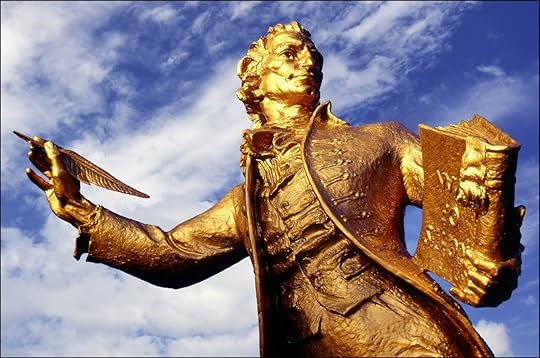
Jump to ratings and reviews
Rate this book

Books That Changed the World

Thomas Paine's Rights of Man: A Biography

Rate this book
Thomas Paine was one of the greatest advocates of freedom in history, and his Declaration of the Rights of Man, first published in 1791, is the key to his reputation. Inspired by his outrage at Edmund Burke’s attack on the French Revolution, Paine’s text is a passionate defense of man’s inalienable rights. Since its publication, Rights of Man has been celebrated, criticized, maligned, suppressed, and co-opted. But in Thomas Paine’s Rights of Man, the polemicist and commentator Christopher Hitchens, “at his characteristically incisive best,” marvels at its forethought and revels in its contentiousness (The Times, London). Hitchens is a political descendant of the great pamphleteer, “a Tom Paine for our troubled times.” (The Independent, London) In this “engaging account of Paine’s life and times [that is] well worth reading” he demonstrates how Paine’s book forms the philosophical cornerstone of the United States, and how, “in a time when both rights and reason are under attack,” Thomas Paine’s life and writing “will always be part of the arsenal on which we shall need to depend.” (New Statesman)

158 pages, Hardcover

First published January 1, 2006

528 people are currently reading
3584 people want to read

About the author

Christopher Hitchens

162 books7,892 followers
Christopher Hitchens was a British-American author, journalist, and literary critic known for his sharp wit, polemical writing, and outspoken views on religion, politics, and culture. He was a prolific essayist and columnist, contributing to publications such as The Atlantic, Vanity Fair, Slate, and The Nation.
A staunch critic of totalitarianism and organized religion, Hitchens became one of the most prominent public intellectuals of his time. His book God Is Not Great: How Religion Poisons Everything (2007) became a bestseller and solidified his place as a leading figure in the New Atheism movement. He was equally fearless in political criticism, taking on figures across the ideological spectrum, from Henry Kissinger (The Trial of Henry Kissinger, 2001) to Bill and Hillary Clinton (No One Left to Lie To, 1999).
Originally a socialist and supporter of left-wing causes, Hitchens later distanced himself from the left, particularly after the September 11 attacks, when he became a vocal advocate for the U.S. invasion of Iraq. His ideological shift, combined with his formidable debating skills, made him a controversial yet highly respected figure.
Hitchens was also known for his literary criticism, writing extensively on figures such as George Orwell, Thomas Jefferson, and Karl Marx. His memoir, Hitch-22 (2010), reflected on his personal and intellectual journey.
In 2010, he was diagnosed with esophageal cancer but continued to write and speak publicly until his death in 2011. His fearless engagement with ideas, incisive arguments, and commitment to reason remain influential long after his passing.

Ratings & Reviews

What do you think?
Rate this book

Friends & Following

Create a free account to discover what your friends think of this book!

Community Reviews

5 stars
910 (31%)
4 stars
1,233 (42%)
3 stars
627 (21%)
2 stars
118 (4%)
1 star
28 (<1%)
Displaying 1 - 30 of 236 reviews
Profile Image for Darwin8u.
1,835 reviews9,034 followers
December 17, 2016
“In a time when both rights and reason are under several kinds of open and covert attack, the life and writing of Thomas Paine will always be part of the arsenal on which we shall need to depend.”
― Christopher Hitchens, Thomas Paine's Rights of Man

description

While there is no imperfect time to read about Thomas Paine or read Christopher Hitchens, 2016 with Brexit and Trump seem to almost BEG for a steroid shot of rationality and intelligence. I read this because I was tired of the news, tired of the discourse, tired of FB debates and arguments that seemed inane and inept (I once saw a debate over some political issue that was carried out entirely using memes). I wondered how we could have dropped from a period where big ideas were discussed by big men (yes, and big women: see Mary Wollstonecraft) to this?

Anyway, about 10 years ago The Atlantic Monthly Press published this book as part of their series Books that Changed the World. Think about this for a minute. Thomas Paine, a largely self-educated son of a corset-maker, wrote a book that would be included on a short list among such books as:

1. Holy Bible: King James Version
2. Machiavelli's The Prince
3. Plato's The Republic
4. Darwin's The Origin of Species
5. The Qur'an
6. Homer's The Iliad/The Odyssey
7. Smith's The Wealth of Nations
8. Clausewitz's On War
9. Marx's Das Kapital

That isn't a lazy peer group. Think about this too. Thomas Paine had his fingers directly in two revolutions (American and French) and was working on a third (England). His words seem almost as natural as the Bible. His concepts are woven into the fabric of our modern sense of freedom, rights, democracy. He is THE prime example showing that simple words, in the right hands, can change the course of global events. Obviously, the French and American revolutions most certainly would have still happened without Thomas Paine, but the revolutions and the ideas behind them would not have been the same. This guy's words were matches of poetry AND power.

It is amazing, also, for me to think Thomas Paine didn't produce just one revolutionary book/pamphlet, but three (more, but I'll focus on his big three). At different times of my life I have loved, reverenced, and revered Common Sense, The Age of Reason, and Rights of Man as THE great Paine book. Each seems destined to continue to be a source of inspiration and direction for those seeking freedom, rights, liberty, and justice. It is hard to imagine my country and the world as it would have been without him. If that isn't tribute enough, here is a final encomium from Bertrand Russell (this appears in the front of the book):

"To all these champions of the oppressed Paine set an example of courage, humanity, and single-mindedness. When public issues were involved, he forgot personal prudence. The world decided, as it usually does in such cases, to punish him for his lack of self-seeking; to this day his fame is less than it would have been if his character had been less generous. Some worldly wisdom is required even to secure praise for the lack of it." - Bertrand Russell, The Fate of Thomas Paine
Profile Image for Riku Sayuj.
660 reviews7,683 followers
April 18, 2015

The Shifting Lights

This book should be read along with Levin’s Great Debate. That will allow a right wing perspective to balance out a left wing perspective. It is very interesting to note how two authors with different viewpoints approach the same two protagonists and mould them to their requirements. With Paine and Burke this is easier because they lived through such momentous events that their ideas and actions can be seen differently depending on where the author chooses to stand.

Levin chooses to stand and judge both from a post-revolutionary viewpoint and exult in the fact that Burke knew the French Revolution would be disastrous while naive Paine precipitated the disaster by not realizing that human institutes and traditions can’t be just pulled down so easily without consequences.

In fact, Levin chooses to examine Burke’s attitudes towards the American Revolution to show his progressive nature and then his attitude to French Revolution to show his wisdom; and Paine’s attitude during the pre-Revolutionary zeal to show how he was just a revolt-monger who has grand plans and no sense of the reality.

Hitchens on the other hand chooses to view the debate from a pre-revolutionary position. This allows him to praise Paine for his contribution the American Independence and Constitution, showing his skills as a spokesman and influencer par compare. When Hitchens comes to Burke, he focuses on his opposition to the French Revolution and ridicules his passionate defense of monarchy. This allows Hitchens to show Paine as a progressive future-oriented leader who changed the course of history and Burke as a reactionary who just wants to hang on to the outdated age of chivalry.

Of course, neither Paine nor Burke were consistently right throughout their political engagement. Both were probably right in supporting the American Revolution and both were perhaps wrong in their over-the-top attitudes to the French Revolution. But Hitchens and Levin combine to show us how just by shifting the viewpoints we can see them in such different lights — the naive and the wise keep shifting before our eyes like in a hall of mirrors. It is a spectacle.
Profile Image for Kevin.
595 reviews215 followers
December 30, 2022
Once or twice in a blue moon, when the celestial purveyors of providence are in alignment, someone you respect and admire will publish a book about someone else you respect and admire (see Robert Crumb’s illustrated Kafka). This is Christopher Hitchens’ Thomas Paine’s Rights of Man.

I hesitantly admit that I can get a little giddy reading Hitchens. He is possibly the closest thing I have to a literary paladin and to say that I value his opinion (although I don’t always necessarily agree with it) is an understatement. I find his arguments persuasive, his knowledge encyclopedic, and his demeanor... well...

“A paradoxical reinforcement of [Paine’s] dissent came from compulsory Bible study at school, supplemented by instruction from Paine’s Anglican mother. He was later to say that he found the teachings of Christianity, especially the human-sacrifice element in the story of the crucifixion, repellent from the start. Freethinking has good reason to be grateful to Mrs Paine for her efforts.”

No legitimate analysis of Rights of Man could be complete without a stanza or two on Edmund Burke. It was, after all, the writings of Burke that enraged and inspired Paine to pen Rights of Man in the first place.

“He [Burke] was attacked in his own day, by both Thomas Jefferson and Thomas Paine, for accepting a small pension from the British government for services rendered. This modest payment was, for them, proof positive that Burke had ‘sold out’ and abandoned his liberal principles. The point is worth stressing, if only because it reminds us that in the view of his contemporaries at least, Burke had had some principles in the first place.”

In expounding on Burke’s political ideologies, Hitch makes mention of the ‘Gordon Riot’ of 1780, an event that I find strikingly and eerily similar to the event in Washington D.C., 6 January 2021.

“...the authorities had completely lost control of London... Lord George Gordon, a rather demented aristocratic demagogue, had raised the mob against a supposed secret Catholic conspiracy, which would rivet the fetters of Rome on honest English folk. This memory was very much alive in Edmund Burke’s mind, and goes far to explain his loathing for mass populism. In the vast crowds mobilized by Gordon, there had been a large contingent carrying American flags and yelling pro-American slogans.”

Burke aside, Hitchens’ take on Paine is one of tempered reverence. He sees Paine as an imperfect but important arbitrator of reason.

“The great achievement of Paine was to have introduced the discussion of ‘human’ rights, and of their concomitant in democracy, to a large and often newly literate popular audience. Prior to this, discussion about ‘rights’ had been limited to ‘natural’ or ‘civil’ rights, and had been limited further to debates between philosophers.”

In summation...

“On 8 June 1809, Thomas Paine died. On 12 February of the same year, Charles Darwin and Abraham Lincoln had been born. These two emancipators of humanity - Darwin the greatest - were in different ways to complete and round off the arguments that Paine had helped to begin.”

Goddamn I miss Hitch.
Profile Image for Sheila Rucki.
2 reviews8 followers
February 21, 2008
He smokes and drinks, is an atheist and actually seems to care about the debate between that old buzzkill Ed Burke and Thomas Pain. Wow.

Plus he writes like a magnificent wreck of a genius with the voice of a sardonic angel. I love this man. I'd read his grocery list.
Profile Image for Warwick.
Author 1 book15.4k followers
June 22, 2021
I was interested to see where Hitchens would come down on the Paine-v.-Burke debate, since both men seem to prefigure Hitch's own career as a public figure. Like Paine, he was an Englishman turned American who became famous as a leftwing firebrand; like Burke, he made a key late switch from liberal to rightwing action, and was perhaps better admired for his rhetorical genius than for being right on the issues.

You can feel his admiration for both men in this short text, which gives it a nice tension – and of course Hitch is too smart to try and adjudicate between them. On the whole, his sympathies are with Paine, whose irreligion and democratic fervour make him an obvious hero for the author – though Paine's arguments are examined with the full critical attention of someone who has plenty to go round. So is his writing style. ‘By the abysmal literary and rhetorical standards of our own day,’ Hitchens says, throwing some typical shade, ‘[Paine's] prose seems to be limpid and muscular and elevated at the same time. But in 1791 it appeared to many loftier critics to be barbarously uncouth.’

Burke, on the other hand, was a master-craftsman when it came to putting sentences together. Hitchens's analysis of Burke is made by means of some wonderful close reading which throws up all kinds of surprising conclusions. Burke's disgust at the replacement, in France, of an aristocracy with a system run by economists and speculators leads Hitchens to class him at one point as ‘an anti-capitalist avant la lettre’, which is an unusual way to read him! Though Hitchens delights in exploring how Paine pulled Burke's arguments apart, he also intercedes whenever he thinks that Paine has overstepped the bounds of reasonable argument – as, for instance, in the suggestion that Burke's government pension made him a shill.

It is a deformity in some ‘radicals’ to imagine that, once they have found the lowest or meanest motive for an action or for a person, they have correctly identified the authentic or ‘real’ one. Many a purge or show trial has got merrily under way in this manner.


(Although I'm pretty sure Hitchens himself was not above such tactics on a few occasions.) The book's structure is a little curious: only the central fifty pages are actually about the Rights of Man, the rest comprising a summary of Paine's life in Europe and America and a quick look at The Age of Reason and his subsequent legacy. Some of this could perhaps have been trimmed in order to make room for some more analysis of the impact that Rights of Man had – there is still not enough sense, here, of quite how far its influence reached and how important it was to the struggle of that generation (as well as many generations that followed).

There are also some ironies in the whole situation that might have been better brought out. The reformers had good reason to be grateful to Burke's attack, since without it, Paine would never have written Rights of Man in the first place – no Burke, no reformers' Bible. To some extent, the two sides of the dialectic needed each other – and perhaps that's something that goes back to the tension Hitchens felt in his own sensibilities. It certainly made him perfectly suited to writing this lucid and insightful introduction.
Profile Image for Theo Logos.
1,268 reviews286 followers
March 24, 2025
”The name of Paine will always be indissolubly linked to those resonant words the Rights of Man. The book which bears that noble title was, however, not just a pean to human liberty. It was partly a short term polemic, directed in particular at Edmund Burke’s Reflections on the Revolution in France. It was also partly a revisionist history of England, written from the viewpoint of those who had gained the least from the Norman Conquest and the successive monarchical coups and usurpations. Then again, it was a manifesto, setting out the basic principles of reform, and if necessary, of revolution.”


While the title of this volume suggests that it is a biography of a book, Rights of Man, Hitchens has written more than that. It is actually a brilliantly concise biography of Thomas Paine, with an expanded focus on his work Rights of Man. Chapter one covers Paine’s life and work in America, including his principle works there, Common Sense and The Crisis, while chapter two deals with Paine and his accomplishments and travails in Europe. He then proceeds to examining Rights of Man in chapters three and four, and for good measure adds another chapter covering The Age of Reason. In a succinct 158 pages, Hitchens gives you all the salient facts of Paine’s career, a deep dive into one of his major works, and an impressive super Cliff Notes on his other famous books and pamphlets.

It’s a treat to observe Hitchens, one of the greatest polemicists of the late 20th and early 21st centuries critique Paine, the greatest polemicists of the 18th century. In examining Rights of Man he picks out Paine’s brilliant rhetorical flourishes, emphasizes his strongest, most salient points, while also showing where he fudges and cheats for the sake of the polemic. He shows both where Paine clearly owned Edmund Burke (whose Reflections on the Revolution in France Paine was responding to) as well as giving Burke his due for points that he scored (most impressively in absolutely predicting the rise of a dominating general who would swallow the revolution).

Finally, Hitchens covers Paine’s last, lean years back in America and considers the great man’s legacy. He closes the book with a reminder of the continued relevance and ongoing importance of Paine and his work:

”In a time when both rights and reason are under several kinds of open and covert attack, the life and writing of Thomas Paine will always be part of the arsenal in which we shall need to depend.”

Profile Image for John Anthony.
941 reviews165 followers
September 11, 2019
Contents:

Introduction
1. Paine in America
2. Paine in Europe
3. Rights of Man Part 1
4. Rights of Man Part 2
5. The Age of Reason
Conclusion: Paine’s Legacy

An excellent introduction to the history of Thomas Paine, his writings and his relevance; told with wit and wisdom. A remarkable man and a remarkable life. It’s hard to disagree with him, writing to George Washington in 1789, when he said (of himself): “A share in two revolutions is living to some purpose”.
Paine certainly lived life to the full, and how..Apparently tipped off by William Blake to flee England and the forces of reaction he narrowly escaped execution in France in the wake of the Revolution there.

This was just the right time for me to read this. Thank you Tom for making sense of the craziness going on all around me these days. One particularly inspiring quote (for me at least):

“I have always strenuously supported the Rights of every Man to his own opinion, however different that opinion might be to mine. He who denies to another this right makes a slave of himself to his present opinion, because he precludes himself the right of changing it”.

I love Paine’s ‘profession of faith’ too and can well relate to it:

“I believe in one God, and no more; and I hope for happiness beyond this life.
I believe in the equality of man, and I believe that religious duties consist in doing justice, loving mercy and endeavouring to make our fellow creatures happy...
I do not believe in the creed professed by the Jewish church, by the Roman church, by the Greek church, by the Turkish church, by the Protestant church, nor by any church that I know of. My own mind is my own church.
All national institutions of churches, whether Jewish, Christian, or Turkish, appear to me no other than human inventions set up to terrify and enslave mankind, and monopolize power and profit”.
Profile Image for A.J..
136 reviews51 followers
March 23, 2010
There may be no better candidate to write a biography of Thomas Paine than Christopher Hitchens. If not for purely academic reasons, they have much in common. Both were natural born Enlgishmen who wandered to the United States and liked it so much that they decided to stay. Both are world famous for the arcane art of polemics. Even their careers strangely mirror one another, marking an evolution from politics to religion, though never surrendering either. And lastly, both made it their life's ambition to pursue freedom at great personal cost.

I've read much of Hitchens' work. He rarely is carried away by passion unless by design, but here one can clearly see the markings of a great respect and reverence for his subject. Thomas Paine was imperfect. He had his blunders, personal and political. In fact he almost lost his place among the founders when his opinions on religion (specifically the bible) became too radical for his adopted American homeland to stomach. In some respects this injustice still stands, but many efforts have been made in recent times to see that he is rightly placed among the Jeffersons and Madisons of the American Revolution.

Paine was an abolitionist and a vocal one. He went to the place Thomas Jefferson saw dimly through the fog but never dared to go himself. While France was in the throes of its own revolution he urged that they exucute the monarchy, not the monarch--one wonders how history might have changed if they'd listened to him. His prose was by the standards of the day coarse, almost barbaric, something I imagine Hitchens also contends with when his style of demystification gouges the subject of readers' most sacred beliefs. Yet Paine's ability to reach the common man in common language without sacrificing the muscle and brute force of his argument should, as I've mentioned in previous reviews of his work, be the blueprint for written argument.

In a strange way we have Paine to thank for a number of things, not the least of which is his crucial role in the American Revolution. His long-fought battle for the sake of reason and Enlightment principles has only become more valuable as time goes on; and, of course, his quest to defend the Rights of Man in the Age of Reason.
Profile Image for Vik.
292 reviews352 followers
August 20, 2016
"In a time when both rights and reason are under several kinds of open and covert attack, the life and writing of Thomas Paine will always be part of the arsenal on which we shall need to depend."

I must beseech a disclosure that my review for this book should not be trusted as the book is written by my literary hero about my philosophical hero. So a certain degree of emotional and intellectual romance is natural and automatic.

Thomas Paine had a hand in two greatest revolution- French & American. He took considerable risk to spread enlightenment through self-printed pirate edition of his famous work Common Sense. He was the inspiration of Thomas Jefferson, Dr King and Lincoln. Above all he is the first men to use words man and rights in same sentence, which inspired the concept of Human rights.

Edmund Burke, a man who was an ally of India, famously impeached Warren Hastings (the first Governor-General of Bengal) for corruption and the crimes he committed under the banner of The East Indian Company. I have deep admiration for Burke's heroic and humane actions but he was blind-folded with Christianity- he defended dictatorship, monarchy and authority, and criticized french revolution. Thomas Pain defended french revolution, human rights, democracy and freedom of expression. They had a literary battle that ranges to endless exchange of letters. Today, we have everything what Paine stood for and hence he is vindicated.

To me, Paine's writing-Common Sense, rights of Man, Age of Reason and The Crisis- is the jewel in the crown of enlightenment. Perhaps, Christopher was wrong in saying, "Had there been no guillotine and no Bonaparte in the immediate future of France, Paine's rebuke to Burke might have been studied to this day as a proof of the superiority of the Enlightenment and of radicalism over the hidebound attachment to tradition, faith and order.", I feel regardless of guillotine and Bonaparte, Paine is still a wonderful proof of splendid triumph of the reason over faith.


Profile Image for Julian Worker.
Author 44 books452 followers
January 30, 2023
Thomas Paine was one of the greatest advocates of freedom in history and his Declaration of the Rights of Man, first published in 1791, is the cornerstone of his reputation.

Christopher Hitchens demonstrates how Thomas Paine's book forms the philosophical framework for the United States of America.

Hitchens covers Paine's life from his early days working as an excise man in England before moving to America where he made influential friends and enemies and where he lit the fire that caused the Americans to overthrow their colonial power.

Moving to France, Paine became influential in their revolution too, although he almost fell victim to The Terror of Robespierre's police. A careless gaoler marked his door with the sign that the occupant was to be executed, but luckily for Paine the door was open at the time, and so the mark appeared on the inside where no one could see it. Paine survived and was released and ensured his safety by staying with the American ambassador to France, a certain James Monroe, later to become 5th President of the USA.

Paine moved back to America and suggested to then President Thomas Jefferson that he purchase Louisiana, which of course is what happened a few years later, although Paine was hoping that the land would be worked by hard-working and thrifty German immigrants plus black families from other states who could purchase their own land there. Unfortunately, the sugar industry interests triumphed and slavery was introduced here too, meaning there were more slave states than free states, making a future civil war almost certain.
Profile Image for Andy.
13 reviews5 followers
April 1, 2008
The best chapter is on Paine's 'Age of Reason', where Hitchens clearly takes great pleasure in recounting Paine:

[Hitchens]
He also cannot decide whether the supposed preachings of the Nazarene are admirable or not. In general, he follows the custom of most deists in rating the sermons and maxims as moral and 'amiable'. Yet he cannot conceal his contempt for the most central tenet of Christianity, which is the morally hideous concept of scapegoating or 'vicarious atonement':

[Paine]
If I owe a person money, and cannot pay him, and he threatens to put me in prison, another person can take the debt upon himself and pay it for me. But if I have committed a crime, every circumstance of the case is changed. Moral justice cannot take the innocent for the guilty even if the innocent would offer itself. To suppose justice to do this, is to destroy the principle of its existence, which is the thing itself. It is no longer justice. It is indiscriminate revenge.

[Hitchens]
In other words, to hope to throw your sins upon another, especially if this involves a human sacrifice, is a grotesque evasion of moral and individual responsibility.
Profile Image for K.J. Wetherholt.
Author 20 books7 followers
February 2, 2012
One of Hitchens' most earnest and least pompous works. His style at times can be irritating and prohibitive, as though needing to flash his intelligence so distinctly as though to belabor its presence. Many times, my response is to silently admonish him and say, "Quit showing off and say what you mean."

This is not the case here. His prose was clear, intelligent, and unadorned with unnecessary verbiage. This is either a testament to his profound respect for Paine, or an editor took one hell of a scythe to his usual style. But I'm guessing he felt the need to be earnest and even perhaps idolizes Paine enough so that Paine's words are not outshone. Instead the real sense of Paine's character, intellect, and no-nonsense sensibilities are profound, indicating truly why his work was so influential in Enlightenment thought. You can tell, too, that Hitchens is proud that like him, the man who is clearly one of his greatest heroes was born in England but was distinctly an American by the end of his life, enough to fight for the soul of the new republic, much like Hitchens did in his own life, and for his adopted country, the United States, two hundred years later.
Profile Image for William2.
859 reviews4,046 followers
May 9, 2011
This is a good introduction to Thomas Paine (1737-1809) and his works. It's main strength is the explication of the war of criticism waged between Paine and his conservative British (Tory) rival, Edmund Burke. Burke was a Monarchist who while possessing sympathy for the American Revolution was appalled by the French one. He is the perfect foil against which to expatiate upon Paine's modern sense of the common man's inalienable rights. Paine's Common Sense and Age of Reason are also summarized and their literary-historical status delineated. Paine's overview of biblical inconsistencies in the latter work must have been especially fun for Hitchens--that staunch atheist--to discuss at length. Highly recommended.
Profile Image for Nick.
159 reviews22 followers
November 3, 2019
I will be generous and assume that Hitchens was not responsible for the laughable decision to put Hitchens's Sears Photo Department portrait on the cover of a book about another, far more famous man's book. It really is generous of me, though, because none of the other volumes in the series to which this book belongs (Atlantic Books' "Books that Shook the World") follow the pattern: for some reason Harvard historian Janet Browne is not staring out from the cover of the Darwin book, for example.
Profile Image for Jeremy.
663 reviews37 followers
January 31, 2011
Apparently Thomas Paine was the man. This one is a little more straightforward and easier to read than the Jefferson book by Hitchens.

Quotes:

“Tyranny, like hell, is not easily conquered; yet we have this consolation with us, that the harder the conflict the more glorious the triumph. What we obtain too cheap, we esteem too lightly.” Thomas Paine

In the United States, he had sought to make the revolution more radical, especially with respect to slavery and freethinking and the extension of democracy, and had been on the ‘Left’ side of the debate. In France, he had sought to make the revolution more temperate and humane, taking his place to the ‘Right’ of the chair.

He admired enterprise and distrusted government, and often wrote of economic inequalities as if they were natural or inevitable.

“The aristocracy are not the farmers who work the land, and raise the produce, but are the mere consumers of the rent; and when compared with the active world are the drones, a seraglio of males, who neither collect the honey nor form the hive, but exist only for lazy enjoyment.” Thomas Paine

Paine wanted to prevent the French Revolution from becoming a full-blown instatement of atheism. Much as he may have welcomed the end of the rotten alliance between the pulpit and throne, he was dismayed by the violent rush towards godlessness.

“My own mind is my own church. All national institutions of churches, whether Jewish, Christian, or Turkish, appear to me no other than human inventions set up to terrify and enslave mankind, and monopolize power and profit.” Thomas Paine

Even as late as my own childhood, the Church of England hymnal included as one verse in ‘All Things Bright and Beautiful’:
The rich man in his castle
The poor man at his gate
God made them high and lowly
And ordered their estate.

In a time when both rights and reason are under several kinds of open and covert attack, the life and writing of Thomas Paine will always be part of the arsenal on which we shall need to depend.
Profile Image for Dimitri.
1,003 reviews256 followers
December 2, 2022
A decent introduction to Thomas Paine vs. Robert Burke (whose "the only thing necessary for the triumph of evil..." quote has a VERY different meaning in the original)... but unlike, say, the volume on Adam Smith's the Wealth of Nations in this series, you do not come away with a clear understanding of the book itself. Or books. Common Sense and the Crisis are much intertwined here.
Profile Image for John.
767 reviews2 followers
January 13, 2020
Hitchens, as usual is always readable. Although I learned a bit (or were reminded of things I had forgotten), especially about the dispute between Burke and Paine, ultimately I had the feeling that this work was tossed off by an expert wordsmith without much research. But its a short work, so I don't hold it against him too much.
Profile Image for Gendou.
633 reviews332 followers
August 18, 2023
I followed Hitchens for his athiests content. But so obsessed am I that I read this historical biography just to hear more of his words. It really isn't a very interesting topic for me, British and early American history. But it's well written, so anyone who loves history will like this book.
Profile Image for denudatio_pulpae.
1,589 reviews34 followers
November 11, 2025
Christopher Hitchens tym razem przybliża nam postać Thomasa Paine’a, brytyjskiego myśliciela i filozofa, autora dzieł politycznych, takich jak „>"Zdrowy rozsądek" (ang. „Common Sense”), „Prawa człowieka” (ang. „Rights of Man”) oraz „Wiek rozumu” (ang. „The Age of Reason”).

Thomas Paine zachęcał do uwolnienia się brytyjskich kolonii w Ameryce i stworzenia niepodległego państwa, poparł rewolucję francuską, był gorącym orędownikiem praw człowieka, nawoływał do zniesienia niewolnictwa i był przeciwnikiem monarchii.

Jako autor biografii Hitchens nadal nie potrafi porzucić swojego gorącego i chaotycznego stylu, więc trudno mi było momentami skupić się i odnaleźć. Mimo to warto zapoznać się z książką dla samej postaci Thomasa Paine’a.

Redukcjonizm Paine’a czasem go zawodzi. Nie może się zdecydować, czy rzekome nauki człowieka z Nazaretu uznać za godne pochwały, czy nie. Ogólnie rzecz biorąc, podobnie jak większość deistów, uważał, że przykazy i maksymy zawarte w Biblii są raczej pozytywne z etycznego punktu widzenia. Jednakże centralne założenie chrześcijaństwa napawało go odrazą. Chodzi tu mianowicie o moralnie odrażającą koncepcję kozła ofiarnego czy też „zastępczego odkupienia”.

»Jeśli winien jestem komuś pieniądze i nie mogę zwrócić długu, mój pożyczkodawca zaś grozi mi więzieniem, ktoś inny może wziąć mój dług na siebie i spłacić go. Jeśli jednak popełniłem przestępstwo, sprawa wygląda zupełnie inaczej. Sprawiedliwość moralna nie może wymierzyć kary niewinnemu zamiast winnemu, nawet jeśli niewinny sam o to prosi. Gdyby traktować sprawiedliwość w ten sposób, żadnej sprawiedliwości by nie było; zamieniłaby się ona po prostu w ślepą zemstę.
Innymi słowy, zrzucanie własnych grzechów na kogoś innego, zwłaszcza gdy zakłada to ludzkie poświęcenie, jest groteskowym uchylaniem się od indywidualnych zobowiązań etycznych«”
.
7/10
Profile Image for Eric G..
57 reviews37 followers
February 1, 2021
Christopher Hitchens's biography writing is stellar. Hitchens never seems to miss small historical facts that bridge on fables, and thus, makes any reading concerning historical personalities that much more interesting to read about. This book is especially unique in its recollection of feuds, arguments, and conflicts that followed Paine throughout his life. The writing in this short book is concise yet dense. Hitchens does a superb job summarizing main points that Paine emphasized throughout his work along with depicting who and what may have influenced his thought. Hence, the reader gets an equal dose of information, theory, and historical context. Foremost among such example is the details surrounding Paine's travels, and how the political situations of any given country affected his perspective, and the most famous feuds that served as catalysts for his revolutionary thinking. One may recall here Paine's notorious feud with the father of ideological Conservatism Edmund Burke - a feud which drove much of Paine's responses in his Rights of Man. All in all, the book is a quick read but is filled with Hitchen's penchant for quirky anecdotes, brilliant analysis, and limitless intelligence - he never backs away from making apt philosophical and/or political comparisons and thus demonstrates his commandment of the subject matter. This is done humbly but effectively, all with due respect for Thomas Paine, which is the reason why I relish his historical/biographical writing that much much.
Profile Image for Joy.
813 reviews2 followers
January 21, 2024
A bit disjointed overall, but an easily read account of Paine's role in the American Revolution.

Edit for second read:

I went on a bit of an American history bender last year. It was better learning about history as an adult than a child still in school. I began to learn bits and pieces about the French Revolution in other places. A little about European history in general. Not from fiction or folk history, which has always interested me, but from documentaries.

A couple of nights ago, scrolling through books, I came across this Hitch Book, and knew that it was worth a re-read. It isn't disjointed, it's told in chronological order. It's not about Paine's role in the American Revolution. The subject is The Rights of Man as an idea, how Paine picked the seeds of revolution, sowed them, and then spread them through pamphleteering and discussion with other intellectuals. Along the way, he made enemies and close friends. He confronted religious bigotry (Adams, of course. Now I remember why I have a vague dislike of him.) and asked all the right questions of divine inheritance.

Hitchens essentially wrote a pamphlet about the pamphlet. I wanted more, but time moves fast in a pamphlet. With my expanded knowledge of both the American and French Revolutions, this made so much more sense to me.

As always with Hitch, I hear his voice when I read his work and miss having something new of his brilliant writing.
Profile Image for Maughn Gregory.
1,287 reviews51 followers
September 25, 2012
Hitchens is a master philosopher / historian, who credits Thomas Paine with getting non-philosophers in Europe and America to talk about, and work and fight for, the idea of human rights that even governments and churches are obliged to honor. Paine also argued for church-state separation, against the authority (and morality) of the Bible, and against slavery and Native American genocide. Today, when Paine's philosophical, anti-liberal foe Edmund Burke is still being quoted by the likes of David Brooks, it's good to revisit Paine.

Very poignantly, Hitchens wrote about the "buzzards" that circled Paine's deathbed, expecting and urging him to recant his anti-Christian views, six years before he himself was diagnosed with cancer and suffered the same kind of abuse. He writes: "Why this was thought to be valuable propaganda it is impossible to say. Surely the sobbing of a human creature in extremis is testimony not worth having, as well as testimony extracted by the most contemptible means?" (139) Hitchens followed Paine's noble example and "expired with his reason, and his rights, both still staunchly defended until the very last" (140).
Profile Image for Tim.
160 reviews8 followers
September 7, 2007
A brilliant overview of Rights Of Man and the life of Tom Paine from a brilliant author.
Profile Image for Jeff Koeppen.
688 reviews53 followers
September 30, 2023
What could be better than reading the eloquent Christopher Hitchens's writings about the underappreciated founding father of America, Thomas Paine? Well, since I listened to it on Audible it would've been better if Hitch had narrated it back when he wrote it. The narrator, Simon Vance, was excellent and has a pleasant English accent so after a while I pretended I was listening to Hitch.

Paine emigrated from England to America in 1774. This is a short biography which focused mostly on Paine's life during the American and French Revolutions, further focusing on Paine's famous book Rights of Man written in 1791 which, at a high level, opined that people are born with human rights at birth and the government's only purpose is to safeguard these rights; and if the government does not uphold the rights of its people revolution is justified. This book was written as a response to a publication by Edmund Burke which attacked the French revolution during this time. Having been instrumental in America's revolution and resulting government, he was very supportive of France's effort and made numerous trips to France after the American revolution to support the cause.

Any American school kid knows that Paine was instrumental in rousing support for the American revolution. His book Common Sense was published in January 1776, and it attacked the British monarchy and outlined reasons for a free country took the Colonies by storm and whipped up support for the revolution which had just started.

While in France supporting their revolution Paine was arrested and imprisoned for almost a year by the French government who rejected his American citizenship and claimed he was an Englishman by birth and therefore technically at war with France. After being released from prison in 1794 through the assistance of new American representative in France, James Monroe, he wrote my favorite of his books, The Age of Reason. This masterpiece was years ahead of its time. In it Paine takes on organized religion and the very legitimacy of the Bible. Paine pointed out how wrongly powerful the christian churches had become and pointed out that the Bible was a man-made creation and not a production of any divine entity, nor influenced by one, and he rejected all miracles. Paine was a deist. For an 18th century writer to demolish organized religion, especially Christianity, and miraculous beliefs so effectively was really impressive (many decades before Robert Ingersoll took the baton), and this book was also a hit amongst American citizens and resulted in growth in deism. The Age of Reason is a fantastic work, and Hitchens devotes a good deal of time relating examples of Paine's train of thought on a number of religious subjects and explaining how influential this was for its time, when most citizens were under the yoke of religion and accepted miraculous beliefs without question.

Hitchens' book ends with a conclusion which talks of Paine's legacy. He gradually withdrew from society but would pop up to support causes he believed in like the expansion of the US west and the fight against slavery. Paine died at home in great pain. On his death bed, he sent away two Presbyterian ministers who showed up uninvited and pushed past his housekeeper to try to convince Paine to accept Jesus Christ and save himself. Hitchens states, "thus he expired with his reason and his rights both still staunchly defended until the very last". Paine has no burial site. His corpse was dug up in 1819 and parts of him were reportedly taken to different places. This is a story in itself.

In February 2022, Congressman Jamie Raskin of Maryland along with eight of his House colleagues, introduced legislation to authorize the construction of a memorial in Washington DC for Paine.

Raskin's statement: “Tom Paine was a person so far ahead of his time that his work still challenges us in significant ways today to build a more democratic society. This luminary patriot of the Enlightenment and the American Revolution inspired people in the colonies not only to overthrow the tyranny of faraway kings but to launch a nation founded on principles of democratic self-government, the rights of men and of women, and reason and science. Despite his catalytic role in founding America and our constitutional republic, Paine remains too often on the dark outskirts of history. It is way past time for Congress to give Paine the central place of respect and awe he deserves in our Nation’s Capital. This memorial to Paine—amazingly, already pre-funded with a flood of voluntary contributions and pledges from private citizens—will be a powerful and dramatic addition to the symbolic life of Washington, D.C.”
Profile Image for Alberony Martínez.
599 reviews37 followers
October 21, 2020
Siendo un polemista, una fiera en la argumentación, sus detractores siempre tenían cierto respecto ante Christopher Hitchens, a quien le concedían las cualidades de honesto y valiente. Un escritor que la verdad le era tal como él quisiese que fuese, sin importa que agrade u ofenda. No es de menos esperar que entre su ínterin investigativo se avocara a estudiar la obra de Thomas Paine, un influyente y revolucionario de las ideas y pensamiento político, y es en este libro que enlaza una biografía, critica y filosofía del mismo.

Hitchens presenta vívidamente a Paine y su Declaración de los Derechos del Hombre, la principal defensa de la democracia en el mundo. Una respuesta indignada al ataque de Edmund Burke a la Revolución Francesa, el texto inmortal de Paine es una defensa apasionada de los derechos inalienables del hombre y la clave de su reputación. Desde el día de su publicación en 1791, la Declaración de los Derechos del Hombre ha sido celebrada, criticada, difamada, suprimida y cooptada. Pero en Los derechos del hombre de Thomas Paine, Hitchens se maravilla de su previsión y se deleita con su polémica. Famoso como polemista y comentarista provocador, el propio Hitchens es un descendiente político del gran panfletista. Aquí, demuestra cómo el libro de Paine se convirtió en la piedra angular filosófica de los Estados Unidos de América, y cómo "en un momento en que tanto los derechos como la razón están bajo varios tipos de ataques abiertos y encubiertos, la vida y la escritura de Thomas Paine siempre serán parte del arsenal del que tendremos que depender ". Animado por la extraordinaria prosa de Hitchens, este "manual elegante y útil ... aún debería interesarnos a todos" Paine, como señala Hitchens en esta apreciación lúcida y de rápido movimiento, no tiene un memorial adecuado en ninguna parte; este libro esbelto es un buen comienzo.

Es un excelente texto que merece la pena leerlo, pues una vez mas demuestra la lucidez de Hitchens cuando trata el pensamiento de Paine en su lucha contra el racismo, la esclavitud, el sexismo y dogmatismo religioso.
Profile Image for Gavin.
566 reviews43 followers
April 14, 2018
I very much enjoyed this audiobook and seriously, who better to write a bio/critique of Thomas Paine i our day than Christopher Hitchens?

A New Yorker review of the time of this publishing written by Jill Lepore opined: "Thomas Paine is, at best, a lesser Founder. In the comic-book version of history that serves as our national heritage, where the Founding Fathers are like the Hanna-Barbera Super Friends, Paine is Aquaman to Washington’s Superman and Jefferson’s Batman; we never find out how he got his superpowers, and he only shows up when they need someone who can swim."

Be that as it may, he wrote the all-time best selling pamphlet, and probably inspired as many colonists to join the cause as all of the Founders. If an exaggeration, I apologize. Moving on, I'll just say that Thomas Paine lived a life that is made for a novel or movie and happens to few people today.

I find interesting here that Paine could write while in prison and quote the Bible verbatim, but has all kinds of issues with it. I realize that is part and parcel of the times to know the Bible, and Hitchens gives Paine some grief about using something that he was not clear about denouncing, but still impressive.

All in all, I have listened to this twice and might at least once more before my Hoopla time is up. Audio is still a chore as I like to mark and annotate, but perhaps I understood this best of all audios so far. I only wish Hitch had been the narrator.
Profile Image for Catherine  Mustread.
3,031 reviews95 followers
May 11, 2021
“Thomas Paine was one of the greatest advocates of freedom in history, and his Declaration of the Rights of Man , first published in 1791, is the key to his reputation. Inspired by his outrage at Edmund Burke's attack on the French Revolution, Paine's text is a passionate defense of man's inalienable rights. Since its publication, Rights of Man has been celebrated, criticized, maligned, suppressed, and co-opted. But in Thomas Paine's Rights of Man , the polemicist and commentator Christopher Hitchens, "at his characteristically incisive best," marvels at its forethought and revels in its contentiousness ( The Times , London). Hitchens is a political descendant of the great pamphleteer, "a Tom Paine for our troubled times." ( The Independent , London) In this "engaging account of Paine's life and times [that is] well worth reading" he demonstrates how Paine's book forms the philosophical cornerstone of the United States, and how, "in a time when both rights and reason are under attack," Thomas Paine's life and writing "will always be part of the arsenal on which we shall need to depend." ( New Statesman )
Displaying 1 - 30 of 236 reviews

Can't find what you're looking for?

Get help and learn more about the design.