

What do you think?

Tropic of Squalor
A new volume of poetry from the New York Times bestselling and esteemed author of The Liar’s Club and Lit.
Long before she earned accolades for her genre-defining memoirs, Mary Karr was winning poetry prizes. Now the beloved author returns with a collection of bracing poems as visceral and deeply felt and hilarious as her memoirs. In Tropic of Squalor, Karr dares to address the numinous―that mystery some of us hope towards in secret, or maybe dare to pray to. The "squalor" of meaninglessness that every thoughtful person wrestles with sits at the core of human suffering, and Karr renders it with power―illness, death, love’s agonized disappointments. Her brazen verse calls us out of our psychic swamplands and into that hard-won awareness of the divine hiding in the small moments that make us human. In a single poem she can generate tears, horror, empathy, laughter, and peace. She never preaches. But whether you’re an adamant atheist, a pilgrim, or skeptically curious, these poems will urge you to find an inner light in the most baffling hours of darkness.
This is not quiet, polite poetry—this is a bare-knuckled conversation with the divine.
Poems about Faith and Karr’s signature voice wrestles with belief and meaninglessness, creating a space for both the adamant atheist and the hopeful pilgrim.Confessional From loony bins to family trauma, these verses are as visceral, unflinching, and deeply personal as her bestselling memoirs, The Liar’s Club and Lit.Dark Humor and Raw Find laughter, horror, and empathy in the same poem. Karr never preaches, but instead invites you into the psychic swamplands to find hard-won peace.Unconventional A collection that dares to talk to God, Jesus, and the divine with a brazen, unfiltered voice that speaks to the most baffling hours of darkness.
Long before she earned accolades for her genre-defining memoirs, Mary Karr was winning poetry prizes. Now the beloved author returns with a collection of bracing poems as visceral and deeply felt and hilarious as her memoirs. In Tropic of Squalor, Karr dares to address the numinous―that mystery some of us hope towards in secret, or maybe dare to pray to. The "squalor" of meaninglessness that every thoughtful person wrestles with sits at the core of human suffering, and Karr renders it with power―illness, death, love’s agonized disappointments. Her brazen verse calls us out of our psychic swamplands and into that hard-won awareness of the divine hiding in the small moments that make us human. In a single poem she can generate tears, horror, empathy, laughter, and peace. She never preaches. But whether you’re an adamant atheist, a pilgrim, or skeptically curious, these poems will urge you to find an inner light in the most baffling hours of darkness.
This is not quiet, polite poetry—this is a bare-knuckled conversation with the divine.
Poems about Faith and Karr’s signature voice wrestles with belief and meaninglessness, creating a space for both the adamant atheist and the hopeful pilgrim.Confessional From loony bins to family trauma, these verses are as visceral, unflinching, and deeply personal as her bestselling memoirs, The Liar’s Club and Lit.Dark Humor and Raw Find laughter, horror, and empathy in the same poem. Karr never preaches, but instead invites you into the psychic swamplands to find hard-won peace.Unconventional A collection that dares to talk to God, Jesus, and the divine with a brazen, unfiltered voice that speaks to the most baffling hours of darkness.
- GenresPoetryNonfictionReligion
75 pages, Hardcover
First published May 8, 2018
About the author
Mary Karr
25 books2,164 followersMary Karr is an American poet, essayist and memoirist. She rose to fame in 1995 with the publication of her bestselling memoir The Liars' Club. She is the Peck Professor of English Literature at Syracuse University.
Karr was born January 16, 1955, in Groves, a small town in East Texas located in the Port Arthur region, known for its oil refineries and chemical plants, to J. P. and Charlie Marie (Moore) Karr. In her memoirs, Karr calls the town "Leechfield." Karr's father worked in an oil refinery while her mother was an amateur artist and business owner.
The Liars' Club, published in 1995, was a New York Times bestseller for over a year, and was named one of the year's best books. It delves vividly and often humorously into her deeply troubled childhood, most of which was spent in a gritty, industrial section of Southeast Texas in the 1960s. She was encouraged to write her personal history by her friend, author Tobias Wolff, but has said she only took up the project when her marriage fell apart.
She followed the book with another memoir, Cherry (2000), about her late adolescence and early womanhood. A third memoir, Lit, which she says details "my journey from blackbelt sinner and lifelong agnostic to unlikely Catholic," came out in November 2009.
Karr thinks of herself first and foremost as a poet. She was a Guggenheim Fellow in poetry in 2005 and has won Pushcart prizes for both her poetry and her essays. Karr has published four volumes of poetry: Abacus (Wesleyan University Press, CT, 1987, in its New Poets series), The Devil's Tour (New Directions NY, 1993, an original TPB), Viper Rum (New Directions NY, 1998, an original TPB), and her new volume Sinners Welcome (HarperCollins, NY 2006). Her poems have appeared in major literary magazines such as Poetry, The New Yorker, and The Atlantic Monthly.
She is a controversial figure in the American poetry "establishment," thanks to her Pushcart-award winning essay, "Against Decoration," which was originally published in the quarterly review Parnassus (1991) and later reprinted in Viper Rum. In this essay Karr took a stand in favor of content over poetic style. She argued emotions need to be directly expressed, and clarity should be a watch-word: characters are too obscure, the presented physical world is often "foggy" (that is imprecise), references are "showy" (both non-germane and overused), metaphors over-shadow expected meaning, and techniques of language (polysyllables, archaic words, intricate syntax, "yards of adjectives") only "slow a reader"'s understanding. Karr directly criticized well-known, well-connected, and award-winning poets such as James Merrill, Amy Clampitt, Vijay Seshadri, and Rosanna Warren (daughter of Pulitzer Prize winner Robert Penn Warren). Karr favors controlled elegance to create transcendent poetic meaning out of not-quite-ordinary moments, presenting James Merrill's Charles on Fire as a successful example.
While some ornamentations Karr rails against are due to shifting taste, she believes much is due to the revolt against formalism which substituted sheer ornamentation for the discipline of meter. Karr notes Randall Jarrell said much the same thing, albeit more decorously, nearly fifty years ago. Her essay is meant to provide the technical detail to Jarrell's argument. As a result of this essay Karr earned a reputation for being both courageous and combative, a matured version of the BB-gun toting little hellion limned in The Liars' Club.
Another essay, "Facing Altars: Poetry and Prayer", was originally published in Poetry (2005). Karr tells of moving from agnostic alcoholic to baptized Catholic of the decidedly "cafeteria" kind, yet one who prays twice daily with loud fervor from her "foxhole". In this essay Karr argues that poetry and prayer arise from the same sources within us.
Karr was born January 16, 1955, in Groves, a small town in East Texas located in the Port Arthur region, known for its oil refineries and chemical plants, to J. P. and Charlie Marie (Moore) Karr. In her memoirs, Karr calls the town "Leechfield." Karr's father worked in an oil refinery while her mother was an amateur artist and business owner.
The Liars' Club, published in 1995, was a New York Times bestseller for over a year, and was named one of the year's best books. It delves vividly and often humorously into her deeply troubled childhood, most of which was spent in a gritty, industrial section of Southeast Texas in the 1960s. She was encouraged to write her personal history by her friend, author Tobias Wolff, but has said she only took up the project when her marriage fell apart.
She followed the book with another memoir, Cherry (2000), about her late adolescence and early womanhood. A third memoir, Lit, which she says details "my journey from blackbelt sinner and lifelong agnostic to unlikely Catholic," came out in November 2009.
Karr thinks of herself first and foremost as a poet. She was a Guggenheim Fellow in poetry in 2005 and has won Pushcart prizes for both her poetry and her essays. Karr has published four volumes of poetry: Abacus (Wesleyan University Press, CT, 1987, in its New Poets series), The Devil's Tour (New Directions NY, 1993, an original TPB), Viper Rum (New Directions NY, 1998, an original TPB), and her new volume Sinners Welcome (HarperCollins, NY 2006). Her poems have appeared in major literary magazines such as Poetry, The New Yorker, and The Atlantic Monthly.
She is a controversial figure in the American poetry "establishment," thanks to her Pushcart-award winning essay, "Against Decoration," which was originally published in the quarterly review Parnassus (1991) and later reprinted in Viper Rum. In this essay Karr took a stand in favor of content over poetic style. She argued emotions need to be directly expressed, and clarity should be a watch-word: characters are too obscure, the presented physical world is often "foggy" (that is imprecise), references are "showy" (both non-germane and overused), metaphors over-shadow expected meaning, and techniques of language (polysyllables, archaic words, intricate syntax, "yards of adjectives") only "slow a reader"'s understanding. Karr directly criticized well-known, well-connected, and award-winning poets such as James Merrill, Amy Clampitt, Vijay Seshadri, and Rosanna Warren (daughter of Pulitzer Prize winner Robert Penn Warren). Karr favors controlled elegance to create transcendent poetic meaning out of not-quite-ordinary moments, presenting James Merrill's Charles on Fire as a successful example.
While some ornamentations Karr rails against are due to shifting taste, she believes much is due to the revolt against formalism which substituted sheer ornamentation for the discipline of meter. Karr notes Randall Jarrell said much the same thing, albeit more decorously, nearly fifty years ago. Her essay is meant to provide the technical detail to Jarrell's argument. As a result of this essay Karr earned a reputation for being both courageous and combative, a matured version of the BB-gun toting little hellion limned in The Liars' Club.
Another essay, "Facing Altars: Poetry and Prayer", was originally published in Poetry (2005). Karr tells of moving from agnostic alcoholic to baptized Catholic of the decidedly "cafeteria" kind, yet one who prays twice daily with loud fervor from her "foxhole". In this essay Karr argues that poetry and prayer arise from the same sources within us.
Ratings & Reviews
Friends & Following
Create a free account to discover what your friends think of this book!
Community Reviews
Displaying 1 - 30 of 86 reviews

April 5, 2018
I read and loved Mary Karr’s memoirs: “Lit” and “The Liar’s Club,” but I had not previously read any of her poetry. In her new collection “Tropic of Squalor,” I felt as though I was reading a different author - both in character and tone. There were some poems and lines within poems that were thought-provoking and really resonated with me. However, on the whole this collection was too dark and bleak for this reader. Maybe I would have liked the poems more if I were in a different frame of mind. So I’m not providing a yes or no recommendation, but I would encourage potential readers to look at other reviews and form their own opinions.

August 21, 2018
Palpable and concentric - the poems in this book are sequestered parts of the pageantry and pace of life. My impression was as if I were watching a parade passing by; a parade that I so wanted to be part of - but understanding that by the time I would be able to join fully it would have already passed on to a place I could not follow.

February 12, 2018
Mary Karr is mostly known as a memoirist, but this is actually her fifth poetry collection. Death is a major theme, with David Foster Wallace’s suicide (“Among genii, whoever dies first wins. / Or so he thought.”) and 9/11 getting multiple mentions. Karr also writes self-deprecatingly about her Texas childhood (“my kidhood (whose torments / Did fill many profitable volumes)”; “Whole years I lost in the kingdom / Of mine own skull”).
Best of all is the multi-part “The Less Holy Bible”: a sort of Devil’s Dictionary based loosely around the books of the Bible, this bounces between Texas and New York City and twists biblical concepts into commonsense advice. Not one for those who are quick to cry heresy, perhaps, but I enjoyed it very much, especially “VI. Wisdom: The Voice of God”: “Ninety percent of what’s wrong with you could be cured with a hot bath, / says God through the manhole covers, but you want magic, to win / the lottery you never bought a ticket for. … Don’t look for initials in the geese honking / overhead or to see through the glass even darkly. It says the most obvious shit, / i.e. Put down that gun, you need a sandwich.” (Out on May 8th.)
Best of all is the multi-part “The Less Holy Bible”: a sort of Devil’s Dictionary based loosely around the books of the Bible, this bounces between Texas and New York City and twists biblical concepts into commonsense advice. Not one for those who are quick to cry heresy, perhaps, but I enjoyed it very much, especially “VI. Wisdom: The Voice of God”: “Ninety percent of what’s wrong with you could be cured with a hot bath, / says God through the manhole covers, but you want magic, to win / the lottery you never bought a ticket for. … Don’t look for initials in the geese honking / overhead or to see through the glass even darkly. It says the most obvious shit, / i.e. Put down that gun, you need a sandwich.” (Out on May 8th.)

September 8, 2023
A modern collection of poems that centre around faith and religion, a sort of contemporary Spiritual Songs (collection of poems by Novalis that I read recently) but with more doubt and with the core existential angst at the core, the fear that life is devoid of meaning.
That description may put you off but don’t let it. These are not overtly religious and certainly not preachy. They cover common human experiences, death, love and its pains and the general musing on the small joys and disappointments in life.
This is from
I. Genesis:Animal Planet
My daddy laboured here, at The Gulf,
Which meant oil refinery, but also
a distance he drowned in,
caged inside this high hurricane fence.
In steel-toed boots for forty-two years, he walked.
The gold hatpin he got at retirement
had four diamond chips
for a smile and two rubies like eyes,
and he passed it to me
because it was a holy relic
of suffering and sacrifice,
so I wanted it most.
And this is perhaps the poem that has resonated and stayed with me the longest,
The Less Holy Bible
Jesus said, “If you bring forth what is within you,
what you bring forth will save you.
If you do not bring forth what is within you,
what you do not bring forth will destroy you.”
Even if you are not a big poetry fan, give these a go as I’m certain there is something in there that speaks to everyone.
That description may put you off but don’t let it. These are not overtly religious and certainly not preachy. They cover common human experiences, death, love and its pains and the general musing on the small joys and disappointments in life.
This is from
I. Genesis:Animal Planet
My daddy laboured here, at The Gulf,
Which meant oil refinery, but also
a distance he drowned in,
caged inside this high hurricane fence.
In steel-toed boots for forty-two years, he walked.
The gold hatpin he got at retirement
had four diamond chips
for a smile and two rubies like eyes,
and he passed it to me
because it was a holy relic
of suffering and sacrifice,
so I wanted it most.
And this is perhaps the poem that has resonated and stayed with me the longest,
The Less Holy Bible
Jesus said, “If you bring forth what is within you,
what you bring forth will save you.
If you do not bring forth what is within you,
what you do not bring forth will destroy you.”
Even if you are not a big poetry fan, give these a go as I’m certain there is something in there that speaks to everyone.

February 15, 2019
I’m so-so on this collection overall. The second half of the collection was a clever group of poems relating her biography via books of the Bible, but she dipped into cliche a few too many times for my tastes.

November 16, 2018
Dark poems. Well written.

January 13, 2019
A lot of these poems are informed by Karr's religious fervor, though they are no didactic or proselytizing. Part One gives us 16 stand-alone poems, some hitting the high notes of some of Karr's earlier poems. Part Two is called "The Less Holy Bible" and harbors 20 (plus a coda) poems, all with themes related to the Bible. Under the onus of this cross, the poems struggle a bit more.
From Part One, an example of one that I enjoyed:
"Exurbia"
In the predawn murk when the porch lights hang
on suburban porches like soft lemons
my love rides out in his black car.
His high beams stroke our bedroom wall.
Half awake, I feel watched over and doze
afloat in swirls of white linen.
Then he's at the Y in trunks I bought him
sleek as an otter, eyes open behind goggles.
He claws the length of his lane.
Oh but his flip turn makes of his body
a spear, and his good heart drubs.
We often call at odd hours from different
star points of the globe. But today
he'll stop home to deposit a hot coffee
on my bedside. For years I fought
moving to this rich gulag because I thought
it was too white or too right or too dumb, but
really, as Blake once said,
I couldn't bear the beams of love.
If you're interested in more, I share a second poem from this collection on my website.
From Part One, an example of one that I enjoyed:
"Exurbia"
In the predawn murk when the porch lights hang
on suburban porches like soft lemons
my love rides out in his black car.
His high beams stroke our bedroom wall.
Half awake, I feel watched over and doze
afloat in swirls of white linen.
Then he's at the Y in trunks I bought him
sleek as an otter, eyes open behind goggles.
He claws the length of his lane.
Oh but his flip turn makes of his body
a spear, and his good heart drubs.
We often call at odd hours from different
star points of the globe. But today
he'll stop home to deposit a hot coffee
on my bedside. For years I fought
moving to this rich gulag because I thought
it was too white or too right or too dumb, but
really, as Blake once said,
I couldn't bear the beams of love.
If you're interested in more, I share a second poem from this collection on my website.

May 22, 2018
3.5 review soon.

June 16, 2019
So great.

December 14, 2020
Best were the irreverent and reimagined books of the Bible toward the end.

March 21, 2018
I won this book in a Goodreads giveaway, and I am definitely not the right reader for it. Karr deals with some dark subject matter here, and her coping strategy is a thick layer of cynicism. For example, take these lines from "The Age of Criticism," where she describes the suicide of a fellow poet: "I believed there might be no one more alluring alive./ But she killed herself. Last April, widowed at sixty,/ she jumped off the high stadium of some snotty college/ where she taught, and whether she died from grief/ or scorn for self or someone gone, it still seems dumb." I usually like plain-spoken poetry, but this is so unadorned, except for that snideness that jumps out and grabs you by the throat. I just couldn't stomach it.

May 24, 2018
What can I say? This is classic Mary Karr: No holds barred poems about life in the Tropic of Squalor, that is, under the curse. Ms. Karr's observations are poignant and almost always have a comic element, even if it's dark. The poems are full of familiar themes for those who've read her memoirs. I don't read a lot of poetry, and my taste runs toward poets like Frost and Yeats and Dickinson, but I keep trying, mostly unsuccessfully, to expand my horizons. My favorite poetry of Karr's are the lyrics produced by her collaboration with Rodney Crowell on the album "Kin."
December 31, 2018
RATING: 2 STARS
2018; Harper/Harper Collins Canada
(Review Not on Blog)
This collection of poetry by Mary Karr was not for me. I just didn't get the humour and found myself skimming through some of the poetry. I have not read anything else by Karr so you may want to check out other reviews of people who have read her previous works.
***I received an eARC from EDELWEISS***
2018; Harper/Harper Collins Canada
(Review Not on Blog)
This collection of poetry by Mary Karr was not for me. I just didn't get the humour and found myself skimming through some of the poetry. I have not read anything else by Karr so you may want to check out other reviews of people who have read her previous works.
***I received an eARC from EDELWEISS***
January 24, 2025
I have read two of Karr’s memoir books previously but haven’t read her poetry before. Having read this, I am anxious to read more.
A convert to Roman Catholicism, Karr can still be irreverent about religion while seeing spirit and saviors in the everyday encounters, particularly on the streets of New York.
These poems are pretty and harsh at the same time.
A convert to Roman Catholicism, Karr can still be irreverent about religion while seeing spirit and saviors in the everyday encounters, particularly on the streets of New York.
These poems are pretty and harsh at the same time.

May 12, 2021
I don't mind dark, but this is too dark for me.

May 12, 2018
“Tropic of Squalor” ranges in subject from the personal to the political. Many of the poems have an autobiographical voice, and an early poem, “Illiterate Progenitor,” speaks to life with a father “undiluted by the written word.” This poem inspired me to write about my own family.
And although Karr never mentions political figures by name, astute readers will understand the subtext. As with her memoir “The Liar’s Club,” Karr infuses some poems with a fair amount of “crazy.”
Karr has structured the last half of the collection as “The Less Holy Bible,” which borrows titles of biblical books reframed as indictments of those who call themselves Christians but who have abandoned any semblance of Christianity in their lives. “Numbers: Poison Profundis,” comments on polluting the bayou: “We live on a scab, that’s what I’m saying./How much is that worth?”
Reviewers who criticize this collection as “too dark” don’t understand poetry’s responsibility to illuminate our lives and world, even its dark spaces. If I were to compare Karr’s tone to another poet, I’d turn to Sylvia Plath. As a poet, Karr hasn’t reached Plath’s iconic stature, but this collection does illuminate that which needs a light shone on it.
And although Karr never mentions political figures by name, astute readers will understand the subtext. As with her memoir “The Liar’s Club,” Karr infuses some poems with a fair amount of “crazy.”
Karr has structured the last half of the collection as “The Less Holy Bible,” which borrows titles of biblical books reframed as indictments of those who call themselves Christians but who have abandoned any semblance of Christianity in their lives. “Numbers: Poison Profundis,” comments on polluting the bayou: “We live on a scab, that’s what I’m saying./How much is that worth?”
Reviewers who criticize this collection as “too dark” don’t understand poetry’s responsibility to illuminate our lives and world, even its dark spaces. If I were to compare Karr’s tone to another poet, I’d turn to Sylvia Plath. As a poet, Karr hasn’t reached Plath’s iconic stature, but this collection does illuminate that which needs a light shone on it.

July 2, 2018
I don't read poetry often but I first encountered Mary on an On Being podcast, which I've listened to multiple times. I've read her memoir and then saw her live at Books Are Magic in Brooklyn. She read poetry aloud from this book and spoke about her inspirations. She is hilarious and so real. I especially love the ones of NY and her experience in the city -- articulated so well.

August 9, 2026
Where modern poetry and revenge meet. If David Foster Wallace threw a coffee table at me, I would do the exact same thing. “IJ was just a means to her end (as it were),” he said about her, said about Infinite Jest. I can see why.
I couldn’t
today name the gods
you at the end worshipped, if any, praise being
impossible for the devoutly miserable. And screw my church who’d
roast in Hell poor suffering
bastards like you, unable to bear the masks
I couldn’t
today name the gods
you at the end worshipped, if any, praise being
impossible for the devoutly miserable. And screw my church who’d
roast in Hell poor suffering
bastards like you, unable to bear the masks

September 29, 2018
a wit with words to be reckoned

August 5, 2018
It has been a long time since I read a volume of poems which made me say "Wow!" more than a couple times. Karr's poems rarely disappoint, and this collection is an absolute joy, despite the suffering (probably because of it) the artist pulls us through like a cranky firefighter.
A number of pieces had me stopping at the end to catch my breath or pray, not for anyone in particular, but about a universe in chaos. Some poems address the dead (the poet's father, a friend who had taken his life, the late Franz Wright), while others take the reader on trips where it is difficult but necessary to see the world in a sacramental light: subways, psych wards, and broken down houses. Most of the book is taken up by a twenty-poem sequence, "The Less Holy Bible." Here, Karr does not translate the books or give us modern interpretations of them, but instead imbues the spirit of their characters into the living world (the effects of the 9/11 attacks, for instance, are a recurring topic). They may seem irreverent, but I think they are holy, sacred in a sense that transcends religion, but does not deny it.
This book is written in the plain English that has always made Karr's verse both powerful and necessary amidst the over-academic and double dense works that are the hallmarks of contemporary verse. But don't you dare confuse the writer with the Instagram "stars" who do nothing but re-format cliches of faux empowerment and angst onto pretty backgrounds. This is poetry with life because it has wrestled several incarnations of death.
A number of pieces had me stopping at the end to catch my breath or pray, not for anyone in particular, but about a universe in chaos. Some poems address the dead (the poet's father, a friend who had taken his life, the late Franz Wright), while others take the reader on trips where it is difficult but necessary to see the world in a sacramental light: subways, psych wards, and broken down houses. Most of the book is taken up by a twenty-poem sequence, "The Less Holy Bible." Here, Karr does not translate the books or give us modern interpretations of them, but instead imbues the spirit of their characters into the living world (the effects of the 9/11 attacks, for instance, are a recurring topic). They may seem irreverent, but I think they are holy, sacred in a sense that transcends religion, but does not deny it.
This book is written in the plain English that has always made Karr's verse both powerful and necessary amidst the over-academic and double dense works that are the hallmarks of contemporary verse. But don't you dare confuse the writer with the Instagram "stars" who do nothing but re-format cliches of faux empowerment and angst onto pretty backgrounds. This is poetry with life because it has wrestled several incarnations of death.

September 12, 2018
I like Karr’s prose much better than her poetry, but there are some gems in the second half of this book, including a couple of searing 9/11 poems.

August 13, 2018
This collection is dark and thought provoking in the way only amazing poetry can be.

July 20, 2018
Goodreads wants to know “what did you think of this book?” I’m not even sure how to put it- there was like a buzz, a thrill that I experienced reading these poems, a familiarity with the landscape and an excitement of discovery as I read descriptions of that land that had not occurred to me. The section of biblical reimagining(s) is pure brilliance. I couldn’t wait to flip back to the first page and read these all over again.
And again.
I love these poems
I love this book
I love this poet
And again.
I love these poems
I love this book
I love this poet

June 24, 2018
Viper Rum was the first of Mary Karr's work that I read and I was hooked. she's a great poet, and this volume is fantastic. As a poet Karr remains a tried and true storyteller and uses all the things I love about poetry to make these moments stick, sound, rhythm, white space, double meanings...a great volume.

May 29, 2018
So much good stuff in here. Sad, thoughtful, reverent, maybe sometimes a little too on the nose, but that's ok too.

June 19, 2018
All spiritual writing should be this grungy, this clear-eyed, this smart.

July 1, 2018
Karr is getting better with age. This is so good.

October 19, 2018
👻👻👻(haunted) by Mary Karr. After loving _Sinner’s Welcome_ I bought the rest of her poetry connections. TROPIC was perfect. I won’t fail to read the rest of her stuff before year’s end.
March 25, 2023
Some good ones. Easy to make comparisons to Franz Wright here, seeing as they're both poets who struggled with lifelong mental illness only to convert to Catholicism as adults (also didn't realize the two ran in the same circles until reading "The Age of Criticism" from this volume. go figure). To do so probably does Karr a disservice, even if they're preoccupied with similar topics, seeing as she's generally going for a much more wry, direct style and tone. All that said—just wasn't my thing.
I joked to my friend about the two questions raised for me by poets like Karr and Wright: first, about what kind of person chooses to be Catholic (??!!!); and the second, about whether Catholicism and the Catholic imagination make that person a better or worse poet. I understand these questions are probably in poor taste. But as someone who grew up Catholic and whose poetic/artistic development was deeply informed by my religious upbringing (something that felt inevitable and inescapable, even as I began trying to distance myself from religious belief)...I can't help that background informing the way I read Karr's poems. They inspire in me a mix of curiosity, amusement, boredom, cynicism—the hardened Catholic school veteran in me can't help cringing at the 'That Man Was Jesus' poems, or the reimagined ""~obscene~"" Our Father prayer. This isn't because I find the beliefs behind them to be embarrassing, but because I recognize in them the desperate impulse to make this religion fit you in spite of your life. I already know the strategies she's using, and I find them wanting. If nothing else I find them cliche, as might a lot of individuals who grew up hearing her motifs repeated in homilies (or, conversely, tumblr posts) for years and years.
I should qualify here that I'm not making any judgements on the strength or quality of a poet's faith based on what I deem to be the quality of their poetic conveyance of their faith. A great poet can be a shit Catholic, a shit poet can be a great Catholic, and on and on. No doubt there are great Catholic poets. I can think of several—practicing, non-practicing, and everything in between—who really think deeply about the faith, who dig to find new things and illuminate old ones. Milosz is the obvious one. Recently I've been enjoying Agnieszka Kuciak, whose work nonchalantly houses the diffuse, inescapable Godhead you can perhaps only come to observe if you grew up a Catholic among Catholics (though I'm unsure whether or not Kuciak is currently practicing). It takes time. Meanwhile these poets who convert as adults seem to go through a second adolescence, this time in the faith. Maybe they travel beyond it (Franz Wright got there at points, for me), or maybe they don't. It feels like there's still a ways to go for Karr. I know that's real rich for me to say as a non-practicing Catholic, but there you go. In keeping with tradition, I find myself arguing that you need to suffer more to really understand.
I joked to my friend about the two questions raised for me by poets like Karr and Wright: first, about what kind of person chooses to be Catholic (??!!!); and the second, about whether Catholicism and the Catholic imagination make that person a better or worse poet. I understand these questions are probably in poor taste. But as someone who grew up Catholic and whose poetic/artistic development was deeply informed by my religious upbringing (something that felt inevitable and inescapable, even as I began trying to distance myself from religious belief)...I can't help that background informing the way I read Karr's poems. They inspire in me a mix of curiosity, amusement, boredom, cynicism—the hardened Catholic school veteran in me can't help cringing at the 'That Man Was Jesus' poems, or the reimagined ""~obscene~"" Our Father prayer. This isn't because I find the beliefs behind them to be embarrassing, but because I recognize in them the desperate impulse to make this religion fit you in spite of your life. I already know the strategies she's using, and I find them wanting. If nothing else I find them cliche, as might a lot of individuals who grew up hearing her motifs repeated in homilies (or, conversely, tumblr posts) for years and years.
I should qualify here that I'm not making any judgements on the strength or quality of a poet's faith based on what I deem to be the quality of their poetic conveyance of their faith. A great poet can be a shit Catholic, a shit poet can be a great Catholic, and on and on. No doubt there are great Catholic poets. I can think of several—practicing, non-practicing, and everything in between—who really think deeply about the faith, who dig to find new things and illuminate old ones. Milosz is the obvious one. Recently I've been enjoying Agnieszka Kuciak, whose work nonchalantly houses the diffuse, inescapable Godhead you can perhaps only come to observe if you grew up a Catholic among Catholics (though I'm unsure whether or not Kuciak is currently practicing). It takes time. Meanwhile these poets who convert as adults seem to go through a second adolescence, this time in the faith. Maybe they travel beyond it (Franz Wright got there at points, for me), or maybe they don't. It feels like there's still a ways to go for Karr. I know that's real rich for me to say as a non-practicing Catholic, but there you go. In keeping with tradition, I find myself arguing that you need to suffer more to really understand.

September 8, 2024
Like the late Maya Angelo, Mary Karr is most famous for her memoirs but identifies as a poet first and foremost. Having loved The Liars’ Club and Cherry, I picked up Tropic of Squalor from my library system to experience her poetry. The work here is dark for the most part, focused on regret, unfulfilled dreams, loss, and trauma - appealing for my black hole of a heart. Karr even references her abusive ex-lover, the author David Foster Wallace, who had died by suicide in 2008. “Read This” is dedicated to someone with the initials DFW and “Suicide Note: An Annual” is clearly about him:
*
*
Tropic of Squalor isn’t all devoutly serious, though. A large section parodies the books of the Bible and is pretty funny. Given her conversion to Christianity recounted in her third and final memoir Lit, we can assume that Karr believes in a god with a sense of humor. This is a very good book of poetry, one worth reading aloud to yourself to truly feel the emotions behind the words.
***************************************************************************
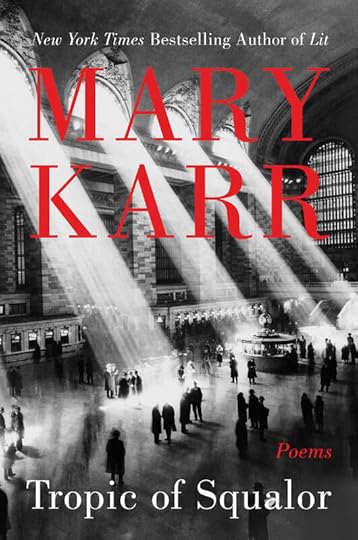
[Image: Book Cover]
Citation:
Karr, M. (2018). Tropic of squalor: Poems [eBook]. Harper. https://www.amazon.com/Tropic-Squalor...
Title: Tropic of Squalor: Poems
Author(s): Mary Karr
Year: 2018
Genre: Poetry
Page count: 96 pages
Date(s) read: 9/5/24 - 9/7/24
Book # 173 in 2024
***************************************************************************
*
“I couldn’t today /
name the gods /
you at the end worshiped, /
if any, /
praise being /
impossible for the devoutly miserable.
…
I wonder does your /
death feel like failure to everybody/
who ever /
loved you
…
I just wanted to say ha-ha, despite /
your best efforts you are every second
alive in a hard-gnawing way for all who breathed you deeply in, /
Each set of lungs, those rosy implanted wings, pink balloons. /
We sigh you out into the air and watch you rise like rain.”
(pp. 24-5)
*
Tropic of Squalor isn’t all devoutly serious, though. A large section parodies the books of the Bible and is pretty funny. Given her conversion to Christianity recounted in her third and final memoir Lit, we can assume that Karr believes in a god with a sense of humor. This is a very good book of poetry, one worth reading aloud to yourself to truly feel the emotions behind the words.
***************************************************************************
[Image: Book Cover]
Citation:
Karr, M. (2018). Tropic of squalor: Poems [eBook]. Harper. https://www.amazon.com/Tropic-Squalor...
Title: Tropic of Squalor: Poems
Author(s): Mary Karr
Year: 2018
Genre: Poetry
Page count: 96 pages
Date(s) read: 9/5/24 - 9/7/24
Book # 173 in 2024
***************************************************************************
Displaying 1 - 30 of 86 reviews