
What do you think?
Rate this book

WINNER OF THE WOLFSON HISTORY PRIZE
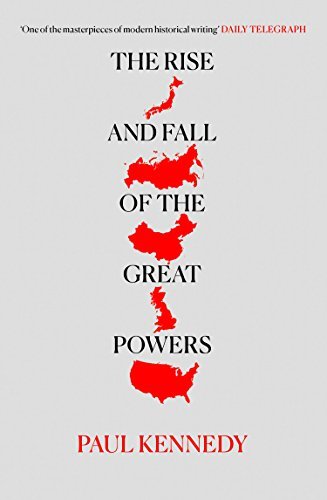
Paul Kennedy’s international bestseller is a sweeping account of five hundred years of fluctuating economic muscle and military might.
Kennedy’s masterwork begins in the year 1500, at a time of various great centres of power including Minh China, the Ottomans, the rising Mughal state, the nations of Europe. But it was the latter which, through competition, economic growth and better military organisation, came to dominate the globe – until challenged later by Japan, the Soviet Union, and the United States. Now China, boosted by its own economic prowess, rises to the fore. Throughout this brilliant work, Kennedy persuasively demonstrates the interdependence of economic and military power, showing how an imbalance between the two has historically led to spectacular political disaster.
Erudite and brilliantly original, The Rise and Fall of the Great Powers is essential reading for anyone with an interest in the politics of power.
705 pages, Kindle Edition
First published December 12, 1987


On the other hand, the Soviet war machine also has its own weaknesses and problems ... Since the dilemmas which face the strategy-makers of the other large Powers of the globe are also being pointed out in this chapter, it is only proper to draw attention to the great variety of difficulties confronting Russia's military-political leadership - without, however, jumpting to the opposite conclusion that the Soviet Union is therefore unlikely to 'survive' for very long. [Emphasis in original]
Although the United States is at present still in a class of its own economically and perhaps even militarily, it cannot avoid confronting the two great tests which challenge the longevity of every major power that occupies the 'number one' problem in world affairs: whether, in the military/strategical realm, it can preserve a reasonable balance between the nation's perceived defense requirements and the means it possesses to maintain those commitments; and whether, as an intimately related point, it can preserve the technological and economic bases of its power from relative erosion in the face of the ever-shifting patterns of global production. This test of American abilities will be the greater because it...is the inheritor of a vast array of strategical commitments had been made decades earlier ... In consequence, the United States now runs the risk, so familiar to historians of the rise and fall of previous Great Powers, of what roughly might be called 'imperial overstretch'.
It may be argued that the geographical extent, population, and resources of the United States suggest that it ought to possess perhaps 16 or 18 percent of the world's wealth and power, but because of historical and technical circumstances favorable to it, that share rose to 40 percent or more by 1945; and what we are witnessing at the moment is the early decades of the ebbing away from that extraordinarily high figure to a more 'natural' share.


