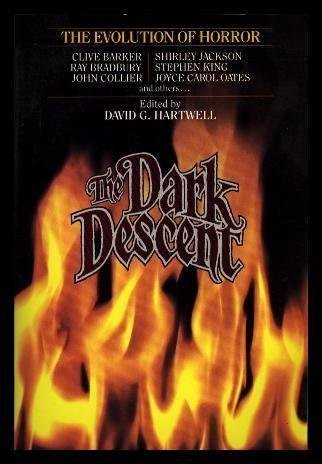
David G. Hartwell ha riunito le allucinanti visioni di celebri scrittori del passato come Poe, Hawthorne, Dickens, Lovecraft, Lawrence - ma anche di autori contemporanei come Ray Bradbury, Philip Dick e Stephen King - dando vita ad una antologia di storie grondanti di dolore e di angoscia. Un sottile filo rosso unisce i racconti: la presenza incombente della morte, legata a una forza sconosciuta del male, che rende i protagonisti vittime designate di un destino tragico e ineluttabile. I racconti presentati in questo volume sono stati ripartiti in tre sezioni, corrispondenti alle tre correnti principali del genere horror: il filone soprannaturale; il filone psicologico; il filone fantastico.
PARTE I - IL COLORE DEL MALE 1. Lo stretto - Stephen King 2. Il frassino - M. R. James 3. La nuova madre - Lucy Clifford 4. C'è una lunga, lunga strada tortuosa - Russell Kirk 5. Il richiamo di Cthulhu - H. P. Lovecraft 6. Gente d'estate - Shirley Jackson 7. Il giovane Goodman brown - Nathaniel Hawthorne 8. Il signor giudice di giustizia Harbottle - Joseph Sheridan le Fanu 9. la folla - Ray Bradbury 10. L'autopsia - Michael Shea 11. Il matrimonio di John Carrington - Edith Nesbit 12. I graticci di legno - Karl Edward Wagner 13. Più forte di noi - Robert Aickman 14. L'espresso per Belsen - Fritz Leiber 15. Sinceramente tuo, Jack lo Squartatore - Robert Block 16. Se viene Damon - Charles L. Grant 17. Vandy, Vandy - Manly Wade Wellman
PARTE II - LO SGUARDO DELLA MEDUSA 1. Le spade - Robert Aickman 2. Gli scarafaggi - Thomas M. Disch 3. La parentesi felice - Theodore Sturgeon 4. Terrore - Clive Barker 5. La rovina della casa Usher - Edgar Allan Poe 6. La scimmia - Stephen King 7. Dentro le mura di tiro - Michael Bishop 8. I ratti dei muri - H. P. Lovecraft 9. Il pittore Schalken - Joseph Sheridan le Fanu 10. La tappezzeria gialla - Charlotte Perkins Gilman 11. Come il professor Guildea trovò l'amore - Robert Hichens 12. Nato di uomo e di donna - Richard Matheson 13. Cara Emily - Joanna Russ 14. Adesso puoi andare - Dennis Etchison 15. Il vincitore sul cavallo a dondolo - D. H. Lawrence 16. Tre giorni - Tanith Lee 17. Mackintosh Willy - Ramsey Campbell 18. L'angolo allegro - Hanry James
PARTE III - UNA RACCAPRICCIANTE OSCURITA' SENZA FORMA 1. Fantasma di fumo - Fritz Leiber 2. Sette notti americane - Gene Wolfe 3. Il segnalatore - Charles Dickens 4. Crouch End - Stephen King 5. Lato notte - Joyce Carol Oates 6. Clara Militch - Ivan Turgenev 7. L'aggiustareputazioni - Robert W. Chambers 8. Che cos'era? - Fritz-James O'Brien 9. Il meraviglioso estraneo - Shirley Jackson 10. La casa maledetta - Ambrose Bierce 11. Dopo - Edith Wharton 12. La costa asiatica - Thomas M. Disch 13. L'ospizio - Robert Aickman
David Geddes Hartwell was an American editor of science fiction and fantasy. He worked for Signet (1971-1973), Berkley Putnam (1973-1978), Pocket (where he founded the Timescape imprint, 1978-1983, and created the Pocket Books Star Trek publishing line), and Tor (where he spearheaded Tor's Canadian publishing initiative, and was also influential in bringing many Australian writers to the US market, 1984-date), and has published numerous anthologies. He chaired the board of directors of the World Fantasy Convention and, with Gordon Van Gelder, was the administrator of the Philip K. Dick Award. He held a Ph.D. in comparative medieval literature.
He lived in Pleasantville, New York with his wife Kathryn Cramer and their two children.
Old Shirl has got matter-of-fact horror down, she owns matter-of-fact horror, and it's a thing of wonder. Perfectly bland boring people do these ordinary things and it all plods on and plods on and you're looking at your watch and scratching your left ventricle until you realise this routine stuff is now involving immense cruelty and death. Come round to tea any day, Shirley Jackson.
Includes many other classic short stories, many of which I like or almost like as much as the ones I mentioned - but I can't quite remember their details at the moment - and some that can be hard to find.
I technically should put this book on my “Abandoned” or “Hiatus” shelf, because I didn’t finish it. But I feel I’ve read everything I’m going to from this book (at least, for the time being), so we’ll call it “Read.”
I started out by reading from the beginning (as is the tradition with books, I hear). I went through the introduction and found that the guy who threw this anthology together had a massive boner for Stephen King. I’ve read Pet Sematary and Salem’s Lot, and from those books I’ve decided I don’t much care for King. It’s the amount of background detail that gets me—I just don’t need that much info.
And, of course, the first story of the book happened to be by Mr. King. Sometimes that’s just the way it goes.
After reading King’s story and then the first few pages of the next two stories, I started to wonder if I even like horror at all. Nothing was grabbing my attention. So I resolved to do the following: instead of just going straight through the book, I’d read stories that were either A) written by authors I knew of/liked, or B) mentioned as some of the “best installments” when people reviewed The Dark Descent. It made for a much more enjoyable reading experience. Here’s the stuff I managed to get through, with asterisks by my favorite tales:
The Reach, Stephen King: The tale of an old woman who’s lived on an island off the coast of New England her entire life. There are some things that I think are supposed to be ghosts. I can’t begin to describe how unhappy I was with this story. Here I’d heard that The Dark Descent was the greatest horror anthology ever, and the first story didn’t have anything that I felt could even be construed as horror. Yuck.
The Summer People, Shirley Jackson: For some reason, I thought this was going to be a haunted house story. I also thought it was going to be good. It’s the tale of a couple who decides to stay at their lake house past Labor Day for the first time ever, only to find that things are a little different after the Summer. This is definitely on the more subtle end of horror, but the problem was that it was too subtle for me. I’ve read a lot of reviews where people have said this story is chilling, but I just didn’t get that. I mean, I understand why people might think it’s chilling, in that it’s one of those things that you feel could actually happen in the real world. But it just didn’t work for me.
*The Crowd, Ray Bradbury: OK, now we’re talkin’. Ever wonder why it is that crowds gather so quickly around accidents? Ray Bradbury answers the question for us, and the explanation is a little unsettling. Great story.
John Charrington’s Wedding, E. Nesbit: I read this story not because I knew of the author, but because it was so short that I figured I could afford to give it a shot. It ended up being much longer than I expected, just because I was damn tired when I tried to read it and had to keep reading the same paragraphs over and over again. In the end, I feel my review is tarnished by the manner in which I read the story. It’s the tale of a man who gets engaged, only to . . . uh . . . something-something. I don’t know. I kinda snoozed through the last few pages.
*Yours Truly, Jack the Ripper, Robert Bloch: The first thing I’ve read by Robert Bloch, and I loved it (save for a weird math error when discussing dates that really threw me off). A detective from London comes to Chicago in search of Jack the Ripper—long after Jack should have been dead from old age. He convinces a psychiatrist to join him on the hunt for a famous murderer who may have found a way to lengthen his lifespan.
If Damon Comes, Charles L. Grant: A couple splits up and the former husband feels bad for his past transgressions, even though he’s a hero in his son’s eyes. When the son goes through a tragic experience, certain truths are revealed and creepiness ensues. (Can you tell I’m having a hard time trying to write some sort of review for this without spoiling anything?) Anyway, I read that this story was creepy, and while I agree with that assessment, it never actually gave me chills. Then again, I don’t think anything in this book did, so that’s not necessarily a bad thing.
*Dread, Clive Barker: I’m not sure what to think of Clive Barker. I read The Hellbound Heart a while ago and thought the prose was great, and even that the concept was good. But man, Barker’s got a whole different level of sadism than I’m used to. I used to think that I’d never read something that I felt was “too disturbing,” ‘cause I like disturbing. Then I came across Barker’s work. The Hellbound Heart was good, but a bit gory for my not-normally-affected-by-gore tastes. Similarly, Dread is a story that is just fucked up, but I’ll be damned if it wasn’t interesting. And the ending was great, I thought. Clive Barker writes stuff that I may enjoy reading myself, but I don’t know that I’d ever recommend it for anyone, and Dread is a perfect example of that. Great story, great writing, not fit for most stable minds.
*Born of Man and Woman, Richard Matheson: I haven’t read a whole lot of Matheson (I Am Legend, Hell House, a few short stories), but I’ll be damned if I don’t love his work. Matheson is definitely my favorite author to be found in this collection, even if I haven’t read a whole lot of his stuff (mostly because I haven’t read much from the other authors here, either). I’d read somewhere recently that Born of Man and Woman was one of the first things Matheson had published (if not the very first), and that it was supposed to be one of the best SF/horror shorts of all time. I can see why. In only three pages, Matheson created an amazing story of a boy unappreciated by his parents, only because he’s different.
The Signal-Man, Charles Dickens: This was another one of those late-night reads that was made much harder by fatigue (though I’ll also blame at least part of my faulty attention span on the fact that I wasn’t particularly sucked in by the story). It’s about a man who operates a signal station for a train track, and the strange things he’s been seeing lately. I wasn’t too impressed with it, overall. Not as bad as The Reach or The Summer People, certainly, but not as great as Bradbury, Bloch, Barker and Matheson.
*Crouch End, Stephen King: OK. Here’s the thing: I’ve always liked H.P. Lovecraft’s ideas, but never much cared for his prose. He’s one of those “unnecessary detail” guys, explaining things that do not require explanation. And his dialogue is some of the worst you’ll ever read. And his voice kinda stinks. And his stories are often formulaic. But the concepts—the concepts are pretty awesome.
On the other hand, there’s Stephen King, whose prose I like but story construction I hate. Way too much background info from this guy. He’ll put you through 200 pages of Salem’s Lot before he even thinks of mentioning something that might be vampiric in origin.
In Crouch End, King wrote a story that took place in Lovecraft’s Cthulhu Mythos. And my god, is this ever the best of both worlds.
We get King’s excellent prose, Lovecraft’s concepts. It’s awesome. The story takes place in London and centers around an American woman who ends up in a bad part of town and sees things that no one should ever see. I always felt that the way Lovecraft’s characters descended into madness could have been done better. King figured out the way it should be. Best Stephen King thing I’ve ever read, though I admittedly haven’t read much of his stuff.
*The Damned Thing, Ambrose Bierce: Never heard of the author before I got this book, but a Google search of “best horror authors of all time” brought the name up. And man, am I glad it did. This story about a man’s unusual death on a hunting trip conjures almost Lovecraft-style imagery in my mind. I was actually reminded of “The Dunwich Horror” as I read this. And there was a cool semi-scientific explanation at the end, which I dug.
You may have noticed that I didn’t include the two Lovecraft stories (The Call of Cthulhu, The Rats in the Walls) in my list, but that’s because I’d read them previously. In fact, I’d read Rats pretty recently, and I have to say, I had a hard time getting through the early pages. It was boring the crap out of me. But by the end, I was glad I read it, which seems to commonly be the case with Lovecraft stories for me.
Overall, the book gets 3 stars. Some stories are 5s, but there are so many stories I couldn't even get into after the first few pages that it made me not want to even try on the authors I hadn't heard of.
My wife recently mentioned that she was expecting a package, and that I should watch for it and make sure to bring it inside when it was delivered. "It's an older anthology of horror stories. I read an online essay that was raving about how good it was. I found a used copy and ordered it. It's called The Dark Descent or something like that?"
The name sounded familiar. We've accumulated a lot of books over the years. "Is that the one edited by [name]?" (I don't remember the name I said, only that it was wrong.)
"No. David G. Hartwell."
It still sounded familiar, so I went into the back room, rummaged around on some shelves, and finally, "Aha!" I marched back into the living room. "This book, you mean?" In her defense, I acquired it at least five years before we even met, and I don't think I've read it since that initial purchase, which would have been in 1990 or so.
So now we have two copies, one a much more recent printing. After going through the trouble of digging it out, I figured I'd reread it.
Wow! I mean, I remember it as being good, but I'd forgotten just how good. As the jacket promises, this book shows the evolution of the horror story, from around the mid-1850's all the way up through the late 1980's. I'm honestly surprised no one's tried to do a sequel or an updated version because surely there have been more modern writers of horror fiction who deserve to be considered in the context of the stories in this anthology. Thomas Ligotti and Laird Barron at the very least …
I'm a bit dismayed by how much of this book I appear to have forgotten over the years. There are stories that I would have sworn that I first encountered elsewhere, in books that I definitely read *after* I read this one: Charlotte Perkins Gilman's "The Yellow Wallpaper," Walter de la Mare's "Seaton's Aunt," Oliver Onions' "The Beckoning Fair One"--how does one forget a name like Oliver Onions?--Algernon Blackwood's "The Willows." About all I can figure is that my younger self lacked the patience to stick with them long enough for them to work their magic, and I skipped ahead. I know that this 2023 reread marks the first time I think I've managed to get all the way through Poe's "The Fall of the House of Usher" without skimming. I love much of Poe, but could never make it through "Fall" for some reason. Turns out it's actually a reasonably straightforward tale, just with the goth factor cranked up to eleven. I now feel silly for having struggled with it previously.
Whether you dip in and out at leisure, or plow straight through as I did, the Dark Descent is as fine a collection of horror stories as you're ever likely to find. Highly recommended!
I am SO looking forward to this tome. I found it in a outlet store for $6 and grabbed it as fast as I could. Stories from some of my favorites (Harlan Ellison's "Whimper of Whipped Dogs" plus a couple from Shirley Jackson, Stephen King, HP Lovecraft and one from Philip K. Dick) as well as from people who I need to read/read more of (Nathaniel Hawthorne, Clive Barker, I think Robert Bloch is also in here). If this is as good as it claims to be, I will be using it when I teach my Horror Short Fiction class again. --------
What a collection! Definitely worth any price you find it for (it's only $20 off of Amazon). What makes this so wonderful are not the stories from the well-known authors (although King's third entry in here, "Crouch End" is one of his best works period) bur rather from those who aren't normally recognized. Karl E. Wagner's "Sticks" is easily one of the best short stories I've ever read and "If Damon Comes" actually truly scared a bunch of hardened students (people who looked at lots of random horror movies and thought nothing of them).
Sure, there are some clunkers in here (the choice for Henry James does not fit in the order that it was put in, for instance). There are also some that most readers will not admit into the horror genre ("The Yellow Wallpaper," "The Beautiful Stranger" by Shirley Jackson, and "Something For Us Tempanauts" by Philip K. Dick), but in the context of the section, they can allow for a great discussion on how the themes of horror stories are found in other types of writing.
Overall, something that everyone should at least look at if not read. A great introduction to a deep genre and the type of book that will make those interested look for even more.
Essential. I would gladly pay for a college course if this book were it's subject. I don't think it would interest a casual horror fan but if you're a writer and want to get a broader understanding of horror then it's a must read. This book taught me that thematically, horror can show up in any genre. It need not be bloody. It can be psychological, hinted at, not explained, subtle or spoken in what is not said. I spent a good three months on this, reading one or two stories a night. There were some misses for me but overall this blew my mind.
The book is split into three sections, covering moral horror, horror that draws its effects out of some kind of psychological element, and horror in which, hmmm, the horror comes from that laws of reality simply not being fixed firmly in place (the fantastical). Otherwise the sections are not organized or are organized by some method that I didn't comprehend.
The first section got tiresome after a while (people receiving their due over and over), the middle section was fun, and the last section, which I had been looking forward most to, was dull. Whatever was supposed to be horrifically fantastical about these stories did not strike me as such. A few of the stories in that section I liked, but mostly they were looooong and without much of the fantastic--mostly ghosts. "Ghosts exist! Ones that aren't normal!" In other contexts I might have been less annoyed. As it was the selection of stories felt heavy handed.
The main benefit of the collection is that it pulls from horror stories across genres and times. This a WIDE-ranging collection in that sense, and I enjoyed being surprised by authors that I didn't know wrote any horror. The collection does indeed live up to its title, even if it would have been more beneficial to have the three sections put in time order, so it was easier to see the lines of descent.
If you're interested in the fantastic types of horror, I'd go with the Vandermeers' THE WEIRD collection instead or in addition. Some of the stories cross over; I feel the exploration of the subgenre gets better treatment there, though.
If you have any interest in horror fiction, The Dark Descent is essential. In fact, if you're new to horror, don't bother with anything else. This compilation will not only introduce some of the best works in short fiction of the last hundred years, but it will do so with a clarity of vision that actually allows you to survey how far we have come and what remains to be explored. Each work in this anthology represents an incredible peak in style and expression that has never been topped regardless of its age, and the editor Hartwell introduces each of these terrors lovingly. I can't tell you how wonderful it was for me to find out about authors like Clive Barker, Robert Aickman, Oliver Onions and many others for the first time in this book. Enjoy the feast of horror!
An anthology with 56 of some of the best all time short horror stories ever written, by many renowned and highly acclaimed authors. I use short story lightly, since many, a lot, are closer to a novella. A very nice collection, all things considered; with many Best, sizeable Good and some Meh, which is not to say they are Bad, it’s just Meh, except if it’s one star, which is Crap.
I very much enjoy collections like these one here; I find them a fantastic way for quickly sampling a lot of new authors, some of which I had never read before and really wanted to, like Clive Barker, Theodore Sturgeon, DH Lawrence, Robert Aickman, Le Fanu, Algernon Blackwood, Ivan Turgenev, Henry James, Flannery O'Connor, Carol Oates, Shirley Jackson and Philip K. Dick.
Some esteemed acquaintances I already knew, like Ambrose Bierce, Stephen King, Fitz O'Brien, Allan Poe, Perkins Gilman, Ray Bradbury, HP Lovecraft, Charles Dickens and MR James.
And all the rest of course, which I don’t particularly care if I know or not, but nice enough to have them ticked anyway.
All in all, a solid anthology. Quite lengthy tbh, but Recommendable, for lovers of classical horror, and stuff.
Go for the Best, consider the Good, whatever the Meh.
----------------------------------------------- PERSONAL NOTE: [1987] [1011p] [Anthology] [Horror] [Conditional Recommendable] -----------------------------------------------
Horror a Mansalva.
Una antología con 56 de algunas de las mejores historias cortas de terror jamás escritas, por muchos autores reconocidos y altamente aclamados. Utilizo cuento a la ligera, ya que varios, muchos, se acercan más a una novela corta. Una colección bastante decente, considerando todo; con muchos Mejores, considerable cantidad de Buenos y algo de Meh, lo cual no quiere decir que sea Malo, simplemente es Meh, excepto si es una estrella, lo cual es Caca.
La verdad que disfruto bastante de colecciones como ésta aquí; las encuentro una forma fantástica de probar rápidamente muchos autores nuevos, algunos de los cuales nunca había leído antes y tenía muchas ganas de leer, como Clive Barker, Theodore Sturgeon, DH Lawrence, Robert Aickman, Le Fanu, Algernon Blackwood, Ivan Turgenev, Henry James, Flannery O'Connor, Carol Oates, Shirley Jackson y Philip K. Dick.
Algunos estimados que ya conocía, como Ambrose Bierce, Stephen King, Fitz O'Brien, Allan Poe, Perkins Gilman, Ray Bradbury, HP Lovecraft, Charles Dickens y MR James.
Y todos lo demás, por supuesto, que particularmente no me importa si conozco o no, pero que es agradable tenerlos tildados de todos modos.
Considerando todo, una antología sólida. Bastante larga para ser honestos, pero Recomendable, para los amantes del terror clásico suave, y esas cosas.
Ir por lo Mejor, considerar lo Bueno, loquesea lo Meh.
If I may quote Forrest Gump for a moment, I'd like to say that The Dark Descent is like a box of chocolates. Not so much because you "never know what you're gonna get" - because these stories are almost uniformly well written - but because the best way to consume it is a few pieces (stories) at a time, so they don't get overwhelming and start tasting all the same (or make you sick).
The editor, David Hartwell, has divided the story collection into what he calls three "streams": 1) moral allegorical, or stories that are "about the intrusion of horror into reality...[and:] the colorful special effects of evil." 2)psychological metaphor, or stories that "have a monster at the center" whether supernatural or psychological, and 3)fantastic, or stories that generate horror through their "ambiguity as to the nature of reality". He admits himself that these are not hard and fast descriptions, in fact many stories cross boundaries, but it is an interesting way of looking at the history of short horror fiction.
It's also interesting to see which types of stories appeal to you the most. I found myself most interested in the "third stream", the fantastic stories, although I had already read almost all of them. Of the other sections, I found I had read only four of the "second stream" stories and three of the "first stream". Whichever type of story appeals to you the most, David Hartwell has done an excellent job in choosing examples from the nineteenth and twentieth centuries, including some from several writers whose names do not spring to mind when the subject of horror writing is being discussed.
I don't know what to say about this book. Other than a few stories...this was a labour and not a pleasure. That said, the few stories in it were worth reading. Uggh!
This anthology features a terrific collection of classic horror stories. But here's my gripe, and for some reason (blame it on my foibles?) I just couldn't get over it: the stories aren't arranged in chronological order. I mean, what? If trying to show the evolution of the horror story, why would you muddle the stories into three arbitrary categories instead of arranging them by year of publication? I can't believe how much this editorial choice irked me, yet it did.
I found this to be an excellent anthology chronicling Hartwell's take on the evolution of the horror tale. However, rather than laying out the tales in chronological fashion, Hartwell instead breaks the anthology into three separate sections delineating the three main types of horror tale as they have developed since the 19th century. There are several well known benchmark classics as well as hard to find gems that outline his conception of the horror genre.
A warning to the casual reader, though. This book is a doorstop and is packed with both short stories and novellas, coming in at over 1000 pages total. I am a very fast reader and it still took me months to get through it. Normally I devour a book in just a few days or weeks but I kept finding that I viewed this anthology as not only something to read for pleasure but also as required reading (it had been my own White Whale for years when I finally found it in used book store recently). I found myself breaking away from it at times to read another novel or something of different genre so that every time I picked it back it would feel like a fresh experience of discovery.
If you consider yourself a horror aficionado (as I humbly do) then you will view this anthology as a must-have for your collection.
This is a sampling of various horror writers over a span of 200 years. Some of the stories (read 'writers') were very interesting and I would have liked them to be longer. Others seemed to drag on and on. I will admit that I just don't have the patience for Lovecraft whose stories seem to go on and on, but maybe that was the style of writing that was popular in those days. I enjoyed the more modern writers both because of the easier-to-read prose style and perhaps I could understand their perspective, being more in line with the current century. I like science fiction and so enjoyed the last story in the anthology a lot (A Little Something for Us Tempunauts by Phillip K. Dick)
I loved so many of the short stories in this anthology, but so many more bored me to literal tears. It's honestly what makes anthologies so hard to rate. I want to give it five stars because of the ones I loved, but three is a fair trade-off.
If you do get this anthology, I really suggest "A Little Something for Us Tempunauts" because it took me by surprise. I think it is so fitting to the way I was feeling with it being the end of the semester. I won't give away too many details, but it was amazing.
2024 Book #25: The Dark Descent (1987), edited by David G. Hartwell
After reading for almost six months, I finally finished this humongous tome of short stories (over 1000 pages, single-spaced, small print). Presenting tales from a variety of well-known and lesser-known writers, The Dark Descent tries its best to encapsulate the history of horror fiction from the mid-nineteenth century to the present (that present being the 1980s). It would be nearly impossible to try to sum up everything in this book in a short paragraph, but I will say that it’s a mostly excellent selection of stories and represents a real milestone in horror anthologies. I highly recommend Hartwell’s introductory essay, in which he argues that horror is fundamentally a short-story genre, and that the chunky horror novel so popular in the ‘80s is something of a historical anomaly. Hartwell organizes the anthology in a very original fashion: over the course of three broad partitions, the stories move from cut-and-dry morality fables to completely amoral, ambiguous horrors. While I sometimes disagree with Hartwell’s categorizations, I think more anthologies should be put together according to some principle like this (rather than chronological, etc.). Below is my ranking of all the stories collected in The Dark Descent, from best to worst (with star-ratings):
***** Algernon Blackwood, “The Willows” ***** H. P. Lovecraft, “The Call of Cthulhu” ***** Theodore Sturgeon, “Bright Segment” ***** Karl Edward Wagner, “Sticks” ***** Charlotte Perkins Gilman, “The Yellow Wallpaper” ***** Michael Shea, “The Autopsy” ***** Shirley Jackson, “The Beautiful Stranger” ***** Robert Aickman, “The Hospice” ***** Oliver Onions, “The Beckoning Fair One” ***** H. P. Lovecraft, “The Rats in the Walls”
**** Robert Hichens, “How Love Came to Professor Guildea” **** Shirley Jackson, “The Summer People” **** Fritz Leiber, “Belsen Express” **** Robert Aickman, “The Swords” **** Tanith Lee, “Three Days” **** Robert W. Chambers, “The Repairer of Reputations” **** Fitz-James O’Brien, “What Was It?” **** Flannery O’Connor, “Good Country People” **** William Faulkner, “A Rose for Emily” **** M. R. James, “The Ash-Tree” **** Edgar Allan Poe, “The Fall of the House of Usher” **** Edith Wharton, “Afterward” **** Ambrose Bierce, “The Damned Thing” **** Robert Aickman, “Larger Than Oneself” **** Stephen King, “The Monkey” **** Thomas M. Disch, “The Roaches” **** Michael Bishop, “Within the Walls of Tyre” **** Ramsey Campbell, “Mackintosh Willy” **** Henry James, “The Jolly Corner” **** Russell Kirk, “There’s a Long, Long Trail a-Winding” **** John Collier, “Evening Primrose” **** Joyce Carol Oates, “Night-Side” **** Walter de la Mare, “Seaton’s Aunt” **** Fritz Leiber, “Smoke Ghost” **** J. Sheridan Le Fanu, “Schalken the Painter” **** Harlan Ellison, “The Whimper of Whipped Dogs” **** D. H. Lawrence, “The Rocking-horse Winner” **** Charles Dickens, “The Signal-Man” **** Gene Wolfe, “Seven American Nights” **** Ray Bradbury, “The Crowd”
*** Thomas M. Disch, “The Asian Shore” *** Clive Barker, “Dread” *** Philip K. Dick, “A Little Something for Us Tempunauts” *** Joanna Russ, “My Dear Emily” *** Stephen King, “The Reach” *** Charles L. Grant, “If Damon Comes” *** J. Sheridan Le Fanu, “Mr. Justice Harbottle” *** Ivan Turgenev, “Clara Militch” *** Stephen King, “Crouch End” *** Nathaniel Hawthorne, “Young Goodman Brown” *** Robert Bloch, “Yours Truly, Jack the Ripper” *** Dennis Etchison, “You Can Go Now” *** Edith Nesbit, “John Charrington’s Wedding” *** Manly Wade Wellman, “Vandy, Vandy” *** Lucy Clifford, “The New Mother”
An exhausting read but in a good way. The Dark Descent features wide range of horror in short and novella length stories which is good as it gets as an anthology that serve as a gateway into horror.
The first part features a lot of the big names in horror and set a certain tone to what you can expect from the horror genre, either it be the traditional spooky ghost haunting to the extreme end of cosmic horror. The second and third part see a mix of the big names in the olden days and some lesser known in the genre and provides something that's less traditional and where we can see some experimental to the way horror narrative can be told.
A great pickup for those wanting to get into the genre or to those who love horror and wanting to read a few of the classics and some lesser known oldies but goodies.
The one indispensable horror anthology for anyone assembling a horror library. Hartwell embraces many varieties of horror, from H.P. Lovecraft to Thomas Disch. If you want to go beyond the best selling novels and see what the history of (mostly American) horror is about, you need to read this generous selection. A fine sampling of authors a beginning reader in the field should know.
One of the best summaries of Horror about, in my opinion. Not all stories are necessarily the author's best nor best known, yet as a primer to give a reader something to work at, this is about as good as it gets.
"The Reach," by Stephen King (1981): 7 - The editor intro here says this story is a “virtuoso performance in which the horror is distanced but underpins the whole.” I can't tell if he read the same story, or if he just imagines horror to be something I do not, something simply winking at or reminiscent of death in any way whatsoever, but the “horror” element here is largely non-existent to me, and the story of an old woman's gradual coming to terms with her death through a drawing nearer to the dead of her family and relations was told so belabored and lukewarm that it was hard to make out the theme from the conceit.
"Evening Primrose," by John Collier (1940): 7 - A lot to parse in this actually quite toss-offy little dark fantasy diddle (STORY: the undead denizens of NYC dept. stores live spookily, until our narrator betrays a girl, getting her undead mummified by some police of the underworld.) There's the half-elliptical, half amateurish dream-world poesie of the prose, which sort of works as a way to render the murkiness of the liminal occupants of this consumer purgatory, although it also shields too much, and there's a level where we just need some more concrete info on the hows and whats of this world. I'm more taken with, however, the nice shibboleth of haunted consumption cathedrals, i.e. department stores haunted by “gone” people. Less in that it is “critiquing” this, than in that it just seems to take for granted that they'd end up here, with no need seen to establish actual connections between the characters and the capitalist places; we just assume, yes, of course they'd go here. As for the “horror” element, there's not much here. I'd have a hard time imagining the person actually “frightened” by any of this stuff, and so, as a non-horror reader, maybe I'm actually completely off the mark regarding what this audience actually expects and gets out of this kind of fiction. More likely, an ambiance of dread or off-ness? Something akin to the “sense of wonder” spoken by SF fans, in that of course it needn't be real wonder, but hot the literary feints acquainted with that feeling enough to qualify.
"The Ash-Tree," by M.R. James (1904): 7.5 - Like many Victorian/Edwardian ghost stories, this examines the longue-duree haunting of a place and the brutal patrimonial legacy of revenge built into that place through a particular act. Namely, a C17 proprietor of a grand English house testifies against a witch, sees to her death, dies mysteriously, and his family subsequently suffers the same fate. What is interesting here, however, are some of the smaller details: 1) the ambiguity of the initial 'act,' i.e. the fact that, unlike many others, the first proprietor did not do anything 'wrong,' such as murder or exploit the innocent or lower classes -- he simply saw a witch and told on the witch, who happened to be a witch ~ this therefore shrouds the story in less a brutal revenge / just desserts narrative, which might comfort us in viewing the savagery, and more in a realization of viewing purer, more unadulterated evil; 2) the straightforward depiction of the 'horror' itself at the climax, meaning James doesn't obscure the monstrosity or act itself. Instead, interestingly, he explicitly disambiguates -- we see the manner and means of the final death, as well as the full figures of the evil death bringers [giant spiders hidden inside a giant ash-tree, given apparent instruction by the desiccated corpse of the witch, propped up hauntingly inside the base of the tree for centuries]. The story itself, on the other hand, did little to win me over, James' resonance and reputation might, I think, rest today on the continued reliance upon these two factors in modern horror, as we've turned away from the curtain-closing off-screen-ness of James' contemporaries.
"The Willows," by Algernon Blackwood (1907): 9.25 - so, this is good. It's good, and remains nonetheless difficult to discuss. And that is because the sometimes seminar already covered Blackwood, and I don't know how much novel or interesting I will have to say that isn't mostly cribbed -- consciously or not -- for their takes: that being, primarily, that what Blackwood lacks as a horror writer, he actually makes up, to their large surprise, as an innovative and evocative nature writer. Our story: two Englishman, rafting down the Danube, put up in a heavily wooded, and very creepy, clearing, increasingly feeling themselves in the liminal Space between worlds. My major addendum to their verdict is that this is actually quite wonderful, with the interesting added wrinkle of the disjunction between the prose description of the willows and the ominous omnipresent feeling of the others around them, and the dialogue and repartee between the two men, which felt more lifelike than I would have supposed based upon the former. I wonder why this doesn't get talked about more. Maybe something to do with the strangeness of a prewar British fantastical story set outside of England. Nonetheless, it should have a more robust reputation, especially as it mixes the large cosmic unease with the more corporeal, granular, and intimate terrors of, for example, the final one-two punch of the minute description of the dead man's skin, as well as seeing him float off and begin to resemble an “otter,” thereby re-re-framing our appreciation for what exactly they been going through from the beginning.
“The New Mother,” by Lucy Clifford (1888): 6.75 - An old fable that shows its age, a rarity in cherry-picked anthologies such as these, and a not altogether unpleasant one at that, serving, as it does, as a reminder of the preponderance of fiction of any age, largely rushed, of a third-time’s-the-charm structure, moralistic, and rote — if not a Sturgeon’s law, something like it. Regardless, we all love putting children in danger; we just change the nature of it. STORY: kids tricked to disobey their mother find a worse replacement, one with a tail that is.
"Seven American Nights," by Gene Wolfe (1978): 6.75 - If science fiction, in its crudest formation, is the literature of engineers, then Gene Wolfe’s fiction might be the literature of autistic engineers. So strange, considering, the degree to which he is held up within most circles as the genre’s premier literary figure. Indeed, Hartwell’s short introduction here says as much: “Wolfe is the finest writer in the contemporary science fiction field …” What irks about his writing – and what irks about this designation – is how devoid it often is of what makes fine writers fine (in the literary tradition, that is [which is what Wolfe’s sf critics are also referring to in their praise of him, given their understandable, yet transparent, status envy and desire to elevate “one of our own” among an illustrious crowd – yet *spoiler alert for my point* they don’t need to do this for genre work to have merit; it’s akin to the way critics will mention the three best composers of all time as Bach, Beethoven, and Duke Ellington. It’s not only diminishing and patronizing; it’s also obfuscatory. In referencing external generic terminology and critical parameters (and blatantly [and needlessly] attempting to squander renown from one tradition to another) – for as true as it is to call him that, what else can mentioning “composers” do than prioritize the conventions of classical music – it tells us little about Ellington or what made him great in his own distinctive lane]). Regarding our topic, it is not a florid style, antiquated syntax, or (god, kill me, but you do see it with Wolfe) a “big vocabulary” that people point at when they say "literature," but more often a type of psychological insight and observational acuity—i.e. precisely the elements commonly lacking in Wolfe’s fiction (but not in sf as a whole by any means). The degree to which this is true is, counter-intuitively, demonstrated by a portion of “Seven American Nights” that does exactly this. About halfway in, our self-possessed protagonist is reflecting on his object of obsession, potentially a prostitute: “In a moment the pain sobered me. For a quarter hour or more I stood at the curbside, spitting into the gutter and trying to clean and bandage my knuckles with strips torn from my handkerchief. A thousand times I thought what a sight I would be if I did in fact succeed in seeing Ellen, and I comforted myself with the thought that if she were indeed a prostitute it would not matter to her-I could offer her a few additional rials and all would be well. Yet that thought was not really much comfort. Even when a woman sells her body, a man flatters himself that she would not do so quite so readily were he not who he is. At the very moment I drooled blood into the street, I was congratulating myself on the strong, square face so many have admired; and wondering how I should apologize if in kissing her I smeared her mouth with red.” This is good. Ask yourself, nonetheless, how often the sentiments expressed in those last few sentences appear in a Wolfe work. What we have instead are puzzles – often elegantly presented puzzles, but puzzles nonetheless – consciously constructed and self-consciously convoluted. At best – and this is even if one is interested in indulging in the first place – the convolution is thin and the solution is visible through the fog. At worst, and I would say “Seven American Nights” deserves inclusion here, the over-mystification is thorough and the slots have been too far cleaved from each other, and any plausible read is as good as the other. In short, and to return to my opening, this game might be why some people come to fiction, but it is not mine [and, indeed, it is admittedly such a queer conception even within sfnal spaces that I’m always a bit perplexed by his prominence within the genre as a point of reference for newcomers! I imagine much of this has to do with some tiresome but enduring correlation between heft and significance (Book of the New Sun) and/or the assumed imprimatur of that laundered prestige]. As for the story, this sfnal OF HUMAN BONDAGE, there is, of course much more there – such as the clearly post-colonial reversal (ie these aren’t Arabian, but American Nights, and the exotic locale for the cultured foreign traveler, driven to un-civilization by the allure and adventure of the foreign world and its delights), although one can only go so far with this turn-the-tables POV; at some point, and at this length, the story needs to work a bit at justifying itself – but I feel I’ve exhausted the take as is. At this point, and maybe as a final say on the matter, I’ll quote some others who’ve managed to say the same more succinctly. From waggishblog [https://www.waggish.org/2007/more-on-...], re: Joyce comparisons: “Now, I can enjoy Ulysses and draw much from it without knowing whether or not Bloom gives a condom to Alec Bannon at the impenetrable end of chapter 14. Unlike Joyce, Wolfe stakes so much of his book on these sorts of narrative obscurities that (a) in the absence of their resolution, the book does not reveal itself sufficiently, and (b) Wolfe subordinates thematic and conceptual integrity to the mere challenge of these games. Many people are content to enjoy the ride and pass over these issues, and Wolfe deserves the attention they give him, but this is not enough for Wolfe to satisfy his books’ ambitions.” And from, actually, the comments to waggish’s post, by a Ray Davis, in which he both identifies and critiques Wolfe’s method – here termed a “machine metaphor” – more concisely than most: “he’s simply not doing the job he wants to do. His factory produces too much smoke and noise for its nanoproduct to be discernible. What seems worthwhile in the work (and it’s not negligible) is a side-effect of its main intent.”
Awhile ago, I read a paperback I found at the library, called Color of Evil. What I did not realize at the time is that volume is merely the first third of this book, which is meant to be a fairly definitive anthology of short horror fiction. So now I'm going to read the rest of it, which will probably take awhile, as this is a certified kitten-squisher. (No kittens were harmed in this review.)
The Swords by Robert Aickman: Here's an effective tale of a young traveling salesman and a strange encounter with a local fair. There's a booth at the fair with a sign that just says "Swords" and an uncanny performance. There's a really strong thread of sexual anxiety in this one that adds to the atmosphere.
The Roaches by Thomas M. Disch: A young woman living in New York fights an unending battle with roaches, until the roaches begin to obey her. Quite disgusting.
Bright Segment by Theodore Sturgeon: A disabled man rescues a woman whose been stabbed and shoved out of a car. While he struggles to speak and thinks in sentence fragments, he's also mechanically skilled and a deft problem solver. This is touching and upsetting in equal measure.
Dread by Clive Barker: A man named Quaid is obsessed with fear and dread. Because this is a horror story, he naturally turns to capturing people and tormenting them with their fears. This backfires when he tortures a young man named Steven to the point of madness, and Steven murders him. I'm not really a Barker fan, but this is creepy good.
The Fall of the House of Usher by Edgar Allan Poe: Everyone knows how this one goes. What strikes me on this reread is how little actually happens, and there's no explanation for any of it. It still totally works. I think I would have picked a different Poe story, but that's just me.
The Monkey by Stephen King: Hal has been haunted throughout his life by a wind-up monkey toy that heralds death every time it shows up, and resists Hal's attempts to get rid of it. Now, as an adult, Hal needs to protect his family from the monkey. This is quite good, but it's the second of 3 Stephen King stories in this volume. Not sure that's necessary. Also, Hal's not a great husband or father, and it's hard to tell if the story knows that or not.
Within the Walls of Tyre by Michael Bishop: This is a weird one. An older woman named Marilyn who manages a boutique in a mall is visited by a salesman who looks remarkably like her boyfriend who died in WWII. Turns out there's a reason for that, and he exposes a secret she's been hiding for years. The idea of selling paint on stockings is weirdly hilarious, though.
The Rats in the Walls by H.P. Lovecraft: I feel like there's probably a whole essay to write about this one and its inclusion in this anthology. Hartwell is specifically positioning this as a psychological horror story, more in the realm of M.R. James than Lovecraft's own Cthulhu mythos. I gotta say, I don't think that really flies. If it was ever possible (and to the degree that it was probably has something to do with who was doing the discussing) to talk about Lovecraft without also discussing his vile bigotry, it's especially egregious to do so in regards to this story, what with its cat named after a slur and its overwhelming theme of "some of us are fully evolved real humans, and some of us are animals."
Schalken the Painter by J. Sheridan Le Fanu: A young, poor painter wants to marry his master's niece. Before he can raise enough money to do so, a rich stranger who seems to appear and disappear at will shows up and gives her uncle a box full of gold to marry her. This is fine, I guess, but it's hard to see the theme of women controlled by a society that doesn't value their lives when we spend basically no time with the woman in question. It's all about Schalken's man pain that someone else gets to have her. The next story does this much better, and is written by an actual woman, so this feels pretty superfluous.
The Yellow Wallpaper by Charlotte Perkins Gilman: The Ur text of feminist social horror. Is the house haunted, or is the protagonist just going crazy? Either way, it's brilliant and its presence in the collection adds some welcome representation.
A Rose for Emily by William Faulkner: Did everyone read this in their first college intro lit class? Probably, if only because you can't talk about American Lit without Faulkner, and this is easier to read than As I Lay Dying. It's a great little slice of Southern Gothic, and a rare example of the multitude as narrator that works effectively.
How Love Came to Professor Guildea by Robert Hichens: Professor Guildea is a misanthropic atheist who becomes besties with a priest, Father Murchison. Guildea fears nothing so much as being loved, and somehow attracts an invisible presence that will not leave him alone. It feels a little gross to me how the presence is continually referred to as "idiotic," but there is some genuine creepiness in the feeling of being stalked by something that only you can perceive.
Born of Man and Woman by Richard Matheson: I... don't know what to say about this one. There's very little here, just the rambling of an abused child that might not be totally human? It's upsetting, but not much else.
My Dear Emily by Joanna Russ: Russ is often considered one of the mothers of feminist sci-fi. I haven't read enough of her work to have much of an opinion; I've only read We Who Are About To... several years ago. (Speaking of feminist sci-fi, where's James Tiptree Jr? The Screw-fly Solution should 100% be in this book!) Back on topic, this is an enjoyable little vampire tale about a young woman named Emily who chooses violence (vampirism) over her respectable life.
The Rocking-horse Winner by D.H. Lawrence: Here's another one from Lit 101. A family living beyond their means finds some temporary respite from their debts when the son discovers he can predict the winners of horse races by riding his rocking horse. It's a bit unnerving, but I wouldn't consider this horror.
Three Days by Tanith Lee: Here's a good little psychological story, as the supernatural element is small and not really the source of the horror. A young man in I'm guessing early 20th Century Paris is invited by a friend to a memorial dinner at his family home. When he gets there he meets his friend's brother, a struggling artist with a young pregnant mistress, and his sister, a plain young woman still living at home, and their evil father who basically summoned them all there to be insulted and berated. Our narrator is horrified, especially by the father's treatment of the sister and how beaten down she seems. But the sister meets some witchy friends and, for a little while, her life seems much improved. The evil father is very well done here, extremely hateable.
Good Country People by Flannery O'Connor: Even more Lit 101. O'Connor has never captured me the way she has so many others. Possibly because she seldom writes characters that I manage to care about. They're all different shades of unpleasant, and while I admire her skill in creating them, I don't actually want to spend any time with them. I would also have picked A Good Man is Hard to Find over this, as again, I wouldn't consider this story horror.
Mackintosh Willy by Ramsey Campbell: Ramsey Campbell does eerie so well. Here we have a story of a boy and a disturbing figure that haunts a local park. A homeless man called Mackintosh Willy dies and the boy finds his body in a shed near the pond. But something happened to Willy's eyes, and the boy's friend might know something about that.
The Jolly Corner by Henry James: I hate Henry James. I read The Turn of the Screw for sophomore English, and it was like wading through glue. This felt the same! Just tell me the story, Mr. James! A guy gets the feeling that his childhood home is haunted by a doppelganger of himself that he could have become, if his life had gone differently. He sees him and faints, to be woken up by his lady friend who tells him that she's not scared of his double.
Smoke Ghost by Fritz Leiber: Here's a very good story of modern terror, or the terror of modernity, with a very creepy cosmic style twist. Our protagonist is, IIRC Catesby Wran (I think we should bring Catesby back as a name) an ad man who opens the story by monologuing at his secretary, as I assume all ad men do. Turns out Catesby has been seeing a figure on his train rides home, a figure that looks like a sack covered with coal dust and soot. He comes to understand that this being is something like a ghost of the city, or of the whole modern world. But while Catesby has seen the smoke ghost, it has also seen him, and it wants something from him.
Seven American Nights by Gene Wolfe: This one is, so far, the story that has stuck in my mind the most. And I am not entirely sure what the hell happened in it. The story is told through the travel journal of a young Iranian man on a trip to Washington D.C. But we're in some very unusual alternate history, where the US has fallen incredibly far, with most cities abandoned to ruins that are mysterious to the contemporary residents. The traveler is fascinated by America and its unusual customs, which he describes with all the patronizing condescension of many a white tourist in 'exotic locales.' He attends a local theater and becomes infatuated with the lead actress, who seems to be planning to scam him and insists on sex with the lights off. This story creates a terrifying atmosphere where nothing is trustworthy and everything is strange.
The Signal-man by Charles Dickens: A man out for a walk startles a signal-man stationed by an isolated train tunnel. He's fascinated by the man, his conscientiousness and dedication, but also his strange, furtive behavior. He and the signal-man develop a friendship, and the signal-man confides in him a series of strange visions he's had that have seemed to presage death and disaster. This is quite good, which I guess shouldn't surprise me, but I've never read much Dickens. I probably should, if only for the sake of my own Victorian pastiches.
Crouch End by Stephen King: Here's the last King story in this collection. All of the included stories are very good, and King is undoubtedly a major figure in the history of horror, but I honestly think this was a missed opportunity to include some different writers. Crouch End is Stephen King playing in Lovecraft's sandbox, and of course he does it very well. A distraught American woman comes into the police station in Crouch End, her husband missing after they were dropped off by a disappearing cabbie. She recounts their experience of seemingly slipping into another, malign world where they were chased by eldritch horrors. After she leaves, one policeman tells the other that these sort of things happen in Crouch End because the boundaries between dimensions are thinner there.
Night-side by Joyce Carol Oates: If you're going to include Joyce Carol Oates, why not pick "Where Are You Going, Where Have You Been?" Instead we get this, which is decently creepy, but it's another bit of Victorian-ish horror, this time featuring a couple guys out to debunk mediums and spiritualists. One isn't especially impressed by their most recent case, but the other hears a voice of a long lost friend telling him "there is no death." This guy really doesn't take this well, and we get the sense it's because the man who died was his secret lover. This subtext is interesting, but no longer feels especially daring.
Seaton's Aunt by Walter de la Mare: A young man tells the story of his frenemy Seaton, an unlikeable weird kid who shared his snacks that he went to school with. He accepted an invitation to visit Seaton during a school break, and they both go to the home where Seaton lives with his aunt. Seaton speaks about his aunt as if she's aware of everything that happens in the house. Later, at the meal, Seaton's aunt puts him down continuously while basically flirting with his friend. After a strange night, the friend decides that while Seaton's aunt is weird, it's no big deal. Several years later, he meets Seaton again, and agrees to visit him again. The narrator doesn't like Seaton, and he basically refuses to ever take him seriously, despite the experiences he has with his aunt. And what are those experiences? Hard to say. Seaton's aunt is unpleasant and weird, and there's a strange tension in the whole story, of something horrible about to be revealed, but it never quite is.
Clara Militch by Ivan Turgenev: This feels like such an unnecessary story in a volume that's supposed to show the history of the horror story. That's probably my biggest complaint about this anthology, how over represented Victorian era writers seem to be. To the best of my recollection, since it's now been a couple weeks since I read this, a bookish young man meets the titular Clara Militch in a salon, and at first is very underwhelmed. However, Clara is weirdly into this guy and sends him a letter to meet. When he arrives, the two have the kind of stupid argument that overdramatic teenagers have, and Clara flounces off. Later, Clara dies and her crush basically falls in love with the idea he creates of her, until it becomes real. This is fine. Why not include another Poe story, maybe "Tell Tale Heart"?
The Repairer of Reputations by Robert W. Chambers: I first read Chambers sometime around the first season of True Detective. He's really remarkably weird for his time, and in this story he seems to predict WWI. This is an alternate history where the world is strange and the narrator is mad but it's hard to say if the world is strange because the narrator is mad. (Also, for Alan Moore fans, this story is one of the many (many) weird fiction stories referenced in Providence, which is basically Moore doing to weird American fiction like Lovecraft what he did with British (mostly) adventure and Gothic stories in League of Extraordinary Gentlemen.)
The Beckoning Fair One by Oliver Onions: I liked this one a lot! It's another Victorian or close to it story, but the details of the house and the characterization are very well done. Really, with the inclusion of this story, we could easily cut the James and Turgenev stories without losing much. A writer, tired of his cramped quarters, arranged to rent an empty house. It's rundown, but there's more space and he's confident he can make the place homey. Everything seems to be going great, until his lady journalist friend visits and remarks that he hasn't been working on his novel. She attributes this to the house and tells him he'll never write while he lives there. She suffers a few strange accidents, and believes the house does not want her there. Unfortunately, she's right.
What Was It? by Fitz-James O'Brien: This one is more interesting due to its place in history more than the story itself. A man and his roommate move into a boarding house that's purported to be haunted. The narrator never experiences anything supernatural, until one evening, after he and his buddy enjoy smoking some opium, as he's bedding down for the night, a creature leaps onto his bed. After the struggle and binding of his attacker, he realizes that the creature is entirely invisible! The rest of the story is taken up with he and his friend doing some shoddy "research" on the creature, which is definitely corporeal, but doesn't speak or eat. Eventually it dies, and they bury it in the garden. There's room for a lot more story, but it would take later writers to do the work.
The Beautiful Stranger by Shirley Jackson: This one fuses Jackson's knack for understated horror with the suburban nightmares of the 60s and 70s. A housewife isn't particularly looking forward to her husband coming back from a work trip; they'd had a big fight before he left. The way she thinks about her husband suggests that he's abusive, but it feels a piece with the sort of Mad Men world we're in. But when she goes to the train station to pick up her husband, she convinces herself that he isn't her husband, instead he's the "beautiful stranger" of the title. The wife casts her husband in a new identity, one that's better and more loving than her actual marriage. But by choosing the imaginary world over the real world, she find herself unmoored, unable to tell her suburban existence apart from any other.
The Damned Thing by Ambrose Bierce: A man has been killed, and his body laid out for examination. But his injuries are inexplicable, and the only witness testifies that he was killed by something invisible. This one is superficially similar to What Was It? by O'Brien, but Bierce has a better sense of what makes a story interesting, with a setting at an inquest and then the impassioned recollection of the witness.
Afterward by Edith Wharton: A young couple who've recently made their fortune move into an old house in the country. They're eager for some spooky atmosphere and so are glad to hear that their new home is haunted, but strangely, people only realize they've seen a ghost afterward. The wife is content to know nothing of her husband's business, which is too bad. If she'd been a bit more curious, if she'd known about his shady business dealings, she might have registered more suspicion at the stranger that arrives at her house asking after her husband. But she doesn't. Instead she tells him her husband is in the house, and then never sees him or her husband again. The haunting can easily be read as retribution for the sins of capitalism.
The Willows by Algernon Blackwood: Before reading this volume, I was familiar with this story as the inspiration for T. Kingfisher's novel The Hollow Places. I think that's probably the best way to read it, as this story spoils some of the scares in the novel and I enjoyed seeing the references that the novel builds on. A man and his friend are taking a canoe trip down the Danube, when they decide to camp on a small island covered with willows. The horror is wonderfully uncanny, with a fantastic sense of creeping dread.
Had reason to re-read something here, so thought I'd place the review here for the inevitable review of the whole book.
Robert Aickman's body of excellent work is large, but "The Hospice" may be in the top 5. The plot - never fully the point in Aickman - is simplicity itself: A man gets lost while taking an ill-advised shortcut. Hungry, low on gas, and nursing a slight wound following a vicious attack by some animal, he finds himself at the titular out-of-the-way retreat, hoping for directions and maybe some rest & comfort. Instead he finds himself, following many frustrating tangents, spending a restless and disturbing night there, before finally departing in a rather morbid manner...
Aickman's work, while not exactly horror (he termed them "strange stories"), has a frission something akin to running up against a fur coat in a dark closet (you know it's in there, but the feeling is still peculiar when it occurs unexpectedly) - there's a mounting sense of unease and dislocation. Many Aickman stories involve an individual blundering into some place or situation, (filled with images, events or people of a strong personal/psychological resonance) in which the presence (but not the immediate threat) of death is detectable, along with a sense that it has always been closer than we thought. Here, the few singular bizarre details (a man's foot chained to the dinner table, screams in the night) don't "add up" to anything (at least that one can coherently state as a theme, there may be no "mystery" to "solve") - and yet the story still works as an engrossing and unnerving piece that sticks in the memory. Interestingly, it has only recently struck me that there is a subdued black humor in Aickman's work as well - as the traditional English "reticence" is often placed in situations in which expectations are unmet, manners upended and boundries or personal/emotional space are violated - so almost a prescursor to modern "awkward humor."
Pretty wonderful collection. Many (albeit usually imperfect) gems here. Well worth reading all of them, even if Hartwell's kind of an ass. Very short reviews of each story below:
The Reach (Stephen King): Pretty meh way to start the book: B-
Evening Primrose (John Collier): Super creepy and wonderful: A-
The Ash Tree (M.R. James): Good, not great - certainly creepy though: B
The New Mother (Lucy Clifford): Excellent, truly horrifying: A
There's A Long Trail A-Winding (Russell Kirk): Really well written if not totally satisfying: B+
The Call of Cthulhu (H.P. Lovecraft): Even at peak Lovecraft fatigue, this story still shines: A
The Summer People (Shirley Jackson): A perfect portrait of a very real kind of anxiety : A
The Whimper of Whipped Dogs (Harlan Ellison): perhaps overly sadistic and cruel, but this is horror, right?: A
Young Goodman Brown (Nathaniel Hawthorne): A little too allegorical for my tastes, but still a fine story: B
Mr. Justice Harbottle (J. Sheridan Le Fanu): Not quite for me, but not a bad story: B
The Crowd (Ray Bradbury): Like most Bradbury, pretty decent story that's solid but doesn't really wow: B
The Autopsy (Michael Shea): Weird little proto-Xfiles story: B
John Charrington's Wedding (E. Nesbit): Second rate campfire ghost story: C
Sticks (Karl Edward Wagner): Maybe the best Lovecraft-inspired thing I've read: A
Larger Than Oneself (Robert Aickman): Aickman never quite makes sense, but I think that's very intentional, and I'm slowly getting very into it: B+
Belsen Express (Fritz Leiber): Uncomfortable, but not in the good way. C
Yours Truly, Jack the Ripper (Robert Bloch): Far better and far more surprising than it has any right to be: B+
If Damon Comes (Charles L. Grant): Oof....psychological misery at its finest: A
Vandy, Vandy (Manly Wade Wellman): Dumb: D+
The Swords (Robert Aickman): That Aickman. Such a weirdo - but I like: A
The Roaches (Thomas M. Disch): Ughhh. Simply disgusting. Now let's never speak of it again: B+
Bright Segment (Theodore Sturgeon): Not bad, but kinda been done: B
Dread (Clive Barker): Some real potential here that it doesn't quite realize, but still pretty good: B+
The Fall of the House of Usher (E.A. Poe): True classic that only gets better upon additional readings: A
The Monkey (Stephen King): Keeps threatening to become a much better story than it is (and it's not bad). Doesn't though: B
Within the Walls of Tyre (Michael Bishop): Weird as hell and almost great: B+
The Rats in the Walls (H.P. Lovecraft): Maybe Lovecraft's finest work, probably his best prose: A
Schalken the Painter (J. Sheridan Le Fanu): So damn close to greatness, but somehow stumbles at the end: B+
The Yellow Wallpaper (Charlotte Perkins Gilman): Quite excellent as a parable, not quite perfect as a story: B+
A Rose for Emily (William Faulkner): Powerful, creepy, and tight, this story packs so much meaning. depth, and history into so little space it's incredible: A
How Love Came to Professor Guildea (Robert Hichens): Great start, tons of potential, enjoyable read, but ultimately falls flat: B
Born of Man and Woman (Richard Matheson): It's been done, and better: C
My Dear Emily (Joanna Russ): Ok idea. Dull execution: C
You Can Go Now (Dennis Etchison): Seemed more like notes for a story than something actually published: C-
The Rocking-Horse Winner (D.H. Lawrence): Solid little bit of upsettingness: B+
Three Days (Tanith Lee): Not quite great as a horror story, but truly excellent as literature about awful family dynamics: A
Good Country People (Flannery O'Connor): Not bad, but nothing special: B
Mackintosh Willy (Ramsey Campbell): Meh: C
The Jolly Corner (Henry James): One of those stories where I'm not sure I really got it, and I'm pretty sure it's cause I'm not smart enough: B+
Smoke Ghost (Fritz Leiber): I don't think Leiber and I are on the same page: C
Seven American Nights (Gene Wolf): WOW - a wonderful turducken of enigma/riddle/mystery wrapping-puzzle boxing, it's also actually a spell-binding story, ontop of all the "what the hell is real anyway?" confusion: A
The Signal-Man (Charles Dickens): Pretty decent little ghost story: B
Crouch End (Stephen King): The second-best Lovecraft-inspired thing I've read? Feels at first like a silly joke, but it actually works REALLY well. I will not be visiting that part of London soon: A
Night-Side (Joyce Carol Oates): Well written, but ultimately merely OK: B
Seaton's Aunt (Walter de la Mare): Another case of almost-but-not-quite greatness: B+
Clara Militich (Ivan Turgenev): And yet another case of almost-but-not-quite greatness (still Turgenev's prose is always a delight): B+
The Repairer of Reputations (Robert W. Chambers): Bonus points for the best title in the anthology. Yet again, this is so close to touching true greatness, but I guess I'll settle for it being pretty damn good: A-
The Beckoning Fair One (Oliver Onions): Fun read, again doesn't quite reach its potential: B+
What Was It? (Fitz James O'Brien): Creepy, weird, and ahead of its time: B
The Beautiful Stranger (Shirley Jackson): Good concept, not so great story: C
The Damned Thing (Ambrose Bierce): This feels like it could have been really good, but it just sort of ends when it feels like it's just getting started: B-
Afterward (Edith Wharton): not so amazing twist, but still a very fine story: B+
The Willows (Algernon Blackwood): Not QUITE as amazing as its reputation, but still a good story: B+
The Asian Shore (Thomas M. Disch): Sort of a lesser (but still good) counterpoint to Wolfe's Seven American Nights. Interesting and very well-written, if not amazing: B+
The Hospice (Robert Aickman): If there's one author this volume has got me interested in seeking out more, it's Aickman. Weird and bulging with never quite specified implication. Like his two other included works, the whole point seems to be "What exactly did I just read?": B+
A Little Something For Us Tempunauts (Philip K Dick): I like a lot of PKD, but this one just didn't do it for me. Maybe it's cause the "time-loop" he describes doesn't really make any sense. Time travel is weird and tricky, and I'm hardly an expert, but I'm pretty sure it doesn't work this way. Oh well. Good little twist at the end though: C+
A massive deep dive into the broad variety of horror fiction, covering Poe and his contemporaries through the late 1980s when it was published. Its reputation as one of the greatest anthologies of the genre is well-deserved. If you’re looking for an entry point into horror, this is it!
This being a doorstop and one I've owned for years, decided to review it in segments after making some headway during pandemic. The first 8 stories:
The Reach - Stephen King
Evening Primrose - John Collier Read it twice, didn't get it. This seems to be anthologized alot, so maybe it's me.
The Ash-Tree - M.R. James Great stuff, once you get on James' wavelength.
The New Mother - Lucy Clifford A bizarro curiosity, a grim cautionary tale. Kids, don't misbehave!
There's a Long, Long Trail A-Winding - Russell Kirk
The Call of Cthulhu - H.P. Lovecraft I've only read two Lovecraft stories, the other being The Rats in The Walls, both have merit and are quite flawed. This one has the virtue of going all in on revealing the monster, and that part is just great, not scary really but audaciously entertaining in a good B-movie kind of way. There is also extreme xenophobia, foreigners constantly being described as mongrels and half-caste. I may want to read the occasional further H.P., but I doubt I'll ever do a deep dive.
The Summer People - Shirley Jackson I've read this before (I've read everything she wrote), a classic of ordinary, every day horror. Sometimes the universe just decides it has it in for you. Deserves has got nothing to do with it, as Clint Eastwood once said.
The Whimper of Whipped Dogs - Harlan Ellison So this is a take on the Kitty Genovese murder, in which supposedly 37 or so neighbors either saw or heard a woman being stabbed to death and no one called the police or tried to help. It became the iconic story of big city crime and apathy in the '70s. It's also a story the media got wrong, the number of people was exaggerated and some did actually call the police. But that only came to light many years later. No matter, this is fantastic, a rage-filled scream of a story. Ellison in his wheelhouse.