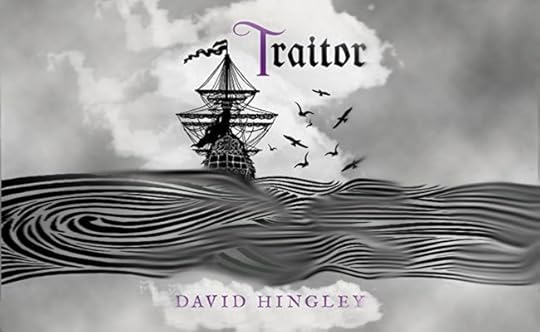
May 1665. With winter passed, Mercia Blakewood is at last headed back to England from America, hoping to leave behind the shadow cast by death and heartache. She expects a welcome from the King considering her earlier mission on his behalf, but the reception she receives after her long voyage home could hardly be called warm. With the country now at war with the Dutch, more manipulation lies ahead as Mercia must accept a clandestine role at the heart of the glittering and debauched royal court to unmask a spy and traitor.
David Hingley was born in the English Midlands. After a Spanish and Russian degree at the University of Manchester, he headed south to London to work for a decade in government. In 2013 he moved to New York, where he wrote his debut novel Birthright. He has also lived in Paris, on the literary Left Bank. In addition to his love of history, he has a passion for travel, including a number of road-trips through over forty American states. In 2016 he moved back to England and finished writing the second book in the Mercia Blakewood series, Puritan. His third novel, Traitor, was published in January 2018.
Traitor is my first experience of a book by David Hingley but put me down as hooked! Although I haven’t read the previous two books in the Mercia Blakewood series – Birthright and Puritan – it certainly didn’t affect my enjoyment of this book. In fact, I thought the author did a great job of providing the right amount of background information for readers new to the series without boring those who have read the previous books. It’s a fine balance to strike but I thought the author nailed it and actually there were some enticing nuggets of information about events in the earlier books that have definitely made me want to go back and read them.
The setting for Traitor is the court of Charles II. It’s a place of intrigue, scandal, gossip, clandestine affairs and power play around the succession since Charles is without a legitimate heir. It’s also a place of artifice, where people are adept at playing parts. The war with the Dutch not only endangers the security of the realm but has implications for important commercial interests, including those who trade in goods, including in human form. There is also a need to maintain the delicate balance of other powers and potential allies in Europe. “One day, perhaps, we shall cease our arguments with Europe, but that day is not yet come.” (Yes, I laughed at that bit too!).
When it is discovered that vital information is being leaked to the enemy, it becomes essential to track down the spy, code name Virgo. Enter Mercia Blakewood, recently returned from America where she performed a valuable service for the King. With the prospect of regaining ownership of the family estate (falsely claimed by her uncle) dangled in front of her, Mercia is persuaded to take on the task of uncovering the spy’s identity. Mercia makes a terrifically likeable leading character – as well as a caring mother, she’s determined, plucky, independent-minded, resourceful albeit a little rash about her own safety at times. As her servant and ally, Nicholas, observes, “Because you can’t resist a puzzle.” Widowed, she’s also a little lonely. “You are strong, Mercia. The bravest woman I’ve known. But there’s no shame in admitting it’s hard to live alone.” Mercia’s beauty means she’s not short of suitors but is their interest in getting close to her merely personal?
The plot is full of twists and turns as various individuals come under suspicion and Mercia tries to unravel the complex web of alliances and loyalties. I really welcomed the Dramatis Personae at the beginning of the book to help keep track of the different characters and inter-relationships. Along the way, Mercia finds she has powerful enemies but also potential allies – if she could only work out which was which! In addition, a figure from her past emerges to claim repayment of a debt that will involve difficult decisions for Mercia.
Traitor is a cracking historical mystery, full of colourful characters, with an intriguing story line and an evocative sense of the period in which it is set. A woman involved in espionage in the 17th century? Well, why not? There is the real life example of Aphra Benn, after all. I really enjoyed Traitor and would enthusiastically recommend it for fans of historical mysteries.
I received an advance reader copy courtesy of publishers Allison & Busby in return for an honest and unbiased review.
If you have a care to step back in time to 17th England , then this is an interesting journey!
A great mystery wrapped up in royal intrigue and the dangers of court life...intriguing
I do have a soft spot for a spy and mystery novel set in a royal court. I’ve read most of those set in the Tudor Court i would think so this was a nice change. A bit more modern but just as evil and fraught with danger.
The stench of the Southhampton docks, the London streets and the smell of fear were evident from the first page. That cover really showcases the book and if you read the hardback it’s almost as if you’re right back inside that court holding a manuscript and hoping the king will notice you or at least not order your death.
A woman at court plays many roles but Mercia has another much more dangerous role to play in this one – that of a spy. She is a great characters with plenty of personality and a backstory to match. Lots more to come from her I hope. As with other King and Queen novels, there is a family tree/list of characters to explain who is who but it’s easy to follow anyway.
If you have a care to step back in time to 17th England , then this is an interesting journey!
This is the third in a series of novels featuring Mercia Blakewood, a 17th century Englishwoman recruited by Charles II to carry out secret missions on his behalf. If you think that sounds far-fetched, it is worth noting that while Mercia is a fictional character, the King really did employ female spies, among them the playwright and novelist Aphra Behn. I haven’t read Mercia’s earlier adventures, but Traitor sounded so intriguing that I jumped at the chance to read it despite my usual preference for starting a series at the beginning.
The novel opens in 1665 and even without having read the previous novels, I quickly picked up all the background information I needed to be able to understand and follow the story. I discovered that Mercia’s father has been branded a traitor and executed following the English Civil War. His manor house has ended up in the possession of Mercia’s uncle, Sir Francis, but Mercia has not given up hope of regaining it, hence her desire to win the King’s favour.
At the beginning of the novel she has arrived back in England from America where she had been sent on a quest for the King and became caught up in the capture of New Amsterdam, now renamed New York. She has barely set foot on the shore when she receives a summons from Charles’ mistress, Barbara Palmer, Lady Castlemaine, who explains her next task to her. The country is now at war with the Dutch and it seems that someone close to the War Council is passing on secrets to the enemy. Mercia’s task is to identify the spy – a woman using the code name Virgo – but her investigations could endanger her own life as well as her young son’s.
I love books set in the seventeenth century but while I’ve read quite a lot about subjects such as the Civil War, the restoration of Charles II, the plague and the Great Fire of London, the specific setting for this novel – the Second Anglo-Dutch War – is something I’ve come across less often. Although the focus is on Mercia’s personal mission and her efforts to uncover the spy, the war provides an interesting backdrop for the story.
Mercia is a strong heroine and despite not having read the first two books in which she appears, I felt that I knew her well by the end of the novel. Other characters who stood out for me were Nicholas Wildmoor, the servant who has accompanied Mercia to and from America, and One-Eye, a sinister old woman who runs a ring of smugglers. There are also five suspects who could each be Virgo and although some of these characters are less developed than others, they are representative of different opinions and different positions in society. Helen Cartwright, for example, is delighted with the black boy, Tacitus, whom she receives as a gift and uses as a sort of fashion accessory, whereas Lavinia Whent has seen the results of slavery first hand in Barbados and has returned with more progressive ideas. Mercia herself is modern enough in her views to make her easy for a modern reader to like and identify with, but not so much that she feels entirely out of place in the seventeenth century either.
The mystery element of the novel worked well. I didn’t guess who Virgo was, although I did have my suspicions as to who else might be involved and wanted to scream at Mercia not to trust anybody! Along the way there’s plenty of suspense as both Mercia and Nicholas get themselves into some difficult and dangerous situations.
As I’ve said, I prefer to read a series in the correct order, but I enjoyed this book so much I think I’ll have to go back and read Birthright and Puritan now!
I loved this book. I was really excited when it first arrived as I had loved the previous two books and wanted to know whee it was going to go next. This book starts as Mercia arrives back in England immediately after the events of Book two where she was in America on a mission for the King. It gets straight back into the action as Mercia is summoned to the king and given another assignment. This time she is to go to the Royal Court and try and uncover who the female spy is within court.
I loved catching up with Mercia again. She's such a brilliant character and I love how she breaks away from the Stuart era stereotype of what a woman should be and is willing to stand up for herself and take on challenges that women would not have been expected to have been involved with.
I really enjoyed the setting of this book and getting to see the working of the Royal Court complete with its mix of glamour, scandal and political manoeuvrings. The story itself unfolds as a mystery as Mercia tries to work out who the spy is by getting close to other women in court and trying to find out more about them.
As a side note the story also looks at the role Britain played in the slave trade by looking at the Stuart fashion of women having a Black African Slave as almost an accessory to accompany them to show off their status and wealth. This fascinated me because the racist ideas behind it are so awful but equally one of the reasons why Britain managed to gain such wealth as its Empire grew.
All in all a story I thoroughly enjoyed and a series I have loved and would thoroughly recommend.
A fitting end to this historical crime trilogy, Traitor was much more focused on court intrigue rather than the wilder everyday life in the Americas. There isn’t much description and the characters can feel a little distant and basic at times, but the overall plot and it’s various twists were excellent and the actual crime story was intriguing. There is never a boring moment, with each scene contributing to the plot.
God this was boring. I had to give up in the end. The 'characters' ( misnomer) were just dressed up in modern guise. I didnt feel there was any real edgy period detail. Lady This and Lady That were all indistinguishable. The Dutch war going on in the background had no meat on its bones - no research had been done. I only ever abandon a book about once in 5 years, but just couldnt carry on with this one.
Didn't leave me eager to jump into the third book, but I suppose I'll get there eventually. (Turns out this WAS the third book. I read them out of order. 🤦♀️)
This is now the third book in the historical series which features the female adventurer, Mercia Blakewood, and we meet her as she arrives back in England from America where she has been on a secret mission for King Charles II. Her arrival into the country is met with suspicion and doubt, that is, until she is taken to London and a clandestine meeting with the King's notorious mistress, Barbara Castlemaine. Given the task of exposing a potential spy ring, Mercia must adopt an entirely new role and one which will place her and those she holds dear in grave danger.
This is a fascinating look at the profligate court of King Charles II and of the dangers which so often lingered in shadows. For Mercia, the task she is assigned is dangerous and filled with many obstacles, and yet, her strength of character sees her though the difficulties, and her ready wit and charm endear her to the reader. That she is also brave and quite fearless is also to her credit as Mercia is no simpering courtesan and is more than a match for any of the men and women who try to thwart her.
The mystery, at the centre of the story is well thought out, and there are more than enough twists and turns to keep the adventure alive in the imagination. I found it quite refreshing to have a female lead protagonist who didn’t conform to the usual rigid protocols which were so evident at this time in history.
Traitor is an intriguing journey into the political arena of the mid-seventeenth century. The wars with the Dutch and the fast growing slave trade form the backdrop to an interesting and lively historical adventure.