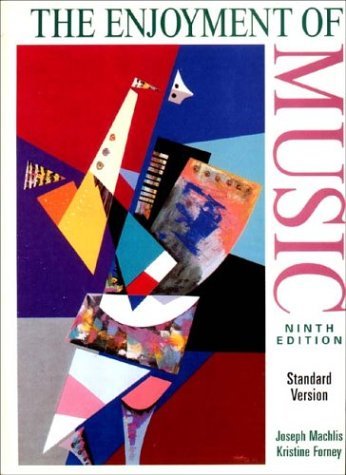
With nearly three million copies sold over eight editions, The Enjoyment of Music is the best-selling music appreciation text of all time. Spanning the Middle Ages through the twenty-first century, the text offers a thorough introduction to the elements of music, a broad overview of the history of musical styles, and fascinating cultural contexts and perspectives. The Ninth Edition of this classic text features a stunning new design, exciting new repertory, and an unmatched ancillary and media package.
Λίγα λόγια για τα κοινωνικοπολιτικά της κάθε εποχής, των καλλιτεχνικών και μουσικών τάσεων της κάθε εποχής, μικρές βιογραφίες για τους πο σημαντικούς συνθέτες και μίνι αναλύσεις κάποιων έργων... γενικά πάντως έτσι και έτσι, εγω για κάποιον περίεργο λόγο ψιλοβαρέθηκα.
This is not a music history book rather it's a short survey on music history that touches upon different ideas and gives you a basic understanding of musical aesthetics, different eras and genres and a general overview of its history with a heavy emphasis on non-vocal music.
This one gets 5 stars simply because the 1st line in the book is a quote of Albus Dumbledore from Harry Potter. I mean, how can you NOT like a textbook that quotes Harry Potter?
Very interesting book about the basic elements of western music...Melody, rhythm, scale,... Through this reading you can fly from one musical period to another in a really enjoyable way. But, at the same time, you can see that all this artistic history is marked by male composers. The only woman cited in this chronological analyses ( from eighteenth to nineteenth century) was Clara Schumann, a prodigious pianist ( but even though she was there, the life story of her husband had a principal spot in the book). Clara Schumann and so many other musical women deserved more attention!
I've been using this for teaching IB DP Music. This book suits the age level (16-19) and thus a suitable material for class. Beautiful layout and concise explanations for a wide range of topics and aspects. Would be even better if there was more score transcripts and less social/historical contexts..
This is one of the few college classes I actually enjoyed. I learned some new pieces of classical music (and a little bit of Jazz), some of my favorites being “Prelude to an Afternoon Faun” by Debussy, “Erlkonig” by Shubert, and “Summertime” (my favorite version is by Janis Joplin).
The best conceptual music theory introduction book. What this book worked well for me was in those select areas of specialized music interest, I was able to better understand how a given area developed through history and became formalized. For audio engineers, this book is essential for having a more broad understanding of how music creation occurs and translated into reproducible forms. The book is not going to explore the Nyquist Theorem, but it will describe how waveforms relate to pitch and so forth, so it points you in the general direction of Nyquist or similar path finding for the interested party's further investigation. The Queen of musical instruments is properly identified and explained, and the theological hints included with the description of melody is helpful to understanding the mysterious yet rather universal human reception to hearing melody.
To me, this book gave a detailed introduction to the world of Western classical music, mainly exploring its fundamental elements such as melody, harmony, rhythm, and forms of elements while guiding us readers through the major historical periods, key composers, and many other musical styles, all with the main goal of helping both novice and non-musicians to better understand, appreciate, and enjoy music. I personally loved the quotes under each chapter and art work that were included within the book. What I mainly liked about this book is that it provides snippets of each piece that corresponds to the music style. Something really nice to look into as a musician myself. :) The author should’ve added more snippets of pieces of music so that more people can better understand the music style and how it has evolved throughout the years. Great Read Though!
This was one of the books that accompanied one of my many collegiate-level classes. I particularly enjoyed the interactive listening guides that came with the bundle, as they helped me appreciate music even more.
The musical examples are juicy, but the style is malignant adjectivoma. I'd rather versify the ingredients in Cap'n Crunch than listen to music critics string adjectives together.
This informative text is as entertaining as it is educational. The reader looking for a deeper knowledge of "classical" music will at once learn basic analytical terminology (without delving deep into music theory) as well as gain knowledge of the major western (and a few non-western) musical instruments. The reader will also come to realize a time-line for Western music history filled with enough information that serves as a starting point for learning further information. The accompanying CDs provide the reader with support to the music discussed in the text. This book is highly recommended for the lay and academic music appreciater alike!
I've been teaching from this textbook since 2009. Joseph Machlis's classic, original Music Appreciation text has been updated and "enhanced" with bits of current academic obsessions such as environmentalism, stirred in like big lumpy raisins.
Also added in are lots and lots of snazzy photographs and illustrations, which break up all those intellectually taxing blocks of text.
It's a pretty book, but most of my students seem to welcome further explication of the music theory elements than that which the text provides.
This was a good read. I enjoyed learning about music dating all the way back to 400 A.D. With gregorian chants till today with modern contemporary music. This text does a good job of breaking down the various eras of music throughout history and portraying historical figures and composers in a realistic and relatable way.
Thorough, informative, and enlightening. Used it for self study for History 1/3, and it helped for the exam, but offered even more in analysis and appreciation of the pieces of the various eras explored.
This book is somewhat long-winded, and can be quite tedious and boring unless you're really into the work that goes in behind the music. It's primary genre is classical and orchestral work.
Yea, I like this class better. I'm learning a ton and I've been a musician for almost 30 years. Love the cd's that come with it. Great online class! I love being back a the U.