This thoughtful and beautifully illustrated picture book shares the story of a trailblazer who has inspired generations of girls to change the world.
Sara Josephine Baker was a strong girl who loved adventure. Growing up in New York in the late 1800s was not easy. When she lost her brother and father to typhoid fever, she became determined to pursue her dream of becoming a doctor. In Jo's day, medical schools were closed to women, but times were changing, and Jo was at the forefront.
When she graduated in 1898, Dr. Jo still faced prejudice against women in her field. Not many people were willing to be seen by a female doctor, and Dr. Jo's waiting room remained mostly empty. She accepted a job in public health and was sent to Hell's Kitchen, one of New York's poorest neighborhoods where many immigrants lived. There, she was able to treat the most vulnerable patients: babies and children. She realized that the best treatment was to help babies get a stronger start in life. Babies need fresh air, clean and safe environments, and proper food. Dr. Jo's successes, fueled by her determination, compassion and ingenuity, made her famous across the nation for saving the lives of 90,000 inner city infants and children.
Monica Kulling was born in Vancouver, British Columbia. She received a BA in creative writing from the University of Victoria. Monica Kulling has published twenty-six fiction and nonfiction books for children, including picture books, poetry, and biographies. She is best known for introducing biography to children just learning to read and has written about Harriet Tubman, Houdini, Eleanor Roosevelt, and Amelia Earhart among others. Monica Kulling lives in Toronto, Canada.
Before reading Dr. Jo, I was somewhat familiar with Monica Kulling’s work, having read three of her picture-book biographies in Tundra Books’ Great Ideas Series. The books introduce kids to the historical figures behind many inventions we take for granted, including inexpensive personal cameras, paper bags, elevators, and the Zamboni machines used on skating rinks’ icy surfaces. One of the good things about the books is Kulling’s focus on African American, female, and economically disadvantaged individuals, whose curiosity, creativity, and grit drove them to make valuable contributions to everyday life. Kulling’s Dr. Jo, resembles her earlier books in both format and content. The narrative is roughly 30 pages long and attractively illustrated—this time by Julianna Swaney, whose clean pencil and water-colour work, with its antique quality, complements the life story of Dr. Sara Josephine Baker.
I’d never heard of Dr. Jo before this book, and I’m glad Kulling decided to write about her. Baker certainly deserves attention for her early understanding of “the connection between poverty and illness” and her tireless work “to improve the health of women and their children” in big cities. Born in 1873 in Poughkeepsie, New York on the Hudson River, Jo was a very unconventional girl. Considered a tomboy, she spent her summers fishing the river with her younger brother, Robbie. Winters, the two skated together.
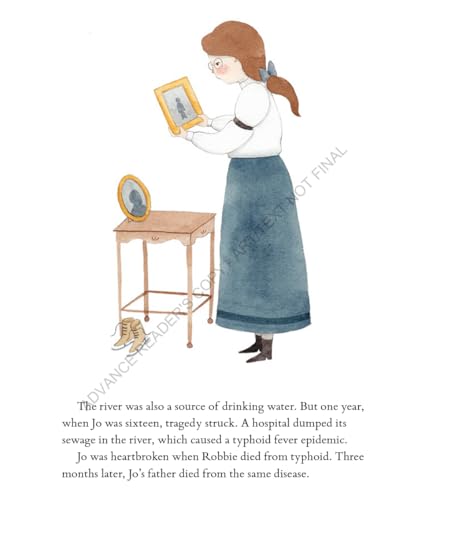
Kulling isolates two key events in Jo’s young life. At age 10, she injured her knee and was tended to by a doctor and his son, who was also a doctor. This experience apparently sparked her interest in becoming a physician herself, a decidedly unladylike career choice at the time. It is what happened when Jo was sixteen, though, that was probably even more decisive. In 1889, sewage was emptied into the river, the source of drinking water for the town. Jo’s beloved brother and then her father contracted typhoid fever and died within a few months of each other. After high school, she traveled to New York City where she received medical training at a college started by two doctor sisters, Elizabeth and Emily Blackwell. (Elizabeth was, in fact, the first woman to receive medical qualifications in the United States.)
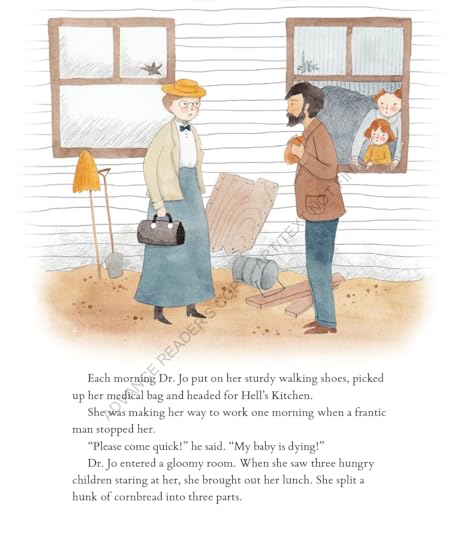
After obtaining her medical license, Dr. Jo struggled to make a living in private practice. Kulling doesn’t explain why, but one assumes that public confidence in “lady” doctors wasn’t high. She ended up becoming a public health inspector (and eventually the first director of the New York City Department of Child Hygiene). Her role as an inspector took her to Hell’s Kitchen, a West-Side neighbourhood with manure-piled streets and squalid tenements, which were mostly occupied by immigrants. In almost no time she realized that many deaths, especially children’s, were due to unsanitary conditions and ignorance. She was determined to make a difference.
Kulling spends the last several pages addressing the improvements Jo made to public health in the city. Among other things, Jo devised antibacterial beeswax containers that held exact (single) doses of the silver nitrate solution applied to prevent blindness in babies. Prior to this, bacteria-laden glass containers for the solution were actually contributing to the problem. Jo designed an infant sleeper, with a button-down front, to replace the swaddling that caused babies to die from heat stroke. She also set up a system for licensing midwives, and she organized accessible stations where mothers could obtain clean, fresh milk for their kids.
For the most part, I really liked Julianna Swaney’s illustrations, but they do fall a bit short at times. Although Swaney does give young readers historically accurate details—for example, a 6-inch medical thermometer (which resembles a knitting needle) appears in one picture, she does not satisfactorily communicate the grit, grime, and general filth of the environment in which Dr. Jo worked. The immigrant families all look a bit too tidy. One illustration is even a bit puzzling: a family, shown seated at a table, is strangely engaged in making paper or cloth flowers. The text offers no explanation about this. Perhaps it was some kind of piecemeal work available at the time?
Aside from a couple of reservations about the book’s artwork, I really liked Dr. Jo. Dr. Sara Josephine Baker was a fascinating and admirable woman, and Kulling’s book does her justice. The vocabulary and content make it best suited to kids aged 8 to 10.
I’m ashamed to admit that I had never heard of Dr. Sara Josephine Baker, who did so much to improve health conditions in Hell’s Kitchen While now trendy Clinton in the West Side, Hell’s Kitchen used to house impoverished New Yorkers beset with smallpox and typhoid. It was so bad that, in 1917, infants in New York City suffered a higher mortality rate than soldiers deployed in World War I!
Dr. Jo realized that much of those deaths were needless, caused by poverty and ignorance. She pioneered official training for midwives, better swaddling clothes (some infants died of heatstroke previously) and milk stations, where mothers could get unadulterated milk for their children, amongst many other improvements. The book estimates that Dr. Jo’s improvements, which spread beyond New York City, saved the lives of 90,000 inner-city children. She became the first director of New York City’s Department of Child Hygiene. By the time, Dr. Jo retired in 1923, New York City had the lowest infant mortality rate of any major American city!
Readers of any age will adore this beautifully illustrated book that recounts the difficulties that women doctors faced at the turn of the 20th century and how much illness depends on access to good food and medical information (a good lesson even today). Kudos to author Monica Kulling for this eye-opening book and illustrator Julianna Swaney for her charming full-color pictures.
In the interest of full disclosure, I received this book from NetGalley. Penguin Random House Canada and Tundra Books in exchange for an honest review.
DR. JO is a beautifully written book about Sara Josephine Baker, a trailblazer in medicine. She lived in New York in the late 1800s, and after her father and brother died from typhoid fever, she vowed to become a doctor. This was easier said than done at that time as Medical schools did not admit women. Josephine was accepted to a Women's Medical School in New York and her dream was realized. Graduating did not mean she would be able to practice medicine. People would not go to a female doctor, so she became a health inspector for the city of New York. In Hell's Kitchen, Jo once again came face to face with typhoid fever. She taught the parents what to do to prevent this terrible disease as well as many other child diseases and ailments. She researched and developed practices, items and inventions for various problems she encountered. Jo helped to change many practices, and in doing so, ultimately saved the lives of 90,000 inner city infants and children in her practice in Hell’s Kitchen. A great book to read when studying health practices, women's rights and growth, poverty, biographies, famous women and more. A great addition to any school or public library. The publisher, Penguin Random House Canada, provided me with a copy of this book to read. The opinions stated are my own.
Known as something of a tomboy when she was young, Sara Josephine Baker wasn't your everyday late-nineteenth-century American girl. Inspired by a childhood encounter with two doctors (a father and son), and spurred on by the death of both her brother and her father from typhoid fever, after their town's drinking water was poisoned by raw sewage, Baker decided to become a doctor herself - something quite unusual for the women of her day. Studying at the medical school founded by Elizabeth Blackwell (the first woman in the USA to receive a medical degree), Baker graduated in 1898. In 1901 she became a health inspector in New York City, assigned to the rough immigrant neighborhood known as Hell's Kitchen. Here she found that the impoverished conditions were particularly rough on her most vulnerable patients: infants and young children. Always one to rise to the occasion, "Dr. Jo" eventually came up with some solutions to the problems she observed, whether it was the heatstroke caused by overly tight "swaddling" clothes (she invented her own infant wear!) to the incorrect dosages often given of silver nitrate for babies' eyes (she created a storage system made of beeswax!). By the time she retired, this amazing doctor had saved over 90,000 young children with her inventions and innovations...
I had never heard of this amazing medical pioneer before picking up Monica Kulling's Dr. Jo: How Sara Josephine Baker Saved the Lives of America's Children, but am very glad to have had that flaw in my education remedied! Dr. Jo was certainly an admirable character, and her work was important. As someone with a serious medical condition myself, I am grateful for the knowledge and technology that has helped to keep me alive, and full of admiration for the people whose discoveries helped to advance that knowledge. It's astonishing to think (as Wikipedia claims) that the infant mortality rate in the United States during WWI was higher than that of the soldiers serving on the front lines. Baker's understanding that infant mortality (and illness in general) was tied to poverty and poor hygiene conditions, is something that seems self evident to us now, but our better knowledge today owes something to her work, and to the work of many others like her. I found Monica Kulling's narrative here engaging, and appreciated the artwork by Julianna Swaney, done in watercolor, gouache and colored pencil. An author's afterword gives more information about Baker, and provides a (very) brief list of sources and further reading material. Recommended to all young would-be doctors, and to anyone curious about the role of women in medicine, or the improvement of child health over time. Also recommended to anyone looking for picture-books set in New York City in the early twentieth century.
Dr. Jo: How Sara Josephine Baker Saved the Lives of America's Children is the story of a courageous and unconventional woman who attended medical school long before it was considered "normal" for women to do so, and who dedicated her life to the vulnerable babies and children living in poverty in New York City.
"Hell's Kitchen" was the name of the neighborhood where she did much of her work in public health. Despite the challenges, Dr. Jo went beyond simply treating patients and tried to come up with big-picture ideas that could help this population in the midst of their poverty -- one of her ideas was to make bottles out of beeswax to help make babies' eye drops safer.
I really appreciated this story of a woman who was ahead of her time and whose compassion drove her to save so many lives. Definitely a great example for girls (and boys) today.
Monica Kulling introduces young readers to Dr. Sara Josephine Baker who worked among immigrant children in Hell's Kitchen. She recognized problems and created solutions to these. Dr. Jo's accomplishments make her a woman worth knowing. She saved the lives of many children, both through her medical efforts and through her efforts to educate midwives, babysitters, and parents. The illustrations are cleanly drawn but more reminiscent of books of an earlier era. Perhaps since we are dealing with a historical figure, it is not a major flaw. The author includes a brief biography of books and websites at the end. I would like to read the doctor's autobiography, written in 1939, to learn more of this remarkable woman. I received a copy of this book through LibraryThing's Early Reviewer program with the expectation of an honest review.
Our memories are short. One of the things we have to do is remember the past, because it teaches us about how far we have come. This picture book of the life of Dr. Sara Josephine Baker reminds us of many things of the past.
It reminds us when it was unusual to have a woman doctor. It was so unusual that Dr. Jo couldn't make it in private practice and had to get a job as a health inspector. But it was while doing this, among the tenements in Hell's Kitchen that she learned of the appalling conditions of the immigrants, all stuff together, and sought to change things.
Great introduction for kids who want to learn about how things were at the turn of the last century. Good starting point to be interested in famous women's lives.
#Dr.Jo #NetGalley
Thanks to Netgalley for making this book available for an honest review.
DR. JO is a lovingly illustrated, beautifully written book about Sara Josephine Baker, a trailblazer in medicine. She lived in New York in the late 1800s, and vowed to become a doctor after her brother and father succumbed to typhoid fever. Med schools did not admit women then but Jo helped to change all that, and in doing so, ultimately saved the lives of 90,000 inner city infants and children in her practice in Hell’s Kitchen. Inspiring! 5/5p
Thank you to the author, Penguin Random House Canada and NetGalley for the review copy. Opinions are mine.
@tundrabooks #partner | “Dr. Jo desperately wanted to help, and she had a few ideas.” | You guys, this book is beautiful! From the thick, high-quality pages to the lovely watercolor illustrations by @julianna_swaney, DR. JO is a work of art. But even better than that, Monica Kulling has written an inspiring picture book about a true heroine, Dr. Sara Josephine Baker, who had a huge positive impact on the poor, immigrant community of New York City at the turn of the century. 💛 ............. This morning, as my thoughts naturally turn to the events of 9/11, I know that our children need examples like Dr. Jo. They need to see the rescuers who combat the evil in the world. They need to see that there is kindness. They need to see that courage can make a difference. They need to see that one person can change lives for good. 💛 DR. JO will be available on October 9, 2018 and is a good read-aloud for ages 5+.
Wonderful read about a woman i've never heard of with v.nice art. Makes the reader want a y.a. version. This will make a great Christmas stocking gift.
An inspiring, beautiful book about a young doctor, Dr. Sara Josephine Baker, who used basic sanitation and smarts to save the lives of countless children in Hell's Kitchen (New York City) in the first decades of the 20th century.
Set against a backdrop of poverty, illness (typhoid for instance) and hunger, Dr. Jo was a tireless and fearless champion for the poor. Among her amazing accomplishments, she set up a licensing system for midwives (which helped to lower the infant mortality rate), she organized milk stations in store fronts so poor mothers could get safe, fresh milk for their babies, and she developed an amazing cheap, safe anti-bacterial bees wax container for infant eye drops, to save children's sight. She did a lot more, too.
I'd never heard of Dr. Jo before, but this lovely, informative and very inspiring book changed that, now I want to know more. What amazes me about Monica Kulling's writing, is that she tells us so much in just a few words, AND she can tell a story about death, disease and poverty for children while somehow making it uplifting. The illustrations by Julianna Swaney are also sweetly whimsical, with just enough detail to suggest the truth about Hell's Kitchen without being too gritty or overwhelming.
I think young readers (and readers of any age) will love this book, and find an inspiring figure in Dr. Jo (I sure did)!
Dr. Jo is a beautifully written and illustrated book that should be included in every school library and read to school children on the accomplishments of women. The book highlights a woman in the 1890’s who wanted to become a doctor, when women doctors were all but non existent. This was the era that studying medicine was not for women and reveals some of the bias that women physicians endured. By the end of her medical career, Dr. Josephine Baker had solved some of the misconceptions and poor practices of immigrant families of taking care of their health. The book states she ”had saved the lives of 90,000 inner-city children across America." This book's text is written in a style that is easily understood and flows well from page to page. The illustrations tend to evoke nostalgic images which depict the time period of the story very well.
Highly recommend this book as a great book for young readers. Five stars!
Thank you to the publisher and #NetGalley for a pre-publication ebook in exchange for an honest review.
What a powerful story!! This is the kind of book that you want your daughters AND sons to be reading as they grow up. All people are capable of learning and doing incredible things!
Dr. Jo has a story of persistence and resilience despite many obstacles. The beautiful illustrations are a cherry on top of a wonderful book.
10/10 would recommend.
I received a copy of this book from NetGalley in exchange for an honest review.
As an adult, I learned a great deal reading this non-fiction title about Dr. Josephine Baker worked to save children's lives. We need more books like this that showcase the hard work and determination of women in the 18- and 1900's. This book showed a strong, determined woman who was also compassionate, intelligent and kind. I look forward to sharing this title with my classroom.
Great story about a trailblazing doctor who worked with poor immigrant families, particularly babies and children, in Hell's Kitchen in the late 19th century and early twenieth century.
Monica Kulling (Mary Anning's Curiosity) and Julianna Swaney's (Mermaid School) Dr. Jo tells the incredible and impassioned life story of Sara Josephine Baker, an American pediatrician who made remarkable achievements in her work with mothers, infants, and families living in inner-cities.
"Jo had wanted to be a doctor ever since she was ten years old, when a kind physician and his son, also a doctor, had taken care of her injured knee. The deaths of her father and brother renewed that dream."
Through Kulling's terrifically clear storytelling style and Swaney's gorgeously soft art, readers are taken into the life of pioneering pediatrician Dr. Jo. We meet Jo as a child, happily skating with her brother; a playful joy soon followed by unimaginable heartbreak in her teens...heartbreak which only serves to increase her desire to become a doctor. In Jo's time- the late 19th century- women doctors were rare; fortunately, Jo was accepted into and able to attend the Women's Medical College of the New York City Infirmary. Jo moves along in her career, becoming a health inspector and is assigned to Hell's Kitchen. It is in her work serving the families of Hell's Kitchen where Dr. Jo's legacy takes off. Kulling, in a straightforward, concise and compassionate matter, takes readers through terrible hardships Dr. Jo saw facing down families with children (often immigrant families) who were living in poverty. In her determination and dedication to help mothers and infants living in harsher inner-city conditions, Dr. Jo revolutionized (among other practices): midwifery requirements; nurse care availability to new mothers; "milk stations" in cities to provide "clean, healthy milk" for moms and children; sterile eye drop applications for newborns; as well as the mass production of "safe baby clothes".
"Dr. Jo understood the connection between poverty and illness. Throughout her life she worked tirelessly to improve the health of women and their children in New York and other big cities."
Overall, Dr. Jo is a wonderfully written and beautifully illustrated title that serves to inspire as well as educate; an excellent title that captures attention and, with Monica Kulling's storytelling, reads ever so smoothly even while delving into more significant subject matter. Julianna Swaney's illustrations are delicate and so lovely, bringing a warm, hopeful feel to Dr. Jo's story even when things take a sad turn. The general category of children's biographies is continuing to grow, and in turn, we are seeing a (much-needed) boom in biographies (pictorial and other) of trailblazing women- women who are both known and under-the-radar. Be sure to add Dr. Jo to your list of must-read children's picture book biographies, alongside titles such as Bloom: A Story of Fashion Designer Elsa Schiaparelli, Mary Who Wrote Frankenstein, Dream Big, Little One, the Little People, Big Dreams titles, and other such illuminating reads.
I received a copy of this title courtesy of Tundra Books/Penguin Random House Canada in exchange for an honest review. All opinions and comments are my own.
I read Dr. Jo to my granddaughters this past week while they were visiting. The book appealed to both the five year old and almost nine year old. It's a wonderful choice for young readers to celebrate Women's History Month (although I know that was in March and we have now slipped into April).
Sara Josephine Baker, still a child, decided she would become a medical doctor after both her father and brother died from typhoid fever. She became one of few female doctors during a time in history when the general public showed prejudice toward professional women. As a result, when she and her friend opened a practice together, she did not have enough clients to stay in business. Not one to be deterred, she found an alternate route to her dreams. She became a public health official and was sent to Hell's Kitchen in New York. Here, among the immigrants and some of the poorest and most desperate, she used her medical background to educate families and promote clinics to help parents know how to properly care for the children's health (as well as their own). Things we take for granted today that keep us healthy like proper diet, fresh air, and dressing babies appropriate for the heat index were things that had to be taught. (Babies at the time were being tightly swaddled while enduring the heat of summer in the tenant housing. Dr. Jo actually created a line of clothing that was loose fitting and comfortable for babies and convenient for their mothers.) Sara Josephine Baker (Dr. Jo) is a great role model for young girls and a likely inspiration to children of all ages.
The author, Monica Kulling, a Canadian author of children's books, has written over 50 children's books. Our grandchildren have received a number of her books as gifts and we highly recommend this author.
I have given the DR. JO book five stars and highly recommend!
* Thank you NetGalley for a digital ARC of this book. All opinions are my own.
Dr. Jo – How Sara Josephine Baker Saved the Lives of America’s Children, by Monica Kulling, tells about one of the earliest female doctors in America, Dr. Baker. She didn’t fit into the normal mold of “girl” in the late 1800s and was intrigued by medicine early on. That intrigue changed when both her brother and father died of typhoid after drinking contaminated water. She attended the Women’s Medical College of the New York Infirmary, but few people wanted to go to a female doctor. Instead, she became a health inspector. That role led her to Hell’s Kitchen, a poor neighborhood in New York, where she saw first hand what poverty and lack of knowledge was doing to new infants. She saw a need and went about fixing it.
Dr. Jo is the kind of character that our children need to learn about because she thought outside of the box. She also saw what ignorance could do and went about changing it without making anyone feel that they were ignorant. She not only cared for infant health, but she saw that women in general needed training in safe ways of taking care of their children and the birthing process.
The book itself might be challenging for younger readers, but if you are wanting to lure older elementary kids into a subject or give them someone completely different to research, this is a great opportunity.
Love this book that takes young readers into the life of Dr. Sara Josephine Baker and the age in which she practiced. As we’ve come to expect of Monica Kulling’s picture book biographies, the text is deftly layered to impact readers of all ages. In this case, Dr. Jo’s story depicts the life of a resourceful, compassionate doctor while at the same time exposing the plight of immigrants in the New World and the opposition faced by women trying to be true to themselves in a world shaped by prejudice.
I particularly noticed and appreciated the inclusion of other female doctors, such as Florence Laighton, who practiced alongside Dr. Jo and of Emily and Elizabeth Blackwell’s Women’s Medical College – assurance that, while this one particular woman doctor may have been incredible, she was not unique in her endeavours.
The back matter and sources are a terrific addition. Delivering further information about Dr. Jo’s impact on health-care, infant mortality and social justice, they encourage deeper thinking about the story and its context. Julianna Swaney’s artwork – described as being inspired by both whimsy and melancholy – is the perfect complement to a compelling text about the sometimes harsh realities of a woman doctor’s life in New York in the early 1900s.
This thoughtful and beautifully illustrated picture book shares the story of a trailblazer who has inspired generations of girls to change the world.
Sara Josephine Baker was a strong girl who loved adventure. Growing up in New York in the late 1800s was not easy. When she lost her brother and father to typhoid fever, she became determined to pursue her dream of becoming a doctor. In Jo's day, medical schools were closed to women, but times were changing, and Jo was at the forefront.
When she graduated in 1898, Dr. Jo still faced prejudice against women in her field. Not many people were willing to be seen by a female doctor, and Dr. Jo's waiting room remained mostly empty. She accepted a job in public health and was sent to Hell's Kitchen, one of New York's poorest neighborhoods where many immigrants lived. There, she was able to treat the most vulnerable patients: babies and children. She realized that the best treatment was to help babies get a stronger start in life. Babies need fresh air, clean and safe environments, and proper food. Dr. Jo's successes, fueled by her determination, compassion and ingenuity, made her famous across the nation for saving the lives of 90,000 inner city infants and children.
'Dr. Jo: How Sara Josephine Baker Saved the Lives of America's Children' by Monica Kulling with illustrations by Julianna Swaney tells of the remarkable life of a woman who found a way to do good in the midst of adversity.
During her childhood, Sara Josephine Baker lost her brother and father to typhoid fever. From that moment, she was determined to become a doctor. This was a tough pursuit for a woman in the late 1800s. There weren't a lot of schools that would teach women, but she found a way. When she graduated, it was tough to find a job, but she found a way. She worked in the poor neighborhood of Hell's Kitchen, and helped children and infants to get better treatment.
I liked this true story of a person determined to help in spite of being told they couldn't. The determination of this story is a good lesson for young readers.
The illustrations by Julianna Swaney are also very nice. They have a good feel for the time of this story, and I liked the warm colors that were used.
I received a review copy of this ebook from Tundra Books, Penguin Random House Canada, and NetGalley in exchange for an honest review. Thank you for allowing me to review this ebook.
I absolutely love children's biographic picture books. They provide a wide open door to introduce the young children to real people at real places doing real and fabulous things in the World. This book by Monica Kulling which is beautifully illustrated by Julianna Swaney is exceptional in the telling of Dr. Jo's story.
The text is for children but doesn't "talk down" to them. It flows in beautiful composition rendering the process of Dr. Jo's life from childhood to becoming America's first pediatrician. It tells of her compassion, her professionality, her insight into the needs of people, and her accomplishments.
Dr. Jo was a strong woman at a time when women did not readily pursue medical professions nor were they much accepted by the populace. This children's biography will teach appreciation and respect for Dr. Jo's accomplishments and for the medical and health profession.
I highly recommend this book. Homes that provide libraries for their families, school libraries, public libraries all need to have copies.
I received a copy through the Librarything.com Early Readers program.
Thank you to Tundra for a free copy of this title in exchange for an honest review. • I am becoming a collector of picture books, but must admit that my picture book collection didn’t include one single biography until Tundra sent this beautiful book my way. • I love that they combined beautiful illustrations and picture book format with an informative and inspiring story. I have three daughters and so love placing books in their hands that can be an inspiration to work hard, follow their dreams and serve others. • Dr. Jo is the story of a woman graduating as a physician in 1898 and spending her life helping immigrant families and the children of New York City. It is beautifully written and illustrated, which is just what I have come to expect from @tundrabooks • If you are a lover of picture books or are looking to include more biography in your home library, I highly recommend checking out this recently published picture book! • Side note: My youngest is named Josephine, which makes this title even more special to have in our home library ❤️ •
I received an advance e-copy of this book through NetGalley to review.
I am loving this new wave of picture book biographies that have been released recently. I especially love learning about people who made a great difference in the world, but that I had previously never heard of.
I found Dr. Jo's story compelling and inspiring. I love the way she saw problems and, instead of despairing, worked hard to find solutions. She took on things that were not in her usual skill set (like designing new baby clothes that were more safe) because she knew it needed to be done. She was just one person doing what she could to help and she saved the lives of thousands of children.
Seeing the way that one person can change the world is something I never get tired of reading about.
The text wasn't too long or cumbersome that my 5 year old was able to enjoy reading it with me.
I will be featuring this book on my blog and social media accounts closer to the release date!
This is a beautifully written and illustrated book that highlights one of the most amazing women in history. I have to admit that I knew nothing of Dr. Sara Josephine Baker before reading this book, and I now feel that everyone should know about this woman who became a doctor at a time when most people thought "studying medicine was not for women," and by the end of her medical career, "had saved the lives of 90,000 inner-city children across America." This book's text is nicely worded and flows well from page to page, and I love the nostalgic illustrations which depict the time period of the story very well.
I highly recommend this book for all children, however this is a great book for people of all ages.
I received an advance reader's copy of this book from NetGalley and the book's publisher in exchange for my honest review, for which I am very grateful.
I learned about the subject of this biography on a podcast and then found this book. I didn't realize when I got it from the library it was a children's book but it was really cute and told a great story. This is a good book to introduce children to a real person and how they did what they could to help others. It also shows how being outside the stereotypical roles society tries to confine people to lead to changes that improved an entire neighborhood and eventually the rest of the nation's health.
Interesting story of Dr. Sara Josephine Baker and her early struggles to help keep children well in the U.S. after losing her father and brother to typhoid fever. She was made a doctor in 1898 and one of the first women doctors in America. She was sent to work in Hell's Kitchen, NYC and worked with the babies to get them fresh air and proper foods. It was a story of one of the trailblazing women of medicine.
I read & rated this book for the Vancouver Children's Literature Roundtable (VCLR)'s 2019 Information Book Award.
This title had cute illustrations, a good narrative, and good back matter. The biography approaches tough topics with tact, and focuses on Jo's inspiration. However, I felt that it wasn't terribly unique.
The biography of Dr. Jo, allows teachers to demonstrate how one person is capable of changing many people's lives. This book can also resemble having a passion about something and working towards pursuing that passion. If you want to be like Dr. Jo, pursue the passion you have and work to change others lives.
The fourth star is because it's important for us to learn about pioneers in science-related fields, not just about celebrities. And female pioneers, too. This is still awfully simple, though; I want more. There is back matter, but that's still not enough. And the pictures, well, they're actually *too* pretty, esp. of the filth, the lack of windows, etc., that her patients suffered with.