Jump to ratings and reviews
Rate this book

Why We Can't Afford the Rich

Rate this book
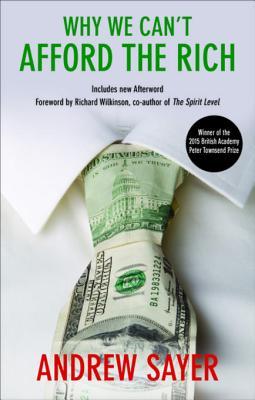
Why we can't afford the rich exposes the unjust and dysfunctional mechanisms that allow the top 1% to siphon off wealth produced by others. With an updated Afterword, Andrew Sayer shows how the rich worldwide have increased their ability to hide their wealth, create indebtedness and expand their political influence.

ebook

First published November 6, 2014

30 people are currently reading
916 people want to read

About the author

Andrew Sayer

16 books10 followers

Ratings & Reviews

What do you think?
Rate this book

Friends & Following

Create a free account to discover what your friends think of this book!

Community Reviews

5 stars
58 (40%)
4 stars
46 (31%)
3 stars
30 (20%)
2 stars
8 (5%)
1 star
3 (2%)
Displaying 1 - 25 of 25 reviews
Profile Image for Trevor.
1,522 reviews24.7k followers
June 17, 2019
Although the author of this book makes it clear at one point that he is not a Marxist, I think it could be argued (and I’m going to argue just that) that he explains most of the problems faced by capitalism as coming from what Marx identified as his theory of surplus value. And so I’m going to start by giving a thumbnail of that and then working out from there.

You could say that Marx was mostly interested in trying to understand where profit came from, and he spends a large part of the start of Capital explaining just that. He goes through many of the explanations that are often presented – like the idea of a capitalist buying things ‘cheap’ and then selling them ‘dear’. But, as he explains, if this was the case then all that would happen would be that the person the capitalist was buying stuff from would eventually go broke. For Marx, economics is ‘relational’ – that is, it depends on the relationship between the worker and the capitalist. Marx says that the worker sells the capitalist his ‘labour power’ – Marx says that this amount of money is what it costs the labourer to be able to reproduce his labour power. Which means, the worker gets paid enough to be able to eat, dress, and house himself – and to also do the same for his family, and to also have the minimum of education to also reproduce his labour. I’m saying ‘his’, because, as Federici makes clear in her excellent Caliban and the Witch, the actual work of social reproduction has been generally left up to women and has been ‘unpaid’, and so up until very recently paying for the reproduction of labour needed to be accounted for in the husband’s pay.

The thing is that the amount of money needed to be paid to the worker so as to enable him to reproduce his labour power is less than what that labour power itself can produce. That is, if the worker can produce enough in four hours work to pay for his wage, but the capitalist works him for eight hours, then the capitalist gets to pocket four hours of surplus labour from the worker – and this, in Marx’s theory of surplus value, is where the capitalists profit comes from. And as the author repeatedly makes clear in this book – this is the only place that profit can come from. Not from clever manipulations on the stock market, not from complicated financial derivatives, not from foreign currency exchange rate fluctuations. In the end profit under capitalism is derived from the relation to production between the worker (who is fully paid the cost of reproducing his labour power) and the capitalist (who extracts from that labour power surplus value in the form of additional product that the worker is required to produce over and above the effort involved in producing enough to reproduce his labour power). And all of the other ways of making a profit ultimately are extracting from the wealth produced in the various forms of ‘surplus value’.

As labour becomes more productive, that is, as it produces more stuff in less time, so the amount of time that the worker has to work to reproduce his own labour decreases – and so the more surplus the worker produces and this goes into the pocket of the capitalist.

From 1945 to about 1975, capitalism went through a kind of golden age. The ‘middle-class’ expanded significantly. But also, and across the world, the rich were taxed at rates that seem inconceivable today. Reaganomics put an end to that, with the myth of ‘trickle down’ economics. The notion was that if you massively cut the taxes that you imposed on the rich, then the rich would ‘invest’ more and this would ‘grow the pie’ so that everyone would be better off. Curiously, in this model, the only people who respond to incentives are the very wealthy – everyone else responds best to the brutal economic punishment of falling wages, and the discipline of diminishing government services. In the US, as a case in point, real wages have hardly increased at all since the 1970s. But labour has become insanely more productive since then – which has meant that the standard of living of most workers has continued to improve, despite the real value of their wages flatlining. This increase in productivity has gone almost exclusively to the rich in profits, and has meant that the fabled ‘trickle down’ has really been ‘gush up’ economics. I find the figures around this too huge to keep in my head – particularly for the richest of the rich. Even when I remember them accurately, they seem so absurd that I feel I’ve exaggerated in quoting them. The best way to grasp how ridiculous these numbers are is to pretend you are a young boy telling someone about dinosaurs, well, using that kind of abandon you are coming close to the situation we are currently living through. For instance, Oxfam has recently said that the 26 richest people own as much as the bottom 50% of the population of the planet – so, 26 people vs nearly 4 billion people (and if it stood on its hind legs it could reach the top of a skyscraper).

Before you say ‘wealth creators’, the author makes it clear that most of the income these insanely wealthy ‘earn’ is from ‘rent collection’ or one form or another. That is, they often don’t produce anything at all – but rather, like ticks, they suck the blood of the real and living world economy. The author discusses in great detail the various ways that this parasitical wealth extraction occurs – and he is invariably clear and simple to read, and so, for that alone, as a way of getting to understand how various ‘financial instruments’ work, the price of the book is well-spent.

So, this gives us one reason why we can’t afford the rich. that they get compensated far too generously for what they do – and what they do is too often ‘not a lot’. But if that was all there was to this book, it probably wouldn’t be worth your while reading. The thing is that capitalism is premised on endless growth. In fact, ‘steady state’ capitalism is basically impossible. And that brings us to the great contradiction facing the planet. The problem is that the massive concentration of wealth at the top of society has meant that there has been a collapse in demand in the economy. The way that we might have addressed this in the past would be to tax the rich, redistribute that money, to drive up demand and that would then have kickstarted the economy. The problem is that the economic crisis we are facing is only one of the crises. We are now facing an ecological catastrophe too, if only to make things more interesting – with something like a million species on the brink of extinction. We are driving towards a brick wall, and the only way we can think to ‘fix’ the economy is to slam our foot down on the accelerator pedal. Not only can we no longer afford the rich, we can’t afford capitalism either.

The book ends with a series of proposals to help turn things around before we hit the wall – BUT I’m a pessimist, I don’t expect any of them to eventuate. The problem is that I don’t believe in human rationality – what I believe in is the power of the media, and that power is an extension of the power of money. Ask the next ten people you meet if they believe they have ever been affected by advertising. I’m yet to have ever met a single person who thinks that they have – they may have tried something because they learnt it existed from having seen an ad, but they will never admit that the ad created their desire for the product – smart people control their own desires. It’s not that they don’t believe in the power of advertising – everyone thinks there are people out there who are dim enough to have their desires controlled by adverts, who drink Coke because they want to teach the world to sing in perfect harmony – whereas we are totally unaffected by advertising other than the informational quality of it, and we drink coke for its taste, not because it adds life.

And the same goes for the propaganda that spews forth from our media – which owned almost exclusively by the very, very wealthy and (unsurprisingly) dedicated to making the current system appear totally rational and inevitable. We inevitably believe we can recognise when it is serving the interests of the rich and powerful. We are wrong on both scores. Our desires control us. Once the media have control over what is common sense, everything else follows, dragged along by the nose – well, less the nose and more the genitals, but you know what I mean.

The recent ‘victories’ of Brexit, Trump, and the Morrison government here in Australia have convinced me that the end of the world is easier to believe in than the end of capitalism. We humans are too easily distracted and too easily fooled. The unfortunate thing is that the continuation of capitalism is mutually incompatible with the continuation of life as we know it. One or the other has to go, and I suspect it is going to be life.

This book ends much more positively than I’m able to muster – it would be great if I was proven wrong, I just doubt that I will be.
Profile Image for Wee Lassie.
415 reviews98 followers
June 29, 2020
A brilliant book that we all need to read right now.
Profile Image for Athene.
42 reviews1 follower
January 30, 2015
A very good introduction to everything that is wrong with our economy and the world. Since reading this book I've existed in a state of semi-permanent outrage. Just ask my friends!
Profile Image for Dinko.
13 reviews2 followers
July 10, 2015
Many good points but so much false logic, and so many poor examples that by the time you've reached the 20% mark, you no longer care what he has to say. I still finished it, but it needs some serious editing.

At one point, for example, to counter the neoliberal defence of paying interest on loans, he gives the example of a family taking out a loan to purchase Christmas gifts for their children.
His argument being that to combat their shame and their children's lack of worth, the parents are coerced by society to purchase gifts for their children even when they cannot afford it and most of these parents will take out an interest-bearing loan to buy the gifts!

For someone who complains that society doesn't pay enough attention to the way our economic world functions as he does repeatedly, he himself fell into the trap he denounces. Equating in this way parenthood and parental love with the mercantile part of Christmas is outright wrong but he doesn't notice that his own subconscious assumption is that parents must give purchased gifts to their children. There are many ways for lower income families to demonstrate love to their children without buying them presents. Including teaching them for one thing that Christmas isn't about buying factory-manufactured goods. If the parents are taking out a loan to purchase presents for their children, they're being completely irresponsible.

But Sayer somehow tries to blame neoliberalism for excusing the bank's interest rate, rather than questioning what kind of parent takes out a loan to buy Christmas gifts (if you need a loan to buy a Christmas gift, interest on the loan is probably not your biggest issue).

Two pages later in the same anti-interest argument he completely confuses the definition of equity with the definition of debt. Or worse, knows better but to try to make his argument, he pretends equity doesn't exist as a form of financial investment.

Later on when he does get to equity, he derides it and uses the attitude of modern 'investors' to condemn equity as a capital investment, ignoring completely the benefits of equity...
I'm not going to claim shareholders aren't an overrated class of clueless short term speculators, I fully agree with him, but their attitude as shareholders/gamblers should be condemned; not the concept of equity itself as Sayer does.

Some statements are outright wrong (he claims construction companies won't increase housing projects because they want to keep prices high. This may be accurate in some places, but was clearly wrong during the Americanand Spanish housing bubbles when whole villages popped up at low prices)

In a complete about face, after giving social media as an example of unproductive rent seeking enterprises with little social value, he names Facebook's Mark Zuckerberg as an exceptional person who developed a new product which "benefitted millions". Which is it? Parasitical or beneficial? It can't be both in the context of the argument.

There are other similarly nonsensical situations which would make Karl Marx think Sayer is an unhinged left wing lunatic (!). Which is too bad, because Sayer's poor examples while individually more or less acceptable, pile on and eventually begin discrediting the whole thing.

Sayer's conclusions are hard to deny when we observe what's happening in the real world. But while his conclusions make sense, his arguments are terrible, at times contradicting some of his own positions. He claims he wanted to write a book in a non-academic style. Perhaps he should have written this book in an academic idiom after all. He is at his best when he analyses data and presents economic theories.

Much as I wanted to like this book, I can't recommend it in its current state. The examples used to support the arguments are simply too often too silly to take seriously. Sayer should bring in an editor or co-author to flesh out his examples and to ensure consistency. Once he fixes the absurd argumentation, the book will be an excellent rebuttal of the last few decades of austerity, "optimization", "maximization of shareholder value", "government downsizing" and other theoretical concepts which look good on paper but completely fail in reality.

If you lean left, this book will likely present a convincing case for your own beliefs, despite the flawed arguments.
If you lean right, you'll dismiss it as leftie rubbish.
If you're pragmatic and somewhere in the middle, you may not be fully convinced by his arguments, but you'll find some intriguing food for thought and some excellent insights into contemporary society.
Profile Image for Ava.
314 reviews73 followers
April 12, 2021
I'd recommend it even if you already agree with the sentiment (if you disagree, even more so). Gives a lot of detailed explanations, definitions, provides data, statistics and examples that you can use while discussing the topic.
25 reviews1 follower
April 13, 2015
This was a tub thumping read. It provided some good ways of evaluating policies concerning tax policy in that it distinguishes productive contributions to society and those among us that get rich by extracting wealth, the so called rentiers. So the recent Tory policies around inheritance tax supports a society that collaborates with rentiers, in that it enables the children of the wealthy to inherit their income rather than earn it. It give some arguments to understand why the Tory party is the party of the rich, and why it is better to vote for those politicians and parties who have redistributive tax policies. I wasn't completely convinced by his final chapter but applaud his attempt at re-imagining a society without the rich - perhaps a failure of my imagination?
Profile Image for Rahul  Adusumilli.
530 reviews74 followers
July 7, 2019
A soft 4, not as slick as the criticisms of the status quo that come out of America. If art is about making you feel sympathetic for people who are unlike you, this book might be called art. I've seen the future and in it people will be holding placards and shouting slogans at people entering and exiting airports. Donald was right when he misrepresented the green new deal as an attack on flights and cows. He was ironically for once ahead of the curve. Can you imagine giving up on travel and meat for the good of the planet? Supply chains across continents and trade of goods from every part of the planet to another don't gel with the need to reduce emissions.

My favourite chapter of the book is probably the one on financial crisis. Securitisation is definitely the devil's favourite trick. And so is the skewed view that shareholders have a greater interest in a Company than its employees. Did you know that the world was doing great under the Bretton Woods system which imposed restrictions on the movement of capital? The charts showing the continuing growth of inequality levels are truly appalling. Banks spend less time funding useful businesses and more time inflating the prices of already existing assets. It's not even a competition.

“I’ve been taking a look at a few super-yachts, as I’ll need somewhere to entertain Labour ministers in the style to which they are accustomed. First I went through the plans for Royal Falcon Fleet’s RFF135, but when I discovered that it burns only 750 litres of fuel per hour I realised that it wasn’t going to impress Lord Mandelson. I might raise half an eyebrow in Brighton with the Overmarine Mangusta 105, which sucks up 850 litres per hour. But the raft that’s really caught my eye is made by Wally Yachts in Monaco. The WallyPower 118 (which gives total wallies a sensation of power) consumes 3,400 litres per hour when travelling at 60 knots. That’s nearly a litre per second. Another way of putting it is 31 litres per kilometre.”

“Of course, to make a real splash I’ll have to shell out on teak and mahogany fittings, carry a few jetskis and a mini-submarine, ferry my guests to the marina by private plane and helicopter, offer them bluefin tuna sushi and beluga caviar, and drive the beast so fast that I mash up half the marine life of the Mediterranean. As the owner of one of these yachts I’ll do more damage to the biosphere in 10 minutes than most Africans inflict in a lifetime. Now we’re burning, baby.”
- George Monbiot.
Profile Image for Fipah.
260 reviews82 followers
June 18, 2024
Fantastické.

"Bohatí premýšľajú o sebe ako o "súbore talentovaných jednotlivcov, ktorí majú jedinečnú schopnosť orientovať sa v našom svete", a nie ako o ľuďoch závislých na obsadzovaní pozícií v ekonomike, z ktorých môžu extrahovať a odčerpávať viac bohatstva, ako sami prispievajú." [str. 319]


Trvalo mi dlho knihu prečítať, pretože nemám dobré (čítacie) obdobie. Ale sme tu – konečne. [všetky citáty sú preložené mnou, keďže knihu mám v angličtine]

Pre mňa to bolo náročné čítanie, pretože nie sú mojou parketou ekonómia a téma ako z peňazí vyrobiť ďalšie peniaze – teda bez reálnej tvorby niečoho užitočného, prospešného alebo jednoducho konzumovateľného, čiže hovoríme o tzv. unearned income, teda o nezaslúženém príjme peňazí. Rentiérstvo, pôžičky a vsádzanie na pôžičky, hedge funds, špekulácie, bankový systém – to všetko sú pre mňa ako názvy zložitých chemických molekúl.

Každopádne – bolo to mimoriadne obohacujúce, smutné a "oči-otvárajúce". Kniha je detailným pohľadom na triedne rozdelenie spoločnosti a jej plutokraciu/oligarchiu najbohatších, ich vyhýbanie sa zdaneniu cez daňové raje, a na neoliberálny kapitalistický systém, ktorý nám všetkým vrátane planéty škodí.

"Môžeme mať demokraciu alebo bohatstvo koncentrované v rukách malej minority, ale nemôžeme mať obe." (Justice Brandeis)


K téme ako bohatí a vlastníci výrobných prostriedkov parazitujú na práci všetkých ostatných:
Keď uvažujeme o tom, koľko peňazí by mali ľudia dostávať, uvažujeme vlastne o tom, aký veľký by mal byť ich nárok na prácu iných - a to v pomere k nárokom iných. (str. 305)


A samozrejme:

"Pracujúci musia vždy vyrábať nielen toľko, aby zabezpečili svoju vlastnú mzdu a všetky ostatné náklady na výrobu a distribúciu – ale aj toľko, aby zabezpečili majiteľov podnikov, akcionárov, vlastníkov pôdy, požičiavateľov peňazí, špekulantov a úžerníkov." (str. 328)


Kniha sa venovala aj tomu, že meritokracia neexistuje, ale len v menšej miere. K tejto téme, že bohatí a vzdelaní si "nezaslúžia" to, čo majú (a čo to presne znamená "zaslúžiť"?), ale sú produktom svojich privilégií a možností a ako je mertiokracia mýtus odporúčam The Tyranny of Merit: What's Become of the Common Good?.

"Ľudia s privilégiami či výhodami neradi veria, že sú jednoducho ľuďmi, ktorí majú privilégiá."(C. Wright Mills, 1956)


Firmy majú byť zo zákona transparentné a deklarovať ich zaplatené dane v každej krajine, v ktorej operujú, aby ich konanie bolo otvorené inšpekcii zo strany vlády. Kniha rozoberala dane, daňové raje a to, ako sa najbohatší vyhýbajú zdaneniu, čo vedie k atronomickým globálnym stratám bohatstva, ktoré by inak slúžilo nám všetkým v školstve, zdravotníctve atp.:

"Pre spoločnosti by nemalo existovať žiadne tajomstvo. Sú súkromné len z hľadiska vlastníctva – zamestnávajú, predávajú a ovplyvňujú verejnosť, takže by sa jej mali zodpovedať." (str. 355)


držte sa, objímam :)
Profile Image for Marc Pressley.
83 reviews1 follower
September 26, 2017
Sayer provides a decent read with a lot of things to think about. There are many good points throughout the book linking consumption, inequality, and the impact that the new financial-product economy has had on society. It was more geared toward Great Britain than the U.S., and it's more of a critical look at what's wrong and less a blueprint for how to fix the inequities of the system. The depressing point being, I guess, that the ones making the most money have no real incentive to change their consumption, their carbon footprint, or their hold on power and resources.
1 review1 follower
July 21, 2018
This is a brilliant book. The level of research by Prof Sayer is immense. His excellent command of ideas fro economics, sociology, philosophy and psychology is astounding. He interrogated every point. His findings are incontrovertible: the increased leeching on the productive economy by those extracting unearned income is unsustainable. Continuous economic growth is unsustainable also. New post-growth values and policies are needed with a greater focus on co-operation and sharing rather than profit-seeking.
Profile Image for José Pereira.
383 reviews21 followers
February 27, 2024
It’s a bit all over the place and way more entry level than I thought it’d be.
The book is sort of a collection of quick leftwing responses to mainstream economic issues and liberal/conservative tropes, which, I guess, isn't an unworthy project.
The writing is good, also, very engaging and clear. So, I can see the book as a good (leftwing) intro manual to political economy.
This is not at all what I needed, tho. And, it also irked me that the question suggested by the book's title is not actually addressed.
Profile Image for Yury.
41 reviews8 followers
August 12, 2019
This book is great in the beginning. Then it goes downhill talking too much about politicians. I cannot stand this kind of talk. The second half of the book written like a giant rant. Too much emotions, too little information. Conclusion has advices that far away from how people think and act. People are too greedy and too-short sighted for whatever author proposes as solutions to the problems of the rich. I hoped that book provides some insight how we can fix this. But there is no hope left after reading it.
Profile Image for Randy.
283 reviews6 followers
June 17, 2025
This is among the best books in economics I've read, it not only answers some questions which have been puzzling me for quite some time, it also takes a step back to look at the big picture, which is urgently needed.
43 reviews44 followers
November 19, 2023
Took me forever to finish the book, was a little draggy. Essence of the story - the world's doomed if rich people continue their lifestyles.
Profile Image for John Newton.
173 reviews3 followers
February 13, 2017
Andrew Sayer’s book is a relentless, multi-sided attack on the fabulously rich people in our society and their neoliberal political supporters. Although I know little about Economics, I came away thinking the attack is justified. I have believed that for some time we westerners live not in a democracy but a plutocracy and this book only gave more substance to my fears. Sayer is an engaging author and his work is copiously footnoted. My only disappointments came towards the end of the book, where, after dealing so convincingly with economic disparities, he moves into the considerably broader issue of global climate change, which in my opinion would require a whole second volume to do it any justice.
Profile Image for Warren.
139 reviews1 follower
March 18, 2015
Interesting book if you're looking for an overview of the current state of the economy and why we're in the state that we're in. There wasn't anything in the book that I hadn't read elsewhere before so the book didn't offer any fresh perspective for me. However, I would, as i mentioned at the outset, recommend this book as a starting point. The author confesses at the start that he picks the best parts of economic thinking, so there is some Marx and Keynes scattered throughout the book, but the author doesn't offer a deep Keynesian / Marxist analysis of the current state of play.
Profile Image for Richard McMahon.
Author 29 books5 followers
May 28, 2016
This book starts out well, with a reasoned critique of the system which has allowed a tiny percent of the world's population to amass most of its wealth. However, when offering solutions it slips into discredited socialist solutions, most of which have already failed. Most radical, the author calls for the elimination of the payment of interest, pointing out it is already forbidden by Sharia law (a fine example!). What lending agency will give me a mortgage on my home if they can't collect interest? I stopped reading.
Profile Image for NarniaGirl.
181 reviews
March 5, 2015
Received the book for free through Goodreads First Reads. Basically this is a book evaluating the economic justifications of the rich in today's society. Not a bedside read for sure, but it is thought-provoking. Why are the rich here? Do the rich have a place in society? Some of it was a bit over my head and I didn't read it from cover to cover and while I may not agree with everything Sayer says, he does raise reasonable questions about the inequality of wealth in society.
6 reviews2 followers
January 11, 2016
First glance quite an intimidating book. However, looks can be deceiving. A great read, really enjoyed it. I won't pretend I read much on economics, however, the first half read much like a book on economics; analysis of the banking crises, ownership of the product of wealth creation, assets and collateralised debt, etc. However, much of the rest read much like a discussion of society; plutocracy and the elite, a greener and more efficient society, etc. Really loved it.
This entire review has been hidden because of spoilers.
93 reviews2 followers
June 12, 2016
I agree with Andrew Sayer that we can't afford the rich people in this world. They "steal" from the poorer people in society and money rushes up to those who already have more than they need. The author also comes with some suggestions for changes in our society. The one that I think would be useful to start working on is making all employees shareholders in the company they work for and not allowing non-employees a share in the profits of the company.
Profile Image for Shawndra.
104 reviews
June 8, 2015
This was more pure political economy than I realized it was going to be. Just fair warning to those who might not have a grasp on that lingo and the data breakdowns presented.

I enjoyed it though and it was nice to see the hard breakdowns of something that is a fairly "well, duh of course" topic that gets skimmed over and outright lied about by those looking to protect their own interests.
Profile Image for José María.
49 reviews41 followers
June 30, 2016
Empieza bien, pero se va desinflando. Conviene leerlo, de todas formas. La primera parte, sobre la extracción de rentas, es fantástica.
159 reviews1 follower
April 2, 2017
There is much in this that is excellent, and needs to brought to the attention of a wider audience. A few examples are
- the difference between investing in productive capacity, and "investing" in existing assets to extract income (eg investing in an existing office block)
- the chronic redistribution (upwards) of the last 40 years
- the symbiotic relationship between power and money, and the parasitic relationship between the wealthy and society at large.
- the extraction of wealth by skimming off part as it flows through the system
- the lack of purposeful finance, ie too many jobs in the City being about what they can generate for themselves (bonuses) or shareholders (dividends), rather than as serving the wider economy.

However, this is a little too flawed for it to be a great book. I didn't go through with a set of post-it notes or scribble in the margin, but I frequently found myself thinking that causation and correlation were muddled; that examples were then extrapolated to make a point but that were stretched too far to be valid; the criticisms of the City were often just wrong.

Some of the proposed solutions seem, to me, naively unrealistic. In an ideal world, where fairness rules, they may just work - but even with stronger government I'm not sure that the drive and greed of individuals could be either supressed or diverted to less selfless purposes. Yes, there is much altruism around, but not in the upper reaches of our plutocrats or leaders.

A lot of food for thought, some interesting ideas. Sadly some get lost among the less robust parts.
Displaying 1 - 25 of 25 reviews

Can't find what you're looking for?

Get help and learn more about the design.