

What do you think?

Venus and Adonis
Venus and Adonis is Shakespeare's narrative poem about the love of the goddess Venus for the mortal youth Adonis, dedicated partly to his patron, the Earl of Southampton (thought by some to be the beautiful youth to which many of the Sonnets are addressed). The poem recounts Venus' attempts to woo Adonis, their passionate coupling, and Adonis' rejection of the goddess, to which she responds with jealousy, with tragic results.
16 pages, Paperback
First published January 1, 1592
About the author
William Shakespeare
18k books48.5k followersWilliam Shakespeare was an English playwright, poet, and actor. He is widely regarded as the greatest writer in the English language and the world's pre-eminent dramatist. He is often called England's national poet and the "Bard of Avon" (or simply "the Bard"). His extant works, including collaborations, consist of some 39 plays, 154 sonnets, three long narrative poems, and a few other verses, some of uncertain authorship. His plays have been translated into every major living language and are performed more often than those of any other playwright. Shakespeare remains arguably the most influential writer in the English language, and his works continue to be studied and reinterpreted.
Shakespeare was born and raised in Stratford-upon-Avon, Warwickshire. At the age of 18, he married Anne Hathaway, with whom he had three children: Susanna, and twins Hamnet and Judith. Sometime between 1585 and 1592, he began a successful career in London as an actor, writer, and part-owner ("sharer") of a playing company called the Lord Chamberlain's Men, later known as the King's Men after the ascension of King James VI and I of Scotland to the English throne. At age 49 (around 1613), he appears to have retired to Stratford, where he died three years later. Few records of Shakespeare's private life survive; this has stimulated considerable speculation about such matters as his physical appearance, his sexuality, his religious beliefs, and even certain fringe theories as to whether the works attributed to him were written by others.
Shakespeare produced most of his known works between 1589 and 1613. His early plays were primarily comedies and histories and are regarded as some of the best works produced in these genres. He then wrote mainly tragedies until 1608, among them Hamlet, Romeo and Juliet, Othello, King Lear, and Macbeth, all considered to be among the finest works in the English language. In the last phase of his life, he wrote tragicomedies (also known as romances) and collaborated with other playwrights.
Many of Shakespeare's plays were published in editions of varying quality and accuracy during his lifetime. However, in 1623, John Heminge and Henry Condell, two fellow actors and friends of Shakespeare's, published a more definitive text known as the First Folio, a posthumous collected edition of Shakespeare's dramatic works that includes 36 of his plays. Its Preface was a prescient poem by Ben Jonson, a former rival of Shakespeare, that hailed Shakespeare with the now famous epithet: "not of an age, but for all time".
Shakespeare was born and raised in Stratford-upon-Avon, Warwickshire. At the age of 18, he married Anne Hathaway, with whom he had three children: Susanna, and twins Hamnet and Judith. Sometime between 1585 and 1592, he began a successful career in London as an actor, writer, and part-owner ("sharer") of a playing company called the Lord Chamberlain's Men, later known as the King's Men after the ascension of King James VI and I of Scotland to the English throne. At age 49 (around 1613), he appears to have retired to Stratford, where he died three years later. Few records of Shakespeare's private life survive; this has stimulated considerable speculation about such matters as his physical appearance, his sexuality, his religious beliefs, and even certain fringe theories as to whether the works attributed to him were written by others.
Shakespeare produced most of his known works between 1589 and 1613. His early plays were primarily comedies and histories and are regarded as some of the best works produced in these genres. He then wrote mainly tragedies until 1608, among them Hamlet, Romeo and Juliet, Othello, King Lear, and Macbeth, all considered to be among the finest works in the English language. In the last phase of his life, he wrote tragicomedies (also known as romances) and collaborated with other playwrights.
Many of Shakespeare's plays were published in editions of varying quality and accuracy during his lifetime. However, in 1623, John Heminge and Henry Condell, two fellow actors and friends of Shakespeare's, published a more definitive text known as the First Folio, a posthumous collected edition of Shakespeare's dramatic works that includes 36 of his plays. Its Preface was a prescient poem by Ben Jonson, a former rival of Shakespeare, that hailed Shakespeare with the now famous epithet: "not of an age, but for all time".
Ratings & Reviews
Friends & Following
Create a free account to discover what your friends think of this book!
Community Reviews
Displaying 1 - 30 of 440 reviews


June 4, 2023
Another zany review, along with the complete Audiobook!
I have never been any kind of Adonis, but, as a teen, romantically aggressive young Venuses were not my cup of tea. I was happy to be out of that loop.
I just preferred my own company.
***
Frankly, I used to have a bitter fascination with Shakespeare for this masterful poem, Venus and Adonis.
So why exactly did I once DISS the Bard over this Golden Oldie in my teens?
Simple. I was a very, very Green uni freshman back then, in 1967, when I read it. The coeds were too agressive for my Aspiesh tastes.
Time Magazine had devoted an entire issue to The Sexual Revolution in the Kennedy era, and I, being enormously shy, was a sexual reactionary when I read it!
You see, these selfsame Venuses had been introduced to the Pill by their watchfully discrete Mamas, Time Mag told me, after it was widely touted and marketed five years previously.
Help!
Was my suppressed Satyriasis to meet its final damning match in some sorta Venusian Nymphomania, like Don Juan in hell? No way.
Shakespeare felt the same revulsion.
For me, being an underdeveloped Aspie, that dangerous eventuality mirrored Cornelius Ryan's literary song of despair, A Bridge too Far!
That was decidedly not for this autistic and straight-laced book nut.
So I fondly thought all coeds were out to get me. Yep, I was a bookish nut case...
Much as Shakespeare musta felt about his admiring Elizabethan wenches. I call it the Adonis Complex. Freud would aprove...
The Adonis Complex (for which thesis I intend to register my trademark, haha) is based on the fact that Adonis was in his timidity a passive misogynist.
(Check out his myth on wiki.)
You see what I mean? Adonis was cornered by his repressed sex drive when he met his nemesis in the Goddess of Love herself! And of course it'd make a great movie.
But the Lord had already given me higher ideals, and was not going to let me fall easily into that Tender Trap WITHOUT real love in it, unlike unwary Adonis. And that was all there was to that!
So that's my story of a green freshman English Major, Growing up Absurd in the sixties...
Oh, but that short-lived Glory of Sublimation!
And that glory is the reason why Shakespeare had to sublimate every iota of his erotic instincts here in this poem -
For the pleasure of his public, but not for God's -
And in fact, to compose his entire wondrously true-to-life Oeuvre:
In a Paean to the crazy Dream of Eros.
A dream which in old age is now wilted within me -
(Though, luckily, my beloved wife had always showered me with the Real Deal throughout my youth and middle age) -
And so the Lord's Will was done, and that was best.
And NOW for your listening delight here's the audiobook!
https://youtu.be/-vxkw6hAsl0
I have never been any kind of Adonis, but, as a teen, romantically aggressive young Venuses were not my cup of tea. I was happy to be out of that loop.
I just preferred my own company.
***
Frankly, I used to have a bitter fascination with Shakespeare for this masterful poem, Venus and Adonis.
So why exactly did I once DISS the Bard over this Golden Oldie in my teens?
Simple. I was a very, very Green uni freshman back then, in 1967, when I read it. The coeds were too agressive for my Aspiesh tastes.
Time Magazine had devoted an entire issue to The Sexual Revolution in the Kennedy era, and I, being enormously shy, was a sexual reactionary when I read it!
You see, these selfsame Venuses had been introduced to the Pill by their watchfully discrete Mamas, Time Mag told me, after it was widely touted and marketed five years previously.
Help!
Was my suppressed Satyriasis to meet its final damning match in some sorta Venusian Nymphomania, like Don Juan in hell? No way.
Shakespeare felt the same revulsion.
For me, being an underdeveloped Aspie, that dangerous eventuality mirrored Cornelius Ryan's literary song of despair, A Bridge too Far!
That was decidedly not for this autistic and straight-laced book nut.
So I fondly thought all coeds were out to get me. Yep, I was a bookish nut case...
Much as Shakespeare musta felt about his admiring Elizabethan wenches. I call it the Adonis Complex. Freud would aprove...
The Adonis Complex (for which thesis I intend to register my trademark, haha) is based on the fact that Adonis was in his timidity a passive misogynist.
(Check out his myth on wiki.)
You see what I mean? Adonis was cornered by his repressed sex drive when he met his nemesis in the Goddess of Love herself! And of course it'd make a great movie.
But the Lord had already given me higher ideals, and was not going to let me fall easily into that Tender Trap WITHOUT real love in it, unlike unwary Adonis. And that was all there was to that!
So that's my story of a green freshman English Major, Growing up Absurd in the sixties...
Oh, but that short-lived Glory of Sublimation!
And that glory is the reason why Shakespeare had to sublimate every iota of his erotic instincts here in this poem -
For the pleasure of his public, but not for God's -
And in fact, to compose his entire wondrously true-to-life Oeuvre:
In a Paean to the crazy Dream of Eros.
A dream which in old age is now wilted within me -
(Though, luckily, my beloved wife had always showered me with the Real Deal throughout my youth and middle age) -
And so the Lord's Will was done, and that was best.
And NOW for your listening delight here's the audiobook!
https://youtu.be/-vxkw6hAsl0

April 14, 2015
Poor queen of love, in thine own law forlorn
To love a cheek that smiles at thee in scorn!
Males are pursuers and females pursued. Nowhere does this more in evidence than in the animal kingdom. In the act of copulation males offer and females accept; males give and females take; males perform the act, and on females, the act is performed. Or so goes the conventional view. But if evolutionary biology is to be believed, all species are obliged to spread their genes around to ensure continued existence of their type. If reproduction is the singly unique purpose of life, any behavior that subverts that purpose, such as evasion on the part of the pursued, is a hindrance whose raison d'être is owed more to incidental, and probably misconstrued, threats to one’s wellbeing than a natural response to some evolutionary compulsion.
In other words, relegating male and female amatory behaviour to the role, respectively, of the pursuer and the pursued, is a social construct and, like the history of ideas, might well fall in the realm of the history of social behavior of the human species. Many writers from the time of Ovid down to the present day, perhaps in the spirit of contrariness, have explored the idea of male coyness to contrast it with female boldness, challenging the conventional wisdom, and thus disturbing the secure notion of the pursuer and the pursued with tantalizing results. Here in the lush playground of this poem Shakespeare extends the franchise with his own retelling of the luscious story of Venus and Adonis.
He burns with bashful shame; she with her tears
Doth quench the maiden burning of his cheeks.
Then with her windy sighs and golden hairs
To fan and blow them dry she seeks.
__He saith she is immodest, blames her miss;
__What follows more, she murders with a kiss
The poem is like a one-act play wherein Venus goes to great persuasive lengths, in a series of claspings and clingings, to win the amorous favours of Adonis who, in his baffling reticence, evades her like a doe with ears alert in alarm, listening to the timid murmurings of danger. Venus entices him with the promise of her beauty, but when At this Adonis smiles as in disdain / That in each cheek appears a pretty dimple, she, exasperated, compares him to Narcissus, rhetorically asking, Is thine own heart to thine own face affected?
She urges a carpe diem approach in seizing the moment of pleasure: Make use of time, let not advantage slip; / Beauty within itself should not be wasted / Fair flowers that are not gathered in their prime / Rot and consume themselves in little time.
She ups the ante with playful double entendres to arouse the young man’s desire comparing herself to a park and him to a deer who is invited to Feed where thou wilt, on mountain or in dale; / Graze upon my lips; and if those hills be dry, / Stray lower, where the pleasant fountains lie. Delights await him. If he wills, he may take a leisurely walk on the sweet bottom grass and take a climb atop the round rising hillocks of her park!
When all else fails she invokes the 'law of nature' according to which living beings must reproduce themselves if they want to conquer time and death. Adonis accuses her of rationalising her lust, O strange excuse, / When reason is the bawd to lust’s abuse!; and he pleads his youth and his inexperience, Measure my strangeness with my unripe years / Before I know myself, seek not to know me.
To assuage his injured manliness Adonis takes leave to go on a boar hunt with his friends. This makes the second half of the poem. Here Shakespeare inlays playful sensuousness with ironic humour, to create an elegant and entertaining picture of the two conflicted lovers and their pathos. Venus, taking him at his word for his untested youth, senses in it a danger to Adonis' life, and advises him against such rash adventure. When he persists, she pulls him off his horse, and tucks him under the arm, pouting and blushing; when he wrenches free from her tight and embarrassing grip (she manages to steal a damp kiss too!), he turns back to mount his horse, only to find it gone in chase of a stray mare. Adonis nonetheless spurns her entreaties and flees, dead set in his goal to hunt the boar, and meets the tragic end, in a darkly humourous ironic twist:
"'Tis true, 'tis true! Thus was Adonis slain:
He ran upon the boar with his sharp spear,
Who did not whet his teeth at him again,
But by a kiss thought to persuade him there;
__And, nuzzling in his flank, the loving swine
__Sheathed unaware the tusk in his soft groin.
As one can infer, not much happens in the poem, with each trying to convince the other of the superiority of their position in an extended, painful, and playful argument which neither wins. Shakespeare does not allow for the development of the characters; they are one-dimensional and flat, symbols representing contrasting attitudes to love. In that the poem may be seen as an allegory in which Adonis represents the rational principle of cautious control in the face of worldly snares as represented by the wanton goddess of erotic love. But this interpretation is frustrated by another reading where the wild boar and the unbridled horse symbolise uncontrolled passions that contradictory approaches to life try to rein in, one, by route of avoidance; the other, by way of taking it head on. This seems to be the case when you consider Venus’ warnings of hunt. This allegorical aspect gives the poem a certain seriousness which is matched by delightful metaphors of sensuous love that makes it a highly entertaining read. Yet, the allegoric content is not central to this poem; it stands on its own as a direct, emotionally charged poem spiced with eros. At any rate, the poem offers an ambiguous view of love as sublime and earthly, gentle and wanton, rational and fickle – that cannot be explained in singular terms.
I was surprised to learn that Venus and Adonis is Shakespeare's first published work, and a fine example of his stylised diction, rich imagery, engaging dialogue, turns of phrase, philosophical ambiguity, and character ambivalence, that set him on course to penning more amatory poems, culminating in the gems we know as Sonnets.
PS: Italics are direct quotes.
May 2015
To love a cheek that smiles at thee in scorn!
Males are pursuers and females pursued. Nowhere does this more in evidence than in the animal kingdom. In the act of copulation males offer and females accept; males give and females take; males perform the act, and on females, the act is performed. Or so goes the conventional view. But if evolutionary biology is to be believed, all species are obliged to spread their genes around to ensure continued existence of their type. If reproduction is the singly unique purpose of life, any behavior that subverts that purpose, such as evasion on the part of the pursued, is a hindrance whose raison d'être is owed more to incidental, and probably misconstrued, threats to one’s wellbeing than a natural response to some evolutionary compulsion.
In other words, relegating male and female amatory behaviour to the role, respectively, of the pursuer and the pursued, is a social construct and, like the history of ideas, might well fall in the realm of the history of social behavior of the human species. Many writers from the time of Ovid down to the present day, perhaps in the spirit of contrariness, have explored the idea of male coyness to contrast it with female boldness, challenging the conventional wisdom, and thus disturbing the secure notion of the pursuer and the pursued with tantalizing results. Here in the lush playground of this poem Shakespeare extends the franchise with his own retelling of the luscious story of Venus and Adonis.
He burns with bashful shame; she with her tears
Doth quench the maiden burning of his cheeks.
Then with her windy sighs and golden hairs
To fan and blow them dry she seeks.
__He saith she is immodest, blames her miss;
__What follows more, she murders with a kiss
The poem is like a one-act play wherein Venus goes to great persuasive lengths, in a series of claspings and clingings, to win the amorous favours of Adonis who, in his baffling reticence, evades her like a doe with ears alert in alarm, listening to the timid murmurings of danger. Venus entices him with the promise of her beauty, but when At this Adonis smiles as in disdain / That in each cheek appears a pretty dimple, she, exasperated, compares him to Narcissus, rhetorically asking, Is thine own heart to thine own face affected?
She urges a carpe diem approach in seizing the moment of pleasure: Make use of time, let not advantage slip; / Beauty within itself should not be wasted / Fair flowers that are not gathered in their prime / Rot and consume themselves in little time.
She ups the ante with playful double entendres to arouse the young man’s desire comparing herself to a park and him to a deer who is invited to Feed where thou wilt, on mountain or in dale; / Graze upon my lips; and if those hills be dry, / Stray lower, where the pleasant fountains lie. Delights await him. If he wills, he may take a leisurely walk on the sweet bottom grass and take a climb atop the round rising hillocks of her park!
When all else fails she invokes the 'law of nature' according to which living beings must reproduce themselves if they want to conquer time and death. Adonis accuses her of rationalising her lust, O strange excuse, / When reason is the bawd to lust’s abuse!; and he pleads his youth and his inexperience, Measure my strangeness with my unripe years / Before I know myself, seek not to know me.
To assuage his injured manliness Adonis takes leave to go on a boar hunt with his friends. This makes the second half of the poem. Here Shakespeare inlays playful sensuousness with ironic humour, to create an elegant and entertaining picture of the two conflicted lovers and their pathos. Venus, taking him at his word for his untested youth, senses in it a danger to Adonis' life, and advises him against such rash adventure. When he persists, she pulls him off his horse, and tucks him under the arm, pouting and blushing; when he wrenches free from her tight and embarrassing grip (she manages to steal a damp kiss too!), he turns back to mount his horse, only to find it gone in chase of a stray mare. Adonis nonetheless spurns her entreaties and flees, dead set in his goal to hunt the boar, and meets the tragic end, in a darkly humourous ironic twist:
"'Tis true, 'tis true! Thus was Adonis slain:
He ran upon the boar with his sharp spear,
Who did not whet his teeth at him again,
But by a kiss thought to persuade him there;
__And, nuzzling in his flank, the loving swine
__Sheathed unaware the tusk in his soft groin.
As one can infer, not much happens in the poem, with each trying to convince the other of the superiority of their position in an extended, painful, and playful argument which neither wins. Shakespeare does not allow for the development of the characters; they are one-dimensional and flat, symbols representing contrasting attitudes to love. In that the poem may be seen as an allegory in which Adonis represents the rational principle of cautious control in the face of worldly snares as represented by the wanton goddess of erotic love. But this interpretation is frustrated by another reading where the wild boar and the unbridled horse symbolise uncontrolled passions that contradictory approaches to life try to rein in, one, by route of avoidance; the other, by way of taking it head on. This seems to be the case when you consider Venus’ warnings of hunt. This allegorical aspect gives the poem a certain seriousness which is matched by delightful metaphors of sensuous love that makes it a highly entertaining read. Yet, the allegoric content is not central to this poem; it stands on its own as a direct, emotionally charged poem spiced with eros. At any rate, the poem offers an ambiguous view of love as sublime and earthly, gentle and wanton, rational and fickle – that cannot be explained in singular terms.
I was surprised to learn that Venus and Adonis is Shakespeare's first published work, and a fine example of his stylised diction, rich imagery, engaging dialogue, turns of phrase, philosophical ambiguity, and character ambivalence, that set him on course to penning more amatory poems, culminating in the gems we know as Sonnets.
PS: Italics are direct quotes.
May 2015

June 2, 2016
I have read quite a few of Shakespeare's plays, but hardly any of his poems or sonnets. I read an excerpt from Venus And Adonis in a book of poetry with horses as the main theme, and I became curious to read the entire poem.
First I read at Wiki that Shakespeare was inspired by Ovid's Metamorphosis, which is on my Someday List and will now move up on that list because I want to read Ovid's version of the story. Once again according to Wiki, Shakespeare changed it in order to have Adonis refuse the lusty attentions of the goddess Venus. For one thing I did not even know refusing her was possible, for another I wondered why would Shakespeare choose that slant? To me Adonis comes across as cold, scared of the goddess/woman who is offering herself to him, and more than a little dense.
Of course the writing was lovely. I mean, it is Shakespeare, after all. And the lines describing the horse perfectly captures the spirit of a frisky stallion showing off for a possible mate. Maybe Shakespeare used the horse sequence and the entire poem to declare that the male should be the instigator in affairs of the heart? Not being a scholar, I do not know about Shakespeare's possible ulterior motives here. All I know is that I do not agree with the idea of the male needing to be the one to make the first move, and I know that I want to read Ovid now.
First I read at Wiki that Shakespeare was inspired by Ovid's Metamorphosis, which is on my Someday List and will now move up on that list because I want to read Ovid's version of the story. Once again according to Wiki, Shakespeare changed it in order to have Adonis refuse the lusty attentions of the goddess Venus. For one thing I did not even know refusing her was possible, for another I wondered why would Shakespeare choose that slant? To me Adonis comes across as cold, scared of the goddess/woman who is offering herself to him, and more than a little dense.
Of course the writing was lovely. I mean, it is Shakespeare, after all. And the lines describing the horse perfectly captures the spirit of a frisky stallion showing off for a possible mate. Maybe Shakespeare used the horse sequence and the entire poem to declare that the male should be the instigator in affairs of the heart? Not being a scholar, I do not know about Shakespeare's possible ulterior motives here. All I know is that I do not agree with the idea of the male needing to be the one to make the first move, and I know that I want to read Ovid now.

August 27, 2018
Unsustained Erotic Tension

I have recently reviewed Ted Hughes' Tales from Ovid. One episode in it that I found curiously unsatisfying is the famous story of Venus and Adonis. There is not much to it, either in Hughes or in the original Ovid. Venus tries to seduce the handsome Adonis, but he rejects her, preferring to be out hunting the wild boar. She tells him, as a cautionary tale, the story of Atalanta—a digression that takes up half the entire episode, and seems to have very little to do with the current situation.* But Adonis is not to be dissuaded; he pursues the boar, is killed by it, and his body is turned by Venus into a flower.
Shakespeare's Venus and Adonis, published in 1593, is a long narrative poem of about 1,200 lines, based on Ovid and possibly other sources.** As he leaves out the Atalanta digression, there is even less story in it than the Ovid. There are many echoes, certainly, of the early sonnets, for example the idea that beauty should mate, so as to preserve a copy of itself in the resultant offspring. There is a lot of musing about the nature of love and physical attraction. But very little action, since Adonis does not reciprocate the advances of the goddess. Surprisingly for Shakespeare, the poem is quite undramatic; I see that it has been staged, but I cannot imagine how.***
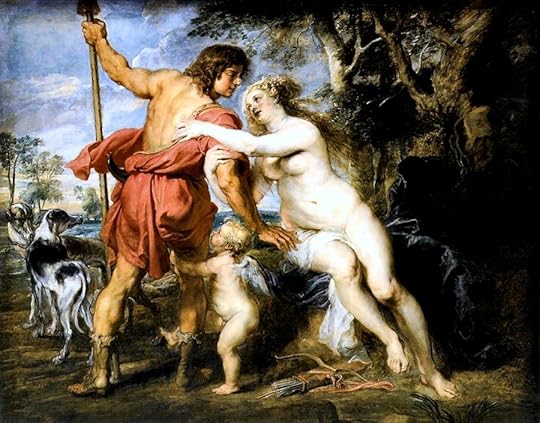
Any lack of drama has little to do with Venus' passion. She is extremely aggressive, coming over as the huntress herself, eventually tackling Adonis to the ground. And there is little doubt, for those who know how to read Elizabethan imagery, that she is offering herself in totality. Read this passage with the understanding that the "park" is the private game preserve of her body, and that its various features encourage Adonis to explore, as John Donne put it, "Before, behind, between, above, below":
"Fondling," she saith, "Since I have hemmed thee hereBut this comes relatively early in the poem. If Adonis is not going to reciprocate, there is nowhere this can go. Even when Venus faints, and Adonis kneels astride of her to rouse her, she is still denied:
Within the circuit of this ivory pale,
I’ll be a park, and thou shalt be my deer:
Feed where thou wilt, on mountain, or in dale;
Graze on my lips, and if those hills be dry,
Stray lower, where the pleasant fountains lie.
"Within this limit is relief enough,
Sweet bottom grass, and high delightful plain,
Round rising hillocks, brakes obscure and rough,
To shelter thee from tempest, and from rain:
Then be my deer, since I am such a park.
No dog shall rouse thee, though a thousand bark."
Now is she in the very lists of love,
Her champion mounted for the hot encounter:
All is imaginary she doth prove,
He will not manage her, although he mount her;
That worse than Tantalus' is her annoy,
To clip Elysium and to lack her joy.
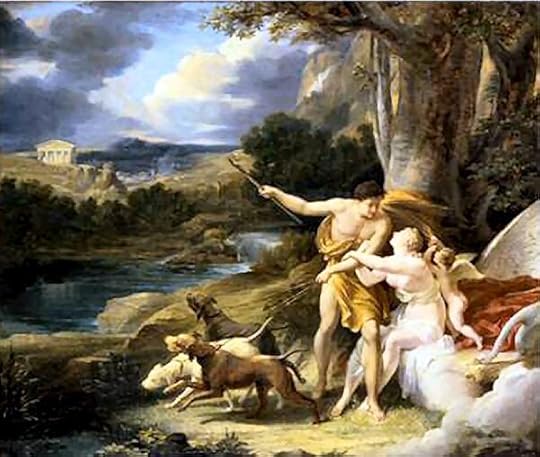
In short, there is a curious discrepancy between the erotic intent and the available repertoire; fervent kisses only get you so far. Even though Shakespeare fills in 100 lines or so with an episode in which Adonis' stallion breaks his bridle to chase after a mare in heat, there is not enough in the situation to sustain interest (or at least my interest). The stanzaic form (sesta rima, or ababcc) results in a series of mini-punchlines, giving a sort of limping effect. And neither character is easy to identify with. Venus is merely predatory, and Adonis comes across as a bit of a prude, as when he lectures her on the difference between lust and love:
Love comforteth like sunshine after rain,It's neat certainly, but how much better would Shakespeare express the same theme in Sonnet 129, "The expense of spirit in a waste of shame." By this time, of course, he was much more experienced as a poet, and the sonnet form is much more compact that the multi-stanzaic ode. But more than that: he had experienced the corrosive power of lust; he was no longer philosophizing from the outside, but writhing from within. That sonnet is intrinsically more dramatic than anything in Venus and Adonis.
But Lust's effect is tempest after sun;
Love's gentle spring doth always fresh remain,
Lust's winter comes ere summer half be done.
Love surfeits not, Lust like a glutton dies;
Love is all truth, Lust full of forgèd lies.

I will say, however, that the end of Shakespeare's poem is quite effective. Venus, fearing the worst, goes to look for Adonis. She is relieved to hear the distant cries of huntsmen, thinking her fears are groundless and that Adonis is leading a successful hunt. Which makes it all the more effective when she comes upon his body, gored with horrible irony through the groin.
======
*
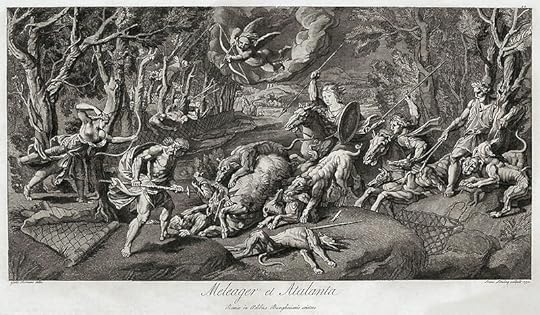
One of the tales about Atalanta does involve a hunt, in which she helped her lover Meleager kill the monstrous Calydonian boar (illustration below), but that is wholly successful and it is not the story Venus tells. Ovid's goddess recounts the story of the race that Atalanta loses to Hippomenes, after which she marries him; the couple are changed into lions after they make love in a temple without preceding it by the proper rites. But this is a fate that comes after having sex, not refusing it as Adonis does.
**
Immediately after this, I read Marlowe's poem Hero and Leander from about the same date, that Shakespeare may have known. Although incomplete, I find it intensely dramatic and altogether more successful. I have reviewed it elsewhere.
***
There is a short modern-dress film by Edward Lui. The two actors declaim the text well, but it involves heavy cutting to turn Shakespeare's extended verse treatment into meaningful dialogue. It is beautiful in a way, but hardly at all erotic.
======
Illustrations, top to bottom: Titian, Rubens, Regnault, Bottala, 16th century unknown.

January 4, 2026
"Love is a spirit all compact of fire."
So, my first review of the year turned out to be on a Shakespeare work.
I was somewhat way behind from reaching my 2025 Reading Challenge and decided to read a couple very short reads and see how close they got me to my challenge. It turned out to be an amazing experience! I was so enthralled and excited on the variety of the genres, stories, writers... I loved it! I decided I should be looking for short stories, essays, short plays, and novellas more often, between longer chunky reads. It was super fun!
And so this is how I ran into Venus and Adonis, added to my TBR quite some while ago, brilliant!
It is a short poetry work whose characters are goddess Venus, god Adonis, and a boar.
Shakespeare was such a genius in the way he put words, ideas, and the most memorable quotes into his writing. It was well worth the reading, I really enjoyed it. (I didn't complete my Reading Challenge, by the way, but I truly enjoyed my last days of 2025 reading such different texts. I'm definitely doing this sparingly throughout 2026).
A couple of lines that I especially loved:
"Had I no eyes but ears, my ears would love that inward beauty and invisible;
Or were I deaf, thy outward parts would move each part in me that were but sensible:
Though neither eyes nor ears, to hear nor see, yet should I be in love by touching thee."
"For where Love reigns, disturbing jealousy doth call himself Affection's sentinel;
Gives false alarms, suggesteth mutiny, and in peaceful hour doth cry "Kill, kill!"
Distempering gentle Love in his desire, as air and water do abate the fire."
So, my first review of the year turned out to be on a Shakespeare work.
I was somewhat way behind from reaching my 2025 Reading Challenge and decided to read a couple very short reads and see how close they got me to my challenge. It turned out to be an amazing experience! I was so enthralled and excited on the variety of the genres, stories, writers... I loved it! I decided I should be looking for short stories, essays, short plays, and novellas more often, between longer chunky reads. It was super fun!
And so this is how I ran into Venus and Adonis, added to my TBR quite some while ago, brilliant!
It is a short poetry work whose characters are goddess Venus, god Adonis, and a boar.
Shakespeare was such a genius in the way he put words, ideas, and the most memorable quotes into his writing. It was well worth the reading, I really enjoyed it. (I didn't complete my Reading Challenge, by the way, but I truly enjoyed my last days of 2025 reading such different texts. I'm definitely doing this sparingly throughout 2026).
A couple of lines that I especially loved:
"Had I no eyes but ears, my ears would love that inward beauty and invisible;
Or were I deaf, thy outward parts would move each part in me that were but sensible:
Though neither eyes nor ears, to hear nor see, yet should I be in love by touching thee."
"For where Love reigns, disturbing jealousy doth call himself Affection's sentinel;
Gives false alarms, suggesteth mutiny, and in peaceful hour doth cry "Kill, kill!"
Distempering gentle Love in his desire, as air and water do abate the fire."

October 2, 2024
Poor queen of love, in thine own law forlorn
To love a cheek that smiles at thee in scorn!
شعر «ونوس و ادونیس» از شکسپیر یک اثر جذاب و احساسی دربارهی عشق ونوس، الههی عشق، به ادونیس، جوانی زیبا و دلرباست. در این شعر قرن شانزدهمی نکتهای وجود داره که اون رو عمیقاً متمایز میکنه و من هم سعی دارم به همون بپردازم:
جابهجایی نقشهای جنسیتی
معمولاً در داستانهای عاشقانه از مرد انتظار میره تا برای جلب توجه زن تلاش کنه، اما اینجا ونوس نقش فعال و قدرتمند در داستانه که از هیچ تلاشی فروگذار نمیکنه تا ادونیس رو به خودش جذب کنه.
ایدهی شکسپیر از زنانگی و معنی زنانه بودن با ایدهی موردقبول و ثابتی که در اون زمان مطرح بوده متفاوته. زنانگی بهعنوان چیزی که تعریف مشخصی نداره و بهنحوی شناوره بهتصویر کشیده شده.
از یک طرف با ونوسی که درگیر هوا و هوسه و مردانه رفتار میکنه و از طرف دیگر با ادونیس کمرو و زنانهخوی مواجه هستیم.
ونوس کلیشهی زن محجوب و خجالتی رو نفی میکنه و حتی از درنده خویی برخورداره که عموماً صفتی مردانه تلقی میشه. در ادامه میبینیم که ونوس حتی لاسزن قهاریه و بارها جلوی ادونیس از زیباییش تعریف میکنه. برای مثال یکجا میگه که اگر ادونیس اجازه نده تا اون رو پرستش کنه، بهنحوی ادونیس زیبایی خودش رو هدر داده. پیک آپ لاینی که معمولاً توسط مردها در ادبیات عاشقانه استفاده میشه.
از طرفی ونوس مثل همتایان مرد خود قادر نیست عملاً به ادونیس تجاوز کنه و اون رو تحت سلطهی خود در بیاره، پس تنها اهرم فشار و چیزی که باعث میشه بر ادونیس برتری داشته باشه همین بیان و گُندهگوییهای اون هستند.
هیپوکراسی تا کجا؟
بر خلاف چیزی که ممکنه در نگاه خواننده امروزی این رویکرد شکسپیر رو پیشرفته و مدرن جلوه بده، حائز اهمیته بدونیم برای شکسپیر این خوانش از زنانگی تنها شیوهای از استهزا کردن اون رو فراهم کرده. مقصود از زنانگی همچنان چیزی پایینتر و درجه دوم نسبت به مردانگیست. از نظر شکسپیر وقتی زنی در عشق حریصه یا غریزهی جنسی خود رو دنبال میکنه، ویژگیهای مردانه اخذ کرده که در مقایسه با اصل مردانگی، آن زنانگی مسخره خوانده و نکوهش میشه. پس زنانگی و زنانه بودن یا مساویست با ضعیف بودن یا قوی بودن، که در هر دو صورت لایق جدی گرفته شدن نیست.
پینوشت: شکسپیر گریه کن
To love a cheek that smiles at thee in scorn!
شعر «ونوس و ادونیس» از شکسپیر یک اثر جذاب و احساسی دربارهی عشق ونوس، الههی عشق، به ادونیس، جوانی زیبا و دلرباست. در این شعر قرن شانزدهمی نکتهای وجود داره که اون رو عمیقاً متمایز میکنه و من هم سعی دارم به همون بپردازم:
جابهجایی نقشهای جنسیتی
معمولاً در داستانهای عاشقانه از مرد انتظار میره تا برای جلب توجه زن تلاش کنه، اما اینجا ونوس نقش فعال و قدرتمند در داستانه که از هیچ تلاشی فروگذار نمیکنه تا ادونیس رو به خودش جذب کنه.
ایدهی شکسپیر از زنانگی و معنی زنانه بودن با ایدهی موردقبول و ثابتی که در اون زمان مطرح بوده متفاوته. زنانگی بهعنوان چیزی که تعریف مشخصی نداره و بهنحوی شناوره بهتصویر کشیده شده.
از یک طرف با ونوسی که درگیر هوا و هوسه و مردانه رفتار میکنه و از طرف دیگر با ادونیس کمرو و زنانهخوی مواجه هستیم.
ونوس کلیشهی زن محجوب و خجالتی رو نفی میکنه و حتی از درنده خویی برخورداره که عموماً صفتی مردانه تلقی میشه. در ادامه میبینیم که ونوس حتی لاسزن قهاریه و بارها جلوی ادونیس از زیباییش تعریف میکنه. برای مثال یکجا میگه که اگر ادونیس اجازه نده تا اون رو پرستش کنه، بهنحوی ادونیس زیبایی خودش رو هدر داده. پیک آپ لاینی که معمولاً توسط مردها در ادبیات عاشقانه استفاده میشه.
Fair flowers that are not gather'd in their prime
Rot and consume themselves in little time.
از طرفی ونوس مثل همتایان مرد خود قادر نیست عملاً به ادونیس تجاوز کنه و اون رو تحت سلطهی خود در بیاره، پس تنها اهرم فشار و چیزی که باعث میشه بر ادونیس برتری داشته باشه همین بیان و گُندهگوییهای اون هستند.
هیپوکراسی تا کجا؟
بر خلاف چیزی که ممکنه در نگاه خواننده امروزی این رویکرد شکسپیر رو پیشرفته و مدرن جلوه بده، حائز اهمیته بدونیم برای شکسپیر این خوانش از زنانگی تنها شیوهای از استهزا کردن اون رو فراهم کرده. مقصود از زنانگی همچنان چیزی پایینتر و درجه دوم نسبت به مردانگیست. از نظر شکسپیر وقتی زنی در عشق حریصه یا غریزهی جنسی خود رو دنبال میکنه، ویژگیهای مردانه اخذ کرده که در مقایسه با اصل مردانگی، آن زنانگی مسخره خوانده و نکوهش میشه. پس زنانگی و زنانه بودن یا مساویست با ضعیف بودن یا قوی بودن، که در هر دو صورت لایق جدی گرفته شدن نیست.
پینوشت: شکسپیر گریه کن

January 14, 2024
Como poema narrativo, "Venus y Adonis" es claramente superior en su estructura formal y su elevado lenguaje poético a "Hero y Leandro" de Marlowe, obra contemporánea con la que tiene evidentes paralelismos en cuanto a temática (amor, seducción, erotismo, destino trágico) y fuentes de inspiración clásica. No obstante, como narrativa la obra de Shakespeare (o atribuida a Shakespeare) si bien adapta de manera original la historia de Ovidio ("Las metamorfosis") es muy convencional si se la compara con el planteamiento mucho más audaz, oscuro y transgresor de Marlowe.

January 2, 2024
*****SPOILERS*****
'Venus and Adonis' is a narrative poem published in 1593, and is probably Shakespeare's first publication. It is inspired by and based on an episode found in Ovid's Metamorphoses. The poem tells the story of Venus's (the goddess of Love) unrequited love, and attempted seduction (i.e. clinging harassment), of Adonis, who is an extremely handsome young man not in the least bit interested in love (or lust in this case) but is obsessed with hunting. Shakespeare illustrates the difference between human love and lust with lively imagery of nature. The poem is sometimes comedic, but is ultimately a tragedy. I'm not fond of romance stories, especially soppy ones like this, with a whiny Venus and bland Adonis. The language is pretty though.
'Venus and Adonis' is a narrative poem published in 1593, and is probably Shakespeare's first publication. It is inspired by and based on an episode found in Ovid's Metamorphoses. The poem tells the story of Venus's (the goddess of Love) unrequited love, and attempted seduction (i.e. clinging harassment), of Adonis, who is an extremely handsome young man not in the least bit interested in love (or lust in this case) but is obsessed with hunting. Shakespeare illustrates the difference between human love and lust with lively imagery of nature. The poem is sometimes comedic, but is ultimately a tragedy. I'm not fond of romance stories, especially soppy ones like this, with a whiny Venus and bland Adonis. The language is pretty though.

March 5, 2025
Love, desire, rejection, and drawing inspiration from classical mythology; and Shakespeare’s masterful use of language, rich imagery, and clever interplay of humor and tragedy

May 1, 2018
This was a pretty enjoyable read. It had a lot to do with love and everything do with that emotion. But I liked the way it ended, and I liked the way it was written, with the rhyme and the meter. And overall it definitely said something about desire, and chasing someone else, rejection and jealousy. Shakespeare doesn't ever really disappoint, does he?
This was a quick read for university.
This was a quick read for university.

January 8, 2017
Well, That was... different. Being Shakespeare, the poetry is lovely and imaginative and evocative, and even in this early work he is using language (rhetorical devices) with great dexterity and to good effect. But the story is more than a little... silly. I read the introduction (I actually read this in a Folger edition, Shakespeare's Sonnets & Poems, and I dug out Metamorphoses and looked up Ovid's Venus and Adonis (which is quite different), and I still found Shakespeare's Venus to be so outrageously lusty and yet, simultaneously, whiny, and Adonis so dull and pouty (not that he doesn't have cause to pout, but we never see even the slightest glimmer of what Venus finds so magnetic about him -- he is devoid of spark or sparkle, and his great qualities seem to be that he's really pretty and has super nice breath) that I couldn't bring myself to care how things came out for them. Venus's antics just make her look ridiculous, and I felt a lot sorrier for Adonis's hounds than for him when he finally met his fate. Still, the poetry is beautiful, and it's not long, and this is the year I read All of Shakespeare, so on we go!

June 28, 2015
[...] será el comienzo dulce, como el final insípido;/ y sea alto o bajo, jamás tendrá equilibrio.
Breve reseña para un poema (no tan) breve. Me gustó más de lo que esperaba. Tuve mis momentos de duda porque la voz patéticamente enamorada de Venus puede volverse muy pesada, pero sobre el final cambia de cariz y todo va mejor.
La historia es sencilla pero tiene muchas cosas bonitas en las cuales detenerse. Venus se enamora perdidamente del joven y hermoso Adonis e intenta seducirlo de todas las formas posibles: con el cuerpo y con la palabra. Sin embargo, a Adonis no le importa el amor y lo único que quiere es quitarse de encima a Venus para irse a cazar. Venus le hace una advertencia... y ahí dejo de contar.
Es innecesario que diga que Shakespeare tiene una gran manera de decir las cosas. Retrata muy bien el momento del deseo, del rechazo, de la lujuria, de la conquista y de la decepción. El poema se lee rapidísimo (incluso con las idas y vueltas de los personajes), hecho que hace juego con la idea de lo efímero que puede extraerse de él. Si les gusta Shakespeare, es muy probable que Venus y Adonis no les desagrade.
Breve reseña para un poema (no tan) breve. Me gustó más de lo que esperaba. Tuve mis momentos de duda porque la voz patéticamente enamorada de Venus puede volverse muy pesada, pero sobre el final cambia de cariz y todo va mejor.
La historia es sencilla pero tiene muchas cosas bonitas en las cuales detenerse. Venus se enamora perdidamente del joven y hermoso Adonis e intenta seducirlo de todas las formas posibles: con el cuerpo y con la palabra. Sin embargo, a Adonis no le importa el amor y lo único que quiere es quitarse de encima a Venus para irse a cazar. Venus le hace una advertencia... y ahí dejo de contar.
Es innecesario que diga que Shakespeare tiene una gran manera de decir las cosas. Retrata muy bien el momento del deseo, del rechazo, de la lujuria, de la conquista y de la decepción. El poema se lee rapidísimo (incluso con las idas y vueltas de los personajes), hecho que hace juego con la idea de lo efímero que puede extraerse de él. Si les gusta Shakespeare, es muy probable que Venus y Adonis no les desagrade.

February 14, 2026
”Full gently now she takes him by the hand,
A lily prisoned in a jail of snow. . .”
As I close out my big Shakespeare read-through, I'm swinging backwards chronologically to cover the long or longish poems which are not usually grouped with the famous sonnet sequence. It's interesting that even Shakespeare diehards seem to largely ignore these works, especially since most of them were actually formally published during Will's lifetime and thus would have been the basis for his literary reputation, at least among "respectable" folks, while he was alive.
But even if play-writing hadn't been somewhat stigmatized by the Elizabethans, Venus and Adonis was printed in 1593, before any of the Shakespeare plays we typically consider great or even particularly good were staged. (The possible exception is The Taming of the Shrew, which I don't personally see much merit in but know has its defenders.) This is a young Shakespeare--about 29--and if you're as bad with classical mythology as I am you probably read that title, think "Venus = goddess of love" and "Adonis = sexy guy" and assume this will be a tale of youthful romance and passion.
As is so often the case with Shakespeare, the reality is more surprising. (At least, again, if you don't know anything about the source material.) The title of Will's other big narrative poem, The Rape of Lucrece, makes its major concern clear right away, but I was a little startled to realize that Venus is also--by modern standards of consent, and I think by Shakespeare's own, too--a story of attempted sexual assault/coercion. Adonis is a youth (he's implied to still be awaiting puberty, or at least adulthood) of unparalleled beauty, much more interested in hunting than "love," who catches the eye of the ageless and powerful goddess. When he turns down her propositions she physically restrains him, tries repeatedly to kiss him, cries, fakes her own death, and subjects him to a long series of rhetorical arguments about why it's wrong for him to refuse what should be natural, desirable, and commendable.
You could imagine this being done in a winking and lascivious way, with a male author clearly shaking his head at a young man not taking an opportunity for free sex with a beautiful woman, but for the most part Shakespeare's framing reads, to me, as more sympathetic and thoughtful--almost shockingly so, given the period and the reversal of "expected" gender roles. Without getting too much into personal baggage, I'll say that I'm an AMAB person who, in my own younger years, had my fair share of uncomfortable encounters with older men and women alike, and I recognized Adonis' anger, revulsion, and frustration as he attempted to shake off his attacker and return to his own boyish pursuits. (Though I don't want to make more of this than there really is; the third-person narration is much closer to Venus' POV than Adonis,' and she's treated with quite a bit of pathos, especially in the last quarter dealing with Adonis' untimely death by boar-goring.) It's usually a bad idea to try to read autobiographical details into Will's works, but I couldn't help but wondering about the personal feelings and experiences that may have informed this depiction. I have my own idle theories, but I'll refrain from going into them here.
Also of interest are the connections to the sonnets. For one thing, this work is explicitly dedicated to Henry Wriothesley, 3rd Earl of Southampton, who is often proposed as a candidate for the "Mr. W.H." to whom the sonnets are dedicated and also for the "fair youth" to whom many of them seem to be addressed. For another, many of Venus' arguments for why Adonis should sleep with her revolve around the rightness of a beautiful young man procreating and ensuring his beauty is perpetuated into future generations--a contention that will be familiar to readers of the sonnets, as Shakespeare famously devotes the first 17 of them to the same idea. Given the uncomfortable overtones of Venus, it's a little strange to read this would-be rapist echoing the arguments which Will himself, in his sonneteer guise, will get so much mileage out of as he urges his male addressee to marry and have children (which is already weird enough in itself). Actually, the whole conceit of the older poet addressing the beautiful "youth" and, essentially, begging for his affection for dozens of sonnets on end reads rather differently after encountering Venus' similar poetic outpouring to Adonis. I confess I don't really know what to make of it all, at least without resorting to even more wild speculation.
On the purely artistic level, this is a serviceable if not quite transcendent work, written in a fairly straightforward (for Shakespeare) rhyming style somewhat reminiscent of musical early plays like Romeo and Juliet and A Midsummer Night's Dream. I admit that--even as a seasoned Shakespeare reader--I sometimes struggle with Will's more elaborate stylistic modes, so I found this a welcome return. It's also intriguing to see him writing narrative poetry rather than drama or lyric poems; it would probably be a stretch to compare this to prose fiction, as the rhyme scheme is pretty restrictive and much of the text still takes the form of character monologues, but I think you could make the argument that it's as close to that medium as he ever got. Finally, at around 1,200 lines, it's also significantly shorter than almost all of his plays, which is no small recommendation at the tail end of a project like this. Hell, there are individual scenes in some of the plays that are nearly as long. And Venus’ final diatribe on the disordering effect of love (or “love”) is a pretty good thesis statement for the way the topic is handled across Will’s body of work, even if most of that work had yet to be written when he wrote this.
Probably not essential reading for most of the population, but Shakespeare devotees really have no reason not to check this off the list!
A lily prisoned in a jail of snow. . .”
As I close out my big Shakespeare read-through, I'm swinging backwards chronologically to cover the long or longish poems which are not usually grouped with the famous sonnet sequence. It's interesting that even Shakespeare diehards seem to largely ignore these works, especially since most of them were actually formally published during Will's lifetime and thus would have been the basis for his literary reputation, at least among "respectable" folks, while he was alive.
But even if play-writing hadn't been somewhat stigmatized by the Elizabethans, Venus and Adonis was printed in 1593, before any of the Shakespeare plays we typically consider great or even particularly good were staged. (The possible exception is The Taming of the Shrew, which I don't personally see much merit in but know has its defenders.) This is a young Shakespeare--about 29--and if you're as bad with classical mythology as I am you probably read that title, think "Venus = goddess of love" and "Adonis = sexy guy" and assume this will be a tale of youthful romance and passion.
As is so often the case with Shakespeare, the reality is more surprising. (At least, again, if you don't know anything about the source material.) The title of Will's other big narrative poem, The Rape of Lucrece, makes its major concern clear right away, but I was a little startled to realize that Venus is also--by modern standards of consent, and I think by Shakespeare's own, too--a story of attempted sexual assault/coercion. Adonis is a youth (he's implied to still be awaiting puberty, or at least adulthood) of unparalleled beauty, much more interested in hunting than "love," who catches the eye of the ageless and powerful goddess. When he turns down her propositions she physically restrains him, tries repeatedly to kiss him, cries, fakes her own death, and subjects him to a long series of rhetorical arguments about why it's wrong for him to refuse what should be natural, desirable, and commendable.
You could imagine this being done in a winking and lascivious way, with a male author clearly shaking his head at a young man not taking an opportunity for free sex with a beautiful woman, but for the most part Shakespeare's framing reads, to me, as more sympathetic and thoughtful--almost shockingly so, given the period and the reversal of "expected" gender roles. Without getting too much into personal baggage, I'll say that I'm an AMAB person who, in my own younger years, had my fair share of uncomfortable encounters with older men and women alike, and I recognized Adonis' anger, revulsion, and frustration as he attempted to shake off his attacker and return to his own boyish pursuits. (Though I don't want to make more of this than there really is; the third-person narration is much closer to Venus' POV than Adonis,' and she's treated with quite a bit of pathos, especially in the last quarter dealing with Adonis' untimely death by boar-goring.) It's usually a bad idea to try to read autobiographical details into Will's works, but I couldn't help but wondering about the personal feelings and experiences that may have informed this depiction. I have my own idle theories, but I'll refrain from going into them here.
Also of interest are the connections to the sonnets. For one thing, this work is explicitly dedicated to Henry Wriothesley, 3rd Earl of Southampton, who is often proposed as a candidate for the "Mr. W.H." to whom the sonnets are dedicated and also for the "fair youth" to whom many of them seem to be addressed. For another, many of Venus' arguments for why Adonis should sleep with her revolve around the rightness of a beautiful young man procreating and ensuring his beauty is perpetuated into future generations--a contention that will be familiar to readers of the sonnets, as Shakespeare famously devotes the first 17 of them to the same idea. Given the uncomfortable overtones of Venus, it's a little strange to read this would-be rapist echoing the arguments which Will himself, in his sonneteer guise, will get so much mileage out of as he urges his male addressee to marry and have children (which is already weird enough in itself). Actually, the whole conceit of the older poet addressing the beautiful "youth" and, essentially, begging for his affection for dozens of sonnets on end reads rather differently after encountering Venus' similar poetic outpouring to Adonis. I confess I don't really know what to make of it all, at least without resorting to even more wild speculation.
On the purely artistic level, this is a serviceable if not quite transcendent work, written in a fairly straightforward (for Shakespeare) rhyming style somewhat reminiscent of musical early plays like Romeo and Juliet and A Midsummer Night's Dream. I admit that--even as a seasoned Shakespeare reader--I sometimes struggle with Will's more elaborate stylistic modes, so I found this a welcome return. It's also intriguing to see him writing narrative poetry rather than drama or lyric poems; it would probably be a stretch to compare this to prose fiction, as the rhyme scheme is pretty restrictive and much of the text still takes the form of character monologues, but I think you could make the argument that it's as close to that medium as he ever got. Finally, at around 1,200 lines, it's also significantly shorter than almost all of his plays, which is no small recommendation at the tail end of a project like this. Hell, there are individual scenes in some of the plays that are nearly as long. And Venus’ final diatribe on the disordering effect of love (or “love”) is a pretty good thesis statement for the way the topic is handled across Will’s body of work, even if most of that work had yet to be written when he wrote this.
Probably not essential reading for most of the population, but Shakespeare devotees really have no reason not to check this off the list!

April 13, 2017
Light and lovely with a slight comic touch emphasized by the three readers: Venus attempts to seduce Adonis but he would prefer to go boar hunting. This is the first poem I've ever read/listened to by Shakespeare, and perhaps Shakespeare is best heard than read. So I'm going to listen to more Shakespeare.

July 13, 2023
Bittersweet and tragic imbued with comic undertones that transform the myth into an all too human story.

January 22, 2023
"She's love, she loves and yet she is not lov'd"
Venus and Adonis is one of Shakespeare's pieces of work that you appreciate more when you hearing or watching it being performed. Shakespeare based the poem on a tale from Ovid's Metamorphoses where Venus and Adonis are lovers who are separated by Adonis's death during a boar hunt. In Shakespeare's version makes Adonis reject the attraction of Venus, and all he cares about is going boar hunting. Venus ends up worried for him as she had a prophecy of him dying while hunting. When the prophecy comes true and she curses all love- you see that Venus's love for Adonis wasn't just lust but she was in love with him.
“Love comforeth like sunshine after rain,
But Lust's effect is tempest after sun.
Love's gentle spring doth always fresh remain;
Lust's winter comes ere summer half be done.
Love surfeits not, Lust like a glutton dies;
Love is all truth, Lust full of forged lies.”
A touching story that shows what we would do when heartbroken , on actions and words spoken that we might have not actually have meant to say. Venus cursing death when at first no proof of anything had happened to Adonis. When his body is found she curses all love.
Venus and Adonis is one of Shakespeare's pieces of work that you appreciate more when you hearing or watching it being performed. Shakespeare based the poem on a tale from Ovid's Metamorphoses where Venus and Adonis are lovers who are separated by Adonis's death during a boar hunt. In Shakespeare's version makes Adonis reject the attraction of Venus, and all he cares about is going boar hunting. Venus ends up worried for him as she had a prophecy of him dying while hunting. When the prophecy comes true and she curses all love- you see that Venus's love for Adonis wasn't just lust but she was in love with him.
“Love comforeth like sunshine after rain,
But Lust's effect is tempest after sun.
Love's gentle spring doth always fresh remain;
Lust's winter comes ere summer half be done.
Love surfeits not, Lust like a glutton dies;
Love is all truth, Lust full of forged lies.”
A touching story that shows what we would do when heartbroken , on actions and words spoken that we might have not actually have meant to say. Venus cursing death when at first no proof of anything had happened to Adonis. When his body is found she curses all love.

March 23, 2023
Touch but my lips with those fair lips of thine,
Though mine be not so fair, yet are they red,
The kiss shall be thine own as well as mine:
What seest thou in the ground? hold up thy head:
Look in mine eyeballs, there thy beauty lies;
Then why not lips on lips, since eyes in eyes?
Though mine be not so fair, yet are they red,
The kiss shall be thine own as well as mine:
What seest thou in the ground? hold up thy head:
Look in mine eyeballs, there thy beauty lies;
Then why not lips on lips, since eyes in eyes?

March 14, 2015
Highly accessible poem, beautifully metered. Will remind you that Shakespeare deserves to be Shakespeare.

September 17, 2022
It """startles""" me how much I can both love and despise Shakespeare, the good ol' cynic ol'd man.

October 18, 2022
SHAKESYP never misses. and this is definitely a success
i was heartbroken for venus
i was heartbroken for venus

June 30, 2023
History tells us that this was Shakespeare's first poetic work, and it's definitely a promising start. The Bard is already good and will just keep getting better.
(The Literary Life Podcast 2023 Reading Challenge – Epic or long poem)
(Lit Life Patreon SIAY 2023-2024)
(The Literary Life Podcast 2023 Reading Challenge – Epic or long poem)
(Lit Life Patreon SIAY 2023-2024)

December 27, 2012
Read this today and loved it. Here are some resources for you: http://www.william-shakespeare.info/w...
http://librivox.org/venus-and-adonis-... (audio at the bottom).
And here is some interesting commentary: http://www.quaternaryinstitute.com/pl...
I was really surprised how approachable this poem was. The language didn’t feel archaic and I understood most of this beautiful poem. I love the imagery, metaphor, and sound in the poem. Shakespeare really puts you in the scene.
I really like these lines:
“No dog shall rouse thee, though a thousand bark”
“Had I no eyes but ears, my ears would love. That inward beauty and invisible;
Or were I deaf, thy outward parts would move each part in me that were but sensible: Though neither eyes nor ears, to hear nor see, yet should I be in love by touching thee.”
“Affection is a coal that must be cooled; Else, suffered, it will set the heart on fire.”
“Lovers’ hours are long, though seeming short.”
And his awesome description of the horse: “Round-hoofed, short-jointed, fetlocks shag and long, Broad breast, full eye, small head and nostril wide, High crest, short ears, straight legs and passing strong, Thin mane, thick tail, broad buttock, tender hide: Look, what a horse should have he did not lack. Save a proud rider on so proud a back.”
http://librivox.org/venus-and-adonis-... (audio at the bottom).
And here is some interesting commentary: http://www.quaternaryinstitute.com/pl...
I was really surprised how approachable this poem was. The language didn’t feel archaic and I understood most of this beautiful poem. I love the imagery, metaphor, and sound in the poem. Shakespeare really puts you in the scene.
I really like these lines:
“No dog shall rouse thee, though a thousand bark”
“Had I no eyes but ears, my ears would love. That inward beauty and invisible;
Or were I deaf, thy outward parts would move each part in me that were but sensible: Though neither eyes nor ears, to hear nor see, yet should I be in love by touching thee.”
“Affection is a coal that must be cooled; Else, suffered, it will set the heart on fire.”
“Lovers’ hours are long, though seeming short.”
And his awesome description of the horse: “Round-hoofed, short-jointed, fetlocks shag and long, Broad breast, full eye, small head and nostril wide, High crest, short ears, straight legs and passing strong, Thin mane, thick tail, broad buttock, tender hide: Look, what a horse should have he did not lack. Save a proud rider on so proud a back.”

January 19, 2022
I've committed myself to reading all of Shakespeare's works this year and spent a considerable amount of time obsessing over what order to read them. After discovering Asimov's Guide to Shakespeare, I was hooked! He starts with the Greeks, and first up was this "minor epic" poem. It was strange and beautiful and Asimov's background knowledge helped me considerably. I'll never look at the anemone flower the same way!
https://www.goodreads.com/book/show/2...
https://www.goodreads.com/book/show/2...

April 4, 2011
This tells the bitter sweet story of Venus as she tries in vain to obtain the attentions of her true love Adonis. Written more as a narration by Venus than a 'typical' poem, it doesn't flow like you would expect, however the words are still as vivid and powerful as you would expect from Shakespeare. An enjoyable read, if you can manage to read to the punctuation rather than the rhymes, as Shakespeare intended.

February 18, 2009
I think this deliberate meditation on incompletion fares much better than Marlowe's Hero and Leander--perhaps unfairly, since Shakespeare didn't drop dead before its publication, thus casting doubt on the poem's intended context.
Shakespeare is also way funnier than Marlowe. Take that, Rupert Everett.
Shakespeare is also way funnier than Marlowe. Take that, Rupert Everett.

January 27, 2018
I'm amazed at how many sayings we have nowadays come from Shakespeare. How different our language would be without him! This poem is sad but beautiful. I love reading the different works of Shakespeare.

May 12, 2014
Overly melodramatic. I can't help but wonder how Elizabethans reacted to such raunchy subject matter.

January 12, 2017
This was written very beautiful and emotional but I didn't like the "plot" at all. Venus seemed to be really dislikable and annoying so that the reader didn't really care about her pain in the end

July 21, 2020
Mrs. Robinson you're trying to seduce me.
Adonis cares not for romantic love as he loves the manly sport of hunting, but Venus has other ideas.
Adonis cares not for romantic love as he loves the manly sport of hunting, but Venus has other ideas.
Displaying 1 - 30 of 440 reviews