

What do you think?
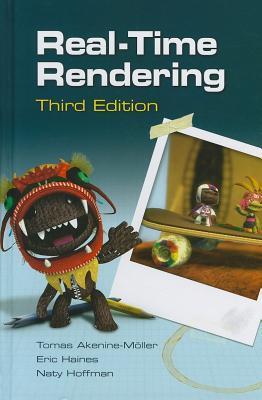
Real-Time Rendering, Third Edition
After three years this "wonderful all-around resource" of computer graphics, "indispensable for every serious graphics programmer", is available in a completely revised and updated edition. Nearly doubled in size, the new edition keeps pace with the astonishing developments in hardware and software that have increased the speed and quality of rendering images. The new edition includes information on the latest technology that is being released concurrently with the publication. The book's trademark--blending solid theory and practical advice--remains intact, making it mandatory for every programmer who wants to stay at the cutting edge. The book contains chapters as diverse as: - Transforms - Visual Appearance - Acceleration Algorithms - Advanced Shading Techniques (New Chapter) - Curved Surfaces (New Chapter) With Topics Including: - Pixel shaders - Subdivision surfaces - Intersection algorithms - Pipeline tuning
1045 pages, Hardcover
Published July 25, 2008
Ratings & Reviews
Friends & Following
Create a free account to discover what your friends think of this book!
Community Reviews
Displaying 1 - 11 of 11 reviews

Did Not Finish
July 12, 2025not beginner friendly

December 2, 2011
A must-have book for any realtime graphics developer. All the nuts-and-bolts math and algorithms you'll need are in here - from rasterizer implementation, to tesselation schemes, to lighting models. Supplement with things like the GPU Gems series for your special effects, and you've got everything you need to build a high-quality graphics engine.

April 26, 2021
327-Real time rendering-Tomas Moller-Computer Science-1999
Barack
2021/04/26
" Real-time rendering ", first edition in 1999. It discusses real-time rendering methods used in games and other applications. It also discusses the theoretical framework in the field of interactive computer graphics.
Tomas Moller studied at Lund University, Chalmers University of Technology, UC Berkeley. He mainly studies computer graphics and image processing. Representative works: " Real-time rendering " and so on.
Table of Contents
1 Introduction
2 The Graphics Rendering Pipeline
3 The Graphics Processing Unit
4 Transforms
5 Shading Basics
6 Texturing
7 Shadows
8 Light and Color
9 Physically Based Shading
10 Local Illumination
" Real-time rendering is concerned with rapidly making images on the computer. It
is the most highly interactive area of computer graphics. An image appears on the
screen, the viewer acts or reacts, and this feedback affects what is generated next.
This cycle of reaction and rendering happens at a rapid enough rate that the viewer
does not see individual images, but rather becomes immersed in a dynamic process. ”
Real-time rendering computer graphics is an important research topic. Changes in the light and shadow of the outside world and changes in position will affect the appearance of the objects we want to show. Sometimes I even feel that the entire real world is like an object being rendered in real-time.
" Movie projectors show frames at 24 FPS but use a shutter system to display each
frame two to four times to avoid flicker. This refresh rate is separate from the display
rate and is expressed in Hertz (Hz). A shutter that illuminates the frame three times
has a 72 Hz refresh rate. LCD monitors also separate refresh rate from display rate. ”
No matter what form the animation is displayed in, it essentially utilizes the characteristic of the persistence of the creature's vision. If living things don't have this characteristic, it seems hard to imagine what the world would be like.
" First, we shall explain the mathematical notation used in this book. F or a more
thorough explanation of many of the terms used in this section, and throughout this
book, get our linear algebra appendix at realtimerendering.com. ”
The author began to introduce some basic mathematical formulas and definitions at the beginning of this book. Computer graphics, the final analysis, a computer science, which involves a lot of mathematical knowledge, if these do not understand the math, then it can not be an in-depth understanding of computer graphics school, and at most remain in the ism level.
" The basic rendering primitives (also called drawing primitives) used by almost all
graphics hardware are points, lines, and triangles. ”
No matter how complicated the graphics are, they all come from the combination and variants of the basic graphics. The changes of the basic elements have formed different combinations of changes. One life two, two beget three, three beget all things. Starting from the most basic starting point, what can be achieved may be beyond our imagination.
" Following well-established computer graphics usage, in this book terms derived from
" Shading," "shader," and related words are used to refer to two distinct but related
concepts: computer-generated visual appearance (eg, “shading model,” “shading
equation," "toon shading") or a programmable component of a rendering system
(eg, “vertex shader,” “shading language”). ”
Shade, referring to a computer to simulate the object appearance, Shade quality algorithm greatly influences whether we are trying to simulate objects realistic enough.
" The main function of the
pipeline is to generate, or render, a two-dimensional image, given a virtual camera,
three-dimensional objects, light sources, and more. The rendering pipeline is thus the
underlying tool for real-time rendering. ”
The pipeline is a set of processes, it discusses that how to render the process object. This process consists of multiple parts.
" In the physical world, the pipeline concept manifests itself in many different forms,
from factory assembly lines to fast food kitchens. It also applies to graphics rendering.
A pipeline consists of several stages, each of which performs part of a larger task. ”
In modern industry, the assembly line may be one of the examples that best reflects the idea of the Pipeline. To achieve a big goal, which may involve different aspects, these aspects must be like the coordination of human organs to assist each other to achieve the design effect.
" The rendering speed may be expressed in frames per second (FPS), that is, the
number of images rendered per second. It can also be represented using Hertz (Hz),
which is simply the notation for 1/seconds, ie, the frequency of update. ”
Rendering is a thing that consumes computer resources very much. Therefore, to render a very beautiful video it is necessary to pay a lot of hardware costs. I'm thinking, our national comic industry is not mature and strong enough. Is it partly because our economic foundation is not enough?
" The developer has full control over what happens in the application stage since it
usually executes on the CPU. Therefore, the developer can entirely determine the
implementation and can later modify it to improve performance. ”
In the application phase, the Shade developers decide how to use computer resources, how much to use, and how to use them, which affects the subsequent rendering performance.
“ The basic construction of the rendering pipeline, consisting of four stages: application,
geometry processing, rasterization, and pixel processing. Each of these stages may be a pipeline in
itself. "
Application, geometry processing, rasterization, pixel processing. These 4 important links constitute the most important part of the rendering process.

March 30, 2007
The best book on the subject, that I have come across. This book pretty much put me on the path to a career as a game programmer. And it's still a great resource, years later. There's a second edition, but I haven't read it.

October 6, 2007
Fabulous book! Reading it helped me get a job in the computer game industry.
May 20, 2023
_F_I_N_A_L_L_Y_ I'm certainly that this book has its place, but that place is nowhere near me. The book is very comprehensive, the structure, the introduction to most chapters were quite interesting, but each chapter starts by a (too ?) technical expose of a lot of the state of the art. For somebody not elbow deep in this domain it makes it quite a struggle (and quite far from being directly applicable). On the other hand there were some topics which were quite enjoyable. But for me it reminded me more about my journey of Ian Goodfellow's book on machine learning, good for building some character but what a pain and struggle to reach the end.
December 16, 2023
Really fantastic resource, I read it once through to familiarise myself with contents and found it generally very readable and informative, especially the chapter on linear algebra and matrix operations, although for some chapters whose subject was new to me, for example spherical harmonics, this first read through didn't get me to a stage of 'understanding' - I'm unsure if that was due to the novelty of the concepts to me, or variable readability between chapters/ topics.

November 5, 2020
Why they keep putting offline renders on the covers for a real-time rendering book series is beyond me (arguably the 4th edition cover could have been rendered real-time in UE4, but it's unlikely). Great book otherwise.

October 22, 2009
I am not an expert of computer graphics but this book really explains how all these amaizing things work. Examples and algorithms are very, very good.

January 10, 2015
The best book about real time graphics.
April 23, 2015
I've only skimmed it, but it is a great reference and the few parts I read were very clear.
Displaying 1 - 11 of 11 reviews