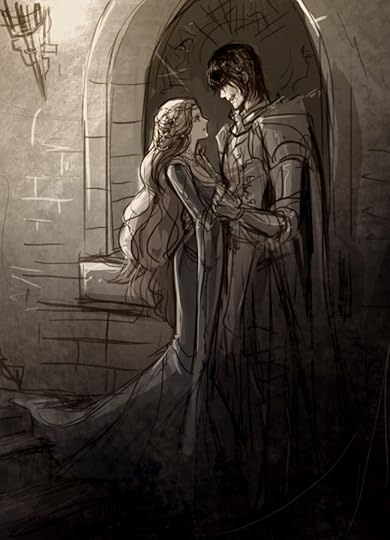
V prvom dieli rozsiahleho sedemzväzkového cyklu známej francúzskej autorky historických románov Juliette Benzoniovej sa zoznamujeme s ústrednou postavou, krásnou Catherine Legoixovou, ktorej osudy na pozadí historických skutočností z dejín Francúzska upútali už milióny čitateľov v mnohých krajinách sveta.
Catherinne už ako trinásťročná stala sa svedkom vyčíňania vzbúrencov a smrti mldého Michela de Montsalvy. Vo výre občianskej vojny sa stretáva neskôr s rytierom Arnaudom de Montsalvy a zaľúbi sa doňho hlbokou, osudovou láskou.
Nezabudnuteľné sú opisy vzbúreného Paríža na začiatku 15.storočia a rovnako i zápas hrdinky o naplnenie jej nesmiernej vášne.
Krajina krváca, hlavná hrdinka spozná biedu i utrpenie, ale i nádheru a veľkosť citov. Navyše sa okolohrdinky roja záhadné postavy.
Získa si dievčina od Seiny lásku najmocnejšieho človeka, kráľa?
Juliette Benzoni, (Andrée-Marguerite-Juliette) was a French author and international bestseller in several genres, including historical romance, historical fiction, mystery and screenwriting. Named by the Media as the « Queen of History Novels » and « Daughter of Alexander Dumas».
Born 1920 in Paris and growing up in an upper-middle-class family. At the age of nine, she discovered her passion for history while looking at a photo of ‘Joan of Arc’. Benzoni studied at the Institut Catholique de Paris’, philosophy, law and literature. At the age of fifteen, her parents moved to Saint-Mandé where she lived until her death.
In 1941, she married a doctor from Dijon, and was soon mother of two children. During that period, she studied at the libraries of Dijon the History of the Dukes of Burgundy, where she stumbled on the Legend of the Order of the Golden Fleece, which would later inspire her for her Catherine series.
In 1950, her husband died and she went to Morocco, visiting relatives of her late husband and joined the editorial staff at a radio station and met her future husband, Colonel Count André Benzoni di Conza. They married in 1953, but because of the unstable political situation, she returned to Paris, while her husband was to join the 6th Regiment of Moroccan Spahis in Hué.
Back in Paris, she launched into journalism and worked for various Newspapers, Magazines and wrote for ‘Confidences’ historical articles and interviewed celebrities such as Jean Cocteau, Jean Marais, Erich von Stroheim and Maurice Chevalier.
In 1959, Gérald Gauthier, director of the Press Agency at Opéra Mundi, watched her in a popular television Quiz show and impressed by her historical knowledge about the Italian Renaissance asked her if she were able to write a historical romance series in the style of Anne Golon's ‘Angélique’.
Benzoni affirmed, remembering her fascination for the ‘Order of the Golden Fleece’. Her research for that soon-to-become Bestseller took up three years and in 1963, 'Catherine, Il suffit d’un amour’ was published. The success was enormous and there followed in 1965, a Song called ‘Catherine, ma mie’ composed by Paul Amar, text by Juliette Benzoni.
The Catherine series was translated into 26 languages. Benzoni's Works includes: 3 Single Novels, 17 series, 18 self-contained short stories; 55 million Readers and 300 million books sold Worldwide. She was a huge fan of the books by Agatha Christie, Anne Perry and Ken Follet. In 1978 she received from the White House a letter by President ‘Ronald Reagan’ for the way she described in her Novel ‘The Lure of the Falcon’ the Independence War!
Four of her Bestsellers the ‘Catherine, Marianne, Le Gerfaut and La Florentine’ series were filmed for French television, for which she wrote the Screenplay, together with Jean Chatenet. Although her later works were not widely translated, in 1984, she was one of the top ten female French writers whose works were translated into English. Two weeks before her death in 2016, her last book ‘Le Vol du Sancy: Des carats pour Ava’? was published. It was the 15th adventure of her favourite hero Prince Aldo Morosini, a mystery series.
Her Awards and Honours: 1973 the Alexandre Dumas Prix, for the Catherine and Marianne series. 1988, the Prix Littéraire « Louis Barthou » Silver Medal from the Académie Française for Felicia au soleil couchant. 1998, the Chevalier of the National Order of Merit Medal, by Prime Minister Lionel Jospin.
What should I say... Forty years passed since it was published for the first time in ex-YU... In libraries in Serbia, still one of the most borrowed titles and author... Librarians crying for new edition, Serbian one... publishers deaf...
One of the best ever ever ever ever historical romance, and French one... and the author is still writes and she is more than 90 years old... bestseller author in France for decades... Each title solds about 100.000 copies after first publication... French history and l'amour! What can you ask more?! :)
During the 1960s and 1970s, these historical novel series (particularly those from France) were absolute reading rites-of-passage for many pre-teens and young adults - and although Benzoni’s heroine never quite eclipses Anne and Serge Golon’s enchanting Angelique and her series of far-flung escapades, there’s still plenty to enjoy in the first of the Catherine series.
The period of the Hundred Years War is well-researched and written - so much so that you can almost forgive the (now) overtly purple prose of the love scenes and several of the unlikely plot turns employed by the author throughout the novel.
This was the first romance novel I ever read --- and it do impressed me that it started me on the long path of being a lover of historical romance novels.
Ce livre je l'ai lu au moins cinq fois. Il ne faillit jamais à m'émouvoir. Jamais. Les personnages sont si bien construits qu'on s'attache tout de suite à eux. Le drame et la romance s'entrechoquent dans une violence mesurée. Et le style de l'autrice est juste irrésistible.
This book is absolutely AMAZING. The historic background is brilliant written, medieval customs are described with precision and the action is full of unexpected twists. I am in love with this book and plan to read a whole series!
I just found a couple of books of this series by only 1,5 Euros at www.bobliopolis.be
This is first book in the Catherine series and this series is the beginning of the "roman historiques" written by this author, in 1964.
This is the story of Catherine Legoix who fails in love the nobleman Arnaud de Montsalvy but she is obliged to become the wife of the great financier of the Duke - Philippe le Bon, Duke of Bourgogne.
Even if in the beginning the main character has a more juvenile than a grown woman, the story flows quite easily.
The historical background is the Hundred Years War.
Je to niečo ako Angelika :). Bolo to skvelé, ale treba mať pri čítaní pevné nervy. Hlavným zaľúbencom osud nepraje a v niektorých situáciách to už ozaj snáď ani nie je možné, aké hlúpe náhody a okolnosti im prídu do cesty.
Catherine started out with interesting characters and a compelling premise. After the first 1/4 of the book it fell into the banality and redundancy that characterizes the romance novel. Juliette Benzoni is a writer who does her research. This is why I continued to read this book, I felt promise in opening. However, the story just didn't have any life to it. Anything that made it more than a romance novel. Perhaps it's my fault for wanting more than that. When I heard if Benzoni first it was in comparison to Serge and Anne Golon's Angelique series. Now THAT is a fabulous series. Great characters, compelling story, wonderfully accurate research and historical reference. Catherine is a simple romance novel. Catherine herself never quite eclipses her role as romance heroine as Angelique does. There were moments when I felt the story could've been interesting, but the writer spent too an entire book 'setting up' her series. That's how it felt at least. Catherine doesn't seem like a complete book but rather a jumping off point for the beautiful Catherine and the handsome Arnaud to start their star crossed lovers future. There were many loose ends left and the writer tended towards the cartoonish at times, or at least the two dimensional. Too bad. There was some promise at times but it fell way short in the end. I highly recommend the Angelique series to anyone looking for a great female character in this vein but leagues better.
As a historical action/adventure saga, the Catherine series is splendid! It's truly exciting, thrilling, 'lose sleep over it because you just can't put it down' stuff. The romance plot, on the other hand... :/ Jesus Christ, Catherine, literally *anyone* would be better! ...okay, maybe not quite anyone as this series is chock-full of despicable men, many worse than Arnaud. It's quite an accomplishment on Arnaud's part, though, that he managed to inspire such bitter loathing in 15-year-old me (who was a) a romantic, b) as 'unwoke' as you could be regarding the issues of feminism, and c) pretty used to rapey abusive "heroes"). And as much as I liked Catherine herself, her obsession with Arnaud (based entirely on his looks and ) brought her potential down considerably and made the series hard to read at times. Despite this, I still rate it highly, partly out of nostalgia, and partly because, if you discount everything Arnaud-related (which is admittedly hard, because he becomes Catherine's main motivation pretty much as soon as she meets him), these books are so much fun!
I really enjoyed the first part of this book, when Catherine was still young and lived in Paris. She was described as an adventurous girl with a strong character, which I loved. Also I found the uncommon setting -France during the hundred Years war- really interesting. While reading this first part I thought I was reading a well written historic novel and I’m a fan of those.
My problem with this book was, that it got worse and worse. Catherine grows to be the prettiest girl you could ever imagine. OF COURSE. That was so disappointing, I was really excited when I read, that as a child she wasn’t particularly good looking. I just hoped, that she wouldn’t be the typical beauty, loved by everyone. I hoped, she would grow a strong, independent woman, who gets known for what she does and not for how she looks. (Of course I didn’t know at that time, that the French title of one of these books was “Belle Catherine” otherwise I would’ve guessed that part..)
Sadly, this is only a melodramatic romance. In the end it was definitely an OK book, it was just a bit lengthy and ultra-cheesy in the middle.
BUT If you already read this, and weren’t toooo disappointed, I can only suggest reading the second book, I promise, it gets (a tad) better!
اين كتابو يه سالي كه رفته بودم نمايشگاه، وقتي با بابام تو آخرين دور گشتنم تو ناشران عمومي بودم پيداش كردم، چقدر هم خوشحالم ازين اتفاق بدون شك از عاشقانهترين كتابهايي هس كه خوندم تو متن كتاب از حوادث تاريخي مثل مرگ ژاندارك و شورش قصابهاي پاريسي هم استفاده شده، كه به نظر من تاريخ رو كنار يه روايت عاشقانه جذابتر و ملموستر كرده هرچند با وجود علاقهي زيادي كه بهش دارم، جاهايي هم بود كه از اتفاقات رنج ميبردم، مخصوصن تو صد صفحهي اول كه خيال ميكردم همه چيز چه زود تموم شد... كه البته نشده بود
I think that this was one of the very first historical fiction series that I read, in the mid-70s. They've been out of print in English, hard to find, or not in ebook form for quite a while, but I stumbled across this yesterday. Now I'm very much hoping that the others become available at some point as well.
I've got quibbles with it- it's definitely pre-feminist. And while I do like a good romance, I'm still not so convinced that the "I take one look at you and am willing to sacrifice everything in my life just to be with you" is love...I think that perhaps that might be infatuation :-)
But she does a wonderful job of conveying the historical setting, I liked how even though Catherine was "desperately in love" with someone she "could never have" she still had a healthy sexual appetite, and while the "diverse" characters are fairly stereotypical, it's still one of the first "grown up books" that I read that had diverse characters.
Loads of fun to revisit- I hope that I can get my hands on the others at some point.
Gaman að finna þessa bókaseríu á kindlinum mínum en þegar ég var 16 ára þá horfði ég á alla sjónvarpseríuna um Catherine á frönsku og var sem dáleidd af þessari fögru konu. Ég get ekki sagt að ég sé fyrir ástarsögur og það er smá "cringy" að lesa um hvað Catherine er rosalega falleg að allir karlmenn horfa á eftir henni með losta í augum en konur með afbrýðsemi. Þetta er vel skrifuð og skemmtileg bókasería um fagra konu á 15 öld og hennar ástir og örlög.
Catherine is a young woman in 15th century France in love with one man but forced into a relationship with another. This was recommended to me by a friend but it wasn't really my thing.
une saga écrite pour faire contrepoids à celle de Angélique, les 7 tomes de "Catherine" mettent en scène une jeune femme dans la tourmente des la guerre de cent ans. Belle, fougueuse, amoureuse, Catherine côtoie de nombreux personnages clés de cette période tragique de l'Histoire : Philippe le Bel, Jeanne d'Arc, Gilles de Rais, ... Mais elle abandonne tout pour retrouver son grand amour. Elle affronte de très nombreux dangers (le propre d'une saga), dont elle se relève à chaque fois. Une histoire très bien écrite, de quoi passer de longues heures de lecture (près de 1200 pages pour les 3 premiers tomes), mais j'avoue que le côté "jeune demoiselle en détresse qui se jette systématiquement dans la gueule du loup" est quelque fois exaspérant
Catherine on tarina elämää suuremmasta rakkaudesta. Päähenkilö Catherine on kaunotar, jota kaikki miehet himoitsevat, mutta hän rakastaa ainoastaan ritari Arnauldia - jonka Catherine on tavannut vain kerran, eikä ole edes varma vastarakkaudesta. Vaikka kirjassa olisi kaikki mahdolliset ainekset oikein turhauttavaan juonikuvioon, Juliette Benzoni kirjoittaa mukaansatempaavalla tavalla.
Kirja lähtee vaudikkaasti liikkeelle, ja aluksi kaikki nimet ja paikat menivät mielessäni sekaisin. Pian pääsin kärryille ja aloin nauttia lukemisesta. Catherine on täynnä voimakkaita tunteita, draamaa, läheltä piti -tilanteita ja historiallisia yksityiskohtia. Ihanaa!
Kirjan historiallinen puoli on runsasta ja pullollaan toimivia elementtejä. Jude Deveraux suorastaan kalpenee Benzonin rinnalla, jonka taustatyö ja saavutus historiallisella sekä romanttisella osalla tässä kirjasarjassa on taidokasta! Ympäristön, maneerien ja pukujen kuvailu luo myöhäiskeskiajan Ranskan lukijalle ihastuttavalla varmuudella ja Catherinen seikkailut hovin kierossa maailmassa ja rakkauden okaisella rintamalla on yksinkertaisesti vastustamatonta luettavaa! Tätä ei kannata missata!
This is the book that got me into reading. I couldn’t put it down. I had the one-bound German Edition, very thick and rusty looking and I started and entered into a different world and couldn’t put it down. As I’m reading it again ca. 25 years later i can’t put it down just the same. It is one of the best books written in my opinion. All I can say is: wow......
Tak na toto sa pamätám, jeden z prvých historicko-romantických príbehov, ktoré som čítala a jedna z mála sérií, preložených v časoch post-socialistických. Ako séria to bola Krásna Katarína, Ale bolo to dobré :-).
I read this series as a teenager and was thoroughly captivated by the story and the characters. As it was over 40 years ago, I cannot really remember much beyond how desperate I was to read the next one!