

What do you think?

Early Earth
Las cien noches de Hero
¿Con qué os toparéis cuando os internéis en Las cien noches de Hero? Con montones de traiciones, lealtades inquebrantables, muchachas hermosas que se vuelven locas, libros prohibidos que se leen a escondidas, maridos malos, padres horrorosos, amantes infieles, cosas que cuelgan de los árboles, Ligas de Narradoras Secretas, bailes nocturnos, guijarros mágicos, brujas sabias, lunas que bajan del cielo por las noches, instrumentos musicales encantados, salchichas envenenadas, amigas y arpas y pájaros y sobre todo, montones, montones de hermanas.
224 pages, Hardcover
First published September 1, 2016
Ratings & Reviews
Friends & Following
Create a free account to discover what your friends think of this book!
Community Reviews
Displaying 1 - 30 of 1,368 reviews

July 27, 2020
*Rated 4.5/5 stars!
This is a beautiful collection of stories, my word.
I love a retelling, so was already excited for this one. What I didn't expect was the true folklore feel to it, the dark themes underlying the whimsy. Even less so was the numerous retellings and references woven into these stories, from retellings of fairytales such as the Twelve Dancing Princesses to possible references to famous literary gothic villains. It all wove together into something that made my literary heart sing.
I didn't even realise how much I loved the stories until I read the final word of each one. Until the moment they hit, and the point of the story made its mark. I was baffled by how the stories then connected together, building a story of celestial magic that was exactly the sort of fairytale feel I love.
I didn't quite give it 5 stars due to some stylistic choices - the small squiggly font proved hard to read at times and some spreads overwhelming if too much was featured on one page. That being said, it wasn't anything too taxing to get through and definitely didn't ruin anything for me, only slowed down my progress slightly.
I really love this graphic novel. If you have similar reading taste to me, I'd highly recommend checking this one out because I honestly think you'd love it!
Content Warnings: suicide, rape threats
This is a beautiful collection of stories, my word.
I love a retelling, so was already excited for this one. What I didn't expect was the true folklore feel to it, the dark themes underlying the whimsy. Even less so was the numerous retellings and references woven into these stories, from retellings of fairytales such as the Twelve Dancing Princesses to possible references to famous literary gothic villains. It all wove together into something that made my literary heart sing.
I didn't even realise how much I loved the stories until I read the final word of each one. Until the moment they hit, and the point of the story made its mark. I was baffled by how the stories then connected together, building a story of celestial magic that was exactly the sort of fairytale feel I love.
I didn't quite give it 5 stars due to some stylistic choices - the small squiggly font proved hard to read at times and some spreads overwhelming if too much was featured on one page. That being said, it wasn't anything too taxing to get through and definitely didn't ruin anything for me, only slowed down my progress slightly.
I really love this graphic novel. If you have similar reading taste to me, I'd highly recommend checking this one out because I honestly think you'd love it!
Content Warnings: suicide, rape threats
![Profile Image for s.penkevich [hiatus-will return-miss you all].](https://i.gr-assets.com/images/S/compressed.photo.goodreads.com/users/1735525095i/6431467._UX200_CR0,11,200,200_.jpg)
August 10, 2024
‘In the beginning was the world…
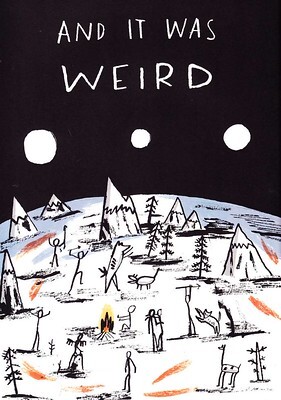
And it was WEIRD’
And you know what? It sure as shit was!
Behold Isabel Greenberg’s The One Hundred Nights of Hero in which the powerful love between two women, Cherry and the aptly named Hero, must outwit and outlast the burdensome onslaught of mens conquests for Cherry’s ‘virtue’ in this tale of tales and the importance of telling them. Especially when lives are at stake in this patriarchal world of bird gods and dastardly deeds. I mentioned the world was weird right???
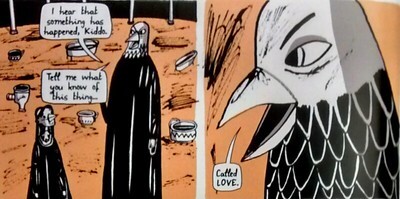
Weird but also whimsical and wonderfully illustrated. I love the style here.
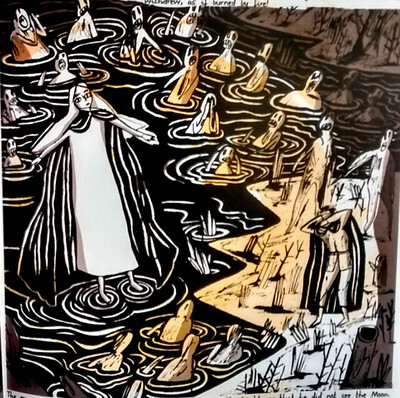
So anyways, Greenberg has crafted a graphic novel that is as gorgeous to look at as it is insightful and outspoken on the social ills against women and the nature of storytelling that can either oppress or be reframed towards freedom. It is a tale where Hero must protect her beloved from the shackles of wooers who have the force of society behind them to reduce Cherry to a trophy to serve their image and lusts as well as shun Hero for loving the very same woman. When he begins to tell stories in order to win Cherry over, Hero devises a countermeasure of storytelling to distract him long enough to win Cherry back in this delightfully feminist and fantastical play on the character of Scheherazade from One Thousand and One Nights.
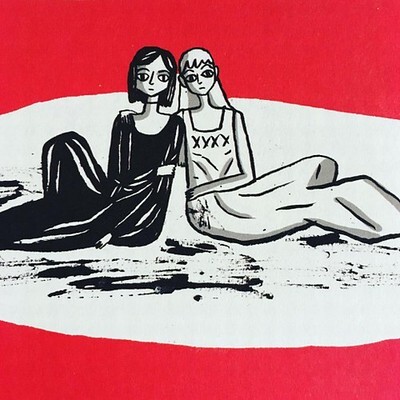
It’s all rather sharply satirical and I enjoy how storytelling is so central to this beautiful tale of queer heroism and love. It directly confronts how through history men have tended to be the canonical voice in framing the world. Such as here where the telling of his tale positions him as the hero and Cherry as his prize:
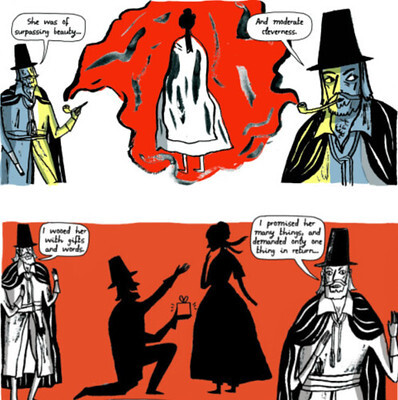
But what happens when women try to tell the story? Well, look how even in the modern day a women doing a classic retelling tends to receive far harsher criticism, women have often been pushed aside for men to receive the prizes in order to hold up said prizes as proof of men’s superiority in writing, historians have centered the acts of men and held their tomes up as proof of men’s historical significance, women have been denied the ability to own property or hold jobs and then had that held against them as proof of their inability to rise in the workforce, the list is endless. Or, simply, when women speak we get this:
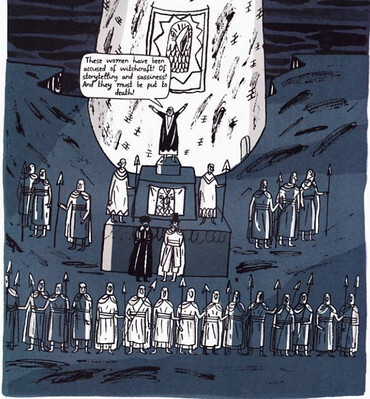
TEXT: These women have been accused of witchcraft! Of storytelling and sassiness! And they must be put to death!
Its all a rather fun story that pokes fun at patriarchy and comes swinging. Will Hero live up to her name? Will the man get the last word (and first and most of the middle ones too?) Will the bird god have some great scenes? Better pick this up and find out!
4/5
And it was WEIRD’
And you know what? It sure as shit was!
Behold Isabel Greenberg’s The One Hundred Nights of Hero in which the powerful love between two women, Cherry and the aptly named Hero, must outwit and outlast the burdensome onslaught of mens conquests for Cherry’s ‘virtue’ in this tale of tales and the importance of telling them. Especially when lives are at stake in this patriarchal world of bird gods and dastardly deeds. I mentioned the world was weird right???
Weird but also whimsical and wonderfully illustrated. I love the style here.
So anyways, Greenberg has crafted a graphic novel that is as gorgeous to look at as it is insightful and outspoken on the social ills against women and the nature of storytelling that can either oppress or be reframed towards freedom. It is a tale where Hero must protect her beloved from the shackles of wooers who have the force of society behind them to reduce Cherry to a trophy to serve their image and lusts as well as shun Hero for loving the very same woman. When he begins to tell stories in order to win Cherry over, Hero devises a countermeasure of storytelling to distract him long enough to win Cherry back in this delightfully feminist and fantastical play on the character of Scheherazade from One Thousand and One Nights.
It’s all rather sharply satirical and I enjoy how storytelling is so central to this beautiful tale of queer heroism and love. It directly confronts how through history men have tended to be the canonical voice in framing the world. Such as here where the telling of his tale positions him as the hero and Cherry as his prize:
But what happens when women try to tell the story? Well, look how even in the modern day a women doing a classic retelling tends to receive far harsher criticism, women have often been pushed aside for men to receive the prizes in order to hold up said prizes as proof of men’s superiority in writing, historians have centered the acts of men and held their tomes up as proof of men’s historical significance, women have been denied the ability to own property or hold jobs and then had that held against them as proof of their inability to rise in the workforce, the list is endless. Or, simply, when women speak we get this:
TEXT: These women have been accused of witchcraft! Of storytelling and sassiness! And they must be put to death!
Its all a rather fun story that pokes fun at patriarchy and comes swinging. Will Hero live up to her name? Will the man get the last word (and first and most of the middle ones too?) Will the bird god have some great scenes? Better pick this up and find out!
4/5

March 26, 2017

In the Empire of Migdal Bavel, Cherry is married to Jerome, a wicked man who makes a diabolical wager with his friend Manfred: if Manfred can seduce Cherry in one hundred nights, he can have his castle--and Cherry.
But what Jerome doesn't know is that Cherry is in love with her maid Hero.

I genuinely feel like this graphic novel was made just for me. It contains nearly everything I've grown to love in books, such as tales of families, Gods, humans and human-ness, love and betrayal, kings, dancing, moons, sisters, empowering women that support one another, a loving f/f ship, dissing disgusting men (I lived for this!!), and so much more.
Also, so many of the tales Hero told to keep Manfred's dick in his pants were some of my favorites: from the League of Secret Storytellers to the story of falling in love with the moon to a retelling of the Twelve Dancing Princesses. These strange and fanciful tales full of bold, clever and crafty women completely enamoured my heart. It also reminded me a lot of Renée Ahdieh's The Wrath & the Dawn with that I always wanted more and more of the tales told by the narrator.

So without further ado, here are some of my favorite moments:

 I was so pleasantly surprised by the subtle humor thrown in here!
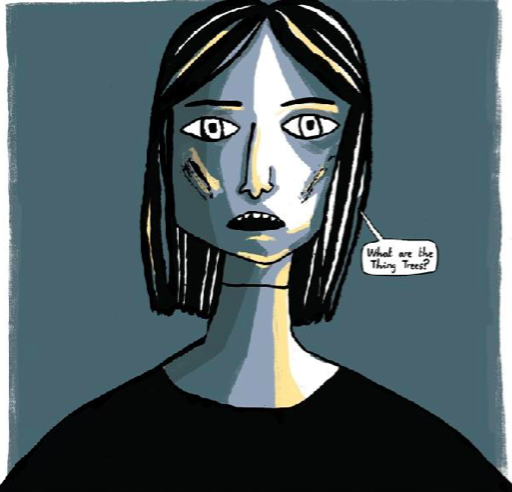 The art in here with its dark lines and colors really managed to enhance the gloomy atmosphere in certain tales.
And on to my favorite story from this graphic novel: the story of the moon and a mortal man falling in love.


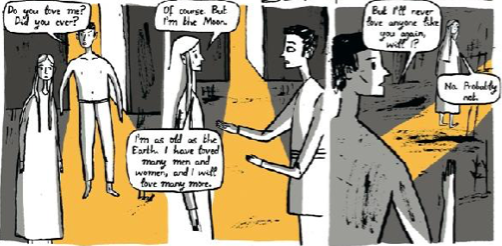 The reason why I cherished this story so much was mainly because of Sokka and Yue from Avatar. I watched their love story years and years ago, but to this day it remains one of the most tragic ones out there for me.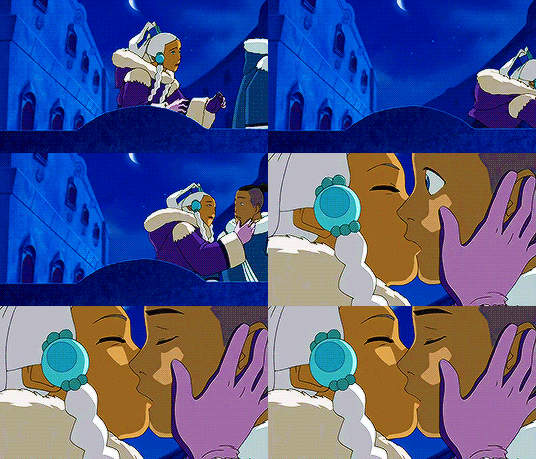


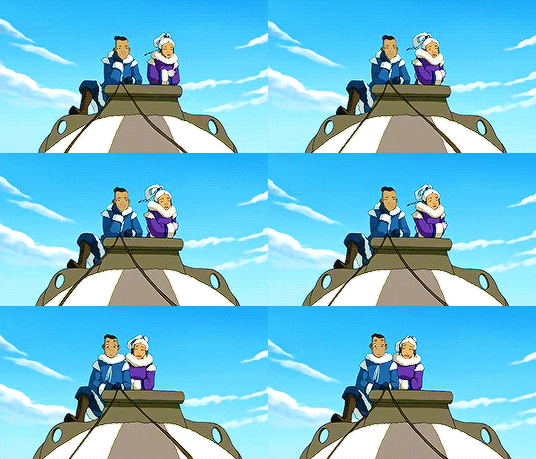
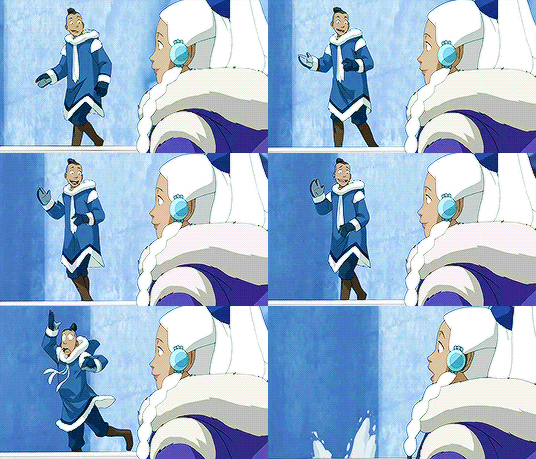
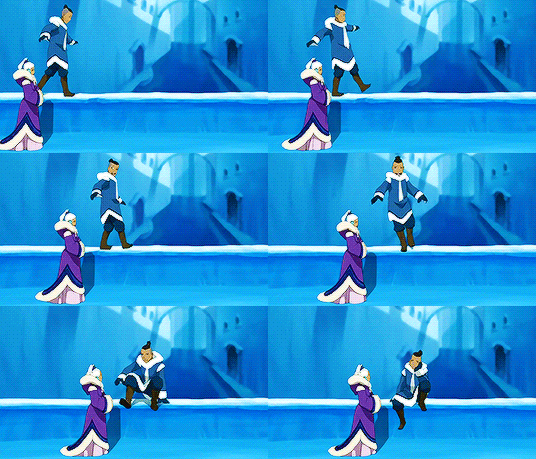
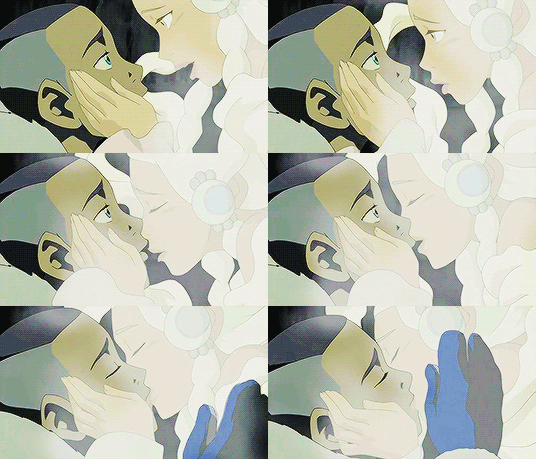
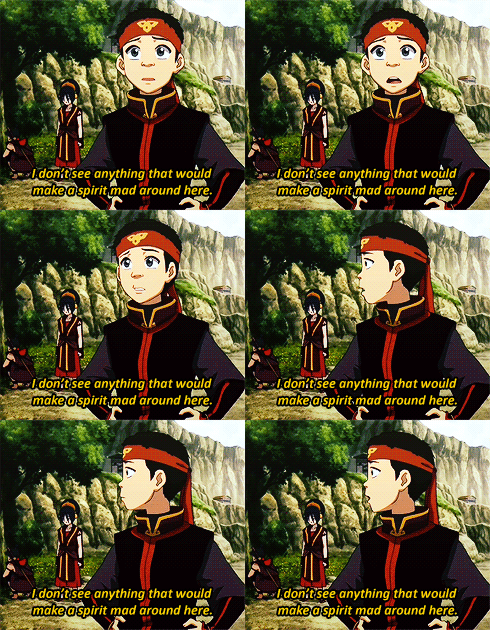

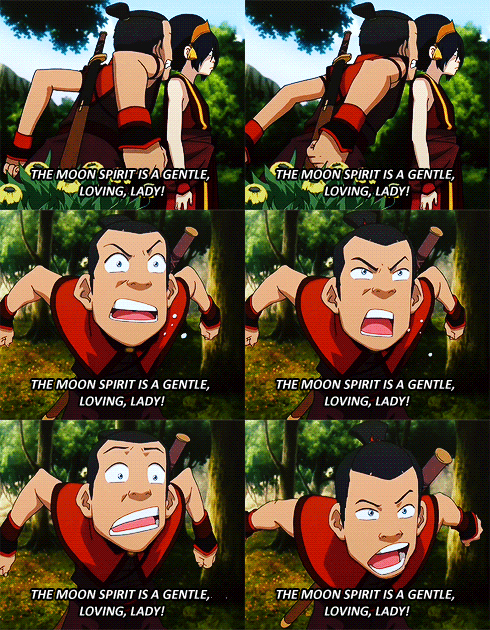
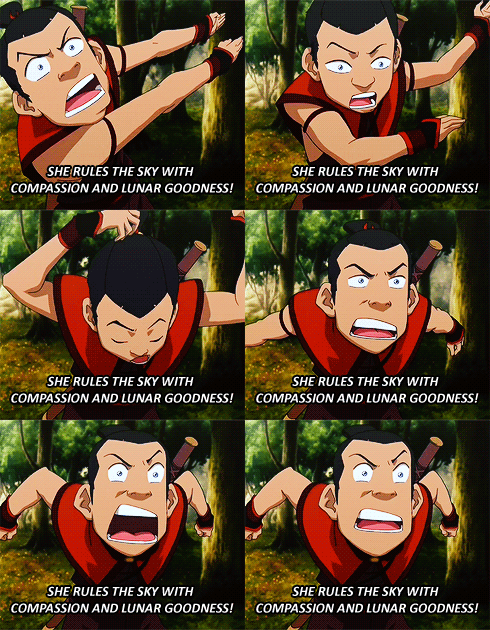
Honestly, my heart breaks a tiny bit every time I recall their adoration and tenderness for one another.
But moving on to the actual story and the love between Cherry and Hero:
 I was immensely proud of Cherry in this moment. To see her stand up for her love and beliefs was beyond gratifying. Also, A+ for her clapback.
 YES!
YES! Their ending, however, left me a bit bewildered. I can't quite gather if it's a tragic one or not... I mean, they're still together, but also not really?? To be completely honest, I don't even know what's exactly went on, but... the art is beautiful:

All in all, I'm beyond grateful to have finally read this epic graphic novel by the immsenly talented Isabel Greenberg. And I'm hopefully onto The Encyclopedia of Early Earth next!
4.5/5 stars
Note: I'm an Amazon Affiliate. If you're interested in buying The One Hundred Nights of Hero, just click on the image below to go through my link. I'll make a small commission!

Support creators you love. Buy a Coffee for nat (bookspoils) with http://Ko-fi.com/bookspoils


February 5, 2021
Weird and amazing!

September 10, 2025
Isabel Greenberg’s gorgeous, queer, feminist graphic novel re-released to coincide with a film adaptation of the same name. Set in Greenberg’s richly-imagined universe of Early Earth, and inspired by tales of Scheherazade, her book pays homage to oral traditions and women storytellers. Early Earth with its looming towers and powerful men is an intriguing blend of ancient male-centred and repressive puritan societies. Men hold all the power here. Mostly confined to the domestic sphere, women are forbidden to even read or write. Those that do are liable to be tried and executed for witchcraft.
Greenberg introduces rank misogynists Manfred and Jerome entangled in a bitter debate about the evils of women. Manfred longs for what’s essentially a trad wife but can’t understand why he hasn’t found one. When Jerome smugly announces he has such a wife, they strike an unusual bargain. Jerome will go away for one hundred nights leaving Manfred free to see if he can seduce Jerome’s wife Cherry. Thus, proving no woman can be trusted. But what Jerome hasn’t worked out is that Cherry’s deeply in love with her maid Hero and vice-versa. So, when Manfred comes calling, they hatch a plan to save Cherry from his clutches: spinning yarns that last through the night, a distraction Manfred finds unexpectedly irresistible.
Greenberg’s love of folklore, myth and magic feeds into the women’s stories. These include retellings of classic fairy tale “The Twelve Dancing Princesses” and the chilling British murder ballad “The Two/Twa Sisters.” Cherry and Hero’s narratives are packed with memorable details from eerie “Thing Trees” to the sinister bog people who try to imprison the moon. All of the chosen tales focus on women navigating and deftly subverting a patriarchal culture in which they’ve been cast as minor characters. As each night passes, Cherry and Hero strive to find a way to live freely and together. It’s an arresting piece overall, bittersweet but laced with flashes of wry humour. Greenberg’s text and powerful artwork fit together perfectly; and I loved her restrained but bold use of colour. Highly recommended.
Thanks to Netgalley and publisher Jonathan Cape for an ARC
Greenberg introduces rank misogynists Manfred and Jerome entangled in a bitter debate about the evils of women. Manfred longs for what’s essentially a trad wife but can’t understand why he hasn’t found one. When Jerome smugly announces he has such a wife, they strike an unusual bargain. Jerome will go away for one hundred nights leaving Manfred free to see if he can seduce Jerome’s wife Cherry. Thus, proving no woman can be trusted. But what Jerome hasn’t worked out is that Cherry’s deeply in love with her maid Hero and vice-versa. So, when Manfred comes calling, they hatch a plan to save Cherry from his clutches: spinning yarns that last through the night, a distraction Manfred finds unexpectedly irresistible.
Greenberg’s love of folklore, myth and magic feeds into the women’s stories. These include retellings of classic fairy tale “The Twelve Dancing Princesses” and the chilling British murder ballad “The Two/Twa Sisters.” Cherry and Hero’s narratives are packed with memorable details from eerie “Thing Trees” to the sinister bog people who try to imprison the moon. All of the chosen tales focus on women navigating and deftly subverting a patriarchal culture in which they’ve been cast as minor characters. As each night passes, Cherry and Hero strive to find a way to live freely and together. It’s an arresting piece overall, bittersweet but laced with flashes of wry humour. Greenberg’s text and powerful artwork fit together perfectly; and I loved her restrained but bold use of colour. Highly recommended.
Thanks to Netgalley and publisher Jonathan Cape for an ARC

September 13, 2017
One Hundred Nights of Hero is a story about stories, and a story about storytelling, and a story about power - the power we yield, and the power we are deprived of.
I don't know if I can fully review this. This book is one that you simply have to experience for yourself. All I can say is that this book is deeply, deeply beautiful. It is a story of love and loss and with a deep, deep power. It's probably enough to say the ending made me cry. Please add this.
Blog | Goodreads | Twitter | Youtube
I don't know if I can fully review this. This book is one that you simply have to experience for yourself. All I can say is that this book is deeply, deeply beautiful. It is a story of love and loss and with a deep, deep power. It's probably enough to say the ending made me cry. Please add this.
Blog | Goodreads | Twitter | Youtube

May 20, 2018
Actual rating 4.5/5 stars.
This delivered absolutely everything I hoped it would and so much. It was full of absurdities, and love, and feminist bad-assery, and I adored every beautifully illustrated page!
This delivered absolutely everything I hoped it would and so much. It was full of absurdities, and love, and feminist bad-assery, and I adored every beautifully illustrated page!

January 30, 2017
A book of charmingly peculiar feminist graphic fairy tales.

February 20, 2017
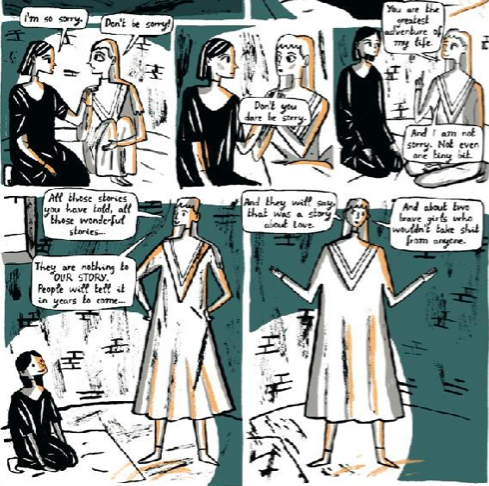
“All those stories you have told, all those wonderful stories…
They are nothing to OUR STORY. People will tell it in years to come…
And they will say, that was a story about Love.
And about two brave girls who wouldn’t take shit from anyone.”
I liked the quirky, whimsical artwork of Early Earth, but was not in love with the vast scope of the myth-making, the broad origins of the universe. I thought it was just all right. Impressive to look at, but it made me a little impatient to read. Sorry, Neil Gaiman and company, I’m just not that into reading Mythology most days.
But this book completely turned me around. It’s pretty amazing. One Hundred Nights of Hero is set in Early Earth, but with different characters; a bunch of largely misogynist, stupid men, and a collection of amazing women who love, who dance, who resist patriarchy.
Early Earth is a feminist/queered revisionist fairytale about two lovers: Cherry, a fair and lovely young woman from the (patriarchal, but what’s new?) Empire of Migdal Bavel, and her maid, Hero. Cherry is married to Jerome, who makes a stupid bet with his stupid friend Manfred: If Manfred can seduce Cherry, then Manfred can have her and Jerome’s castle. If he fails to seduce her, Manfred’s castle would become Jerome’s. Jerome gives Manfred a full one hundred days to sleep with Cherry, who is actually Hero’s lover, so in one funny, sweet sense this bet is off.
Something like the Arabian Nights, Hero distracts stupid Manfred for 100 days with a collection of folklorish/feminist tales, tales of madness, lust, deception, bravery and ingenuity. Stories about strong women and stupid men, mostly, but they are linked, and increasingly entertaining and inspiring. Stories about moons and lovers. And girls who wouldn’t take shit from anyone.
The artwork is bold, with splashes of color, echoing “primitive” cave art in its attempt to connect with ancient mythology, to bring things to a feminist present. With a mixture of language that both echoes old English in translation and contemporary snarky powerful bonding girl talk.
Do you recall the Women’s March, in January 2017? This was released a few months before that but it would have been perfect for it. Sure to become a feminist classic, a funny and angry and sweet cry against oppression, against forced marriage, against stupid and unconscionable male standards and expectations for female behavior and bodies.
They are nothing to OUR STORY. People will tell it in years to come…
And they will say, that was a story about Love.
And about two brave girls who wouldn’t take shit from anyone.”
I liked the quirky, whimsical artwork of Early Earth, but was not in love with the vast scope of the myth-making, the broad origins of the universe. I thought it was just all right. Impressive to look at, but it made me a little impatient to read. Sorry, Neil Gaiman and company, I’m just not that into reading Mythology most days.
But this book completely turned me around. It’s pretty amazing. One Hundred Nights of Hero is set in Early Earth, but with different characters; a bunch of largely misogynist, stupid men, and a collection of amazing women who love, who dance, who resist patriarchy.
Early Earth is a feminist/queered revisionist fairytale about two lovers: Cherry, a fair and lovely young woman from the (patriarchal, but what’s new?) Empire of Migdal Bavel, and her maid, Hero. Cherry is married to Jerome, who makes a stupid bet with his stupid friend Manfred: If Manfred can seduce Cherry, then Manfred can have her and Jerome’s castle. If he fails to seduce her, Manfred’s castle would become Jerome’s. Jerome gives Manfred a full one hundred days to sleep with Cherry, who is actually Hero’s lover, so in one funny, sweet sense this bet is off.
Something like the Arabian Nights, Hero distracts stupid Manfred for 100 days with a collection of folklorish/feminist tales, tales of madness, lust, deception, bravery and ingenuity. Stories about strong women and stupid men, mostly, but they are linked, and increasingly entertaining and inspiring. Stories about moons and lovers. And girls who wouldn’t take shit from anyone.
The artwork is bold, with splashes of color, echoing “primitive” cave art in its attempt to connect with ancient mythology, to bring things to a feminist present. With a mixture of language that both echoes old English in translation and contemporary snarky powerful bonding girl talk.
Do you recall the Women’s March, in January 2017? This was released a few months before that but it would have been perfect for it. Sure to become a feminist classic, a funny and angry and sweet cry against oppression, against forced marriage, against stupid and unconscionable male standards and expectations for female behavior and bodies.

February 16, 2019
we love sapphics burning down the patriarchy

September 8, 2019
*4.5 stars*
god, this was delightful
god, this was delightful

April 27, 2016
The moral of this story is: Tell stories to get out of dangerous situations. But not just any stories. Smart stories. Stories about brave women who don't take shit from anyone.
That's simplifying "The One Hundred Nights of Hero" quite a bit since there is a lot more to this gorgeously illustrated book. It gives off a warm and fuzzy feeling with its messages of love and independence, yet, it is a very somber and sobering tale. It's muted tones create an aesthetic palette that is just as central to the book's essence as are the splashes of excitement in colour and humour. The way in which the darkness and the comedy mixes into the artwork reminds me fondly of Kate Beaton's Hark! A Vagrant and Emily Carroll's Through The Woods. I'm extremely taken by this story told here on the art of storytelling so much so that I'd stay up one hundred nights (and more!) to live them myself as a member of The League of Secret Story Tellers.
That's simplifying "The One Hundred Nights of Hero" quite a bit since there is a lot more to this gorgeously illustrated book. It gives off a warm and fuzzy feeling with its messages of love and independence, yet, it is a very somber and sobering tale. It's muted tones create an aesthetic palette that is just as central to the book's essence as are the splashes of excitement in colour and humour. The way in which the darkness and the comedy mixes into the artwork reminds me fondly of Kate Beaton's Hark! A Vagrant and Emily Carroll's Through The Woods. I'm extremely taken by this story told here on the art of storytelling so much so that I'd stay up one hundred nights (and more!) to live them myself as a member of The League of Secret Story Tellers.

July 2, 2018
This book is an absolute delight.
It had everything I could have wanted: a compelling story, wonderful characters, and a sense of bittersweet hope throughout.
This book is a celebration of women storytelling, and the ways in which other people (mostly men...) try to stifle these stories and the women who tell them.
The art is gorgeous and visually interesting--I loved just staring at the pages.
I want MORE. So much more. I especially adored the ending of this book... It's everything I could have wanted.
It had everything I could have wanted: a compelling story, wonderful characters, and a sense of bittersweet hope throughout.
This book is a celebration of women storytelling, and the ways in which other people (mostly men...) try to stifle these stories and the women who tell them.
The art is gorgeous and visually interesting--I loved just staring at the pages.
I want MORE. So much more. I especially adored the ending of this book... It's everything I could have wanted.

December 28, 2016
I feel guilty for not loving this. I really thought I would. The artwork is beautiful, and the stories are all about sisterhood and empowerment. But I didn't think the text was anything special. First of all, Greenberg combined stilted, fairytale-esque language (no contractions, saying expository things aloud) with colloquial, trying-to-be-funny language. Didn't really work for me. And I also think it's difficult to adapt the Scheherazade story because, come on, you have to convince us that the stories that are being told are so good they make someone put off sex for 100 nights. So...nope. (Still would recommend this - I just think I wasn't blown away because there was so much hype.)

December 28, 2016
This was beautiful. The art. The narration. The nesting stories. The message. And an epic, mythic love story between two brave, smart women. Clever, funny, inspiring.

June 5, 2018
Essentially an f/f retelling of a thousand and one nights, the one hundred nights of hero was addictive, funny, brilliantly sarcastic and full of sassy, bad ass women and feminist tales and messages from start to finish. With artwork that was quirky, unique and incredibly inviting, a compelling plot and a brilliantly witty reflection on society and the way it treats women, I’d without recommend this as a thoroughly enjoyable read.

November 18, 2018
Greenberg’s concept is to tell fairy tales in a way that would have been real to the women in them - women who are subjected, terrorized, blamed by men. The stories are based on folk tales of various cultures, with a Sheherezade-like framing story. The stories are all altered to end badly.
The message is that women’s stories are important, and we should keep telling them. No matter how oppressive is the rule, if enough people know the stories, things can change.
While I give credit to the message, unfortunately the format, the writing and characterization of most men is simply atrocious. The art is terribly ugly: kids drawings are shaded so they all look dirty and messy, occasionally so bad you can’t even tell what it is. The writing is simplistic like for little children, but the topics are adult, and the occasional cursing is extremely jarring, as it does not fit with the rest of the text. In addition, the text is in a difficult to read hand-written font. And men (with a couple exceptions toward the end) are depicted as stupid, vile, power-obsessed tyrants who hate women and demand absolute obedience. While a lot of that certainly went on, Greenberg made the men into dumb caricatures.
I read this because of some of my Goodreads friends liked it - but I do not share the enthusiasm. If one wants to read a clever, feminist retelling of a story where women are blamed and killed, I highly recommend The Penelopiad by Margaret Atwood.
The message is that women’s stories are important, and we should keep telling them. No matter how oppressive is the rule, if enough people know the stories, things can change.
While I give credit to the message, unfortunately the format, the writing and characterization of most men is simply atrocious. The art is terribly ugly: kids drawings are shaded so they all look dirty and messy, occasionally so bad you can’t even tell what it is. The writing is simplistic like for little children, but the topics are adult, and the occasional cursing is extremely jarring, as it does not fit with the rest of the text. In addition, the text is in a difficult to read hand-written font. And men (with a couple exceptions toward the end) are depicted as stupid, vile, power-obsessed tyrants who hate women and demand absolute obedience. While a lot of that certainly went on, Greenberg made the men into dumb caricatures.
I read this because of some of my Goodreads friends liked it - but I do not share the enthusiasm. If one wants to read a clever, feminist retelling of a story where women are blamed and killed, I highly recommend The Penelopiad by Margaret Atwood.

February 15, 2017
I'd read The Encyclopedia of Early Earth and quite enjoyed its whimsical mythology, but I wasn't expecting to get the same again PLUS such feminist fierceness and intense love. So much depth that I wouldn't be surprised to see it popping up on college syllabi within the next few years. I wish I had literature skills enough to write a proper glowing review, but all I can say is READ IT. :)

December 12, 2016
Greenberg's The Encyclopedia of Early Earth was such a delight, and one of my favorites of 2016. I was really looking forward to another story in this universe of Early Earth, and it's islands and people. One Hundred Nights of Hero was even better than expected. I loved the nested stories, the tongue-in-cheek commentary and sidenotes, the feminist and queer storylines, and the beautiful resounding love of the characters.
A particular favorite was the retelling of the old fairytale The Twelve Dancing Princesses, one that I enjoyed as a child, but LOVED here in its new form.
--
Read for Book Riot's 2017 Read Harder Challenge: "An All-Ages Comic"
A particular favorite was the retelling of the old fairytale The Twelve Dancing Princesses, one that I enjoyed as a child, but LOVED here in its new form.
--
Read for Book Riot's 2017 Read Harder Challenge: "An All-Ages Comic"

July 20, 2017
I very nearly put it down.
The intro was a SLOW start for me - the framing of god-conversation was tiresome, the aesthetic of the illustrations didn't immediately please me.
But as soon as I finished it, I immediately handed it to two different family members. "Read it," I said, "You'll love it." One of them was leaving the state less than 24 hours later, and she later told me it was her favorite graphic novel of all those I shared with her while she visited.
Good stuff, this.
It's a story within a story within a story, all revolving around the empowerment of women. The cleverness of women. The creativity of women. The awesome storytelling abilities of these women.
It feels grand and specific at the same time. Like a legend that has existed through time.
Yes.
Read it. You may love it.
Read while consuming The Handmaid's Tale, in any medium.
The intro was a SLOW start for me - the framing of god-conversation was tiresome, the aesthetic of the illustrations didn't immediately please me.
But as soon as I finished it, I immediately handed it to two different family members. "Read it," I said, "You'll love it." One of them was leaving the state less than 24 hours later, and she later told me it was her favorite graphic novel of all those I shared with her while she visited.
Good stuff, this.
It's a story within a story within a story, all revolving around the empowerment of women. The cleverness of women. The creativity of women. The awesome storytelling abilities of these women.
It feels grand and specific at the same time. Like a legend that has existed through time.
Yes.
Read it. You may love it.
Read while consuming The Handmaid's Tale, in any medium.

February 3, 2017
While I liked the empowering messages this graphic novel by Isabel Greenberg has at its core, for me it didn't really offer anything drastically new to the already crowded genre of retellings of Arabian Nights. I liked the quirky footnotes and the actual book itself is beautiful. I just felt like something was missing, I didn't feel fully invested in the story and in the fate of Hero and Cherry. That being said, there were individual stories I really liked, my favourite I think was Phases. I think maybe I struggled a little as I haven't read a graphic novel in ages and I just wanted more from it. However, I would still recommend to fans of the genre as it's still a worthwhile read.

February 20, 2017
4.5 stars
Loved it. There was a little bit of everything: fantasy, humour, drama, feminism, fairy tales and romance. There wasn't any part that wasn't engrossing or funny or interesting. The stand outs for me was the stories within stories format, the humorous dialogue, and the illustrations. The only things that were a let down was that the ending seemed a little rushed, and the scrawly font that was used wasn't easy to read.
Loved it. There was a little bit of everything: fantasy, humour, drama, feminism, fairy tales and romance. There wasn't any part that wasn't engrossing or funny or interesting. The stand outs for me was the stories within stories format, the humorous dialogue, and the illustrations. The only things that were a let down was that the ending seemed a little rushed, and the scrawly font that was used wasn't easy to read.

February 6, 2019
I don't read a ton of graphic novels, but this was part of a reading challenge.
I've read about half of it, and I don't think I'm going to read the rest. I felt like I was getting more and more depressed reading it. This is a very black and white, men are bad, sort of thing. You probably know that the basic premise of the book is that there's a man willing to allow his friend one hundred nights in which to test his wife's fidelity. By the way, raping her counts as infidelity too. There's sort of a Scheherazade thing going on, where the wife's maid tells stories all night long to distract this guy from seducing/raping the wife, who is also her friend and lover. It's a story within a story narrative, mostly using stories or folklore that I've read in the past, slightly repurposed for this book. In the story-within-stories, all the men are also horrible people who will kill girls for knowing how to read, seduce both sisters in a family with no consequences, etc.
I'm not a fan of this over-the-top male bashing. Sure, there are a lot of horrible men out there, but in this book there are nothing but horrible men. It feels like I'm being hit over the head with a hammer while being told "men bad!! trust only women!!!!!" There's more nuance in the world than this, and I don't find it amusing or comforting. I also didn't really care for the artwork. It also felt jagged and angry, with thick black lines and characters that I didn't enjoy looking at. I'm sure that there are people who are in a place where they need this book. I am not one of them, and reading it left me sad and unsettled. I got to the point that I didn't believe what the author was trying to say because of the over-the-top way in which she said it.
I've read about half of it, and I don't think I'm going to read the rest. I felt like I was getting more and more depressed reading it. This is a very black and white, men are bad, sort of thing. You probably know that the basic premise of the book is that there's a man willing to allow his friend one hundred nights in which to test his wife's fidelity. By the way, raping her counts as infidelity too. There's sort of a Scheherazade thing going on, where the wife's maid tells stories all night long to distract this guy from seducing/raping the wife, who is also her friend and lover. It's a story within a story narrative, mostly using stories or folklore that I've read in the past, slightly repurposed for this book. In the story-within-stories, all the men are also horrible people who will kill girls for knowing how to read, seduce both sisters in a family with no consequences, etc.
I'm not a fan of this over-the-top male bashing. Sure, there are a lot of horrible men out there, but in this book there are nothing but horrible men. It feels like I'm being hit over the head with a hammer while being told "men bad!! trust only women!!!!!" There's more nuance in the world than this, and I don't find it amusing or comforting. I also didn't really care for the artwork. It also felt jagged and angry, with thick black lines and characters that I didn't enjoy looking at. I'm sure that there are people who are in a place where they need this book. I am not one of them, and reading it left me sad and unsettled. I got to the point that I didn't believe what the author was trying to say because of the over-the-top way in which she said it.

November 5, 2017
Sometimes you're taken by surprise by a book, and it's the most wonderful of feelings. I started this graphic novel expecting a nice little tale, but I ended up crying my eyes out and absolutely loving the art work to bits!

January 18, 2021
All the storytelling stars!
This book was a feast for the eyes and a song for the soul.
RTC
This book was a feast for the eyes and a song for the soul.
RTC

April 21, 2022
when is it my turn to manipulate men with my storyteller girlfriend who is also the granddaughter of the moon and then start a revolution

Read
October 22, 2025Decided to pick this up after hearing about it from a friend and I'm so glad I did.
The One Hundred Nights of Hero is a story about stories. It's a love-letter to myths and folk-tales, reimagining and spinning new stories from fairytales; all with the purpose of showing the power stories give women in a world intent on stripping it from them. It was witty and magical and sad; but ultimately hopeful.
My only real complaint is the design of the pages and the font made it slightly hard to read sometimes, especially as someone that doesn't have the greatest eyesight to begin with lol.
Overall, really glad I picked this one up.
The One Hundred Nights of Hero is a story about stories. It's a love-letter to myths and folk-tales, reimagining and spinning new stories from fairytales; all with the purpose of showing the power stories give women in a world intent on stripping it from them. It was witty and magical and sad; but ultimately hopeful.
My only real complaint is the design of the pages and the font made it slightly hard to read sometimes, especially as someone that doesn't have the greatest eyesight to begin with lol.
Overall, really glad I picked this one up.

March 15, 2017
Uncle also read it in Mar 2017.
The art work was okay. The stories were not that engaging. I was not dying to finish them but I read them only because of Uncle's critique of the book and he wanted me to judge for myself.
The blurb on the back says that this is a book about love but the overall theme in the book was pure hate. I could not see the love anywhere.
The entire book was about men vs. women. No cooperation. No kindness. I am not sure how we can spread feminism if we make an entire section of the society unwanted and unwilling to support feminism.
The book perpetuates stereotypes of women - as dumb, naive, petty and mean. How is this empowering?
The book goes on and on about sisterhood. From my life experience, sisterhood exists but we cannot make an assumption that all women look out for each other. They are equally capable of betrayal and leave you in the lurch as much as any other gender.
Open agenda against one gender.
According to this book, the only true love is a lesbian one.
No healthy heterosexual relationships in this book.
All the men in our lives are vile creatures according to this book
The art work was okay. The stories were not that engaging. I was not dying to finish them but I read them only because of Uncle's critique of the book and he wanted me to judge for myself.
The blurb on the back says that this is a book about love but the overall theme in the book was pure hate. I could not see the love anywhere.
The entire book was about men vs. women. No cooperation. No kindness. I am not sure how we can spread feminism if we make an entire section of the society unwanted and unwilling to support feminism.
The book perpetuates stereotypes of women - as dumb, naive, petty and mean. How is this empowering?
The book goes on and on about sisterhood. From my life experience, sisterhood exists but we cannot make an assumption that all women look out for each other. They are equally capable of betrayal and leave you in the lurch as much as any other gender.
Open agenda against one gender.
According to this book, the only true love is a lesbian one.
No healthy heterosexual relationships in this book.
All the men in our lives are vile creatures according to this book

April 2, 2025
“These women must be charged with sorcery, witchcraft, reading, and sassiness! Their behavior is intolerable.” Lock me up✊🏻
I absolutely loved this graphic novel with every iota of my being. The blatant cynicism of white cis males had me chuckling throughout, revealing some sharp wit that kept me entertained. The star-crossed love between Cherry and Hero really tugged at my heartstrings, capturing the essence of longing and connection. And the ending? It was so perfect that it left me feeling completely satisfied🤌🏻
I absolutely loved this graphic novel with every iota of my being. The blatant cynicism of white cis males had me chuckling throughout, revealing some sharp wit that kept me entertained. The star-crossed love between Cherry and Hero really tugged at my heartstrings, capturing the essence of longing and connection. And the ending? It was so perfect that it left me feeling completely satisfied🤌🏻

February 12, 2017
I really liked her first graphic novel, so was looking forward to the publication of this one. It's a beautiful book - the actual book I mean - and the story itself is an Arabian Nights type saga. While I didn't love every one of the stories, I was delighted by the feminist take of these strange fairy tales. The art is folksy and sketchy with wonderful use of color. This is an ode to stories and storytellers, especially women. Delightful.
Displaying 1 - 30 of 1,368 reviews