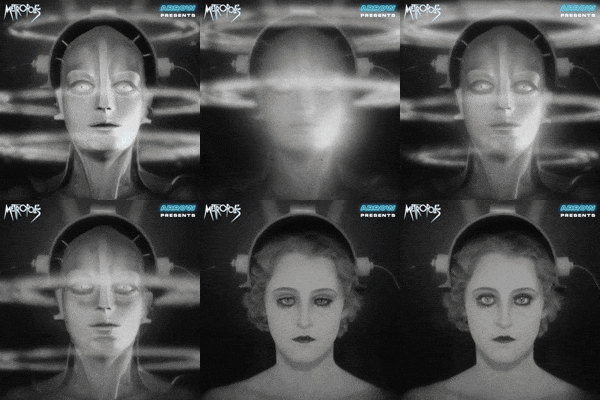
Excerpted from Wikipedia: Catherine Lucille Moore was an American science fiction and fantasy writer, as C. L. Moore. She was one of the first women to write in the genre, and paved the way for many other female writers in speculative fiction.
Moore met Henry Kuttner, also a science fiction writer, in 1936 when he wrote her a fan letter (mistakenly thinking that "C. L. Moore" was a man), and they married in 1940. Afterwards, almost all of their stories were written in collaboration under various pseudonyms, most commonly Lewis Padgett (another pseudonym, one Moore often employed for works that involved little or no collaboration, was Lawrence O'Donnell).
I read this (downloaded, in free but error-loaded PDF form http://hell.pl/agnus/anglistyka/2211/... ) because the professor, Gary K. Wolfe, in the Great Courses series I'm listening to, "How Great Science Fiction Works," mentioned it and it sounded interesting. Which, in a modest sort of way, and given that I didn't pay for it, it is. Set in New York in the future, the story concerns a beautiful actress/dancer/singer -- "the loveliest creature whose image ever moved along the airways" -- who is terribly injured in a fire. The whole world is saddened by her loss, and a clever inventor/scientist makes her a new, robotic body. Moore makes many references to Frankenstein, and the similarities and differences between these creator/creation stories are interesting.
The story has three characters: the "creator," Maltzer; the agent, Harris; and Deirdre. Despite the author's gender (Catherine Louise published much of her work, in magazines such as "Astounding Science Fiction" and"Weird Tales," under "C.L." to avoid discrimination), the story's attitudes towards women are often dismaying. The men, both of whom feel possessively protective of Deirdre, refer to her as "my dear," and are sure they know far better than she could what is best for her. Deirdre, for her part, is celebrated for her grace, charisma, and beauty, which is fine, as far as it goes, but not much to hang a story on. I just couldn't bring myself to care whether Deirdre's return to the stage was successful or not.
Still, Moore touches on a number of interesting ideas here, and there is enough good to overcome some rough patches and datedness. The extent to which personality is connected to a body, the question of what makes a particular individual charismatic, the obligations of scientists to the recipients of their efforts, and so on. And, as Wolfe points out in his lectures, Moore was prescient in her vision of ubiquitous television/computer screens creating the possibility of truly World famous personalities.
This short story asks a number of fascinating questions: What remains of our identity without the reference of others? (Granted, not many of us have the experience of being literally disembodied). How much of our identity do we draw from our facial expressions? Our mannerisms, our movements, our voice? Would anyone still know us, or choose to associate with us, if we were suddenly divorced from any-or many-of these things? Without our five senses, are we still human at all? Do we only remain human (and what even is it to BE human, really) by constant and reinforced contact with other people like us?
It is a real credit to the author that she is able to keep the idea that Diedre is both human and yet not in tension in the story for so long and so convincingly. Beautifully done.
Read this because it was nominated for a retro Hugo award, so I was reading quite a few works from the same year in a short period of time.
Moore did such beautifully inhuman characters, and this story of one woman reformed in metal is a lovely example. Almost a character study, this is a lovely, intimate story encompassing three people.
A lovely story - fantastically dated and infused with 1940's sexism, even from a woman author, but absolutely beautifully written. It was a pleasure to read, and explored some really fascinating ideas with such precision and control at every moment. I generally hate robot stories because it doesn't matter if you give a computer arms and legs, it doesn't have 'humanity' and you aren't obligated to treat it like a human, but this was a nice twist on that. What gives us humanity? How much can a person lose and still keep theirs? How far removed from other humans can they be before they become a monster? (She exercises some admirable restraint in answering this one, which is a refreshing change from every other story that starts with a scientist unveiling their great creation to another person) How much of female charm back in the forties was a performance? How much does performing femininity cause men to underestimate women? This is one I'd like to reread.
Read for an English class I thought it was a really weird mix of robot sci-fi and 1940's sexism towards women, especially those in Hollywood. Explores themes of how much a woman's sexuality and physical body contributes to her humanity/how the world perceives her Deirde shows at the end of that story how much autonomy she actually has, regardless of her body She pulls Maltzer out of the window and starts speaking on how there is nothing she physically is incapable of doing due to her new body and that because of her new body that she technically is better than humans, putting herself is a standing above the men that previously were infantilizing her. I thought that this was a really weird story especially, coming from a described to be feminist author. It's really interesting how physical most descriptions of Deirdre are. Both of the men in this story sort of have a possessive and idealist viewpoint of what made Deirdre the desirable human that she used to be before the fire. This viewpoint is based on how she can be alluring to others instead of just being herself. This can be shown in how Maltzer is afraid that Deirde in her new metallic body can compete with human women when he states that “she’s an abstraction now” building on this concept of Deirde by saying “ One of the strongest stimuli to a woman of her type was the knowledge of sex competition. You know how she sparkled when a man came into the room? All that’s gone, and it was essential … she’s withdrawn from all physical contact.”. This is a VERY one dimensional view of what Maltzer perceived as what made her successful. Not her voice or how much dance training she had had but how she used her senses and her body to attract men. Most of the comparisons throughout the story of the pre fire Deirde to the post fire Deirde is based on physical, sensual aspects. This perspective is very interesting coming from a feminist female author and whether it shows the internalized misogyny of the time of the author wrote the story this way to point out how much a woman's physical body makes up her humanity in this setting is interesting
This entire review has been hidden because of spoilers.
After a horrific theatre blaze kills a renowned actress, adored throughout the world for her good looks and Hollywood charm, a brilliant but tortured scientist manages to preserve her brain and "resurrect" her with a mechanical body. Contrary to expectations, her return to the stage is warmly received, but she knows the novelty will eventually wear off.
Written by a woman - which I didn't know, and which makes the story more interesting - this story makes an important (though nowadays hardly uncommon) statement against the sexist undertones of female stardom. It wasn't a bad story, but I found it a little boring and predictable.
Fantastic story. What happened to Deirdre is heartbreaking, which makes the description of how she comes back so vivid and fascinating. Even though from a modern perspective the story of a human's consciousness being transported into a machine is quite familiar, the way Moore analyzes what cost this could have on someone's sanity and mental health is still so refreshing. Our bodies are nothing without our minds, and our minds aren't the same without our bodies. This story is well worth reading and is now definitely one of my favorite sci-fi plots.
Interesting read although the professor was pretty darn melodramatic about how Deirdre would have her psyche crushed if she weren't accepted by the world in her new form. After spending a year trapped in her own mind, you'd think she could handle anything. One thing that drove me crazy was the use of the word "Poise". I must have been used a dozen times in the first half of the story.
Creo que lo poquito malo es que la única versión que encontré en línea está bastante mal transcrita: se pegan palabras y los párrafos están mal. Tampoco es que sea muy exigente, pero sí hace un poco pesado el proceso de lectura de esta novela.
Fuera de eso una gran historia. La escena del teatro está bien bonita.
Read this one today in the "We, Robots" collection edited by Simon Ings but it seemed so familiar to me that I checked and I had indeed read it before in the "Science Fiction 101" collection by Robert Silverberg. Great tales of how a dancer is revived in a metal body and what it means to her in terms of reconnecting to humanity.
This short story was worth the read - it was intriguing and enchanting, and though it centers around three characters, it isn't boring in the slightest. The story builds at a good pace, and has quite a few great quotes considering how short it is.
Written in 1944 it is often called the first story on cyborgs. It was also written by one of few women who created science fiction. Quite an achievement.
A very interesting meditation on what it means to be human versus what it might mean to be half-human and half-robot. Not much happens in the story, but it nonetheless held my attention.
This story doesn't need another review here but I feel it's earned one from me.
Much anthologized, I encountered it this time in Tomorrow x 4 where it's blurbed as "the penetrating psychological insight of C L Moore". Me, I don't know about that.
What I do know is that between the story and the poem Deirdre* by James Stephens, which it shamelessly adduces, their glorious celebration of womankind and the part of mankind that desires them has stuck for decades in the mind of a man who's among the other, minority part. ------------------ * Not the short story Deirdre by James Stephens, about which I knew nothing but what is written on this platform. The poem is, e.g., at https://www.poetrynook.com/poem/deirdre.