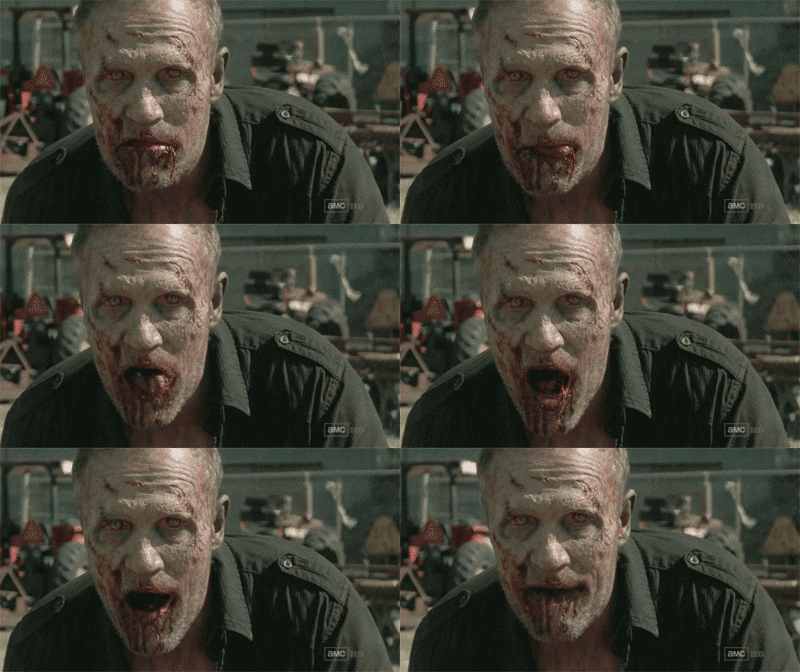
In Danse Macabre, Stephen King wrote: "I recognize terror as the finest emotion and so I will try to terrorize the reader. But if I find that I cannot terrify, I will try to horrify, and if I find that I cannot horrify, I'll go for the gross-out. I'm not proud."
This book is the embodiment of that quote. It didn't terrify me. It didn't horrify me. But it did gross me out and disgust me.
*Sigh* I have heard so much greatness about this book, and about this author, but this book just didn't do it for me. I wanted so much to love it, but I ended up just counting down the pages until it was over.
The format was clearly, and admittedly, influenced by Stephen King's Carrie, but it didn't work for me here. There were a few moments when I could see that Cutter was trying to build up a sense of dread with a little foreshadowing, but on the whole I think that all of the excerpts would have worked so much better as an epilogue. I would have been much more invested in this story had I NOT known what it was that the boys were up against. We find out so early in the story that it's almost like we're not meant to be frightened of an unknown danger. Is the communicability supposed to make up that much of the horror aspect? For me it didn't. It just simply wasn't enough of a threat.
Let's put this into perspective: Less than a week ago, I was reading The Stand.
Both stories contain a contagious, bio-engineered, very adaptable bug that goes awry, and once infected, the outcome is death.
Both stories contain a rather limited cast of main characters. Granted, The Stand has probably about double, but it's also twice as long. So, it's even enough.
Both stories contain some rather depraved psychopaths, and some military folks, and a pregnancy (of sorts)... And you know, I could go on.
So here's the thing. With The Stand, the communicability is near perfect. It's airborne, and a single encounter is deadly. Someone sneezes, and you happen to walk by, you're a goner. In The Troop, contact with some sort of bodily orifice is required - which means that it's already less communicable than a flu virus. It must physically touch and enter your body somehow... so if you're smart and prepared, you could potentially avoid being infected at all. A 14 year old boy did just that, and without much going for him in the way of "being prepared". And, presumably, "Typhoid Tom" came into contact with several people before making it to the island, and it seems that none of those people were infected... (Speaking of which. Umm, Typhoid Mary was called that because she actually carried typhoid. People know this, right? Typhoid is not synonymous with "contagion carrier".)
What makes the communicability scary though, is the fact that nature exists. It's not just a case of "I know that is deadly, so I won't touch it, and there's no more threat" - it's an organism that can jump species and infect EVERYTHING it touches, potentially. And then the breed and feed orgy begins.
Which is one of the places that this story breaks down for me. If this is as hardy and adaptable as it was described, once it's in the ocean (THE FUCKING OCEAN, WHICH COVERS LOTS OF THE PLANET WE ALL LIVE ON), I'm pretty sure that we're all dead. It can survive in water, obviously, and there's a whole lot of live things to infect in the water. All it has to do is be eaten, and coincidentally, fish eat worms! But, yeah, I'm sure that dumping whatever fun chemical stuff they used in the water did the trick. Because water just stays right where its put and doesn't ever go anywhere else, and also all the stuff that lives in water is very well behaved and will stay inside the quarantine zone.
I have to wonder what the goal of the release was. Did they know there was going to be a troop of boys there? It seemed that the island was pretty devoid of animals (except skunks?) so, it seems like a huge risk to take just to see what would predictably happen to some different kind of mammal. Maybe it would be different because it's outside of a lab!! *Rolls eyes*
You'd think, that after experimenting and cataloging the horrific ways that various infected animals can slowly die, they'd be pretty confident that it works. I got the point halfway through the first transcript of the experimentation deathporn. But to make sure that I got it 100 million bajillion percent, there had to be more and more and more of it, and each one had to be more disgusting and depraved than the last.
And then there was Shelley. Because one type of animal torture just isn't enough for a novel, we needed to have even more to prove that he was a creepy son of a bitch. I'd already got that from my awesome powers of reading comprehension when we were told that. But no, a good author SHOWS. So we were shown. Again and again and again.
But then, just to contrast, we had to have just ONE more animal die, this time at the hands of kids who were doing it for their survival, but then felt too bad to eat the poor thing after it FINALLY dies, so they bury it.
This book was like a catalog of animal suffering. Not a fucking fan. I can deal with a bit, when necessary, but this was just ridiculous amounts of animal torture porn, described in fucking detail.
Finally, the nail in the coffin for me: I didn't care about any of the characters. They were so stereotypically cast that it was hard to feel like they were real, fleshed out people, as opposed to a set of boys with strategically picked traits who will be in conflict with each other. Maybe that conflict was supposed to be the real horror... but it just felt fake to me. I couldn't care and kept thinking how ridiculous it all was.
You know, when I started this review, it was a 3 star book. But the more I type, the more I realize that I like the book less and less. *sigh* I had really hoped that it would be great. And then it wasn't.





 come to my blog!