In a word, inconsistent.
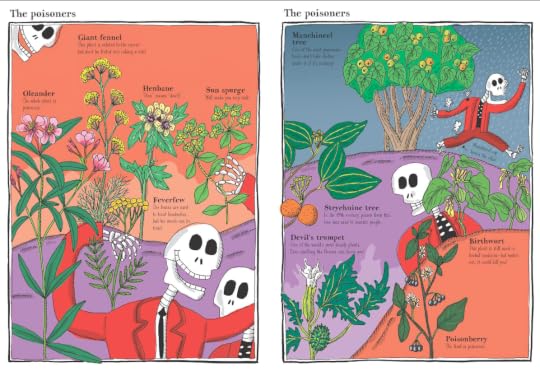
Plantopedia is in no way encyclopedic as the title suggests, and I was left wondering what, if any, criteria for inclusion or exclusion were used to select the plants covered. A more cohesive vision for who the intended audience is could have made this a better book. Several of the categories manage to strike the right tone to engage a preteen. Kids love the bizarre, gross, and extreme. Had they expanded categories such as "Giants," "Poisoners," and "Perfumed" with more even and extensive tidbits of curious facts, it might have earned a 4 star review.
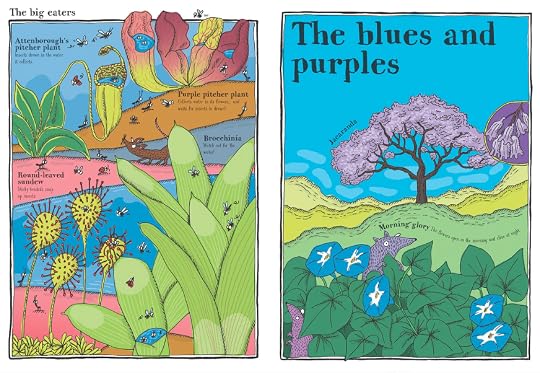
The art is vibrant and engaging, with cute animals peeking out around plants, and many full-page spreads of scenes that are fun to explore. Though the overall art style is consistent, each category gets a slightly different treatment. The Dyes category is especially well done, with streams of color coming out from beneath each plant and being used as dye. The art is not sufficiently detailed to identify plants, and there are a few places where a close-up view would have better matched the writing ("Marsh Pennywort: Turn over the floating leaves to see tiny pink flowers." - I want to see these tiny pink flowers!).
If Plantopedia is not intended to be botanically accurate, the inclusion of an appendix of leaf shapes is incongruous. The appendix and other elements implied a level of botanical accuracy which was not met. "Cereals" included buckwheat, which is botanically a pseudocereal. In Fruits You Have to Peel, quince is misleadingly described as "a hard lumpy pear." (Though both in the family Rosaceae, quince are in a genus by themselves, and many varieties are not pear-shaped.) There is no reason this work could not have been accurate and served as a better introduction to botany through the allure of the illustrations.
Many, but not all, of the categories have explanatory subtitles. They were omitted at times where they were called for, and where a bit of elementary scientific information about plants could easily have been conveyed; there was plenty of space on the otherwise fairly simple Stone Fruits page to define drupes, the Cereals page would have benefited from a simple statement that cereals are the edible seeds of grasses, and the category Hybrids is left undefined. Other categories are wildly subjective (Tasty Fruits, Useful). The contents of the Healers and Magical sections do not differentiate fact from fiction ("Milk Thistle: Heals the liver." and "Lily: White Magic. Carry a bulb in your pocket to break a love spell.").
The factoids that accompany some entries are similarly uneven, giving the impression that they were the result of a quick internet search rather than a thoughtful addition.
I was disappointed that the work did not live up to the quality of the illustrations.
Optional purchase for middle readers collection at large public libraries.
I received an ARC from the publisher for review purposes.