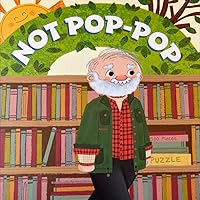
It’s visiting day, and Dad smells like peppermint—yuck! If only he would wear that nice, breezy cologne that smells like hazelnut... So begins one boy’s brief weekly visit with his father in prison. Here’s a man who gets angry, but beneath that peppermint surface is much to admire, if only you take the time to look. This richly imagined picture book explores the inner life of a boy who struggles to love a father who can be difficult to love at times. Though they may only have brief visits together, it’s clear they love each other. This story bravely explores the all-too-hidden world of incarcerated parents. It’s also a beautiful testament to the power of love to bridge the walls that divide us.
I’m on a children’s book committee right now with an interesting mix of members. Some folks are old hands that have read more picture books in their lifetime than I could ever attempt. Others are fresh-faced newbies, coming onto the committee with their own ideas of what does and doesn’t constitute appropriate picture book fare for kids. The next time we have a meeting I’m planning on bringing with me a secret weapon. A picture book that defies age categorization, even as book distributors, review journals, and even its own publisher, struggle to determine the best age to read it. For me, Hazelnut Days by Emmanuel Bourdier and ZAÜ represents a very distinct form. Sometimes, picture books are best suited for older readers. Not always. Not exclusively. But from time to time we’ll get a book of deep emotional complexity, flawed characterizations, and reality for the elementary school set that redefines the narrow confines of what some folks assume picture books are capable of accomplishing. On the surface, Emmanuel Bourdier’s Hazelnut Days is just another message book about a boy with an incarcerated father. In reality, it’s a whipsmart approximation of all the conflicted feelings a child is privy to when they visit a beloved parent behind bars. A book that works beyond its surface message.
His dad isn’t wearing his hazelnut fragrance today. Instead it’s that peppermint one that makes him smell like a school bathroom. His son doesn’t approve of that, or the fact that his dad has clearly started smoking again, but then his mind wanders. He thinks about the ways he deflects questions in school about his dad’s job. He considers how he and his dad have the same ears. He thinks about how he discusses dad with mom, how his bad report cards anger his father, and how he wants to be just like him one minute, and then is furious at him the next. When his dad cries, sometimes the boy cries with him. Sometimes he doesn’t. Next thing you know the guard is jingling his keys. Visiting hours are over and the next time he comes the boy will bring hazelnuts. A great big bag of them.
I’ll say right off the bat that this isn’t the first book about an incarcerated dad I’ve ever read. The gold standard for years was always Jacqueline Woodson’s Visiting Day, and for a long time it was the only game in town. Then in 2013 the author/performer Daniel Beaty’s poem Knock Knock was turned into a poem at the instigation of artist Bryan Collier. Like Hazelnut Days, Knock Knock never uses the word “jail” or the word “prison” or “prisoner”. But Hazelnut Days is less interested in the process of a kid going to jail (as in Visiting Day) or thinking deeply about what it means to grow to be a man without a father (as in Knock Knock) than it is in examining the day-to-day realities of missing your father, hating your father, loving your father, blaming your father, forgiving your father, and above all wanting to be your father. It isn’t the first book about incarcerated dads I’ve seen, but it is clearly one of the best.
One choice that Bourdier made early on was to mention the dad’s incarceration only at the end of the book. This means that an initial read will differ widely from a second close reading. For obvious reasons, you miss a lot of details the first time. Sentences like, “One day we’ll race each other to see who’s the fastest, and I’ll win. By then he’ll be too old to catch me.” The deeper meaning of those words sinks in when you know the context. Or the moment when the mom “looks through his small, square window” before it is revealed where the family is. I can see teachers and educators using this book in children’s English classes to highlight how much a story can change when you’re given all the information, rather than just bits and pieces. It’s a book that certainly rewards multiple readings.
It's also French. To my mind, a good translation is one where it would never occur to you in a million years to think that the book was translated. Consider this passage when our hero makes up fake occupations for his dad, to deflect questions from his schoolmates: “Now I tell them: He’s a cloud sculptor, a mole tamer, an inventor of dirty words . . . But at the same time he’s also: a void maker, a ghost king, a fog machine.” That’s such an elegant translation. No doubt the translator had their work cut out for them. Once you know the book was originally published in France, some of the more surreal but charming elements fall into place. For example, when asked how she met his dad, the boy’s mom “said that one summer day he crashed into her car in a parking lot. The rest is history.”
Generally speaking I have one rule when it comes to children’s books: No brown covers. I don’t care if you’ve written a work of scintillating nonfiction, a poetry collection, a picture book, or a middle grade novel. You slap a brown cover on that book and I don’t care how cool an image you have featured, kids are going to avoid that book like it was the plague. In the deepest recesses of their little reptilian brains, children have somehow come to the inescapable conclusion that brown = boring. Sepia = excruciatingly dull. And tan? Don’t even get me started on tan. And sad as it is to say, Hazelnut Days has been done no favors with its brownish brown brown book jacket. To be fair, the images inside are brown as well and you could make a very good case about why it is bad form to mislead child readers with book covers that don’t match their interiors. My worry in the case of this book is that both child readers and adult readers will miss the contents inside, eschewing the brownness of the book.
Inside, the brown is there, but it makes a fair amount of thematic sense. Right off the bat we learn that our hero likes it best when his dad wears a hazelnut fragrance. This is accompanied by art rendered in graphite, white and gray pastels (perhaps) all done on top of hazelnut-colored paper. The artist ZAÜ spends most of his time examining faces. The very first shot, in fact, is a large close-up of the dad’s face laughing, the glint of his gold tooth just barely visible. The boy’s face is interesting to contrast with this. To a certain extent, the illustrator places him on the margins. Since the book is written in the first person, it stands to reason to believe that we are being placed in the boy’s shoes for the most part. So you’ll find him peeking around the edges of his mother or at the sides of the pages themselves. Watch his eyes. Look where they look. Gauge how they reflect his feelings when even his words can’t. Watch this boy.
Few libraries and fewer bookstores allot a section of their layout to “Older Picture Books”. At best they might interfile them with the regular fiction, but that’s hardly a guarantee of success. Few 10-year-olds want to be seen eyeballing a picture book when there are Rick Riordan tomes to devour. That makes a book like Hazelnut Days a tricky number. It can certainly be read and enjoyed with younger children. Obviously you can read it with kids that have their own incarcerated loved ones. But this is the kind of book that doesn’t have a single solitary audience. Hazelnut Days is going to find a home with the kids that like to think a lot about the world in which they live. It’s going to appeal to educators and teachers. Librarians and other gatekeepers will approve its artistry, even as the occasional bold 12-year-old sneaks a peek at it on the sly. It will never be a massive hit. It will never be on the tip of the tongue of every children’s literature fan in America. But it will garner slow, steady, approval and aplomb. And most importantly, those that read it will find it hard to forget. A book for our times, whether we want to admit that to ourselves or not.
Children face troubles in our world today. Everything isn't bunnies and puppies. Sadly. Children need books that help them know that other people have troubles, and that other people can face them and deal with them. This book helps children face their troubles and find ways of dealing with them.
The boy in Hazelnut Days has a father in prison, and there are parts of the boy's father that the boy loves and there are parts he finds difficult. The boy is trying to reconcile this in his mind. It's hard for a little boy to do this. Stories help, I think.
This is a poetic story, with lovely illustrations, and it takes on ideas that are big and hard and somehow stays with truth, even when it is hard.
A young boy visits his father in prison in this lovely, heartfelt picture-book from France. His complicated feelings about the man - his simultaneous love and admiration for him, and his anger and hatred of him, because of the pain he has caused his mother - are all explored. The narrative is both poetic and matter-of-fact, capturing the deprivations of imprisonment - the tiny window, the snide guard - and also the expansive power of emotion - the hope for a reunion outside prison, the warm feelings when the father laughs, the despair when he cries. At the conclusion of the book, the visit must come to an end, but the boy leaves with hope: he will return the next week with hazelnuts for his father...
Originally published as Les jours noisette, and translated into English by the Hong Kong-based publisher minedition, Hazelnut Days addresses a difficult topic, one not often seen in the picture-book world. There are exceptions of course - the marvelous Jacqueline Woodson's Visiting Day, for instance - but this is the first example of the form that I have seen in quite some time that is about a child with a parent in the prison system. I found it quite moving, and thought that text and image - the art is done by Zaü, the pen name of French artist André Langevin - worked seamlessly together to capture the emotional resonance of each scene. I think this is one I would recommend for an older audience, compared to your average picture-book, unless the child in question is actually experiencing what the narrator here is.
Both the text and the illustrations provide a spare but intense story of a boy, his mother, and their regular visits to his imprisoned father. This picture book allows children in similar circumstances to recognize themselves, while allowing others to empathize and identify with the first person narrator. I don't feel that it is a spoiler alert to reveal the prison settling, since that seldom-discussed scenario is part of the reason the book deserves our attention. Even so, the cover and the bulk of this book allows the reader to enter the story through the relationships and "normalcy" of the people and problems presented. This is story with hope, with love, with stability, and with agency. That is true on all sides-- the child, the mother, the father. Those are not emotions or conditions that spring instantly to mind when "parent-in-prison" is a book's identity. My only concern about this book is that it could be held aside to share intentionally with children living in this circumstance. That would be of value, for those children, but it would overlook entirely the greater value to sharing and circulating the book among all children. Please do that.
Thanks to the @kidlitexchange network for the review copy of this book. All opinions are my own.
Hazelnut Days depicts a difficult, underrepresented situation— being a child with a parent in prison. The text is honest and contemplative, and the characters are well developed. The length of the text and the way the story is told make it more suited to older readers. It is heart-warming that despite his father’s faults, this young boy is able to find things he admires in his dad. The illustrations pair well with the seriousness of the text.
This realistic fiction is a heart-wrenching story. I empathize with the main character because I was once in this same situation growing up. I remember growing up like the character having anxiety about when visiting his Dad in jail. Or coming up with stories about where my dad works knowing that I'm ashamed to tell the truth. The illustrations are very dark. Its plain black, white,tan and gray and it sets the tone for the book. I knew before I was reading this book that it was going to be a little sad. I like how the author doesn't favor the stereotype of only minorities, mainly African Americans being incarcerated.
With its text-heavy narrative, symbolism, and mature themes (e.g., discussion of mother’s sexuality), this poignant story would work much better as a middle-grade early reader or chapter book to develop the characters, strengthen the plot, and tell the rest of this family’s compelling saga; Zau’s sophisticated charcoal drawings often seem too abstract and a bit menacing for the picture-book set but would be suitably sinister for middle-grade readers. A better title would be welcome, too.
A unique narrative about a boy whose father is imprisoned. It reads like nothing I’ve ever read before. We need books like this for children, to not feel alone in their experience and to understand others’ challenges.
@kidlitexchange #partner Could be a bit of a spoiler alert... ✨Wow! Hazelnut Days by Emmanuel Bourdier is COMPLETELY different from anything I have EVER read. ✨It is the story of a boy visiting his father in prison. I had NO idea he was in prison until the end of the book. I loved that, but I also loved reading it again knowing that this is what was going on. I was able to feel every SINGLE emotion because of the details the author puts on each page. This young boy is on an emotional roller coaster of love, hate, confusion, sadness, hope, and fear. He has so much pain and so MUCH LOVE for his father. The boy also shows you his relationship with his mother and how upset he is to see her struggle through this difficult time. He describes what happiness really means to him. ✨The illustrations look as if ZAÜ had a perfect piece of charcoal to sketch these beautifully detailed pictures. They add so much to this story! ✨ It is incredible to think how many children will relate and benefit from a book like this! This will open conversations and aid in the understanding of different family situations. I would recommend this picture book to elementary school libraries. Even though this is a picture book, I recommend it for children at least 7 and up due to the seriousness of the story. This would be great for a kids book club. ✨This book will be released in May. I am sure it will be a success! . . . . . #kidlitexchange #thesmilelines #familystruggles @ipgbook #emmanuelbourdier
Mine Edition books describes themselves as publishing: "Beautifully crafted picture books that open the door to the world-created by authors and illustrators from around the globe." Pretty excellent. It isn't until the final page that we see the young boy's father is with him during visitation in prison. The boy describes his father through the story, in positives and negatives, the balance we all find within. The pictures and colors reflect well the tone of the story. Depending where you live, it might not be rare to have students in your midst that are dealing with a similar life experience. There must be such an internal struggle when someone you love is incarcerated. If you do not work with children that might see themselves in this story, share it anyway. Talk about it. Make it not shameful. Look at the young boy on the cover, his openness, his hope, he is not to be shamed for his father's path.
This is an engaging, sensitively-told, everyday story about visiting a family member in prison. The main character, who narrates the story in the first person, tells about how his dad smells like peppermint instead of hazelnut, which depresses him, how he's super strong, how he gets angry at the narrator's bad report card and squeezes the narrator's arm in rage, how the narrator and his mom process and discuss their reality in bits and pieces. Instead of focusing entirely on the father's imprisonment, this book focuses on how the father is a father--flawed and real. Illustrated in striking charcoal and gray on beige paper. The main character and his family are white.
Themes: Family, Prison, Social Emotional Learning Age range: 3-10
Brown-toned illustrations denote sadness, and at first, I thought this was about some kind of abuse. In a way it is, but it shows the good and bad of the father in the son’s eyes, who tells this story. As it meanders through his thoughts, the mother’s sadness is evident, too. The boy says fog clouds her eyes. But there are some parts of happiness, the mother hugging when a scary thunderstorm happens, the father and son wiggling ears together. And then there is the end when the reader realizes that this is visiting day and the father is in prison. It's a book for everyone who may have a child with the same experiences and for others who need to know how it feels.
Not your typical picture book, this story explores a young boy's feelings about his father, whose location isn't immediately revealed. The first-person protagonist clearly loves both parents but is conflicted about his dad. "Sometimes I hate Dad when I see Mom's sad eyes." Dad is strong and funny, but he also cries. (Spoiler alert -->) We learn at the end that it's visiting day at prison, where Dad is an inmate. This book is even richer on subsequent readings when you know the situation. No doubt it would be a powerful read for kids with incarcerated parents as well as those who feel conflicting emotions about family members. Probably best for the older end of the picture book range. The illustrations, in a limited palette of tan, black, and white, don't come across as immediately kid-friendly but they're an appropriate accompaniment for the moving text. (Thanks to the @kidlitexchange for the review copy of this book -- all opinions are my own.)
This book takes a very delicate subject - a parent in jail - and tells the story of a young boy who visits his dad there. Nice picture book with a good message that kids can relate to, especially if they are in a similar situation. I really like that there is no mention that dad is incarcerated till the very end of the book, when they guard is coming to take dad back and signal the end of the visit.
This story was dark and sad about prison and a child's relationship with his father. The smells of hazelnut remembering his father's cologne smell. It mirrors what he tells his classmates about his father and his mother's comments. A very sad story but one another child would find soothing if they have had this experience and gone to visit their father and heard the desperation and sadness.
This was beautifully written and has a lot of depth for a picture book. I'm glad to see this soulful book as an offering for kids who may have an incarcerated parent, as well as for kids who have parents with complicated relationships. The drawings are wonderfully expressive.
Wow! This story is told in a way that lures the reader in to know more and more about the boy and his dad. His dad is in prison. This is the first picture book, or maybe the second, I have come across that tells that story in a child-friendly way. Well told; great subdued illustrations.
This is the story of a young boy visiting his father in prison. Zau's brown toned illustrations create a somber ambience for this complicated book. It's full of love and sadness and anger: all of it completely authentic.
This is a very somber picture book. I’m not sure of its intended audience. - It is so vague - at the end I’m left with too many questions. No story, no resolve. The illustrations are beyond lovely.
I had forgotten what this book was about when I sat down to read it, and the unique narrative structure led me to be surprised. I think kids could have the same reaction - and then felt seen by reading a story about a boy visiting his father in prison.