

What do you think?

کوتاه ترین سایه
What is it that makes Nietzsche Nietzsche? In The Shortest Shadow, Alenka Zupancic counters the currently fashionable appropriation of Nietzsche as a philosopher who was "ahead of his time" but whose time has finally come -- the rather patronizing reduction of his often extraordinary statements to mere opinions that we can "share." Zupancic argues that the definitive Nietzschean quality is his very unfashionableness, his being out of the mainstream of his or any time.
To restore Nietzsche to a context in which the thought "lives on its own credit," Zupancic examines two aspects of his philosophy. First, in "Nietzsche as Metapsychologist," she revisits the principal Nietzschean themes -- his declaration of the death of God (which had a twofold meaning, "God is dead" and "Christianity survived the death of God"), the ascetic ideal, and nihilism -- as ideas that are very much present in our hedonist postmodern condition. Then, in the second part of the book, she considers Nietzsche's figure of the Noon and its consequences for his notion of the truth. Nietzsche describes the Noon not as the moment when all shadows disappear but as the moment of "the shortest shadow" -- not the unity of all things embraced by the sun, but the moment of splitting, when "one turns into two." Zupancic argues that this notion of the Two as the minimal and irreducible difference within the same animates all of Nietzsche's work, generating its permanent and inherent tension.
To restore Nietzsche to a context in which the thought "lives on its own credit," Zupancic examines two aspects of his philosophy. First, in "Nietzsche as Metapsychologist," she revisits the principal Nietzschean themes -- his declaration of the death of God (which had a twofold meaning, "God is dead" and "Christianity survived the death of God"), the ascetic ideal, and nihilism -- as ideas that are very much present in our hedonist postmodern condition. Then, in the second part of the book, she considers Nietzsche's figure of the Noon and its consequences for his notion of the truth. Nietzsche describes the Noon not as the moment when all shadows disappear but as the moment of "the shortest shadow" -- not the unity of all things embraced by the sun, but the moment of splitting, when "one turns into two." Zupancic argues that this notion of the Two as the minimal and irreducible difference within the same animates all of Nietzsche's work, generating its permanent and inherent tension.
309 pages, Paperback
First published January 1, 2001
About the author
Alenka Zupančič
35 books257 followersAlenka Zupančič is a Slovenian philosopher whose work focuses on psychoanalysis and continental philosophy.
Born in Ljubljana, Zupančič graduated at the University of Ljubljana in 1990. She is currently a full-time researcher at the Institute of Philosophy of the Slovenian Academy of Sciences and Arts and a visiting professor at the European Graduate School. Zupančič belongs to the Ljubljana School of Psychoanalysis, which is known for its predominantly Lacanian foundations. Her philosophy was strongly influenced by Slovenian Lacanian scholars, especially Mladen Dolar and Slavoj Žižek.
Zupančič has written on several topics including ethics, literature, comedy, love and other topics. She is most renowned as a Nietzsche scholar, but Immanuel Kant, Georg Wilhelm Friedrich Hegel, Henri Bergson and Alain Badiou are also referenced in her work.
Born in Ljubljana, Zupančič graduated at the University of Ljubljana in 1990. She is currently a full-time researcher at the Institute of Philosophy of the Slovenian Academy of Sciences and Arts and a visiting professor at the European Graduate School. Zupančič belongs to the Ljubljana School of Psychoanalysis, which is known for its predominantly Lacanian foundations. Her philosophy was strongly influenced by Slovenian Lacanian scholars, especially Mladen Dolar and Slavoj Žižek.
Zupančič has written on several topics including ethics, literature, comedy, love and other topics. She is most renowned as a Nietzsche scholar, but Immanuel Kant, Georg Wilhelm Friedrich Hegel, Henri Bergson and Alain Badiou are also referenced in her work.
Ratings & Reviews
Friends & Following
Create a free account to discover what your friends think of this book!
Community Reviews
Displaying 1 - 21 of 21 reviews

September 22, 2021
This turned out to be everything I had hoped it would be.
My experience from every Zupančič book I've read is that I learn more about her thoughts, increase my knowledge and understanding of Lacanian theory, and certainly learn something new and interesting about whatever she is setting her focus on (in this case Nietzsche). There were parts where I felt my comprehension slipping (like when she was describing the third position of affirming the affirmation) but soon enough it all crystalizes and I find myself nodding along and feeling those explosions in my brain where everything starts getting applied to my own ideas and those of others I've read.
The sections on active and passive nihilism were very strong and evocative, as was the underlying ethical nature of what she was unpacking in Nietzsche.
Much like Zupančič's What Is Sex?, I would strongly recommend this work to anyone even remotely interested in the topics discussed.
My experience from every Zupančič book I've read is that I learn more about her thoughts, increase my knowledge and understanding of Lacanian theory, and certainly learn something new and interesting about whatever she is setting her focus on (in this case Nietzsche). There were parts where I felt my comprehension slipping (like when she was describing the third position of affirming the affirmation) but soon enough it all crystalizes and I find myself nodding along and feeling those explosions in my brain where everything starts getting applied to my own ideas and those of others I've read.
The sections on active and passive nihilism were very strong and evocative, as was the underlying ethical nature of what she was unpacking in Nietzsche.
Much like Zupančič's What Is Sex?, I would strongly recommend this work to anyone even remotely interested in the topics discussed.

July 5, 2022
صالح و مراد و مازیار، یک جلسه در --مثلا-- بررسی این کتاب دارند. فقط حرفهای مازیار به درد میخورد در آن جلسه؛ که البته سخنرانی او دربارهی کتاب نیست دقیقا، بلکه نظریهی رئالیسم در سینما را با یک ارجاع بسیار کلی، به کوتاهترین سایه ربط میدهد. حرفهای صالح هم که تکرار مقدمهی مترجمان و سیخونکزدنهای بیحاصل به کتاب است.
یک جلسهای هم باربد گلشیری و صالح دارند دربارهی چهارگوش سیاه مالویچ. صالح در این جلسه، ایدهی زوپانچیچ دربارهی مالویچ و نیچه را بازگویی میکند. البته خود کتاب بهتر این کار را انجام میدهد. ضمنا حرفهای باربد دربارهی مالویچ، هزار بار جالبتر از تکرار مکررات کسالتبار صالح است.
یک جلسهای هم باربد گلشیری و صالح دارند دربارهی چهارگوش سیاه مالویچ. صالح در این جلسه، ایدهی زوپانچیچ دربارهی مالویچ و نیچه را بازگویی میکند. البته خود کتاب بهتر این کار را انجام میدهد. ضمنا حرفهای باربد دربارهی مالویچ، هزار بار جالبتر از تکرار مکررات کسالتبار صالح است.
October 28, 2018
زوپانچیچ، از گرایش روانکاویِ لکانی شاخهی اسلوونی، در این کتاب که میتوان تکنگاریای بر «دو» نامیدش، رخدادِ نیچه را در خلال استعارههای تصویریِ غیرمفهومیاش با محوریتِ «نیمروز» یعنی لحظهای که یک دو تا میشود، در حالی که باری از لکان بر دوش دارد به نظاره مینشیند. چیزی که در حین لذت بردن از کتاب عیشم را بیشتر مُنَغّص میکرد، صوری نمودن ساختارهای سوبژکتیو به قسمی است که هر گونه ( شاید نه هر گونه) عاملیتی در آن به اُبژهای مورد تأمّل و بالاخص ابژهی میل تبدیل میشود.
اضافات و ملحقات کتاب واجد برخی نکات راهگشا بود، اما بدون آنها، به ویژه شاید بدون مقالهی آلن بدیو، صحنهی نمایش دو ( افزودهی مترجمان)، انسجام این تکنگاری به نحوی فاصلهنیانداختنیتر از رخدادِ نیچه حفظ میشد.
اضافات و ملحقات کتاب واجد برخی نکات راهگشا بود، اما بدون آنها، به ویژه شاید بدون مقالهی آلن بدیو، صحنهی نمایش دو ( افزودهی مترجمان)، انسجام این تکنگاری به نحوی فاصلهنیانداختنیتر از رخدادِ نیچه حفظ میشد.

Did Not Finish
October 24, 2018
“Nietzsche is to Philosophy what [Kazimir] Malevitch* is to Art”. Both introduced something in the world; they “created”. Nietzsche is the anti-philosopher; Malevitch the anti-artist. Lacanian psychoanalyst and author Alenka Zupancic posits so. The Slovenian essayist considers Nietzsche as being a metapsychologist.
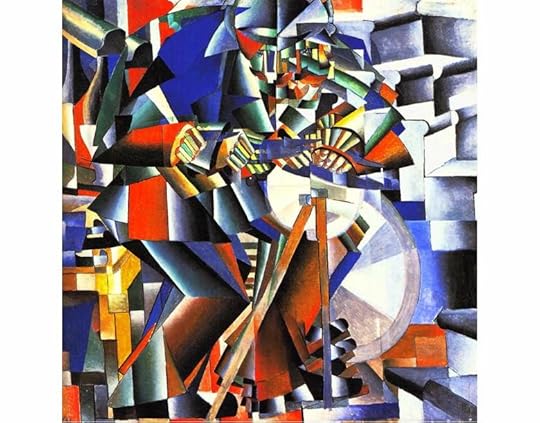
Then she proceeds reexamining “the death of God”, “nihilism” and "sublimation" apropos the creation of values.
Finally, she ponders on the Noon, the midday “shortest shadow” as associated to “beyond good and evil”. Truth and "nothingness" are approached as well.
Interesting essays.
*https://theculturetrip.com/europe/rus...
June 5, 2008
she made me a little depressed toward the end, but this is my favorite quote:
What seems like a megalomaniac aspect of most manifestoes should in no
way be read as shameless (subjective) arrogance on the part of the
artists themselves as individuals. Yet this does not mean that
statements are meant ironically; they are subversive precisely because
they are meant very seriously. Fundamentally, irony is simply an
assertion of the ego, and of its supremacy. Most avant-garde
manifestos go to great lengths to abolish the notion of the artist (as
the ego "who makes art"): they accomplish this not by means of irony,
but by substituting the subject-work in place of the ego. In other
words, the subjectivity that so vehemently affirms itself in
manifestoes is the art-object itself. Megalomania (or, rather, its
effect) is strictly correlative to the withdrawal of the ego. We are
dealing with the reversal of the freudian formula "Wo Es war, soll Ich
werden": "Wo Ich war, soll Es werden." Does the declaration in which
art is declairing itself (in the form of a manifesto) lack the real?
The point is that the declaration is part of the Real it declares.
This is why it cannot declare the event from the outside but, rather,
takes the form of r"I, the event, am speaking"
Take the example of the "event love," of an encounter that makes us
fall in love and, in this process, declare our amorous state. The
Real here is the very ground in which we stand when we are declaring
it, and this is what redoubles the declaration of love at its core. A
declaration of love is always a precipitated statement. It involves a
leap in causality not only in relation to the preexisiting situation,
but also in regards to its own begetting. The declaration love is a
precipitated statement that creates the condition of its own
enunciation and the conditions of the what it declares.
What seems like a megalomaniac aspect of most manifestoes should in no
way be read as shameless (subjective) arrogance on the part of the
artists themselves as individuals. Yet this does not mean that
statements are meant ironically; they are subversive precisely because
they are meant very seriously. Fundamentally, irony is simply an
assertion of the ego, and of its supremacy. Most avant-garde
manifestos go to great lengths to abolish the notion of the artist (as
the ego "who makes art"): they accomplish this not by means of irony,
but by substituting the subject-work in place of the ego. In other
words, the subjectivity that so vehemently affirms itself in
manifestoes is the art-object itself. Megalomania (or, rather, its
effect) is strictly correlative to the withdrawal of the ego. We are
dealing with the reversal of the freudian formula "Wo Es war, soll Ich
werden": "Wo Ich war, soll Es werden." Does the declaration in which
art is declairing itself (in the form of a manifesto) lack the real?
The point is that the declaration is part of the Real it declares.
This is why it cannot declare the event from the outside but, rather,
takes the form of r"I, the event, am speaking"
Take the example of the "event love," of an encounter that makes us
fall in love and, in this process, declare our amorous state. The
Real here is the very ground in which we stand when we are declaring
it, and this is what redoubles the declaration of love at its core. A
declaration of love is always a precipitated statement. It involves a
leap in causality not only in relation to the preexisiting situation,
but also in regards to its own begetting. The declaration love is a
precipitated statement that creates the condition of its own
enunciation and the conditions of the what it declares.
July 8, 2010
I enjoyed this because I love Nietzsche and have a weakness for Lacanian terminology (though not necessarily the correlative concepts). That being said, Zupancic's work is not too original or interesting. I sort of hate to make such an easy comparison, but she's like Zizek-lite: on page 68 she even repeats his argument about decaffeinated coffee & nonalcoholic beer nearly verbatim (an argument he makes in like every other book...note to self: never mention decaffeinated coffee around a Lacanian) and the reference to Bret Easton Ellis was also very Zizekian.
Overall, if you love Nietzsche and Lacan and wonder why they never get a sustained treatment together, then this book is for you. If you're looking for a superior philosophical work, then go read Z's "Sublime Object of Ideology" or "The Ticklish Subject".
Overall, if you love Nietzsche and Lacan and wonder why they never get a sustained treatment together, then this book is for you. If you're looking for a superior philosophical work, then go read Z's "Sublime Object of Ideology" or "The Ticklish Subject".

June 24, 2020
Nietzsche read along side Lacan, with Badiou thrown in here and there (who has a lot to say about both, and also seems to have influenced Zupancic's thinking on Nietzsche). I love what Zupancic achieves. Her writing style is very clear and concise, holding a quality of freshness that is easy to engage.
Through reading Nietzsche with Lacan Zupancic locates a novel aspect of Nietzsche's philosophy, which overall she has covered humanely and with great care—to a point where I think I can say I like Zupancic's Nietzsche best, even better than Deleuze's denser more schematical one.
The novel aspect is something which Zupancic admits, "in Nietzsche, has no concept." Instead what she is aiming at is what she sees as a "blind spot or dysfunction," a "stumbling block" that, according to Zupancic, Badiou misinterprets as the source Nietzsche's madness. She has instead located a new aspect, derived from Nietzsche's concept of midday, which he often described as the moment of 'the shortest shadow,' and also by the phrase 'when one turns into two.'
It is at this moment of the shortest shadow, she states, when a gap becomes visible and the Lacanian Real is exposed. The gap is the moment when one turns into two, and " the minimal difference of the same" is uncovered. This minimal difference, or "noncoincidence of the same," represents shifts in perspective, and in turn generate the locus of Nietzsche's philosophy of truth.
This fusion of Lacan and Nietzsche has given me a lot of insight into both. Zupancic is a very interesting, lucid, and digestible writer. She doesn't have very many books translated to English (though this one appears to not be translated), but I can't wait to scoop up more of her work.
Through reading Nietzsche with Lacan Zupancic locates a novel aspect of Nietzsche's philosophy, which overall she has covered humanely and with great care—to a point where I think I can say I like Zupancic's Nietzsche best, even better than Deleuze's denser more schematical one.
The novel aspect is something which Zupancic admits, "in Nietzsche, has no concept." Instead what she is aiming at is what she sees as a "blind spot or dysfunction," a "stumbling block" that, according to Zupancic, Badiou misinterprets as the source Nietzsche's madness. She has instead located a new aspect, derived from Nietzsche's concept of midday, which he often described as the moment of 'the shortest shadow,' and also by the phrase 'when one turns into two.'
It is at this moment of the shortest shadow, she states, when a gap becomes visible and the Lacanian Real is exposed. The gap is the moment when one turns into two, and " the minimal difference of the same" is uncovered. This minimal difference, or "noncoincidence of the same," represents shifts in perspective, and in turn generate the locus of Nietzsche's philosophy of truth.
This fusion of Lacan and Nietzsche has given me a lot of insight into both. Zupancic is a very interesting, lucid, and digestible writer. She doesn't have very many books translated to English (though this one appears to not be translated), but I can't wait to scoop up more of her work.

Read
July 30, 2025معجزهی حقیقی عشق -واین چیزیست که عشق را به کمدی پیوند میزند- عبارت است از حفظ تعالی در عین دسترسپذیری دیگری. یا با استفاده از واژگان دلوز: خلق یک مدار خنده-عاطفه، که اولی به یک تفاوت ناچیز اشاره دارد و دومی به فاصلهای بزرگ، بدون آنکه هیچیک دیگری را محو کند یا بکاهد
اگر ما با تناوب جاذبه و دافعه سروکار داریم، معنایی جز این ندارد که عشق به منزلهی والایش (تصعید) روی نداده، کارش را انجام نداده و حقهاش نگرفته است. معجزهی عشق قبل از هرچیز این است که دو ابژه (مضحک و والا) را در یک سطح ادراک کنیم؛ به علاوه، این یعنی هیچ یک از این دو ابژه جایگزین دیگری نمیشود یا دیگری را محو نمیکند. ثانیاً این معجزه مستلزم آگاهشدن از این واقعیت است که دیگری در مقام «ابژهی مبتذل» و دیگری در مقام «ابژهی میل» یکی و عین هماند... در واقع از این واقعیت آگاه میشویم که هر دو صورتهای ظاهرند، اینکه هیچکدام از آنها واقعیتر از دیگری نیست
اگر ما با تناوب جاذبه و دافعه سروکار داریم، معنایی جز این ندارد که عشق به منزلهی والایش (تصعید) روی نداده، کارش را انجام نداده و حقهاش نگرفته است. معجزهی عشق قبل از هرچیز این است که دو ابژه (مضحک و والا) را در یک سطح ادراک کنیم؛ به علاوه، این یعنی هیچ یک از این دو ابژه جایگزین دیگری نمیشود یا دیگری را محو نمیکند. ثانیاً این معجزه مستلزم آگاهشدن از این واقعیت است که دیگری در مقام «ابژهی مبتذل» و دیگری در مقام «ابژهی میل» یکی و عین هماند... در واقع از این واقعیت آگاه میشویم که هر دو صورتهای ظاهرند، اینکه هیچکدام از آنها واقعیتر از دیگری نیست
April 13, 2019
Fantastic book on Nietzsche written in the light of the thought of Lacan. The view of the two - as the beginning of multiplicity, as the challenge to be overcome and pressed into a single "truth".
The author clarifies the ideas of Nietzsche as those of Lacan - both known for insights impenetrable to newbies.
The author clarifies the ideas of Nietzsche as those of Lacan - both known for insights impenetrable to newbies.
January 8, 2024
I only read this because I was hankering for some Zupančič - I am not interested in Nietzsche nor do I know how to pronounce his name. Of course she did a great job demonstrating what his philosophy has to offer the dialectical materialist philosophy, but I still don’t care about him - I’m glad she did the work for me.
July 21, 2019
Probably the best book I've read on Nietzsche. Alenka writes with great intellect and pizzazz. Offers an invigorating insight into the philosophy of Nietzsche that even a layman can appreciate.
September 21, 2024
nietzsche would have hammered such lacanian nonsense.
October 22, 2024
really tough but interesting and valuable read! i almost felt like the conclusion was lackluster compared to the rest, but all in all it was worthwhile and i’m looking forward to her other books
June 28, 2026
Read:
- Introduction to Chapter Two
- Troubles with Truth
- Introduction to Chapter Two
- Troubles with Truth

June 9, 2024
Pleasant, heady.
Most important takeaways for me:
Forgetting as a substitute for forgiveness. That forgetting is more emancipatory from history/past than forgiveness. This connect well with Nietzsche’s essay On The Uses and Abuses of History and more fully emphasizes “forgetting” as a core Nietzschean concept. If history is a nightmare then memory is the bed on which we lay when the nightmare comes to us. (connecting Joyce and Borges to Nietzsche??)
Perception versus point of view. Perception-in-a-narrow-sense: that phenomenology must contend with the fact that the “self” is embedded into perception. There is no perspective without the phenomenological subject. I can imagine your point of view — what it looks like to see from where you are — but I cannot capture the meaning which the world reflects back into you. Like the Kantian aesthetic, perception demands both an object and gaze which cannot be replicated outside of the conditions of their occurrence.
Most important takeaways for me:
Forgetting as a substitute for forgiveness. That forgetting is more emancipatory from history/past than forgiveness. This connect well with Nietzsche’s essay On The Uses and Abuses of History and more fully emphasizes “forgetting” as a core Nietzschean concept. If history is a nightmare then memory is the bed on which we lay when the nightmare comes to us. (connecting Joyce and Borges to Nietzsche??)
Perception versus point of view. Perception-in-a-narrow-sense: that phenomenology must contend with the fact that the “self” is embedded into perception. There is no perspective without the phenomenological subject. I can imagine your point of view — what it looks like to see from where you are — but I cannot capture the meaning which the world reflects back into you. Like the Kantian aesthetic, perception demands both an object and gaze which cannot be replicated outside of the conditions of their occurrence.
June 3, 2012
Begins with a smart and innovative discussion of Nietzsche, but by the end of the book the conversation shifts its focus almost completely onto Lacan. Apart from the author's own sympathies, there was little in the text that prompted/defended this shift, and when the latter thinker eclipsed the former, I quickly lost interest. Worth reading the first section of the book, and perhaps the first chapter or two of the second, but unless you already approach this text with the idea these two thinkers belong together, you will likely not be persuaded.
July 23, 2021
Presents a version of perspectivism that makes clear the common ground rationalists could find with it (as opposition to letting skepticism have the last word). The analysis of comedy in the addendum, especially her apt commentary on Chaplin, make a (for the most part convincing) case that far from merely reducing events to laughability, comedy is implicitly conceptual in its exposure of the gap that divides appearance from itself.

February 3, 2008
Zupancic's extremely close reading of Nietzsche provides a new way of interpreting his work. Would be good to do a comparative analysis with Deleuze's influential book, Nietzsche and Philosophy.

to-keep-reference
March 14, 2016Sobre la crítica de Nietzsche al Parfisal de Wagner, ver Sobre la Violencia Pág.112

Read
November 4, 2025o.O O.o

June 25, 2017
Bir yari kavram olan Nietzsche'nin oglen dusuncesini hic, bir ve iki ile birlikte ele almasiyla, Lacan yorumlariyla, Zizek'in es gectigi bir cok noktayi acmis olmasiyla zaman zaman tekrar bakilmasi gereken bir kitap olmus.
Displaying 1 - 21 of 21 reviews