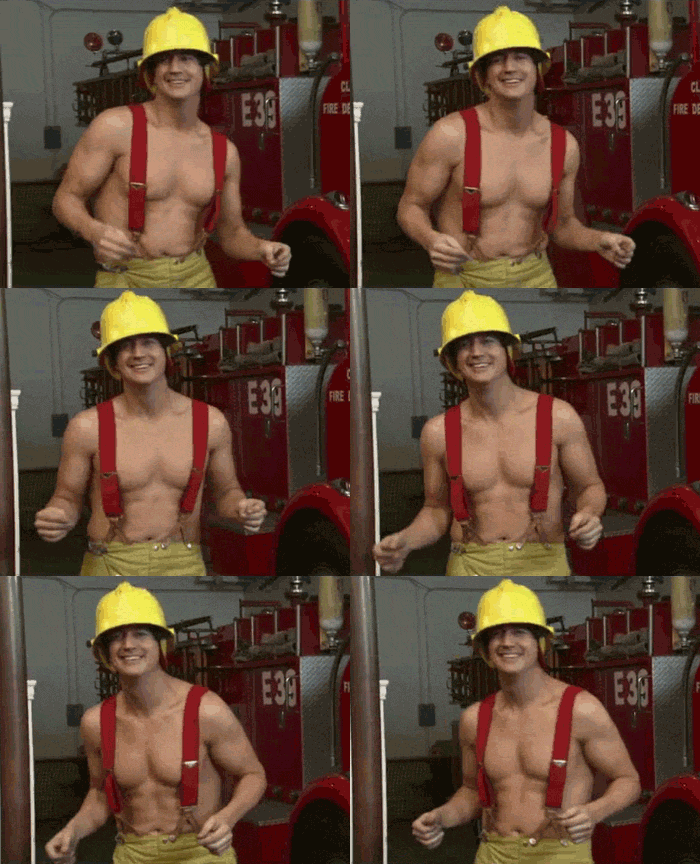
“It was first period and no kids were out now, the only time of day there wasn’t a flock of screaming, rioting, laughing, colliding children rushing about in sight of the health office. There was just the man, a guy in a baggy green army jacket and loose brown work pants, face in the shadow of a grimy baseball cap. He crossed the asphalt at a slant, coming around the back of the building. His head was down and he staggered, couldn’t seem to hold to a straight line. Harper’s initial thought was that he was drunk. Then she saw the smoke coming out of his sleeves. A fine, white smoke poured out of the jacket, around his hands, and up from under his collar into his long brown hair… Even from this distance, Harper could see something on the back of his hand, a dark stripe, like a tattoo, but flecked with gold. The specks flashed, like motes of dust in a blinding ray of sunlight…”
- Joe Hill, The Fireman
This happens at least once a year. No matter how hard I try to avoid it, how careful I am in the selection process, I always end up with a clunker of a book. Given how slowly I read – and the painful realization that a lifetime is not long enough to get to every worthy volume – I take these clunkers a bit too personally.
This year – quite to my surprise – my annual dud turned out to be Joe Hill’s The Fireman. This is doubly unfortunate, because I’ve really liked Hill’s other books, and because The Fireman is really, really long.
It also starts strong, which meant that by the time I realized my mistake, I’d already sunk too much time into it to quit.
***
The premise of The Fireman is simultaneously so dumb and so effective that it has to be reckoned a minor stroke of genius. A strange fungus is loose in the world. People infected by it develop markings on their skin called Dragonscale that eventually causes them to burst into flames.
When the novel opens, this fiery pandemic has just begun. The most immediate consequence – compelled by physics – is that fire spreads as long as it has fuel and oxygen. With a significant and growing population of human torches, cities, towns, and forests begin to burn. Then there are the side effects: fear, panic, hyper-religiosity, conspiracy mongering, and systemic breakdowns leading to societal collapse. In almost no time at all, governmental services have been replaced by roving Quarantine Patrols and Cremation Crews taking matters into their own hands.
Amid this chaos, a pregnant school nurse named Harper Grayson meets the titular “fireman,” who leads her to a community of infected trying to manage their condition, while remaining hidden from those uninfected who wish to kill them.
There are no shortage of books in the post-apocalyptic genre, and though I am a huge fan, they tend to share a lot of the same thematic elements. Altogether, though, The Fireman brought an interesting twist to a familiar landscape.
Unfortunately, Hill’s storytelling choices squander his somewhat-brilliant idea.
***
The Fireman is written in the third person, but it is a limited perspective, focused solely on Harper. Throughout this book’s 768 pages – with a couple exceptions – we only see things through Harper’s eyes. This structural choice had two important ramifications with regard to my enjoyment.
First, it takes an epic event – a global flame-demic – and drastically downscales it to a lone person’s knowledge and experience. To a certain point, I appreciated the fact that we only received information in bits and pieces, as it heightens the tension, and accurately reflects the choppy flow of dubious evidence that always attends big news events. However, this also forces Hill to rely on goofy literary devices – a hidden journal; long monologues – to tell us the things we need to know to understand the big picture. Furthermore, much of The Fireman is like a bottle-episode, taking place within the infected community Harper joins. It creates a kind of claustrophobia that’s fine at first, but quickly becomes tedious. The Fireman works best when it actually puts Harper on the move, allowing us to see how the wider world is dealing with the Dragonscale.
Second, it means that we have to spend all our time with Harper, and Harper is simply the worst.
***
Harper Grayson is not a human being so much as a collection of quirks assembled at a factory owned by Zooey Deschanel, Inc. She loves Mary Poppins, is obsessed with Julie Andrews, and carries a potato around in her pocket because Hill mistakes eccentricity for characterization.
To take just one example, Harper creates an album for her baby-to-be, filled with pictures and advice. Most people in the world are content to call this a baby book. But because Harper is not a woman, but a pathological fantasia from the Isle of Pretty-Pretty, she has to call it the Portable Mother.
This shouldn’t have bothered me so much, but God help me it did, and every time it got mentioned, it triggered my irritation. The Fireman answered an important personal question: How much twee can I ingest before becoming physically ill?
The answer: this much twee.
***
Aside: You might be thinking to yourself: that's a really small thing to get upset about. To which I say: It is! Book reviews are generally subjective feelings masquerading as objective truths. That is especially true here. Honestly, you shouldn't even bother using this to decide whether you want to read The Fireman or not. Just pretend you're my kids and ignore me.
***
Back to the review: Harper is also a fool, which is a more fundamental issue than her forced zaniness. One of the things required of people in apocalypses is growth. You have to learn to adapt, or you die. But not Harper. She saunters through Armageddon whistling supercalifragilisticexpialidocious.
Harper’s muddle-headedness is a symptom of Hill’s decision to anchor The Fireman to a single location, where drama has to be manufactured. To create any sense of propulsion – which shouldn’t be a problem in an end-of-the-world scenario – Hill forces Harper to make a mind-boggling series of unconsidered decisions, just to keep things moving. Her choices are internally inconsistent and generally free of coherent motivation. In short, the deadliest infection that Harper faces is plot-derived stupidity.
Of course, as the headliner, she also is given Kevlar-tough armor that assures she will never have to pay for her choices.
***
At the risk of belaboring the point, even Hill seems to recognize that it was a mistake to run everything through Harper’s viewpoint
About two-thirds of the way through, there is a big set-piece scene with a lot of moving pieces that simply couldn’t work if it was narrated through the senses of just one person. To work around this, Hill essentially breaks the fourth wall to explain why he is abandoning the heretofore established Harper-centered perspective. Once the scene is over, he quietly returns to it.
It’s a total cheat, and Hill knows it.
***
Obviously, Harper didn’t work for me. Alas, the characters surrounding her are no better. They are all-or-nothing types, either good people or bad people, or good people who turn instantly bad when necessary, or bad people who turn instantly good when convenient.
The end times are a grand stage in which to explore ethical gray areas, but Hill is not interested in that. There is an X-Men-like vibe in The Fireman, in which the infected people are the heroes, while the villains are those who are hunting them down. This might have proven fascinating. Regrettably, Hill makes every healthy person into an unthinking rage-monster, apparently killing out of sadistic glee rather than understandable fear.
Instead of exploring a complex moral universe, Hill becomes increasingly fixated on the nature of Dragonscale, which he explains, overexplains, and then over-overexplains. Without venturing into spoiler territory, Hill injects elements of science-fiction and fantasy, pushing The Fireman across the line from plausible-enough to absolutely silly.
***
Once it dawned on me that The Fireman wasn’t working, I admittedly became hypercritical, noticing things I otherwise might have ignored. I actually had a running list of annoyances – starting with characters who laughed at inappropriate times – but I’ll spare you. Every writer has tics, and it’s churlish to point them all out. You might – and probably won’t – even notice them.
That said, I cannot help noting that there are at least two moments in The Fireman in which the bad guys – on the verge of winning – stop to fully explain the intricacies of their schemes, thereby giving the good guys time to flip the script. It’s stunningly beneath the level of Joe Hill’s talent.
***
The Fireman is a book that has been generally well-received, and this is a minority report. I found it to be a contradictory work. It starts out ambitious, but ends up confined. It unfolds a vast canvas, and then paints only a corner. It raises a lot of questions, but only gives answers to the least interesting ones.
More than that, Joe Hill places a big bet on Harper. For well over seven-hundred pages, she is asked to carry the entire burden. What you think of her ultimately determines what you think of The Fireman.