

What do you think?
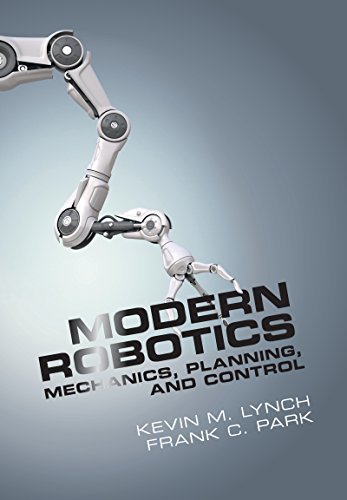
Modern Robotics: Mechanics, Planning, and Control
This introduction to robotics offers a distinct and unified perspective of the mechanics, planning and control of robots. Ideal for self-learning, or for courses, as it assumes only freshman-level physics, ordinary differential equations, linear algebra and a little bit of computing background. Modern Robotics presents the state-of-the-art, screw-theoretic techniques capturing the most salient physical features of a robot in an intuitive geometrical way. With numerous exercises at the end of each chapter, accompanying software written to reinforce the concepts in the book and video lectures aimed at changing the classroom experience, this is the go-to textbook for learning about this fascinating subject.
544 pages, Kindle Edition
Published May 25, 2017
Ratings & Reviews
Friends & Following
Create a free account to discover what your friends think of this book!
Community Reviews
Displaying 1 - 5 of 5 reviews


June 22, 2026
I only had access to the free preprint version of this book, which is publicly available online. I studied it rigorously in a self-directed effort to learn robotics from scratch.
My opinion after reading seven chapters is that it is definitely not a great book. Granted, it helps you understand where to start and how to navigate the topics, but if you really want to dive deep into the material, the book severely lacks mathematical depth. I constantly found myself asking ChatGPT, Gemini, and Copilot about the math behind the formulas, and you would be amazed by how much is missing. While I did not expect the book to fully derive every mathematical concept, it was still necessary to address the implications of the underlying math, because it heavily influences how we understand the relationships between different concepts. At least, that is my opinion.
Another serious problem I encountered was the book's outdated notation. I only realized this months after starting it, specifically when I was trying to understand the relative motions of different joints in a robot. As I searched the web further, I found myself confused by the notation used by other resources. Delving deeper, I realized that the older convention used in this book fails to deliver the clarity needed to clearly define relative motions—expressing them in frames rather than spatial or their own body frames. You can easily verify this by asking any AI agent.
I do not know if the notation issues have been resolved in the final published version, but I doubt the core material has changed much, meaning the lack of mathematical depth remains a serious flaw.
P.S. Like many others, I started this book alongside the Coursera series, but the videos were simply too short and held little pedagogical value for me. After all, I am a math guy—I need to know what is really going on.
My opinion after reading seven chapters is that it is definitely not a great book. Granted, it helps you understand where to start and how to navigate the topics, but if you really want to dive deep into the material, the book severely lacks mathematical depth. I constantly found myself asking ChatGPT, Gemini, and Copilot about the math behind the formulas, and you would be amazed by how much is missing. While I did not expect the book to fully derive every mathematical concept, it was still necessary to address the implications of the underlying math, because it heavily influences how we understand the relationships between different concepts. At least, that is my opinion.
Another serious problem I encountered was the book's outdated notation. I only realized this months after starting it, specifically when I was trying to understand the relative motions of different joints in a robot. As I searched the web further, I found myself confused by the notation used by other resources. Delving deeper, I realized that the older convention used in this book fails to deliver the clarity needed to clearly define relative motions—expressing them in frames rather than spatial or their own body frames. You can easily verify this by asking any AI agent.
I do not know if the notation issues have been resolved in the final published version, but I doubt the core material has changed much, meaning the lack of mathematical depth remains a serious flaw.
P.S. Like many others, I started this book alongside the Coursera series, but the videos were simply too short and held little pedagogical value for me. After all, I am a math guy—I need to know what is really going on.

May 28, 2021
an alternative for fundamental of robotics "Introduction to Robotics" by John J Craig

December 8, 2023
Thank you
December 28, 2025
Fantastic breadth-first coverage that I would recommend to any upperclassmen engineering student
Displaying 1 - 5 of 5 reviews