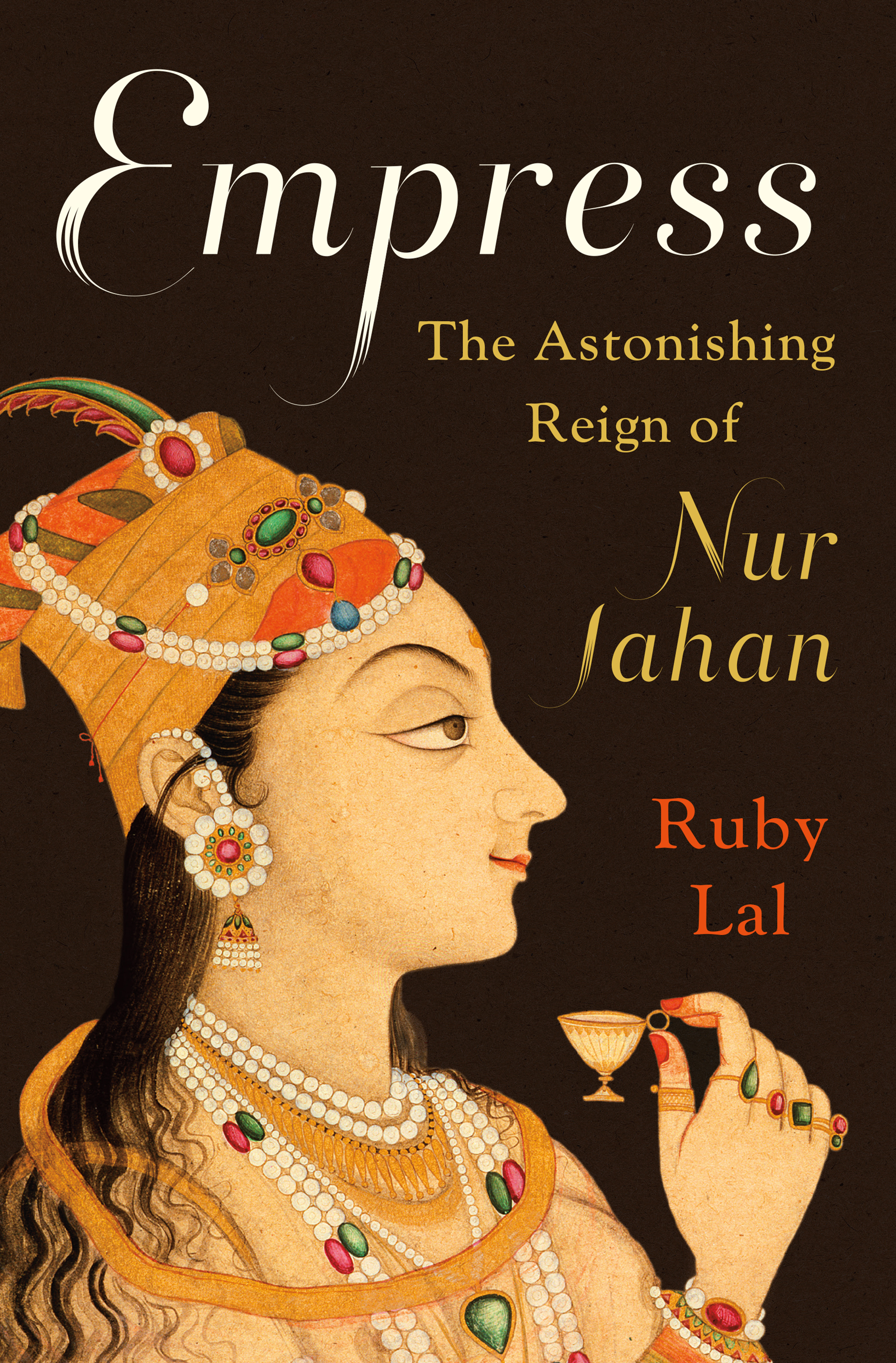
Four centuries ago, a Muslim woman ruled an empire.
When it came to hunting, she was a master shot. As a dress designer, few could compare. An ingenious architect, she innovated the use of marble in her parents’ mausoleum on the banks of the Yamuna River that inspired her stepson’s Taj Mahal. And she was both celebrated and reviled for her political acumen and diplomatic skill, which rivaled those of her female counterparts in Europe and beyond.
In 1611, thirty-four-year-old Nur Jahan, daughter of a Persian noble and widow of a subversive official, became the twentieth and most cherished wife of the Emperor Jahangir. While other wives were secluded behind walls, Nur ruled the vast Mughal Empire alongside her husband, and governed in his stead as his health failed and his attentions wandered from matters of state. An astute politician and devoted partner, Nur led troops into battle to free Jahangir when he was imprisoned by one of his own officers. She signed and issued imperial orders, and coins of the realm bore her name.
Acclaimed historian Ruby Lal uncovers the rich life and world of Nur Jahan, rescuing this dazzling figure from patriarchal and Orientalist clichés of romance and intrigue, and giving new insight into the lives of women and girls in the Mughal Empire, even where scholars claim there are no sources. Nur’s confident assertion of authority and talent is revelatory. In Empress, she finally receives her due in a deeply researched and evocative biography that awakens us to a fascinating history.
Ruby Lal is professor of South Asian history at Emory University. She is the author of Empress: The Astonishing Reign of Nur Jahan, Domesticity and Power in the Early Mughal World, and Coming of Age in Nineteenth Century India: The Girl-Child and the Art of Playfulness.
I was not impressed with this biography. The author insists that as a feminist historian she’s able to make use of traditionally overlooked sources in writing this biography of Nur Jahan, who despite being the 20th wife of Mughal emperor Jahangir and the fact that the couple had no children together—she married him in her 30s, with one daughter from a prior marriage to an official killed while being arrested for treason—rose to exercise royal prerogatives herself, such as issuing coins bearing her name. Clearly Nur Jahan had a fascinating life, but this book doesn’t provide much more than an overview. Not long ago I read Daughters of the Sun, itself an imperfect book and one that races through the lives of dozens of Mughal women in just 250 pages, but its single chapter on Nur Jahan covers nearly everything that’s in this 225-page volume. (The rest is endnotes etc.) In the end I had the sense that there just weren’t enough sources to put together a picture of Nur Jahan’s life outside of the bare facts.
So instead, Lal speculates a lot, and I don’t mean the kind of informed speculation historical biographies necessarily engage in to some extent, but passages like this, on the relationship between Nur and her first husband, about which no documentation exists:
“He would appreciate her curiosity and innate intelligence. Rather isolated in the eastern provinces, he would be likely to lean on her and discuss matters of trade, taxes, public grievances, the particulars of his visit to Rajmahal, and news from the Mughal court.”
And later:
“Jahangir had likely discussed with Nur whether to send Khurram to Mewar as commander in the first place. The emperor certainly would have consulted Nur’s father and older brother, his chief advisers, about the matter, and it’s not a stretch to imagine Nur, the trusted and admired wife, as part of the conversation.”
Perhaps not, but we read biographies for facts, not imagination, right?
Meanwhile, perhaps because the record is so sparse, there’s a lot about official occasions including lists of gifts people presented each other, etc. The worst is when the speculation and the excessive detail about state occasions combine into a vortex of worthless words:
“Under ordinary circumstances, as the bride’s mother, Nur would have been by Ladli’s side during the wedding ceremony. But she was also the Mughal empress. The emperor and empress likely sat together on a gold-embroidered divan, with Nur on the right, at the helm of the gathering. Hangings embroidered with silken gold threads and strings of pearls surrounded the divan, and Persian carpets covered the floors. The older women like Harkha and Asmat would have sat beside Nur. Slightly behind them, on cushioned divans, would sit Nur’s sisters, Khadija and Manija; the wives of her brothers; her niece Arjumand; and other women of Ghiyas’s extended family. And perhaps in a smaller section, Ladli would be surrounded by women friends and relatives and Dai Dilaram, tucked away from the public eye. On Jahangir’s side, Shahryar, the princes, Ghiyas, Asaf, foster brothers, distinguished nobles, and officers would all be positioned according to rank. Musicians and sweet-voiced reciters performed wedding poems and songs. The qazi, the officiating cleric, finally pronounced the words of marriage.”
I could see (just barely) describing the seating arrangements at Nur’s daughter’s wedding if this were one of the few things recorded about her, but as it clearly wasn’t, why are we talking about it?
Meanwhile, the author is selling Nur hard as this amazing woman, in sometimes unconvincing ways. Lal argues for instance that Nur’s edicts were groundbreaking compared to those of other Mughal princesses, which covered “very small local matters,” but then the only such edict discussed specifically is ordering some raja to have one of his officials pay his debt to one of her officials, stat. Which, while hardly the act of a shrinking violet, still seems minor in the scheme of things, only affecting a couple of people. And Lal expresses disdain for male commentators who in her view blamed Nur for sowing dissension simply because she was a powerful woman… but in Lal’s own telling it seems Nur did sow dissension, in that she transferred her allegiance from Jahangir’s heir presumptive, Shah Jahan, to the more malleable younger son to whom Nur married her daughter. This ultimately culminates in fighting and death, and Lal posits that Nur did it just to maintain a hold on power after Jahangir’s death, but also seems okay with it? Overall it’s one of those works that can’t seem to bear passing any negative judgment on a woman who was powerful and ahead of her time.
So, overall, I found this book to be rather hagiographic, non-specific and dull. However, that said, it isn’t the worst biography ever. The author is at least clear on when she’s speculating, cites her sources, and it’s readable and short. And Nur Jahan is certainly a historical figure worth writing about. Perhaps if I hadn’t already had most of the information from Daughters of the Sun I would have found it more interesting. But I wouldn’t recommend it.
The only biographies I read are ones about women in history, the more ancient the better. I was so prepped to like this one, as I know virtually nothing about the Mughal Empire, and had never even heard of Nur Jahan. She sounds great! She become Jahangir's favorite wife despite never bearing him any children, which is usually pretty important for rulers. Unfortunately, this reads more like a quick overview of Mughal rule for a certain time period than a biography of Nur Jahan. I know more about the type of person her husband Jahangir was than anything about her. I understand that with any historical figure this far back in history, it's hard to find sources. And since the Mughals were a very patriarchal society (keeping women in harems) it makes it even harder to find information about what the women were doing. In addition, Nur Jahan's stepson, who was emperor after Jahangir, also did not want Nur mentioned in the records. So I totally understand the why there's a real lack of information on Nur. Regardless, it's just not a fun biography to read. Nur does maybe one thing of note, even though the author continually expresses how incredible it was to have a woman have so much power, we don't really get to see the power. We get to hear about what Jahangir and his sons are doing, and endless descriptions of gifts people give to each other.
An aside, the author dedicates one sentence to the bubonic plague sweeping through the empire. Seems like maybe that could have been an interesting topic!
The only reason I kept reading is because the author kept making references to Nur's power and influence, and decisions she made, and I thought at some point I'd get to read about those decisions. The book seems well-researched, there's over 100 pages of notes and sources, so I guess I just have to complain that the Mughal historians of old did not adequately document Nur's life, which is a huge shame.
Born to refugee parents from Persia during their trip across Afghanistan to Mughal-ruled India, a girl named Mihr would not have seemed to have a glorious future. Her father sought a position in the Mughal court where Persian was the language of government and numerous Persians already worked. This book tells the story of how this girl rose to be the twentieth wife of the Mughal emperor Jahangir, son of the great Akbar. She not only became empress, but outshone and outmaneuvered all the other wives to become the emperor’s closest advisor and confidant. Such a position was extremely rare in Islamic history and in most other parts of the world as well. Mihr was given the name “Nur Jahan” by Jahangir himself. It means “Light of the World”. She faded into obscurity when the emperor died in 1627, but has been remembered amongst the people of the subcontinent ever since. Numerous tales, true and fanciful, are told about her to this day and her tomb still stands outside Lahore.
The details of Nur Jahan’s life are not that easy to come by. Ruby Lal must have scoured the world for every single source and for that I’ve got to hand it to her. The story is a fascinating one—how this woman managed, in an extremely patriarchal society, to become the co-ruler of one of the world’s largest empires at the time. Despite opposition, she controlled decisions in financial, military, and diplomatic affairs. She was also a crack shot, killed tigers, and engaged in at least one military battle, being slightly wounded. At the same time, she had to maneuver in the endlessly changing power struggles within the court, among the vast family that made up the Mughal dynasty. She backed her husband loyally, but favored a lesser son for successor, thus earning the enmity of the ultimate winner, Shah Jahan.
India, like Europe, was ruled by a myriad kings and princelets. The Mughals were a basically foreign dynasty advancing their control over two centuries. The Mughals’ assistants in this process were largely Persians or Central Asians, though they allied themselves with various Hindu rulers over time. This aspect—their foreign-ness—is totally absent, as are the Hindu denizens of the subcontinent. The author plumped for a narrower picture—and she has drawn it very well—but she neglected the framework of how they fit into India. What was Nur Jahan’s relation to India, then and now, over and above being a Mughal ruler? You will not find out. Family intrigue, her rise and fall, her brothers, her father, her mother—these are paramount. A second objection I have is that I think a historian should be removed from her subject to some degree. I felt that Lal was actively promoting (boosting) Nur Jahan because she felt that this empress had been downplayed or neglected by historians who didn’t give enough credit to an exceptionally brave and intelligent woman. That is no doubt true, but constant insisting on the fact tends to provoke weariness of being told yet again. I think the facts do speak for themselves. I would say the same of male historians who make heroes of their subjects. I’m afraid I’m not a believer in heroes, male or female. And finally, I found a few factual errors, which don’t detract from the very well-written text, but do make me wonder how many others there might have been. For these reasons I’ve only awarded three stars. All in all, though, this is a most readable study. It might not be at the top of the academic scale, but is well-worth the time if you haven’t come across much on Mughal India before.
Empress by Ruby Lal is a wonderfully researched and well-written book on Nur Jahan. It is perhaps not for all to read. There are those biographies that are more empathetic, but not Empress. Lal has managed to give us a clean and clear picture of the times Nur Jahan lived. Nur's life and her impact on those who came after her time are documented with aplomb. Painting a picture as close to reality as could be is a daunting task. Ruby Lal has done her best and has also included some notes for the reader. If this book reads like an academic paper, I figure it was meant to be so. Lal really did not cross the line when it comes to romanticising the subject of her research.
Bottom line first. This may be all that we can know about a demonstratively exceptional and unlikely Empress. But not a. exceptionally well told biography.
I came into Empress: The Astonishing Reign of Nur Jahan by Ruby Lal wide-eyed and ready to be wowed. An ancient Moghul/Muslin empress who held executive authority at a time and place where this was almost unknown, if not impossible. Further it is a bio by a woman scholar, freed from both old school scholarship and male perspective. Clearly there is much to admire about Empress Nur Jahan and Professor Lal as a scholar. In their defense, there is very little in the written record about this great woman. Much of her achievements were edited out from the contemporary record for reasons political as well as sexual. In the end the writing is not as exceptional as the subject.
I like several women readers found the writing to be mundane. My first clue that something was missing was in the fact that it would take almost half f the book, it is only 240 odd pages just to get the Empress in place to wield authority. Historic context and court politics had to be established, but half the book gone gives little time to speak of what she did, or how she ruled. Based on one tiger hunt, and one (lost battle) we are told about how great she was in matter military and hunting. Told. That seems to be the main technique. Tell us often that the Empress was exceptional and there need be no, or not many examples. Of her work in designing gardens and memorials, much of the evidence still stands. We have to accept that as an Empress, she took lead in the designing and directing, but we are hustled into that conclusion with decidedly little time given to the possibility that she gave her general preferences to a design team who did what they did and sold her on it.
Professor Lal admits that Empress Nor, shared power with an Emperor, Emperor Jahangir who was a heavy drinker and drug user. Further he was more interested in things spiritual and artistic than governing a historically militant empire. Further Nor’s family, father , brother among others, held, between then massive amounts of political power. It barely allowed that these things could have opened to Nor opportunities to exceed he role as wife number 20. Had she weak powers of reason, poor skills in handling the many intrigues of court and harem politics she could never have achieved her position. But we are mostly asked to accept what we are told rather than asked to judge specifics. What is missing from the record is replaced with things conjectured from nontraditional sources, or skipped in favor of more insistence that what is missing was extraordinary. .
Much is made of how women could aid each other from within the harem. Almost nothing is made of the degree to which fighting within the Harem and among the harem attendants could make life terrible, even dangerous for Nor who would arrive as a stranger, and achieve no status as the mother of a possible heir. This part stuck out as a feminist determination to downplay how women can work politics, especially the politics of imperial succession.
Empress Nor achieved her status as favorite wife over the corpse of her first husband, a senior member of a violent coup attempt. Her force retirement came at the end of another. In the first she lucked into history. In the last she was beaten down by her inability of maintain against the intrigue in which she was an active intriguer, and the sexual politics that was gathering in its resentment of a too visibly active woman.
I took my time with this book but it is a great read and honestly one of the most comprehensive biographies of my favorite historical figures. Ruby Lal is also open about how much we don't know about Nur Jahan (I've read a lot of purported history books where assumptions/theories are presented as definite fact).
Empress Nur Jahan is the most colourful figure in Mughal history. Born Mihr un-Nissa as the daughter of a middling Persian noble in Akbar’s court, her destiny turned for the marvelous with her second marriage to Emperor Jahangir. The queen’s exceptional intellect and ability prompted Jahangir to elevate her to the title of co-sovereign. Nur Jahan’s tales still lift up the spirits of Indian womanhood. Hers is a household name in South Asia. She has been the subject of many movies, plays, opera and historical romances. In a strictly patriarchal society like India, it is not an easy matter for even daring men to progress much far in their career. The advent of a woman is still stranger and not repeated often. After Nur, it took 350 years for another woman to ascend the heights of such power in Indian statecraft – Indira Gandhi. Ruby Lal is a historian of Mughal India who has authored two other books on the topic. She teaches at Emery University and divides her time between Atlanta and Delhi.
Lal claims herself to be a feminist historian and imparts many facts about the status and condition of imperial women in early Mughal history. The Mughals were a peripatetic dynasty in the beginning which offered much freedom to its womenfolk due to the practical difficulties of effectively sequestering them while on the move. The situation changed during the reign of Akbar who declared that women of the royal household were to be segregated in a well-ordered, high-walled harem. The movement of the sequestered women was restricted and rules governed who could visit them and who could not. Still, they exerted much freedom as seen in Akbar’s aunt’s pilgrimage to Mecca. Even though they were secluded, senior women in the harem were called upon by the emperor for counsel on matters of diplomacy. They were also instructed accordingly in the best traditions of the Mughal state. They used to read the treasured manuscripts kept in the confines of harems and enjoyed them.
Lal proceeds to narrate Mihr un-Nissa’s birth and her entry into adulthood with her marriage to Ali Quli, a courtier in Akbar’s entourage. She had had a good education against the injunctions of moral preceptors. We see this pattern throughout the world. There are wide variations in the implementation of the commandments in moral codes. Often, these literal advices go into extreme depths and we would be in serious error if we assume that the people of that time fully acquiesced and put in place such commands. According to the Akhlaqi-Nasiri, girls should be prevented from learning to read and write. The Qabus Nama, another guide to good conduct, declared that it was best for the girl not to come into existence at all, but being born, she had better be married or buried. But still, individual families did as they pleased and enlightened fathers taught their daughters to read and write.
Popular legends claim that Jahangir knew Mihr un-Nissa even before her first marriage and tried to obstruct the wedding to Ali Quli who served Akbar and later Jahangir. But Akbar intervened and overruled him. After the wedding, Quli was sent to Bengal where the couple stayed for many years. The author does not pass her judgement on this issue and stays neutral. So it is also likely that Jahangir didn’t know the girl till much later. Anyhow, Quli had the misfortune to associate with the losing party in the succession struggle between Jahangir and his son Khusraw. Whether Jahangir had coveted his wife or not, Ali Quli was killed on Jahangir’s orders for siding with Khusraw. Mihr un-Nissa returned to Agra upon becoming a widow and married Jahangir after a few years later at the age of 34.
Jahangir used to maintain a journal called Jahangirnama to record the noteworthy events of his reign. There are no entries on Nur Jahan till three years after their wedding. After that, he paints an admiring portrait of her as a sensitive companion, superb caregiver, accomplished adviser, hunter, diplomat and aesthete. No other Mughal record gives such a rich and full depiction of a royal woman. She was elevated as a co-ruler and coins were struck in the joint name of the royal couple. However, she was not given the other mark of sovereignty – reciting the Friday prayers in the congregation mosque in her name. That would have been bending the rules to the breaking point.
The book dutifully narrates Nur Jahan’s fall from grace, which was expected in the complex web of Mughal family relations and machinations of power. Jahangir always desired Shah Jahan to succeed him. In the early years of her reign, Nur Jahan also supported him as a capable prince. However, Nur had a daughter named Ladli Begum from her first marriage who had to be settled in life with a suitable alliance. Shah Jahan was already married to ArjumandBano, Nur’s own niece. Polygamy was the rule rather than the exception, but Shah Jahan was intimately attached to Arjumand for whom he would later build the Taj Mahal. It was clear that Ladli would be relegated to a junior position in the harem. Nur Jahan then selected Shahryar, Jahangir’s son from another woman and propped him up as a contender for the throne. This stung Shah Jahan into rebellion. He was routed in the early battles, but his father-in-law Asaf Khan, who was also Nur’s brother, handled the power vacuum after Jahangir’s death exceptionally well and enthroned Shah Jahan as the king. Nur was permanently eclipsed from power and she settled at Lahore, planning and constructing Jahangir’s mausoleum. As the break with the throne came about, condemnatory statements on her character and the dangers of her womanly wiles began to emerge. In the absence of a man in whose name she could fight and with no nobles or family members supporting or celebrating her imperial service, her fall was swift.
The book, coming from a self-professed feminist historian, is ideal for light reading. No new facts are revealed in this book. Lal exhibits a tendency to get carried away by the gravity of events she describes and comes up with fanciful descriptions of royal weddings that looks uncannily similar to modern elite marriages. In the epilogue, she states that ‘Islamic history is full of powerful women’ and cites Borte, the senior consort of Chingiz Khan as one of the examples. This is unfortunate as both Chingiz Khan and Borte were not Muslims. Such a grave slip is incredible on behalf of a professional historian.
Well researched but fell a bit flat in execution. It felt as though Lal tried to cram every little detail of research into the book and connected the dots by inserting her own imaginative speculations - read: lots of skippable details without impactful ones. Appreciate the research and effort into this book though and totally understand how titanically difficult the task of writing such a biography could be. Also finding it hard to see (in this account) what if any hardships or struggles Noor Jehan truly overcame that would’ve made her legacy more magnificent and impressive. Seemed like a lot of things were simply handed down to her one way or another. Not discounting that she must’ve been a talented person nonetheless but didn’t come across as impressive going by this account alone.
I thought this would focus on her but I suspect due to limited sources the author had to use a lot of evidence about Nur's spouse in order to discern what Nur was doing. Unfortunately, this makes for a biographer where she is not much spoken about.
After a good introductory chapter, this book lost ALL its steam. This story would be a wonderful Nat Geo or Smithsonian article. It doesn’t warrant 240+ pages.
i’ve been wanting to read more about nur jahan for a long time and this book was such a good introduction to that. though it was a historical biography, it was written in a way that felt literary and current. another non-fiction towards my goal 😻
Dr. Lal's biography of Nur Jahan could be to an artist or writer what Ron Chernow's biography of Alexander Hamilton was to Lin-Manuel Miranda. Too many historians have diminished the accomplishments of truly extraordinary women and I'm so glad to live in a time where new lenses are re-examining historical figures that have been undersung or diminished by biased narratives. Many hear of Nur Jahan as the woman who stole an Emperor's heart, but she was a phenomenally educated, ambitious and accomplished woman in her own right.
I love the moments where Dr. Lal hasn't censored herself from sharing what she imagines with the wealth of knowledge she has guiding that imagination. It's a beautiful way to write a reference book for insuring the next generation of artists jump from these pages to new and improved storytelling about Nur Jahan, the first and only female co-sovereign of her time.
My one great frustration with this book is one of coverage; an enticing allusion that Nur Jahan was wearing a fabric she'd invented left me wishing for a chapter on that instead of a sentence fragment. Did she invent many things? Was she a renowned weaver or seamstress? It reminded me of a painting I saw when I was ten years old; an opening in a wall and a garden beyond. I leaned, hoping I could see more, when I could only see what was painted in the opening. While that was cruel in its lack of detail, some of the men's politicking left me wishing it'd been summarized in something shorter than a full chapter. In the end though, those longer chapters helped provide context for the various decisions Nur Jahan made and the alliances she formed.
Over all, the book is a wonderful look at the verifiable facts of Nur Jahan's life and helps clarify contemporary and post-humous embellishment (perspectives local and abroad) from what we actually know happened from reliable sources. Recommended! Would make a great read for Women's History Month.
The Light of the World has returned. Nur Jahan Begum is the history of India. She was a Shia married to a Sunni Muslim who was also half Hindu Rajput. Further, Nur Jahan is the only woman ruler among the great Mughals of India. Nur’s life history shows her dynamism and boldness. However, there is a very long history of the erasure of Nur Jahan’s power that Lal has brilliantly restored.
When it came to hunting, Nur Jahan was a great tiger huntress with a master shot as depicted in a classic portrait that shows her tamping down the gunpowder in a musket. She designed gorgeous gardens and the tomb that became the model for the Taj Mahal itself. She was an accomplished soldier, planning the operation that rescued her husband from a kidnapping. Remnants of imperial orders issued by her, coins minted in her name, paintings that paid homage to her sovereignty and bravery are all evidence of the powerful figure Nur was.
Renowned historian Ruby Lal uncovers the rich life and world of Nur Jahan, restoring her full splendor in the process. Lal has not only rescued this dazzling figure from patriarchal clichés of romance and intrigue, but has also given new insights into the lives of women and girls in the Mughal Empire. In this revisionist feminist biography, Nur Jahan finally receives her due in this deeply researched and evocative biography that awakens us to a fascinating history. This page-turning, eye-opening biography shatters our impressions of India and is an imperative, indispensable, and integral masterpiece that must be read.
What makes Ruby Lal’s account of Nur Jahan stand out is the personal touch she has added to this retelling of history. Her admiration for the Mughal queen, and how the interest was kindled at an early age, is a fascinating read. Having read only accounts of male Mughal rulers in our textbooks, this remarkable narrative of India’s female ruler four centuries ago is commendable indeed.
Lal’s book is not just a biography of Nur Jahan, but also a commentary on the sixteenth century Mughal India. At a time when romeo squads are beating up couples in New India, upper caste parents don’t dither killing their child for falling in love with a dalit, and universities offer courses on how to become an adarsh bahu, Nur Jahan’s ascension to power is a lesson that needs attention.
I really, really enjoyed this. The abundance of detail was a little daunting to wade through at first but it helped to establish context. Lal refrains from making assumptions she can't prove and tries to present a coherent timeline of Noor Jahan's life. Learnt so much from this book.
There was a time in my life when I thought that being fully immersed in the milieu that puts out works such as this for the general public would be the best way of ensuring that I would be able to live with myself and my actions for as long as possible. These days, I'm more of a generalist when it comes to the whole question of literary underrepresentation, and thus don't treat with the word 'feminism' as fervently as I used what, with all the cloying simplifications and underlying bigotry wrapped up in the conventional sense of the word. I am also sickeningly aware of the mechanics of academia under capitalism, and thus have a hard time enjoying even the most socially conscious piece if certain aspects of it were obviously put into place for the sake of that passive aggressive cash grab known as tenure. In the case of this work, I appreciate the author's efforts, to the point that I'm rather keen on seeing where she decides to go next in her publications. However, this piece is poorly put together in some places and pure conjecture in others, and the eighty pages of endnotes tacked onto to the end of an already well spaced out narrative made the whole thing feel like a rather interested academic query padded to hell and back for the sake of that coveted spot on the next Book Riot list. As such, I did enjoy what I got, especially when it came to filling in the gaps of my knowledge. However, this work could have used more time, a more stable frame of analysis, or at least something that didn't leave it wide open to sustained academic criticism, if not outright attack.
Tamberlaine (Timur), Genghis Khan (Chinggis Khagan), the Taj Mahal: Europeans have certainly cherrypicked their fill from the richness of a vast empire-spawning sociocultural richness, with those three aforementioned names easily spanning from the 12th century to the 17th. In light of that, I can't fault Lal for feeling not only permitted, but encouraged to take the typical reader likely to pick up her work to task and expose them to as many major tendrils of location, historical point, theological perspective, and cultural aspect as she could infuse her chosen subject's narrative with. Indeed, had the writer been able to hold it together to the end and phrased her hypotheses a tad less flippantly, this would be an excellent starting point to many an autodidact's delving into a history that is neither West European based nor East Asia derived, but something on the margins of each that, had it not existed, would have left its two compatriots the poorer for it. However, in addition to the flaws mentioned above, there was a feeling of the argument dawdling too much at the beginning and rapidly speeding up at the end. Of course, this is somewhat understandable given the availability of material when contrasting the contextualization of Nur Jahan in her wider culture at the beginning with the cold hard facts of the end of her life in the conclusion. Still, this, alongside a more casual style of argument and an expected yet still rather distracting distance from the biography's purported subject through the actions and records and presences of many a male supporting cast member, often made for an unfocused reading. All in all, I appreciate the work Lal did, I really do. I just think she should have spent more time doing it, rather than repeatedly stopping to explain that not only that we readers should appreciate it, but for what specific reasons.
Another day of reading, another revelation that what I know is but a grain of sand in the beach of the universe. In any case, for whatever reason, I've been on a nonfiction kick this year of 2023, and it's given me the opportunity to compare and contrast a number of styles of presenting the 'facts' in an 'objective' manner and observing what works and what doesn't. I have my own biases of course, but after decades of schooling and an ongoing career path devoted to promoting critical literacy, I'd like to say I have some sort of professional handle on the difference between credibly presenting an argument and bullshitting your way via words, words, words. Lal's earnestness blurs the line between the two more often than I feel comfortable awarding a higher rating to, so all I can say is that she takes what criticism she receives (that doesn't fall into the category of sealioning/hate speech/other forms of status quo bootlicking, at any rate) and applies it to her next project. For her area of expertise is not the one that will most easily make the NYT bestseller lists, and who knows what breeds of self-absorbed hate would be disabused of their illusions of being the norm were this sort of information promulgated as widely as the latest treatise on the Eiffel Tower or the latest rhapsody on those war criminals known as US presidents.
"Empress: The Astonishing reign of Nur Jahan" by Ruby Lal depicts a story of the outstanding, bold, decisive woman in the Mughal India. Nur Jahan was the twentieth wife and chief consort of the Mughal emperor Jahangir. More decisive and proactive than her husband, Nur Jahan is considered by certain historians to have been the real power behind the throne for more than a decade. Wielding a level of power and influence unprecedented for a Mughal empress, she was granted honours and privileges never enjoyed by any of her predecessors or successors, such as having coinage struck in her name.
The adviser, the architect, the warrior, the benefactress - Nur Jahan life was full of activities. Her memory is materialised in gorgeous architecture f.e. Patthar mosque, Tomb of I'timād-ud-Daulah, which usually is called the tomb the Baby Taj, although the Taj Mahal is the baby of the memorial that Nur Jahan built for her parents, the tomb of Jahangir. Architecture experts said that Jahangir's tomb was the product of Nur Jahan's vision. Shah Jahan gave the orders for its construction, but the tomb was designed by and built under the supervision of Nur. And don't forget her beautiful gardens. She wasn't speechless woman and her power was her ambitions and frenzied love. She was smart and knew how to manipulate seasoned soldiers and fearless princes. Moreover, she with her husband created a realm of light.
Shah Jahan have attempted to erase Nur from history. Later records omit all the extraordinary achievements of a twentieth wife who became co-sovereign, giving audience from the imperial balconies, offering political advice, making laws, shooting a tiger to protect her subjects, commanding a battle on roaring river and etc. When Nur isn't absent from the histories written during the reign of Shah Jahan, she is blamed for the chaos that befell the empire during the final years of Jahangir's reign. Shah Jahan claimed to be the second Timur and would be no female co-sovereigns for a second Timur - and laudatory record of such a woman preceding him.
R. Lal's book is very informative and shows the new image of Indian women. The author presents different portrait of Shah Jahan, because we usually see him only as the architect of Taj Mahal and passionate lover. This book also has many Mughals-Ottomans associations or the Quran and Islam philosophical interpretations. It is superb work if you want to know the Mughal history much better, because the history doesn't represent only the brave men and their crucial campaigns.
Mihr-un-nissa or Nur Jahan is the light of the world. A woman with virtues immeasurable and beauty insurmountable . The only woman in historical records ever to hold the position of co-sovereign with her husband Jahangir ( the fourth Mughal emperor ) was Nur . With so much to talk about and expand upon , Ruby Lal's ode to Nur in the form of a biography Empress is nothing short of delightful .
At a time when women were referred to in historical texts as
" 𝗮 𝘀𝗼𝘂𝗿𝗰𝗲 𝗼𝗳 𝘁𝗿𝗼𝘂𝗯𝗹𝗲 , 𝘁𝘂𝗿𝗺𝗼𝗶𝗹 𝗮𝗻𝗱 𝘁𝗲𝗺𝗽𝘁𝗮𝘁𝗶𝗼𝗻 "
she issued commands , appeared on coins , yielded a musket , killed tigers , constructed gardens , commanded battles and designed clothes . Lal navigates her journey from birth , to education , to her first marriage , motherhood and alliance with Jahangir . The book isn't puff piece about Nur . It does represent her as flawed and imperfect . She rises above the slurs and jeers of " gold digger " and " schemer " That for me is a high point about this book.
Besides , this book also describes in detail several aspects of the Mughal era. Clothing , food habits , architecture and rituals are explored beautifully . The book is vivid , everything plays out right in front of your eyes. It's magical ! I think you should definitely read this one if you enjoy history and want to meet a woman from history who was so dynamic and enigmatic!
As sick of the male gaze as the rest of you turning to this book probably are, I try to read historical fiction by and about women and biographies about powerful women as often as I can. In this regard, Empress was a natural pick for me, if only for the simple reason that Nur Jahan has always been cast as the villain in every set-piece. Yet her power and prominence always shines through. I was never convinced by the logic that fuelled the central idea, which sing like a typically misogynist song: a drunken, sex-crazed, stoned, morally bankrupt emperor left the reins of the empire to a bewitching, scheming woman who sidelined everything and everyone else and caused anarchy until the male comes to resolve all. How did such a detested pair hold onto power this long without some form of a coup? Moreover, how have the annals of history not entirely erased them? Lastly, if Jahangir was of such weak character, why did no other wife before or after Nur Jahan manage to attain her prominence? These contradictions were ones I had long hoped to resolve for myself.
This book provides the answers. For those of you familiar with narratives revolving around women, you know how ambition in women was always the harbinger of chaos and evil, whereas it was considered perfectly natural in men. Here are some of the main takeaways from the book, without spoilers:
- I grasped that Nur Jahan is resplendent here and elsewhere because of the sheer amount of detail lavished on her as a woman in various biographies. This, despite Shah Jahan's earnest desire to try and erase her as much as possible from history. Moreover, considering the ideas of propriety that governed at the time (women to be seen and heard at the Emperor's pleasure; no more, no less,) the amount of space she takes in the Tuzk-e-Jahangiri alone is revolutionary. The rights given to her as co-ruler were and remained unprecedented.
- Jahangir is recast as an Emperor who isn't, to put it mildly, steeped in vice. The Emperor took a keen interest in philosophy, history and culture. Deeply attentive to detail and passionate, he stands out as a man very aware of what he was doing, why and when. His political dynamic with his wife was not one where he ceded power, but shared it. This allowed both of them to thrive in domains they liked as part of their co-rule.
- The feminist debate around soft and hard power is ever present through the narrative. Queens Regnant such as Elizabeth I were considered key precisely because they nakedly held the reins of government while navigating all the murky waters misogyny thrown at them; sole rulers by law. Nur Jahan's connection to the throne has always been married to the idea of her sexuality. Lal decouples these concepts, showing us an Empress who was tender with the poor, insistent upon justice being served and deeply respectful of balances of power, while trying to ensure her own survival post her husband's death. Unlike other Queens Regnants, she accedes to the throne as a Queen Consort. Today's ideas of feminism will thus betray characters like Nur Jahan; Queen Consorts whose trajectories fall somewhere between soft and hard power. Does this make her abilities, prowess, political acumen any the less impressive? Lal insists that the answer is no.
- A problem, however, with the beginnings of the book and until 1613, is that suppositions are not demarcated clearly from what we know as historical fact based on evidence. That said, myths around Nur Jahan are clearly debunked, analysed and discussed so that they do not lose their charm on the reader, but they still know clearly that we are not fully equipped with all the facts.
- The intimacy of each setting is cast as a fiction writer would; you stand with Mihr-un-Nissa's parents as they enter a bazaar, smelling what they would easily have smelt; you touch the fabrics that they touched and you taste the food that the characters eat. You attend the wedding, as well. This is poetry wrapped in prose, and is worth every page.
- Lastly, I found that Lal can be repetitive, particularly in the description of relationships and blood ties between characters. Less of that would have been greatly appreciated.
All in all, this book makes a marked departure from narratives about and around Nur Jahan. I read the entire biography in less than 48 hours and was deeply impressed by its thoroughness. Though it can be fawning sometimes, it is less so than most feminist biographies of women; in instinct I, as a feminist understand considering the amount of mud men have generally slung at women for having any sort of ambition. Yet you are left wishing more criticism of Nur Jahan's policies and politics was included, if only to dilute the saccharine tone sometimes taken to describe the Empress. Still, the book remains revolutionary and I would strongly recommend it.
A remarkable historical account of a magnificent and powerful royal Mughal woman, Ruby Lal does complete justice in painting a vivid picture of Nur-Jahan's life. Nur-Jahan, born as Mihr-un-Nissa to Iranian refugees, Ghiyas Beg and Asmat, rose from being a protected girl in her parent's Agra house to a bold, independent and fierce woman, who carved a niche and a name for herself in history books. Unapologetic about her status as a "co-sovereign" with Emperor Jahangir, the brilliance of Nur-Jahan is evident in the subtle incidents described all throughout the book. The only female to amass such power in Mughal empire, Nur-Jahan is a distinctive exception to the veiled existence of the harem women of the Mughal era. Her stature rose in leaps and bounds, due to exposure to matters of governance from an early age owing to her first husband Ali Quli, her astuteness in royal politics and her mystical hold over Emperor Jahangir. A lucid narrative coupled with heavy research, makes this book a fine feminist biography. The author manages to give an interesting peak into how Nur-Jahan's ambitions and vision, an unheard concept for females in Mughal era, gave her the virtual reigns of expanse of the Mughal kingdom. What did it mean to be a "co-sovereign" in an era, where neither religion nor the public, were accepting of a female ruler, is in itself an extremely fascinating theme.
Something worth noticing is the looming question, whether Nur-Jahan's rise to power and her being declared as a "co-sovereign" was intrinsically linked to the fact that Jahangir had a leaning towards finer things in life like nature, arts, poetry etc. rather than waging wars and building alliances. Some specific accounts to that effect have been pointed in this book, to support the theory that many believed that Jahangir's temperament coupled with his habit of alcohol, may have indirectly helped Nur-Jahan's prominence and rise in the royal politics.
It's a fascinating account of a powerful female, at a period when women were often erased from history, this book is surely to give readers a fresh perspective of the bygone Mughal period.
Few voices have been as marginalized by both their contemporaries and later commentators as those of women. In fact, it was only really in the 1970s that feminist historians first forced their male colleagues to acknowledge the fact that their work neglected half of humanity. Nearly fifty years later, the situation has improved. Gender and sexuality are firmly established in the history curriculums of schools and universities around the world. But there are still some glaring omissions.
That’s where Ruby Lal’s study of Nur Jahan comes in. Born a decade after England’s Elizabeth I ascended to the throne on the other side of the world, Nur went on to become a figure every bit as fascinating and inspiring in her role as the Mughal Empire’s first and only empress.
But despite her larger-than-life achievements and undoubted brilliance, Nur was virtually erased from the historical records by resentful men before she’d even reached the end of her life.
Intent on correcting the record, Lal traces Nur’s story from its humble beginnings to her crowning achievements as the ruler of one of the world’s greatest empires.
Nur Jahan was a unique character in the history of the Mughal Empire: the only empress to ever wield as much power as her husband. A woman of great intelligence, kindness and bravery, Nur excelled in every traditionally male-dominated field she took an interest in. A gifted markswoman and hunter, she had an eye for architectural design and proved herself a competent custodian of large rural estates. While contemporary rivals and commentators tried to belittle her achievements, she remains a feminist icon whose example is every bit as relevant to us as it was in her own age.
I bought this book merely because of the nice cover photo. Surprisingly, the book was much better than what I expected. It’s well-written, well-researched and contains no exaggerations. As for the events on which she has doubt or couldn't find significant evidence, she has let it for the readers to judge. However, there are some issues that I thought are worth mentioning. In the first chapter, the author is desperately trying to put as much information as possible to make sure the reader finds it interesting, while some readers might take it as a spoiler for the rest of the book. Also, on the one hand the author tried to present the events with a story-telling narrative and on the other hand, she tries to present it as a deeply researched thematic. I wish she could use a bit more first-hand sources of non-court authors. She could also use better translations and transliteration for the terms. The transliteration is from modern Iranian Dialects which is not the same as the Persian used in Mughal courts. There are some issues in the geographic representation of the regions beyond India, but this problem is not specific to this book, many modern authors (especially western authors) fall in that trap. For example, talking about Khorasan, there should be a distinction between the Iranian province of Khorasan which was formally named in the late nineteenth century and the Greater Khorasan. Another example of this is the names Iran and Turan taken from Shahnamah, and it would have been nice to mention that the Iran of Shahnamah is not the modern Islamic Republic of Iran.
Acclaimed historian Ruby Lal uncovers the rich life and world of Nur Jahan, rescuing this dazzling figure from patriarchal and Orientalist clichés of romance and intrigue, and giving new insight into the lives of women and girls in the Mughal Empire, even where scholars claim there are no sources. Nur’s confident assertion of authority and talent is revelatory. In Empress, she finally receives her due in a deeply researched and evocative biography that awakens us to a fascinating history. ~ The Empress recounts the History Nur Jahan was once an Empress of the Mughal empire. She was very influential figure in her time inspiring art, and architecture, poetry and in her politics. Alongside side her husband created a strong region during her time until the death of her husband and Emperor Jahangir.
This is the first time in years I have picked up a history book and I’m so glad I finally got my hands on this one. I would never pass up the chance of reading about Empress Nur Jahan. She is one of my favourite female rulers in history. Her influence can be seen today through the construction of the Taj Mahal. She is an inspiration and I wish she was more well know outside of India.
I enjoyed learning about her, the book was very informative and detailed not only about Nur Jahan but also about the many political figures and the society at the time. Reading the empress I want to delve more back into Mughal history.
Empress by Ruby Lal is a wonderful researched and well written book on Nur Jahan.This book is a wonderful look at the verifiable facts of Nur Jahan's life and helps clarify contemporary and post-humous embellishments (perspectives local and abroad) from what we actually know happened from reliable sources. Recommended ! Would make a great read for Women's History Month.
“no matter what, some people will themselves into history” read for my thesis research and honestly was not familiar with the sheer amount of aura Nur Jahan had. this book def could have focused on Nur more than it did but I enjoyed it for the most part because the context was helpful most of the time.
This biography of Nur Jahan is beautiful written and vividly brings to life the world of the 17th century Mughal Empire. It reads as historical chronicle, sprawling epic, and intimate romance all folded together in Lal's fluid prose. Very informative, thoughtful, and evocative.
I was wondering why Mughal history is yet to become stale despite absorbed multiple times by readers across different generation and geography. Just try recalling an empire which has had occupied the same volume of printed space as that of Mughal empire. The answer is none. The chronicles recorded by historian during that era definitely makes it rich. The empire is about, not only war, emperors, success and monuments symbolizing love but also it is about hatred, jealousy, fratricide and defeat. The passion for Mughal history has been beautifully summed up by Diana Preston whom we better known as one half of writing duo Alex Rutherford; popular for writing best-selling history fictions- “Raiders from the North”, “Brothers as War” and “Ruler of the World”. She says, “Mughal Empire has extraordinary, interlocking stories that to understand completely, one has to go back to a blank piece of paper. Nothing is more dynamic, exciting or compelling than the Mughals. Nothing was more significant than their courts in those days. The European ones were puny by comparison. At the heart, you have this absolutely irresistible story of family dynamics uncoiling with the horrible inevitability of a great tragedy”. These are apt words, which you cannot deny. Such is the irresistible charm of the empire. The three centuries empire can be best described in two phases. The Great Mughal and Later Mughal describing the rise and fall of the empire respectively. Prior to this, the last book I read was on fall of Mughal Empire by revered author Jadunath Sarkar. I still relish reading on Mughals. The interest on the empire does not seems to subside. Therefore, from the vault, I decided to pull out an interesting and piqued character to read. When most women cloistered in harems, Nur Jahan defied norms by openly ruling alongside her husband. Nur Jahan was beautiful, brave, strong, educated and charismatic. She served as an inspiration and central character to many novelists, filmmakers and painters.
Nur Jahan was a daughter of a noble who had fled Persia to escape persecution. She was widow of a court official, who was implicate in a plot against Jahangir. Still Jahangir fall hard for her. She later proved to be a devoted wife, wise queen, shrewd politician and commanding strategist. Mughal Empire has a history of assertive royal wife and influential mothers and aunts but never a woman had taken complete charge of the empire in a de-facto sense. However, she was born to foreign parents and was not daughter of Mughal Empire but she had garnered enough power through official signs of sovereignty. Issuing orders was one of three exclusive privileges of Mughal rulers. It was also official sign of Islamic sovereignty. The other two being named in Friday prayers and striking of coins bearing monarch’s name. She was issuing orders in her own rights, which was similar to her husband farmans. The orders were against debt and revenue collection, land grants, military matters and criminal cases. Her name also began to appear in gold and silver coins. Jahangir for more and more times was indulging in his curiosity and admiration of the natural world. In other words, he was indulging in leisure activities that soon alienated him from day to day affair of the State. Its then his empress took in more and more matters of governance in her hand. Until Jahangir’s death, she shared a wonderful relationship with him. As per Mughal records, he mentioned her as a sensitive companion, superb caregiver, accomplished adviser, hunter and a diplomat. She was the backbone of Mughal Empire and ensured that her name recorded indelibly in public memory and history.
A struggle for power begins while Jahangir was still an emperor. In fact, it was a norm during those days. A family used to be polarized. Survival was dependent on whose side taken. Akbar had been disappointed with Jahangir. He saw the abilities in Jahangir son Khusrau to succeed him. After Akbar’s death, Jahangir still ascended into the throne. Khusraw rebelled against his father to secure the throne for himself. His rebellion was crush by Jahangir forces and was imprisoned, blinded and killed, though not everything on Jahangir’s order. Khusraw rebellions left Jahangir emotionally worried and he started getting concern about the dynasty future. Nur Jahan’s influence started increasing and soon her relatives occupied chief posts of the realm. Her father Mirza Ghiyas Beg and brother Asaf Khan occupied key portfolios. Asaf Khan’s daughter Mumtaz Mahal married Khurram, better known as Shah Jahan. Nur Jahan aligned on Khurram side and assured her husband that dynastic transition would be smooth. Both Nur Jahan and Khurram had a mutual respect for each other and both had a motive. She knew that Khurram being the most competent prince was the likely successor and he would someday be a key player in Mughal succession. She was probably also being shrewd about her own future. Nur Jahan along with Khurram, Ghiyas and Asaf Khan would be the new axis of order. Khurram too then rebelled which distressed Jahangir. With Khurram out of favour with Jahangir, Nur Jahan moved to further Shahryar’s fortune. Shahryar was Jahangir’s son and at the same time husband of Nur Jahan’s daughter from first marriage. Shah Jahan had known that his powerful stepmother would not back his imperial ambition. The rift between Shah Jahan and Nur Jahan was open. Shah Jahan has had support of his father-in-law, who was also brother of Nur Jahan. The influence and power was polarized and schism started developing between two factions.
Nur Jahan’s strategies begin to backfire after Shahryar developed Fox disease, which badly disfigured him. He lost his hair, beard, eyebrows and eyelashes. Her husband health was deteriorating and son-in-law, who she thought would succeed him was threatened by a disease. When Jahangir died, because of Asaf Khan’s initiative , son of Khusraw - Dawar Bakhsh became the new emperor. Asaf Khan did this for two reasons. The first reason was that Shah Jahan was away and it was a stopgap arrangement to secure throne for his son-in-law. The second reason was to counter claims of Nur Jahan, who wanted Shahryar as a king. Shahryar army clash with Asaf Khan’s forces and was defeated and captured. With husband gone, son-in-law captured and brother in opposing camp, none of Nur Jahan’s maneuvers worked. Shah Jahan was proclaimed as the new emperor on his return. In the power battle, Shah Jahan’s side used Dawar Bakhsh as a pawn. Shah Jahan had then ordered killing of all possible contenders for throne that includes both Dawar Bakhsh and Shahryar. After Jahangir’s death, these men galloped at an astonishing speed to restore old older and override Nur Jahan. Her rise to power had been relatively swift, her fall was even swifter.
Despite the enmity, Shah Jahan treated Nur Jahan well after she faced reverses. She was no longer active in governance. Rather she spent rest of her life in retirement and seclusion. Shah Jahan fixed an annual income of two lakhs for her expenses. She spend rest of her life in Lahore. She used to spend on the needy and poor people. The official historians during Shah Jahan’s reign deliberately removed Nur Jahan’ merits and extraordinary achievements from the Mughal history. Despite Shah Jahan’s chronicle describing Nur Jahan in a very disparaging tone and making her look trifle, her supremacy emerges undiluted. No one can sully her due standings in history.
Historians, travelers, poets and travelers require special mentions. So are the researchers, who had gone distance, to decipher meanings out of the different sources and collate together the events in a chronological order. One of the major sources is Jahangirnama, which contains extensive detail on government, provincial affairs, revenues, rewards and punishments. It also contains Jahangir’s insightful analysis of natural phenomenon, people, places and events. To write his memoir, Jahangir entrusted responsibility initially to Mutamad Khan and later Muhammad Hadi, who continued until Jahangir’s death. However, the court historians gave a biased account of their king. Still, there work provides wealth of information. To understand about socio-economic lifestyle prevalent during those times, one has to rely on other sources. Often travelers provided us with extensive and unbiased account on royal family, harem and society. Portuguese priests - Father Monserrate and Father Sebastien Manrique , administer in the government of British India - Mountstuart Elphinstone , British ambassador Thomas Roe, his accompany William Hawkins, author Della Valle, French physician Francois Bernier gave their own assertions about life in Mughal kingdom. The vivid descriptions helped nineteenth century and later historians to stich together a useful and informative dossier on the subject.
I came across an interview of the author. She replied in a childlike glee. She was sanguine about her work and gave replies with alacrity. There is a mixed feeling after reading this book. Harem life and Persian influence made interesting read. However, some topics like Nur Jahan first marriage and her parent arduous journey from Persia to India unnecessarily were stretched. Sometime it seems like authors on historical books takes some liberty. Usually many knows, regarding what are the rituals followed during a noble Muslim women marriage and what it undertakes to pursue a painful journey from Persia to India during those times. I do not doubt credence of the book but you cannot tell with surety whether the narrations are outcome of research. Still I believe as per my findings that you are unlikely to find such a comprehensive book on Nur Jahan. The rigor put by author is clearly visible. It is a readable narration with an engaging style, especially after couple of chapters.
I had heard of Jahanara, but if her father's stepmother Nur Jahan was included in the Royal Diaries series book based on the young Indian princess (and I now suppose she must have been), her role was not significant enough to have imprinted her name on my brain. I'm all the more pleased to have discovered this excellent, well-researched biography of Empress Nur Jahan, born while her parents were traveling as political refugees from Persia to India. Although remembered for her love story with Emperor Jahangir (her second marriage and his twentieth), she was also a profoundly capable stateswoman who rose to be co-sovereign with her husband, the first and last woman to lead the state of India until Indira Ghandi was elected Prime Minister over 300 years later. Nur Jahan designed gardens and clothes, shot tigers to protect her subjects, generously funded and arranged marriages for orphaned girls who wished to marry, issued imperial orders, led troops in battle, rescued the twice-kidnapped emperor, and negotiated political alliances. I plan to read this book again and again so that my children will grow up hearing stories of Nur Jahan.