

What do you think?

Light of the Stars: Alien Worlds and the Fate of the Earth
Astrophysicist and NPR commentator on what the latest research on the existence and trajectories of alien civilizations may teach us about our own. Light of the Stars tells the story of humanity’s coming of age as we awaken to the possibilities of life on other worlds and their sudden relevance to our fate on Earth. Astrophysicist Adam Frank traces the question of alien life and intelligence from the ancient Greeks to the leading thinkers of our own time, and shows how we as a civilization can only hope to survive climate change if we recognize what science has recently discovered: that we are just one of ten billion trillion planets in the Universe, and it’s highly likely that many of those planets hosted technologically advanced alien civilizations. What’s more, each of those civilizations must have faced the same challenge of civilization-driven climate change. Written with great clarity and conviction, Light of the Stars builds on the inspiring work of pioneering scientists such as Frank Drake and Carl Sagan, whose work at the dawn of the space age began building the new science of astrobiology; Jack James, the Texas-born engineer who drove NASA’s first planetary missions to success; Vladimir Vernadsky, the Russian geochemist who first envisioned the Earth’s biosphere; and James Lovelock and Lynn Margulis, who invented Gaia theory. Frank recounts the perilous journey NASA undertook across millions of miles of deep space to get its probes to Venus and Mars, yielding our first view of the cosmic laws of planets and climate that changed our understanding of our place in the universe. Thrilling science at the grandest of scales, Light of the Stars explores what may be the largest question of all: What can the likely presence of life on other worlds tell us about our own fate? 20 illustrations
272 pages, Hardcover
First published June 12, 2018
About the author
Adam Frank
29 books182 followersAdam Frank is a professor of astrophysics at the University of Rochester. He is a co-founder of NPR’s 13.7: Cosmos and Culture blog and an on-air commentator for All Things Considered. He also served as the science consultant for Marvel Studio’s Dr. Strange. He lives in Rochester, New York.
Ratings & Reviews
Friends & Following
Create a free account to discover what your friends think of this book!
Community Reviews
Displaying 1 - 30 of 170 reviews

September 6, 2022
I am back on a nonfiction kick, and my latest read is Light of the Stars: Alien Worlds and the Fate of the Earth. Forget the bird’s-eye view! Light of the Stars is a book about Earth and its life, set in the context of the broader universe, a scale that my mind can’t quite grasp, but which makes you humble.
Adam Frank takes his readers on a quite the journey. The possibility of alien life and advanced civilizations on other worlds has taken awhile to be taken seriously by the science community—Francis Drake only came up with his famous Drake equation only in the early 1960s and that is about the time that the Search for Extraterrestrial Intelligence (SETI) started popping up in the science mainstream.

The Drake equation helped to narrow down the various conceptual issues with quantifying the number of advanced civilizations that have been or currently are. Then further study could be done on each of the factors to advance our knowledge on these “exo-civilizations” overall.
The Drake equation is made up of many parts, so let’s break it down, because it looks intimidating as a whole! See the helpful visual aid (credit: Business Insider) below:
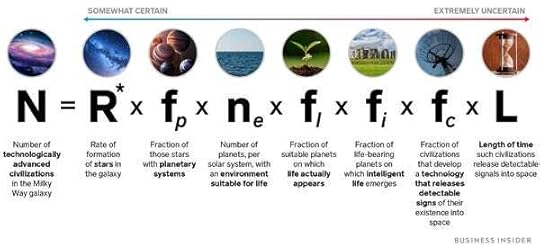

Whew! Thanks for bearing with me on that, but I think it’s important to look at each part of the equation because it really gets at how difficult it will be to get a precise answer on the big question of “Are we alone?”
However, after considering what the author brings up throughout the book, I tend towards the more optimistic side when it comes to, simply, how many planets out there could have life. I also think it would be extremely self-centered of humans to think we’re the only ones who have ever been, are, or will be in the universe. It’s kind of a callback to the days where many scientists (and religious leaders) considered Earth to be the center of everything, and anyone suggesting we weren't tended to get burned at the stake.
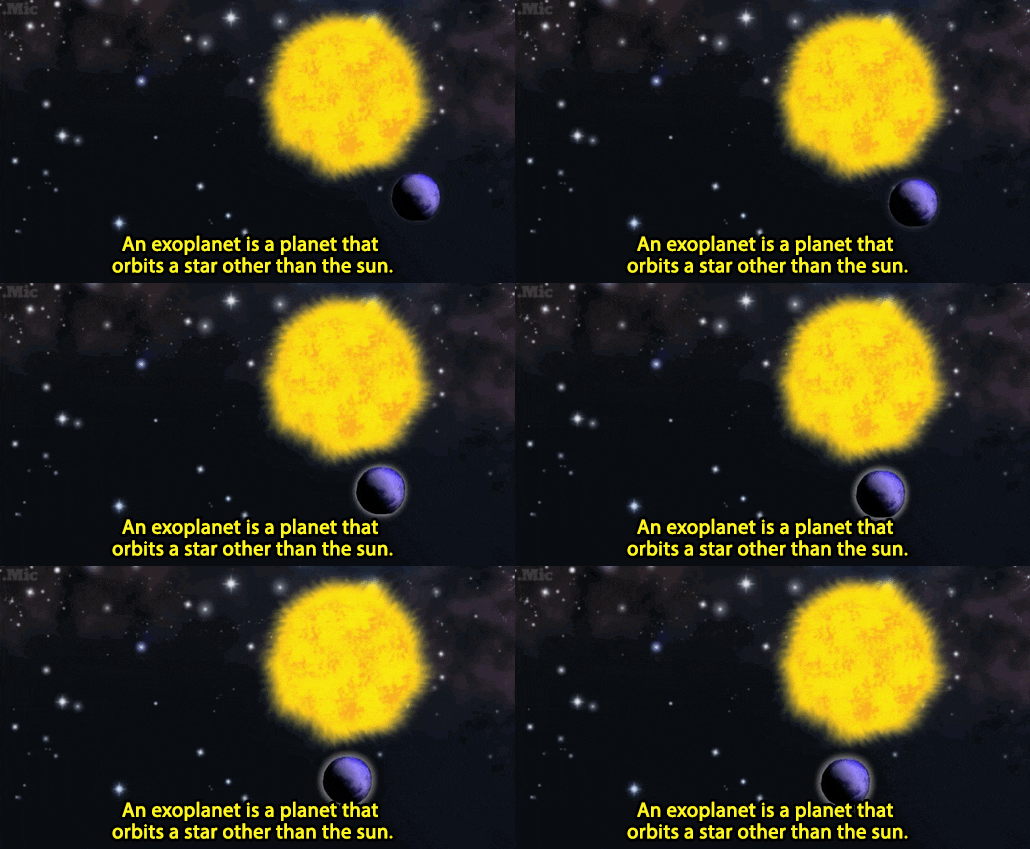
As science has advanced, we have been able to better estimate the number of stars out there and are spotting other planets (exo-planets) with increased frequency, especially those that are part of their own solar system.
With our newest and most advanced eye on the galaxy now operational, the James Webb Space Telescope (JWST) hopes to spot more of these exo-planets and stars during its operational mission. (I believe it has already found at least one new exo-planet previously unknown to science via its capability to “see” things in infrared—e.g., the heat energy that objects radiate into space at a wavelength our eyes can’t see.)

I can’t wait to see how the JWST advances our knowledge on this front. (Perhaps Frank will eventually have to write an updated edition of this book!)
Moving away from that tangent, Frank is trying to get people to view the climate change problem as part of the bigger picture. In other words, if there have been civilizations like ours, it is likely that the process of technological development has led to world-threatening challenges like climate change. Many civilizations may have or have not made it to this stage, but that doesn’t mean we should not try.

But the first step towards that is recognizing that humans, like any other advanced species out there, have an impact on their planet and the entirety of its ecosystem whenever it reaches a developmental or technological milestone.
For example, the production of energy seems to be the big driver of climate change on our planet, and likely others (based on observations of, say, Venus, a planet fallen victim to a runaway greenhouse effect), and people will make an impact no matter what we do.
What it comes down to is humanity producing enough energy to sustain itself with as little an impact on the planetary system as possible. (The author used a term like "civilizational coming of age" or something similar to describe a civilization successfully transitioning to a lower-impact society.)

While Light of the Stars is not ultimately what I thought it was going to be based on its blurb, it still was a treat to read, especially for those fascinated with the possibility of life on other worlds. The science can be above some readers’ heads, like my own (perhaps requiring some googling along the way!), but is one of those books that makes you think differently on some of the current crises humanity is grappling with, so I think it's worth the read!

-Cora
Find this book and other titles within our catalog.
See also:
https://webbtelescope.org/resource-ga... (James Webb Space Telescope)
Adam Frank takes his readers on a quite the journey. The possibility of alien life and advanced civilizations on other worlds has taken awhile to be taken seriously by the science community—Francis Drake only came up with his famous Drake equation only in the early 1960s and that is about the time that the Search for Extraterrestrial Intelligence (SETI) started popping up in the science mainstream.
The Drake equation helped to narrow down the various conceptual issues with quantifying the number of advanced civilizations that have been or currently are. Then further study could be done on each of the factors to advance our knowledge on these “exo-civilizations” overall.
The Drake equation is made up of many parts, so let’s break it down, because it looks intimidating as a whole! See the helpful visual aid (credit: Business Insider) below:
Whew! Thanks for bearing with me on that, but I think it’s important to look at each part of the equation because it really gets at how difficult it will be to get a precise answer on the big question of “Are we alone?”
However, after considering what the author brings up throughout the book, I tend towards the more optimistic side when it comes to, simply, how many planets out there could have life. I also think it would be extremely self-centered of humans to think we’re the only ones who have ever been, are, or will be in the universe. It’s kind of a callback to the days where many scientists (and religious leaders) considered Earth to be the center of everything, and anyone suggesting we weren't tended to get burned at the stake.
As science has advanced, we have been able to better estimate the number of stars out there and are spotting other planets (exo-planets) with increased frequency, especially those that are part of their own solar system.
With our newest and most advanced eye on the galaxy now operational, the James Webb Space Telescope (JWST) hopes to spot more of these exo-planets and stars during its operational mission. (I believe it has already found at least one new exo-planet previously unknown to science via its capability to “see” things in infrared—e.g., the heat energy that objects radiate into space at a wavelength our eyes can’t see.)
I can’t wait to see how the JWST advances our knowledge on this front. (Perhaps Frank will eventually have to write an updated edition of this book!)
Moving away from that tangent, Frank is trying to get people to view the climate change problem as part of the bigger picture. In other words, if there have been civilizations like ours, it is likely that the process of technological development has led to world-threatening challenges like climate change. Many civilizations may have or have not made it to this stage, but that doesn’t mean we should not try.
But the first step towards that is recognizing that humans, like any other advanced species out there, have an impact on their planet and the entirety of its ecosystem whenever it reaches a developmental or technological milestone.
For example, the production of energy seems to be the big driver of climate change on our planet, and likely others (based on observations of, say, Venus, a planet fallen victim to a runaway greenhouse effect), and people will make an impact no matter what we do.
What it comes down to is humanity producing enough energy to sustain itself with as little an impact on the planetary system as possible. (The author used a term like "civilizational coming of age" or something similar to describe a civilization successfully transitioning to a lower-impact society.)
While Light of the Stars is not ultimately what I thought it was going to be based on its blurb, it still was a treat to read, especially for those fascinated with the possibility of life on other worlds. The science can be above some readers’ heads, like my own (perhaps requiring some googling along the way!), but is one of those books that makes you think differently on some of the current crises humanity is grappling with, so I think it's worth the read!
-Cora
Find this book and other titles within our catalog.
See also:
https://webbtelescope.org/resource-ga... (James Webb Space Telescope)

November 3, 2018
98th book for 2018.
I can't work out why this got so many five-star reviews. You'd think from the title and description it would be interesting take on the latest findings on exoplanetary research and it's application to the environmental management of the Earth. However, it's nothing of the kind. It's mostly a very padded rehash of old stuff (Fermi's Paradox; the Drake Equation; the Venus and Mars landers). Whole chapters are devoted to what could have been summarized in a matter of sentences. The final part of the book talks about exoplanets and their implications to earth sciences, but is very superficial. This would have made a nice article somewhere, but never deserved to be bloated into a book.
2-stars.
I can't work out why this got so many five-star reviews. You'd think from the title and description it would be interesting take on the latest findings on exoplanetary research and it's application to the environmental management of the Earth. However, it's nothing of the kind. It's mostly a very padded rehash of old stuff (Fermi's Paradox; the Drake Equation; the Venus and Mars landers). Whole chapters are devoted to what could have been summarized in a matter of sentences. The final part of the book talks about exoplanets and their implications to earth sciences, but is very superficial. This would have made a nice article somewhere, but never deserved to be bloated into a book.
2-stars.

April 25, 2018
Take everything you think you know about aliens and throw it out. Light of the Stars is a brilliant and fascinating look into the world of astrobiology and its implications for Earth’s future. Using a combination of science, history, and narrative, Frank illuminates how humans, as an intelligent civilization, are driving the course of Earth’s evolutionary fate. He asserts that we are most likely not the only intelligent civilization to have existed in the cosmos, and by taking this concept seriously, we can begin to understand our full impact on our planet. He illustrates how we can learn from other planets and other universes throughout time and (literally) space to broaden our understanding of what it is like to be an intelligent civilization in the driver’s seat. Frank’s ability to take complex scientific theory and break it down into palatable portions is a gift. Light of the Stars is indeed brilliant, both in substance and execution.

July 16, 2026
From the leaflet, “Light of the Stars tells the story of humanity’s coming of age as we awaken to the possibilities of life on the other worlds and their sudden relevance to our fate on Earth.
Astrophysicist Adam Frank traces the question of alien life and intelligence from the ancient Greeks to the leading thinkers” questioning climate change as “we are just one of ten billion trillion planets in the universe, and it’s highly likely that many of those planets hosted technologically advanced alien civilizations.”
Frank Drake was one of the astronomers at Green Bank, West Virginia, - which held the best radio observatory in the world in 1958. He was interested in using the telescope to search for signs of intelligent life on other worlds. Thus, Project Ozma was born. By the spring of 1960 the equipment was ready, but Project Ozma never captured any alien signals.
Meanwhile, in 1959, two physicists Giuseppe Cocconi and Philip Morrison published a study arguing that with radio waves the galaxy becomes transparent. And Drake has reached the same conclusion.
This gave beginning to exo-civilizations. A new human story was emerging. NASA projects began for search for extraterrestrial life. (From new knowledge, NASA did see life on Mars it was just not revealed to the public).
James Lovelock and biologist Lynn Margulis introduced Gaia theory of life as a self-regulating planetary system.
Vladimir Ivanovich Vernadsky, Russian scientist, also stated that planetary evolution was not just a force, but a force with its own kind of intention.
Building on those three scientists, a new generation of scientist began speaking of “coevolution” between life and the planet.
In the last few decades, the knowledge of planets as generic cosmic phenomena has exploded.
Written with great clarity and conviction, the author recounts the work of pioneering scientists in regards to extraterrestrial life and explores the question – what can we learn from extraterrestrial life on other worlds?
This book is informative and at the same time doesn’t overwhelm with its information.
In May 2026, over 400 documents were released to the public which is part of disclosure about extraterrestrial life. The scientists are studying those documents now. According to ancient wisdom, extraterrestrial beings have been among us since the inception of our planet. The question is - are we ready to open ourselves to such possibility?
Astrophysicist Adam Frank traces the question of alien life and intelligence from the ancient Greeks to the leading thinkers” questioning climate change as “we are just one of ten billion trillion planets in the universe, and it’s highly likely that many of those planets hosted technologically advanced alien civilizations.”
Frank Drake was one of the astronomers at Green Bank, West Virginia, - which held the best radio observatory in the world in 1958. He was interested in using the telescope to search for signs of intelligent life on other worlds. Thus, Project Ozma was born. By the spring of 1960 the equipment was ready, but Project Ozma never captured any alien signals.
Meanwhile, in 1959, two physicists Giuseppe Cocconi and Philip Morrison published a study arguing that with radio waves the galaxy becomes transparent. And Drake has reached the same conclusion.
This gave beginning to exo-civilizations. A new human story was emerging. NASA projects began for search for extraterrestrial life. (From new knowledge, NASA did see life on Mars it was just not revealed to the public).
James Lovelock and biologist Lynn Margulis introduced Gaia theory of life as a self-regulating planetary system.
Vladimir Ivanovich Vernadsky, Russian scientist, also stated that planetary evolution was not just a force, but a force with its own kind of intention.
Building on those three scientists, a new generation of scientist began speaking of “coevolution” between life and the planet.
In the last few decades, the knowledge of planets as generic cosmic phenomena has exploded.
Written with great clarity and conviction, the author recounts the work of pioneering scientists in regards to extraterrestrial life and explores the question – what can we learn from extraterrestrial life on other worlds?
This book is informative and at the same time doesn’t overwhelm with its information.
In May 2026, over 400 documents were released to the public which is part of disclosure about extraterrestrial life. The scientists are studying those documents now. According to ancient wisdom, extraterrestrial beings have been among us since the inception of our planet. The question is - are we ready to open ourselves to such possibility?

July 18, 2018
It's all about the experiment that the universe is conducting on the planet Earth - this civilization project. We've made it this far. It's a question of how long will humanity survive.
The book basically starts out with the creation of the planets in our solar system, specifically Earth and goes through the harsh eons as it cools, develops water, develops continents, life, oxygen, and variations that we see outside our windows, in a zoo or a museum. The writer then goes into how we began investigating our closest neighbors - Venus and Mars - and the investigations of various climatic models.
Eventually the question of other worlds and alien civilizations received more focus. Which, in turn, lead to the Drake Equation and Fermi Paradox. Parts of the equation have slowly been answered over the decades. We now have an idea of how many stars are in the galaxy as well as how common exo-planets are.
Previously, it was thought that nuclear war was the last part of the Drake Equation. But what if it is actually climate change and the impact humanity has on the planet? Millions of years ago, the first microbes produced oxygen as a waste product. Produced so much that it led to a massive extinction event which has forced what few anoxygenic phototropes to survive into the dark depths of the ocean near geothermal vents which are close to the Earth's surface at the time of their dominance.
What if the human impact on Earth did the same? Drove the climate into conditions which made human life unsustainable? We, as a civilization, would become extinct, the Earth would simply create another new major species and continue spinning merrily on it's way.
And that is a major point that Frank - I believe - is trying to make. The impact that the major species has on the planet and in order to achieve technological advances, must continue to make that impact when using energy. Thousands of computer models have been run with variations of population growth, changes in energy sources (high-impact to low-impact) and whether the civilization develops sustainability or drives itself into extinction.
And that part of the Drake equation is still unknown. Frank can call it bio-technical probability or pessimism lines on how long an exo-civilization can survive but it basically comes down to whether or not our civilization experiment will survive. And no one knows that answer.
In the end, it was not what I expected but I am glad that I got the chance to read it.
The book basically starts out with the creation of the planets in our solar system, specifically Earth and goes through the harsh eons as it cools, develops water, develops continents, life, oxygen, and variations that we see outside our windows, in a zoo or a museum. The writer then goes into how we began investigating our closest neighbors - Venus and Mars - and the investigations of various climatic models.
Eventually the question of other worlds and alien civilizations received more focus. Which, in turn, lead to the Drake Equation and Fermi Paradox. Parts of the equation have slowly been answered over the decades. We now have an idea of how many stars are in the galaxy as well as how common exo-planets are.
Previously, it was thought that nuclear war was the last part of the Drake Equation. But what if it is actually climate change and the impact humanity has on the planet? Millions of years ago, the first microbes produced oxygen as a waste product. Produced so much that it led to a massive extinction event which has forced what few anoxygenic phototropes to survive into the dark depths of the ocean near geothermal vents which are close to the Earth's surface at the time of their dominance.
What if the human impact on Earth did the same? Drove the climate into conditions which made human life unsustainable? We, as a civilization, would become extinct, the Earth would simply create another new major species and continue spinning merrily on it's way.
And that is a major point that Frank - I believe - is trying to make. The impact that the major species has on the planet and in order to achieve technological advances, must continue to make that impact when using energy. Thousands of computer models have been run with variations of population growth, changes in energy sources (high-impact to low-impact) and whether the civilization develops sustainability or drives itself into extinction.
And that part of the Drake equation is still unknown. Frank can call it bio-technical probability or pessimism lines on how long an exo-civilization can survive but it basically comes down to whether or not our civilization experiment will survive. And no one knows that answer.
In the end, it was not what I expected but I am glad that I got the chance to read it.

August 30, 2018
In Light of the Stars, Frank surveys the last decades' leap into space and exo-planet discovery, as well as the burgeoning field of astrobiology. It is a fascinating read, both for its history and its futurism. This book would also be a great textbook for an astrophysics class: accessible and comprehensive in scope.
I recently read The Sixth Extinction: An Unnatural History, and that served as a great companion piece to this: looking at earth's changes, shifts over the millenia, and then this book, putting Earth into context amongst all the other systems and galaxies.
I recently read The Sixth Extinction: An Unnatural History, and that served as a great companion piece to this: looking at earth's changes, shifts over the millenia, and then this book, putting Earth into context amongst all the other systems and galaxies.

September 28, 2019
To date, there are 528 reviews of this book and its average is only 3.86 stars. This seems vexing, considering the fact that it is probably one of the most important books to come out in 2018. My only guess is that his inclusion of his "skepticism line" might have muddied that waters. I feel unqualified to know whether the skepticism line is something I should accept. As of now, I am not sold. However, the rest of the book was top notch. In fact, this book is exceptional not simply for its subject matter -- keeping the planet habitable for humans and other oxygen greedy species -- but even more so for the vast ground it covered when recounting the history of climate research. If you don't know who Vladimir Vernadsky is, that is because until now, he has not really gotten his due. Adam Frank brought his research front and center and showed how from the time of Vladimir Vernadsky onward, climate research / earth's systems science flourished. If we do not understand the history of climate research, and indeed the history of our planet -- a history that created the very atmosphere we depend upon for our lives -- than we cannot make informed decisions. In fact, even if we take into account everything we know, which is a lot, it is still difficult to know what changes we need to make and actions we need to take in order to save our planet. We do not even know if it can be saved. In an effort to help save it, Frank and others are running computer simulations that will hopefully play a role in informing policy. The programs are far from giving optimal answers. There are just so many possible scenarios of how this can all play out. Even if we get fairly solid answers from his latest work, which is extremely important work, will the politicians take it into account? Will it filter down to voters in society enough for them to take action? Who knows, but these are extremely meaningful things to think about. I read this book twice because it was clear that once I finished, I needed to go back and take notes.
In Light of the Stars, Adam Frank not only detailed how Earth's climate changed over time and why it matters, but also provided an extradorinaiy history of climate change. Frank's history reached all the way back to Carl Sagan's research on Venus (if you are unfamiliar with this research, this will be a real treat) as well as investigation into the climate on Mars and then Frank took the reader all the way through present day and into the future of exoplanet research, which will inform society even more about how and why climates change. Frank wrote about the ways in which we probed our in order to unlock the record or its changing climate over the past 4.5 billion years. The incredibly detailed manner in which the history was told ensured that the average reader can answer, "What do we know about climate change on Earth and other planets and *how do we know it*?" Most importantly, Frank's focus is ultimately on the thermodynamic process that creates and changes climate. For example, is life itself something a planet uses to do work? The great biosphere scientist Vladimir Vernadsky asked this question. The public freaked out at the mere mention, from any scientist, that Earth might be a living system. Yet, all work from later scientists working on the biosphere demonstrated that Earth does indeed regulate itself like a body does, breathes like a body does, and uses life (the biosphere) to remain active and alive. In my estimation, looking at the planet from this perspective, that of thermodynamics, is the only meaningful way to do so.
One important thing this book does is give credit to the work of Lynn Margulis. Just like many other scientists, Margulis didn't get it all right, but she was a revolutionary in what she got right. Way ahead of her time, strong in the face of criticism and the politics of science, and because of all of that, she was able to change the way we thought about evolution. I was extremely happy to see that Frank didn't jump on the band wagon of scientist who have, of late, been trying to destroy her well earned reputation for her work on the theory of endosymbiosis. At the same time, Frank skillfully created an exceptional history of others who contributed to our knowledge (especially Vernadsky) as well as clear up some misconceptions left by pasts scientists, such as Vernadsky, Lovelock, and Margulis. He also made it clear why the naming of the Gaia hypothesis was so unfortunate. Lovelock and Margulis would have received a lot more credibility if the crystal-loving hippies hadn't latched onto their Mother Gaia notions and misunderstood them so. But, that is what you get when you go to your neighbor William Golding, who wrote Lord of the Flies, for advice when naming your hypothesis. A name really can make or break an idea. Renaming Gaia "Earth Systems Science," was surely a help.
Early on in the book, Frank discussed the chemical composition of the atmosphere and how the climate will change if the chemical composition changes. We have a wonderful blanket of greenhouse gasses, to which we owe our very existence. Without greenhouse gasses, the planet would not have been habitable for humans at all. So, it's not that green house gasses are "bad". It's just that they have to be at just the right concentration to support fragile human life. Consider oxygen. Current levels of oxygen hold steady at about 21% of Earth's atmospheric composition. What would happen if those gasses rose a bit higher, to about 30%? The atmosphere could not support life because any old lightning bolt could set the atmosphere on fire. Luckily for us, life itself regulates the percent of oxygen in the atmosphere. As long as we don't mess with the living things too much, we can keep that percentage pretty steady. The same complex regulation is present with other greenhouse gasses such as carbon or methane. They need to be at trace amounts to optimally support life on the planet. If too much CO is sent into the atmosphere, but volcanoes or by human made factories (and other human made contributions), then it changes the atmospheric composition and if it changes too much, it can become what is called a "runaway greenhouse effect," in which it is too late to bring levels back to where they need to be for life to be sustainable.
Calculating the equilibrium temperature of Earth is very simple math that can be done by first year undergraduate astronomy students. I hope politicians read this book and learn just how simple it is to understand about how energy flows and cycles through and out of Earth. If you do not understand this simple formula, you should not be allowed to join in any discussion of climate change policy. Of course there are many complex aspects of climate change that still need to be worked out. For example, other books examine the net effects of the 22 year sunspot cycle on Earth's climate. These are more difficult to determine. But, the least someone should know is how to calculate the equilibrium temperature of Earth.
A simple version goes sort of like this: Earth without an atmosphere would have an equilibrium temperature of zero degrees Fahrenheit . But, with an atmosphere, the equilibrium temp is the climate we experience now. Change that atmosphere and the climate will change too much.
In order for the earths climate to remain fairly stable over time and not be in long periods of a boiling cauldron or a frozen snow mall, the amount of energy that comes in from the sun needs to equal the amount of energy that is radiate it out, at the right rate. If too much energy is trapped inside the atmosphere by the greenhouse gases, a planet will become too hot. Trapping energy makes things hot. Consider Venus' atmosphere, which is all CO2. The COS trapped greenhouse gasses in the atmosphere, creating a runaway greenhouse gas effect that resulted in an absolutely sweltering planet that cannot support life. If too much energy is allowed to evaporate out and not get trapped, it will make a planet too cold.This is what happened with snowball Earth.
The greenhouse gasses of Earth have only a spattering of CO2. If CO2 levels rise, then of course too much energy gets trapped. Our place in the solar system is called the Goldilocks Zone for a reason. We are at just the right distance from the sun to have an atmosphere that can support earth *IF* we do not mess with the composition of the atmosphere too much. When too much CO2 is present, such as on Venus, hydrogen gas is allowed to float away. Volcanoes already produce a lot of CO2. There is no question that humans should be very careful about adding more if they plan to continue depending on Earth as a home planet. One good thing about the aftermath of volcanic eruptions is that water can bring much of the CO2 back underground. But if humans spew more CO2 into the atmosphere, the hydrogen that floats away can no longer participate in making the water that sucks the CO2 underground. So many climate change deniers like to pretend the "science just isn't settled." Most of the science is settled. Basic chemistry has been "settled" for a very long time. We know what happens when you add or subtract chemicals from a medium. Different reactions happen. We know that when you add CO2 to the other greenhouse gasses found in the atmosphere, it helps to dissociate hydrogen from the oxygen that makes the water we need to keep us from experiencing a runaway greenhouse effect. Similarly, we know from studying Mars, that if CO2 levels are high but there is *no atmosphere*, the CO2 cannot be trapped. It radiates out too quickly. No trapped energy means cooler temps. It's very basic science backed up by very basic math (energy in v energy out). It's not unsettled.
Adam Frank asked his readers to think about that for a second and reminded the reader that all of these people denying climate change seem to understand nothing about basic physics. Where a rock is formed on the earth determines its shape, color, density. Being closer to a heat source makes up the salt, further from that heat source makes it granite, and even further makes it less dense rock. How hot or cold and entire planet is is merely an extension of this simple physics. Depending on what you have in the atmosphere and what you have coming out of the earth it’s going to change not just rock but temperature on that rock it’s not rocket science it’s just rock science.
The best thing about Adam Frank's discussion in this book is that it follows the slogan, "Follow the money." When you want to understand corruption, of course you follow the money. In Frank's case, the slogan would be, "Follow the energy". Once you do that, things become very clear.
Frank also included a really nice section about Trade winds and Hadley Cells. Our planet spins, which makes wind patterns much more interesting and complex. Every rotating planet with an atmosphere has trade winds. Warping winds can bring things like the polar vortex of 2014. His inclusion of trade winds was to show that Earth is not a special case. The principles of physics laid out in this book apply to all planets. If scientists know if a planet has or does not have an atmosphere, spins or does not spin, is close to or far from a star, and so on, they can make predictions. The more we know about other planets in the universe, the more we will continue to inform our knowledge of how planets work in general.
In addition to including what we know about other planets, Frank, of course, included what we know about our own. He looked at how the Earth developed from a young planet to now and how organisms developed upon its surface. He went through all the extinctions, well covered in many books but beautifully covered in this one. Most notably, it is essential for humans to understand the history of cyanobacteria (my very, very favorite bacteria). When cyanobacteria came on the scene, it, like all species, ingested energy and created a waste product. That waste was oxygen. **Oxygen was poisonous to everything living on Earth at that time, including cyanobacteria. We love their waste. We take nice deep breaths of that waste. In fact if we are having trouble breathing, we humans often go to the hospital and breathe in the purest form of that waste. Yum! But make no mistake, oxygen killed the vast majority of species alive at the time. Those who survived did so only if they were able to find new niches like an animal gut or the hot springs of Yellowstone.
We humans create a lot of waste. Our waste from factories, farming, and just about every aspect of daily living is CO2. It's poisonous to us. Maybe not to whatever AI will come later. Who knows. But there is no question that the living green stuff on Earth and the vast majority of species that eat all that green stuff are poisoned by high levels of CO2. Basically, we are changing the atmosphere just as cyanobacteria did. We are in danger of killing most of what is currently living on our planet. We can keep choosing to do that or we can make ourselves even slightly scientifically literate and make informed choices that give our species a better chance at survival.
In Light of the Stars, Adam Frank not only detailed how Earth's climate changed over time and why it matters, but also provided an extradorinaiy history of climate change. Frank's history reached all the way back to Carl Sagan's research on Venus (if you are unfamiliar with this research, this will be a real treat) as well as investigation into the climate on Mars and then Frank took the reader all the way through present day and into the future of exoplanet research, which will inform society even more about how and why climates change. Frank wrote about the ways in which we probed our in order to unlock the record or its changing climate over the past 4.5 billion years. The incredibly detailed manner in which the history was told ensured that the average reader can answer, "What do we know about climate change on Earth and other planets and *how do we know it*?" Most importantly, Frank's focus is ultimately on the thermodynamic process that creates and changes climate. For example, is life itself something a planet uses to do work? The great biosphere scientist Vladimir Vernadsky asked this question. The public freaked out at the mere mention, from any scientist, that Earth might be a living system. Yet, all work from later scientists working on the biosphere demonstrated that Earth does indeed regulate itself like a body does, breathes like a body does, and uses life (the biosphere) to remain active and alive. In my estimation, looking at the planet from this perspective, that of thermodynamics, is the only meaningful way to do so.
One important thing this book does is give credit to the work of Lynn Margulis. Just like many other scientists, Margulis didn't get it all right, but she was a revolutionary in what she got right. Way ahead of her time, strong in the face of criticism and the politics of science, and because of all of that, she was able to change the way we thought about evolution. I was extremely happy to see that Frank didn't jump on the band wagon of scientist who have, of late, been trying to destroy her well earned reputation for her work on the theory of endosymbiosis. At the same time, Frank skillfully created an exceptional history of others who contributed to our knowledge (especially Vernadsky) as well as clear up some misconceptions left by pasts scientists, such as Vernadsky, Lovelock, and Margulis. He also made it clear why the naming of the Gaia hypothesis was so unfortunate. Lovelock and Margulis would have received a lot more credibility if the crystal-loving hippies hadn't latched onto their Mother Gaia notions and misunderstood them so. But, that is what you get when you go to your neighbor William Golding, who wrote Lord of the Flies, for advice when naming your hypothesis. A name really can make or break an idea. Renaming Gaia "Earth Systems Science," was surely a help.
Early on in the book, Frank discussed the chemical composition of the atmosphere and how the climate will change if the chemical composition changes. We have a wonderful blanket of greenhouse gasses, to which we owe our very existence. Without greenhouse gasses, the planet would not have been habitable for humans at all. So, it's not that green house gasses are "bad". It's just that they have to be at just the right concentration to support fragile human life. Consider oxygen. Current levels of oxygen hold steady at about 21% of Earth's atmospheric composition. What would happen if those gasses rose a bit higher, to about 30%? The atmosphere could not support life because any old lightning bolt could set the atmosphere on fire. Luckily for us, life itself regulates the percent of oxygen in the atmosphere. As long as we don't mess with the living things too much, we can keep that percentage pretty steady. The same complex regulation is present with other greenhouse gasses such as carbon or methane. They need to be at trace amounts to optimally support life on the planet. If too much CO is sent into the atmosphere, but volcanoes or by human made factories (and other human made contributions), then it changes the atmospheric composition and if it changes too much, it can become what is called a "runaway greenhouse effect," in which it is too late to bring levels back to where they need to be for life to be sustainable.
Calculating the equilibrium temperature of Earth is very simple math that can be done by first year undergraduate astronomy students. I hope politicians read this book and learn just how simple it is to understand about how energy flows and cycles through and out of Earth. If you do not understand this simple formula, you should not be allowed to join in any discussion of climate change policy. Of course there are many complex aspects of climate change that still need to be worked out. For example, other books examine the net effects of the 22 year sunspot cycle on Earth's climate. These are more difficult to determine. But, the least someone should know is how to calculate the equilibrium temperature of Earth.
A simple version goes sort of like this: Earth without an atmosphere would have an equilibrium temperature of zero degrees Fahrenheit . But, with an atmosphere, the equilibrium temp is the climate we experience now. Change that atmosphere and the climate will change too much.
In order for the earths climate to remain fairly stable over time and not be in long periods of a boiling cauldron or a frozen snow mall, the amount of energy that comes in from the sun needs to equal the amount of energy that is radiate it out, at the right rate. If too much energy is trapped inside the atmosphere by the greenhouse gases, a planet will become too hot. Trapping energy makes things hot. Consider Venus' atmosphere, which is all CO2. The COS trapped greenhouse gasses in the atmosphere, creating a runaway greenhouse gas effect that resulted in an absolutely sweltering planet that cannot support life. If too much energy is allowed to evaporate out and not get trapped, it will make a planet too cold.This is what happened with snowball Earth.
The greenhouse gasses of Earth have only a spattering of CO2. If CO2 levels rise, then of course too much energy gets trapped. Our place in the solar system is called the Goldilocks Zone for a reason. We are at just the right distance from the sun to have an atmosphere that can support earth *IF* we do not mess with the composition of the atmosphere too much. When too much CO2 is present, such as on Venus, hydrogen gas is allowed to float away. Volcanoes already produce a lot of CO2. There is no question that humans should be very careful about adding more if they plan to continue depending on Earth as a home planet. One good thing about the aftermath of volcanic eruptions is that water can bring much of the CO2 back underground. But if humans spew more CO2 into the atmosphere, the hydrogen that floats away can no longer participate in making the water that sucks the CO2 underground. So many climate change deniers like to pretend the "science just isn't settled." Most of the science is settled. Basic chemistry has been "settled" for a very long time. We know what happens when you add or subtract chemicals from a medium. Different reactions happen. We know that when you add CO2 to the other greenhouse gasses found in the atmosphere, it helps to dissociate hydrogen from the oxygen that makes the water we need to keep us from experiencing a runaway greenhouse effect. Similarly, we know from studying Mars, that if CO2 levels are high but there is *no atmosphere*, the CO2 cannot be trapped. It radiates out too quickly. No trapped energy means cooler temps. It's very basic science backed up by very basic math (energy in v energy out). It's not unsettled.
Adam Frank asked his readers to think about that for a second and reminded the reader that all of these people denying climate change seem to understand nothing about basic physics. Where a rock is formed on the earth determines its shape, color, density. Being closer to a heat source makes up the salt, further from that heat source makes it granite, and even further makes it less dense rock. How hot or cold and entire planet is is merely an extension of this simple physics. Depending on what you have in the atmosphere and what you have coming out of the earth it’s going to change not just rock but temperature on that rock it’s not rocket science it’s just rock science.
The best thing about Adam Frank's discussion in this book is that it follows the slogan, "Follow the money." When you want to understand corruption, of course you follow the money. In Frank's case, the slogan would be, "Follow the energy". Once you do that, things become very clear.
Frank also included a really nice section about Trade winds and Hadley Cells. Our planet spins, which makes wind patterns much more interesting and complex. Every rotating planet with an atmosphere has trade winds. Warping winds can bring things like the polar vortex of 2014. His inclusion of trade winds was to show that Earth is not a special case. The principles of physics laid out in this book apply to all planets. If scientists know if a planet has or does not have an atmosphere, spins or does not spin, is close to or far from a star, and so on, they can make predictions. The more we know about other planets in the universe, the more we will continue to inform our knowledge of how planets work in general.
In addition to including what we know about other planets, Frank, of course, included what we know about our own. He looked at how the Earth developed from a young planet to now and how organisms developed upon its surface. He went through all the extinctions, well covered in many books but beautifully covered in this one. Most notably, it is essential for humans to understand the history of cyanobacteria (my very, very favorite bacteria). When cyanobacteria came on the scene, it, like all species, ingested energy and created a waste product. That waste was oxygen. **Oxygen was poisonous to everything living on Earth at that time, including cyanobacteria. We love their waste. We take nice deep breaths of that waste. In fact if we are having trouble breathing, we humans often go to the hospital and breathe in the purest form of that waste. Yum! But make no mistake, oxygen killed the vast majority of species alive at the time. Those who survived did so only if they were able to find new niches like an animal gut or the hot springs of Yellowstone.
We humans create a lot of waste. Our waste from factories, farming, and just about every aspect of daily living is CO2. It's poisonous to us. Maybe not to whatever AI will come later. Who knows. But there is no question that the living green stuff on Earth and the vast majority of species that eat all that green stuff are poisoned by high levels of CO2. Basically, we are changing the atmosphere just as cyanobacteria did. We are in danger of killing most of what is currently living on our planet. We can keep choosing to do that or we can make ourselves even slightly scientifically literate and make informed choices that give our species a better chance at survival.

August 16, 2018
What practical use is research into possible extraterrestrial live and civilizations?
We need a new frame to think about our own planet and our relationship. It's just false to all the evidence that we don't affect the habitability of Earth. It's unhelpful, providing no useful path forward, to think of ourselves as a completely malign, destructive force.
We need a new story to tell ourselves, that correctly places us as an active force on Earth, currently doing a lot of damage out of our ignorance until now, but able to change direction and, through use of our growing knowledge, able to make different, more useful decisions.
Adam Frank looks at both the history of our thinking and investigation of the idea of alien life, up to and including the recent explosion of discovery of extrasolar planets and what that means for the likelihood that other technologically advanced civilizations at least have existed, and the history of our growing understanding of our real impact on the habitability of Earth for us and our technologically advanced civilization. It turns out that that history of growing understanding of the crucial factor of our contribution to global warming goes back not to the 1970s, but to the latter part of the 19th century.
He looks at how early life changed our planet to make in habitable for life like us, the crucial fact that it's not Earth we need to worry about protecting, but ourselves (Earth, and life, will go one almost regardless of what we do, but we might not), and how even the study of certainly lifeless Venus and so far not proven to harbor life Mars have enhanced our understanding of Earth and our relationship to it. Even understanding that planets, at all sizes and types, are fairly common in the universe, and that therefore it's wildly unlikely that we're the first technological civilization to exist, expands our understanding. We further need to understand whether it's common, possible, or wildly unlikely for civilizations to survive the technological and environmental bottleneck we are currently struggling through.
We want to be a civilization that survives.
It's a fascinating book, and well worth reading. Recommended.
I initially borrowed this book from my local library, and then bought it.
We need a new frame to think about our own planet and our relationship. It's just false to all the evidence that we don't affect the habitability of Earth. It's unhelpful, providing no useful path forward, to think of ourselves as a completely malign, destructive force.
We need a new story to tell ourselves, that correctly places us as an active force on Earth, currently doing a lot of damage out of our ignorance until now, but able to change direction and, through use of our growing knowledge, able to make different, more useful decisions.
Adam Frank looks at both the history of our thinking and investigation of the idea of alien life, up to and including the recent explosion of discovery of extrasolar planets and what that means for the likelihood that other technologically advanced civilizations at least have existed, and the history of our growing understanding of our real impact on the habitability of Earth for us and our technologically advanced civilization. It turns out that that history of growing understanding of the crucial factor of our contribution to global warming goes back not to the 1970s, but to the latter part of the 19th century.
He looks at how early life changed our planet to make in habitable for life like us, the crucial fact that it's not Earth we need to worry about protecting, but ourselves (Earth, and life, will go one almost regardless of what we do, but we might not), and how even the study of certainly lifeless Venus and so far not proven to harbor life Mars have enhanced our understanding of Earth and our relationship to it. Even understanding that planets, at all sizes and types, are fairly common in the universe, and that therefore it's wildly unlikely that we're the first technological civilization to exist, expands our understanding. We further need to understand whether it's common, possible, or wildly unlikely for civilizations to survive the technological and environmental bottleneck we are currently struggling through.
We want to be a civilization that survives.
It's a fascinating book, and well worth reading. Recommended.
I initially borrowed this book from my local library, and then bought it.
September 3, 2018
Wherever there's a book (or lecture or podcast) about the size of the universe, count me in. I'm fascinated by the subject, and Light of the Stars is an excellent addition to the genre.
Frank writes clearly about the possibilities of technologically advanced civilizations throughout the universe--how many there might be and how long they might last. He writes persuasively because he includes a range of scientific inputs (astrophysics, astrobiology, sociology, evolutionary science...) to develop his analysis and because he's willing to distinguish scientific endeavors from speculation. I can't say I'm convinced by his ideas; however, I am persuaded to consider them seriously.
Additionally, this book is about a whole lot more. Frank uses thinking about alien worlds, i.e., he uses the "light of the stars," to give fresh insights into the evolution of the earth, the evolution of civilization here, and the interdependence of those evolutions. He then proceeds to look at the possibilities for the future of the earth and human life. His tone seems just right, neither scolding about our doomed fate nor denying there's a problem. He has a point of view, an argument, but he's not argumentative.
I won't replay Frank's thinking here, but I will say Light of the Stars is mind bending and paradigm shifting. Frank provides new ways to think about climate change and the interplay between mankind and the earth, as well as what we can learn from possible alien worlds. I'm no scientist so I can't confirm or rebut his thinking. I can say I'm a bit wiser having read Light of the Stars, and I enjoyed the journey along the way.
Frank writes clearly about the possibilities of technologically advanced civilizations throughout the universe--how many there might be and how long they might last. He writes persuasively because he includes a range of scientific inputs (astrophysics, astrobiology, sociology, evolutionary science...) to develop his analysis and because he's willing to distinguish scientific endeavors from speculation. I can't say I'm convinced by his ideas; however, I am persuaded to consider them seriously.
Additionally, this book is about a whole lot more. Frank uses thinking about alien worlds, i.e., he uses the "light of the stars," to give fresh insights into the evolution of the earth, the evolution of civilization here, and the interdependence of those evolutions. He then proceeds to look at the possibilities for the future of the earth and human life. His tone seems just right, neither scolding about our doomed fate nor denying there's a problem. He has a point of view, an argument, but he's not argumentative.
I won't replay Frank's thinking here, but I will say Light of the Stars is mind bending and paradigm shifting. Frank provides new ways to think about climate change and the interplay between mankind and the earth, as well as what we can learn from possible alien worlds. I'm no scientist so I can't confirm or rebut his thinking. I can say I'm a bit wiser having read Light of the Stars, and I enjoyed the journey along the way.

June 22, 2019
Light of the Stars wasn't quite what I expected (I don't remember what I did expect), but I'm so glad I read it, because I loved it.
One element that I totally didn't expect was the discussion of climate change. Specifically, how a lot of our understanding of climate change has come from studying other planets, as well as looking deep into our own planet's history. It was unexpected, but so interesting.
The book also largely focuses on the idea of an equation that could provide a very concrete idea about the possibility of life on other planets. Normally, the idea of following the creation of an equation would not interest me at all, but this one is a really interesting equation. Moreover, Frank is a really good writer, which only improves what is already an interesting topic.
I've seen reviews from other readers who didn't love this book because it covered a lot of information they already knew. Certainly, this is a book for the everyday person interested in space and aliens, and it doesn't expect much background knowledge of the reader. So it probably wouldn't be all that entertaining to those who already know a lot about astrophysics and the like. However, for me, someone still testing these waters and very much a humanities student, it was a very interesting book. And I'll emphasise again, because it's not always the case, it's very well written, too!
So if Light of the Stars sounds interesting to you, I absolutely recommend it. It's fun and interesting and informative. I was engaged from start to end, which is rarely the case for me with non-fiction, even if the topic is interesting.
One element that I totally didn't expect was the discussion of climate change. Specifically, how a lot of our understanding of climate change has come from studying other planets, as well as looking deep into our own planet's history. It was unexpected, but so interesting.
The book also largely focuses on the idea of an equation that could provide a very concrete idea about the possibility of life on other planets. Normally, the idea of following the creation of an equation would not interest me at all, but this one is a really interesting equation. Moreover, Frank is a really good writer, which only improves what is already an interesting topic.
I've seen reviews from other readers who didn't love this book because it covered a lot of information they already knew. Certainly, this is a book for the everyday person interested in space and aliens, and it doesn't expect much background knowledge of the reader. So it probably wouldn't be all that entertaining to those who already know a lot about astrophysics and the like. However, for me, someone still testing these waters and very much a humanities student, it was a very interesting book. And I'll emphasise again, because it's not always the case, it's very well written, too!
So if Light of the Stars sounds interesting to you, I absolutely recommend it. It's fun and interesting and informative. I was engaged from start to end, which is rarely the case for me with non-fiction, even if the topic is interesting.

October 2, 2021
Is there life out there? It is a question that has taxed some of the finest minds and we are not really any closer to answering it. We can speculate about how many stars have planets that might have the particular and specific factors that allow life to arise. Even though we can now see those stars that have planets orbiting, we are still no closer to proving that they carry a form of life that we can detect.
What we have learnt through the pioneering work of scientists such as Frank Drake and Carl Sagan, Jack James, Vladimir Vernadsky and James Lovelock and Lynn Margulis is much more about is how life has formed and was created on this planet. Their pioneering work is explored in this book as Frank writes about their discoveries and the way that they changed our understanding of how a planet changes and evolves over millennia.
Overall I thought this was ok. He is a reasonable writer and the prose was engaging without being too dry and academic. That said I felt that it seemed to lack a little focus as to what he was trying to achieve from a popular science book and it felt too speculative at times throughout the book. 2.5 stars
What we have learnt through the pioneering work of scientists such as Frank Drake and Carl Sagan, Jack James, Vladimir Vernadsky and James Lovelock and Lynn Margulis is much more about is how life has formed and was created on this planet. Their pioneering work is explored in this book as Frank writes about their discoveries and the way that they changed our understanding of how a planet changes and evolves over millennia.
Overall I thought this was ok. He is a reasonable writer and the prose was engaging without being too dry and academic. That said I felt that it seemed to lack a little focus as to what he was trying to achieve from a popular science book and it felt too speculative at times throughout the book. 2.5 stars
September 7, 2018
I'm not sure what I was expecting from this book, but I was left with a general sense of "Why did he write this?". There's a fair amount of speculation about alien worlds ( reasonable, yes, but speculation nonetheless) and the applicability of their situations to us, a whole lot of background that just doesn't seem particularly relevant, and not much in the way of a conclusion that would inspire anyone. Perhaps the author had to produce this as a justification for an extended sabbatical. Perhaps I entirely missed his point. Either way, I wouldn't recommend this book very highly.
July 6, 2018
I found this book fascinating as I do all things space. Adam makes a compelling case that there’s very likely millions and millions (or more) of other planets that have produced not just life, but intelligent life. So where are they? Adam methodically describes the stresses created by that intelligent life on the host planet as they develop the technology and energy sources to support their lifestyle. These stresses may have lead to the destruction of these intelligent civilizations and their host planets which is at least a partial explanation of no contact with us. More importantly, we need to manage our own planet and resources intelligently to ensure our own survival. A fascinating and thought provoking read!
June 13, 2018
The beginning of this book made me anticipate that it was going to be LIFE CHANGING. It sorta then just ended up being a summary of a lot of other work - most of it real cool! - but that never really turned into what I expected. Prolly a 3 star, but I just felt let down at the end.
Lot of really cool thought experiment stuff, though! I also prolly read it too fast.
Lot of really cool thought experiment stuff, though! I also prolly read it too fast.

February 15, 2022
Growing up, I was obsessed with astrophysics. And this beautiful book is going to throw me right back into it.

November 25, 2018
Let me preface with this brief point: I am a Climate Reality Leader with former vice president Al Gore's Climate Reality Project; as such, I am steeped in the subject of climate change, from green-tech initiatives to public-policy proposals to the science of global warming itself. There's new information on those different facets of the subject coming out all the time, but seldom are there new perspectives on the climate crisis. To my delight and wonder, astrophysicist Adam Frank offers exactly that in Light of the Stars.
In this thought-provoking and accessible book (no PhD required!), Frank makes the compelling case that anthropogenic climate change would be the inevitable byproduct of any energy-intensive, technologically advanced civilization, and that we are likely not the first intelligent lifeforms in the vast history of the cosmos to have impacted our planetary climate, and by extension threatened its very habitability -- a consideration which prompts an unsettling cosmic question:
With climate change finally becoming a regular fixture on the front page, and a new generation of congressmembers calling for committees and introducing legislation to address the problem, Frank's book is a welcome contribution to a long-overdue public conversation. If you're unfamiliar with the basic science of climate change or how you can take meaningful action to mitigate it, there are other books worth reading first: An Inconvenient Sequel: Truth to Power and This Changes Everything: Capitalism vs. The Climate . But this one frames what's happening -- our entry into the Anthropocene -- in a grander contextual narrative that offers an astonishingly sobering perspective, one that just may help us strike that elusive balance between panic and denial to take the steps required to give our project of civilization the best shot at enduring and prospering. That's a renewable resource we'll need in abundance to fuel the Sustainability Revolution of the coming decades...
In this thought-provoking and accessible book (no PhD required!), Frank makes the compelling case that anthropogenic climate change would be the inevitable byproduct of any energy-intensive, technologically advanced civilization, and that we are likely not the first intelligent lifeforms in the vast history of the cosmos to have impacted our planetary climate, and by extension threatened its very habitability -- a consideration which prompts an unsettling cosmic question:
"How do we know there is such a thing as a long-term version of our kind of civilization? Most discussions of the sustainability crisis focus on strategies for developing new forms of energy or the projected benefits of different socioeconomic policies. But because we're stuck looking at what's happening to us as a singular phenomenon -- a one-time story -- we don't think to step back and ask this kind of broader question. To even pose it seems defeatist. But it must be addressed if we are to make the most informed, intelligent bets on the future" (Adam Frank, Light of the Stars: Alien Worlds and the Fate of the Earth, [New York: W. W. Norton & Company, 2018], 169–70).
With climate change finally becoming a regular fixture on the front page, and a new generation of congressmembers calling for committees and introducing legislation to address the problem, Frank's book is a welcome contribution to a long-overdue public conversation. If you're unfamiliar with the basic science of climate change or how you can take meaningful action to mitigate it, there are other books worth reading first: An Inconvenient Sequel: Truth to Power and This Changes Everything: Capitalism vs. The Climate . But this one frames what's happening -- our entry into the Anthropocene -- in a grander contextual narrative that offers an astonishingly sobering perspective, one that just may help us strike that elusive balance between panic and denial to take the steps required to give our project of civilization the best shot at enduring and prospering. That's a renewable resource we'll need in abundance to fuel the Sustainability Revolution of the coming decades...

December 8, 2018
Climate change scares the crap out of me. After a lifetime of being a careful student of nature, culture, astronomy, and evolution, I can easily visualize how the ravages wrought by climate change can eventually bring down civilization as we know it. In addition to being a climate activist, I employ numerous daily strategies to keep my spirit from dropping into an abyss of existential anxiety and dread. One of them has been reading this book which takes a big-picture view of our little planet and its crisis.
Frank helps us understand our climate crisis from the cosmic perspective of astrobiology and planetary science - everything we've learned about our solar system neighbors but also what we're beginning to learn about a galaxy and universe teeming with planets, millions with their own conditions for the possibility of harboring life and civilizations. Frank shows how astronomy, earth history research, recent discoveries in our solar system, plus the new knowledge streaming in from exoplanet research, provides us with a new context for understanding how planets evolve, what conditions allow for life to arise, what conditions alter a planet’s habitability, and what the chances are for our own continued existence as a civilization.
As much as I love Frank’s big picture context, as a Buddhist and retired integralist, it’s not big-picture enough for me (https://www.goodreads.com/book/show/1...). One thing that bothered me about the book was a certain cavalier ethical attitude towards the destruction of biodiversity, extinction of species, and the immense suffering of the earth’s living beings due to human activities. Maybe earth doesn't care, but caring humans care. Yes, holding the view that “humans suck” is unproductive, and yes, we have to see that it doesn't matter to the earth whether human civilization survives or not, and yes, as biologist Lynn Margulis quipped, “earth is a tough bitch” and will recover, and yes, this is a science book and not one about the ethical dimensions of climate change but… but… it would have helped towards the end of the book if Frank had said more about how an ethical awakening, not just an awakening based on astrobiology and planetary evolution knowledge, would help us grow up from being a teenage fossil fuel civilization and into a fully-mature sustainable civilization. Alas, perhaps nothing will awake enough of us in time.
If you care about the earth and its inhabitants, if you love big picture science and cosmic Carl-Sagan-grand-evolution stuff, you will love this book. Frank’s book has provided us with an important new planetary perspective on the global crisis facing humanity in this second decade of the 21st century. Let’s just hope it doesn’t become, like this review, one among billions of relics of our civilization to be discovered by some distant future alien archaeologist.
Frank helps us understand our climate crisis from the cosmic perspective of astrobiology and planetary science - everything we've learned about our solar system neighbors but also what we're beginning to learn about a galaxy and universe teeming with planets, millions with their own conditions for the possibility of harboring life and civilizations. Frank shows how astronomy, earth history research, recent discoveries in our solar system, plus the new knowledge streaming in from exoplanet research, provides us with a new context for understanding how planets evolve, what conditions allow for life to arise, what conditions alter a planet’s habitability, and what the chances are for our own continued existence as a civilization.
As much as I love Frank’s big picture context, as a Buddhist and retired integralist, it’s not big-picture enough for me (https://www.goodreads.com/book/show/1...). One thing that bothered me about the book was a certain cavalier ethical attitude towards the destruction of biodiversity, extinction of species, and the immense suffering of the earth’s living beings due to human activities. Maybe earth doesn't care, but caring humans care. Yes, holding the view that “humans suck” is unproductive, and yes, we have to see that it doesn't matter to the earth whether human civilization survives or not, and yes, as biologist Lynn Margulis quipped, “earth is a tough bitch” and will recover, and yes, this is a science book and not one about the ethical dimensions of climate change but… but… it would have helped towards the end of the book if Frank had said more about how an ethical awakening, not just an awakening based on astrobiology and planetary evolution knowledge, would help us grow up from being a teenage fossil fuel civilization and into a fully-mature sustainable civilization. Alas, perhaps nothing will awake enough of us in time.
If you care about the earth and its inhabitants, if you love big picture science and cosmic Carl-Sagan-grand-evolution stuff, you will love this book. Frank’s book has provided us with an important new planetary perspective on the global crisis facing humanity in this second decade of the 21st century. Let’s just hope it doesn’t become, like this review, one among billions of relics of our civilization to be discovered by some distant future alien archaeologist.

August 31, 2019
One of my favorite scenes in the original Cosmos series, hosted by Carl Sagan, is when he scribbles out the famous Drake equation. This is a rather simple equation which wonderfully expresses the likelihood of there being other intelligent life in the universe. Through Sagan’s clear conversational style, and some practical math, we begin to make worthwhile hypotheses about the likelihood there is intelligent life beyond our solar system.
Adam Frank’s book, Light of the Stars: Alien Worlds and the Fate of the Earth, builds on Drake’s equation as well as other foundational ideas regarding life in the cosmos. Like Sagan's style, Frank’s clear and conversational style becomes a big selling point for this book. It’s the second of his works I’ve read, the first being About Time: Cosmology and Culture at the Twilight of the Big Bang. I read this book on the strength of that one.
Rather than pound away on one thesis using a single discipline, Frank pulls many things together: geology, astrobiology, evolution, climate change, and exoplanet studies. They all relate. Understanding how they relate will be crucial to our survival. Using what we’ve learned studying Mars and Venus, as well as what we are beginning to learn about planets orbiting other stars, perhaps its time to rethink the questions we are asking about life. How does it start? What conditions allow life to become technological? How might life and its home planet affect each other’s story? Lastly, can life ever truly be sustainable?
Thanks to ongoing scientific research, these are questions which have begun moving out of the realm of hypothesis and into the realm of serious theory. Light of the Stars is not a book which reveals some grand new answer. Frank even goes out of his way to downplay the frequently unwise headline/click-bait writing in the media which exaggerates research findings. At its boldest, this book makes an assertion: hey, we have figured out the most useful questions to research going forward! In science, as ought to be the case in any area of life and knowledge, arriving at the right questions is a great thing.
I enjoyed Light of the Stars for the way Frank arranged an ensemble of scientific fields into a cohesive project for all of humanity. I value this multi-disciplinary approach. As humanity grapples with the reality and potential effects of climate change, books like this give non-scientist readers a way to grasp the issues and make desperately needed sense of them.
Adam Frank’s book, Light of the Stars: Alien Worlds and the Fate of the Earth, builds on Drake’s equation as well as other foundational ideas regarding life in the cosmos. Like Sagan's style, Frank’s clear and conversational style becomes a big selling point for this book. It’s the second of his works I’ve read, the first being About Time: Cosmology and Culture at the Twilight of the Big Bang. I read this book on the strength of that one.
Rather than pound away on one thesis using a single discipline, Frank pulls many things together: geology, astrobiology, evolution, climate change, and exoplanet studies. They all relate. Understanding how they relate will be crucial to our survival. Using what we’ve learned studying Mars and Venus, as well as what we are beginning to learn about planets orbiting other stars, perhaps its time to rethink the questions we are asking about life. How does it start? What conditions allow life to become technological? How might life and its home planet affect each other’s story? Lastly, can life ever truly be sustainable?
Thanks to ongoing scientific research, these are questions which have begun moving out of the realm of hypothesis and into the realm of serious theory. Light of the Stars is not a book which reveals some grand new answer. Frank even goes out of his way to downplay the frequently unwise headline/click-bait writing in the media which exaggerates research findings. At its boldest, this book makes an assertion: hey, we have figured out the most useful questions to research going forward! In science, as ought to be the case in any area of life and knowledge, arriving at the right questions is a great thing.
I enjoyed Light of the Stars for the way Frank arranged an ensemble of scientific fields into a cohesive project for all of humanity. I value this multi-disciplinary approach. As humanity grapples with the reality and potential effects of climate change, books like this give non-scientist readers a way to grasp the issues and make desperately needed sense of them.

December 3, 2018
If you're looking for a book that speculates on the particulars of what alien life might be like, this isn't your book. Frank takes a macro approach, looking at what we currently know about exoplanets and applying to them all the things we know about planetary formation and development using the inner planets (Mercury, Venus, Earth and Mars) as models.
He covers the major thinkers in this area and topics like the Drake equation and the Kardashev scale and puts some modern spins on them to come up with probabilities of other civilizations and the likelihood that civilizations in general can last for long periods of time. You may not be surprised to hear that the odds aren't good.
What I like about this book is Frank's ability to just push aside the question of human-powered climate change (it's settled, people) and focus on that fact that we've entered a period in which we are in charge. By luck of location in our system and the way our planet has developed, we're here. But now, by dint of our effect on our biosphere, we need to step up and make sure our home survives. He's optimistic that we can do this, but it's going to take planet-wide goal-setting and planning. And we need to get started yesterday.
He covers the major thinkers in this area and topics like the Drake equation and the Kardashev scale and puts some modern spins on them to come up with probabilities of other civilizations and the likelihood that civilizations in general can last for long periods of time. You may not be surprised to hear that the odds aren't good.
What I like about this book is Frank's ability to just push aside the question of human-powered climate change (it's settled, people) and focus on that fact that we've entered a period in which we are in charge. By luck of location in our system and the way our planet has developed, we're here. But now, by dint of our effect on our biosphere, we need to step up and make sure our home survives. He's optimistic that we can do this, but it's going to take planet-wide goal-setting and planning. And we need to get started yesterday.

January 31, 2019
This book is a stunningly fascinating exploration of the possibilities of life on other planets, as well as the broader impact of species' co-evolution with the planet, namely the ways life dramatically affects the other systems of a planet. From discussing how micro-organisms oxygenated the Earth to predicting the weather patterns on Mars, the author is always rigorous and yet clear in his explanations. The conclusions of the book are as profound as they are unsettling: statistically, it is highly improbable that there *haven't* been many instances of other intelligent life on other planets, and the capacity of species to pass the point of no return in terms of climate change is pretty high, given the nature of self-reinforcing feedback loops.
In short, we are just one small part of the story of life in the universe, and our choices will decisively impact how much of that story the human species gets to be around for.
In short, we are just one small part of the story of life in the universe, and our choices will decisively impact how much of that story the human species gets to be around for.
June 28, 2018
This book doesn't deliver what it promises at all. I was very disappointed. It promises to tell us "what the latest thinking on alien civilizations reveals about our own", but in reality it just gives four or five simple points, none of which are based on even recent research. For instance, one whole chapter is dedicated to pointing out that Mars and Venus have had various climates over their history. Another chapter tells us that Earth has too. Each of these chapters could have been boiled down to single sentences. The rest of it is filler: "dramatic" retellings of astronomers making observations, biographies of scientists, etc.
If you were hoping for a volume that reported the latest research on exoplanets, this is not it. I honestly don't think there's anything here that someone who just casually reads about this topic whenever it makes the news wouldn't know already.
If you were hoping for a volume that reported the latest research on exoplanets, this is not it. I honestly don't think there's anything here that someone who just casually reads about this topic whenever it makes the news wouldn't know already.

April 13, 2019
Light of the Stars is a brilliant narration of our history as a planet and a civilization from an astrobiological perspective, with specific emphasis on planetary cycles of climate change and the role biology plays as an earth system. I listened to this one on audio and promptly pre-ordered the hardcover as it hasn't been released yet, and I would love to read the print version. Adam Frank did an excellent job of developing a cohesive story through time, sharing scientific theories as they were developed and built upon by a number of key scientists through the ages. I loved how accessible Frank made the science to non-science majors, while including the formulas and data to support his claims. I highly recommend this book to anyone interested in learning more about the human/biological role in planetary evolution during our common era!

December 25, 2020
I was thinking this would be a book about the search for life on other planets, and it is not. Rather it is a history of our changing view of the possibility of extraterrestrial life, the evolving science in it, and above all, the importance of a larger view in regard to the changes happening in our own planet. It's a pretty low key book, the author doesn't preach, but the ideas he presents are compelling and well argued. I'd never thought of alien worlds in this context before, though the sub-title of the book should have been a giveaway. I've been reading a lot of popular science lately, and am always energized when I find parallel ideas in different books about different things. Overall this is an excellent read--and it made me more than a little lonesome for Carl Sagan.

March 28, 2021
Erm, yeah.
I'm not entirely sure what I thought of this one.
There seemed to me to be far more questions asked than answered.
Whilst the brief, varied history of space study, physics and astronomy was somewhat interesting, there didn't feel like enough to hold my attention. Some of the themes of the "fate of Earth" overlapped with ecology, climate study and meteorology and perhaps I would rather have met this discussion in those forums, rather than in this ambiguous one.
Maybe physicists would find this book more appealing, it just didn't strike any type of chord with me.
I'm not entirely sure what I thought of this one.
There seemed to me to be far more questions asked than answered.
Whilst the brief, varied history of space study, physics and astronomy was somewhat interesting, there didn't feel like enough to hold my attention. Some of the themes of the "fate of Earth" overlapped with ecology, climate study and meteorology and perhaps I would rather have met this discussion in those forums, rather than in this ambiguous one.
Maybe physicists would find this book more appealing, it just didn't strike any type of chord with me.
August 24, 2022
It's less about physics and more about the search for exostars/exoplanets and the possibilities of aliens. I loved how it mentioned my favorite things like the Kardashev scale and the Drake equation. Was also really fun reading about astronomer beef.

October 8, 2018
Astronomer and Physicist Adam Frank approaches the central problem of our time, the formulation of a societal response to anthropogenic climate change, in the context of astronomical evidence from other planets. Starting with our earliest observations of Venus and Mars, then the outer planets and later exoplanets, we have found evidence of changing "climate" in multiple planets. Earth itself has has experienced multiple climate swings over geological time. Frank argues convincingly that the sudden climate change we face risks not the earth, as is the popular conceit, but the particular state of earth in which we thrive. The earth is perfectly capable of thriving, even developing other sentient, intelligent life, if we pass from its stage. However, considering the work of Drake, Sagan, Kardashev and many other astrobiologists of the latter half of the 20th century, Frank points to the multiple bottlenecks any advanced civilization inevitably has to cross, and how climate change may be the latest one humanity faces, one that we are not guaranteed to clear. Kardashev's scale that ranks civilizations by the energy they can commandeer to their purposes rang as a particularly useful categorization of universal value. The organizing principle of human society today being intra-species competition makes any action on mitigating climate change a common good that has negative marginal utility to the individual actor. An extra-planetary perspective like Frank's here is important in reimagining the climate change conversation and recasting salutary actions as an exciting story in the larger narrative of civilization than mere belt-tightening.
March 5, 2020
I kind of expected this book to mainly be about the potential of other life in the universe, which it certainly discusses, but I thought this book was the best explanation of Earth's climate change that I have read. Much of our knowledge of what may happen on Earth stemmed from our understanding of other planets, Venus for example. By studying and confirming what has happened on other planets, we can be very confident of what will happen to Earth, and Frank does a great job explaining this from an angle I was unfamiliar with. There is plenty more research explained around climate change that I have not heard that Frank discussed, and I thought it was very good.
Much of the rest of the book is interesting, and it is all accessible and well written
Much of the rest of the book is interesting, and it is all accessible and well written

October 13, 2021
I think this book would be a good read for someone who's never studied astrobiology or astrophysics before. A lot of the information in the earlier chapters were a reiteration of things I already knew, and sometimes got a little caught up in the details. In my opinion the strongest chapters were 4 and 5, although I'm not sure if this is simply because I'm a big nerd about space. An interesting read.
October 12, 2023
An informative and provocative read. The book is well written, easy to follow and holds the readers attention. The author provides a good review of recent astronomers and astrological discoveries of exoplanet in addition to the emerging field of astrobiology. Frank also provides an overview of the current knowledge of the universe and our civilization on earth as we enter the Anthropocene era. The book help us understand the task that humans are facing in advancing our civilization and how the likely presence of life on other worlds will help in determining our own fate.
I do wish that the author would have provided an additional chapter on a possible path forward with reference to our current knowledge of physical and biological science.
I do wish that the author would have provided an additional chapter on a possible path forward with reference to our current knowledge of physical and biological science.

Displaying 1 - 30 of 170 reviews