Jump to ratings and reviews
Rate this book

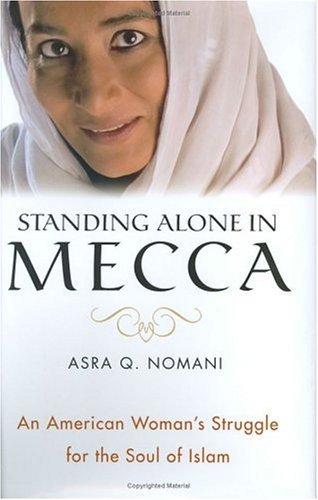
Standing Alone in Mecca: An American Woman's Struggle for the Soul of Islam

Rate this book
As President Bush is preparing to invade Iraq, Wall Street Journal correspondent Asra Nomani embarks on a dangerous journey from Middle America to the Middle East to join more than two million fellow Muslims on the hajj, the pilgrimage to Mecca required of all Muslims once in their lifetime. Mecca is Islam's most sacred city and strictly off limits to non-Muslims. On a journey perilous enough for any American reporter, Nomani is determined to take along her infant son, Shibli -- living proof that she, an unmarried Muslim woman, is guilty of zina, or "illegal sex." If she is found out, the puritanical Islamic law of the Wahabbis in Saudi Arabia may mete out terrifying punishment. But Nomani discovers she is not alone. She is following in the four-thousand-year-old footsteps of another single mother, Hajar (known in the West as Hagar), the original pilgrim to Mecca and mother of the Islamic nation.

Each day of her hajj evokes for Nomani the history of a different Muslim matriarch: Eve, from whom she learns about sin and redemption; Hajar, the single mother abandoned in the desert who teaches her about courage; Khadijah, the first benefactor of Islam and trailblazer for a Muslim woman's right to self-determination; and Aisha, the favorite wife of the Prophet Muhammad and Islam's first female theologian. Inspired by these heroic Muslim women, Nomani returns to America to confront the sexism and intolerance in her local mosque and to fight for the rights of modern Muslim women who are tired of standing alone against the repressive rules and regulations imposed by reactionary fundamentalists.

Nomani shows how many of the freedoms enjoyed centuries ago have been erased by the conservative brand of Islam practiced today, giving the West a false image of Muslim women as veiled and isolated from the world. Standing Alone in Mecca is a personal narrative, relating the modern-day lives of the author and other Muslim women to the lives of those who came before, bringing the changing face of women in Islam into focus through the unique lens of the hajj. Interweaving reportage, political analysis, cultural history, and spiritual travelogue, this is a modern woman's jihad, offering for Westerners a never-before-seen look inside the heart of Islam and the emerging role of Muslim women.

320 pages, Hardcover

First published February 15, 2005

34 people are currently reading
1066 people want to read

About the author

Asra Q. Nomani

9 books19 followers

Ratings & Reviews

What do you think?
Rate this book

Friends & Following

Create a free account to discover what your friends think of this book!

Community Reviews

5 stars
164 (29%)
4 stars
176 (31%)
3 stars
151 (26%)
2 stars
51 (9%)
1 star
21 (3%)
Displaying 1 - 30 of 71 reviews
Profile Image for Farhat Amin.
Author 24 books111 followers
August 28, 2020
You get the impression the book was written by a person who dislikes everything about Islam. The author clearly wants to do her own thing as illustrated by the quotes:

“I didn’t wear a wedding ring, but I didn’t feel as if I had done something wrong. I had loved my boyfriend deeply and surrendered myself to him. Even if my assumptions had been wrong, I loved him when I made this baby. ”

“I didn’t pray the requisite five prayers a day. I didn’t cover my hair. And, yes, with my baby as evidence, I had sex outside of marriage. Although I had a firm faith in a divine force, I didn’t invoke the name of a God who judges, punishes, and rewards. I tried simply to live as a good Muslim with humanitarian values, in the same spirit as a good Christian, Jew, Hindu, or Buddhist. I didn’t lie. I didn’t cheat. I tried not to hurt others. I tried to live sincerely.”

It comes as no surprise that Bill Maher is the author's biggest fan, she has been on his Islamophobic liberal show a few times. Let's be clear Asra Nomani thinks Islam needs to be secularised and reformed, just like Bill Maher, Sam Harris, she is a liberal and no Muslim is fooled by her donning a headscarf for the book cover. She is not a popular or respected figure amongst Muslims, similar to Ayaan Hirsi Ali and Mona El Tahawi.
Profile Image for Andrew.
2,254 reviews925 followers
Read
May 15, 2019
I wanted to like Asra Nomani, I really did. But... just no. Maybe she's a talented enough short-form journalist, but this was a repetitive slog, first of ham-fisted attempts to find spiritual meaning and metaphor, and second of every grisly detail of her one-woman crusade (OK, I could have looked for a better word choice there, but don't read too much into my use of it) to bring gender equity to her local mosque. And moreover, her keen eye only seems to turn towards matters spiritual (which I care little about) while being seemingly completely blind about larger-scale sociocultural forces (which I care deeply about).

Oh, and she said nice things about The Da Vinci Code. Maybe this is petty, but that allows me to completely disregard her as a writer. That's like being a musician and admiring Imagine Dragons.
838 reviews85 followers
July 30, 2014
Oscar Wilde said God's law is love. He asked the eternal question why is there separate rules for men and women? The title of this book is a woman's struggle for the Soul of Islam, it may be more accurate to say a woman's struggle for her soul within Islam. For the generation of young people in Islam that where either in North America or Europe as small children or where born there raises many issues and conflicts. Many governments cry that all citizens should declare alliance to nationalisation first and religion second and any affinity with their parents or grandparents homeland as a distant third at best. The usual questions since the civil rights began assimilation to a melting pot where mixed cultures and heritage is dismissed or separate but equal status? Does Asra Nomani mention or handle any of these necessary questions in her book? Not really. Only in around about way that the generation born in her life time in similar circumstances haven't studied their faith or when they grew up forgot their learning. In Asra Nomani's case she continually sought affirmation from Man and not Allah. The judgements of Man, although brutal, was the only thing that gave meaning to her life. She only mentions the love of God briefly as a after word at the end of the book. No where in the thrust of the book does she turn to the love of God, the teachings of the Sufis, who get scant mention or the affirmation that only Allah can give. Later on she admits pleased that no lightening bolt or thunder descended, however, she doesn't say but of course God wouldn't send those things as I have not sinned. They do not sin at all those that sin for love, another Oscar Wilde quote and there is no sin except stupidity, all from a man who was not religious in the way it is termed by modernists. Asra Nomani works hard for women to pray next to men equally in her hometown mosque. God's work again or still seeking confirmation among Man for who she is? In the end she could easily have another mosque for men and women to pray in and learn and meditate than the ascribed mosque. The fight against ignorance is knowledge, but what do you do with wilful ignorance? Wilful ignorance in my mind is people that deliberately not hear or heed the voice and word of knowledge. You can teach ignorance knowledge if a person is willing and keen. But you can't force wilful and intended ignorance until the person is open within themselves. It is human nature of course that we look to others to be confirmed, parents, peers, the community and sometimes law enforcement, we look to others when we are very young, to be assured. When are we ever sure of ourselves before we need assurance by others? When we learn to feed ourselves at our mother's breast, when we crawl on the floor to get where we need to go. After that? We need the guiding hand of a parent or guardian when we learn to walk, ride a bicycle, we think we need assurances on the steps of life. Asra Nomani looked for reassurances about who she was. American first or Muslim? One or other it couldn't be both for a long time. What was her identity? Her parents couldn't provide it because they were not in her shoes, she panicked, she rebelled, she withdrew and became afraid, there are countless others like her. Countless others that deem Islam's breaking point (in the world or at home) was defined in the latter period of 2001. Nothing else in the world to do with Islam existed before this one date in the history of humanity. But these Muslims and others in North America and Europe should ask Muslims of Palestine, Sudan, Rwanda, of the Pacific part of the world if anything dramatic altered for them on this mind searing date? Yes many innocent lives were lost needlessly on this date, but more so to AIDS, to the massacre to Rwanda, the deaths is Kosovo, I don't seek to play the numbers game, these are human lives. But to constantly use this date as a stigma to say the world had changed. For countless lives in the world things didn't and have not changed. Poverty, sickness and death to millions of children still happen everyday as they have for countless generations needlessly. Women, in some aspects of Muslim households as with other faiths or non faiths are treated as second class citizens, a certain date in 2001 didn't alter this one way or another.
As a whole this book is well written, well worth a read regardless of the reader's faith or not having a faith. We must do what Asra Nomani lightly touches on. We must learn about each other, ourselves for a better understanding of the world and who and what makes up this world. You don't have to be an academic or have intense training to be a scholar of the world and what lies within it.
Profile Image for Kristina Coop-a-Loop.
1,299 reviews556 followers
August 10, 2016
Asra Nomani’s Standing Alone in Mecca: An American Woman’s Struggle for the Soul of Islam is an interesting book because it’s a very intimate look at an American Muslim woman’s struggle to align her Muslim cultural values with her Western lifestyle. I recently read Ayaan Hirsi Ali’s Heretic and her point of view is that Islam itself needs to reformed and modernized. She spent most of her life as a Muslim, but now considers herself an atheist. Nomani’s perspective is that Islam is a good religion, but it is being transformed into a religion of hate, intolerance, misogyny and violence due to radical interpretations (mostly coming from Saudia Arabia’s Wahhabism). She is still a practicing Muslim and this book is very spiritual in nature. I read both books to get a different perspective on the same growing problem: terrorism fueled by Islam. My goal in reading these books is to answer a question for myself: is Islam itself the problem or is it radical interpretations of Islamic scriptures?

The book is split into seven parts and it’s unfortunate that it’s not until Part 6: “Asserting the Lessons of the Pilgrimage” that Nomani finally captures my full attention and I can see her as an intelligent, determined woman instead of a thirty-six year old bratty, immature teenager. The majority of the book details Nomani’s pilgrimage to Mecca and Medina with her parents, young nephew and niece and her young son. It’s exhausting, rather boring, full of spiritual details of Islam that had me rolling my eyes (they greet the angels who sit on their shoulders when praying?) and reveals Nomani to be, for an experienced traveler, journalist and woman in her mid-30s, immature, ignorant of her own religion, somewhat stupid, immersed in her own musings and rather oblivious of the outside world. She’s also very taken with her infant son, Shibli, and readers must endure many mentions of his toes, his radiant smile, how much fellow pilgrims adore him and her struggle to breast feed him. I found that the most irritating—she seemed surprised that the baby would get hungry! Then many paragraphs would follow of Nomani’s search to find somewhere private to breast feed, worry that she’d be caught boob out, and possibly arrested. Seriously. You’d think she would have invested in a breast pump and a bottle. Even though she wrote this book after her pilgrimage and after she’d educated herself more fully, it’s interesting to see how different “during” pilgrimage Nomani is to “after” pilgrimage Nomani. This earlier Nomani doesn’t seem to connect the way Saudi Arabia interprets the Qur’an as a problem for Western Muslims or Islam itself. I don’t want to call her an apologist, but she does lean heavily into the stereotype that the Muslim men who committed the horrendous act of terrorism on 9/11 were men driven to despair by their economic inequalities and lack of opportunity. In her view, they committed suicide via terrorism. This view has since been disproven but it continues to be a false view of Islamic terrorists. They are often well-educated and wealthy. What do they all have in common? Hirsi Ali would say they are following the guidelines of the prophet Muhammad. Nomani would say they are following radical interpretations of Muhammad’s words. Nomani and Hirsi Ali both quote the Qur’an and some of the hadiths to prove their points. During the pilgrimage, Nomani discusses the early life of Muhammad and his first wife, Khadijah, and describes how much power and independence women had at that time. She uses this as proof that at the time of Muhammad, Islam is a woman-friendly religion. However (as she later specifies), this is pre-Islam. Islam, like Christianity, wasn’t a fully formed, organized religion until after the death of its originator. So I’d say those examples don’t count. Also, she says that many of the more misogynist practices of Islam are carryovers from pre-Islamic tribal culture. So was pre-Islam woman friendly or not? It’s a bit muddled.

Nomani’s inability to grasp the seriousness of the misogyny of the Wahhabism practiced in Saudi Arabia often left me flabbergasted. On page 80, she discusses that women in SA cannot drive and calls it “one of the most imposing restrictions on a women’s right to self-determination.” Then she compares that with the panic she felt one day when she couldn’t find her car keys and how relieved she was when she did. Um, you momentarily couldn’t find your car keys. How is that at all relatable to the experience of a woman in Saudi Arabia who is probably a professional, but can’t drive anywhere, even if she’s holding the keys to 50 cars in her hand? During the pilgrimage, they went to Muzdalifah, a place where you throw stones at a symbolic image of the devil: “They were a wonderful image to see: Samir in his white, my father in his white, the two of them separated by two generations but united in purpose: collecting stones for the three days of stoning” (131). All I can think is, lady, they STONE women in Saudi Arabia. Her sentimental description of her father and nephew gathering rocks for a stoning really creeped me out, even if it was for a symbolic ritual.

The last one hundred pages or so of the book are a welcome change from all the mommy touchy-feely, sentimental navel-gazing. Descriptions of Shibli playing in his Evenflo Portable Fun Ultrasaucer are replaced by Nomani’s realization that her own mosque is spouting radical interpretations of Islam and is becoming more and more misogynistic. This is the story I wanted to read: Nomani’s defense of women’s rights and using Islam to support her perspective. This is the best part of the book. Nomani consults scholars of the Qur’an and legal experts (at one point, consulting with a tax attorney in a defense that I found to be particularly brilliant) to say to the prophets of hate and misogyny: you are WRONG. Islam supports equal treatment of women. While reading, kept thinking: this is just like Christianity. Later, Nomani echoes my thought when she too realizes that misogynists use religion—any religion—to deny women their equal place in society alongside men. I don’t know why I never thought of it like that, but the more I read of Nomani’s research into the Qur’an, the more obvious it seemed to me. Islamic misogynists have many reasons why women cannot enter the mosque, cannot pray with men, must keep their head covered (or in some cases, their whole bodies), why they cannot drive, why they cannot walk alone, why they cannot be educated and all of these reasons supposedly come back to the need to keep women pure, to protect them, to show humility before Allah, etc. Supposedly all these “nos” are for the benefit of women. How familiar does this sound? I’m certain fundamental Christianity has much stricter rules that I, thankfully, am ignorant of, but how many times have I heard a Congressman say that all the restrictions placed on abortions are for “women’s protection” or for “women’s health”? Bullshit. It goes back to religion and keeping women from owning their own bodies. “Some men don’t want to relinquish the power and control it has taken them centuries to accumulate. Some think it is their God-given right to express this power and control over women” (271). Exactly, Nomani.

So is my question, posed earlier in this review, answered by either of these two books? No. Not definitively. Both women approached the issue differently. Hirsi Ali didn’t focus specifically on the misogyny of Islamic teachings (although she did write about it) but addressed the problem as a whole: the Qur’an contains many passages that espouse violence against women and nonbelievers and moderate Muslims need to reform Islam and disregard those passages. Nomani focused on the problem of women’s rights within Islam. She sees it as a problem of interpretation, and she is not alone in this. Many scholars she spoke with said that the more radical and hateful interpretations come from Saudi Arabian clerics. When tracking the hate speech back to its source, Nomani discovered Sheikh al-Ghazzawi. He is so dangerous that his critics call him the cleric version of Hitler Germany’s Goebbels. A UCLA law professor, Khalid Abou El Fadl, spoke with Nomani about Islamic feminism. He argued against the theological arguments used by al-Qaeda leader al-Zarqawi to behead prisoners: “Al-Zarqawi searches for the trash that everyone threw out centuries ago and declares the trash to be Islam” (274). Of course, my question is, again, but what is that “trash”? Is it located within the Qur’an? Is it located within one of the hadiths accepted as being part of Islam? I think the answer to my question is that the Qur’an, like the Bible, contains many passages that encourage violence and ways of treating people that are absolutely unacceptable today. Both this book and Heretic discussed Martin Luther’s Reformation and say Islam needs its own version of this. In the end, I don’t think my question is all that important, but I’m glad I took the time to investigate it. I’m now much more informed on the subject. Both Hirsi Ali and Nomani discuss the cognitive dissonance that American Muslims must feel when trying to practice their religion yet live in a society that seems to contradict its teachings. Nomani has several excellent paragraphs about this, but I’ll quote just a few things she says:
“We need to create an American Muslim versus having just Muslims in America” (185, actually a quote from a man named Amir Kanji).

“Both the world and the Muslim ummah (community) are at a crossroads in history. Within the Muslim world, we must open the doors on ijtihad, not slam the doors on critical thinking for the sake of political correctness” (255).

“If we were going to truly live up to the ideals of an honest society, it seemed to me, Muslims had to reconcile these contradictions (holding sexist attitudes but participating freely in American society), guided by the principals of tolerance and equity” (263).
If you’re trying to comprehend the rise in terrorism around the world being perpetrated by men who yell “Allahu Akbar” while committing these heinous acts, Ayaan Hirsi Ali’s Heretic and Asra Nomani’s Standing Alone in Mecca are both good books to read. Nomani’s book is a more spiritual view of Islam, but I think both women’s goals are to inform people about the causes of these terrorist acts and how to counteract them. If terrorists and misogynists get their validation from the Qur’an itself or radical, questionable interpretations of the Qur’an, the problem is still the same: how to effectively stop them and their ideology of hatred and violence. Both women express amazement at America’s reluctance to question the more intolerant practices of Islam due to political correctness. Both of them also think that while America is guarding its airports and borders, it’s letting radicalization in via Islamic websites and radicalized clerics in the mosques. This type of ideological terrorism cannot be fought solely by guns and bomb-dropping drones. Moderate Muslims like Nomani who speak out against the hate being preached in their mosques must be supported by their communities and the American government. For anyone at all interested in the subject of Islam, both of these books are recommended, although Nomani comes with the caveat that the first three-quarters of the book are rather tedious and annoying, but the last 100 pages or so make up for it.
Profile Image for Linda ~ they got the mustard out! ~.
1,890 reviews140 followers
dnf
May 22, 2019
DNF @ 28%

88 pages all saying about the same thing: radical Islam hates women. Which I didn't even need to read one page to know that. There are certainly a lot of interesting things here, and I enjoyed what I learned, especially about the roots of Islam and how it's changed. The issue is that while this is technically well-written (the author is a journalist and knows her grammar), it's not very absorbing. It's repetitive, and reads like an article rather than a book. Half of these 88 pages could have been trimmed out without losing anything essential.
Profile Image for Peacegal.
11.6k reviews102 followers
August 4, 2016
On one hand, I think it’s good for my book discussion group to read this, as several of the members could use a basic education about the Islamic world that isn’t taught by Glenn Beck.

On the other, the writing style and the author’s constant repetition of herself did not make for enjoyable reading in my opinion. Standing Alone in Mecca became an utter chore.

The gist of Nomani’s book is that Islamic fundamentalists have misinterpreted the Qur'an in order to repress women in Muslim communities. The author draws upon her own experience going on a pilgrimage to Mecca and enduring prejudice in various areas for having a child out of wedlock.

Non-parents, beware: expect a lot of smug and sticky-sweet mommy talk. You’ll have to suffer lines like:

A spiritual umbilical cord connects all women through the timeless universality of motherhood.

Sigh. Where’s that facepalm?

Facepalm

Ah yes. There it is.

There are also so many uses of the word “conception” and its variants that I wanted to throw something across the room (possibly the book).

Part of the hajj, or spiritual journey, undertaken by pilgrims to Mecca involves the sacrifice of an animal, usually a lamb. However, like most today’s meat-eaters, Nomani doesn’t participate in or witness the slaughter, but rather pays someone to conduct it out of sight:

We simple pay a fee to our travel agency to sacrifice lambs for our family and are told that the meat will go to pilgrims and the poor.

A picture in the photo section depicts a sea of sheep in a massive arena, the text explaining that they are “waiting to be slaughtered for the Day of Sacrifice.” The animals are packed so tightly it would be difficult for one to turn around. A major theme of this book is family bonds; it is worth noting that every one of these sheep, as well as all of the other billions of animals slaughtered for food, are also mothers, fathers, children, and friends.

The author also speaks of renting a tiger cub from a roadside menagerie to appear at her baby son’s birthday party. No legitimate zoo is going to farm out big cats in this way, and sure enough, a quick Google search revealed photos taken by zoo patrons of the facility. We see two bears (described by the photographer as constantly pacing) in a barren, concrete-floored enclosure and a chimpanzee in a concrete-and-steel-bar enclosure that resembles a prison cell. The photographer pronounced the facility “the worst zoo ever.”

But back to the book. One of the aspects I found most intriguing was the author’s description of the mix of traditional and Western culture in Saudi Arabia. The road to Mecca, we learn, is lined with KFCs and Donut Houses. Avril Lavigne and Oprah appear on TV, and

In a country where homosexuality was illegal and punishable by death, “Will and Grace,” the sitcom about a gay man and his female roommate, could be seen on the Comedy Channel.”

However, some of the culture clashes the author described just didn’t ring true. At one point, the text reads:

Samir stared at the soldier. He thought to himself, He has a gun. It was not a scene he normally saw in West Virginia. Samir was scared.

I was born and raised in West Virginia. And while the scene of a military road block would indeed be an unusual sight, guns are most certainly not. From the fairground gun shows to the ubiquitous NRA stickers and gun racks on hunters’ pickup trucks, firearms are a huge part of everyday culture in this state. (There are probably more guns than people!) I understood the author’s point, but she worded the passage very strangely.
Profile Image for Nabeela.
6 reviews
July 4, 2007
I didn't know what to expect when I picked this up, but I really enjoyed it. It is a candid point of view of the things many American Muslim women might wonder about but not have the courage to ask or question. Seeking to understand within one's faith isn't always the same as questioning ones faith though sometimes it may feel that way. In the author's case there were doubts about her faith which lead her down a path of self discover and actualizing her relationship with God. It is a book about how there isn't one version or one universal interpretation of Islam and how the Muslim community continues to spiral down a path of judgment and intolerance among Muslims and non-Muslims alike. I learned the depth of "Hadith Fishing" which means I can find two hadith to support my interpretation and combat your one hadith which supports your interpretation....in that case who is right? Well at the end of the day we should still be able to show humanity that Islam above all is about peace, dignity, respect and tolerance regardless of which Hadith I/we chose to stand/hide behind.
10 reviews2 followers
August 2, 2021
there was one really good thing about this book. it was the first time i read an account of hajj from a woman's perspective. loved that. it really made me want to go there myself. when the author starts talking about reform after she return from hajj, she really starts to lose it. she wants to reform a community she has played no part in and then wonders why no one welcomes her. she sounds very out of touch with her muslim background. her constant surprise at how islam and modernity can and do co-exist is rather annoying.

her cause sometimes has merit but her approach is very aggressive and works against her. any true activist who really wants positive change knows that it is HARD work and takes patience.
Profile Image for Ad Astra.
605 reviews3 followers
November 23, 2015
I can't express my gratitude for having this book written. This is a manifesto of women's rights in Islam. It is a book that questions and speaks to me as an American, and as the wife of an Islamic follower.

This is a really engrossing, and at times very intimidating, story of the female psyche in Islam. One woman's journey and the forces that supported her to bring more rights to women in mosques and for the right to practice Islam alongside men. It is about her travels to Mecca and her experience at the Hajj.

It is a very dense book, with a lot of ideas and analysis to unpack. I will certainly be reading this several times over so I can better appreciate and understand her position. It took me a long time to get into her book.

I found my own copy in a used bookstore. I wish more knew or have heard about Nomani.
Profile Image for Lisa.
132 reviews1 follower
July 1, 2015
Interesting images of the author on her hajj with baby in carrier. However, the narrative was slow going.
10.6k reviews34 followers
June 6, 2024
A SOMEWHAT “UNCONVENTIONAL” MUSLIM GOES ON THE PILGRIMAGE

Asra Quratulain Nomani is an American author, former Georgetown University professor, and Wall Street Journal reporter. She wrote in the Preface to this 2005 book, “This is a tale of a journey into the sacred roots of Islam to try to discover the role of a Muslim woman in the modern global community. This book is a manifesto of the rights of women based on the truth faith of Islam. It heralds a revolution in the Muslim world of the twenty-first century. My book is about sorting out the contradictions about religion. Two defining moments shaped my relationship with my religion: the murder of my friend [journalist] Daniel Pearl, and the birth of my son… the men who killed my friend did so in the name of my religion. The man who is the father of my baby went to the mosque for his Friday prayers but did not stand beside me when I brought my baby into the world. He considered me illegitimate in the eyes of my religion because, while foolishly in live, we weren’t married when we conceived our baby. Others called ma a criminal in the name of Islam.

“I was very much at odds with my religion. But … I decided to find out more about my faith… I embarked on the holy pilgrimage to Mecca… in the kingdom of Saudi Arabia, one of the most repressive regimes in the world for women. What happened there shocked me. The hajj became the catalyst to my empowerment as a woman in Islam… I returned to my home … with an awakened understanding of the highest ideals for Islam for both women and men and for the community. The hajj gave me courage to act on the ultimate conviction that women can be fully engaged members of the Muslim community.”

In the first chapter, she recounts, “I was also trying to do my hajj. This time I had a potential assignment from … an outdoor adventure travel magazine… I was fortunate to know a fellow Wall Street Journal reporter who had penetrated Saudi Arabia’s bureaucracy and reported from there. His name was Daniel Pearl… ‘Should I go as a journalist or an ordinary pilgrim?’ I asked him… From Danny’s warning… I decided to proceed as an ordinary Muslim pilgrim... a Saudi architect, Dr. Sami Angawi … warned me… ‘The Saudis have destroyed so much in the name of Wahhabism.’… I didn’t know what this term meant. I hadn’t grown up with the sense of the differences between Muslims… To Sami’s professional horror, Wahhabi clerics had dismantled the prophet’s house in Mecca to clamp down on anything that might be interpreted as worship of the prophet Muhammad.” (Pg. 16-18)

She and her son set out. “I had to admit something: I was afraid for my safety. I was in a country that was totally defined by repressive ideology that I was just learning about, Wahhabism… I stood in Saudi Arabia sad that my religion was being misrepresented by Osama bin Laden and his brand of puritanical Islam. No longer perceived in all their complexity and humanity, Muslims had become a monolithic enemy. What troubled me even more was that our broader Muslim community was being taken over by right-wing Muslims.” (Pg. 41-42)

She states, “We slipped our sandals off and put them into plastic bags … to keep from misplacing them… As our sheikh led the way, I followed him. There was no women’s entrance… There was no distinction of space separating men and women. We were one and the same here. It felt so liberating.” (Pg. 55)

She laments, “Islam encourages men and women to be courageous in their spiritual jihad. I tried to fulfill the expectations of my culture by marrying a man of my faith. When it became clear after I married him that we were incompatible, I had to overcome my cultural programming to leave him, believing that Allah did not want me to suffer in a suffocating, emotionally empty marriage. Ten years later I chose to leave the father of my baby after it became clear that the relationship would be unfulfilling and tumultuous. I realized that I had been trying to stay together with him for the wrong reasons. I felt incomplete, and I wanted him to make me legitimate.” (Pg. 67)

She suggests, “To me, there is something fundamentally wrong about the way Muslim communities define themselves. It strikes me that women… should be bound by something greater than rules: the inspiration of living well. All around me in Mecca were reminders of the constraints imposed upon women in traditional Muslim society.” (Pg. 75) Later, she adds, “It saddens me to realize that [the Prophet’s wife] Khadijah could never have lived in modern-day Saudi Arabia. The Saudi government doesn’t allow women to run businesses in their own names.” (Pg. 87)

She points out, “My experiences with my mixed-gender tour group, my forays into the Sacred Mosque where men and women prayed together… revealed the inherent contradictions in Muslim society. Men and women mingled comfortably in Mecca. How could men and women be equal and interact without this burden of sin in Mecca but not elsewhere? This question had a profound impact on me. Places like Saudi Arabia strictly segregate men and women, but in the West Saudi men and women freely circulate in mixed-gender situations. Even where Muslim women are allowed to work in the West, the attitudes of segregation still prevail in traditional communities, even at dinner parties… where women are sitting separately from men.” (Pg. 94)

She argues, “The Qur’an [40:40] evokes the virtue of righteousness equally in men and women… In [3:195] God says that men and women are equally rewarded for their acts of goodness on this earth… Over and over again the Qur’an teaches us that woman are equally charged with carrying their weight… My eyes were opened to see Muslim women excelling in the world under the umbrella of Islam.” (Pg. 202-203)

Afterwards, she acknowledges, “Sitting in the safety of my hometown, I had to admit I’d gone to Saudi Arabia with a bias against the country, I didn’t subscribe to the rhetoric of division that I had heard promulgated by its ranks of mullah, or religious clerics. I returned from Saudi Arabia, however, having heard only hints of disturbing rhetoric and without having witnessed blatant expressions of hatred toward people who didn’t agree on theological doctrine. The Saudi government was starting to wise up to the dangers fomented by hate speech.” (Pg. 229)

She concludes, “As Muslims in America, we are engaging in … a struggle for the renewal of the soul of Islam. We aren’t trying to change Islam. We are trying to question defective doctrine from a perspective based on the Qur’an, the traditions of the prophet, and … critical thinking. I was fortunate enough to travel to the heart of Islam through the pilgrimage of the hajj, and I was blessed to come to know the pulse of the true spirit of Islam. As a result, I was prepared to join the quiet tide of reform that is very much under way in U.S. Muslim communities. That movement eschews bigoted, sexist, and intolerant practices that betray Islam, the prophet Muhammad, and all of the good people who call themselves Muslims.” (Pg. 281)

While some may reject Ms. Nomani on the grounds of her “past history,” her book is a penetrating perspective on women in Islam, the future of Islam, and the hajj itself.
Profile Image for KD.
Author 12 books35 followers
January 15, 2011
The book chronicles Nomani's coming to terms with Islam and her own identity through a series of major events over a period of 3 years: the death of her friend Daniel Pearl at the hand of Muslim terrorists in Pakistan; the birth of her son Shibli after she is deserted by the partner she had intended to marry; her decision to perform the hajj with her parents, son, niece, and nephew; and her struggle for women's rights within her own mosque in Morgantown, Virginia and in American Islam more generally.

My only complaint is with one aspect of her writing style: displays of (past) ignorance, as she walks you through what she learned about Islam. I was surprised at, and find hard to believe, her ignorance of some basic facts about Islam. I think she may have done this deliberately so her readers could learn alongside her, but I would have preferred her to speak with some authority.

Her descriptions of hajj are detailed and honest. I could imagine myself in her shoes, trying to tow the line with all the Saudi-imposed rules on hajj even when they conflict with my own beliefs about islam.

I was really moved by her fight for an equal prayer space for women in her mosque and her bravery in speaking up at the Islamic Society of North America convention, in the media, etc. During her fight with her own mosque, she wrote the Islamic Bill of Rights for Women in Mosques, which I agree with.

Through the course of her experience and research, she meets with Amina Wadud, Kecia Ali, Khalid Abou el Fadl, and many other progressive Muslims. Her book is a great introduction to their work for those who haven't already read them. She is a model for how we might all fight for our rights as women within Islam, and a voice of tolerance and open-mindedness.
This entire review has been hidden because of spoilers.
Profile Image for Danial Tanvir.
414 reviews26 followers
November 8, 2016
this book was just lovely.
i read it two times in 3 to 4 days,
it is about Islam.
it starts with the author who was lost in holy city in India.
Asra Nomani is a brilliant writer.
she was born in India but moved to america when she was young.
she was friends .with the reporter Daniel pearl and was in karachi when he got killed.
she then talks about how she had sex before marriage and produced a son Shibli.
she talks about her journey into the holy city of Mecca which is in Saudi Arabia.
she talks about how it is considered bad and immoral to have sex before marriage.
it talks about how women are oppressed and not given equal rights as men and are treated badly.

she travels in many countries including India , Pakistan and Saudi Arabia etc.
she goes to Mecca and prays to god.
she has with her , her son Shibli.
she is a Muslim and wants to find her friends Daniel pearls killers.
she goes to the mosque in her home town of Virgina where she is mocked for being immoral and having a child without marriage.


the book is actually about Asra Nomani , her life and about Islam,
in Mecca , she prays to God.
people say bad things to her for having a child without marriage.

this was a great book indeed!.
Profile Image for Chadijah Mastura.
57 reviews17 followers
August 30, 2007
A must-read! This is a revolutionary book which sets a small path yet significant toward a peaceful living and better understanding among all humans. It shows the real face of Islam--Nomani said that she could be rated as ´Moslem Generation X´, but I think, indeed, she should be rated as Moslem Generation A: the real one. Because the ones who teach and spread hatred, violence and intolerance are actually the ones who should be called the X-Generation, the ones who misinterpreted and bended the teaching itself in the name of power, such as Osama bin Laden (I consider him as a ´kafir´ because no man had ever spread hatred and ambiguities toward God as he does).

I like the critic from BOOKLIST which said: "Ultimately, Nomani´s riveting, cogent, and inspiring account urges the moderate majority in all faiths to rescue their traditions from those who twist religion into a weapon of mass destrustion and terror." -- so true.


128 reviews6 followers
February 11, 2017
1. I would be very interested in a publication that explores how much the author's campaign for womens' equal rights in mosques has progressed since she wrote this one.
2. As someone who resorts to exit as a first option, I find it very hard to understand, or develop empathy with people who resort to voice. It is a little baffling to me that women would campaign to be allowed into mosques, instead of just giving up on the mosque or religion as a whole. But this book brought me a little closer to sympathy or empathy with that course of action, even though I am still not sure if I agree with it.
3. The death threats described are horrifying.
4. But one reason this book also is a little irritating is that as an autobiography (and this is autobiography far more than serious research or advocacy), it is a little too preening.
Profile Image for Lisa.
223 reviews1 follower
March 31, 2009
This is a great book for anyone interested in learning about some of the struggles progressive Muslims face in shaping how Islam will be expressed in the United States. Some of the writing was repetitive and a little choppy, but that was the least of my concerns--Nomani's story was so powerful that it kept things interesting, even when points were repeated. And besides that, the points that she repeated are extremely important: that women have a religious right to equality; that men have a responsibility to support women's equality. Her story of going on the hajj, or pilgrimage to Mecca, was fascinating. Her experiences taking action for women's equality after returning from hajj are equally compelling. Highly recommended.
Profile Image for Sarah.
24 reviews
October 14, 2009
This is a great read if you are ready to hear about one woman's personal struggle with her religion. The tone isn't an "enlightened" one but it is an honest book (not some behind the burqa, thousand splendid suns or other opportunist "I am an oppressed Muslim woman" book). There are some insightful descriptions of Hajj and Mecca as well.
Profile Image for Marilyn Chilcote.
51 reviews5 followers
May 8, 2011
Al-hamdilulla! Praise be to Allah! I gave this four stars for the writing, but definitely five stars for the content. I'm so grateful for An invitation into Islam. This is Islamic liberation theology. I can't recommend it more highly. I am ready for my Shahadah,statement of faith, assuming as I do, multiple memberships– all in this kindom of God.go to sleep what's my next book Bobby got it for me
Profile Image for Beth.
100 reviews7 followers
July 3, 2017
"The challenge for each of us," Asra Nomani writes, "is to discern our personal faith from the doctrines others try to impose on us" (255).

An independent woman, a journalist, an unmarried single mother, and a Muslim, Standing Alone in Mecca is Nomani's journey to integrate these disparate parts of herself in a way that allows her to become her fullest and most authentic self within her faith, not despite it. Her journey, though, is not merely a spiritual one, but the spiritual is reflected in the physical world as Nomani joins the hajj, the Muslim pilgrimage to Mecca and Medina.

Standing Alone in Mecca is an intimate autobiography, a matrilineal history of Islam, and a spiritual reflection told in an unflinching voice by an author who acknowledges both her strengths and her weaknesses equally. Indeed, even as she chronicles her crusade for the rights of women within Islam, Nomani positions herself as a pilgrim, not a savior, and she unfailingly credits those whose insights and guidance have made her journey possible.

Nomani's chronicle of her quest to find a place for herself within religion in which the Divine has been hijacked by cultural forces of patriarchy and control reminded my very much of my own search for a woman-affirming faith within the Christianity of my childhood, though perhaps she has found herself and her faith more effectively than I ever have. An interesting and thought-provoking read, I would recommend to anyone who is seeking a deeper understanding of Islam, particularly within the use, or who searches for a way to be a feminist woman within a deeply patriarchal social, cultural, and religious framework,
Profile Image for Sanjay Banerjee.
541 reviews12 followers
June 16, 2020
A personal narrative relating the modern day lives of the author and other Muslim women to the lives of those who came before, bringing the changing face of women in Islam into focus through the unique lens of the Haj. The author, an American of Indian Origin and born in India before emigrating at the age of two with her parents and sibling, shows how many of the freedom enjoyed centuries ago have been erased by the conservative brand of Islam practised today giving a false image of Muslim women as veiled and isolated from the world.

Her narration of the free and open mixing of men and women during worship at Mecca (during Hajj) and contrasting it with the restrictive Saudi society as also Muslims in some other societies is revealing. She also provides insights into the inconsistencies in the approach of the Puritans. Her 'crusade' for emanicipation has shades of Gandhi's Satyagraha especially in her dealing with the mosques in America. Interesting and relevant theme but the narrative tends to meander and is disjointed and loose at times.
Profile Image for Matt.
22 reviews1 follower
July 31, 2021
Standing Alone in Mecca is the journey of a single mother doing the hajj with her family and experiencing it from the standpoint of a woman journalist. As she explores gender roles in Islam in its most holy places she begins to form a world view about her place in her religion and what the religion as a whole is really about. It is a book written by a dedicated reformist with insight into culture in Mecca (something few westerners will ever be able to understand.
Profile Image for Eli.
225 reviews6 followers
July 24, 2025
This work falsely paints an optimistic picture of Islam. The author conveniently ignores much of the misogyny in Islam and instead blames culture and men. The fact that she doesn't mention feeling guilty or repenting blatantly betrays the state of her faith: iffy at best, since Islam holds faith without works to be next to useless.
1 review
November 15, 2019
I gave it five stars. It’s a very detailed analysis of how Islamic law has developed over the years. I loved the historic context she gave during her own journey to KSA. I learned a lot about my religion in this book.
63 reviews
April 14, 2018
Don't forget to get the Recommended Readings!
30 reviews
February 23, 2020
At first, it seems like a travel report of a woman going on hadj, with the addition of the setting where she struggles finding herself as a single mom in Islam. Nomani is good at making observations, and relating them to her journey, her fears and her believe that what's happening in the modern world is not what she was taught that Islam means. Apart from the personal level, she succeeds to translate the observations to a more society meta level, trying to make sense of all of it.
Back in the States, she starts putting into practice what she learned for herself on her religious journey and the learnings of the hadj, especially on the woman's position in Islam. While doing so, she finds a lot of obstacles in her way, but she doesn't give up.
It was an eye opener what kind of incidents take place in western society. This book teaches about these (unseen) influences as well as what can be achieved if one defies them. I found both lessons a must read for everyone who is not an expert on this topic. Even 15 years after it was published.
Profile Image for Alex Shrugged.
2,747 reviews30 followers
July 25, 2019
"Standing Alone in Mecca" is an autobiography of a Muslim, raised in the United States who has a child out of wedlock and travels to Saudi Arabia with her baby for the hajj to find herself. Asra Nomani does a good job of it too. Her writing is easy to read. The typography is inconsistent but that is a technical point and more a criticism of the publisher than anyone else.

My wife met the author recently and picked up the book. I read it. It reminded me a lot of Blu Greenberg's book "On Women and Judaism: A View From Tradition" where it is not only autobiographical but teaching what one's religion says about a woman's role and how it got all mucked up by men... essentially. I think Blu makes a better case than Asra but that might be because Blu has a larger background in the technical aspects of Judaism than Asra has about Islam.

For example, it seems clear that Asra does not understand what "Fear of G-d" means... in Hebrew: Yirat Hashem. The problem is with English which does not have a corresponding word for "yirat". Most translators use the word "fear" but that is misleading. It is more like awe... like... you respect someone so much that you are afraid you will disappoint them. You are NOT afraid they will hit you. See what I mean? I presume Arabic has the same problem in translating into English... Hebrew and Arabic share many language roots.

She also delves briefly into the Palestinian/Israeli controversy. I don't think she understands the nuances there either, but she doesn't dwell upon it. She mentions it and moves on.

Her view of Pakistan matches my own but her view is more authoritative born of experiencing Pakistan. Mine is just from reading about Pakistan. And because I've read about Pakistan, when she makes veiled criticisms of Pakistan, I know what she is talking about.

So... overall, good book. I think her thrust to get women's rights recognized in American mosques is a good one. Where I think she is incorrect are minor points anyway... to me. Of course... I'm not a Muslim. Muslims will have to figure this out on their own, but Asra's main points are good ones and well founded. I hope she makes it work.

From a Jewish perspective I can see how some Jewish women could draw a parallel with how women are treated in Orthodox Judaism. I can see some parallels but a solution is not parallel. Where Asra finds clear precedence in Islamic religious texts, none are so clear in Jewish texts. They do exist, however and can be found in Blu Greenberg's book mentioned above. You can read the book yourselves to see if they are compelling.

For example: I have no problem creating equal spaces in the synagogue for women. During study sessions, women should be included as equals. Although I think that men and women should be separated during prayer, the floor seating ought to be equal. I think men should lead the prayers, but if women wish to start their own prayer group, I have no problem with that being led by women. (I have good technical, legal reasons for thinking this is OK which I won't mention here. Just know that I'm not saying this to kiss someone's backside.)

I remember speaking to a board member of a Conservative synagogue, asking that they put up a mechitza (a separation between men and women in prayer.) She asked me scornfully, "If we put up a mechitza in the back of the synagogue, would you stand behind it?" (She meant like the women are forced to do in some Orthodox synagogues.) I replied, sincerely, "I would." She dropped the subject immediately, and we never spoke of it again. I don't want people to think negatively of her. Even if she had agreed with me, and wanted to do this, I doubt it would have happened. She was just one board member, but I did ask, and I was sincere. I would have stood at the back of the synagogue and prayed.

Update 2019-July-25. I added a link to Blu Greenburg's book and added a few commas and connective words for the sake of better grammar and a clearer flow of text.
Profile Image for Sandy.
202 reviews
March 14, 2015
“Wow, what a brave, strong, and spirited woman.” I just had to get that said. From the first page, I was drawn in and touched by Asra Nomani in the book Standing Alone in Mecca. In the preface and first chapter, I connected with her - a woman my own age - and her stated quest: “sorting out the contradictions about religion.” She completes this task and educates and inspires us along the way.

Asra Nomani immigrated from India to a college town in eastern U.S. when she was a child. She was raised Muslim, and as many thoughtful young people do, she felt frustrated at times with her religion and questioned its limits and traditions. Nomani became a successful journalist and traveled extensively throughout the world. But her most meaningful journey is with her family to Mecca and Medina in Saudi Arabia to experience hajj, the Islamic holy pilgrimage, possibly the largest gathering of humanity in the world. I am grateful that I can know so intimately what the hajj could be like from her detailed and heartfelt account. She takes us with her to the embassy to secure a visa, onto the bus, into the massive crowds — in 2003, over two million pilgrims were completing the hajj when Nomani was there — and to all the holy sites. She journals the highs and the lows of the hajj and reveals her spiritual development which informs the second half of the book.

Back at home in the US, Nomani encounters sexism and prejudice within her local mosque that was not present during the hajj in the conservative Kingdom of Saudi Arabia. Confused and hurt, she begins a search for truth in Islam. Her exploration, revealing a downside of religion when holy texts are interpreted as a means of power and control, leads her to take a stand against oppressive male domination within her religion, and in doing so, she empowers not only herself but all women, of all faiths, or none. Standing Alone in Mecca will encourage anyone who would like an equitable world to stand up, and speak out, for positive change.

Some of my favorite lines: “It started becoming clear to me that the world was desperate to hear the voices of Muslim moderates.”

“But I had never really set forth my views about…well…anything. Now all of a sudden I had to speak, and my words were causing a stir. I was shocked. So many people stay silent because they believe, as I did, that others know more than they do or that their thoughts are irrelevant. When I realized that my own thoughts were not only relevant but well informed, it occurred to me that many people have important things to say but remain silent because of their fears.”


Profile Image for Christine mary.
57 reviews1 follower
February 11, 2016
Picked up this book after hearing Asma on NPR. I liked what she had to say about hijabs in Islam and so looked up some of her work.

Asra has written a very interesting, informative, bold, and beautiful account of her revival of faith through the Hajj and using that momentum to steamroll over shocking puritan bigotry she found back home in her American mosque. It is a great mix of personal soul-searching and revealing investigative work, from analyzing the Qur'an and Islamic history to finding out the identities of the internet trolls slut-shaming her. It leaves the reader with a feeling of positive intrigue about the Islam as explained and lived by the Prophet Mohammad, as well as a sense that American Muslims must break out of complacent or apathetic silence and have the motivation and courage to protest the hateful rhetoric coming from the loud (and well-resourced by Wahabi/Salafi schools) puritanical voices in Islam.

I really liked her story, and have only two criticisms that detracted slightly from my enjoyment. She was quite repetitive at times (how many times must I be reminded that men and women prayed side by side in Mecca?), so that is a bit taxing when reading a large number of pages in one sitting. Also, I got a sense of self-importance and self-satisfaction from Asra. I feel that her actions and results speak for themselves, and I didn't need to see so many emails, letters, and quotations from friends calling her a role model and telling her that she is doing such amazing, important revolutionary work. A few to illustrate her incredible support network would be fine, but it was a couple too many, coming off like tooting her own horn.

All in all, made me feel much more knowledgeable and made me want to learn more. I visited a mosque in Madison, WI several years ago and remember well how horrifying the women's entrance (not shoveled after a foot of snowfall) and room (tiny and completely separated from the main hall, with only a tiny TV with horrible sound and video quality to show the sermon) were. I'm happy that this blatantly discriminatory standard is not going unnoticed. The experience certainly did not make me want to go back and consider joining the faith. Perhaps someday all American mosques will follow the standards as set by the founder of the religion as envisioned by Asra.

Thanks Asra!

https://www.youtube.com/watch?v=yWNv9...
Profile Image for Nishith Vasavada.
Author 1 book7 followers
December 22, 2013
Do not be misled by the title of Standing Alone in Mecca . . . because it speaks not of Islam or even religion but for the eternal human search for liberty, fairness and justice. Her expose of Islam is the expose of abuse that every religion has gone through at the hands of dogmatic zealots. It is the story of human propensity to leverage any and all means of power--religion, politics, money--to control others. The author's journey to Mecca is a fascinating account of the pilgrim that only Muslims are allowed to go to. Other religions have been guilty of this exclusion as well, to be fair. While feeling guilty of bringing a child to the world out of wedlock, Asara ends up in Mecca to seek redemption, and finds a surprise.

"After undergoing the most sacred of experiences as a Muslim woman in one of the most repressive regimes in the world, I received a shocking wakeup call when I tried to bring lessons from the pilgrimage home to my own community in America--one of the most democratic societies in the world."

She found that "In my mosque, what was alarming was not that this man, living with two Saudi wives in Morgantown,spewed this hate-filled rhetoric just blocks from the campus of West Virginia university, but that none of the 150 WVU doctors, professionals, PhD students, and undergraduate students in the congregation uttered a protest. From the trenches in small-town Americana, I was observing something disturbing. Even at a time when the government of Saudi Arabia was taking a moderate position--at least publicly--tolerant and inclusive Islam was losing in places like Morgantown as zealots filled a vacuum created by an ambivalent moderate majority and a passive, even sympathetic, leadership."

Let me repeat for clarity that the men who schemed in the name or religion to ostracize Asra from the mosque that her father had founded are not the exclusive domain of Islam. Such bigotry runs across all cultures and religions. This book is a bold attack on such behavior and not on a religion. Asra chose to face these and other discriminations as a thinking, courageous speaker of truth, supported by like-minded courageous and thinking Muslim men and women. To me, this was the best part of the book. Moderate, fair-minded people must speak out or lose to the tyrant minority, be it Hitler, Khomeini, Putin, or others like them.
Profile Image for Ron.
761 reviews145 followers
April 2, 2012
Although written mainly for an American Muslim audience, Nomani's book tells an absorbing story for other readers whose knowledge of Islam is limited by whatever happens to be the day's news. Nomani, best described as a reformer within the American Muslim community, accomplishes two things: describing in detail the compelling experience of hajj (a pilgrimage with her family to Mecca in post-9/11 Saudi Arabia) and opening the doors of the mosque to reveal the fiercely intense political struggles that are currently being waged there between hard-line conservatives and moderates.

The polarizing issue (and its magnitude may surprise some readers) is the role of women in the mosque, where the near absolute dominance of men prevents women from worshiping as equals before the Creator. Simply insisting on the right to enter by the front door of her family's mosque in Morgantown, WV, causes an uproar, and her Bill of Rights for Women in Mosques has the impact of Luther's 95 Theses in shaking the foundations of rigidly held Islamic dogma.

Meanwhile gender intolerance, as she notes, is accompanied by the anti-Western, anti-democratic politicizing of Islam that is being advocated within the walls of many mosques in America. Hers is a disturbing account of a religious community under siege. Nomani is not a scholar, and her book is more the story of a personal journey than a reasoned argument in support of toleration, compassion, and equality, which she holds as the core values of Islam now betrayed by religious extremists.

Along the way, she struggles with doubts and uncertainties, confronts obstacles, and over a period of time (2001-2004) overcomes barriers both within and without to assume leadership as an advocate for Muslim women's rights. It's easy to find fault with aspects of this book, and many are noted in the other reviews posted here. While her story is fascinating and worth reading by anyone wanting to understand more deeply the political and cultural complexities of Islam both in the world and here in the U.S., it's probably not the only one a person should read.
Displaying 1 - 30 of 71 reviews

Can't find what you're looking for?

Get help and learn more about the design.