

What do you think?

Durand's Curse: A Line Across the Pathan Heart
Blood and fire have often blighted Afghanistan, the three Anglo-Afghan wars being among the
bloodiest and the cruelest in its history. But Britain’s partitioning of Afghanistan will rank as
the greatest crime of the nineteenth century. That arbitrary line which Mortimer Durand drew
in 1893 on a small piece of paper continues to bleed Afghanistan and hound the world. Alas,
this story remained untold until now.
Written in an inimitable style, Durand’s Curse is the result of deep research. Fascinating details
from long-buried archives of history reveal for the first time a tale of intrigue and deceit against
Afghanistan. First the British and then Pakistan had taken away territory that originally belonged
to Afghanistan. But the divided Pathan families refuse to accept this division even now and for the
last century and over, there has been a struggle to rub out the cursed line drawn across the sand.
Rajiv Dogra brings alive the wars, the tragedies and the Afghan anger against injustice in this
heart-wrenching account of Afghanistan’s misfortunes. This is an absolutely riveting story of the
Indian sub-continent's history told by an important writer of our generation.
bloodiest and the cruelest in its history. But Britain’s partitioning of Afghanistan will rank as
the greatest crime of the nineteenth century. That arbitrary line which Mortimer Durand drew
in 1893 on a small piece of paper continues to bleed Afghanistan and hound the world. Alas,
this story remained untold until now.
Written in an inimitable style, Durand’s Curse is the result of deep research. Fascinating details
from long-buried archives of history reveal for the first time a tale of intrigue and deceit against
Afghanistan. First the British and then Pakistan had taken away territory that originally belonged
to Afghanistan. But the divided Pathan families refuse to accept this division even now and for the
last century and over, there has been a struggle to rub out the cursed line drawn across the sand.
Rajiv Dogra brings alive the wars, the tragedies and the Afghan anger against injustice in this
heart-wrenching account of Afghanistan’s misfortunes. This is an absolutely riveting story of the
Indian sub-continent's history told by an important writer of our generation.
- GenresNonfictionIndiaHistory
254 pages, Kindle Edition
Published August 22, 2017
About the author
Rajiv Dogra
8 books8 followersAn electrical engineer by training, a diplomat by profession and a writer by choice, Rajiv Dogra became a member of the Indian foreign service in 1974.
He has served as the consul general of India in Karachi; the ambassador of India to Italy, Romania, Moldova, Albania and San Marino; and India’s permanent representative to the United Nations agencies based in Rome. Other diplomatic assignments have included those in London, Doha and Stockholm, and various tenures in the ministry of external affairs in New Delhi. Uniquely, Dogra has advised a foreign government on restructuring its foreign ministry and has sat on the advisory boards of multinational corporations.
Rajiv Dogra is also a well-known media commentator on foreign and strategic affairs. He lives in New Delhi, and paints when he’s not writing.
He has served as the consul general of India in Karachi; the ambassador of India to Italy, Romania, Moldova, Albania and San Marino; and India’s permanent representative to the United Nations agencies based in Rome. Other diplomatic assignments have included those in London, Doha and Stockholm, and various tenures in the ministry of external affairs in New Delhi. Uniquely, Dogra has advised a foreign government on restructuring its foreign ministry and has sat on the advisory boards of multinational corporations.
Rajiv Dogra is also a well-known media commentator on foreign and strategic affairs. He lives in New Delhi, and paints when he’s not writing.
Ratings & Reviews
Friends & Following
Create a free account to discover what your friends think of this book!
Community Reviews
Displaying 1 - 30 of 33 reviews

December 19, 2017
The guiding mantra of British throughout the 19th and 20th century can best be summed up as, 'On principles there should be no compromise and on compromise there should be no principle'. This also epitomizes the manner in which the British conducted their dealings with Afghanistan. Durand had indeed forced the agreement on the Amir to accept the line that ran through the heart of Pashtun land. The author brings out quite brilliantly how the British hoodwinked the Amir. British did the same when it came to dividing India, leaving behind myriads of contentious issues that have kept the neighbours "occupied". Rajiv Dogra feels that " the British atrocities in India after the First War of Independence were far greater than those they had inflicted in Afghanistan" but quoting from "My Early Life", he illustrates how the British "proceeded systematically, village by village......and destroyed the houses, filled up the wells, blew down the towers, cut down the great shady trees, burned the crops and broke the reservoirs in punitive devastation". Unfortunately, "it is the privilege of conquerors to tell stories that flatter their past". Hardly anyone exposes "its misdeeds". Even the "ugly business of gobbled frontiers is glossed over or passed off as unfortunate exception to an honourable enterprise". Durand line was one such "gobbled frontier".
An amazingly well researched book that keeps you hooked.
An amazingly well researched book that keeps you hooked.

November 21, 2017
Durand’s Curse as the name suggest is a book on the history of Afghanistan. The tale comes from the heartland of Pathans and tells a riveting story of a line drawn across the Pathan heart. The land that painted blood and witnessed many wars.
Rajiv Dogra, bestselling author of Where Borders Bleed, written on India-Pakistan relationships brings you an untold story of the Durand line long buried in a fascinating book telling the truth to the world has not known so far. The lucidly written book is a result of deep research. The book is not only a good read for the readers of history but also for the students. It is a detailed account of the land. I appreciate the efforts; the author has made to bring such a comprehensive book for the readers.
The book accounts the life, trouble, wars, tragedies and injustice on the face of the people and the country that give way to the Afghan anger to fight for the land belonged to them and was taken away forcibly. Read to know the history of misfortunes of Afghanistan and the cursed line drawn on sand.
https://thereviewauthor.com/
Rajiv Dogra, bestselling author of Where Borders Bleed, written on India-Pakistan relationships brings you an untold story of the Durand line long buried in a fascinating book telling the truth to the world has not known so far. The lucidly written book is a result of deep research. The book is not only a good read for the readers of history but also for the students. It is a detailed account of the land. I appreciate the efforts; the author has made to bring such a comprehensive book for the readers.
The book accounts the life, trouble, wars, tragedies and injustice on the face of the people and the country that give way to the Afghan anger to fight for the land belonged to them and was taken away forcibly. Read to know the history of misfortunes of Afghanistan and the cursed line drawn on sand.
https://thereviewauthor.com/

Read
December 3, 2017Finally a book that gives a complete historical background to how the British cheated the Afghans, how the Pastuns or Pathans have been historically wronged. Rajiv has written on a topic no British historian has ever bothered to write about. The book exposes the treachery of British and how they tricked the Amir into signing the ambiguous agreement. A must read for anybody who is interested to know the alternate history of Afghanistan, a perspective completely different from the biased Western view.
September 11, 2021
It's hard to decide a rating for this book. As long as it is a history book, it is excellent. Unfortunately, after a point it stops being a history book and starts reading like ranting and pontifying on WhatsApp.
A large part of the book is well-researched, well-told, fairly neutral, and overall just USEFUL. You will understand what the Durand Line is, the history that lead to the drawing of the Durand Line, and how much of a curse it has been: "a line through the Pathan heart", one could even call it a dagger through the Pathan heart.
Russia's expansion through central Asia made the British paranoid about Russian designs on Asia, and the British repeatedly went to war in Afghanistan, in senseless interventions that caused too much bloodshed and suffering.
Here's a nugget:
"... the British army used poison gas on the Frontier Pathans in the early twentieth century. This was only to be expected because the British Manual of Military Law stated that the rules of war applied only to conflict between civilized nations. In fact, the Manual of 1914 clarified that 'they do not apply in wars with uncivilized States and tribes.' "
The Western powers still seem to operate with similar beliefs in Afghanistan.
The Durand Line was drawn arbitrarily, in mysterious circumstances, on a document written in English, a language the Amir did not understand. Nobody seems to know or understand how the Amir gave up claims to a large chunk of Pathan territory. Mr Dogra explains at length that the Durand Line was supposed to separate British and Afghan areas of influence but was never supposed to be a border. He informs us that no Afghan government, not even the Taliban, has ever recognised the Durand Line.
And he seems to feel that this historical wrong can be undone.
But will any modern state give up territory it has inherited? Will any country redraw an unjust inherited border in order to return territory to a neighbour? Why will Pakistanis give up land to help unite the Pakhtoons? Especially when more Pakhtoons live in Pakistan than in Afghanistan? And when Afghanistan itself is multi-ethnic?
Peshawar and other Pakhtoon areas became part of British India because they had been conquered by Maharaja Ranjit Singh's forces and were a part of the Sikh kingdom that the British brought under direct British rule. The book would be more complete if it contained more about dealings between the Sikhs and the Afghans.
Beyond a point, the book changes character and becomes an incoherent mishmash of rants, philosophising, and conspiracy theorising, some related to the Durand Line and some unrelated. The existence of Pakistan is, according to Mr Dogra, a result of a deliberate British plan, not just a result of British divide and rule policy. He thinks Nehru betrayed the Pathans. He has a whole chapter on how some states such as India and Afghanistan don't do enough to hold on to their land. The last is a paradox: if holding onto 'your land' is admirable, then why the rants against Pakistan?
A large part of the book is well-researched, well-told, fairly neutral, and overall just USEFUL. You will understand what the Durand Line is, the history that lead to the drawing of the Durand Line, and how much of a curse it has been: "a line through the Pathan heart", one could even call it a dagger through the Pathan heart.
Russia's expansion through central Asia made the British paranoid about Russian designs on Asia, and the British repeatedly went to war in Afghanistan, in senseless interventions that caused too much bloodshed and suffering.
Here's a nugget:
"... the British army used poison gas on the Frontier Pathans in the early twentieth century. This was only to be expected because the British Manual of Military Law stated that the rules of war applied only to conflict between civilized nations. In fact, the Manual of 1914 clarified that 'they do not apply in wars with uncivilized States and tribes.' "
The Western powers still seem to operate with similar beliefs in Afghanistan.
The Durand Line was drawn arbitrarily, in mysterious circumstances, on a document written in English, a language the Amir did not understand. Nobody seems to know or understand how the Amir gave up claims to a large chunk of Pathan territory. Mr Dogra explains at length that the Durand Line was supposed to separate British and Afghan areas of influence but was never supposed to be a border. He informs us that no Afghan government, not even the Taliban, has ever recognised the Durand Line.
And he seems to feel that this historical wrong can be undone.
But will any modern state give up territory it has inherited? Will any country redraw an unjust inherited border in order to return territory to a neighbour? Why will Pakistanis give up land to help unite the Pakhtoons? Especially when more Pakhtoons live in Pakistan than in Afghanistan? And when Afghanistan itself is multi-ethnic?
Peshawar and other Pakhtoon areas became part of British India because they had been conquered by Maharaja Ranjit Singh's forces and were a part of the Sikh kingdom that the British brought under direct British rule. The book would be more complete if it contained more about dealings between the Sikhs and the Afghans.
Beyond a point, the book changes character and becomes an incoherent mishmash of rants, philosophising, and conspiracy theorising, some related to the Durand Line and some unrelated. The existence of Pakistan is, according to Mr Dogra, a result of a deliberate British plan, not just a result of British divide and rule policy. He thinks Nehru betrayed the Pathans. He has a whole chapter on how some states such as India and Afghanistan don't do enough to hold on to their land. The last is a paradox: if holding onto 'your land' is admirable, then why the rants against Pakistan?
May 15, 2021
1. We can call this book an ‘Indian Perspective of the Great Game’. It covers the 19th, 20th, and 21st century’s plight of Afghanistan. There is so much in Afghan history that the book looks like a political drama movie and sometimes like a thriller movie.
2. The book has depicted that British and even Russians consider themselves to be a civilized and superior race and shamelessly and repeatedly consider Afghans as uncouth and savage people.
3. The book deals following aspects: -
(a) The Great Game in Afghanistan which includes: -
(i) Internal politics in Afghanistan.
(ii) British policy towards Afghanistan.
(b) Signing of Durand Agreement in detail.
(c) Validity of Durand line during the partition of India and accession of Frontier Province to Pakistan.
(d) Brutal treatment of Afghanistan by British forces, followed by Pakistan, Soviets, and the US.
(e) Author has also proved that Pakistan was created as a strategic state for British access to Asia and oil-rich gulf states as they knew India will no more act as a British pawn. This miscalculation has created a state which is the hub of all terror activities and the rise of Islamic fundamentalism. He also argues that in fact Afghanistan is more strategically located than Pakistan and the US had a misplaced policy in wooing Pakistan for a long time and now Pakistan has drifted away from the US in favor of China.
(f) ‘Post-West World Order’ with specific reference to Afghanistan and role played by China, Pakistan, and Russia. The US is facing a strategic space crunch in the Eurasian landmass as China and Russia are becoming more assertive. One reason for the waning state of the US is its ill-placed faith in Pakistan as a strategic partner despite the failure of Pakistan to meet any US expectation.
(g) As per the author, the only solution is the correction of the Durand Agreement and the greatest geographical mistreatment to Afghan and Pashtun people.
4. The British policy towards Afghanistan was based mainly on two premises: -
(a) Paranoid about the Russians.
(b) Over enthusiastic civil and officers who wanted to gain glory by expanding British Indian territory.
5. Doubts over Agreement: -
(a) Written in English despite agreeing to use the Persian language. Even Duran knew Persian.
(b) No one else was present when the agreement was signed.
6. Validity of the agreement: -
(a) As per the British declaration, the Pashtun area was an independent entity. Then, how there was no representation of the Pathan in the signing of the agreement.
(b) For Northern borders with Russia, the term used is ‘Boundary’ and for SE border with British India, the term used is ‘Frontier’.
(c) When the British correspondence is analyzed, it seems that they talk about only influence over these areas. There is no talk about absorption of the area.
(d) No exit clause or an expiry date in the treaty.
(e) There was no provision of ratification or approval of viceroy was there which has been part of all treaties before and after this treaty.
(f) As per the language used in the Durand treaty, it was ‘executory’ rather than ‘executed’.
(g) There are many more such points in the book.
7. Ceding land up to Durand Line has been contested by the author on the following grounds
(a) The Duran Agreement was between Britain and Afghanistan. Therefore, Frontier Province couldn’t be given to either India or Pakistan.
(b) As per Durand Agreement, Duran Line was not a boundary, but a line to limit the area of influence.
(c) Pakistan was not a successor state rather it was a new state. This was even stated by the UN. Therefore, Durand Agreement cannot be carried forward by them.
(d) The author has also questioned the role played by Nehru in this issue.
8. Outcome of Durand Line.
(a) Illogical division of land as well division of people of one ethnicity into two separate countries. It followed with atrocities and retribution by the British and subsequently by Pakistan, the Soviet, and the US.
(b) The excesses by various foreign powers have led Afghans away from soft Sufi ideology and moved them towards Wahhabism thereby inducing extremism.
(c) It has resulted in the Pashtunistan movement.
9. My favorite lines in the book: -
(a) “Afghanistan today can be described as a strong nation but a weak state, while Pakistan is a strong state with no strong sense of nationhood”.
(b) The British guiding mantra throughout the nineteenth and twentieth centuries can best be summed up as, ‘On principles there should be no compromise and on compromise, there should be no principles.’
10. Writing Style.
(a) Story-like writing which engages a reader to the book more effectively.
(b) In the first half of the book, the author goes to and forth in history which sometimes creates confusion.
(c) The author is fond of using Latin phrases which increases reading challenges for a simple reader like me.
(d) There are no footnotes or endnotes. These are required to make the book more authentic.
11. Recommendations.
(a) An appendix for timeline/ chronology should be given at the beginning or end of the book.
(b) More maps should have been provided to clearly convey the facts and happenings in Afghanistan. With so much happening in the Afghanistan quagmire, just two maps are not sufficient.
(c) Footnotes should have been there to refer and verification by the reader.
Throughout, the British guiding mantra
July 8, 2022
The book has a single point, after backgrounds and histories are given - namely, that Durand Agreement was questionable in the first place, and invalidated soon thereafter, but Durand Line never intended as frontier or border, nor in practice administered as such, and is in fact long defunct.
Rajiv dogra is chiefly questioning the Durand Line and attempting to puzzle out why, the Amir who signed away so large a territory to British, did so.
At only halfway through the book as he takes time describing personalities and events, analyzing and questioning meanwhile, its unclear whether he's going to get the reply.
But the strong possibility is that British, having done do to Ireland, had always had partition of India in mind, with a territory on two sides of Sindhu River separated from mainland and heart of India, for use by wedt against Russia.
" ... Ever since 1893, these tribal areas have been in ferment; a people who wanted to be left to themselves are now home to multiple mutations of terror, not because they wanted to but because terrorists were imposed on them.
"The question that must be asked of heavens is this—why of all the tribes in the world are only the Pathans tormented?"
Dogra exaggerates.
Compared with native tribes of both, Australia on one hand, and the continent across Atlantic on the other, all of them forcefully dispossessed of their own homeland, and much worse in case of Australia's natives, Pathans in comparison have only a gullibility of their own to jihadist furore to blame.
Or so one would think, until one reads this! Just when on is exasperated with the legal nitpicking dogra repeatedly gies into regarding behaviour of British and subsequently pakis, neither of which have been exactly known to be anywhere near even moderately strict adherents of fair dealings as such, Dogra suddenly changes tack and gets interesting.
***
"One such convulsion began in 1979 when Zbigniew Brzezinski, the then US national security adviser, persuaded his president, Jimmy Carter, to launch ‘Operation Cyclone’ with an annual kitty of $500 million. Its aim was to mobilize Islamic militants to attack the Soviet Union in its Central Asian states and defeat the Red Army in Afghanistan.
"‘We didn’t push the Russians to intervene in Afghanistan,’ Brzezinski said in 1998, ‘but we increased the probability that they would… That secret operation was an excellent idea. Its effect was to draw the Russians into the Afghan trap.’
"The US officials were quick to follow up on this political decision. They saw advantage in the mujahideen rebellion which grew after a pro-Moscow government toppled Afghanistan’s Daoud Khan government in April 1978. In his memoirs, Robert Gates, then a CIA official and later defence secretary under presidents Bush and Obama, recounts a staff meeting in March 1979 where CIA officials asked whether they should keep the mujahideen going, thereby ‘sucking the Soviets into a Vietnamese quagmire’. The meeting agreed to fund them to buy weapons.
"Asked about this operation’s legacy when it came to creating a militant Islam hostile to the US, Brzezinski was unapologetic. ‘What is most important to the history of the world?’ he asked. ‘The Taliban or the collapse of the Soviet empire?’"
***
"Kabul Must Burn
"There is an oft-quoted comment in this regard by the cricketer-turned-politician Imran Khan. He told The Daily Star newspaper of Bangladesh about his experience as an 18-year-old on tour in Dacca in 1971. ‘These ears heard people saying: “Small and dark. Kill them. Teach them (Bengalis) a lesson,”’ he said. ‘I heard it with my own ears.’
"Many years later, as the leader of the political party Pakistan Tehreek-e-Insaf (PTI), Imran said he now hears similar commands being given in Pakistan. ‘It is exactly the same language which I hear this time,’ he said, adding that today it is the Pashtuns who are ill-treated. ‘In Pindi, in Lahore, in Karachi, they’ve been picked up and thrown into jail because they are Pashtun. This is a sad legacy.’*
"Pashtuns have been targeted under every Pakistani regime. To compound their misery, they were tortured by their own, too, when the Taliban were in government in Afghanistan. They wanted to bind the people in a tight fundamentalist leash. As a former torturer of the Taliban, Hafiz Sadiqulla Hassani admitted to The Telegraph, his indoctrination into methods of torture began with this instruction, ‘I want your unit to find new ways of torture so terrible that the screams will frighten even crows from their nests and if the person survives he will never again have a night’s sleep.’
"These were the words of the commandant of Taliban’s secret police to his new recruits.
"‘Pleasure was outlawed,’ Hassani added, ‘if we found people doing any of these things we would beat them with staves soaked in water—like a knife cutting through meat—until the room ran with their blood or their spines snapped. Then we would leave them with no food or water in rooms filled with insects until they died.’*
"It is a matter of conjecture if the Taliban’s torture was being encouraged by their mentors across the border. But it is a fact that the attitude of the Pakistani Generals towards Afghans and Afghanistan has been nothing short of tyrannical. General Akhtar Rahman was the director general of Inter-Services Intelligence (ISI) during the period of Pakistan-sponsored Taliban resistance to the Soviet occupation of Afghanistan. In that phase, General Rahman had remarked that when the Taliban take over, ‘Kabul must burn.’
"No one questioned him or tried to impede his venom or asked why innocent men, women and children must burn?"
And yet, Pakistan citizens recall that they had a perfectly good alternative to a Swiss holiday close at hand until Russia was invited by the then president of Afghanistan to help against the jihadists streaming in from Pakistan, as per Zia Ur Rehman policy of infiltration to destabilise Afghanistan.
"A recent case exemplifies this. Five days after the Pakistani army launched a major offensive in the summer of 2014, the people of North Waziristan received a notice of evacuation. All residents surrounding the towns of Miram Shah, Mir Ali, Datta Khel and others were given three days to leave, after which all roads leading out of North Waziristan were going to be closed. Anyone who stayed behind would be considered hostile to the state, said the evacuation notice.**
"Pakistani army was not satisfied with simply pushing out close to a million people from their homes. The military suspected that terrorists could find shelter in these vacant homes. So, it removed the roofs of all the houses in the area to have a better aerial view and stop the militants from taking refuge inside the houses!
"Meanwhile, the displaced Pashtuns have been living like nomads in open, inhospitable spaces. Some are known to wonder in deep winter if the world is immune to their pain."
***
"IN HIS ADDRESS TO THE nation on Afghanistan and Pakistan in December 2009, US President Barack Obama said: ‘We will act with the full recognition that our success in Afghanistan is inextricably linked to our partnership with Pakistan…’"
" ... was Obama fearful of the terrorists that Pakistan breeds as in a hatchery? ... "
"The day after 9/11, I happened to be in Central Asia. Now, in retrospect, it seems like a leaf out of the Great Game that soon after a cataclysmic event an Indian diplomat should be in Central Asia consulting with its leadership. But this happened just by chance.
"Inevitably, the conversation turned to the horror of that attack and the likely retribution from the US. It could not have been mere coincidence that every Central Asian leader that I talked to conveyed the same message; if America targets terrorists in Afghanistan, it will only be trimming the branches. If it wants to strike out terror once and for all, it must destroy the roots of terror in Pakistan.
"Yet, after eight frustrating years of bombing Afghanistan and achieving very little because of Pakistani perfidy, Barack Obama was serenading Pakistan as America’s partner!"
"If the reality on the ground is the test of Pakistani sincerity to American concerns, then the harsh fact is that even as Obama was making that address, Pakistan was giving shelter to Mullah Omar and his Quetta Shura, besides hiding Osama bin Laden.
"But the US propitiation of Pakistan did not end there. Seymour Hersh, an American journalist, wrote in his book, The Killing of Osama bin Laden, that under President Obama, Pakistan’s ISI secured ‘a commitment from the US to give Pakistan “a freer hand” in Afghanistan as it began its military draw-down there.’
"Once it had received that nod the ISI got busy pushing even more terrorists across the Durand Line into Afghanistan. And this time, they terrorized and slaughtered Afghans (mainly Hazaras) under a new brand name: the Islamic State.
"One of the most persistent myths of recent wars in Afghanistan is Pakistan’s decisive role. It is accepted unthinkingly as part of the conventional narrative of the war. And Pakistan does nothing to discourage it. Some Pakistanis go as far as to say that the alleged Soviet defeat in Afghanistan helped to cause the collapse of the Soviet Union itself. Some claim they destroyed one superpower in Afghanistan and are on their way to destroying another."
Those claims are, have been for several years, routine over the internet, having percolate to common pakis presumably from above.
But are people in West really stupid enough to believe the obvious lie about pakis fighting terror, when the whole Central Asia knows, apart from India, just how very opposite reality is, and has been?
"The reality is different. The US and Pakistan-backed mujahideen did not defeat the Soviets on the battlefield. They won some important encounters, notably in Panjshir valley, but lost others. The Soviets could have stayed on in Afghanistan for several more years, but they decided to leave when Gorbachev calculated that the war was no longer worth the high price in men, money and international prestige.
"In private, US officials came to the same conclusion. Morton Abramowitz, of the State Department’s Bureau of Intelligence and Research said: ‘In 1985, there was real concern that mujahideen were losing, that they were sort of being diminished, falling apart. Losses were high and their impact on the Soviets was not great.’
"If that was so, why is the US worried? Surely it can defeat the Taliban. It can also summon courage to keep Pakistan in check, or at least check its potential for mischief in Afghanistan."
***
"In 2014, Barack Obama told then Afghan President Hamid Karzai that Pakistan is a strategic ‘ally’ in the War on Terror, and while already fighting a war in Afghanistan, his administration ‘cannot open another front against Pakistan’. He repeatedly urged his Afghan counterpart to address Pakistan’s ‘concerns’ about the Indian influence in Afghanistan. Encouraged by Pakistan, the US President even suggested that Karzai find a ‘resolution of differences’ on the Durand Line with Pakistan. He proposed that ‘any issues concerning the border must come through mutual agreement between the parties concerned’."
Was he really that stupid?
"Karzai is said to have responded that Afghanistan cannot accommodate Pakistan’s desire to control Kabul’s foreign policy, nor can it be expected to recognize the imposed Durand Line.*"
Courage under fire, there!
***
"‘Will that historical wrong ever be corrected?’ I asked Mr Karzai, ‘What did your American interlocutors think about it?’
"He was hesitant at first. But when I pressed him to give at least one instance from his discussions, his eyes sparkled, ‘In the last year of my presidency, I was meeting CIA Chief John Brennan at his office in Washington,’ Karzai said opening up. ‘We were discussing the issue of the Durand Line and my anguish over its historical inequity. At one point, he went into one of the adjoining rooms and came back with a map of South Asia. It was a two-century-old map drawn much before the Durand Agreement was signed. There was naturally no Pakistan then. The CIA Chief smiled as he handed over the map to me.’
"Karzai too had smiled as he recalled that incident. I left our meeting wondering whether Obama and his CIA chief were playing good cop, bad cop. While one was massaging the Pakistani ego, the other was hinting at its demise. Otherwise, what was that two-century-old map about?"
***
"China, too, has been consistently revisionist in its conduct. The most serious trouble to flare up in East Asia in recent decades was that between China and Vietnam. There have also been stand-offs between China and the Philippines besides those between China and Japan. The list of China’s transgressions is large, but by way of illustrating the point it should suffice to mention the following incidents:
"In 1974, China seized the Paracel Islands from Vietnam, killing more than seventy Vietnamese troops. This was followed in 1988 by another clash between the two sides in the Spratly Islands, with Vietnam again coming off worse, losing about sixty sailors.
"In early 2012, China and the Philippines engaged in a lengthy maritime stand-off, accusing each other of intrusions in the Scarborough Shoal.
"In 2013, the Philippines sought international arbitration through the UN Convention on the Law of the Sea. Giving its verdict in July 2016, the tribunal backed the Philippines’ case, saying China had violated the Philippines’ sovereign rights.
"China knew it had a weak case so it decided to boycott the proceedings. When the ruling went against it, China brazenly called it ‘ill-founded’ and insisted that it would not be bound by it. The world community has not been able to tell China that it should abide by the rules of the Convention to which it is a party."
Dogra seems to lack courage to mention China forcefully occupying Tibet, claiming Tibet, and conducting a genocide amounting to a million, of indigenous Tibetans.
***
Dogra discusses the post WWII world order and subsequent changes.
"The Russian Foreign Minister Sergey Lavrov has gleefully termed the coming change, ‘Post-West World Order’.
"Lavrov may have been hasty in that pronouncement, but there is no denying the fact that the West is no longer the undisputed leader of the world. In this evolving picture, power and influence are not likely to stem from economic strength alone."
"Within the region, the picture is becoming increasingly complex and intense; more players are crowding into the Afghan arena. Pakistan continues to play all sides and all roles with equal ease. ...
"However, it is China that is positioning itself to take the lead role in the region stretching from the furthest steppes of Central Asia to Afghanistan and Pakistan. Its ability to capitalize on resentment of centuries of Western domination should not be underestimated."
And yet, it was the worst coloniser ever, from the moment it occupied Tibet and proceeded with a genocide therein, more as a heritage from China's Mongol ruler's past inherited and accepted by China than a copy or revenge against West.
***
"The Pathan response has mostly been emotional and knee-jerk; the code of ‘Pashtunwali’, the ‘way of the Pathan’ being their guide. The chief among its aspects is the need for badal, revenge, the tribal vendettas that can last generations. Badal wreaks its malign curse against foreigners too. It is, therefore, no coincidence that the Waziristan villages that were bombed by the RAF in the 1930s in an attempt to curb jihadist revolt proved readiest to take in al-Qaeda fighters fleeing Afghanistan in 2001. The Haqqani network is among the Afghan Taliban’s deadliest elements, but its headquarters have for long been in North Waziristan, on the Pakistani side of the Durand Line."
Dogra is being slightly ingenious in indirect assertion that Pathans are, in fact, responsible; while fact is its pakis that have given the encouragement to terrorist networks and schools, training camps and more, and provided them weapons and ammunition as well, whether from funding from US - reports of Zia having sacks filled with US dollars lying around his hall aren't secret - or by stealing US military supplies trucks and replacing them with trucks filled with potatoes. As for the actual males in those networks, they are poor citizens used as cannon fodder for terrorism, known not often to live to mature age; but the population of Pakistan is reduced to the level of poverty where a free school for male children is a relief to families because it boards and lodges them from young age. Since family planning US against faith, it's a vicious circle that works To advantage of such regimes as have dominated Pakistan almost since beginning.
So when Dogra says "The Haqqani network is among the Afghan Taliban’s deadliest elements, but its headquarters have for long been in North Waziristan, on the Pakistani side of the Durand Line.", it's for the very good reason that ita of completely paki manufacture.
And the Taliban that have taken over Afghanistan after Biden had announced withdrawal of forces and they left, isn't Afghan at all, but paki, as attested by Afghans.
Illegal migrants from East Bengal pretending to be local are caught out by Indians from Bengal. This is no different.
***
" ... if Mortimer Durand had followed this secret communication of 1892 by the viceroy’s office to London, he may not have caused the havoc of his agreement,
"All the Pushtu speaking tribes consider themselves Afghans whether they reside in what is now distinctly the Amir’s territory or what is now British territory, or in the intervening hills now occupied by what we call border tribes…they were politically part of Afghanistan till Sikhs annexed them; the fact that these border tribes are independent or semi-independent is nothing new; they were so when the Afghan boundary extended to the Indus, and then there were Governors of the Amir of Kabul in Peshawar and Kohat, and they were so still earlier when the whole of Afghanistan was part of the Mughal Empire. And in fact, not only these border tribes which are semi-independent; the same position has generally been held by the mountain tribes in most parts of Afghanistan… These mountain tribes, including those we call border tribes used to say that they were Afghans, and the Amir of Kabul their Amir…*
"But Durand and his colleagues refused to recognize the basic truth that all the Pushtu speaking tribes consider themselves Afghans."
How Dogra decides that it was Durand’s fault is unclear, but if he'd done something that British did not want, they could have torn it up, ....
Rajiv dogra is chiefly questioning the Durand Line and attempting to puzzle out why, the Amir who signed away so large a territory to British, did so.
At only halfway through the book as he takes time describing personalities and events, analyzing and questioning meanwhile, its unclear whether he's going to get the reply.
But the strong possibility is that British, having done do to Ireland, had always had partition of India in mind, with a territory on two sides of Sindhu River separated from mainland and heart of India, for use by wedt against Russia.
" ... Ever since 1893, these tribal areas have been in ferment; a people who wanted to be left to themselves are now home to multiple mutations of terror, not because they wanted to but because terrorists were imposed on them.
"The question that must be asked of heavens is this—why of all the tribes in the world are only the Pathans tormented?"
Dogra exaggerates.
Compared with native tribes of both, Australia on one hand, and the continent across Atlantic on the other, all of them forcefully dispossessed of their own homeland, and much worse in case of Australia's natives, Pathans in comparison have only a gullibility of their own to jihadist furore to blame.
Or so one would think, until one reads this! Just when on is exasperated with the legal nitpicking dogra repeatedly gies into regarding behaviour of British and subsequently pakis, neither of which have been exactly known to be anywhere near even moderately strict adherents of fair dealings as such, Dogra suddenly changes tack and gets interesting.
***
"One such convulsion began in 1979 when Zbigniew Brzezinski, the then US national security adviser, persuaded his president, Jimmy Carter, to launch ‘Operation Cyclone’ with an annual kitty of $500 million. Its aim was to mobilize Islamic militants to attack the Soviet Union in its Central Asian states and defeat the Red Army in Afghanistan.
"‘We didn’t push the Russians to intervene in Afghanistan,’ Brzezinski said in 1998, ‘but we increased the probability that they would… That secret operation was an excellent idea. Its effect was to draw the Russians into the Afghan trap.’
"The US officials were quick to follow up on this political decision. They saw advantage in the mujahideen rebellion which grew after a pro-Moscow government toppled Afghanistan’s Daoud Khan government in April 1978. In his memoirs, Robert Gates, then a CIA official and later defence secretary under presidents Bush and Obama, recounts a staff meeting in March 1979 where CIA officials asked whether they should keep the mujahideen going, thereby ‘sucking the Soviets into a Vietnamese quagmire’. The meeting agreed to fund them to buy weapons.
"Asked about this operation’s legacy when it came to creating a militant Islam hostile to the US, Brzezinski was unapologetic. ‘What is most important to the history of the world?’ he asked. ‘The Taliban or the collapse of the Soviet empire?’"
***
"Kabul Must Burn
"There is an oft-quoted comment in this regard by the cricketer-turned-politician Imran Khan. He told The Daily Star newspaper of Bangladesh about his experience as an 18-year-old on tour in Dacca in 1971. ‘These ears heard people saying: “Small and dark. Kill them. Teach them (Bengalis) a lesson,”’ he said. ‘I heard it with my own ears.’
"Many years later, as the leader of the political party Pakistan Tehreek-e-Insaf (PTI), Imran said he now hears similar commands being given in Pakistan. ‘It is exactly the same language which I hear this time,’ he said, adding that today it is the Pashtuns who are ill-treated. ‘In Pindi, in Lahore, in Karachi, they’ve been picked up and thrown into jail because they are Pashtun. This is a sad legacy.’*
"Pashtuns have been targeted under every Pakistani regime. To compound their misery, they were tortured by their own, too, when the Taliban were in government in Afghanistan. They wanted to bind the people in a tight fundamentalist leash. As a former torturer of the Taliban, Hafiz Sadiqulla Hassani admitted to The Telegraph, his indoctrination into methods of torture began with this instruction, ‘I want your unit to find new ways of torture so terrible that the screams will frighten even crows from their nests and if the person survives he will never again have a night’s sleep.’
"These were the words of the commandant of Taliban’s secret police to his new recruits.
"‘Pleasure was outlawed,’ Hassani added, ‘if we found people doing any of these things we would beat them with staves soaked in water—like a knife cutting through meat—until the room ran with their blood or their spines snapped. Then we would leave them with no food or water in rooms filled with insects until they died.’*
"It is a matter of conjecture if the Taliban’s torture was being encouraged by their mentors across the border. But it is a fact that the attitude of the Pakistani Generals towards Afghans and Afghanistan has been nothing short of tyrannical. General Akhtar Rahman was the director general of Inter-Services Intelligence (ISI) during the period of Pakistan-sponsored Taliban resistance to the Soviet occupation of Afghanistan. In that phase, General Rahman had remarked that when the Taliban take over, ‘Kabul must burn.’
"No one questioned him or tried to impede his venom or asked why innocent men, women and children must burn?"
And yet, Pakistan citizens recall that they had a perfectly good alternative to a Swiss holiday close at hand until Russia was invited by the then president of Afghanistan to help against the jihadists streaming in from Pakistan, as per Zia Ur Rehman policy of infiltration to destabilise Afghanistan.
"A recent case exemplifies this. Five days after the Pakistani army launched a major offensive in the summer of 2014, the people of North Waziristan received a notice of evacuation. All residents surrounding the towns of Miram Shah, Mir Ali, Datta Khel and others were given three days to leave, after which all roads leading out of North Waziristan were going to be closed. Anyone who stayed behind would be considered hostile to the state, said the evacuation notice.**
"Pakistani army was not satisfied with simply pushing out close to a million people from their homes. The military suspected that terrorists could find shelter in these vacant homes. So, it removed the roofs of all the houses in the area to have a better aerial view and stop the militants from taking refuge inside the houses!
"Meanwhile, the displaced Pashtuns have been living like nomads in open, inhospitable spaces. Some are known to wonder in deep winter if the world is immune to their pain."
***
"IN HIS ADDRESS TO THE nation on Afghanistan and Pakistan in December 2009, US President Barack Obama said: ‘We will act with the full recognition that our success in Afghanistan is inextricably linked to our partnership with Pakistan…’"
" ... was Obama fearful of the terrorists that Pakistan breeds as in a hatchery? ... "
"The day after 9/11, I happened to be in Central Asia. Now, in retrospect, it seems like a leaf out of the Great Game that soon after a cataclysmic event an Indian diplomat should be in Central Asia consulting with its leadership. But this happened just by chance.
"Inevitably, the conversation turned to the horror of that attack and the likely retribution from the US. It could not have been mere coincidence that every Central Asian leader that I talked to conveyed the same message; if America targets terrorists in Afghanistan, it will only be trimming the branches. If it wants to strike out terror once and for all, it must destroy the roots of terror in Pakistan.
"Yet, after eight frustrating years of bombing Afghanistan and achieving very little because of Pakistani perfidy, Barack Obama was serenading Pakistan as America’s partner!"
"If the reality on the ground is the test of Pakistani sincerity to American concerns, then the harsh fact is that even as Obama was making that address, Pakistan was giving shelter to Mullah Omar and his Quetta Shura, besides hiding Osama bin Laden.
"But the US propitiation of Pakistan did not end there. Seymour Hersh, an American journalist, wrote in his book, The Killing of Osama bin Laden, that under President Obama, Pakistan’s ISI secured ‘a commitment from the US to give Pakistan “a freer hand” in Afghanistan as it began its military draw-down there.’
"Once it had received that nod the ISI got busy pushing even more terrorists across the Durand Line into Afghanistan. And this time, they terrorized and slaughtered Afghans (mainly Hazaras) under a new brand name: the Islamic State.
"One of the most persistent myths of recent wars in Afghanistan is Pakistan’s decisive role. It is accepted unthinkingly as part of the conventional narrative of the war. And Pakistan does nothing to discourage it. Some Pakistanis go as far as to say that the alleged Soviet defeat in Afghanistan helped to cause the collapse of the Soviet Union itself. Some claim they destroyed one superpower in Afghanistan and are on their way to destroying another."
Those claims are, have been for several years, routine over the internet, having percolate to common pakis presumably from above.
But are people in West really stupid enough to believe the obvious lie about pakis fighting terror, when the whole Central Asia knows, apart from India, just how very opposite reality is, and has been?
"The reality is different. The US and Pakistan-backed mujahideen did not defeat the Soviets on the battlefield. They won some important encounters, notably in Panjshir valley, but lost others. The Soviets could have stayed on in Afghanistan for several more years, but they decided to leave when Gorbachev calculated that the war was no longer worth the high price in men, money and international prestige.
"In private, US officials came to the same conclusion. Morton Abramowitz, of the State Department’s Bureau of Intelligence and Research said: ‘In 1985, there was real concern that mujahideen were losing, that they were sort of being diminished, falling apart. Losses were high and their impact on the Soviets was not great.’
"If that was so, why is the US worried? Surely it can defeat the Taliban. It can also summon courage to keep Pakistan in check, or at least check its potential for mischief in Afghanistan."
***
"In 2014, Barack Obama told then Afghan President Hamid Karzai that Pakistan is a strategic ‘ally’ in the War on Terror, and while already fighting a war in Afghanistan, his administration ‘cannot open another front against Pakistan’. He repeatedly urged his Afghan counterpart to address Pakistan’s ‘concerns’ about the Indian influence in Afghanistan. Encouraged by Pakistan, the US President even suggested that Karzai find a ‘resolution of differences’ on the Durand Line with Pakistan. He proposed that ‘any issues concerning the border must come through mutual agreement between the parties concerned’."
Was he really that stupid?
"Karzai is said to have responded that Afghanistan cannot accommodate Pakistan’s desire to control Kabul’s foreign policy, nor can it be expected to recognize the imposed Durand Line.*"
Courage under fire, there!
***
"‘Will that historical wrong ever be corrected?’ I asked Mr Karzai, ‘What did your American interlocutors think about it?’
"He was hesitant at first. But when I pressed him to give at least one instance from his discussions, his eyes sparkled, ‘In the last year of my presidency, I was meeting CIA Chief John Brennan at his office in Washington,’ Karzai said opening up. ‘We were discussing the issue of the Durand Line and my anguish over its historical inequity. At one point, he went into one of the adjoining rooms and came back with a map of South Asia. It was a two-century-old map drawn much before the Durand Agreement was signed. There was naturally no Pakistan then. The CIA Chief smiled as he handed over the map to me.’
"Karzai too had smiled as he recalled that incident. I left our meeting wondering whether Obama and his CIA chief were playing good cop, bad cop. While one was massaging the Pakistani ego, the other was hinting at its demise. Otherwise, what was that two-century-old map about?"
***
"China, too, has been consistently revisionist in its conduct. The most serious trouble to flare up in East Asia in recent decades was that between China and Vietnam. There have also been stand-offs between China and the Philippines besides those between China and Japan. The list of China’s transgressions is large, but by way of illustrating the point it should suffice to mention the following incidents:
"In 1974, China seized the Paracel Islands from Vietnam, killing more than seventy Vietnamese troops. This was followed in 1988 by another clash between the two sides in the Spratly Islands, with Vietnam again coming off worse, losing about sixty sailors.
"In early 2012, China and the Philippines engaged in a lengthy maritime stand-off, accusing each other of intrusions in the Scarborough Shoal.
"In 2013, the Philippines sought international arbitration through the UN Convention on the Law of the Sea. Giving its verdict in July 2016, the tribunal backed the Philippines’ case, saying China had violated the Philippines’ sovereign rights.
"China knew it had a weak case so it decided to boycott the proceedings. When the ruling went against it, China brazenly called it ‘ill-founded’ and insisted that it would not be bound by it. The world community has not been able to tell China that it should abide by the rules of the Convention to which it is a party."
Dogra seems to lack courage to mention China forcefully occupying Tibet, claiming Tibet, and conducting a genocide amounting to a million, of indigenous Tibetans.
***
Dogra discusses the post WWII world order and subsequent changes.
"The Russian Foreign Minister Sergey Lavrov has gleefully termed the coming change, ‘Post-West World Order’.
"Lavrov may have been hasty in that pronouncement, but there is no denying the fact that the West is no longer the undisputed leader of the world. In this evolving picture, power and influence are not likely to stem from economic strength alone."
"Within the region, the picture is becoming increasingly complex and intense; more players are crowding into the Afghan arena. Pakistan continues to play all sides and all roles with equal ease. ...
"However, it is China that is positioning itself to take the lead role in the region stretching from the furthest steppes of Central Asia to Afghanistan and Pakistan. Its ability to capitalize on resentment of centuries of Western domination should not be underestimated."
And yet, it was the worst coloniser ever, from the moment it occupied Tibet and proceeded with a genocide therein, more as a heritage from China's Mongol ruler's past inherited and accepted by China than a copy or revenge against West.
***
"The Pathan response has mostly been emotional and knee-jerk; the code of ‘Pashtunwali’, the ‘way of the Pathan’ being their guide. The chief among its aspects is the need for badal, revenge, the tribal vendettas that can last generations. Badal wreaks its malign curse against foreigners too. It is, therefore, no coincidence that the Waziristan villages that were bombed by the RAF in the 1930s in an attempt to curb jihadist revolt proved readiest to take in al-Qaeda fighters fleeing Afghanistan in 2001. The Haqqani network is among the Afghan Taliban’s deadliest elements, but its headquarters have for long been in North Waziristan, on the Pakistani side of the Durand Line."
Dogra is being slightly ingenious in indirect assertion that Pathans are, in fact, responsible; while fact is its pakis that have given the encouragement to terrorist networks and schools, training camps and more, and provided them weapons and ammunition as well, whether from funding from US - reports of Zia having sacks filled with US dollars lying around his hall aren't secret - or by stealing US military supplies trucks and replacing them with trucks filled with potatoes. As for the actual males in those networks, they are poor citizens used as cannon fodder for terrorism, known not often to live to mature age; but the population of Pakistan is reduced to the level of poverty where a free school for male children is a relief to families because it boards and lodges them from young age. Since family planning US against faith, it's a vicious circle that works To advantage of such regimes as have dominated Pakistan almost since beginning.
So when Dogra says "The Haqqani network is among the Afghan Taliban’s deadliest elements, but its headquarters have for long been in North Waziristan, on the Pakistani side of the Durand Line.", it's for the very good reason that ita of completely paki manufacture.
And the Taliban that have taken over Afghanistan after Biden had announced withdrawal of forces and they left, isn't Afghan at all, but paki, as attested by Afghans.
Illegal migrants from East Bengal pretending to be local are caught out by Indians from Bengal. This is no different.
***
" ... if Mortimer Durand had followed this secret communication of 1892 by the viceroy’s office to London, he may not have caused the havoc of his agreement,
"All the Pushtu speaking tribes consider themselves Afghans whether they reside in what is now distinctly the Amir’s territory or what is now British territory, or in the intervening hills now occupied by what we call border tribes…they were politically part of Afghanistan till Sikhs annexed them; the fact that these border tribes are independent or semi-independent is nothing new; they were so when the Afghan boundary extended to the Indus, and then there were Governors of the Amir of Kabul in Peshawar and Kohat, and they were so still earlier when the whole of Afghanistan was part of the Mughal Empire. And in fact, not only these border tribes which are semi-independent; the same position has generally been held by the mountain tribes in most parts of Afghanistan… These mountain tribes, including those we call border tribes used to say that they were Afghans, and the Amir of Kabul their Amir…*
"But Durand and his colleagues refused to recognize the basic truth that all the Pushtu speaking tribes consider themselves Afghans."
How Dogra decides that it was Durand’s fault is unclear, but if he'd done something that British did not want, they could have torn it up, ....

October 12, 2017
Afghanistan, a country in the clutches of foreigners since decades. The homeland of brave Pashtuns is divided by the powerful destiny shaping Durand line, from borders of the Punjab to parts of Balochistan and South-Eastern Afghanistan.
Sir Mortimer Durand, a foreign secretary of imperial India drew a line over the Hindu Kush and the western Himalayas, thanks to the consent from Abdur Rahman, the Amir of Afghanistan. The year 1893 brought doom over once paradise kind land, and since then it has either been a victim of foreign interference and internal clashes of Taliban.
Durand’s Curse by Rajiv Dogra, a former diplomat, an expert on details related to Pakistan and Afghanistan decipher the past, present, and future of this land. In one single book, Rajiv Dogra has covered the history from the negotiations of Durand Line to former U.S President Barack Obama’s policies and the continued war on terror that Pakistan considers legitimate and Afghanistan would love to get rid of.
This one single Line has caused so much friction between Pakistan and Afghanistan that it seems like that there’s no end to this ages-old conflict in near future, and Rajiv Dogra has beautifully presented these facts in this book. A line that may act like an eyesore to others, is a savior to India as it gives our country reason to raise a red flag every time “cross-border” attacks are carried out by Pakistan-based elements against Afghanistan.
Till now, I have only read fictional books related to Afghanistan, thanks to brilliant writers like Khaled Hosseini. But Durand’s Curse is one-stop for all information related to Afghanistan. Whether it is the past related to Shah to present mellow times where people of Afghanistan silently weep for their destroyed Homeland.
Reading fiction related to Afghanistan is easy, but deciphering Afghanistan through real facts is tough. And Rajiv Dogra has done a brilliant job in collating and presenting such facts to the readers through extensive research. The book may prove to be a challenge for some, given that it only has a constant flow of events that led to the present situation of Afghanistan.
But, even if Durand’s Curse may not be everybody’s cup of tea but it is a book that we need to read. So make sure you grab your copy soon.
Sir Mortimer Durand, a foreign secretary of imperial India drew a line over the Hindu Kush and the western Himalayas, thanks to the consent from Abdur Rahman, the Amir of Afghanistan. The year 1893 brought doom over once paradise kind land, and since then it has either been a victim of foreign interference and internal clashes of Taliban.
Durand’s Curse by Rajiv Dogra, a former diplomat, an expert on details related to Pakistan and Afghanistan decipher the past, present, and future of this land. In one single book, Rajiv Dogra has covered the history from the negotiations of Durand Line to former U.S President Barack Obama’s policies and the continued war on terror that Pakistan considers legitimate and Afghanistan would love to get rid of.
This one single Line has caused so much friction between Pakistan and Afghanistan that it seems like that there’s no end to this ages-old conflict in near future, and Rajiv Dogra has beautifully presented these facts in this book. A line that may act like an eyesore to others, is a savior to India as it gives our country reason to raise a red flag every time “cross-border” attacks are carried out by Pakistan-based elements against Afghanistan.
Till now, I have only read fictional books related to Afghanistan, thanks to brilliant writers like Khaled Hosseini. But Durand’s Curse is one-stop for all information related to Afghanistan. Whether it is the past related to Shah to present mellow times where people of Afghanistan silently weep for their destroyed Homeland.
Reading fiction related to Afghanistan is easy, but deciphering Afghanistan through real facts is tough. And Rajiv Dogra has done a brilliant job in collating and presenting such facts to the readers through extensive research. The book may prove to be a challenge for some, given that it only has a constant flow of events that led to the present situation of Afghanistan.
But, even if Durand’s Curse may not be everybody’s cup of tea but it is a book that we need to read. So make sure you grab your copy soon.

October 26, 2017
Unputdownable. While there have been reams written on the Great Game and what it led to, 'Durand's Curse' manages to bring it all together. Anyone keen on understanding the history of how Afghanistan is in the state it is today, this is the 'one' book.

February 16, 2018
The book begins with an interesting sentence that represents the author’s surprise in the formation of Durand’s line. He says - it must have been he lucky stars, otherwise the ‘strongest man from Europe’ was not expecting the ‘Iron Amir of Afghanistan’ to wilt so readily.
The sentence by itself explains the great resolve of the Amir to not bend to any forces in while they were trying to annex portions of his land. However, the Amir, rather readily, decides to sign on the document in the formation of Durand’s line with no witness around.
In the first chapter after expressing his surprise Rajiv Dogra goes on to express the might and resolve of the Afghans that even Alexander had a tough time conquering.
Very famously he says- ‘May God keep you away from the venom of the cobra, the teeth of the tiger and the revenge of the Afghans.’
The author has strategically divided the book into several chapters. After giving a geographical account of the land he describes how it grabbed the attention of the British. And as it is said famously, wherever the British leave from, they leave a thousand issues to be resolved which leads to centuries of discord in the land. This is exactly what transpired in Afghanistan as well.
After continuous made-up threats and strengthening of the forces at the border of Afghanistan land the British tried to take over the land once and for all. Dogra gives the account of all three Anglo-Afghan wars fought between the two countries and each one resulted in a humiliating defeat of the British Army.
What the British couldn’t conquer they destroyed. Such was the case with Pashtun land as well. The Durand’s line which was initially meant to be a frontier and not a border, at the time of India’s partition forms a border for Pakistan. This line which was supposedly never agreed upon now divided the Pathans right in the middle. Durand spent 7 weeks in Afghanistan, that’s as much time as Radcliffe spent India to divide India into two. The only difference being Durand didn’t spent the time studying the land but looking for an opportunity to catch Amir at the right time to draw an arbitrary border across a very small map. The result was sloppy, to say the least.
In many cases, the Durand’s Line passed through their lands in such a way that there land which produced their food and where their animals grazed was now on one side of the line and that their house on the other side.
The sloppy work of dividing the land has caused us decades of trouble. The constant tension in the South-Asian subcontinent remains unresolved.
Dogra further proceeds to expose the different players in the game who are moving afghans as they were on the chess board. Pashtun, as Kashmir, remains a subject of much tension but those in power do not really care for peace until it keeps serving their purpose. There are many political anecdotes that Dogra gives towards the end which could help to put certain things in perspective now.
Rajiv Dogra has had an extensive career as a foreign service office which gives him great depth of circumstantial knowledge and familiarise with historical evidences. The book written by him is simple and factual. The narration is devoid of any intellectual nonsense, put together in simple understandable language.
The sentence by itself explains the great resolve of the Amir to not bend to any forces in while they were trying to annex portions of his land. However, the Amir, rather readily, decides to sign on the document in the formation of Durand’s line with no witness around.
In the first chapter after expressing his surprise Rajiv Dogra goes on to express the might and resolve of the Afghans that even Alexander had a tough time conquering.
Very famously he says- ‘May God keep you away from the venom of the cobra, the teeth of the tiger and the revenge of the Afghans.’
The author has strategically divided the book into several chapters. After giving a geographical account of the land he describes how it grabbed the attention of the British. And as it is said famously, wherever the British leave from, they leave a thousand issues to be resolved which leads to centuries of discord in the land. This is exactly what transpired in Afghanistan as well.
After continuous made-up threats and strengthening of the forces at the border of Afghanistan land the British tried to take over the land once and for all. Dogra gives the account of all three Anglo-Afghan wars fought between the two countries and each one resulted in a humiliating defeat of the British Army.
What the British couldn’t conquer they destroyed. Such was the case with Pashtun land as well. The Durand’s line which was initially meant to be a frontier and not a border, at the time of India’s partition forms a border for Pakistan. This line which was supposedly never agreed upon now divided the Pathans right in the middle. Durand spent 7 weeks in Afghanistan, that’s as much time as Radcliffe spent India to divide India into two. The only difference being Durand didn’t spent the time studying the land but looking for an opportunity to catch Amir at the right time to draw an arbitrary border across a very small map. The result was sloppy, to say the least.
In many cases, the Durand’s Line passed through their lands in such a way that there land which produced their food and where their animals grazed was now on one side of the line and that their house on the other side.
The sloppy work of dividing the land has caused us decades of trouble. The constant tension in the South-Asian subcontinent remains unresolved.
Dogra further proceeds to expose the different players in the game who are moving afghans as they were on the chess board. Pashtun, as Kashmir, remains a subject of much tension but those in power do not really care for peace until it keeps serving their purpose. There are many political anecdotes that Dogra gives towards the end which could help to put certain things in perspective now.
Rajiv Dogra has had an extensive career as a foreign service office which gives him great depth of circumstantial knowledge and familiarise with historical evidences. The book written by him is simple and factual. The narration is devoid of any intellectual nonsense, put together in simple understandable language.

November 5, 2018
Arguably, no other country in modern history has shaped the world polity quite like Afghanistan. For the past four decades or so, developments in this strategically located country have had reverberations that continue to haunt the world order to this day. No matter what the ever present violence indicate, the truth remains that its a country which has never employed aggression or expansionist ambitions against foreign lands. However, it has always been a victim to the Great Game and its subsequent reincarnations, played by the other world powers be it colonial British rule or the more recent military adventures by Soviet Union, US and Pakistan. The single common feature of all these maneuvering has been the ruthless exploitation and miseries suffered by the indigenous population especially the Pashtuns (Pathans).
The book's central theme is the examination of the circumstances leading to the signing of the controversial Durand Agreement and its impact on regional stability. Meticulously researched and chronologically presented, the book exposes the exploitative side of the British rule which can be summed up as the oft quoted British philosophy: "In matters of principles, have no compromises and in matters of compromises have no principles". The Great Game began in early part of the nineteenth century when colonial Britain paranoid of growing Russian influence aspired to have a buffer to keep Russian designs in check. The book reflects how a seemingly innocuous act of settling the frontier areas lying between Afghanistan and British India with utter disregard to the aspirations of the pashtun tribes inhabiting them opened a can of worms with repercussions continuing to the present day. The author succeeds in establishing a relevant connect between this historic though erratic act of 1893 and the current imbroglio facing US, Afghanistan, Russia, China and Pakistan. Building upon a credible list of evidences from history, the author argues that if the long drawn issue of border between Afghanistan and Pakistan is not resolved, it would only end up becoming a dangerous mound of explosives waiting for the briefest of the sparks to detonate.
With almost all the stakeholders being nuclear armed states and with a resurgent Taliban not only demanding a major role in Afghanistan but also making efforts to acquire weapons of mass destruction, a global conflict of apocalyptic proportions is inevitable. In all this, Pakistan emerges as the chief impediment to a concrete solution. Instead of indiscriminate bombing of tribal areas or erection of wall along the Durand Line, Pakistan should take genuine initiative to resolve the dispute with its western neighbour as it would surely de-escalate the rising extremism and keep the Pashtun nationalism from flaring up. However, this does not seem plausible in near future unless the world powers employ stringent forms of coercive diplomacy with Pakistan instead of dismissing its actions as a nighbourhood drunk.
Overall, its an interesting read especially those who are interested in learning about the history of Afghanistan and its impact on world politics. #Durand's_Curse #Book_Review
The book's central theme is the examination of the circumstances leading to the signing of the controversial Durand Agreement and its impact on regional stability. Meticulously researched and chronologically presented, the book exposes the exploitative side of the British rule which can be summed up as the oft quoted British philosophy: "In matters of principles, have no compromises and in matters of compromises have no principles". The Great Game began in early part of the nineteenth century when colonial Britain paranoid of growing Russian influence aspired to have a buffer to keep Russian designs in check. The book reflects how a seemingly innocuous act of settling the frontier areas lying between Afghanistan and British India with utter disregard to the aspirations of the pashtun tribes inhabiting them opened a can of worms with repercussions continuing to the present day. The author succeeds in establishing a relevant connect between this historic though erratic act of 1893 and the current imbroglio facing US, Afghanistan, Russia, China and Pakistan. Building upon a credible list of evidences from history, the author argues that if the long drawn issue of border between Afghanistan and Pakistan is not resolved, it would only end up becoming a dangerous mound of explosives waiting for the briefest of the sparks to detonate.
With almost all the stakeholders being nuclear armed states and with a resurgent Taliban not only demanding a major role in Afghanistan but also making efforts to acquire weapons of mass destruction, a global conflict of apocalyptic proportions is inevitable. In all this, Pakistan emerges as the chief impediment to a concrete solution. Instead of indiscriminate bombing of tribal areas or erection of wall along the Durand Line, Pakistan should take genuine initiative to resolve the dispute with its western neighbour as it would surely de-escalate the rising extremism and keep the Pashtun nationalism from flaring up. However, this does not seem plausible in near future unless the world powers employ stringent forms of coercive diplomacy with Pakistan instead of dismissing its actions as a nighbourhood drunk.
Overall, its an interesting read especially those who are interested in learning about the history of Afghanistan and its impact on world politics. #Durand's_Curse #Book_Review

November 19, 2017
I really liked this book till about two-thirds of its way. Any writer that makes history a pleasure to read deserves credit. Dogra did exactly that describing the history of Durand's Line - the line that divides present-day Afghanistan and Pakistan - and its injustice to the Pathans. The way he builds up to the eventual agreement between the Amir and the Britsh was thoroughly enjoyable.
However, I was very disappointed when Dogra tries to decipher the present-day International politics - involving India, Pakistan, China, Russia, and the US - and the possible impact it might have on Afghanistan. He seems to abandon the point of the book and goes on a rant against Pakistan. I was especially disappointed when he spends a page proving a point about how India and Afghanistan are
'good countries' since they do not protest much when their lands are taken, while China and Pakistan are 'bad countries' who are ever-greedy for more land. Even if the argument is true, how does proving the point that India's territory has been taken unfairly on multiple occasions have anything to do with the book? For such a well-written history book, I felt Dogra, at the end, let his 'patriotism' overpower the objective author that he promised to be. And that's the only reason why I felt I could not give this book five stars.
However, I was very disappointed when Dogra tries to decipher the present-day International politics - involving India, Pakistan, China, Russia, and the US - and the possible impact it might have on Afghanistan. He seems to abandon the point of the book and goes on a rant against Pakistan. I was especially disappointed when he spends a page proving a point about how India and Afghanistan are
'good countries' since they do not protest much when their lands are taken, while China and Pakistan are 'bad countries' who are ever-greedy for more land. Even if the argument is true, how does proving the point that India's territory has been taken unfairly on multiple occasions have anything to do with the book? For such a well-written history book, I felt Dogra, at the end, let his 'patriotism' overpower the objective author that he promised to be. And that's the only reason why I felt I could not give this book five stars.
October 10, 2018
Indeed a gem to understand Afghan situation
I would like to congratulate the author and publishers to bring out this gem which is indeed a result of hard work and persistence. Many fascinating facts appear as you go through the book. This book brings out precisely what the situation was and is currently for Afghans. Keep it up Mr. Rajiv Dogra ☺
I would like to congratulate the author and publishers to bring out this gem which is indeed a result of hard work and persistence. Many fascinating facts appear as you go through the book. This book brings out precisely what the situation was and is currently for Afghans. Keep it up Mr. Rajiv Dogra ☺
June 26, 2019
Brilliant and Factual
A well researched book written about the war torn territories. One feels the pain of the Afghans who have been dealt a cruel hand by fate since centuries and for whom no peace is yet in sight. Also a good expose of the grisly and bloody nature of the source of wealth if "Great Britain"
A well researched book written about the war torn territories. One feels the pain of the Afghans who have been dealt a cruel hand by fate since centuries and for whom no peace is yet in sight. Also a good expose of the grisly and bloody nature of the source of wealth if "Great Britain"

March 2, 2018
An insightful look on historical wrongs let upon the frontier area. The quagmire of Afghanistan!

October 4, 2018
Afghanistan : The land Of The Warriors
--------------------------------------------------------------------
'May God keep you away from the venom of the Cobra, the teeth of the tiger and the revenge of the Afghans'.
- Alexander the Great
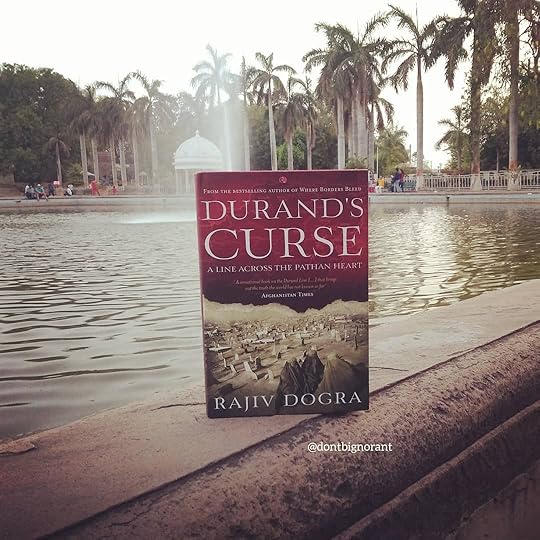
Durand's Curse, a line across the Pathan heart, is a meticulously researched book on the subject which is very close to the Afghan or Pathan heart. And here the author revealed the nefarious agendas of the then, British colonist government, who in the pretext of the 'Great Game', fooled, the then, Amir of Afganistan, Abdur Rahman Khan, for signing the 'Durand Agreement.
Durand agreement was signed on 12 November 1893 by the then, Amir Abdur Rahman, and his British counterpart, Henry Mortimer Durand. And according to this agreement, the southern-part of afghanistan was ceded to the British empire (At present FATA, the seven autonomous tribal areas of Pakistan, and NWFP or Khyber Pakhtunkawa, was once the part of the Afganistan, before the Durand agreement)
Infact after the creation of Pakistan in 1947, this durand line is considered as the official boundary between Pakistan and Afghanistan. Though Kabul and its citizens never recognized this so-called artificial-line which divides the brethrens from brethrens.
So here the question arises that why, the then, British Government, divided Afghanistan, and what's the reason behind this illogical agreement. And for finding the answer of this question we have to travel back to the early nineteenth century when the 'Great Game' began.
This term The 'Great Game', was first used by Arthur Conolly, an intelligence officer of the 6th Bengal light cavalry.
Like the cold war of the 20th CE, the Great Game was a proxy war between the British Empire and the Czarist Russia. And the main objective of the British at that time was to stop the Russians from gaining any kind of influence in Afghanistan, and also safeguard their Jewel of the Crown, India.
And because of this Russian- phobia, the enthusiastic Brits decided to invade Afghanistan. And they invaded Afghanistan thrice, and these conflicts are famously known as the 'Anglo-Afghan' wars.
Though the Brits succeeded in subduing the pathans partially, but they portrayed them for the outer world as the people who are, barbarians, treacherous, cruel and corrupt. And this image of the pathans or Afghans is still lingered throughout the world.
Infact after the creation of Pakistan in 1947, the then, government of Afganistan demanded that either a independent country of Pakhtunistan should be created or the people of FATA ( Federally Administered Tribal Areas) and NWFP (Northwest Frontier Province) should be give a chance to join their motherland Afghanistan once again, instead of Pakistan.
But sadly no one in the international community paid heed to the injustice suffered by the pashtuns, because of this illogical Durand agreement. And whoever controls Kabul but they never ever recognizes the 'Durand line', Infact even the Afghan Taliban refuses to recognize this artificial line. And there are several maps in Afghanistan which shows the area of FATA and NWFP, as Pakhtunistan.
And if we connect the past with the present, then we can find that, Afghanistan and the tribal areas of Pakistan were created as a buffer-zone where the major world Powers fought their proxy wars against each other. Take for example, in the 19th century, British and Russians fought against each other in this area, and in the 20th century, USA and Soviet Union fought against each other in the same region. And the people who suffered the most because of this Power game are the Afghans.
And in this 21st century the 'New Great Game' already began between the USA and its allies on one side, and China, Russia, Pakistan on the other side, and the battlefield is Afghanistan, 'The Graveyard of Empires'.
The writer of this book has really done a great amount of research before writing this brilliantly written book. And I recommend this book to those readers who are genuinely interested in reading about Afganistan. I am pretty sure you that will not get disappointed after reading this literature on Afghanistan.
I will end this with these lines:-
'The Problems which the world had faced during the 20th century, was given to them by the Britain, and the conflicts which we all are facing worldwide in this 21st century is the gift of the world's oldest democracy, USA'.
My Ratings : ⭐⭐⭐⭐⭐ (5/5)
I hope you like the Review, thanks for reading, Jai Hind.
--------------------------------------------------------------------
'May God keep you away from the venom of the Cobra, the teeth of the tiger and the revenge of the Afghans'.
- Alexander the Great
Durand's Curse, a line across the Pathan heart, is a meticulously researched book on the subject which is very close to the Afghan or Pathan heart. And here the author revealed the nefarious agendas of the then, British colonist government, who in the pretext of the 'Great Game', fooled, the then, Amir of Afganistan, Abdur Rahman Khan, for signing the 'Durand Agreement.
Durand agreement was signed on 12 November 1893 by the then, Amir Abdur Rahman, and his British counterpart, Henry Mortimer Durand. And according to this agreement, the southern-part of afghanistan was ceded to the British empire (At present FATA, the seven autonomous tribal areas of Pakistan, and NWFP or Khyber Pakhtunkawa, was once the part of the Afganistan, before the Durand agreement)
Infact after the creation of Pakistan in 1947, this durand line is considered as the official boundary between Pakistan and Afghanistan. Though Kabul and its citizens never recognized this so-called artificial-line which divides the brethrens from brethrens.
So here the question arises that why, the then, British Government, divided Afghanistan, and what's the reason behind this illogical agreement. And for finding the answer of this question we have to travel back to the early nineteenth century when the 'Great Game' began.
This term The 'Great Game', was first used by Arthur Conolly, an intelligence officer of the 6th Bengal light cavalry.
Like the cold war of the 20th CE, the Great Game was a proxy war between the British Empire and the Czarist Russia. And the main objective of the British at that time was to stop the Russians from gaining any kind of influence in Afghanistan, and also safeguard their Jewel of the Crown, India.
And because of this Russian- phobia, the enthusiastic Brits decided to invade Afghanistan. And they invaded Afghanistan thrice, and these conflicts are famously known as the 'Anglo-Afghan' wars.
Though the Brits succeeded in subduing the pathans partially, but they portrayed them for the outer world as the people who are, barbarians, treacherous, cruel and corrupt. And this image of the pathans or Afghans is still lingered throughout the world.
Infact after the creation of Pakistan in 1947, the then, government of Afganistan demanded that either a independent country of Pakhtunistan should be created or the people of FATA ( Federally Administered Tribal Areas) and NWFP (Northwest Frontier Province) should be give a chance to join their motherland Afghanistan once again, instead of Pakistan.
But sadly no one in the international community paid heed to the injustice suffered by the pashtuns, because of this illogical Durand agreement. And whoever controls Kabul but they never ever recognizes the 'Durand line', Infact even the Afghan Taliban refuses to recognize this artificial line. And there are several maps in Afghanistan which shows the area of FATA and NWFP, as Pakhtunistan.
And if we connect the past with the present, then we can find that, Afghanistan and the tribal areas of Pakistan were created as a buffer-zone where the major world Powers fought their proxy wars against each other. Take for example, in the 19th century, British and Russians fought against each other in this area, and in the 20th century, USA and Soviet Union fought against each other in the same region. And the people who suffered the most because of this Power game are the Afghans.
And in this 21st century the 'New Great Game' already began between the USA and its allies on one side, and China, Russia, Pakistan on the other side, and the battlefield is Afghanistan, 'The Graveyard of Empires'.
The writer of this book has really done a great amount of research before writing this brilliantly written book. And I recommend this book to those readers who are genuinely interested in reading about Afganistan. I am pretty sure you that will not get disappointed after reading this literature on Afghanistan.
I will end this with these lines:-
'The Problems which the world had faced during the 20th century, was given to them by the Britain, and the conflicts which we all are facing worldwide in this 21st century is the gift of the world's oldest democracy, USA'.
My Ratings : ⭐⭐⭐⭐⭐ (5/5)
I hope you like the Review, thanks for reading, Jai Hind.
March 20, 2023
Of the many lines in the book that stand out because of their astuteness of observation, this may be one of the most memorable: “Afghanistan [has] remained largely unloved and little understood.” (p.57)
Rajiv Dogra, a former Indian Foreign Service officer, may have been talking about the British of the nineteenth century. But he could just as well have been talking about us, Indians, in the twenty first century.
How far is Kabul from New Delhi? 1000 kms. As the crow flies. Between Amritsar and Jalalabad? 500 kms. And the distance between Kolkata and Patna? 600 kms.
And, yet, we know so little about the land. A land that is so intimately connected with our civilizational memory. From being Duryodhana’s maternal uncle’s house in Gandhar to Buddhism to Subhas Bose’s escape to Europe.
But today, our only memory is Tagore’s old, adorable, homesick Kabuliwala (for us, Bengalis, additionally immortalized by Chhabi Biswas in the eponymous Bengali film) and the public stoning to death by Taliban fanatics of that hapless young woman for her “crime” of being in relationship with a man.
Tragic? It is.
And it is this tragedy that Rajiv Dogra has tried to capture in this excellent book.
As the name suggests, Durand’s Curse: A Line Across the Pathan Heart is not about the Afgan history in its entirety, but that part of its history which touches a disputed line - the so called Durand Line. It is named after the British official who brought the "agreement” about - Henry Mortimer Durand – between the Imperial British and the Afgan Amir, Abdur Rahman Khan (1893). The book deals with the mystery surrounding the signing of the "Agreement". Was the Amir, ailing and not in control of his faculties, duped by the wily British? As Shri Dogra says: "... new interpretations about the nature of Durand's mission are coming up regularly. While much of it remains an enigma, there are enough straws in the wind to support the suspicion that it was a fixed match." (p.115)
Supported by meticulous research, Shri Dogra has tried to unravel the mystery. He wryly observes that for long we have looked at the Afgan problem – the so called Great Game – through the Western prism and that has warped our perspective. “Since the British had the monopoly on written English word, their prejudice became global conviction. From the mid-nineteenth century onwards that British labeling of Afgans as wild beasts has stuck. (p.43) He has tried to right that distorted colonial narrative. His sympathy for the Pashtuns, betrayed and savaged over and over in history, will find much resonance.
As I finished the book my mind wandered, in spite of myself, to another Line. A line that went across the Bengali heart, the Punjabi heart, the Indian heart.
Should we revisit the Radcliff Line?
A weighty question like this is for history to ponder over and deliver judgement on. It is beyond us mortals.
But I have the humble feeling that we should not. We need not.
Pakistan - that political, social and religious monstrosity - will crumble anyway. But, after the tortuous journey from being eastern Bengal, East Bengal, East Pakistan to Bangladesh, our eastern neighbour seems to be finally finding her feet. Slowly but surely. The socio-cultural milieu of the Gangetic and deltaic Bengal can arguably claim much credit for that. From machher jhol to Robi Thakur, from Bangla bhasa to leisurely adda, these markers of cultural affinity have reined in two centrifugal forces - political Hindutva on the one hand and crude attempts at Arabization on the other. So far, at least.
But, again, this is a call for history to take. Our children and grandchildren will have a surer answer.
Meanwhile, Shri Dogra, in telling the story of the Afgans and a disputed line that bears the unmistakable stamp of British chicanery, has served a sumptuous food for thought.
Rajiv Dogra, a former Indian Foreign Service officer, may have been talking about the British of the nineteenth century. But he could just as well have been talking about us, Indians, in the twenty first century.
How far is Kabul from New Delhi? 1000 kms. As the crow flies. Between Amritsar and Jalalabad? 500 kms. And the distance between Kolkata and Patna? 600 kms.
And, yet, we know so little about the land. A land that is so intimately connected with our civilizational memory. From being Duryodhana’s maternal uncle’s house in Gandhar to Buddhism to Subhas Bose’s escape to Europe.
But today, our only memory is Tagore’s old, adorable, homesick Kabuliwala (for us, Bengalis, additionally immortalized by Chhabi Biswas in the eponymous Bengali film) and the public stoning to death by Taliban fanatics of that hapless young woman for her “crime” of being in relationship with a man.
Tragic? It is.
And it is this tragedy that Rajiv Dogra has tried to capture in this excellent book.
As the name suggests, Durand’s Curse: A Line Across the Pathan Heart is not about the Afgan history in its entirety, but that part of its history which touches a disputed line - the so called Durand Line. It is named after the British official who brought the "agreement” about - Henry Mortimer Durand – between the Imperial British and the Afgan Amir, Abdur Rahman Khan (1893). The book deals with the mystery surrounding the signing of the "Agreement". Was the Amir, ailing and not in control of his faculties, duped by the wily British? As Shri Dogra says: "... new interpretations about the nature of Durand's mission are coming up regularly. While much of it remains an enigma, there are enough straws in the wind to support the suspicion that it was a fixed match." (p.115)
Supported by meticulous research, Shri Dogra has tried to unravel the mystery. He wryly observes that for long we have looked at the Afgan problem – the so called Great Game – through the Western prism and that has warped our perspective. “Since the British had the monopoly on written English word, their prejudice became global conviction. From the mid-nineteenth century onwards that British labeling of Afgans as wild beasts has stuck. (p.43) He has tried to right that distorted colonial narrative. His sympathy for the Pashtuns, betrayed and savaged over and over in history, will find much resonance.
As I finished the book my mind wandered, in spite of myself, to another Line. A line that went across the Bengali heart, the Punjabi heart, the Indian heart.
Should we revisit the Radcliff Line?
A weighty question like this is for history to ponder over and deliver judgement on. It is beyond us mortals.
But I have the humble feeling that we should not. We need not.
Pakistan - that political, social and religious monstrosity - will crumble anyway. But, after the tortuous journey from being eastern Bengal, East Bengal, East Pakistan to Bangladesh, our eastern neighbour seems to be finally finding her feet. Slowly but surely. The socio-cultural milieu of the Gangetic and deltaic Bengal can arguably claim much credit for that. From machher jhol to Robi Thakur, from Bangla bhasa to leisurely adda, these markers of cultural affinity have reined in two centrifugal forces - political Hindutva on the one hand and crude attempts at Arabization on the other. So far, at least.
But, again, this is a call for history to take. Our children and grandchildren will have a surer answer.
Meanwhile, Shri Dogra, in telling the story of the Afgans and a disputed line that bears the unmistakable stamp of British chicanery, has served a sumptuous food for thought.
August 19, 2020
Who should read: People interested in history, politics or international relations.
Book difficulty level: Easy
Short Summary:
The book is about the Durand line, i.e. present-day border between Afghanistan and Pakistan and how it does not qualify as a legal international border. It presents arguments about why North Waziristan/ Baluchistan province should not be a part of Pakistan, and how the controversial Durand line does injustice to the people living there.
Book difficulty level: Easy
Short Summary:
The book is about the Durand line, i.e. present-day border between Afghanistan and Pakistan and how it does not qualify as a legal international border. It presents arguments about why North Waziristan/ Baluchistan province should not be a part of Pakistan, and how the controversial Durand line does injustice to the people living there.

October 19, 2018
A book written by an Indian diplomat turned author..... on the sufferings the Durant's line caused the Pashtoons who found themselves caught in the cross border terror and their families living on both sides of the line since 1893. The Asia especially the middle East and central Asia is full of such lines left by the British making these areas the curse of the world be it the India China border India pak border or the pak Afghan border. These are the reminders of the English rule and the thought they cared least for the population they ruled for centuries is a fact that brings on shudder.
The rogue state of Pakistan left behind by them and it's supporters like the NATO didn't make the case easier. Only point of contest in this essay is how much of the knowledge in this book is nonbiased.... because when you study history you should be able to separate the truth from a biased narrative as the biases of the authors is the largest peril to a true narrative. Being a book on Afghanistan by a retired Indian diplomat will be like a book on Kashmir by Pakistani diplomat. Hopefully I feel this narrative is more closer to the truth. Another drawback that jumps out is the absence of Maps ... the two maps that are given is either not readable or put there just for the sake of filling pages. When a book is brought out on a boundary between nations what is required the most is omitted here. I go with a 3 star here just because this absence creates a big hole in the whole narrative.... which for me is close to a big blunder....
The rogue state of Pakistan left behind by them and it's supporters like the NATO didn't make the case easier. Only point of contest in this essay is how much of the knowledge in this book is nonbiased.... because when you study history you should be able to separate the truth from a biased narrative as the biases of the authors is the largest peril to a true narrative. Being a book on Afghanistan by a retired Indian diplomat will be like a book on Kashmir by Pakistani diplomat. Hopefully I feel this narrative is more closer to the truth. Another drawback that jumps out is the absence of Maps ... the two maps that are given is either not readable or put there just for the sake of filling pages. When a book is brought out on a boundary between nations what is required the most is omitted here. I go with a 3 star here just because this absence creates a big hole in the whole narrative.... which for me is close to a big blunder....

April 14, 2020
Book 11, Durand’s Curse by Rajiv Dogra. Few days back while watching 12 Strong, a movie based in Afghanistan after 9/11 attack , can’t help notice dialogue by General Dostam(who went on to become VP of Afghanistan) says this is Afghanistan , grave of 1000 empires. Also, near to that date Trump signed peace accord with Taliban , all of these led to me to search on origins of Afghanistan and I tumbled upon authors book based on Durand’s line. It was an arbitrary line drawn by on a rough map by Mortimer Durand of British and Amir Abdur Rahman of Afghanistan, that went onto become international border between Af-Pak. Although the status of this line whether it was frontier line or an international border is still contested and unclear. This book is story of evolution of Afghanistan over 1600s to present with focus on how Durand’s line came into existence. It depicts the master plot of britishers to keep Russia in check in Central Asia , inadvertently leading to forever plight of pathans. This book will leave you richer with far deeper understanding of afghan evolution over 4 centuries and its current state. One can’t help but wonder , what if that line wasn’t drawn, would INDIA had not been divided , the troubles of terrorism being bred in frontier regions wouldn’t have been there , and many more wonderings.

May 25, 2018
This book address an important question and examines it in-depth, something which few books on Afghanistan or the region have done. Unfortunately, it is a poor historical account. While full of impressive details about the major historical figures and events; it cannot be taken seriously as a historical inquiry. Too often it falls back on the stereotype of the perfidious British to categorise their motives in the sub-continent; accusing them of acting on 'whimsy' or other ulterior motives. Dogra also has prejudged the outcome of the book, interpreting every attempt to expand beyond the Indus for the British Indian state as a mistake waiting to happen; it might well have been but some critical analysis would have been good. Some of the motives for specific events are also just ridiculous; Abdur Rahman Khan is accused of suffering from physical illness, mental illness and then perhaps of having been drugged by Durand as a prelude into signing the agreement demarcating the border. The whole chapter is painful to read for the serious minded.
As for the statement that India and Afghanistan are good countries that have ceded territory peacefully while Pakistan and China are greedy, unprincipled countries always looking to expand their territory. This statement speaks for itself.
As for the statement that India and Afghanistan are good countries that have ceded territory peacefully while Pakistan and China are greedy, unprincipled countries always looking to expand their territory. This statement speaks for itself.

June 13, 2018
If we look into the contemporary problems of south Asia and track its origins we would end up in British colonial era. Almost every problem created by British colonizers to help feed thoes parasites .
same is the problem with AfPak relations. every problem between afghanistan and pakistan end up in legitimacy of DURAND line. the tensions between the two states both claiming a certain territory and thier susequent attempts to claim the disputed area sperated by durand line.
I agree with the writer to call it durand curse. this line has made our lives hell . this curse has cost more on both sides of durand line than LOC has done in kashmir . but at the same time there isnt enough literature available on durand line . this effeort to collect information about durand line in a book form is appreciable .the narration is very fluent until the end of the book which is the only part which i didnt agreed with his unrealistic solution to Durand line
same is the problem with AfPak relations. every problem between afghanistan and pakistan end up in legitimacy of DURAND line. the tensions between the two states both claiming a certain territory and thier susequent attempts to claim the disputed area sperated by durand line.
I agree with the writer to call it durand curse. this line has made our lives hell . this curse has cost more on both sides of durand line than LOC has done in kashmir . but at the same time there isnt enough literature available on durand line . this effeort to collect information about durand line in a book form is appreciable .the narration is very fluent until the end of the book which is the only part which i didnt agreed with his unrealistic solution to Durand line

August 20, 2023
A very short and concise history of what led to the current Afghan situation - well written. Unlike more books on history that provide of minute details (and eventually end up overloading the reader with too much information thus disrupting the flow and how of reading), this one stands out be being an easy read.
As always you get to see the way Britain and it’s officers handled the situation keeping only their country’s interest in mind. A painful account of what happened to Afghans. The author seems to re-iterate one thing umpteen times i.e.,. How did the Amir agree to the Durand line? But then in retrospect you may find it quite alright as this is thousands of square kms we talking about, so a sense of “awe” on can some one can sign this without any thought is definitely ridiculous. No argument makes sense here.
Nonetheless, overall a very good book that can be recommended to Asian history buffs.
As always you get to see the way Britain and it’s officers handled the situation keeping only their country’s interest in mind. A painful account of what happened to Afghans. The author seems to re-iterate one thing umpteen times i.e.,. How did the Amir agree to the Durand line? But then in retrospect you may find it quite alright as this is thousands of square kms we talking about, so a sense of “awe” on can some one can sign this without any thought is definitely ridiculous. No argument makes sense here.
Nonetheless, overall a very good book that can be recommended to Asian history buffs.

March 3, 2021
Excellent Book on the not so known history of Afghanistan
I have always been intrigued about the history of our country.
Why the British came?
How they became a superpower in the 18-19th century?
How India became independent?
How Pakistan was born?
These questions were always been there in the back of my mind.
I have always known the history of British, India and Pakistan but never heard or knew anything beyond that.
Durand's Curse shed some light on the history of Afghanistan.
Afghanistan has long suffered from various dominant powers.
It's an excellent book on the history of a country not many knows about.
It should be your next book
History buffs go ahead
And anyone who wanna know more about Afghanistan go ahead read it
I have always been intrigued about the history of our country.
Why the British came?
How they became a superpower in the 18-19th century?
How India became independent?
How Pakistan was born?
These questions were always been there in the back of my mind.
I have always known the history of British, India and Pakistan but never heard or knew anything beyond that.
Durand's Curse shed some light on the history of Afghanistan.
Afghanistan has long suffered from various dominant powers.
It's an excellent book on the history of a country not many knows about.
It should be your next book
History buffs go ahead
And anyone who wanna know more about Afghanistan go ahead read it

April 26, 2021
This is an excellent book. Like many people, I have been vaguely following the fate of the Afghans over the last years. Most of us know them as terrorists and as Talibans. While the problems that the Taliban causes is unparalleled, it is clear that the Afghans have been more sinned against than sinning.
Rajiv Dogra's eminently readable book takes you on a journey through time. It starts at a period in time before The Great Game began, and carries you through the subterfuge that became the Durand Line.
He has carried on the story to the present times, showing how the Afghani people are still being persecuted be everyone around them.
They are hardy people and will survive. Maybe, the world should just let them live.
An absolutely brilliant book.
Rajiv Dogra's eminently readable book takes you on a journey through time. It starts at a period in time before The Great Game began, and carries you through the subterfuge that became the Durand Line.
He has carried on the story to the present times, showing how the Afghani people are still being persecuted be everyone around them.
They are hardy people and will survive. Maybe, the world should just let them live.
An absolutely brilliant book.

February 13, 2018
The book throws light on the doubts which surround the Durand Line and how this disputed line lead to fault lines being created in the region. However it only details the events which led to the treaty in which the Afghan Amir agreed to sign in 1893 and what it really meant or is supposed to mean. The book only superficially touches on other players and especially the people who were effected by the Durand Line. The latter chapters touch upon the role being played by different countries in post-colonial era.
Overall a good read which can be a good starter to build your perspective about this region.
Overall a good read which can be a good starter to build your perspective about this region.

May 30, 2021
Durand’s curse is an unbiased brief history of Afghanistan in the shadow of The Great Game. This book explains in detail as to how the British cheated Afghan ruler and he had to part away with what is now known as NWFP in Pakistan. In this book the author has given several arguments as to how according to well accepted international laws, the treaty between Afghan rulers and Britain does not hold true any more.
A great book for Asian history lovers.
A great book for Asian history lovers.

May 6, 2021
An interesting and intense account of Afganistan; an insight on how the history of Indian subcontinent played during British rule and their treatment of colonies.
In current context, I pray the politics please be spared to people of Afganistan and their children given the opportunity to lead a normal civic life.
In current context, I pray the politics please be spared to people of Afganistan and their children given the opportunity to lead a normal civic life.

October 30, 2018
I've been anticipating this book for a while. However, once the major contours of the book have been laid, which happens by the time you're done with 30% of the book, no major points are made by the author.
Repeating the same point all over again maketh none too good a read.
Repeating the same point all over again maketh none too good a read.

Read
December 23, 2019Self situating Historical tale with tunnel approach to prove it right. Disregarding the boundary commission misappropriation and leverages provided to so called successor state; India, whish still haunts millions of people across northern and eastern boundaries.
April 14, 2021
Afghanistan destiny
Well explained, brings out the colonial power sly and cunningly put Afghanistan on road to hell. Can it survive the current war with radicals remains uncertain as it was century ago
Well explained, brings out the colonial power sly and cunningly put Afghanistan on road to hell. Can it survive the current war with radicals remains uncertain as it was century ago
Displaying 1 - 30 of 33 reviews