¡La bruja Winnie puede manejar cualquier crisis! Extraviar a Wilbur, salvar niños en apuros, festejar a la señora Parmar y detener una escoba fuera de control…
Paul was born in 1951 into a family of seven children in Salisbury, Southern Rhodesia (now Harare, Zimbabwe) where he had what he calls "a wild and privileged childhood" in the African Bushveld.[1]
He went to Estcourt High School[2] before graduating from Durban School of Art in 1972 and working at an advertising agency in Cape Town.[3] In 1976 he travelled to Greece where he met James Watt, then working for a Greek publisher who commissioned Paul to illustrate a series of educational books teaching Greek children to speak the 'Queen's English'.
He then spent some time working in an advertising agency in London and Los Angeles, and then studied film animation under Jules Engel at California Institute of the Arts in Valencia, California. His first children's book was a pop-up called The Crocodile and the Dumper Truck published in 1980, with paper engineering by Ray Marshall.
In 1986 Paul met the editor, Ron Heapy, at Oxford University Press, who looked at his work and commissioned him to draw several pictures for a short book about a witch written by Valerie Thomas as part of OUP’s Reading Tree programme.[4] Paul liked the story enough to turn it into a complete picture book. Although this was not strictly within Paul's brief, Heapy nevertheless presented it to the OUP delegates. The resulting book, Winnie the Witch, went on to win the Children's Book Award in 1987 and has since been published in over 10 languages. Paul's illustrations for this are full of visual jokes and witty detail.[5] Since then he has illustrated a further nine Winnie the Witch titles that have sold over a million copies.[4]
Three of Paul's picture books have been adapted for CD-ROM; The Fish Who Could Wish which won the European Multi-Media Award (EMMA) in 1995,[6] Dragon Poems and Winnie the Witch.
His anarchic yet detailed work, executed with bright watercolour paint and pen and ink, is distinguished by its "wild characterisation".[7] It has been compared to Tom and Jerry cartoons, and also to the artists Ronald Searle and Ralph Steadman.[8] He has original artwork on display at The Mazza Collection Galleria, University of Findlay, Findlay, Ohio, USA. He lives in Oxford, Britain and is married to the artist Susan Moxley.
Describing the technical details of his work he says: "I use an Apple Mac, Schminke watercolours, Caran d’Ache pencil crayons (with electric sharpener), Saunders Waterford paper 190gm3 [sic], black kandahar and coloured inks with a dip pen, toothbrush, porcupine quills, and my trusty left hand
Ma pole küll sihtrühm, aga aeg-ajalt otsin midagi lapselikku, lõbusat ja siirast. Siin raamatus oli mitmeid seiklusi, aga silme ees jooksis pigem virvenav film kui lugu. Mõtted hüplesid kiirelt järjest uuele teemadele ja vahepealne tuli kiirelt endal juurde mõelda. Illustratsioonid on lahedad ja sarja fännidel kerge järgmine teos üles leida.
I try not to read books in Chinese that were originally written in English and then translated into Chinese but this was a lovely collection of stories about a witch that I thought would be too fun to pass up. The book contained no pinyin but thankfully had the original English at the back as there were a lot of strange vocabularly words (like abracadabra) that naturally weren't in my Chinese-English dictionary! The book was also written in a handwriting style font which took some getting used to. A lot of the characters looked very different to their normal "printed look" which was also very good practice for reading a different style. While the vocabularly was quite difficult the grammar structures were very good. I found it really good practice for looking at the sentence order (particularly when they were quite different to the sentence order in English). I'm not sure if I will get the other Winnie books (there's 6 all together). It was good practice reading as I could read one of the short stories on my lunchbreak. However, the stories were not as great as I was hoping. Winnie seemed to be a wich mostly by eating gross things, there was nothing nice or spooky about her character. The stories, while having magic, were all quite normal and a bit absurd. The one I did like very much involved them going to a library and then Winnie reading a story about a rocket ship with a robot that was going to take people away to Mars.
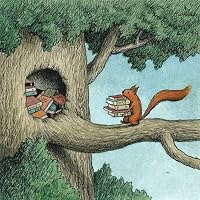
Ceritanya kurang menarik dan tidak 'menyihir' tapi yang sangat kusuka adalah ilustrasinya yang detail sekali, termasuk angka halaman yang juga diberi ilustrasi berbeda-beda. Ada satu bagian yang kusuka dari kalimat Winnie di bab "Winnie dan Hari Buku"
"Tahu tidak, Wilbur, ... Ada sihir yang lebih beragam ketimbang sihir Abrakadabra" .... "Kurasa cerita dalam buku-buku juga bisa menyihir."