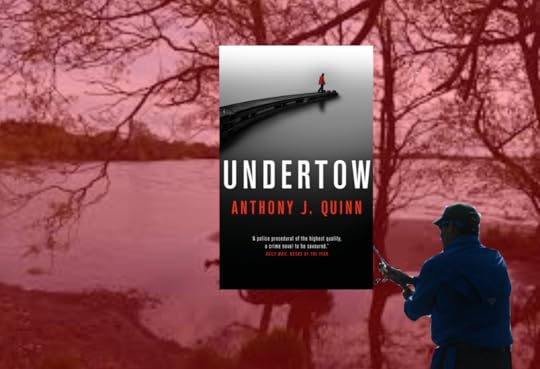
A simple case of suicide takes on a more sinister tone when Detective Celcius Daly travels across the Irish border to the desolate village of Dreesh, a place where law and order have ground to a halt, and whose residents, ruined by a chain of bankruptcies, have fallen under the spell of a malevolent crime boss with powerful political connections to the IRA.
Out of his jurisdiction, out of his claustrophobic cottage and out of his comfort zone, Daly is plunged into a shadowy border world of desperate informers, drunken ex-cops, freelance intelligence agents haunted by their own reflections and violent smugglers.
Doomed to be kept on the fringes by two separate police forces working in parallel, Daly’s dogged search for the truth soon sparks an outbreak of murderous violence as the desire to keep the Irish border in the shadows intensifies.
Anthony Quinn (b. 1971) is an Irish author and journalist. Born in Northern Ireland’s County Tyrone, Quinn majored in English at Queen’s University, Belfast. After college, he worked a number of jobs—social worker, organic gardener, yoga teacher—before finding work as a journalist. His first novel DISAPPEARED was published by Otto Penzler's Mysterious Press in 2012, and was shortlisted for a Strand Literary Award, as judged by book critics from the LA Times, the Washington Post, the San Francisco Chronicle, CNN and the Guardian. It was also selected by Kirkus Reviews as one of the top ten thrillers of 2012. BORDER ANGELS, the sequel, also features Inspector Celcius Daly and was published by Mysterious Press in 2013. He has written short stories for years, winning critical acclaim and, twice, a place on the short list for the Hennessy Literary Awards for New Irish Writing. He also placed as runner-up in a Sunday Times food writing competition. He is represented by Paul Feldstein of the Feldstein Agency.
"The country had secured a lasting peace, but many had suffered and died on its long and crooked road."
You won't see the Ireland depicted in this novel in any tourism brochures that is for sure. This is an economically depressed, bleak, violent, and desolate Ireland. The book is set in the border region of this country which has been wracked with turmoil for decades. Just because "The Troubles" are over, doesn't mean that this hinterland is not beset by trouble of the most serious kind. This is a place where hard men have become impervious to violence due to prolonged exposure. A place rife with smuggling, money laundering, and corruption of all kinds. A place where paranoia is justified and people's allegiances are suspect.
"In Dreesh, no one respected the uniform any more."
Myriad characters and agencies are involved in this novel. Not only were there two distinct police forces, but there was also 'Special Branch', crime bosses, former IRA, intelligence agents, 'handlers' and informants.
"A northern country of treacherous skies and loughs brimming with fathomless gloom."
Although this is the fourth novel to feature the policeman Celcius Daly, it reads quite well as a stand-alone. Daly's character was well wrought, though he was a solitary man and as bleak as the landscape in which he lives. Divorced and childless, Daly is a workaholic and an insomniac. His only company is his black hen who fancies herself as being a sort of 'guard dog' for his property.
I found the writing very skillful, though personally the plot seemed quite complicated. Anyone who enjoys crime fiction that leans more toward political thriller will be sure to enjoy this novel.
I received a complimentary digital copy of this novel from Head of Zeus for purposes of this review. All opinions are my own. 3.5 stars rounded down
Undertow is a book of our times. It is set along the currently open border between the Irish Republic and Northern Ireland, and debates what may replace it (and how it will all work) as Brexit kicks in. Money is to be made or lost depending on what transpires. Investment gambles are being taken.
Smuggling is rife along the border. The IRA gangs of yesteryear have morphed into criminal manipulators of communities and some of those who are supposed to police them. Blind eyes are turned to nefarious practices. The Police Service of Northern Ireland and the Garda Síochána – the forces of law and order on either side of the border – have little formal contact and little formal cooperation. They do, though, work unofficially together on occasion. A body is washed up on the shore of Lough Neagh in the North. It is quite close to where Inspector Celcius Daly lives. He investigates.
His investigations take him south to the imagined village of Dreesh in the Republic. Dreesh is the base of Tom Morgan, a notorious former IRA commander, now making a living (a very good living) smuggling diesel across the border. It is also the home of Garda Sergeant Peter McKenna. Does Morgan have anything to do with the killing, do we think? And what might McKenna’s role be? And who is Robert Hunter? He is allegedly a Special Branch detective from the North, who seems to have an interest both in Morgan and in Tommy Higgins, an informer at the time of ‘The Troubles’ who has just returned to Dreesh from a period of exile in Andalusia, southern Spain. Daly, though, finds Hunter very hard to trace. All roads lead to a dead end.
The plot is complex. Full of intrigue, and ‘who can you trust’. Daly operates in a shadowy underworld populated by former IRA men, current IRA men, informers, serving Garda officers, serving PSNI officers, Special Branch, and the intelligence services. It is not a straightforward investigation. At the same time he is facing problems in his personal life. His erstwhile boss drowned himself and left a note saying that he had been driven to suicide because of the persecution he suffered from Daly and a journalist. Not true, but an issue for Daly to face.
Undertow is a very well written and very well constructed thriller. The locations – especially Lough Neagh – are lovingly described. You can imagine yourself, as Daly does at the beginning of the book, walking through the dawn mist down to the water’s edge.
Undertow is the fourth Inspector Celcius Daly novel by Anthony Quinn. The others have all been critically acclaimed and nominated for awards. I would not be surprised if Undertow followed in their footsteps. It is a very good, and a very exciting read.
I would like to thank Netgalley and Heads of Zeus for an advance copy of Undertow, the fourth novel to feature DI Celsius Daly of Armagh, PSNI.
Daly is called out to a body found drowned in Lough Neagh. Nobody, including the pathologist, is quite sure if it is suicide, murder or an accident but when it is identified as Detective Brian Carey of An Garda Síochána Daly's suspicions are aroused. He quickly discovers that Carey was investigating Tom Morgan, ex IRA enforcer turned smuggler, but then his investigation leads him into the murky depths of border policing and intelligence gathering.
Undertow is the first novel in the series that I have read and I think I would have benefited from reading the prior novels to get the references to past cases but apart from that it works well as a standalone. It is a fairly bleak novel, some of that is due to Daly's personality and the rest to the picture it paints of cross border cooperation or rather the lack of cooperation. Add in Special Branch secrecy and you get a dismal picture if it is anywhere near to reality.
I like the plot which is engrossing, convoluted and has some excellent twists. It seems realistic but I have no way of knowing. I did, however, get lost in some of the finer detail of motivation but as greed and corruption are the overarching motivations it didn't really matter.
Celsius Daly is a really dreary protagonist. In his mid forties and divorced he lives alone and is completely antisocial, even doing his best to alienate those who want to help him. He is a smart and tenacious detective but his actions and methods don't meet with universal approval so he is an unpopular officer. Is he paranoid or are they out to get him? One novel doesn't answer that question. I didn't like the way he has let his family past in The Troubles engulf his way of life - he needs a good shake.
Despite this Undertow is an engrossing read which I have no hesitation in recommending.
I have been a huge fan of Anthony J. Quinn’s ever since I read his first book ‘Disappeared’ which seems like many moons ago. So imagine my excitement when I was asked if I would like to take part in the blog tour for ‘Undertow’? I absolutely loved the book but more about that in a bit. I must admit that it took a little while to warm to Inspector Celsius Daly but that was only until I had sussed him out so to speak. He strikes me as a bit of a loner, who has certain behavioural quirks. It’s obvious that Daly has been scarred by his past experiences, both professionally and personally, which is hardly surprising given he lived through ‘The Troubles’ in Northern Ireland, so he truly has seen the worst that Northern Ireland has to offer. Daly almost seems to want to be anonymous, which is impossible professionally. Daly is a bit like a dog with a bone and if something doesn’t sit right with him, he doesn’t let the matter drop until he has fully investigated it. Nine times out of ten Daly’s gut instinct is correct or very near to the truth. Daly does what he can to seek answers for the victims and their families. I get the impression that Daly is not easily intimidated, which takes a lot of courage and nerve. ”Undertow’ and indeed all of Anthony’s Daly books appeal to me in several different ways. I absolutely love Irish (both Northern & Southern) history so to read a book such as ‘Undertow’ is fascinating to a history nerd like myself. I basically love all things Irish. I haven’t been over to either Northern or Southern Ireland yet but this book provides a snapshot of how experiences of the past have shaped the attitudes of today. Reading ‘Undertow’ brought back certain memories for me too. I can remember certain terrorist atrocities happening even though I wasn’t that old when they happened. I can also remember when I was at school and a military band came to play for us. We couldn’t be given any warning that it was happening just in case the IRA were to decide to take out the military band and blow our school up. I can even remember when certain Republican Irish politicians’ voices had to be dubbed because their real voices were banned from being broadcast. I can’t even begin to imagine how it felt to live in Northern Ireland during the Troubles and the climate of fear that existed at that time. I absolutely loved reading ‘Undertow’. I would say that it is more of a slow burn type of book, which isn’t such a bad thing when you are dealing with such sensitive issues as Northern & Southern Ireland. I was hooked immediately from the very first word of the prologue and I just knew that I was going to become addicted to reading it. I was so correct as I found that I couldn’t put the book down because I just had to read on to see if Daly solved the case and to see how many people he upset along the way. I was so into the story that I didn’t notice how quickly the pages were turning and before I knew it I had finished the book, which I was pleased about because at least I knew how this chapter in Daly’s life ended. On more than one occasion I thought that I had figured out how the book was going to pan out but on each occasion, I was thrown a curveball and sent down another path entirely. There were also the odd times when I almost had to read through my fingers because I genuinely feared what Daly was going to uncover next. In short, I loved reading ‘Undertow’ and I would recommend the Daly series to anybody, but particularly to those people who are interested in how ‘The Troubles’ still affect Ireland (Northern & Southern) to this day. I can’t wait to see what else Anthony J. Quinn has in store for Inspector Celsius Daly. The score on the Ginger Book Geek scoreboard for ‘Undertow’ is a whopping and well deserved 5* out of 5*.
Celcius Day ist Mitte Vierzig, geschieden und lebt in einem Wohnwagen, solange das Haus seines Vaters repariert wird. Seit seinem letzten Fall ist er bei den Kollegen nicht mehr gut angesehen und an seinem aktuellen Tatort wird er von einem Fischer auf eine gemeinsame Vergangenheit angesprochen, an die er sich nicht erinnern kann, die aber ebenfalls mehr als einen schwarzen Fleck aufweist. Am Lough Neagh wird die Leiche eines Polizisten gefunden und die Spur führt in Irlands dunkle Vergangenheit.
Das ist der zweite Teil der Reihe um Celcius Daly. Es gibt immer wieder Anspielungen auf den ersten Teil, aber ich hatte keine Schwierigkeiten mit der Geschichte. Allerdings wird der erste Teil ziemlich gespoilert, deshalb sollte man die beiden Krimis doch in der richtigen Reihenfolge lesen.
Das Buch ist eine eigenartige Mischung aus einer wunderbar düsteren Stimmung und einer verworrenen Kriminalgeschichte. Der Autor beschreibt das Misstrauen zwischen dem Norden und dem Süden Irlands, das auch Jahre nach dem Ende der Bürgerkriege immer noch herrscht und die Machenschaften, die durch das Machtvakuum entstanden sind, sehr gut. Auf der anderen Seite beschreibt er die Ermittlungen eher verworren, so dass ich auch nach dem Ende der Lektüre nicht ganz die Hintergründe der Tat durchblickt habe.
For much of the time this was more straightforward, Celcius Daly more clear-headed than the previous couple of novels and, for my enjoyment, the better for it. Only towards the end did he appear to lose common sense and consciousness. Which isn't to say it was not enjoyable; the sense of place as ever well-evoked and the truly labyrinthine tale well convoluted.
This was my first in this series and even though it is #5 I do not think reading it out of order detracted from this being a good read. I will read the others as I found this gritty book set in Ireland with the onset of Brexit and Celsius Daly a protagonist who I can 'follow'.