Jump to ratings and reviews
Rate this book

Republic of Rhetoric: Free Speech and the Constitution of India

Rate this book
Exploring the legal and political history of India, from the British period to the present, Republic of Rhetoric examines the right to free speech and it argues that the enactment of the Constitution in 1950 did not make a significant difference to the freedom of expression in India. Abhinav Chandrachud suggests that colonial-era restrictions on free speech, like sedition, obscenity, contempt of court, defamation and hate speech, were not merely retained but also strengthened in independent India. Authoritative and compelling, this book offers lucid and cogent arguments that have not been advanced substantially before by any of the leading thinkers on the right of free speech in India.

384 pages, Hardcover

Published January 1, 2017

43 people are currently reading
515 people want to read

About the author

Abhinav Chandrachud

14 books35 followers

Ratings & Reviews

What do you think?
Rate this book

Friends & Following

Create a free account to discover what your friends think of this book!

Community Reviews

5 stars
58 (38%)
4 stars
68 (45%)
3 stars
24 (15%)
2 stars
1 (<1%)
1 star
0 (0%)
Displaying 1 - 19 of 19 reviews
Profile Image for Vishal Pranav.
16 reviews1 follower
March 21, 2020

Giving this book a 5 star rating mainly because there are not many books talking about this subject with such elaboration and research. The goal of this book is to prove that many of the laws in relation to freedom of speech in contemporary India is virtually identical to that of the laws in the time of British's rule over India. The book is roughly condensed into three parts, it starts with sedition, proceeds to obscenity and finally ends with defamation/contempt of court along with laws regarding the freedom of press. This book focuses only on the law with regard to freedom of speech in India and not the culture surrounding it, though, the author himself briefly talks about the influence of culture with regards to the functioning of these laws.

It was surprising to know that the drafting of the constitution India was actually inspired by the Irish constitution and not the American one. Surprising, mainly because many of the Supreme court Justices refer to landmark decisions made by legendary judges such as Justice Oliver Holmes and Justice Robert H.Jackson from the United States whenever it's required and from the looks of it, the SC have never referred to Irish justices. Our constitution technically gives us freedom of speech but there are a number of limitations to it(inspired by the Irish) which almost nullifies Article 19(1)(a). Most of these limitations were basically made for the 'public good', to avoid riots and uprisings. I personally believe it's because of the socialist nature of our country. Some of the laws that we follow are identical to 20th century Britain and a number of them remain largely identical to the Indian Penal Code created by Thomas Macaulay in 1860(No typo). The tragedy is that the British have radically switched sides on a number of laws that still persist in India whereas India remains docile. For example, sedition is non-existent in Britain at the moment.


The law on sedition is a big one as it is a cognizable offence meaning that the police do not require a warrant to arrest thereby having the authority to arrest upon only accusation and can jail you overnight. You also need to go to the court for a bail if you want to get out of there. All of this can occur over someone just accusing you of making an anti-government comment which may have sounded 'unaffectionate'. On obscenity, there's something called as the Hicklin's test where if any few lines in a 400 page book is 'obscene' (can corrupt a mind), the whole book can be banned.

On defamation, if you're defending yourself against a defamation case in India, good luck. To prove your innocence, it is irrelevant if you've said the truth with regards to the matter, all that matters is if you've said it for the welfare of the public. Contempt of court is a sticky one. It's made Jawaharlal Nehru ji to apologize to three people when he called a Supreme court justice 'unintelligent'. He escaped jail and a hefty fine because of his swift apology. You'll be surprised to know that there are concise standards for even accepting apologies in the Supreme court.

With the law related to the national anthem, two kids got kicked out of a school in Kerala for not singing it, though they were standing respectfully with their peers during their school assembly. They were Jehovah's Witnesses and they were sentimental towards the singing of the national anthem.
There are many more such cases with regards to each of the above mentioned offences. They're interesting to read and on some occasions you can almost sympathize with the lawmakers with the culture that surrounded them.


However, my most favourite part of the book came from an unexpected person and in an unexpected case. The following excerpt from the book was said by Era Sezhiyan to the House with regards to the 'Anti-DMK Amendment' which disallowed Tamil Nadu from leaving India:


"[P]lease argue with us, contend with us, convince us. If you find we are incorrigible, leave us alone, and go to the people, convince them. If you do that, that is real democracy. If you do other things, the name is not democracy, but it is something else"


Sezhiyan further goes on to cite the dissent of Justice Oliver Wendell Holmes in the famous case of Abrams vs US, then refers to Justice Jackson's iconic lines,
"Compulsory unification of opinion achieves only the unanimity of the graveyard.”
and ends it with a quote from Thomas Jefferson. This was a defining moment for me in the book because never have I thought that a leader from my state would be so outspoken, liberal and knowledgeable with regards to free speech that too way back in the 60's. It hit a cord for me.

Though, I've been living in this country for almost 20 years now, it was shocking to know about some of the laws regarding the freedom of speech. Didn't even know they were there. I believe that the idea of freedom of speech and the elevation of the individual over the 'government'/ruling body made the west what it is today. The belief in truth is right at the top of their culture though their inhabitants may not articulate it through words. Say what you want but they’ve created the best place to live in the world , at least in relative to all the other countries in the world. This book is written by an author is a Harvard and Stanford Alumni, and the author is from one of the most well-known legal families in India as well. His grandfather, Justice Yeshwant Chandrachud is the only Chief Justice of India to have a term of 7 years which happens to be the longest ever. Further, his father is soon to become the Chief Justice of India starting from 2022. All this background, especially his education, makes him quite credible apart from the 100+ pages of end notes.

This is was a dense book for me, took a while to read it. Strongly recommend this if you're an Indian and/or you're interested in freedom of speech in India, and how it compares with the west. I don't think any other book in this subject is better than this one though few come close.
Profile Image for Manvendra Shekhawat.
98 reviews17 followers
January 5, 2022
Who doesn't love a debate or a discussion on Freedom of speech and expression? and for all the good and bad reasons in the present times it has reached a pretty high level of popularity.

This book would try to cover everything related to the topic in the context of India while providing historical and contemporary perspectives and also comparing the same issue in different polities but mainly USA and The UK.
It is a good introduction for anyone interested in Media law or the debate on Freedom of speech, however it tends to get too repetitive. it might be way too boring for someone from the non-legal background. However, boring would be a wrong way to describe it and right now I am short of words to put my feeling here.

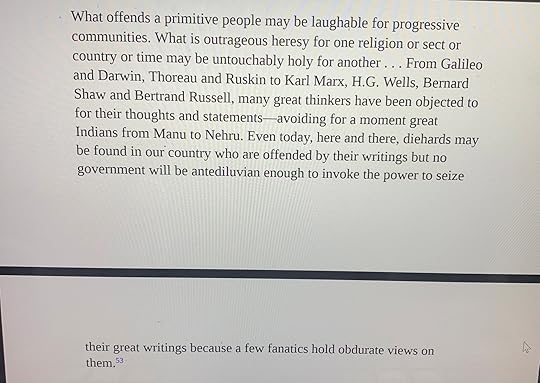
Prior restraint was dealt with pretty well. Various judgements and their impactful paragraphs were reproduced in full. One of which I wanted to reproduce here as well. V.R. Krishna Iyer in 1976

Cheers!
Profile Image for Harshita Singhal.
4 reviews6 followers
May 13, 2020
This book traces the development of the law with respect to various facets of the Right to free speech and expression in India.

While the author repeatedly mentions that rights under Articles 19(1)(a) and 19(2) were inspired by the Irish Constitution little has been written on it. Much of this is because of the fact that the framers of the Constitution themselves referred to judgments not of Irish courts but of American ones. However, it would have been interesting to see the developments in this regard in Ireland to draw a parallel or contrast in law. This addition would definitely earn a 5-star rating.

Overall, it's an easy read.
Profile Image for Muthu Raj.
87 reviews16 followers
May 14, 2018
This was an interesting read. This not only traces the history of free speech, but also properly introduces the context, and makes intelligent comments in relevant places. One also learns quite a bit of history, and learns to understand the evolution of opinions on speech - hate, free or otherwise.
Profile Image for Abhay Nanda.
36 reviews1 follower
April 18, 2021
This book is written like an academic paper with case after case and numerous facts cited throughout the chapters without making many comments. It is a record of how freedom of speech and expression was implemented in colonial India and how has it changed to the shape it has taken now.

I did not find the book interesting but it sure can help people who are interested to know about free speech.
Profile Image for Ranesh Rai.
10 reviews
May 11, 2022
Interesting read but the writing style makes it more like a thesis than a book. Although it's important for any student of Law and political science to understand the history and mindset behind the constitution making .
Profile Image for Sudarshan.
68 reviews15 followers
August 29, 2020
Brilliant. The author's thesis is that the enactment of the Indian constitution made little to no difference to Freedom of speech in independent India.

The exceptions to Freedom of speech are much the same in independent India when compared to the Metropole. The detailed explanations on sedition, obscenity, contempt of court and defamation provide a lucid explanation of exceptions to Article 19 in the Indian constitution.

The author provides a succinct explanation of the four exceptions to Freedom of speech via abridged case law. This is a must read for anyone interested in getting their feet wet into Article 19 of the constitution.

On a more sombre note, having read through these cases and the subsequent judgements that were passed by the Supreme Court of India, I am of the opinion the exceptions to Article 19 are responsible for the intolerance that exists in the Indian polity, something that I am deeply uncomfortable with, being a card carrying liberal.
It was disconcerting to read through some of the cases and it's a polar opposite to the values I espouse wrt freedom of expression.

Lastly, this provides some much needed context on the ongoing Prashant Bhushan case regarding contempt of courts. The chapters on that are most enlightening. Highly recommend this to Indian citizens.
Profile Image for Ribhav Pande.
81 reviews36 followers
January 27, 2020
This treatise on Indian free speech jurisprudence is exhaustive and illuminating. It does well to set the law in its historical context and traces its development through cases, both lesser known and widely famous alike. There are some rich historical snippets coupled with moments where you’d just wonder how that thing you just read isn’t widely known.

A splendid effort, this book has become the touchstone when it comes to reading up on freedom of expression under the Indian Constitution.

I just wish authors would use both end notes and footnotes, the latter for immediately relevant additional info. The numerous endnotes causing excessive page flipping really detracts from the reading experience.
4 reviews
Read
March 10, 2024
Considering it's a nonfiction book, it was a difficult read in terms of maintaining consistency. However, being a law student and generally for any citizen, having a basic understanding of freedoms, fundamental rights, and something as imperative as free speech is important. This book is comprehensive in the sense that it covers multiple dimensions, the history, and the comparative context between India and the USA on the idea of freedom of speech and expression. The book gives you questions to think, ponder, and debate and, most importantly, makes you more knowledgeable and aware. But some points are opinions, and there is an undertone of liberalism; read with an open mind and form your own opinions on leaders and politicians, as everything here is grey.
1 review
May 19, 2022
This is one of the book I loved reading that gave a clear idea how the curbing of Free Speech was/is being curbed in the name of Sedition. The book presents various cases from the Colonial rule to the latest cases. Mr. Chandrachud did a wonderful job on capturing some interesting arguments how SCOTUS cases dealt with cases related to Free Speech and how Indian Apex Course did when some similar questions came in front of it. A must read book for those who love to understand the Freedom of Speech and its limitations in India.
Profile Image for Vikrant.
90 reviews4 followers
November 28, 2020
Institutional void to protect citizenry emerges from the constitution document itself and none of the central govts have been willing to correct this since independence.. and seeds to this were sown actually by the liberal most who drafted the original constitution document..provisions of sedition, contempt of court, hate speech all have a big colonial history and no correction has happened while UK and US laws have evolved with times
Profile Image for Sriram.
129 reviews
October 20, 2020
An interesting book on a very interesting topic. I wasn’t actually interested in the historical evolution on the freedom of expression/speech but was interested more on how articles 19(1) and (2) have been interpreted in various cases by our courts. To an extent I should say - a bit disappointed with how this has been dealt in the book.
624 reviews
December 22, 2021
A wonderful account of evolution of free speech as interpreted by the Indian Judiciary basing on the provisions of the Constitution of India as well as cases from abroad. The book is a goldmine of cases relevant to the subject and a must read for law students. It would be equally enjoyable to any citizen conscious of his/her right to freedom of speech and expression.
28 reviews3 followers
September 11, 2022
While the book does provide a glimpse of the law on free speech in England, USA and India and how the law in Independent India has not fulfilled the cherished ideals of free speech, it becomes an overload of information with few attempts made at summarizing the positions on the various restrictions on free speech.
Profile Image for Neha Singh.
30 reviews7 followers
November 2, 2022
“Please argue with us, contend with us, convince us. If you find we are incorrigible, leave us alone, and go to the people, convince them. If you do that, that is real democracy. If you do other things, the name is not democracy, but it is something else"
24 reviews
February 15, 2023
A stunning work on Article 19. Author has explained everything in chronological way for development of Article 19(1)(A) and Article 19(2) of Indian Constitution without any bias to any political party or view which is quite a difficult task in itself.
5 reviews
April 20, 2020
The amount of research, the writing style and the commentary is absolutely top notch. One could learn more from this book than from actual constitutional law books.
Profile Image for Khushi.
6 reviews
December 29, 2022
An interesting and gripping read for someone from a non-law background too :)
Displaying 1 - 19 of 19 reviews

Can't find what you're looking for?

Get help and learn more about the design.