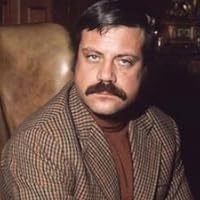
Franklin Patrick Herbert Jr. was an American science fiction author best known for the 1965 novel Dune and its five sequels. Though he became famous for his novels, he also wrote short stories and worked as a newspaper journalist, photographer, book reviewer, ecological consultant, and lecturer.
The Dune saga, set in the distant future, and taking place over millennia, explores complex themes, such as the long-term survival of the human species, human evolution, planetary science and ecology, and the intersection of religion, politics, economics and power in a future where humanity has long since developed interstellar travel and settled many thousands of worlds. Dune is the best-selling science fiction novel of all time, and the entire series is considered to be among the classics of the genre.
Six nouvelles dont une avec l'agent Mc Kie (du bureau de Sabotage cf L'Étoile et le Fouet) six nouvelles donc de Maître Frank Herbert bien dans le style des années 70-80 : manipulation ou pouvoir psychologiques, aliens en compétition ( in les marrons du feu un exemple : sortant de la bouche de Smeg sans crime il n'y aurait pas besoin de lois et d'agents de la force publique pour la faire respecter (...) la première règle lorsqu'on occupe un poste consiste à préserver une activité suffisante pour assurer la pérennité de son emploi ) , et l'homme vu à la loupe ( in la course du rat) ou encore le surhomme en voie de disparition (in le rien du tout) ... Le tout bien emballé par une écriture à la fois précise et complexe Moi, j'adore !
The capacity of Herbert to create new worlds in a few dozen pages is frankly astonishing, as is his ability to examine the questions of faith, religion, violence, and crucially control, of the society and by the society. An interesting collection of stories.
Interesting to read Frank Herbert's vision of the future. His scenarios with mind control haven't happened (that we can see!) but perhaps his writing about it was enough to put us in the right direction. Anyway, it makes for a good read!
Even in these early short stories you get the classic Herbert themes: freedom vs. control, truth vs. Institutional power, religion as a means of conditioning - in his brilliant controlled prose that almost reads as poetry.
For some reason Goodreads won't let me give this more than one star. But obviously it deserves at least three. Lovely novella which explorers ideas very similar to the gum Jabbar well before Dune.
The first story is interesting but it lacks the grand sci-fi setting Frank Herbert excels at. His work with language as a concept is still fascinating.
The second story is forgettable and frankly a disappointment.
The other three stories were fantastic. Every time I finished one I thought the next one couldn’t be as good but I was always mistaken. Each one is extremely different from the other and while you can find themes of identity, the nature of conflict and how interacting with the universe affects the person and the universe itself on all the three stories, they all delve into different aspects in such a perfect way. In them all there is one constant, chaos is a necessary part of life and stasis is a cancer that rots away life itself.
All in all, I enjoyed this book thoroughly and it’s fun to see how these stories tie into the larger themes Herbert tackled in Dune. The idea of stagnation as a danger to life, his thoughts on religion that are such an important part of Dune are the main themes of the Priests of Psi, prescience and memory of other lives, etc.
I keep saying I'm not a short story person and yet, now that I am keeping track, it seems I not only have short story collections, but that I read and enjoy them. My notes say "Excellent!"
Interesting read from the author of dune, similar themes return, like the function of religion in controlling human affairs, musing on rebirth, souls and mind, all in all a good view at of the mind that brought forth the god emperor of arrakis