Jump to ratings and reviews
Rate this book

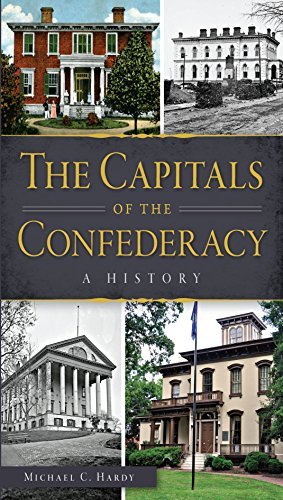
The Capitals of the Confederacy: A History

Rate this book
“A handy, all-in-one reference on the Confederate capitals . . . Rich details and effective anecdotes . . . evok[e] a real sense of the people, places, and events” (The Civil War Monitor).   The Confederate States of America boasted five capital cities in four years. The center of the Confederate government moved from one Southern city to another, including Montgomery, Richmond, Danville, Greensboro, and Charlotte. From the heady early days of the new country to the dismal last hours of a transient government, each city played a role in the Confederate story. While some of these sites are commemorated with impressive monuments and museums, others offer scant evidence of their importance in Civil War history. Join award-winning historian Michael C. Hardy as he recounts the harrowing history of the capitals of the Confederacy.   Includes photos!

131 pages, Kindle Edition

First published April 20, 2015

4 people are currently reading
12 people want to read

About the author

Michael C. Hardy

32 books6 followers

Ratings & Reviews

What do you think?
Rate this book

Friends & Following

Create a free account to discover what your friends think of this book!

Community Reviews

5 stars
4 (57%)
4 stars
3 (42%)
3 stars
0 (0%)
2 stars
0 (0%)
1 star
0 (0%)
Displaying 1 - 2 of 2 reviews
Profile Image for Susan Molloy.
Author 149 books88 followers
March 21, 2023
🖊 My review: The following Confederate capitols are discussed in this book in a condensed form:
1. Montgomery, Alabama: February 4 to May 21, 1861
2. Richmond, Virginia: May 1861 to July 1863
3. Richmond, Virginia: July 1863 to April 2, 1865
4. Danville, Virginia: April 3 to April 10, 1865
5. Greensboro, North Carolina: April 14 to April 15, 1865
6. Charlotte, North Carolina: April 19 to April 26, 1865

In addition, a chapter discusses the “The Flight of Jefferson Davis: South Carolina to Georgia, April 26 to May 10, 1865.” This was, indeed, a thought-provoking chapter.

Finally, in “Looking for the Capitals of the Confederacy,” this chapter gives valuable material for a starting point in history.

Overall, this is a good work for a jumping off point in studying Confederate history. The writing style is intelligent and succinct.

📌 Would I read this again? Yes, for my research projects on the American Civil War.
🤔 My rating 🌟🌟🌟🌟🌟
🏮 Media form: Kindle Unlimited version.
🔲 Excerpts that interested me quite a bit:
🔸 Much of wartime Montgomery is gone. No longer present are the Exchange Hotel, where many of the delegates from various states lived and where Jefferson Davis was introduced and spoke to the crowd. Montgomery Hall, where Mary Chesnut chronicled the beginning days of the Confederate government, is also gone. The Exchange was located on Commerce Street, and Montgomery Hall was on Dexter Avenue. Mrs. Cleveland’s boardinghouse is also no longer standing. It was located on the corner of Catoma and Montgomery Streets.

🔸 SOUTH CAROLINA: [Jefferson] Davis, a few of the cabinet members, various Confederate generals and an escort of three thousand cavalry moved through South Carolina from April 26 until May 2, 1865. They stopped at various sites along the way. There are historical markers following the route.

🔸 LEXINGTON: On US 29, outside Lexington, is a historical marker denoting the site where Davis’s group camped on the night of April 16, 1865. CONCORD A state historical marker, on North Union Street, marks the location of a house where Jefferson Davis stayed on April 18, 1875.


🔸 CHARLOTTE: Time has progressed forward at a furious pace in the Queen City, and very little of wartime Charlotte remains. All of the homes that housed Confederate officials have been demolished. The Phifer home was torn down in the late 1940s; the Bates home was gone by the mid-twentieth century; and the old bank building that served as the last capital of the Confederacy, and later as an office for the Charlotte Observer, was razed in 1970. There is a bronze plaque at 122 South Tryon Street that marks the spot where the last meeting of the whole Confederate cabinet took place.

Profile Image for J. Jones.
Author 9 books7 followers
December 29, 2015
The Capitals of the Confederacy, a History
By Michael C. Hardy
Reviewed by J. Keith Jones


Funny how no one until now had thought to write a consolidated history of the various capitals of the Confederate States of America. Maybe one reason is that it sounds like a dry subject, but in Michael Hardy's hands it is anything but dry. Hardy's usual flair for making what may seem to be a mundane subject into good storytelling is on full display in this book.

Many people, unfortunately, are so woefully deficient in their history knowledge that they are unaware that there ever was any other capital for the CSA during the four years it fought for survival. The truth is that Richmond was not the first nor the last. Prior to Virginia's departure from the Union, the capital was established in Montgomery, Alabama. Feeling that this was too far from the seat of war, this was moved to Richmond, which was perhaps too close. Nonetheless, the Confederate army managed to keep the mightiest army the world had ever seen from breaching its gates for four long years.

During the final month of the war, several cities laid claim to that title. A few more with a more tenuous claim have tried to use that title through the years. Michael Hardy discusses all this in the appropriate level of detail. He keeps the story moving and lively without getting bogged down in the painfully routine minutiae. The Capitals of the Confederacy is an informative and entertaining read. Two thumbs up.
Displaying 1 - 2 of 2 reviews

Can't find what you're looking for?

Get help and learn more about the design.