Veteran travel writer Eric Newby has a massive following and is cherished as the forefather of the modern comic travel book. However, less known are his adventures during the years he spent as an apprentice and commercial buyer in the improbable trade of women's fashion.
From his repatriation as a prisoner of war in 1945 to his writing of the bestselling ‘A Short Walk in the Hindu Kush’ in 1956, Eric Newby’s years as a commercial traveller in the world of haute couture were as full of adventure and oddity as any during his time as travel editor for the Observer.
‘Something Wholesale’ is Newby's hilarious and wonderfully chaotic tale of the disorder that was his life as an apprentice to the family garment firm of Lane and Newby, including hilariously recounted escapades with sudden-onset wool allergies, waist-deep predicaments in tissue paper and the soul-destroying task of matching buttons. In addition to the charming chaos of his work in the family business, it is also a warm and loving portrait of his father, a delightfully eccentric gentleman who managed to spend more energy avoiding and actively participating in disasters than he did in preserving his business.
With its quick wit, self-deprecating charm and splendidly fascinating detail, this is vintage Newby - only with a garment bag in place of a well-worn suitcase.
George Eric Newby CBE MC (December 6, 1919 – October 20, 2006) was an English author of travel literature.
Newby was born and grew up near Hammersmith Bridge, London, and was educated at St Paul's School. His father was a partner in a firm of wholesale dressmakers but he also harboured dreams of escape, running away to sea as a child before being captured at Millwall. Owing to his father's frequent financial crises and his own failure to pass algebra, Newby was taken away from school at sixteen and put to work as an office boy in the Dorland advertising agency on Regent Street, where he spent most of his time cycling around the office admiring the typists' legs. Fortunately, the agency lost the Kellogg's account and he apprenticed aboard the Finnish windjammer Moshulu in 1938, sailing in what Newby entitled The Last Grain Race (1956) from Europe to Australia and back by way of Cape Horn (his journey was also pictorially documented in Learning the Ropes). In fact, two more grain races followed the 1939 race in which Newby participated, with the last race being held in 1949.
It is probably only due to my 'completist' tendencies that I read this. I have no specific (or even general) interest in wholesale fashion 1945-1956, (surprise, surprise), but I do like Eric Newby and his writing. He is very British in his thinking, self-deprecating, funny and still very honest.
In a business owned by his parents, Newby having returned to England from being a prisoner of war, is in need of work. His father makes him (he has no choice) fill in for an ill traveller to visit some wholesale customers, and that is pretty much that. He becomes a salesman of ladies dresses in an already outdated and old fashioned business.
I had read some excerpts of this book in one or other of Newby's short story collections, and it turned out to be one of the funnier parts, so the wind was taken out of its sails a little. But this book covers a little more than just Newby's work. There is a lot about his eccentric father, and Eric's relationship with him.
To me his descriptions of Lane and Newby, the various departments, the various characters who manage their departments etc called up images of Grace Brothers Department Store from Are yo being Served? on television. Despite that being a department store rather than a fashion house, and running in a different decade (1972 to 1985), it was still conjured up from the imagery Newby describes. Newby writes very good character portraits, and he does this for most people he works with in this book.
Perhaps lacking the excitement of his adventure books A Short Walk in the Hindu Kush, The great Grain Race, Love And War in the Apennines to name a few, it is however a very easy read - I knocked through it in two days. Clearly many other reviewers picked it up expecting it to be much more than it is too, although they were much more disappointed than me.
3.5 stars, rounded down. Still a great read at 3 stars.
Most of Britisher Eric Newby's writings were in the vein of travel or adventure, among them an autobiographical account about taking a shipload of grain from the Antipodes to Finland under sail (THE LAST GRAIN RACE), escaping an Italian POW camp during the Second World War (LOVE AND WAR IN THE APENNINES), and my personal favorite, scaling Nuristani mountains with a friend (A SHORT WALK IN THE HINDU KUSH). Along with lots of derring-do, there's plenty of comedy in these books.
SOMETHING WHOLESALE isn't quite in that class, and isn't as good: the roughly ten years Newby spent after World War Two working for his family's fashion house, Lane and Newby. It has moments that are funny, but there just isn't the kind of countervailing drama involved in getting out the fall couture or enduring the privations of shabby provincial hotels that there is in sailing, mountaineering, warfare, and those aspects of the Great Game that took Newby and his family down the Ganges or across the Soviet Union on the Trans-Siberian Express in other books.
Happily, after years of scrounging for rationed dress materials in the late Forties, Newby's situation improved to the point he could attend the annual showings in Paris and Florence. Better yet, Newby wired his old friend Hugh Carless to ask CAN YOU TRAVEL NURISTAN JUNE and received a reply in the affirmative. This ultimately led to A SHORT WALK IN THE HINDU KUSH (1958), a much better book and the one I recommend.
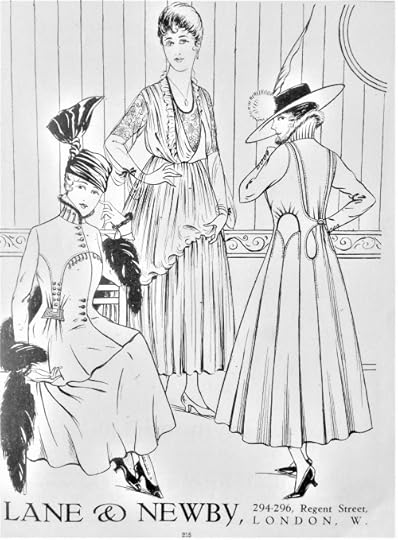
Illustration: Lane & Newby fashions, prewar
from the book: The following summer when for the first time since the end of the war the use of fur was permitted and we showed coats that were intended to be worn in the depths of winter, they [models] all crawled about like displaced esquimaux. It was an odd business. Living always six months ahead of myself, time soon ceased to have any meaning. At twenty-four, old age came zooming towards me. (p. 117)
I really enjoyed a couple of Eric Newby books ('A short walk in the Hindu Kush' and 'Love and war in the Apennines') so I was hoping for more of the same from this one. From the blub it seemed that this would be a follow up to love and war in the Apennines and I was super keen to find out what happened after the war and how things worked out with Wanda, Unfortunatly his is more of a collection of humorus short stories about the wholesale clothing business and lacks any kind of narrative thread. The authors style remains chatty, funny and self depricating and kept me reading 'till the end but I am afraid that I wanted more. Major life events are glossed over in a few sentences - as if he felt the had to be there but he was much more intersted in describing the minute inner workings of his failing fashion house. Other events - his 'Disasters' in the cutting room etc are alluded to but never fully explained. He presents himself as being thorughly hapless and disinterested, but describes his rise to the position of senior buyer for a big company, I don't completely buy it. He seems to be creating his own mythology, it would make for entertaining dinner party chit-chat, but as a book it falls short of the mark. I will read more from this author, for sure. The other books were superb. As he is a renowned travel writer it is perhaps only fair to judge him on his travel writing. This book is one to avoid.
They don't have my paperback edition from 1985 on GR so I'll just settle for this version.
This is a curious memoir, in a way its almost about nothing at all and should be dull as dishwater, but owing to the quality and nature of Newby's prose he actually turns this into quite an enjoyable yarn about a subject I have almost no interest in whatsoever.
Newby seems to strike a tone and mood somewhere between Spike Milligan's war diaries and an episode of "Are You Being Served?" (I'm free!) and this makes for fun, light-hearted and at times, amusing reading.
A great January read; this book is a real tonic against the ongoing extremely wet and stormy weather we’re currently experiencing in Britain.
Eric Newby possessed a glorious gift (or, should I say, survival mechanism) for seeing and sustaining the absurd and affectionately funny almost anywhere and everywhere. As such, I surmise the only weak point of this book to be that those readers who do find themselves instinctively disliking his style will do so with vehemence.
For the rest of us, this book is an easy and hugely pleasurable read. I don’t know that I learnt that much about the general workings of the British, and in particular London, fashion industry at that time (1945-1956); but I was entertained to learn about the importance of rowing, of business acumen (including listening to one’s accountants) and of employing the most competent company secretary one can afford. It also, for some odd unfathomable reason, brought back affectionate memories for a small business I used to work for in the City of London.
In the competitive business of clothes manufacturing immediately after WW2 (rationing continuing), how was it that firms such as Lane & Newby failed so entirely and completely to produce designs to delight their buyers, and thence the end customers? In Chapter 16 there is the most pricelessly hilarious description of the design and rationale behind the drawing up of a programme to show the Lane and Newby’s new season range to Scottish buyers. This would have been fully worthy of the comedic interpretative skills of Ronnie Barker and Ronnie Corbett. What a lost opportunity! Most telling were the buyers who knew that their customers wanted quality, and would pay for it; and whose difficulties lay in finding a business which was able to supply quality, to time, and at an agreeable price. Plus ça change, quality, and functionality of design in 2013-2014 has noticeably decreased, yet prices continue to rise.
As for Eric Newby’s wife and children; well, thank goodness he succeeded in keeping them from destitution by becoming such a prolific and bestselling author. I suppose the lesson to be learnt from this book is don’t try to be what you’re not cut out to be (excuse the pun); instead network and find another way to make a living from what you’ve learned from life.
NOTE: This edition published 1985 by Picador (of revised edition 1970).
Having jumped straight into this after finishing Love and War, my hopes were high for more of the same, but whilst there were some sparks, it lacked the fizz of the previous chapter. I was looking forward to more on his reconnecting with Wanda, but that whole episode and her settling in England are touched on very sparsely, instead we get a warm tribute to his father, interspersed with tales of his time in the often unglamorous side of fashion. I often ponder on the ratings of books I’ve read, and in what others saw that was a excellent enough to warrant 4 stars, that I missed, but to me it was OK, and OK’s only 2 stars 🌟…
I love Eric Newby's personal, entertaining writing style and his excellent books. Unfortunately, this is not one of them, but Eric Newby not-at-his-best is still ahead of heaps of other writers. Even if his adventures are slightly unbelievable, the characters, the places and the times are seen through his eyes and brought to life for his readers. Just go with the flow and enjoy the ride!
I never would have read this if not for my subscription to Slightly Foxed editions, whose physical form pleases me. The contents rarely disappoint either. Eric Newby is best known as a travel writer--though not by me before reading this memoir of how he "found his feet" (after being a prisoner of war in WWII) at his parents' wholesale clothing business. The story is really about his father and a few of his coworkers (most memorably traveling--not the sort he later wrote about--with Mr. Wilkins, or Willukins as they said, to Scotland in an attempt to sell his dresses. Who knew that two pieces and coats would be completely different departments. The picture is not complete, anecdotes more than full biography, but there's room on my reading list for that. (Biographies put me off these days.) I am tempted to read some of his travel writing. He finally found his feet at the Observer for ten years. I'm sure few who read his books at the time realized he was working as a buyer in fashion, for after his parents' firm went out of business, he kept in the trade for another ten years because you can't live on writing and certainly not feed a family. He intriguingly mentioned, twice at least, Kalamazoo Notebooks. There's a Kalamazoo, Michigan near my hometown, and I wonder if the stationery is connected to that place or a British brand with that name for some other reason. I'll be home next month; maybe I'll look into it at the Kalamazoo public library or historical society. At the very least, Newby has led me to look into whether there is a Kalamazoo Historical Society.
After the life of high adventure led by eric Newby before and during the war (see The Last Grain Race and Love And War in the Appenines) it seems a bit of an anticliax that he should have found himself working in his father's wholesale ladies clothing business, yet he manages to make this rather less dramatic era in his life very amusing. Mr Newby snr was an eccentric individual whose great passion was rowing on the Thames, and whose clothing business was already hopelessly old-fashioned by the time the young eric newby started working there. the book is full of vivid and entertaining portraits of the people he encountered and the sometimes quite bizarre clothing he was expected to sell. There is a painfully hilarious passage where eric's newly married Slovenian wife, Wanda, is reduced to tears by the truly terrible clothes that have been made for her "I'm so unhappy. i want to go back to my country and my people. I wasn't rich but nobody treated me like this." Somehow this extrardinary antiquated firm staggered on into the mid 1950s, and this account of its declining years is a deligtful little slice of social history.
Das Buch ist der zweite Teil der Biografie von Eric Newby. Er schließt direkt an "Love and war in the Appennines" an.
Der Unterschied zwischen Krieg und Lumpenhandel, wie er den Betrieb seines Vaters nannte, könnte nicht größer sein. Für Eric war der Unterschied vielleicht zu groß. Kaum hatten ihm seine Eltern gesagt, dass er bei ihnen anfangen könne, als er schon einen verzweifelten Brief an alten Sergeant schrieb mit der Bitte, ihn zurückzunehmen.
Aber auch bei der Damenbekleidung gibt es Krieg. Es ist nicht nur der Kampf um die Kunden, sondern auch der Kampf im Betrieb selbst, bei dem gerade die alteingesessenen Mitarbeiter dem Neuen das Leben schwer machen. Aber auch ohne diesen täglichen Beschuss wäre es ein Krieg geworden, nämlich gegen sich selbst. Eric Newby stellt sich stellenweise schon sehr ungeschickt an. Ich konnte darüber schmunzeln, aber er hat wahrscheinlich sehr gelitten. Trotzdem hat er es irgendwann geschafft, sich seinen Platz zu erobern.
Auch im Leben ausserhalb der elterlichen Firma ist er nicht immer der Geschickteste. Aber er kann über sich selbst lachen, zumindest mit dem zeitlichen Abstand, mit dem er das Buch geschrieben hat. Obwohl ich mir schon vorstellen kann, dass ihm seine Frau manchmal am liebsten den Hals umgedreht hätte.
Es ist mehr als nur die Geschichte der Karriere eines Kleiderverkäufers. Es ist auch die Geschichte von Newbys Vater, der das Geschäft aufgebaut hat und die er mit viel Liebe und Respekt erzählt. Eine wunderbare Fortsetzung der Geschichte seiner Kriegserlebnisse.
Some of Eric Newby's books are terrific, others (including this one) less so. Nevertheless, having read 'A Short Walk ...', 'The Last Grain Race', and 'Love and War ...', I was pleased to read this one, which serves to tie them together, to some extent. It provides much biographical detail about Newby and his family (especially his father) and some interesting social history about Britain during the 1930s to 1950s.
There are glimpses of Newby's keen observation, wit and sense of the ridiculous, but I found much of the book rather depressing, dealing as it does with the struggles of a failing industry during the more general struggles of the post-war years in England. I doubt I will read it again.
There is an epilogue that is of rather different character to the rest of the book, wherein Newby reflects on the nature of the fashion industry, seeming to conclude that on the whole it is a 'good thing'.
This is the late Mr Newby's hilarious account of his years spent as a fashion buyer in his father's fashion design emporium. Mr Newby has a wonderful talent for describing the strange characters across whom he comes in his day to day activities, from pompous blue-rinsed lady customers to martinets and harridans of his workplace. The irony here, as he admits himself, is he is not cut out for his role, and yearns instead for travel and adventure, feats which he later accomplishes with great brio and determination. Another irony is that the business is failing, because fashions are changing, but the family firm stays firmly rooted in its glorious past. I found the narrative full of subtle ironies like this and one could argue this is the wittiest yet most poignant of Mr Newby's books except, perhaps, his account of his wartime experiences as an escaped POW in Italy.
artistic creations tend to drag in the middle, but this one does so in the end. it may be a consequence of the additions made in the two(?) revisions the book went through before meeting my gaze—no matter its origin, this flaw stands out. newby writes with the most aplomb on those things that happened years or decades ago, perhaps those events whose witnesses are sufficiently dead that there are few, if any, left to object to newby's characterizations. i don't mean to be harsh, truly, as i far prefer to read a punched-up memoir than an accurate one except where there are practical consequences. anyway. you'll have squeezed about as much juice as you can from this book by the time you've finished the long chapter about his first scottish tour, and beyond that i'd only recommend you read the reflection on the new look.
For Eric Newby completists, Something Wholesale is quite different from his war and adventure memoirs. It tracks his years in the family business: women’s fashion. The book begins with Newby’s return to Britain from a German prisoner of war camp and, in that respect, makes a pretty fascinating portrait of the post-war transition (reminiscent, in a way, of the third installment of Waugh’s Sword of Honor trilogy). Something Wholesale isn’t as cohesive as Love and War in the Apennines or A Short Walk in the Hindu Kush, but it’s very funny. The highlight, I think, is Newby’s comic but affectionate portrait of his elderly father, who might have been one of the last Jerome-K.-Jerome-style Victorians.
I've never read Eric Newby's travel books. I read and reread this one, sticking to the sections about fashion. An afternoon at Throttle and Fumble. I miss out the rather sophomoric humour of the other chapters. The fashion chapters are very, very funny and plus they're about clothes. Clients are middle-aged ladies in the provinces who need something to wear at the masonic banquet, at weddings and to keep out the cold. "She don't need a outfit, she needs a operation!" Other clients are the Scottish Misses McRobbie. "Our leddies are not the type to wear wool georgette!" Eric quickly designs them some thornproof tweed dresses for shooting and deerstalking; and offloads a series of black chiffon, "funereal" evening dresses. "Back as 'Dawn', but without the channel seaming..." Time to reread.
I really liked Newby's 1971 memoir about being a POW in WW2 Italy, so I thought I would enjoy this earlier book, about his postwar life working in his family's clothing business. I didn't, though, and I think it's because of the difference in tone -- this Eric is a pretty feckless person whom ridiculous things are constantly happening to, rather than the WW2 Eric who was a competent adult navigating complicated life situations. Did his sense of himself (or at least what self he wanted to present to the public) change between the 50s and the 70s? I don't really know, but I wasn't enjoying this one so I finally decided to let it go. [Jan 2024]
The story of Eric Newby’s rather chequered career in the rag trade post WWII working for his parents’ couture company trying, often unsuccessfully, to sell expensive gowns and coats to needle-sharp and reluctant buyers throughout the UK, one of whom wore:
…a stone so enormous that it would have been more at home on the landing of a geological museum than stuck in a hat.
Having spent the war in the SBS and as a prisoner in Italy and Germany (read the superb ‘Love and War in the Apennines’) Newby has no experience and is ill-suited to the task. But with a wife (Wanda) and children he tries hard. The real star of the show is Eric’s father who is a committed rower but seems, cleverly, to have very little business sense and has succeeded - up to 1946 anyway - through sheer eccentricity.
…the simplest excursion made by our family resembled a street-fighting patrol in hostile territory.
Eric’s experiences are embellished by the presence of the delightfully odd employees that teach him the ropes and we become immersed in a now-vanished world of cutters, models, seamstresses and rather grand departmental heads as well as some workers of whom Eric never figured their function except that they’d been there for years.
At eleven o’clock there was a sound like a traction engine mounting a steep hill and Mrs Smithers . . . came grunting up the stairs from the the cellar bearing a tray loaded with ‘elevenses’.
Unfortunately the premises at 54 Great Marlborough Street seems to have been demolished. It ought to have a Blue Plaque.
Love this guy, have read lots of his books and his style is so amusing and serious at the same time. An education in post war fashion industry, how lucky we are now to have such choice now: I wouldn't want to be wearing the tweed monstrosities he described? True his epilogue talks about high fashions frippery which hasn't changed much but this book is a period piece well worth reading.
Newby is such a good writer that even a topic that I'm not really interested in (fashion) was engaging. What makes this book so engaging is Newby's personalization of it. Set primarily in post war (1946) London we get a glimpse into Newby's life and the fashion industry at that point in time. To me its very "English" which I like.
Disappointing. His first book was the Last Grain Race, an amazing account of a round-the-world trip as an apprentice on one of the last trading tall ships. His second, Love and War in the Apennines, was an account of his war years as a commando and escaping prisoner-of-war in Italy, where he was helped to escape the Germans by Wanda, who he was later to marry, the love of his life. What is there in the London Rag trade, his family's business, to compare, to compete?
Silly of me to expect anything, of course, although I really wanted to know more of his courting of the fabulous Wanda, which he didn't write much about in this book.
Sure, some amusing stories, some great word-pictures of family business and his eccentric dad.
But if you're looking for the essential Newby, give this one a miss and move on to 'A short walk in Hindu Cush', and his many later books.
I purchased this one after reading Love and War in the Appinines, and it's been sitting on a shelf for nearly three years. Well, it's not nearly as entertaining as Love and War, and I don't recommend it. Newby tries very hard to be funny, but much of what happened to him right after the war was not funny. He entered the family business, a wholesale clothing manufacturing company, and didn't enjoy the work. He describes his father in less than flattering ways. He marries Wanda but expends little time or detail on their wedding or marriage. He seems to be grasping at any tangential tale that comes into his head just to pad the book. All in all, a disappointment. Do read Love and War. . ..
Not in the same league as A Short Walk in the Hindu Cush, which for sheer improbability is hard to beat. I have read two or three other books by Eric Newby, but none of them comes up to A Short Walk. This one of passing interest.
I could not get into this story. Even though it was a memoir of sorts, the characters seemed more like caricatures. There was a great deal of mid nineteenth century British idiom that must have contributed to my lack of interest in the story.