

What do you think?

Bread Givers
The classic novel of Jewish immigrants, with period photographs. This masterwork of American immigrant literature is set in the 1920s on the Lower East Side of Manhattan and tells the story of Sara Smolinsky, the youngest daughter of an Orthodox rabbi, who rebels against her father's rigid conception of Jewish womanhood. Sarah's struggle towards independence and self-fulfillment resonates with a passion all can share. Beautifully redesigned page for page with the previous editions, Bread Givers is an essential historical work with enduring relevance. 16 black-and-white photographs
297 pages, Paperback
First published January 1, 1925
About the author
Anzia Yezierska
42 books89 followersAnzia Yezierska was a Jewish-American novelist born in Mały Płock, Poland, which was then part of the Russian Empire. She emigrated as a child with her parents to the United States and lived in the immigrant neighborhood of the Lower East Side of Manhattan.
Ratings & Reviews
Friends & Following
Create a free account to discover what your friends think of this book!
Community Reviews
Displaying 1 - 30 of 710 reviews

December 4, 2019
This is a novel about a poor Jewish immigrant family in Manhattan’s Lower East Side in the 1920’s. The father is devoted to studying the Torah and does not work. So his wife and four daughters are expected to provide for him. The main character and narrator is the youngest daughter who rebels against her father after seeing him chase away three men her sisters loved and then arranging what turned out to be bad marriages for all of them. The daughters range from large and homely (the father calls her ‘the burden bearer’) to beautiful and self-centered. The father gets the cream, the best soup, and often, the only piece of meat.

How poor are they? As a young girl, one of the main character’s chores include hunting through ash bins on the street looking for tiny bits of coal. They have one rag that serves as towel for all of them. Her mother yells at her for not peeling the potato skins thin enough. They brush their teeth with ashes using a common toothbrush.
The father is always spouting off verses telling the women of the house that “only through a man has a woman an existence“ and that “No girl can live without a father or a husband to look out for her.” The youngest girl rebels and goes off on her own to get a job. Her father disowns her and eventually (after six years of work and study drudgery) she finishes college and becomes a teacher. All this time she has no love in her life; no contact with her family other than through letters, and no girlfriends because she has no money for fashion and no time to hang out making friends.
She asks a dean at the college a key question: “Why is it that when a nobody wants to get to be a somebody she’s got to make herself terribly hard, when people like you who are born high up can keep all their feelings and get along so naturally well with everybody?”
The narrator’s goal, she tells us several times, is to “become a person.”
The language is interesting, even odd at times, because we don’t know if it a translation, or written by an author with imperfect English, or, most likely I suppose it reflects the imperfect English spoken by the family at home. Here are some phrases thought, not spoken, by the narrator: “From him it hollered money, like a hundred cash registers ringing up the dollars.” “I want some day to make myself for a person and come among people.” “It smelled from him yards away, the fish he was selling.” “When I met him at the corner he was blowing from himself like a millionaire.”
The author, who grew up at the time of this story and in this neighborhood, wrote a few novels and collections of short stories which brought her some fame and money. But her work fell out of vogue and she died in poverty. Alice Kessler-Harris, a history professor at Columbia, is credited with brining her work back into notice. She provides an extensive foreword and introduction telling us about the author’s life and to what extent the story is autobiographical. Although the story is fiction, the writer of the introduction tells us that the author and the main character are “emotionally interchangeable.”

A good story - a classic American story of an immigrant (Old World vs. New) pulling herself up by her bootstraps. An inspirational story for women, especially young women.
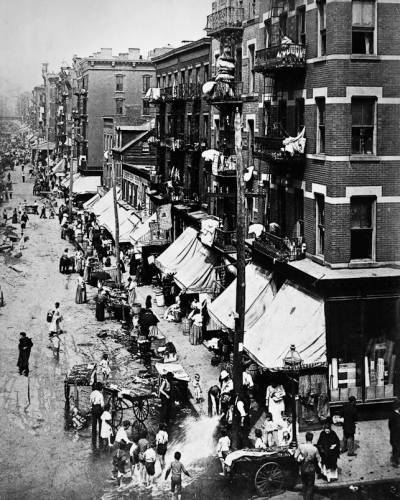
Top photo of Orchard St., the main shopping district of the Jewish community on the Lower East Side in the 1920's from static01.nyt.com/images
Middle photo from www.nycvintageimages.com
The author from www.azquotes.com/picture-quotes
How poor are they? As a young girl, one of the main character’s chores include hunting through ash bins on the street looking for tiny bits of coal. They have one rag that serves as towel for all of them. Her mother yells at her for not peeling the potato skins thin enough. They brush their teeth with ashes using a common toothbrush.
The father is always spouting off verses telling the women of the house that “only through a man has a woman an existence“ and that “No girl can live without a father or a husband to look out for her.” The youngest girl rebels and goes off on her own to get a job. Her father disowns her and eventually (after six years of work and study drudgery) she finishes college and becomes a teacher. All this time she has no love in her life; no contact with her family other than through letters, and no girlfriends because she has no money for fashion and no time to hang out making friends.
She asks a dean at the college a key question: “Why is it that when a nobody wants to get to be a somebody she’s got to make herself terribly hard, when people like you who are born high up can keep all their feelings and get along so naturally well with everybody?”
The narrator’s goal, she tells us several times, is to “become a person.”
The language is interesting, even odd at times, because we don’t know if it a translation, or written by an author with imperfect English, or, most likely I suppose it reflects the imperfect English spoken by the family at home. Here are some phrases thought, not spoken, by the narrator: “From him it hollered money, like a hundred cash registers ringing up the dollars.” “I want some day to make myself for a person and come among people.” “It smelled from him yards away, the fish he was selling.” “When I met him at the corner he was blowing from himself like a millionaire.”
The author, who grew up at the time of this story and in this neighborhood, wrote a few novels and collections of short stories which brought her some fame and money. But her work fell out of vogue and she died in poverty. Alice Kessler-Harris, a history professor at Columbia, is credited with brining her work back into notice. She provides an extensive foreword and introduction telling us about the author’s life and to what extent the story is autobiographical. Although the story is fiction, the writer of the introduction tells us that the author and the main character are “emotionally interchangeable.”
A good story - a classic American story of an immigrant (Old World vs. New) pulling herself up by her bootstraps. An inspirational story for women, especially young women.
Top photo of Orchard St., the main shopping district of the Jewish community on the Lower East Side in the 1920's from static01.nyt.com/images
Middle photo from www.nycvintageimages.com
The author from www.azquotes.com/picture-quotes

September 20, 2016
Male Liberation
A gem in so many dimensions: King Lear with an extra daughter, a proto-feminist masterpiece, a profoundly moving documentary about the true cost of immigrant-assimilation, a charming remembrance of Yiddish-American dialect. It reads as fresh and possibly as scandalously as it did in 1925.
Most surprisingly, however, among its many surprises the book is also a charter for men's liberation long before the idea became a ‘thing’ in today's culture. Bread givers are husbands. Bread giving is what men not only do, it is their primary quality as human beings. It is what they should be valued for in the American culture as seen so accurately by those entering the culture from abroad. The way for a woman to get on is by identifying and capturing a reliable bread giver. The fact that this tactic most often ends in personal tragedy is not so much the fault of the (patently faulty) men involved but of the culture which seems to demand that this is their primary role.
Those most prone to the cultural myth of bread giving are of course men themselves, especially men steeped in the patriarchal culture of the Polish shtetl. And most particularly that man who dominates the lives of all females in his orbit, the rabbi-like paterfamilias of the piece, who has only studied Torah for his entire life and who has no skills with which to give any bread to anyone in his new world. The contradiction is obvious to everyone but himself so he ends up participating in the same tragedy which he has inflicted on his daughters by, as a widower, marrying a woman who expects nothing but … a bread giver.
American culture hasn’t changed much in the last 90 years or so, except to become a fair bit less direct in its expectations around marriage. Women are still considered second-class members of the human race by a large portion of the population, largely with biblical witness for support. Men are still considered for their economic achievement or their potential for achievement as ‘husband material’. The idea that a man could possibly waste his life in spiritual activity which, somehow, his family should fund is incomprehensible except in those orthodox Jewish communities that still seek to emulate the shtetl in America. The fact that Yezierska never has her protagonist, Sara, condemn this central aspiration/need/calling of her father is perhaps the most scandalous theme of the book to modern sensibilities, just as it undoubtedly was in 1925.
A gem in so many dimensions: King Lear with an extra daughter, a proto-feminist masterpiece, a profoundly moving documentary about the true cost of immigrant-assimilation, a charming remembrance of Yiddish-American dialect. It reads as fresh and possibly as scandalously as it did in 1925.
Most surprisingly, however, among its many surprises the book is also a charter for men's liberation long before the idea became a ‘thing’ in today's culture. Bread givers are husbands. Bread giving is what men not only do, it is their primary quality as human beings. It is what they should be valued for in the American culture as seen so accurately by those entering the culture from abroad. The way for a woman to get on is by identifying and capturing a reliable bread giver. The fact that this tactic most often ends in personal tragedy is not so much the fault of the (patently faulty) men involved but of the culture which seems to demand that this is their primary role.
Those most prone to the cultural myth of bread giving are of course men themselves, especially men steeped in the patriarchal culture of the Polish shtetl. And most particularly that man who dominates the lives of all females in his orbit, the rabbi-like paterfamilias of the piece, who has only studied Torah for his entire life and who has no skills with which to give any bread to anyone in his new world. The contradiction is obvious to everyone but himself so he ends up participating in the same tragedy which he has inflicted on his daughters by, as a widower, marrying a woman who expects nothing but … a bread giver.
American culture hasn’t changed much in the last 90 years or so, except to become a fair bit less direct in its expectations around marriage. Women are still considered second-class members of the human race by a large portion of the population, largely with biblical witness for support. Men are still considered for their economic achievement or their potential for achievement as ‘husband material’. The idea that a man could possibly waste his life in spiritual activity which, somehow, his family should fund is incomprehensible except in those orthodox Jewish communities that still seek to emulate the shtetl in America. The fact that Yezierska never has her protagonist, Sara, condemn this central aspiration/need/calling of her father is perhaps the most scandalous theme of the book to modern sensibilities, just as it undoubtedly was in 1925.

January 4, 2016
Even up to this day, in the Philippines, fathers are still considered the head of the family. No matter what happens, he is the one who decides against anything concerning familial problems. It is neither the mother nor the eldest child. It is just him none other than anyone else in the family. There are some cases that a father figure tends to be authoritarian and dictatorial. No matter what you opine of is not acceptable for him. Your opinions and suggestions will just go in the ear and out the other. He imposes draconian rules whether you like them or not. So all you have to do is shut your mouth and live with intestinal fortitude. Otherwise, he will hurl abuse at you, or if you are a son, he will make a man of you by punching you in the chest or stomach. The classic one? He will redden your ass with his flagellant belt. If you happen to be a girl, he will turn your face black and blue with his iron palm. Do I sound exaggerated? Take it for granted if you are in the same boat. I guess you understand what I am talking about. If you remonstrate with me, well, luckily, you never have this kind of father. Neither do I.
As a social science student, I have learned that the common reasons why a man is perceived to be the head of the house are based on distorted culture molded by ancient teachings particularly such as of Confucianism and Christianity. Men are superior to women. Men are biologically stronger than women. So with these patterns of learned ideas, we learn that we, I mean you , should pay homage to us men. Bravo! Thanks to those misleading bodies of teachings! We are always put on the pedestal. Consequently, we peoples in the world tend to be incorrigible. No wonder there is no world peace. (charot!)
The good thing is we are creatures of human expression. We can express our disappointment in human ignorance through literature. And this is what Anzia Yezierska must have intended; she wrote Bread Giver that deals with the clash between the Old World and the New World. The consequence? A masterpiece everyone deep-seated should read.
Anzia Yezierska was a Jew immigrant in New York in the 1900’s. She may have been one of those immigrants, along with her family, escaped the pogrom in Russia and was stopped at Ellis island from entering the US when the American President was still in the air whether it should adopt the immigrants or not. (I just read this information from Nicholson Baker’s book Human Smoke: The Beginnings of World War II, the End of Civilization.)One thing I am cocksure about Yezierska: As an immigrant, she went through the pressures of American dream in New York where she and her family ventured in to survive. In her novel, Bread Givers, although it was said to have been drawn deep inspiration from her immigrant experience, she wrote a story dealing with what kind of culture she may have grown up with- her father’s patriarchal authority, struggles with feminine independence, and grinding poverty. So this novel will make you tear your hair and your toes curl.
The only thing you might notice in the book is Yezierska’s writing styles. The sequence of the stories is not similar to other surreal books you love to bury yourself in. Every scene is so fast that you will end up in a hanging position as if you want to read more at full length. Probably, you are used to much description. Nonetheless, for me, it is not that a big deal.
Yezierska’s setting begins with endless scenes crawling with miseries which are so annoying, frustrating, soporific, and heart-breaking that I carp at her intention. So, amidst of reading it, I predict that the ending of the story could be like a-happily-ever-after denouement. However, as the story goes deeper, the more foolishly miserable the story becomes until I come to the point that it might be a disappointing story after all. In the end, the story turns out to be more interesting because of the main character‘s determination to surpass all the struggles. On the other hand, I did not like the way Yezierska wrote the sequence of the events: fast and slapdash.
The hallmark of this book is its quotable and witty dialogues. You can be serious about the philosophical dialogues among the characters, but you will end up finding them funny. However, be ready for the character of Mr. Reb Smilonsky. You might go mad at him that you might feel like engaging him in a debate over religion and life. As a Jew, he is always preaching to his children( Masha, Bessie, Fania, and Sarah, the narrator) the teachings of the Old Torah especially the statement that , “ Women can’t go to heaven without men.” Or “ Only through a man can a woman an existence.” In other words, he teaches the traditional Jewish culture that men are superior to women. So there are times that I put this book down for a moment gnashing my teeth as though I can no longer stand listening to a character, a byword for hypocrisy, megalomania, and grandeur delusion.
Another highlight of the book is the grammar structures of the sentences. Anzia Yezierska’s English must be old –fashioned since she was a Jew. I cringe at the sentences, but they convey substantial tones and emotions. I am predisposed to anger, annoyance, and empathy, so I am no bothered at them at all. Every scene tends to carry me away.
Most importantly, I really liked the book -despite that it may not be among the crème de la crème of critically acclaimed novels - because it is scattered with different themes: hypocrisy, wrong culture, feminism, Americanism, human Independence, and determination.
Bread Givers is not the only one I have read dealing with immigrant life in America. My heart broke when I first read The Jungle by Upton Sinclair. I was also astounded at The Assistant by Bernard Malamud which TIME magazine included in its list for 100 Best Novels of All Time since 1924.Last year, I rankedMy Ántonia by Willa Cather first in my top ten favorite books in 2015. For non-fictions, I read Richard Rodriguez's Hunger of Memorywhich narrates his education life in the US as a gringo and the other one,'Tis by Frank McCourt on his life adventure in America. For local books, I read Carlos Bulosan’sAmerica Is in the Heart: A Personal History and Bulosan: An Introduction With Selections .All of these books bear the same concept: American dream. No wonder reading just the likes of them have a significance impact upon readers like me.
Next time, I will read The Big Sleep by Raymond Chandler Hooray!!! ^^
As a social science student, I have learned that the common reasons why a man is perceived to be the head of the house are based on distorted culture molded by ancient teachings particularly such as of Confucianism and Christianity. Men are superior to women. Men are biologically stronger than women. So with these patterns of learned ideas, we learn that we, I mean you , should pay homage to us men. Bravo! Thanks to those misleading bodies of teachings! We are always put on the pedestal. Consequently, we peoples in the world tend to be incorrigible. No wonder there is no world peace. (charot!)
The good thing is we are creatures of human expression. We can express our disappointment in human ignorance through literature. And this is what Anzia Yezierska must have intended; she wrote Bread Giver that deals with the clash between the Old World and the New World. The consequence? A masterpiece everyone deep-seated should read.
Anzia Yezierska was a Jew immigrant in New York in the 1900’s. She may have been one of those immigrants, along with her family, escaped the pogrom in Russia and was stopped at Ellis island from entering the US when the American President was still in the air whether it should adopt the immigrants or not. (I just read this information from Nicholson Baker’s book Human Smoke: The Beginnings of World War II, the End of Civilization.)One thing I am cocksure about Yezierska: As an immigrant, she went through the pressures of American dream in New York where she and her family ventured in to survive. In her novel, Bread Givers, although it was said to have been drawn deep inspiration from her immigrant experience, she wrote a story dealing with what kind of culture she may have grown up with- her father’s patriarchal authority, struggles with feminine independence, and grinding poverty. So this novel will make you tear your hair and your toes curl.
The only thing you might notice in the book is Yezierska’s writing styles. The sequence of the stories is not similar to other surreal books you love to bury yourself in. Every scene is so fast that you will end up in a hanging position as if you want to read more at full length. Probably, you are used to much description. Nonetheless, for me, it is not that a big deal.
Yezierska’s setting begins with endless scenes crawling with miseries which are so annoying, frustrating, soporific, and heart-breaking that I carp at her intention. So, amidst of reading it, I predict that the ending of the story could be like a-happily-ever-after denouement. However, as the story goes deeper, the more foolishly miserable the story becomes until I come to the point that it might be a disappointing story after all. In the end, the story turns out to be more interesting because of the main character‘s determination to surpass all the struggles. On the other hand, I did not like the way Yezierska wrote the sequence of the events: fast and slapdash.
The hallmark of this book is its quotable and witty dialogues. You can be serious about the philosophical dialogues among the characters, but you will end up finding them funny. However, be ready for the character of Mr. Reb Smilonsky. You might go mad at him that you might feel like engaging him in a debate over religion and life. As a Jew, he is always preaching to his children( Masha, Bessie, Fania, and Sarah, the narrator) the teachings of the Old Torah especially the statement that , “ Women can’t go to heaven without men.” Or “ Only through a man can a woman an existence.” In other words, he teaches the traditional Jewish culture that men are superior to women. So there are times that I put this book down for a moment gnashing my teeth as though I can no longer stand listening to a character, a byword for hypocrisy, megalomania, and grandeur delusion.
Another highlight of the book is the grammar structures of the sentences. Anzia Yezierska’s English must be old –fashioned since she was a Jew. I cringe at the sentences, but they convey substantial tones and emotions. I am predisposed to anger, annoyance, and empathy, so I am no bothered at them at all. Every scene tends to carry me away.
Most importantly, I really liked the book -despite that it may not be among the crème de la crème of critically acclaimed novels - because it is scattered with different themes: hypocrisy, wrong culture, feminism, Americanism, human Independence, and determination.
Bread Givers is not the only one I have read dealing with immigrant life in America. My heart broke when I first read The Jungle by Upton Sinclair. I was also astounded at The Assistant by Bernard Malamud which TIME magazine included in its list for 100 Best Novels of All Time since 1924.Last year, I rankedMy Ántonia by Willa Cather first in my top ten favorite books in 2015. For non-fictions, I read Richard Rodriguez's Hunger of Memorywhich narrates his education life in the US as a gringo and the other one,'Tis by Frank McCourt on his life adventure in America. For local books, I read Carlos Bulosan’sAmerica Is in the Heart: A Personal History and Bulosan: An Introduction With Selections .All of these books bear the same concept: American dream. No wonder reading just the likes of them have a significance impact upon readers like me.
Next time, I will read The Big Sleep by Raymond Chandler Hooray!!! ^^

May 24, 2017
It is interesting to note that this semi-autobiographical novel was written in 1925. It is certainly readable and compelling- as many historical books are. This is the tale of a Polish-Jewish family who have immigrated to the teeming, impoverished ghetto of New York. Sarah, who is the youngest of four daughters of a Talmudic rabbi, is the narrator of this tale. As is often typical of ultra- religious families, women are subjugated to the rules of male dominance. In this case, the daughters were expected to earn enough money to provide sustenance for the family while their father was free to "study", preach and dictate every whim of expected behavior. The girls were rarely free for individual pleasures or to choose prospective husbands. The substandard wages they earned kept them in constant poverty.
We'd come home worn and tired from working hard all day and there was Father with a clear head from his dreams of the Holy Torah, and he'd begin to preach to each and every one of us our different sins that would land us in hell.He remembered the littlest fault of each and every one of us, from the time we were born. (p.65 )
Weary and discouraged from this life and eager for education, Sarah flees from this dark, crowded
unhealthy environment to better herself. When she returns to visit with her family after her initial educational endeavor, her reception was as expected. Her father erupted.
Rage flamed from his eyes as he thundered at me, stamping his feet. 'Pfui on your education! What's going to be your end? A dried-up old maid? You think you can make over the world?You think millions of educated old maids like you could change the world one inch? Woe to America where women are let free like men. All that's false in politics, prohibition and all the evils of the world come from them. I no longer saw my father before me, but a tyrant from the Old World where only men were people. To him I was nothing but his last unmarried daughter to be bought and sold. (P.205) '
So Yezierska has painted a vivid, but accurate picture of life for these women almost 100 years ago. While much progress has been made since the inception of Women's Lib, we still have further to go and many women continue to suffer in patriarchal societies.
Note: Included in this book there are many interesting notes written by the daughter and historical researchers.
We'd come home worn and tired from working hard all day and there was Father with a clear head from his dreams of the Holy Torah, and he'd begin to preach to each and every one of us our different sins that would land us in hell.He remembered the littlest fault of each and every one of us, from the time we were born. (p.65 )
Weary and discouraged from this life and eager for education, Sarah flees from this dark, crowded
unhealthy environment to better herself. When she returns to visit with her family after her initial educational endeavor, her reception was as expected. Her father erupted.
Rage flamed from his eyes as he thundered at me, stamping his feet. 'Pfui on your education! What's going to be your end? A dried-up old maid? You think you can make over the world?You think millions of educated old maids like you could change the world one inch? Woe to America where women are let free like men. All that's false in politics, prohibition and all the evils of the world come from them. I no longer saw my father before me, but a tyrant from the Old World where only men were people. To him I was nothing but his last unmarried daughter to be bought and sold. (P.205) '
So Yezierska has painted a vivid, but accurate picture of life for these women almost 100 years ago. While much progress has been made since the inception of Women's Lib, we still have further to go and many women continue to suffer in patriarchal societies.
Note: Included in this book there are many interesting notes written by the daughter and historical researchers.

May 30, 2008
This is one of my absolute favorite books of all time. I really enjoyed her writing style. I felt connected to her characters and love the plot. I can totally relate to this story. Her dilemma to choose college over marriage. It was heartbreaking seeing the daughters marry and struggle and become controlled by their abusive husbands. Her overbearing father cracks me up but also annoys and irritates me. I found joy in watching her make her way through college and then find the love of her life. What a joy to read. I will treasure this book always.
This entire review has been hidden because of spoilers.
March 21, 2013
This book was assigned reading as part of a course on immigration policy within the US. The professor recommended it highly and told the class that it was a good read and that we would all find ourselves absorbed in the book once we got into it. Truth was spoken.
Bread Givers is the story of Russian Jew immigrant Sara Smolinsky and her desire and struggle to achieve the pinnacle of what it means to be an American; the opportunity to invest one's self in individual pursuits.
As with any book I read through the foreword and introduction, written by Alice Kessler-Harris, and she tells of how she discovered Yezierska when she was a grad student and became entranced by her. I was intrigued by her passion for the text and encouraged further to read (I also had a deadline, the test was in one day and I hadn't started the book). Kessler-Harris uses the adjective "powerful" to describe the writing style, and it was appropriate. I became so engrossed in the book that I finished in one day (not a huge feat, the book is only 297 pages).
After the first chapter I was hooked. I felt the hunger of her family as they scrounged for food and warmth, the shame of being impoverished, and the singular hope of Sara's brave spirit to live free from the shackles of oppressive patriarchy. I wanted to throttle her sisters and I found Yezierska's adjective of "dumb" accurate to describe the broken, spiritless, acquiescence of her sisters and mother. In our in class discussion the professor mentioned the "necessary cooperation of women for any paternalism to exist" and I hoped silently that at least a few of the women in the classroom fully understood the comment. Line after line I found myself silently railing against the self entitled patriarch, and while I understand that much of his faults were enabled by social constructs I could not completely sympathize with his position. I was reminded of my own grandfather who had as much fault in his own death as the diabetes and strokes that were listed on his death certificate, the same sense of imperial entitlement. I was also reminded of him when Sara comes home from college to find that her mother's feet have rotted away from gangrene, and her refusal to have them removed to save her life. I had to take a few moments to reflect on my own past. I celebrated her Sara's strength of conviction to continue with her studies in the face of hunger, isolation, and discouragement. I felt like I was beside her in her dingy basement room covered in filth and lit by candle. I celebrated when she sees through the guise of the predatory suitor, I laugh knowingly as she falls for improbable crushes and I enjoy her triumphant completion of college and return to New York as a teacher. Her resolution with her father and stepmother left me a bit confused, perhaps I am a bit too hard. Then again I see much of my own family in the enabled, manipulative, and yet dependent father. So many emotions and so much commentary on social constructs.
The fact that this book was written in the 1920's and that it was not immediately recognized as a masterpiece of literary work, says much about American society in the turn of the twentieth century. Perhaps it is my American self that cries out for Sara to come among us and take her place as one of the brave and free. I hear her desire to stretch her wings to their greatest span and to live without imposed restraints of social obligation, because that is what it means to be free to live as you will. Understanding that celebration of the self is a celebration of life. Anzia Yezierska, I take my hat off to you. Well done madam, well done.
Bread Givers is the story of Russian Jew immigrant Sara Smolinsky and her desire and struggle to achieve the pinnacle of what it means to be an American; the opportunity to invest one's self in individual pursuits.
As with any book I read through the foreword and introduction, written by Alice Kessler-Harris, and she tells of how she discovered Yezierska when she was a grad student and became entranced by her. I was intrigued by her passion for the text and encouraged further to read (I also had a deadline, the test was in one day and I hadn't started the book). Kessler-Harris uses the adjective "powerful" to describe the writing style, and it was appropriate. I became so engrossed in the book that I finished in one day (not a huge feat, the book is only 297 pages).
After the first chapter I was hooked. I felt the hunger of her family as they scrounged for food and warmth, the shame of being impoverished, and the singular hope of Sara's brave spirit to live free from the shackles of oppressive patriarchy. I wanted to throttle her sisters and I found Yezierska's adjective of "dumb" accurate to describe the broken, spiritless, acquiescence of her sisters and mother. In our in class discussion the professor mentioned the "necessary cooperation of women for any paternalism to exist" and I hoped silently that at least a few of the women in the classroom fully understood the comment. Line after line I found myself silently railing against the self entitled patriarch, and while I understand that much of his faults were enabled by social constructs I could not completely sympathize with his position. I was reminded of my own grandfather who had as much fault in his own death as the diabetes and strokes that were listed on his death certificate, the same sense of imperial entitlement. I was also reminded of him when Sara comes home from college to find that her mother's feet have rotted away from gangrene, and her refusal to have them removed to save her life. I had to take a few moments to reflect on my own past. I celebrated her Sara's strength of conviction to continue with her studies in the face of hunger, isolation, and discouragement. I felt like I was beside her in her dingy basement room covered in filth and lit by candle. I celebrated when she sees through the guise of the predatory suitor, I laugh knowingly as she falls for improbable crushes and I enjoy her triumphant completion of college and return to New York as a teacher. Her resolution with her father and stepmother left me a bit confused, perhaps I am a bit too hard. Then again I see much of my own family in the enabled, manipulative, and yet dependent father. So many emotions and so much commentary on social constructs.
The fact that this book was written in the 1920's and that it was not immediately recognized as a masterpiece of literary work, says much about American society in the turn of the twentieth century. Perhaps it is my American self that cries out for Sara to come among us and take her place as one of the brave and free. I hear her desire to stretch her wings to their greatest span and to live without imposed restraints of social obligation, because that is what it means to be free to live as you will. Understanding that celebration of the self is a celebration of life. Anzia Yezierska, I take my hat off to you. Well done madam, well done.

March 6, 2021
The novel BREAD GIVERS is narrated by Sara Smolinsky, a Jewish Immigrant in New York City. Her mother, father, and three sisters emigrated from Poland to the Lower East Side in the early 20th century. The book describes the family’s struggle with money, tradition, religion, in a foreign country.
I kept thinking about “The Fiddler on the Roof” while reading this book. I haven’t explored many stories of Ashkenazi Jews from before World War 2, so Fiddler is a touchstone for me. Like the musical, this book explores tradition and religion in a rapidly changing world. The father doesn’t work, doesn’t contribute to the house, claiming his devotion to God and his studies takes priority. The father stays home all day and prays while all his daughters work. He’s not funny or sweet or looking out for his daughters’ interests in any way. I despised the father in this book who prized education above all but would not support Sara’s pursuit of an education herself. He was a horrible father and person. He’s not a smart or savvy man either, making one foolish mistake after the other. It was devastating to see the effect he had on the mother and sisters. I was rooting for Sara throughout this story as she grows and finds her own place in the world. I found the book uplifting and an easy read. The prose was not sophisticated and the story is very plot driven, but the book was enjoyable and I’m glad I read this.▪️
I kept thinking about “The Fiddler on the Roof” while reading this book. I haven’t explored many stories of Ashkenazi Jews from before World War 2, so Fiddler is a touchstone for me. Like the musical, this book explores tradition and religion in a rapidly changing world. The father doesn’t work, doesn’t contribute to the house, claiming his devotion to God and his studies takes priority. The father stays home all day and prays while all his daughters work. He’s not funny or sweet or looking out for his daughters’ interests in any way. I despised the father in this book who prized education above all but would not support Sara’s pursuit of an education herself. He was a horrible father and person. He’s not a smart or savvy man either, making one foolish mistake after the other. It was devastating to see the effect he had on the mother and sisters. I was rooting for Sara throughout this story as she grows and finds her own place in the world. I found the book uplifting and an easy read. The prose was not sophisticated and the story is very plot driven, but the book was enjoyable and I’m glad I read this.▪️

July 29, 2010
This was my absolute rave-about-and-recommend-to-everyone favorite book in my early twenties because it explored all the things I cared about most: falling in love, a burning ambition to write, and Judaism. At the time, I said I wanted to be Anzia Yezierska, but in mirror image; whereas she ran away from Yiddishkeit, I was embracing it. I wanted to portray my world and choices just as poignantly as she. That's still my ambition, but now that I'm older, I see many more flaws in Anzia Yezierska, not just because she abandoned Judaism and her own daughter in favor of her writing, but in her style. Even still, I've ranked this a 5 for how much I loved it then and for this roughly-quoted, life-changing insight: Every time my heart broke over a man and I thought my world would end, it turned out to usher me into some newer, bigger world.

August 28, 2014
In Better Angels of our Nature, Stephen Pinker describes literature as a "tool for empathy." Few books emphasize this point as well as Bread Givers. Yezierksa puts you in the shoes of a poor Jewish immigrant girl growing up in New York City under the tyrannical reign of her father. I'd love to use a number of inappropriate words to describe the father, but I'll stick to ones I feel comfortable saying on goodreads: hypocritical, fundamentalist, narcissistic, impractical, terrible with money, lazy, unwilling to admit error, and misogynistic in the true sense of the word. One can only celebrate the protagonist Sara's escape and victorious quest to remake herself as an American and a teacher. The father is so backwards and tyrannical that he almost seems to be a one-dimensional caricature, although by the end of the book you see how helpless he really is. He's a great example of the self-serving nature of religious and cultural fundamentalism and how these systems of belief are incompatible with the rights and happiness of oppressed groups, especially women. Seriously, he ranks up there with some of the most hatable figures in literature. He belongs in the Pantheon of literary a-holes with Dolores Umbridge, Mr. Ewell, and Humbert Humbert.
This book also raises a number of important issues in American history. Sara escapes from the limited future and hypocritical preaching of her father by latching onto an American identity of the value of labor, education, and individual independence. In other words, American culture offers her an outlet from her more oppressive cultural background. She asserts herself as a person independent of man, and maintains that independence throughout the story. Nevertheless, there's a cost to this breaking away. First, she must labor incredibly hard to work her way into the American dream. Second, she is not accepted by most other Americans, especially in college, because they can see her impoverished immigrant background. Finally, she is ultimately drawn back to supporting her father by a lingering feeling of responsibility for her parents, no matter how bad her father was. All in all, this book makes you think about the plight of women and immigrants everywhere, and how social and cultural systems need to leave room for the genuine dreams of all people who are willing to work at them.
297 pages.
This book also raises a number of important issues in American history. Sara escapes from the limited future and hypocritical preaching of her father by latching onto an American identity of the value of labor, education, and individual independence. In other words, American culture offers her an outlet from her more oppressive cultural background. She asserts herself as a person independent of man, and maintains that independence throughout the story. Nevertheless, there's a cost to this breaking away. First, she must labor incredibly hard to work her way into the American dream. Second, she is not accepted by most other Americans, especially in college, because they can see her impoverished immigrant background. Finally, she is ultimately drawn back to supporting her father by a lingering feeling of responsibility for her parents, no matter how bad her father was. All in all, this book makes you think about the plight of women and immigrants everywhere, and how social and cultural systems need to leave room for the genuine dreams of all people who are willing to work at them.
297 pages.

November 25, 2012
Bread Givers, by Anzia Yezierska is a compelling book, not only in its vivid descriptions of life in New York City during the 1910s-1920s, but also in its look into an Orthodox Jewish family, and its standards. It is a coming of age story, of the youngest of four daughters, told through her narration.
The familial patriarch is Rabbi Smolinksy, and his wife is Shenah, who is in awe of him, despite her nagging manner. His interactions, decisions and doctrine influence his daughters, Fania, Bessie, Mashah, and Sara in ways that mold their lives, in a negative manner. The three older daughters go along with his dogmatic and fanatical whims and attitude.
His manipulations, rants and raves eventually cause them to give in to his dictates. The youngest daughter, Sara, learns at the age of ten, about the family dynamics, and how each daughter was expected to turn over their entire income to support the family. She learns what she wants early in life, due to her father’s looming presence and demands. She is very strong-willed. Family life is seen through her eyes, and they are the eyes of a three-dimensional person, a person of substance and depth.
The masterful writing of Anzia Yezierska has given us an inspiring character to admire. The past is ever present, no matter how hard we try to leave it behind. One world was trying to compete with another, and not always successfully, as culture clashes were abundant. The book has much historical value, giving the reader a perspective on the Jewish immigrant experience, and bringing the reader insight into the life of Jews trying to assimilate into the American/New York City social structure.
The familial patriarch is Rabbi Smolinksy, and his wife is Shenah, who is in awe of him, despite her nagging manner. His interactions, decisions and doctrine influence his daughters, Fania, Bessie, Mashah, and Sara in ways that mold their lives, in a negative manner. The three older daughters go along with his dogmatic and fanatical whims and attitude.
His manipulations, rants and raves eventually cause them to give in to his dictates. The youngest daughter, Sara, learns at the age of ten, about the family dynamics, and how each daughter was expected to turn over their entire income to support the family. She learns what she wants early in life, due to her father’s looming presence and demands. She is very strong-willed. Family life is seen through her eyes, and they are the eyes of a three-dimensional person, a person of substance and depth.
The masterful writing of Anzia Yezierska has given us an inspiring character to admire. The past is ever present, no matter how hard we try to leave it behind. One world was trying to compete with another, and not always successfully, as culture clashes were abundant. The book has much historical value, giving the reader a perspective on the Jewish immigrant experience, and bringing the reader insight into the life of Jews trying to assimilate into the American/New York City social structure.

September 13, 2011
I said it before, but it stands repeating: Coming-of-age stories of young women straining against social inequities are important to tell as long as such inequities exist. Bread Givers places this common narrative in the social context of a Jewish immigrant enclave of early 1900s New York City, and stands slightly above the middle of the pack with the intensity with which Anzia Yezierska imbues the novel.
It's said to be heavily autobiographical, and that's easy to believe. There's a palpable hunger in Bread Givers, the hunger of the flesh and the soul. The vividness with which Yezierska depicts such experiences -- the despair at the prospect of no dinner, the pride of having sold a few herring from the bottom of a barrel -- pitches one headlong into her heroine's need for a way out. If the story is pitched at too high of a register to sustain itself, and the heroine's father too much of a caricature of the chauvinistic patriarch, there are more than enough moments of genuine feeling to make up for it. Months after reading Bread Givers, I'm still remembering the grievance of being ladled less at a soup kitchen, the eloquent joy at having a door*. Rating: 3.5 stars
*Yeah, take that, Virginia Woolf.
It's said to be heavily autobiographical, and that's easy to believe. There's a palpable hunger in Bread Givers, the hunger of the flesh and the soul. The vividness with which Yezierska depicts such experiences -- the despair at the prospect of no dinner, the pride of having sold a few herring from the bottom of a barrel -- pitches one headlong into her heroine's need for a way out. If the story is pitched at too high of a register to sustain itself, and the heroine's father too much of a caricature of the chauvinistic patriarch, there are more than enough moments of genuine feeling to make up for it. Months after reading Bread Givers, I'm still remembering the grievance of being ladled less at a soup kitchen, the eloquent joy at having a door*. Rating: 3.5 stars
*Yeah, take that, Virginia Woolf.

January 10, 2014
A story of culture and poverty struggle of an extremly poor, highly religious immigrant family merging into the new culture of the new world : the America.
The story took place in 1890s when the Jewish family migrated from Russian Poland to The America with dreams of quick wealth and fortune.
Then a cultural war emerge between the conservative, eastern-way of thinking father with a daughter that dreams of going to college at a time where colleges were thought to be only for men and women shouldn't be more than school teachers.
I enjoyed reading every page of this book. A true story of contention and strife !
The story took place in 1890s when the Jewish family migrated from Russian Poland to The America with dreams of quick wealth and fortune.
Then a cultural war emerge between the conservative, eastern-way of thinking father with a daughter that dreams of going to college at a time where colleges were thought to be only for men and women shouldn't be more than school teachers.
I enjoyed reading every page of this book. A true story of contention and strife !

January 16, 2025
Lovely.
This family left Poland in the 1920s and resettled in the Lower East Side of New York City.
They, like many immigrants, came here with nothing.
This is the story of the interplay between an ultra-orthodox and domineering father, his wife, and four daughters, narrated by the youngest.
The father is consumed by prayer and less concerned about the well-being of his girls as they navigate adolescence and young womanhood.
Rather, he will decide the fates of his children through the oral and written laws conceived five thousand years ago.
Sarah, the protagonist, unlike her older sisters, wages a personal war against the old values of the fanatical religious Polish shtetls and those of her papa.
It is not a Hollywood-type story but steeped in realism.
Kudos to this authoress.
I found the novel, albeit autobiographical, wonderful in its innocent conveyance.
Highly enjoyable, relatable, and recommended to any reader.
This family left Poland in the 1920s and resettled in the Lower East Side of New York City.
They, like many immigrants, came here with nothing.
This is the story of the interplay between an ultra-orthodox and domineering father, his wife, and four daughters, narrated by the youngest.
The father is consumed by prayer and less concerned about the well-being of his girls as they navigate adolescence and young womanhood.
Rather, he will decide the fates of his children through the oral and written laws conceived five thousand years ago.
Sarah, the protagonist, unlike her older sisters, wages a personal war against the old values of the fanatical religious Polish shtetls and those of her papa.
It is not a Hollywood-type story but steeped in realism.
Kudos to this authoress.
I found the novel, albeit autobiographical, wonderful in its innocent conveyance.
Highly enjoyable, relatable, and recommended to any reader.
February 5, 2015
Wow, back at it again. As i was reviewing the Secret Garden as the worst literary work our world has had the displeasure of encountering, I remembered Bread Givers. O' Bread Givers...why? Why? Why in all of god's heavenly earth does this book exist? I cringe at the fact that the average rating for this book is 4 stars.
Just to give a brief plot summary of this book (and yes unlike Secret Garden i actually finished this one) there's a Jewish girl who complains how bad her father is. The father is a giant douche-bag. Rinse and repeat. Bam, you've finished this book! As the great rabbis of the past once said "The Torah teaches you one thing. Do onto others as you wish they would do onto you. That is it. The rest is commentary. Go out and learn it."
Bread Givers is the same to the Torah in that matter. This book is about a complaining girl whose father is the biggest, most backwards Old World idiot to ever walk the face of the Earth. The rest is simply fluff. All 310 pages of it or so.
Now then, i understand it is based off the life of the author. I get it. The father and the people of that generation were backwards, I get it. However, the image and antics of the father gets to a point where he doesn't seem to be a real person anymore. Every fucking moment of this book is the father fucking up the lives of his family in the most drastic and senseless ways. I simply became angry with the book. How the fuck is he such a fucking moron? Their lives would of been so much better with the shithead dead.
Though, eventually my anger shifted from the father to the main narrator. There is truly no way that this man is supposed to believable. I understood how stupid he was in the first 25 fucking pages....I didn't more proof. Though the Father isn't the only one who pissed me off. Every single character in this book are senseless sad sacks who are too shallow and mindless to try to improve their way of life. No one seems capable of making the slightest inch of progress other than the narrator. This just added to the lack of credibility for this story.
There is a clear foil. The narrator and her Father. Cool, that's a basic tool used to formulate a story. However, every character is a foil for the narrator. Everyone is the opposite of the narrator. Every one is depicted as shitty to raise the opinion of the main narrator for the audience. There is not a single character in this book I can find as a model on how to live life or just be a decent human being. The fish peddler definitely isn't one. The vain sister of the narrator sure isn't one. The ignorant and whiny mother sure isn't one.
The setbacks this family encounter isn't exactly motivating either. Usually in stories like these, there is a conflict and they overcome it and move on from it improved and more experienced. I'm not saying that i wanted this story to be a "happily ever after story" (i hate those stories) either. However, the problem with the family is that despite how many setbacks they encounter they never fucking learn from them. They keep acting ignorant and continued to do the same shit that fucks them over and over and over and over again.
I suppose that's the core problem with this terrible story. Its repetitive. The complaining is repetitive. The setbacks are repetitive. The constant use of outdated and antiquated terms/phrases (i.e. the hair tearing out phrase, use of the word "Nu", and the derogatory terms the Father uses for his daughters) are fucking repetitive! Everything is predictable. I know the second that they rise a bit up in the social ladder a problem is going to set them back...you know why!?!? BECAUSE THE STORY ALWAYS DOES THAT!. ITS ALL A CYCLE OF DESPAIR AND SORROW THAT COULD BE AVOIDED IF THE FAMILY WEREN'T USELESS AND HAD A INCH OF WORKING BRAIN MATTER!
Fuck Bread Givers.
Just to give a brief plot summary of this book (and yes unlike Secret Garden i actually finished this one) there's a Jewish girl who complains how bad her father is. The father is a giant douche-bag. Rinse and repeat. Bam, you've finished this book! As the great rabbis of the past once said "The Torah teaches you one thing. Do onto others as you wish they would do onto you. That is it. The rest is commentary. Go out and learn it."
Bread Givers is the same to the Torah in that matter. This book is about a complaining girl whose father is the biggest, most backwards Old World idiot to ever walk the face of the Earth. The rest is simply fluff. All 310 pages of it or so.
Now then, i understand it is based off the life of the author. I get it. The father and the people of that generation were backwards, I get it. However, the image and antics of the father gets to a point where he doesn't seem to be a real person anymore. Every fucking moment of this book is the father fucking up the lives of his family in the most drastic and senseless ways. I simply became angry with the book. How the fuck is he such a fucking moron? Their lives would of been so much better with the shithead dead.
Though, eventually my anger shifted from the father to the main narrator. There is truly no way that this man is supposed to believable. I understood how stupid he was in the first 25 fucking pages....I didn't more proof. Though the Father isn't the only one who pissed me off. Every single character in this book are senseless sad sacks who are too shallow and mindless to try to improve their way of life. No one seems capable of making the slightest inch of progress other than the narrator. This just added to the lack of credibility for this story.
There is a clear foil. The narrator and her Father. Cool, that's a basic tool used to formulate a story. However, every character is a foil for the narrator. Everyone is the opposite of the narrator. Every one is depicted as shitty to raise the opinion of the main narrator for the audience. There is not a single character in this book I can find as a model on how to live life or just be a decent human being. The fish peddler definitely isn't one. The vain sister of the narrator sure isn't one. The ignorant and whiny mother sure isn't one.
The setbacks this family encounter isn't exactly motivating either. Usually in stories like these, there is a conflict and they overcome it and move on from it improved and more experienced. I'm not saying that i wanted this story to be a "happily ever after story" (i hate those stories) either. However, the problem with the family is that despite how many setbacks they encounter they never fucking learn from them. They keep acting ignorant and continued to do the same shit that fucks them over and over and over and over again.
I suppose that's the core problem with this terrible story. Its repetitive. The complaining is repetitive. The setbacks are repetitive. The constant use of outdated and antiquated terms/phrases (i.e. the hair tearing out phrase, use of the word "Nu", and the derogatory terms the Father uses for his daughters) are fucking repetitive! Everything is predictable. I know the second that they rise a bit up in the social ladder a problem is going to set them back...you know why!?!? BECAUSE THE STORY ALWAYS DOES THAT!. ITS ALL A CYCLE OF DESPAIR AND SORROW THAT COULD BE AVOIDED IF THE FAMILY WEREN'T USELESS AND HAD A INCH OF WORKING BRAIN MATTER!
Fuck Bread Givers.

November 14, 2025
Current events have told us that New York City has the largest concentration of Jewish people outside of Israel. This is one story of how that came to be. The Smolinsky family emigrated from Poland following the pogroms under the Russian Tsar. We aren't told exactly when this was, but the novel having been published in 1925, we can surmise that this large immigration happened about 1900 or thereabouts.
The novel opens on Hester Street. The Smolinsky family consisted of a very devout father who steeped himself and family in readings from the Torah, a long-suffering wife, and 4 daughters: Bessie, Mashah, Fania, and Sara. Sara is the narrator of the story which opens when she is 10 years old. Father doesn't work as he is too busy being religious and expects his daughters to support the family. They live in poverty.
Don't let that have you feeling this is a dark story. Sara has some starch in her drawers and determines to succeed in spite of, well, in spite of everything, perhaps in spite of Father most of all. It was hard and lonely and sometimes she felt like giving up. At the end? You go, Sara!
I remarked to myself that I was prescient enough to pick this up several years ago, but not so prescient as to read it back then. Maybe I should just congratulate myself on saving it for just this time. I probably could have read it any time and felt the same way, but would I have said "You go, Sara!"? Maybe not. A few years ago this might have been just 4 stars, but today it is worth another. Just because.
The novel opens on Hester Street. The Smolinsky family consisted of a very devout father who steeped himself and family in readings from the Torah, a long-suffering wife, and 4 daughters: Bessie, Mashah, Fania, and Sara. Sara is the narrator of the story which opens when she is 10 years old. Father doesn't work as he is too busy being religious and expects his daughters to support the family. They live in poverty.
Don't let that have you feeling this is a dark story. Sara has some starch in her drawers and determines to succeed in spite of, well, in spite of everything, perhaps in spite of Father most of all. It was hard and lonely and sometimes she felt like giving up. At the end? You go, Sara!
I remarked to myself that I was prescient enough to pick this up several years ago, but not so prescient as to read it back then. Maybe I should just congratulate myself on saving it for just this time. I probably could have read it any time and felt the same way, but would I have said "You go, Sara!"? Maybe not. A few years ago this might have been just 4 stars, but today it is worth another. Just because.

March 3, 2012
Sara Smolinsky, lives a hard life. No one in their family, can find a good-paying job in the family. With a household of 5, and having a small amount of wages being used for the family, Sara strives to make some money for her family. Her father however, is studying the "Torah" and is not looking for work at all. Every single day, he sits at home in his own private room reading the bible. Having to live in a poor family and a father that doesn't work due to his "learning", she decides to live her life and rebel against her father.
In the beginning of the book, Sara tried not to rebel her father at all, and be a good daughter. However, she was sick of her father's nonstop preaching, so she packed her bags and left. As her life goes on, she never gave up at all. With a dusty and a small room to live in, working in the morning, and studying to be a teacher at night, life is exhausting. With no food to eat, not much money to pay for rent and school fee's, Sara still tries to make progress with the life she has. She never gave up despite all the troubles that were being tossed in her journey of discovering herself.
From this book, I learned to never give up, even if everything else in your life is crashing down. Sara never gave up and still tried to make the best of her life without her father always nagging her.
In the beginning of the book, Sara tried not to rebel her father at all, and be a good daughter. However, she was sick of her father's nonstop preaching, so she packed her bags and left. As her life goes on, she never gave up at all. With a dusty and a small room to live in, working in the morning, and studying to be a teacher at night, life is exhausting. With no food to eat, not much money to pay for rent and school fee's, Sara still tries to make progress with the life she has. She never gave up despite all the troubles that were being tossed in her journey of discovering herself.
From this book, I learned to never give up, even if everything else in your life is crashing down. Sara never gave up and still tried to make the best of her life without her father always nagging her.

November 8, 2015
It is important to note that this is not historical fiction, this book was written in 1925 and is semi autobiographical. This is the real life immigrant story, and quite amazing to me. Sara will not give in to the strictures of her tyrannical Orthodox father and goes out on her own, almost unheard of in those years. She gets an education and goes to college!! This is not a spoiler, as the impact of the book is the life of these immigrants, the unbelievable crushing poverty and ignorance! What I liked best is the English of the people in the book is how I remember my grandmother speaking. "...so we could all sit down by the table and eat like people" just one of the phrases.This is a heartbreaking book, but I thank my grandparents for leaving their homes and coming to this country. I hope they didn't have to go through the life Sara did, but I tried to ask when they were alive and never got a clear picture. So I appreciate that this book exhists, even though some reading it today think some of the characters are overdrawn, maybe it was accurate for the time.

June 19, 2011
Remarkable book. The style is often melodramatic--and yet the emotions are so thoroughly felt and convincing that the melodrama is transcended. The narrative seems to be written in a naive Yiddish-inflected English... yet that inflection drops imperceptibly away as Sara, the protagonist, educates herself out of the impoverished Jewish Lower East Side life of her early years, goes to college, and becomes a teacher. Each of her sisters, by contrast, becomes trapped by marriage (even the one who marries rich), and all of them, including Sara, have forever to deal with the terrifying power that their tyrannical, ultra-pious father holds over them. Impoverishment in the broadest sense seems to be Yezierska's subject--whether material, emotional, or intellectual. Sara's attempt to breathe a freer air is genuinely heroic and greatly costly.

March 20, 2016
Semi-autobiographical work by a Jewish-American female author, Anzia Yezierska. It's a great book, although quite sad in parts . . . but the ending is beautiful, and well worth all the struggle of the earlier chapters. (I often find myself thinking about it, in fact, even though it's been a good many months since I finished it.) I could really identify with Sara's struggle to get an education and become a teacher, because that's what I want to do myself (although of course I haven't had to work nearly as hard.) It's a fascinating story, and highly recommended for anyone interested in American immigration history.
May 17, 2011
I love books about immigrants during the early 20th century. The clash of cultures is fascinating. It's nearly impossible to comprehend a father sending his kids out to work and bring home every penny to him, while he sits at home reading his religious books. He then berates his entire family on a regular basis telling them how lucky they are for having such a devout father. It's infuriating, but of course one has to understand the behavior within the context of the religion and time period.

December 10, 2015
I read this book more than ten years ago when my son had to read it for a history class. He enjoyed it greatly and suggested I read it, too. We had many good conversations about it and that makes me treasure it even more.

March 6, 2021
Do I give this book 2 stars because I was so frustrated with the characters? (So far, yes.)
Or is my reaction a sign of a good book that can make me so frustrated with the characters?
Spilling Tea discussion tomorrow morning! I reserve the right to up my stars ;-)
Or is my reaction a sign of a good book that can make me so frustrated with the characters?
Spilling Tea discussion tomorrow morning! I reserve the right to up my stars ;-)

Read
January 30, 2011If you are American, and probably even if you are not, you have heard this story before: determined immigrant leaves the Old World behind to seek their fortune in the New; working their way out of a life of crushing poverty, they encounter the prejudices of those better-established than they are, and struggle to find a balance between honoring the traditions of their family while at the same time becoming acculturated to their new, adopted country. Anzia Yezierska's The Bread Givers presents this archetypal plot-line with little to no variation: the specifics of the Smolinsky family's Polish, Orthodox Jewish background and their life on Hester street in New York City's Lower East Side tenements, let alone the characterization of individual family members, often seem secondary to the overwhelming familiarity of the plot. I found this to be particularly true due to Yezierska's simplistic, episodic style of narration, which skips from event to event, sometimes encapsulating whole years in two or three pages, and allowing most characters to remain mere sketches rather than rounded individuals.
Given these initial reactions, though, there are a few things that distinguish The Bread Givers from other versions of the "immigrant experience novel." Surprisingly unusual, especially given its 1925 publication date, is the simple fact that Yezierska's narrator protagonist, Sara Smolinsky, is a woman. Reading of Sara's clashes with her Orthodox rabbi father, I was reminded of such modern immigration tales as Maxine Hong Kingston's The Woman Warrior and Edwidge Danticat's Breath, Eyes, Memory—in both of which, as in The Bread Givers, the female protagonist's primary point of conflict is with the traditions and assumptions of her family or culture of origin, rather than with the dominant American culture. Sara, for example, manages to win over her initially aloof professors and college classmates, but making peace with her own father is much more challenging. This is, of course, also true of many immigrant tales with male protagonists (Chaim Potok's The Chosen leaps to mind), but I wonder if it's a more common theme in those centering around women. Even in The Chosen, Danny has only to fight against his father's prescriptiveness, which stems from a cultural assumption that he is too precious, too valuable to make his own decisions. Sara Smolinsky, on the other hand, struggles against cultural assumptions that she is worth nothing, has no value of her own outside of serving men:
"God put people on earth to get married and have children yet. It says in the Torah, Breed and multiply. A woman's highest happiness is to be a man's wife, the mother of a man's children. You're not a person at all. What do you make from yourself? Why do you hold yourself better than the whole world?"
Indeed, this concept of "a person" is one of the more interesting linguistic specifics in The Bread Givers, and forms a thematic thread outlining Sara's attempts to clarify her own goals in life. She wants to be "a person" in her own eyes and the eyes of the world, and perceives her home of origin—a cramped tenement on Hester Street—to be below the "bottom starting point" on the road to this goal. In some contexts, "a person" seems to mean simple humanity, as in Reb Smolinksy's quote above. In this sense, Sara's comment about her family's living quarters is strictly true: they are living in de-humanizing conditions. But "a person" or "a person among people" can also mean more than this. When little Sara goes in search of herring to re-sell cheaply, she insists on paying for them: "I want to go into business like a person. I must buy what I got to sell." Likewise, upon leasing her first flat away from her family, she thinks of the closing door as "the bottom starting point of becoming a person." After her graduation from college, she muses "How grand it felt to lean back in my chair, a person among people, and order anything I wanted from the menu." Being a "person," then, relates to economic and lived independence—the ability to assert one's own selfhood. It also relates to self-respect; "a person among people" doesn't make money or secure lodgings any way she can, but does it in a manner that lets her respect herself. A real "person" is also respected by those around her, accepted and valued by others who also live up to the standard of person-hood. To Reb Smolinsky, this means allying his family with others further up the social ladder:
"The impudence of that long-haired beggar—wanting to push himself into my family! I'm a person among people. How would I look before the world if I introduced such a hunger-squeezed nobody for a son-in-law?"
For Sara, on the other hand, it means self-actualization, and finding a community that values the same things she does, that shares her own estimation of her own value:
"Don't worry. I'll even get married some day. But to marry myself to a man that's a person, I must first make myself for a person.
Fully "being a person," I suppose, means at the most basic level that one matters, that one asserts one's own value, and that one has succeeded in finding a community that agrees with that assertion.
Another thought-provoking element of The Bread Givers was its depiction of Rabbi Smolinsky's self-justification for living off the labors of his wife and daughters. Despite my utter secularism, I must say that the value placed on textual study and reasoned, informed argument is something I find pretty inspirational about the tradition of Judaism. I may not restrict my own textual analysis to scripture (or even, I may as well admit, include scripture in the texts I study), but I do feel strongly the spiritual importance, in my own life, of keeping sacred some time to study, to think and reason, to engage with texts, to discuss and interpret. In order for that activity to remain sacred, however, I feel it must either be self-supported, or supported consensually by one's whole community (a congregational ministry model, in which the rabbi or minister is presumably giving something of value BACK to the community supporting him or her—and let me just acknowledge that in my limited experience of modern-day rabbis and ministers, many are radically underpaid for the value they offer their congregations). Reb Smolinsky's self-satisfied assumption that he deserves to live off the sweat of his wife and daughters, while the only way he contributes to their spiritual well-being is to berate them with self-serving aphorisms, is therefore undeniably horrifying to me, as it becomes to Sara herself.
And I wonder if the mixture of "traditional" American values with Smolinsky's Orthodox background, make for a particularly violent collision. After all, the United States is known for fetishizing individualism, particularly male individualism, and particularly male individualism that manifests itself in monetary earnings. Americans, collectively, are obsessed with the notion of the "self-made man." When Americans come into contact with a culture or an individual that values knowledge, education, or artistic expression over self-earned income, we are often at a loss. Reb Smolinsky's case is more complex than this: he obviously does value wealth, and uses it as a yardstick to measure the worth of his daughter's suitors and others, but one gets the sense that this kind of value exists, for him, on one level, whereas he himself exists on a more rarefied plane. Whether this is a genuine belief of his or a mere self-justification for his hypocrisy, it's severely problematic, especially since he is unwilling or unable to acknowledge that others may not share his own priorities. Sara, for example, has moments of admiration for her father's dedication to his Torah studies, but he is largely incapable of admiration for her own drive to educate herself, let alone of respecting her on her own terms.
So um, not sure how long I'm going to keep this up, but...
BREAD GIVERS
Hibbledy hobbledy
Sara Smolinsky, she
Worked her way up from the
Lower East Side;
Fighting her patriarch's
Ultra-misogynist
Hellfire and brimstone helped
Toughen her hide.

February 28, 2021
I was into chapter three before I looked at the cover and realized this was a piece of fiction and not a memoir! This would have gotten a higher rating, I actually really liked the story and wanted to know what happened, if the writing wasn't so poor.
March 21, 2013
This book was assigned reading as part of a course on immigration policy within the US. The professor recommended it highly and told the class that it was a good read and that we would all find ourselves absorbed in the book once we got into it. Truth was spoken.
Bread Givers is the story of Russian Jew immigrant Sara Smolinsky and her desire and struggle to achieve the pinnacle of what it means to be an American; the opportunity to invest one's self in individual pursuits.
As with any book I read through the foreword and introduction, written by Alice Kessler-Harris, and she tells of how she discovered Yezierska when she was a grad student and became entranced by her. I was intrigued by her passion for the text and encouraged further to read (I also had a deadline, the test was in one day and I hadn't started the book). Kessler-Harris uses the adjective "powerful" to describe the writing style, and it was appropriate. I became so engrossed in the book that I finished in one day (not a huge feat, the book is only 297 pages).
After the first chapter I was hooked. I felt the hunger of her family as they scrounged for food and warmth, the shame of being impoverished, and the singular hope of Sara's brave spirit to live free from the shackles of oppressive patriarchy. I wanted to throttle her sisters and I found Yezierska's adjective of "dumb" accurate to describe the broken, spiritless, acquiescence of her sisters and mother. In our in class discussion the professor mentioned the "necessary cooperation of women for any paternalism to exist" and I hoped silently that at least a few of the women in the classroom fully understood the comment. Line after line I found myself silently railing against the self entitled patriarch, and while I understand that much of his faults were enabled by social constructs I could not completely sympathize with his position. I was reminded of my own grandfather who had as much fault in his own death as the diabetes and strokes that were listed on his death certificate, the same sense of imperial entitlement. I was also reminded of him when Sara comes home from college to find that her mother's feet have rotted away from gangrene, and her refusal to have them removed to save her life. I had to take a few moments to reflect on my own past. I celebrated her Sara's strength of conviction to continue with her studies in the face of hunger, isolation, and discouragement. I felt like I was beside her in her dingy basement room covered in filth and lit by candle. I celebrated when she sees through the guise of the predatory suitor, I laugh knowingly as she falls for improbable crushes and I enjoy her triumphant completion of college and return to New York as a teacher. Her resolution with her father and stepmother left me a bit confused, perhaps I am a bit too hard. Then again I see much of my own family in the enabled, manipulative, and yet dependent father. So many emotions and so much commentary on social constructs.
The fact that this book was written in the 1920's and that it was not immediately recognized as a masterpiece of literary work, says much about American society in the turn of the twentieth century. Perhaps it is my American self that cries out for Sara to come among us and take her place as one of the brave and free. I hear her desire to stretch her wings to their greatest span and to live without imposed restraints of social obligation, because that is what it means to be free to live as you will. Understanding that celebration of the self is a celebration of life. Anzia Yezierska, I take my hat off to you. Well done madam, well done.
Bread Givers is the story of Russian Jew immigrant Sara Smolinsky and her desire and struggle to achieve the pinnacle of what it means to be an American; the opportunity to invest one's self in individual pursuits.
As with any book I read through the foreword and introduction, written by Alice Kessler-Harris, and she tells of how she discovered Yezierska when she was a grad student and became entranced by her. I was intrigued by her passion for the text and encouraged further to read (I also had a deadline, the test was in one day and I hadn't started the book). Kessler-Harris uses the adjective "powerful" to describe the writing style, and it was appropriate. I became so engrossed in the book that I finished in one day (not a huge feat, the book is only 297 pages).
After the first chapter I was hooked. I felt the hunger of her family as they scrounged for food and warmth, the shame of being impoverished, and the singular hope of Sara's brave spirit to live free from the shackles of oppressive patriarchy. I wanted to throttle her sisters and I found Yezierska's adjective of "dumb" accurate to describe the broken, spiritless, acquiescence of her sisters and mother. In our in class discussion the professor mentioned the "necessary cooperation of women for any paternalism to exist" and I hoped silently that at least a few of the women in the classroom fully understood the comment. Line after line I found myself silently railing against the self entitled patriarch, and while I understand that much of his faults were enabled by social constructs I could not completely sympathize with his position. I was reminded of my own grandfather who had as much fault in his own death as the diabetes and strokes that were listed on his death certificate, the same sense of imperial entitlement. I was also reminded of him when Sara comes home from college to find that her mother's feet have rotted away from gangrene, and her refusal to have them removed to save her life. I had to take a few moments to reflect on my own past. I celebrated her Sara's strength of conviction to continue with her studies in the face of hunger, isolation, and discouragement. I felt like I was beside her in her dingy basement room covered in filth and lit by candle. I celebrated when she sees through the guise of the predatory suitor, I laugh knowingly as she falls for improbable crushes and I enjoy her triumphant completion of college and return to New York as a teacher. Her resolution with her father and stepmother left me a bit confused, perhaps I am a bit too hard. Then again I see much of my own family in the enabled, manipulative, and yet dependent father. So many emotions and so much commentary on social constructs.
The fact that this book was written in the 1920's and that it was not immediately recognized as a masterpiece of literary work, says much about American society in the turn of the twentieth century. Perhaps it is my American self that cries out for Sara to come among us and take her place as one of the brave and free. I hear her desire to stretch her wings to their greatest span and to live without imposed restraints of social obligation, because that is what it means to be free to live as you will. Understanding that celebration of the self is a celebration of life. Anzia Yezierska, I take my hat off to you. Well done madam, well done.
July 14, 2013
I really liked this book. Really. I felt like I was reading a biography and a very believable one of a Jewish immigrant family and how each member adapted or failed to adapt to their new country. Also, how past habits and thoughts hindered success of some. I was fully immersed in this book. A great read.

August 10, 2014
what an unexpected book. at first it seemed as though this would be a dull read but it was very entertaining. the style and tone is so different and helps the reader remember the setting. while this is an old book, some of the themes are sadly still relevant, especially the struggle for gender equality.

March 5, 2021
Written in the 1920’s I struggled to understand this story of Jewish immigrants in NYC. Maybe my ignorance of Judaism is at the core of my confusion.
Told through the eyes of youngest daughter Sarah, this is a story of a family where the father has no gainful employment. I guess he is a rabbi (?) but has no congregation in the way I have always assumed rabbis do. He simply studies the Torah all day, every day and puts his daughters out to work to maintain him.
The daughters…Bessie, Mashah, Faniah and Sarah are all dutiful daughters but when they find love…Reb Smolinsky rejects all the suitors and arranges marriages of his own (to advance his own aims) with disastrous results….then blames his daughters for not divining the true characters of the men he has chosen. When his wife passes, he heartlessly remarries after a scandalously short grieving period and when that marriage goes poorly, Sarah steps in to help him even after he has treated her and her ambitions horribly.
Is this truly the Jewish immigrant experience in America?
I listened to the audio and found that enjoyable, especially the parts where Smolinsky addresses his wife as “woman” and where Sarah says she wants to “be a person”. The accents and dialogue really make this story come to life.
Told through the eyes of youngest daughter Sarah, this is a story of a family where the father has no gainful employment. I guess he is a rabbi (?) but has no congregation in the way I have always assumed rabbis do. He simply studies the Torah all day, every day and puts his daughters out to work to maintain him.
The daughters…Bessie, Mashah, Faniah and Sarah are all dutiful daughters but when they find love…Reb Smolinsky rejects all the suitors and arranges marriages of his own (to advance his own aims) with disastrous results….then blames his daughters for not divining the true characters of the men he has chosen. When his wife passes, he heartlessly remarries after a scandalously short grieving period and when that marriage goes poorly, Sarah steps in to help him even after he has treated her and her ambitions horribly.
Is this truly the Jewish immigrant experience in America?
I listened to the audio and found that enjoyable, especially the parts where Smolinsky addresses his wife as “woman” and where Sarah says she wants to “be a person”. The accents and dialogue really make this story come to life.
July 31, 2024
LOVED THAT. i picked this book up bc i liked the cover and im so happy i did. felt like little women w added themes of religion and generational trauma. which sounds no fun but makes for a really compelling story

November 18, 2024
This reminded me so much of A Tree Grows in Brooklyn, but less hopeful and with a lot of Jewish heritage mixed in. I enjoyed reading it!
Displaying 1 - 30 of 710 reviews