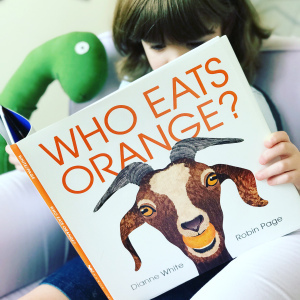
Who eats orange—a chicken? A bunny? A bear? Find out in this unique exploration of colors and animals’ favorite foods.
Animals eat a rainbow of different foods. Gorillas in the mountains eat green, octopi in the ocean eat red, and toucans in the canopy eat purple. Young animal enthusiasts will love digging into this lively journey around the world to explore the colorful diets of many animals, from the familiar to the exotic.
What do bunnies eat? How about bears or octopuses or even quetzals? And just what color is all that food all those animals eat? In Who Eats Orange? author Dianne White takes little readers on a trip around the world to explore the many different colors of food that animals (familiar and exotic) eat...including what people eat!
Who Eats Orange? with its bright colors, delightful text, and fun factual information put such a big smile on my face! Dianne White’s simple, yet effective text will charm and captivate little readers as they learn all about different kinds of animals and the various foods they eat. And Robin Page’s colorful, lively and wonderfully engaging illustrations perfectly capture those animals and foods being explored. Plus, included at the back of the book is even more neat information about each of the animals, foods, and geographies found in the book.
Who Eats Orange? is a cleverly amusing and sweetly illustrated way to explore the fascinating world of animal diets and colors!
A fun new book to learn about colors! What color do the different animals eat? This book will keep kids and grownups guessing as they learn what an assortment of animals (including quetzals, marmots and waxwings).
An enjoyable nonfiction picture book exploring colors, animals, and the foods they eat. Questions engage the reader throughout and bright illustrations pop on each page. This would be a great book to introduce to early readers and a fun way to interact at home or in the classroom.
I liked this non fiction picture book! It’s repetitive so that the child begins to interact with the reader and gives ample opportunities to have fun with a little drama to your voice as you turn the page for a new color. I also liked how it has the color words for the child to read or begin to visually recognize, and it covered an interesting assortment of animals from the farm, Africa, ocean, forest, rain forest, and the tundra. The last two pages are filled with all the questions the reader or child may have about each brightly illustrated page. I feel as though this would be a fun, yet education book for children ages three through six. My first grader was fully engaged and asked questions about each picture.
Who eats orange? Bunnies do! Question and answers introduce readers to different animals who eat various colored foods. What do you eat? I eat the rainbow!
WOW, five stars for the illustrations in this title done by Robin Page. The soft precious eyes looking straight at you will melt your heart. I am in love with the goat, the giraffe, and the whale. Each page is an illustrated very close up picture of one animal, hence one can look into their eyes. And oh, the text by Dianne White, well, it isn’t much and doesn’t flow well. Still I would share this with lots of children as the illustrations are spectacular!
Great book with interesting information, engaging structure, stunning illustrations, and lots of extra information in the back matter. Loved this and will be ordering for my library asap. As I read it, was thinking it could be a good pairing for some Lois Ehlert books.
This review was originally written for The Baby Bookworm. Visit us for new picture books reviews daily!
Hello, friends! Our book today is Who Eats Orange? by Dianne White & Robin Page, a gorgeous and engaging look at colors, food, and wildlife.
Who eats orange? Rabbits do (carrots), and so do chickens (cantaloupe). Goats and pigs do, too! And gorillas- wait! Gorillas don’t eat orange, they eat green! In this rhythm, the reader follows the diets of different animals, large and small, from different areas around the globe – ocean, farm, forest, etc. – each themed around a different color. At last, the reader is shown a rainbow of food – all delicious natural foods of the human diet.
What a clever concept! It seems complicated, and feels a little hard to explain, but works so well in the finished product. JJ was eager to name both the colors and the animals, all of which are illustrated with stunning realism in mixed-media patterns and vibrant colors. The text that signaled the transition between colors was a little awkward to read aloud, and might have been phrased a little differently. It’s a minor complaint, more than made up for in the quality of art and information on the animals, their diets, and their habitats in the backmatter. The length was perfect for storytime, and JJ loved it. This is a really great book for learning about animals from around the world, reinforcing color concepts, and is just plain beautiful to look at. We definitely recommend it – Baby Bookworm approved!
(Note: A copy of this book was provided to The Baby Bookworm by a representative of the author in exchange for an honest review.)
Asking which animals eat what colors allows this book to explore both animals and colors at the same time. Starting with the title question, the book looks at bunnies eating carrots, chickens pecking cantaloupe, goats biting oranges, and pigs munching pumpkins. But what about a gorilla? No, gorillas eat green! And the book merrily moves on to that color and then on to other food colors as well. The animals are varied and interesting including turkeys, foxes, quetzals, marmots, reindeer and many more. The book ends asking you about the colors you eat and revealing the rainbow of food that humans enjoy.
White has created an energetic picture book that has a strong structure that young children will find enticing. She has selected the featured animals cleverly, using both familiar animals and exotic animals side-by-side. The book’s structure includes asking about a different animal to move to the new color of food, leading very nicely into the final part of the book as well.
The digital illustrations have a great physicality about them, feeling more like paper collage than digital on the page. Each of the animals has a great light in their eyes, looking back at the reader usually with a playful and inviting glint while not being anthropomorphized at all.
A great book for the youngest set that introduces colors and animals and allows for some guessing games as well. Appropriate for ages 2-4.
First sentence: Who eats orange? Bunnies in their hutches do. Chickens in the henhouse too. Who else eats orange? Goats. Pigs. Gorillas too. Gorillas? No! Gorillas don't eat orange. They eat...
Premise/plot: This nonfiction concept book focuses on the colors various animals eat.
My thoughts: I picked this one up because of the awesome cover. It said--to me--READ ME, READ ME. I had high expectations because of the cover. The book didn't meet those high expectations, but that says more about me than the book itself. If you choose a book based solely on a cover without reading any reviews, then that's a risk you take--being disappointed.
So this one goes through a rainbow of colors. White chooses a few animals to highlight per color. My slight issue with the book--again this says more about me--is that animals rarely eat just one color. So while bunnies do eat orange carrots--they eat plenty of other vegetables that are not orange. You could just as easily list them under green. I read the notes on each animal, and more often than not, the animals eat a rainbow of colors. It just seems arbitrary to me to assign one color per animal.
Text: 2 out of 5 Illustrations: 4 out 5 Total: 6 out of 10
Who Eats Orange? by Dianne White, illustrated by Robin Page. PICTURE BOOK. Beach Lane Books (Simon & Schuster), 2018. $18. 9781534404083
BUYING ADVISORY: Pre-K, EL (K-3) - ADVISABLE.
AUDIENCE APPEAL: HIGH
Every few pages the question is asked, who eats a certain color, and then there are three examples of what animal eats that color. Then an animal that doesn’t eat that color is named and the book moves on to the next color. For example, who eats purple? Quetzals, toucans, and butterflies, but not reindeer.
The colors is the book are bright and engaging and they contrast with a simple white background. The best part of the book is talking about what colors of foods the reader eats. The text is a little bit clunky, given its repetitive nature and the expectation of rhythm that comes with that.
Thank you to @kidlitexchange for sharing the review copy of this book. All opinions are my own.
This picture book creatively teaches preschoolers about colors, foods and animals in a most unusual manner. The bold, colorful illustrations accompany the descriptions of each animal and the foods they eat. In addition to teaching about animals, their diets and colors of their favorite foods, the story also offers many opportunities to discuss some unusual vocabulary such as canopy and savannah.I’m sure this will prove to be very popular with your toddler and will be one they ask for time and time again!
a list of various animals, sorted by the color of the food they eat. A few animals are listed, then one that doesn't eat that color, with a new color being introduced. The animals are both common and exotic-a few that I was unfamiliar with and thus not sure how to pronounce their names. The illustrations are nice, they almost remind me of Eric Carl, without the edges. Close up of each animal and their food with a white background. The ending is predictable-a human hand reading for food of the last color, then mentioning that they eat a rainbow and a large illustration of a rainbow of food. Not very exciting, but would work in a story time with a color, or animal theme.
Huh. A fun idea - combining colours, foods, and animals in a simple picture book. I really liked some of the unusual animals that were included (quetzals, yellow-bellied marmots), but I feel like the transition between colours ("Gorillas too. Gorillas? No! Gorillas don't eat orange, they eat...") is unnecessarily confusing. And while it's nice that the text in the back goes into more detail (carrots are actually more of a treat or dessert for rabbits; lobsters are only bright red when cooked) and I'm not always a huge stickler for that kind of thing in this reading level of book, I am left feeling like I'm not really sure what level of book it is.
A fun question and answer game for listeners, white backgrounds makes each anatomically correct animal pop as they enjoy their favorite eats. Toddlers will love the contrary humor that an animal doesn't eat a specific color, they actually eat another color. And so the cycle begins again. And what do we eat? A rainbow of colors! For the inquisitive minds, back material includes more detail about what the featured animals eat.
Who Eats Orange is a fun read (and read-aloud) for little ones and primary students. The story flows with a rhythmic pattern, as it introduces the name of an animal on one page, asking if this animal eats a certain color. The answer is NO, of course. This peaks a child's interest. Well what color does this animal eat! Turn the page to find out! This is like a game. Two pages of notes are included at the back on eating patterns of animal and humans around the world. The full-page illustrations are beautiful. It's what one might call, a Healthy Read!
I liked this different sort of approach to concept books. The style of illustrations reminded me of Steve Jenkins's style of illustrations (just looked at the dedication page and the illustrator's dedication was to Steve Jenkins). Each animal's diet leads to the next color seamlessly and then leads to the rainbow ending and what people eat. A brief informational section at the end covers animal and people's diets around the world (specifics for biomes/zones/areas).
I would like to try this in a storytime and see how it goes over.
Thanks to the publisher for the review copy. All opinions are my own.
WHO EATS ORANGE is a mix of concept book introducing colors and nonfiction book about animal eating patterns. Find out which animals eat which colors, with a fake-out twist at the end of each spread that leads readers to a new color. Fans of BROWN BEAR, BROWN BEAR, WHAT DO YOU SEE? will love this book. An added bonus: it rhymes!
This is a non-fiction picture for the pre-k, k, younger elementary kids. "Who Eats Orange" is a book about food colors. Different animals eat different kinds of food and different colors of food. Who eats read? Who eats green? what about you :) Love the full page watercolor illustrations of animals and the food. Very simple language targeted towards the very young ones. Definitely recommend reading to your little ones to learn about eating all kinds of food!
This easy-to-read picture book reminded me of Brown Bear, Brown Bear by Eric Carle. The repeated refrain speaks directly to the reader and entices students to turn the page to see what animal comes next. Don't miss the end pages - They are filled with information about different animal habitats, who lives there, and what they eat. This is a must-have for kindergarten and first-grade classrooms.
Animals I spotted this book at Queen Ann Branch Library, Seattle and had to take it home. It a lovely book with rich vocabulary about what animals eat - stemming from the color of the food. It interjects where these animals live. Common animals are included, but so are uncommon creatures, such as grunts and quetzal. Back matter included more information about these animals organized by habitat.
I would recommend this as an addition to a library. It could maybe be a writing prompt.
Love the illustrations. Cute and simple book about animals and colors, more specifically animals and the colors of food that they eat. Great introduction to new vocabulary because you learn where all of the animals live: "giraffes in the savanna...toucans in the canopy..." I would use this in a storytime about food, colors, or animals.
Will give this to my Kinder teachers when they ask for books about colors. As a teacher/parent I would pre-read the final pages that explain what each creature eats and how lobsters are only red when cooked by humans, etc. Then as you read or reread you can share these tidbits and the kinders can share back with they know.
Nice and simple book about which animals eat different colored foods. There are some animals in this book that I had to google what they were because I never heard of those words before. Had to google what reindeer eat too because I wasn't sure what the picture was showing. It was cool learning something new! Illustrations are great, no complaints.
This book could be used for a variety of themes for either toddler or family storytime. The most obvious from the title is food but it goes through different colors and what animals eat food that color. In the back of the book, there is information about different habitats and the animals that live there. There are opportunities for children to learn new animals.
Bright illustrations and simple text are sure to please a variety of ages at storytime. A great teaching tool for colors, animals, and foods, making this a versatile book that will lend itself to a variety of accompanying activities.