You’ve just laid down for the night when suddenly doors slam and the curtains shift. The lights begin to flicker and a white mist forms in front of you. You shut your eyes and keep muttering, “ghosts aren’t real.” But then you open your eyes and realize that “harmless” mist has shifted into the form of a man, staring intensely at you, as he floats above your bed.
What causes ghostly experiences?
Are ghosts real?
Why do certain people report numerous ghostly encounters and others none?
For centuries these questions have intrigued, puzzled, and bedeviled science, skeptics, and even believers. Based on cutting-edge research and new theories, The Ghost Studies provides insight into some of life’s greatest mysteries.
This fascinating book is far more than a compilation of ghost stories. The Ghost Studies provides scientific explanations for paranormal occurrences, including: New and exciting scientific theories that explain apparitions, hauntings, and communications from the dead. The latest research on the role of energy and electricity in hauntings. The role that emotions, bioenergetics, and the environment play in supernatural phenomena. New research into why some individuals are more prone to ghostly encounters.
Brandon Massullo is a clinical therapist and parapsychologist residing in Northeast Ohio. He has his graduate degrees in clinical counseling from the University of Toledo and psychological research methods from the University of Edinburgh in Scotland, UK. His research at the University of Edinburgh centered on neurobiological correlates of ghostly encounters and he studied within the Koestler Parapsychology Unit at the University of Edinburgh. Brandon has been fascinated by paranormal phenomena for 20 years and has been a participant and featured speaker in numerous paranormal forums and events, including the Parapsychological Association's 60th Anniversary Celebration. His research has been cited in parapsychological journals, newspaper articles, and mainstream books. Brandon's first book The Ghost Studies: New Perspectives of the Origins of Paranormal Experiences combines the thrill of reading real-life ghostly encounters and the satisfaction of new perspectives and insights into the cause of these thrilling encounters. Please visit Brandon’s blog Haunted Theories for more research into ghosts, apparitions, and all things paranormal.
An impressive and thought-provoking new look at why people may experience paranormal events. Don't expect Ghost Hunters, rather be ready for something along the lines of "Phantasms of the Living." I dig it.
Someone else's review says "you blinded me with science" I think that is the point of the book.
Here is the structure of the book: 1. Accept that hauntings are real and don't ask anymore questions about that. 2. Here is the proven and tested science of actual true thing X and here is a somewhat dry and academic presentation of it, you can verify everything from a high school textbook. 3. Now here is some speculative mumbo jumbo delivered in the same way so you think it is also science.
I was expecting a book that talked about the ghost frequency and sleep paralysis explanations as well as other new (to me) actually scientific explanations.
An egregious early passage is a scientific description of radio waves and frequency. Then he jumps right into saying EVP is real and here is how ghosts communicate via it. Instead, I was expecting him to then say "and Audio Pareidolia explains why people think EVP is real when it is all your brain's pattern recognition."
Knowing more science than the author will hurt your enjoyment of the book. Having blind faith in the word science slapped on something will trick you into loving the book. If you like Ancient Aliens and call it science, then this is your thing.
I recommend this for those who like to geek out on the science of hauntings. It starts out with your basic paranormal information that you can get from watching a few episodes of Ghost Hunters or Ghost Adventures. It quickly evolves to complex scientific hypotheses on magnets and electricity and their effect on humans and telepathy. It was a little dry for my taste.
My layman's interpretation of the first five or six chapters:
Intense emotional upheaval + electricity in humans = ghostly sightings
I much preferred chapter seven that dealt with a spontaneous cases presented in anecdotal form. (I simply find that more interesting.)
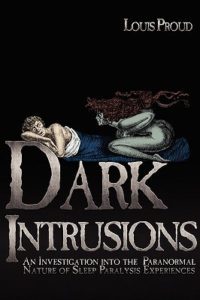
The author has an extensive background as a professional therapist in mental illness. He brings this to the table in chapter ten. I agree with him that mental illness should be ruled out first. If it has been ruled out, or meds and therapies aren't working, I'm open to seeking out a priest. I'm a little more skeptical when it comes to his take on sleep paralysis. I've read all about the scientific explanation, but I do think there is something more sinister going on. Especially in the cases of small African and Asian villages with an epidemic level of sleep paralysis that sometimes results in death. For an interesting and different take on sleep paralysis, I recommend this book:
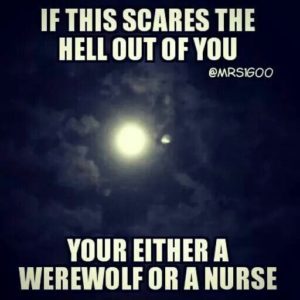
A little aside. When he mentioned the unfounded belief by some in healthcare about the full moon, I thought of this meme.
This book is what you wanted to read as a child - knowing that ghosts definitely exists. Only it is written for you as an adult. It has all the magic, but it brings it into the "adult-world" with good arguments and scientific explanations, giving you back the opportunity to say that ghosts are in fact real without sounding childish or crazy. I'm absolutely thrilled that Brandon has taken this topic seriously, it has made me rethink a couple of things. Thoroughly recommend this book for people that are interested in bringing the fantasy with them into adulthood, but also for people that are wondering if there's more to life than this.
____________________________
Above is the 2018 read, I've now (2025) reread it to see how it holds up and if I still feel the same. And I think I do. It's a line bending book between what's real and not, so I let my mind fluctuate between reality and fantasy, just to see what it would come up with. Some of the research material referenced have been questionable, others seem interesting and I will be checking them out for further study. I'm thoroughly intrigued by the collective consciousness theory. I'll let the five stars stand, honouring my past self. Also because I've been thinking about this book and it's theories since my first read, so that says something.
This book is great for the believer or nonbeliever. Too many books give an opinion and then don't give you anything to support it. This book is not that. Massullo's theory is actually plausible and supported by stories and "facts" that make the reader ponder their own theories. I must say, after reading it, I am starting to re-evaluate the way I view certain hauntings now. The book was a quick read and one that is appropriate for just about any level of paranormal enthusiast.
This book was more interesting than I thought it was going to be. I thought the author was going to take the stand that there was no such thing as ghosts, and then present scientific type reasons. While there are some not particularly interesting "scientific" ideas in the book, there are also many interesting ghost stories. In addition, Mr. Massullo covers psychological reasons some see or hear ghosts, but stresses not all who have paranormal type encounters have psychological problems. He's really quite open to paranormal studies. He just isn't open to the idea ghosts are actually deceased individuals come back to Earth to communicate with the living.
One interesting theory the author proposed was that both humans and animals can telepathically pick up distress signals from other humans and animals; even those far away; and those distress signals can still be picked up long after the actual distressful event happened. He uses a story from his own life of an incident where he felt both he and his bloodhound picked up the distress signal from the neighborhood stray white cat, who drowned early one morning in his pond. Unfortunately, I thought his example was an extremely poor one, and that it was his dog's hearing and sense of smell that started the whole situation.
Maybe his bloodhound actually heard the cat yowling outside, because it probably was a tom; or heard it fearfully screaming; or heard or smelled the presence of a predator. Summer is loaded with predators on the prowl to feed their babies; including night creatures, such as coyotes and foxes, out during daylight hours. Maybe that's how the cat ended up floating in the pond. Or maybe the author's dog actually chased the cat into the pond, and the cat couldn't come out since the dog was at the edge of the pond barking at it. Maybe that's where the author's distress and guilt about the matter actually came from, not from a telepathic distress signal from the cat. Seasoned stray cats don't just accidentally fall into ponds and immediately drown. They swim or claw their way out.
This book is very "scientifical". That means it uses scientific jargon, concepts, even cites research, in an attempt to present a view of credibility. It's not at Ghost Hunters level of fake expertise, though. Unfortunately, much of the research and evidence used to support the author's idea of how ghostly experiences occur are deeply flawed. Citing individual researchers whose work is far from confirmed and accepted (notably Persinger and Sheldrake) does not make for a solid scientific argument. The ideas provided are weak. There is always the possibility that they might be true - human emotions might affect a person's electrical field, that then spreads so far as to interact with the earth's magnetic field, transmitting information to another person, who tunes into the field and receives the message that looks like a ghost. That is what the author proposes, which is far-fetched and lacking empirical foundation. It is more like a house of cards easily blown over. A good theory has to hang together across scientific disciplines based on what has been confirmed before and predictive of the reoccurrence of similar events. It must be logical and cohesive. This book is airy speculation with a heavy sciencey smell that will be convincing to several readers, but those who dig into the assumptions made will find them unscientific.
Como recomienda el autor al final del libro, al momento en el que me pregunten: ¿crees en fantasmas? Por su puesto que citaré varias partes de esta obra.
Siempre me ha interesado el fenómeno fantasmal, siempre estamos rodeados de historias de pariciones, encuentros, casas embrujadas y casos paranormales que nos dejan pensando un buen rato en todos los aspectos de la vida, porque como dice Brandon (y comparto mucho), el únicamente hecho de tener una experiencia paranormal nos soluciona un montón de preguntas existenciales.
Me gustó como abordó el tema desde la ciencia y descartó casos donde psicología interna de cada uno se prestaba más para superposiciones.
Seguiré creyendo que los encuentros paranormales tienen que ver más con una área de la física que aún no comprendemos del todo, más allá de algo espiritual, aunque siendo sincero, sería más emocionante lo segundo.
Excellent! Less than two hundred pages, you will go through this book fairly quickly. "The Ghost Studies" has an excellent Index, and Notes section making it both easy to navigate and a great jumping off point for your own research. Each chapter ( for example "Not Everything is Paranormal" ) concludes with a brief summary. All in all, I really enjoyed it but I wanted more. Maybe that's what Massullo had in mind?
Disclosure of Material Connection: I received this book free from New Page Books. I was not required to write a positive review. The opinions I have expressed are my own. I am disclosing this in accordance with the Federal Trade Commission’s 16 CFR, Part 255 : “Guides Concerning the Use of Endorsements and Testimonials in Advertising.”
While I find the subject matter fascinating and the premise of the investigation interesting, the execution left a lot to be desired for me.
The writing style was just so clinical, so dry and textbook droll at times, that I couldn't get into it and ended up skimming a fair chunk of the book. While there are little nuggets that I enjoyed - especially the recounted experiences - they were too far and between for me to really engage.
Clinically, it is a good book, but the writing just made it inaccessible for me.
This was a pretty good read. I think it is a good option for both someone that is well-versed in parapsychology, but also someone that is newly interested as it will introduce a lot of basic theories and concepts before expanding on them. I do think that this author comes with a clear view that he is a believer, and at points appears biased in how they are interpreting information. But he does present counter arguments of ways that paranormal phenomena can be explained, just in a separate chapter rather than when he is presenting his argument directly. Overall, not a bad read.
The book I don't necessarily agree with because I am a firm believer in ghosts and paranormal activity, however, just because I don't agree with what an author says, doesn't mean it's a terrible book. This book has dry scientific reasoning that tries to debunk theories of ghosts. 90% of the book is referring to ghosts to trauma and coping strategies. One chapter is on actual hauntings at historic places. I challenge the author to explore the actual ghost theories and go on a ghost hunt or two.
The Ghost Studies has some interesting ideas concerning ghostly activity. Not all of it stands up to logic but some points are definitely worth considering. Recommend for both skeptics and believers to challenge your way of thinking on the issue.
I thought I might like to read a thoroughly researched and plausible theory of ghostly manifestations. I was wrong. Call this a, "it's not you it's me," review: A Gentleman's 4 Stars, in recognition of a well rendered study, but if I'm being honest, I didn't care for the book.
I love science. I love the paranormal. This just adds to my rational mind, but has made my mind more open, as well. There are things we may never understand, but this was a great read and gave me plenty to think about.
This was maybe not a great choice of an audiobook on my part, as my mind tended to wander a bit. Brandon Massullo is very passionate about his subject, I didn't find it any better 'studied' or grounded in data than any other theory.
Not my favorite. Author likes to hear the sound of his own voice. Doesn’t really explain much and adds random “explanations” on why things occur. Chalks it up to mental illness at one point, and then had the audacity to say he still believes. Stick to your other career.
I mean... Oof. It starts with a promising concept - That the experiences of paranormal activities are actually experienced by those who report them have scientific explanations.
And then it just kinda... doesn't prove that. Pseudo-sci with the veneer of real-sci.
Immensely fascinating and insightful – whether you’re a believer or not! You may enjoy it more if you’re familiar with basic physics and cell biology though.
There are some interesting anecdotes and theories in this book but very few actual studies. This book is effective as an encouragement to others to view the paranormal in a more scientific way.
If Dana Scully penned The Ghost Studies: New Perspectives on the Origins of Paranormal Experiences, it would have been rooted in non- bias science. She would have presented case studies, cited facts, and included all the things she (and the science of her day) could not explain. Scully never cherry picked data to fit her narrative and always questioned everything in the hopes of finding answers that were rooted in evidence, not ideology.
But she didn’t write this book, and so it reads more like a skeptic trying to convince themselves that the paranormal has little to do with the afterlife, which is an odd path to take considering the author explicitly mentions all the things he left out in order to come to this conclusion.
This was an interesting read but didn’t quite hit the mark for me.
This book delves into some explanations of the science of the paranormal.
First, I should state that I have a huge interest in the paranormal. While I’m no expert there was nothing new to me in this book. However, the author’s opinions and theories were interesting. But that is basically what it was - a book based on one man’s theories and thoughts. Not to say he doesn’t know his stuff or didn’t state information from other sources but in a field that has no definitive science a lot of it is based on theories. Looking at this book as more of a think/opinions piece allowed me to enjoy it.