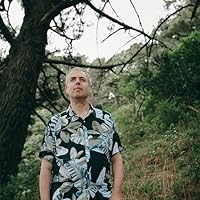
Robert Fripp has been an influential presence in contemporary music since he founded King Crimson in 1969. Renowned among fellow musicians for his electric and acoustic guitar technique, Fripp is also a producer, teacher, composer and writer. He has worked with Brian Eno, David Bowie and Talking Heads and has produced albums for Peter Gabriel and Darryl Hall. Eric Tamm is the author of "Brian The Vertical Colour of Sound".
Most rock stars aren t worth writing about. They're not up there playing music because they ve got a lot of interesting things to say. Otherwise they d be writers or public speakers, wouldn t they?[return][return]But Robert Fripp, founder and leader of the band King Crimson through several incarnations from 1969 to the present, student of the mystic Gurdjieff, inventor of The Drive to 1981 and other three-year plans, founder of the Guitar Craft workshops, small, mobile, intelligent unit Robert Fripp is different. He s, you know, an intellectual. Me and a book is a party, he says, me and a book and a cup of coffee is an orgy. He puts out solo albums with songs on them in 17/8 time. Leading rock luminaries - like Eno and Bowie - call on him to spray burning guitar over their songs, yet he d just as soon write articles about the history of stereo mixing for Musician magazine.[return][return]I find the guy quite interesting, in short, and his music three parts fascinating, one part awe-inspiring, and one part extremely irritating. And he s a short bloke from Wimborne, Dorset who sounds like rather like Arthur C. Clarke. That makes it even better.[return][return]But let s talk about the book. Eric Tamm is an academic musicologist, but don t let that put you off. He s also a rock musician, and was a student at one of Fripp s Guitar Craft workshops. In this book, he does three things no, make that four:[return][return]1. He gives a partial biography of Fripp (who is disinclined to spill out personal details).[return][return]2. He goes chronologically through the albums Fripp s been involved in, from King Crimson to the League of Gentlemen to ventures with Brian Eno to solo efforts, treating some briefly and others in depth.[return][return]3. He takes us through the twists and turns of Fripp s thinking, particularly after he disbanded King Crimson for the first time in 1974 and spent ten months attending the Fifth Course at the Sherborne Centre of the International Society for Continuous Education, founded by J.G. Bennett, a student of Gurdjieff s who was, in Fripp s words, living proof that if a creepy, uptight Englishman, with severe emotional problems, could become a human being through dint of effort, so could I. What Fripp learned (experienced?) there has been in the background of his work ever since, and comes out most notably in the Guitar Craft workshops, in which he teaches young guitarists a new way of tuning, thinking about, and playing acoustic guitar.[return][return]4. He describes his time at a Guitar Craft workshop led by Fripp. It sounds a bit like encounter group therapy it s fascinating, but scary; you feel most of the time that you re making a major breakthrough, and then some of the time it feels like it s all a con, or maybe you re being brainwashed. What I ve heard from Guitar Craft graduates sounds technically impressive but empty to me but then, I ve never liked Bach, either. The workshop certainly made a big impact on Eric Tamm, and this is the best part of the book, because his feelings about Fripp and his music come to the fore, and the academic musicology is set to one side for a while.[return][return]At one point, Tamm remarks that Fripp has, by becoming a teacher, turned being an egotistical smart-ass into his greatest strength. Fripp may be as full of ego and delusion as any other guitar hero, but it s interesting ego and delusion, and it makes good reading.[return][return](Review originally written for Aotearapa)
Most rock stars aren’t worth writing about. They're not up there playing music because they’ve got a lot of interesting things to say. Otherwise they’d be writers or public speakers, wouldn’t they?[return][return]But Robert Fripp, founder and leader of the band King Crimson through several incarnations from 1969 to the present, student of the mystic Gurdjieff, inventor of “The Drive to 1981” and other three-year plans, founder of the Guitar Craft workshops, small, mobile, intelligent unit — Robert Fripp is different. He’s, you know, an intellectual. “Me and a book is a party,” he says, “me and a book and a cup of coffee is an orgy.” He puts out solo albums with songs on them in 17/8 time. Leading rock luminaries - like Eno and Bowie - call on him to ‘spray burning guitar’ over their songs, yet he’d just as soon write articles about the history of stereo mixing for Musician magazine.[return][return]I find the guy quite interesting, in short, and his music three parts fascinating, one part awe-inspiring, and one part extremely irritating. And he’s a short bloke from Wimborne, Dorset who sounds like rather like Arthur C. Clarke. That makes it even better.[return][return]But let’s talk about the book. Eric Tamm is an academic musicologist, but don’t let that put you off. He’s also a rock musician, and was a student at one of Fripp’s Guitar Craft workshops. In this book, he does three things — no, make that four:[return][return]1. He gives a partial biography of Fripp (who is disinclined to spill out personal details).[return][return]2. He goes chronologically through the albums Fripp’s been involved in, from King Crimson to the League of Gentlemen to ventures with Brian Eno to solo efforts, treating some briefly and others in depth.[return][return]3. He takes us through the twists and turns of Fripp’s thinking, particularly after he disbanded King Crimson for the first time in 1974 and spent ten months attending the Fifth Course at the Sherborne Centre of the International Society for Continuous Education, founded by J.G. Bennett, a student of Gurdjieff’s who was, in Fripp’s words, “living proof that if a creepy, uptight Englishman, with severe emotional problems, could become a human being through dint of effort, so could I.” What Fripp learned (experienced?) there has been in the background of his work ever since, and comes out most notably in the Guitar Craft workshops, in which he teaches young guitarists a new way of tuning, thinking about, and playing acoustic guitar.[return][return]4. He describes his time at a Guitar Craft workshop led by Fripp. It sounds a bit like encounter group therapy — it’s fascinating, but scary; you feel most of the time that you’re making a major breakthrough, and then some of the time it feels like it’s all a con, or maybe you’re being brainwashed. What I’ve heard from Guitar Craft graduates sounds technically impressive but empty to me — but then, I’ve never liked Bach, either. The workshop certainly made a big impact on Eric Tamm, and this is the best part of the book, because his feelings about Fripp and his music come to the fore, and the academic musicology is set to one side for a while.[return][return]At one point, Tamm remarks that Fripp has, by becoming a teacher, turned being an egotistical smart-ass into his greatest strength. Fripp may be as full of ego and delusion as any other guitar hero, but it’s interesting ego and delusion, and it makes good reading.[return][return](Review originally written for Aotearapa)
I am fascinated by, and love Robert Fripp's music. I was very excited to hear about this book, but I found it very difficult to read. It is more like a series of notes put together in an academic paper, rather than a book as a whole. There are some fine moments, but I couldn't get into the writing style of the author. However there are some great insights and things to learn about the man that I did not know.
Far too many Beatles reference, far far too many Bible references and quotes and Tamm has a nasty penchant for inserting himself into the text (completely warranted, of course, in the chapter where he talks about his time in the Guitar Craft program). The commentary/criticism is pretty minimal except, for some blinding reasons, he decides to wade further with it when discussing the 80s version of King Crimson. Very annoying.